

Consumer Insights
Uncover trends and behaviors shaping consumer choices today
Procurement Insights
Optimize your sourcing strategy with key market data
Industry Stats
Stay ahead with the latest trends and market analysis.
The Europe pharmaceutical packaging market attained a value of USD 28.62 Billion in 2025 and is projected to expand at a CAGR of 6.70% through 2035. The market is further expected to achieve USD 54.74 Billion by 2035. Europe's packaging transition is increasingly being shaped by material traceability and circular-design engineering. PPWR began applying in August 2026, while EU rules require recyclable packaging from 2030, creating a procurement advantage for suppliers able to validate material performance, documentation, and recycling pathways alongside pharmaceutical-grade protection.
Two structural developments are particularly important for pharmaceutical packaging procurement. First, the EU's Critical Medicines Act, proposed in March 2025, is designed to encourage strategic pharmaceutical manufacturing projects, supply diversification, and stronger European production capacity. As pharmaceutical companies localize or diversify production, packaging suppliers must provide dependable regional capacity rather than relying on single-site supply. Second, demographic aging is expanding the operational requirement for packaging that supports dosing accuracy, accessibility, and adherence. Eurostat reported 99 million EU residents aged 65 or older in 2025, equivalent to 22% of the population, while people aged 80 and above represented 6%. This strengthens the commercial case for senior-friendly closures, clear labeling, unit-dose systems, and adherence-oriented formats, thereby boosting the Europe pharmaceutical packaging market value.
Innovations with respect to advanced container-closure systems, which address the issue of sensitivity of biological products, have become a new niche in Europe. Herein, the supplier designs the packaging according to extractables and leachables, moisture entry and drug stability issues rather than designing a package as an independent element. Here, internal coatings, special elastomers and high-performance polymer barriers are integrated into traditional glass and plastic options. This enables pharmaceutical manufacturers to extend product stability while supporting newer formulations that are more sensitive to interaction with packaging materials. The innovation is particularly relevant to high-value injectable products, where packaging failure can create substantial product-loss and regulatory risks. For B2B suppliers, the opportunity lies in offering validated material combinations and compatibility data alongside the physical container, shortening qualification work for pharmaceutical customers.
Packaging qualification complexity for combination products can constrain adoption of innovative pharmaceutical packaging in Europe. When containers are integrated with delivery devices such as autoinjectors, pens or prefilled systems, changes to materials, dimensions, coatings or closure components can trigger additional compatibility, stability, usability and regulatory assessments. Even technically superior packaging may therefore require lengthy customer validation before commercial adoption. This creates a particular challenge for smaller packaging suppliers attempting to displace established components in validated production lines. The issue is intensified for biologics and other sensitive formulations, where extractables, leachables, container closure integrity and drug-device interactions must be carefully assessed. Consequently, pharmaceutical manufacturers may prioritize proven packaging platforms over newer solutions when qualification timelines or regulatory risk are critical, thereby boosting the Europe pharmaceutical packaging market developments.
Compound Annual Growth Rate
6.7%
Value in USD Billion
2026-2035
Read more about this report - REQUEST FREE SAMPLE COPY IN PDF
Gerresheimer and Milliken & Company announced a partnership in April 2026 to apply LeneX™ UltraGuard® additive technology to high-density polyethylene packaging for demanding pharmaceutical applications. According to Gerresheimer, the technology can provide up to 40% improvement in moisture-barrier performance while supporting processing efficiency. The collaboration focuses on strengthening protection for medicines packaged in HDPE containers and demonstrates continued development of polymer-based primary packaging for formulations requiring improved moisture resistance and product protection.
Amcor’s Winterbourne facility in the United Kingdom received ISO 13485 certification in March 2026, strengthening its quality-management systems for medical and regulated healthcare packaging. The certification supports the site’s ability to manufacture packaging under internationally recognised quality requirements for healthcare applications. Amcor has also stated an objective of having its European, Middle Eastern and African healthcare packaging sites certified to relevant ISO pharmaceutical or medical standards by the end of 2027, supporting consistent quality across its regional manufacturing network.
SCHOTT Pharma introduced EVERIC® lyo & amber vials in January 2026 for sensitive pharmaceutical formulations, particularly lyophilized and light-sensitive antibody-drug conjugates. The vial combines amber glass with an internal coating designed to provide additional protection for demanding biologic formulations. The development expands SCHOTT Pharma’s specialised containment portfolio for medicines requiring protection against light and interaction with the container surface. The launch also reflects increasing pharmaceutical industry requirements for primary packaging capable of supporting complex formulations and advanced therapies.
Smurfit Westrock inaugurated a dedicated clinical and adherence packaging facility near Dublin Airport in November 2025 following an investment exceeding €40 million. The facility employs approximately 170 people and is designed to support pharmaceutical packaging and clinical-trial requirements. Its location and specialised infrastructure strengthen the company’s ability to serve pharmaceutical customers requiring regulated packaging solutions for clinical programmes. The investment also expands Smurfit Westrock’s European capabilities in adherence-focused packaging and supports growing demand for specialised packaging throughout pharmaceutical development and commercialisation.
The application of the EU Packaging and Packaging Waste Regulation in August 2026 is moving pharmaceutical packaging discussions beyond broad sustainability claims toward documented recyclability, material composition, and technical compliance. The European Commission states that mandatory recycled-content measures and requirements for recyclable packaging will apply from 2030, while medicinal-product packaging can receive specific exemptions where product quality or safety requires them. For packaging manufacturers, this creates a more segmented procurement environment: secondary and transport packaging can face stronger circularity pressure, whereas primary packs must balance recyclability with extractables, barrier performance, sterility, and drug compatibility. Suppliers that can provide regulatory dossiers, material declarations and design-for-recycling evidence will therefore become more valuable to pharmaceutical buyers.
As per the Proposal of the Critical Medicines Act by the European Commission, the initiative is clearly aimed at boosting manufacturing resilience, diversification of supplier sources, and investment in strategic pharma projects in the EU region. These have implications for packaging procurement, as any investments in drug production in the region would require the availability of vials, bottles, closures, labels, cartons and transport formats. The Commission's supporting analysis states that strategic projects could involve building new facilities or upgrading existing production lines. Packaging suppliers therefore have an opportunity to align capacity expansion with pharmaceutical manufacturing clusters, establish dual-source production and offer validated alternatives for critical components. The resulting market opportunity is increasingly tied to supply assurance rather than packaging volume alone.
The structure of Europe's demographics leads to an increased need for packaging solutions for administering drugs in unsupervised clinical settings. In 2025, Eurostat reported 99 million people aged 65 or older in the European Union, which comprised 22% of the population and a median age of 44.9 years. Such demographics increase the importance of easy-open and child-proof closures, dosage instructions legible, adherence packs and packaging that minimizes handling complexity. For B2B suppliers, the opportunity is not simply to redesign containers but to integrate ergonomic testing, information hierarchy, opening-force specifications and patient-use validation into packaging development. Packaging engineering is consequently becoming more closely connected with drug-delivery and patient-support programs, thus shaping the demand of the Europe pharmaceutical packaging market.
Industrial pharmaceutical output remains an important demand indicator for packaging converters and primary-container manufacturers. France's official industrial production index for pharmaceutical preparations reached 125.16 in July 2026, compared with a 2021 base of 100. Germany also maintains a substantial pharmaceutical manufacturing base, with official structural statistics identifying 700 enterprises within the pharmaceutical-products manufacturing classification in the latest dataset. These manufacturing footprints support recurring demand for validated primary packaging and associated secondary formats. Suppliers can capitalize by maintaining local technical service teams, shortening qualification timelines, and offering packaging platforms that can be transferred across multiple manufacturing sites without extensive revalidation.
The European Critical Medicines Alliance identified geographical concentration of APIs and raw materials, erosion of parts of Europe's manufacturing base, and limited investment as vulnerabilities in critical-medicine supply chains. Packaging procurement is consequently becoming more closely connected with business-continuity planning. Pharmaceutical manufacturers increasingly need qualified alternate sources for packaging components, standardized specifications across plants, safety stocks for critical items and suppliers capable of supporting rapid qualification. For packaging producers, this favors multi-site manufacturing and standardized product platforms. Companies able to combine regulatory documentation with geographic redundancy can reduce the qualification burden associated with switching suppliers during shortages, transportation disruptions or unexpected manufacturing interruptions.
The Expert Market Research’s report titled "Europe Pharmaceutical Packaging Market Report and Forecast 2026-2035” offers a detailed analysis of the market based on the following segments:
Market Breakup by Materials
Key Insight: Plastic and polymers have gained popularity in Europe because of their light weight, sterilization, and flexibility as far as bottle caps, blister packs, closures, and flexible packaging is concerned. EU plastic packaging on the market has risen to 5.9 million tonnes in 2025 from 11% increase from 2011 levels. Glass packaging is vital in the manufacture of vials and ampoules because of its chemical and barrier properties, while paper and paperboard continue to receive more attention from circularity objectives such as 85% recycled paper and cardboard packaging in the EU by 2030. Aluminum foil is used in blister packs because of moisture, light, and gas barriers, and there is a target of 60% recycled aluminum packaging in the EU by 2030. Other materials include specialized polymers and composites.
Market Breakup by Product Type
Key Insight: Plastic bottles are gaining traction for oral liquids and solid medicines, while specialty bags are supported by demand for intravenous therapies and fluid administration. Parenteral containers are becoming increasingly important as Europe’s pharmaceutical industry expands, with EU pharmaceutical production reaching €263 billion in 2024, up 12.7% year on year. Blister packing remains important for unit-dose medicines, while closures increasingly incorporate secure and child-resistant features. Labels are gaining importance as EMA requirements cover information on both immediate and outer packaging, including mandatory product information. The expanding pipeline of medicines is also supporting demand for specialised packaging, with the EMA recommending 104 new human medicines for approval in 2025, including 38 containing new active substances
Market Breakup by Packaging Type
Key Insight: Primary packaging is gaining traction as pharmaceutical manufacturers prioritise direct drug protection, sterility and compatibility, particularly for biologics and injectable medicines. The European Medicines Agency's 2025 report recorded 104 medicines recommended for human-use approval, including 38 containing new active substances, reinforcing the need for specialised packaging. Secondary packaging is evolving through serialisation, patient information and anti-counterfeiting requirements, with EU Directive 2011/62/EU mandating safety features on most prescription medicine packs. Tertiary packaging is gaining relevance through temperature-controlled distribution and secure bulk handling, especially for sensitive medicines. EU Regulation 2025/40 distinguishes sales, grouped and transport packaging, corresponding broadly to primary, secondary and tertiary formats, and strengthens the focus on packaging recyclability and waste reduction, thus driving the demand in the Europe pharmaceutical packaging market.
Market Breakup by Drug Delivery Mode
Key Insight: Oral drug packaging continues to gain traction through widespread use of bottles, blister packs and sachets for solid and liquid medicines, while injectable packaging is receiving greater attention as biologics and sterile therapies expand. The European Medicines Agency recommended 104 human medicines for marketing authorisation in 2025, including 38 with new active substances, increasing the need for specialised primary packaging for different drug formulations. Topical medicines are supporting demand for tubes, pumps and specialised containers that enable controlled application and protect formulation stability. Other delivery modes are also becoming more significant as Europe’s pharmaceutical pipeline diversifies, with 41 biosimilars receiving positive recommendations from EMA in 2025, requiring packaging compatible with sensitive biological products and administration systems.
Market Breakup by End Use
Key Insight: Pharma manufacturing is gaining traction as European drug production expands, with Eurostat reporting €286 billion of pharmaceutical production sold in the EU in 2024, up 11.8% from 2023. Contract packaging is benefiting from manufacturers seeking specialised blistering, labelling, serialisation and secondary packaging capabilities without expanding every in-house operation. Retail pharmacy continues to require compliant, traceable and patient-friendly packs, particularly as EU pharmaceutical rules strengthen safety features and product information requirements. Institutional pharmacy is supported by hospitals and healthcare providers requiring secure unit-dose, sterile and administration-ready formats. The European Medicines Agency recommended 104 medicines for human-use approval in 2025, including 38 containing new active substances, creating additional packaging requirements across manufacturing, outsourced packaging and healthcare distribution channels.
Market Breakup by Country
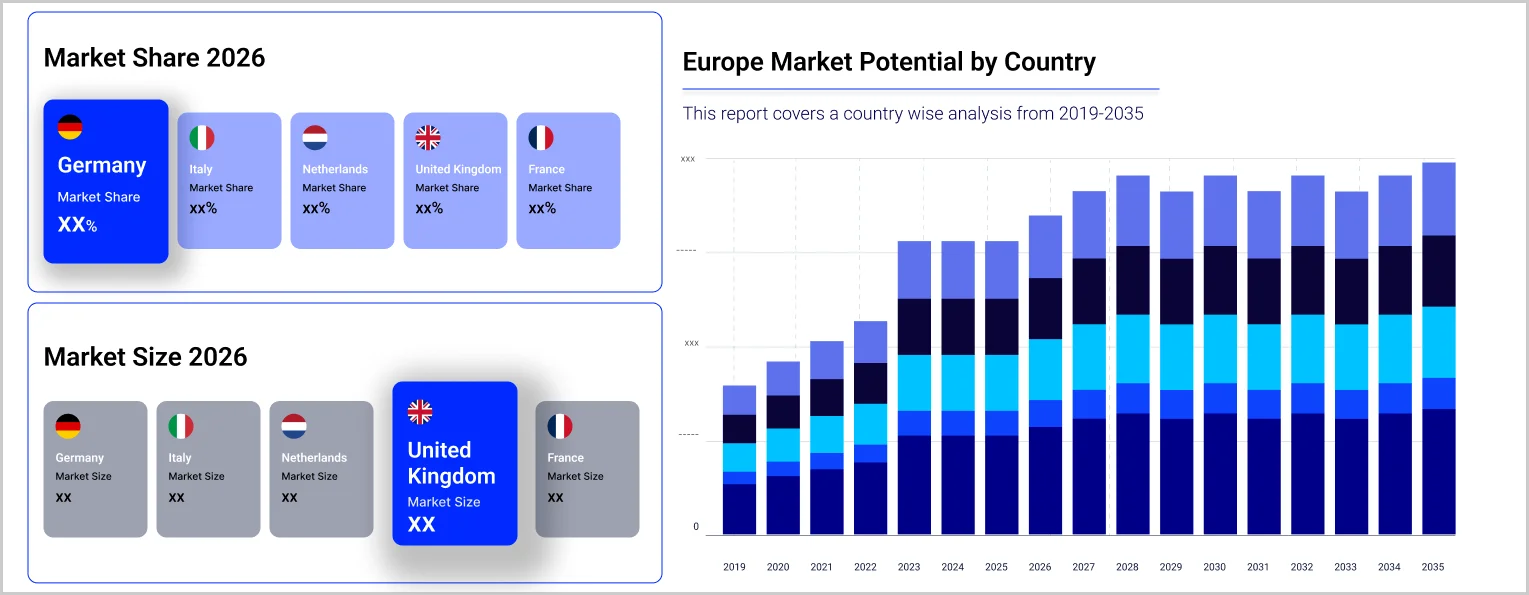
Key Insight: Germany is gaining traction as a major pharmaceutical packaging market because of its strong drug manufacturing base and extensive pharmaceutical trade. Germany recorded €37.5 billion in pharmaceutical production in 2024 and was the EU’s largest extra-EU exporter of medicinal and pharmaceutical products at €67.9 billion. The United Kingdom remains significant due to its established life sciences manufacturing ecosystem, with pharmaceutical manufacturing GVA reaching £20.4 billion in 2023 and pharmaceutical exports valued at £24.7 billion in 2024. France benefits from its sizeable pharmaceutical manufacturing and healthcare base, while Italy is gaining importance through expanding pharmaceutical trade and production, with pharmaceutical exports rising 33.7% during January to October 2025. Others, including Belgium, Ireland, Spain and Switzerland, contribute through pharmaceutical manufacturing, exports and specialised packaging demand, with Ireland and Belgium recording €56.6 billion and €41.4 billion respectively in extra-EU pharmaceutical exports in 2024.
Read more about this report - REQUEST FREE SAMPLE COPY IN PDF
Plastics and polymers represent a major material category because they combine lightweight construction with flexibility across bottles, blister components, closures and other formats. Eurostat reported that 19.8% of EU packaging waste was plastic in 2023, equivalent to 35.3 kg per person. Of this waste, 14.8 kg per person was recycled, demonstrating the scale of plastic packaging flows and the growing importance of recyclable pharmaceutical-grade polymer solutions. Such developments will thus boost Europe pharmaceutical packaging market trends in the long run.
Paper and paperboard are gaining procurement attention as pharmaceutical companies assess recyclable secondary and transport formats. The regulatory environment strengthens this opportunity because the PPWR promotes recyclable packaging and greater circular-material use. Fiber-based systems can be particularly attractive for cartons, inserts and external protection where direct drug-contact performance is not required. The commercial opportunity is therefore strongest in packaging layers where pharmaceutical-grade functionality can be retained while reducing dependence on difficult-to-recycle structures.
Blister packaging remains central to European pharmaceutical distribution because it enables individual-dose separation, product identification and protection of solid medicines. Its relevance is reinforced by Europe's extensive medicines pipeline and the need for controlled dispensing. The EMA recommended 104 human medicines for marketing authorisation in 2025, including 38 containing new active substances. This continued flow of authorised medicines supports requirements for established unit-dose formats capable of accommodating different tablet and capsule configurations.
Parenteral containers, anticipated to gain the fastest growth, will be positively affected by the growing complexity of drugs in injectable form. Suppliers of packaging are developing vials, cartridges, and syringes that will satisfy the needs of stability, device compatibility, and administration at the same time. Development of cartriQ® BioPure by SCHOTT Pharma until 2026 is an example of this trend with commercial launch at the end of 2026.
Primary packaging remains fundamental because it is the component directly contacting the medicine and therefore must maintain product quality throughout its shelf life. EMA's regulatory framework requires medicines to undergo continuous monitoring after authorisation, including quality surveillance and potential batch recalls. This places sustained emphasis on container integrity, material compatibility and reliable closure systems. Pharmaceutical manufacturers consequently continue to prioritise validated primary packaging capable of maintaining the required protection under European regulatory conditions, thereby shaping the demand in the Europe pharmaceutical packaging market.
Secondary packaging is gaining importance as European packaging policy increasingly links packaging design with recyclability, material efficiency and information requirements. Regulation EU 2025/40 entered into force in February 2025, with its provisions beginning to apply from 12 August 2026. The European Commission states that all packaging is required to be recyclable by 2030, encouraging pharmaceutical companies and packaging suppliers to redesign cartons, labels and other outer formats while maintaining mandatory product information and protection.
Oral medicines remain a major packaging application because tablets and capsules require formats that support accurate dosing, protection from environmental exposure and convenient handling. The breadth of the European medicine pipeline supports this demand. In 2025, EMA recommended 38 medicines containing new active substances, covering therapeutic areas including oncology, neurology, respiratory disease and metabolic conditions. This continuous introduction of oral formulations sustains requirements for bottles, blister packs, sachets and other dose-oriented packaging configurations.
Injectable packaging is positioned for rapid development as pharmaceutical pipelines increasingly include biologics and sophisticated injectable therapies. In 2026, SCHOTT Pharma and Nemera verified a pen-injector platform combining a sterile 3 ml glass cartridge with a self-administration system, illustrating the convergence of containment and drug delivery. This creates opportunities for suppliers capable of delivering validated packaging-device combinations rather than standalone components.
Pharma manufacturing represents the principal demand centre because packaging is integrated directly into drug production, filling, inspection, labelling and release processes. The scale of Europe's pharmaceutical trade reinforces this requirement. In 2024, UK pharmaceutical exports were valued at £24.7 billion, demonstrating the importance of internationally distributed pharmaceutical production. Manufacturing facilities serving domestic and export markets require packaging systems that meet regulatory, quality-control and product-protection requirements throughout production.
Contract packaging is gaining traction as pharmaceutical companies increasingly use specialised external capabilities for filling, blistering, labelling, serialisation and packaging-line operations. The scale of pharmaceutical production creates opportunities for these specialised providers. UK official statistics show pharmaceutical manufacturing exports reached £28.1 billion in 2025, compared with £19.8 billion in 2024. Such changes in production and international supply activity can increase demand for flexible external packaging capacity supporting different product formats and market requirements.
Germany represents the leading demand center within the defined country group because its pharmaceutical manufacturing infrastructure provides a broad recurring base for primary and secondary packaging. Destatis identifies 700 pharmaceutical-product manufacturing enterprises in its structural business statistics, while the country's wider industrial ecosystem supports specialist glass, plastics, paper converting and machinery capabilities. Germany is therefore strategically important for suppliers seeking long-term pharmaceutical accounts requiring validated packaging platforms, engineering support and supply continuity. France also demonstrates substantial production activity: its official pharmaceutical-preparations production index reached 125.16 in July 2026 against a 2021 base of 100, thereby directly boosting the Europe pharmaceutical packaging market regional growth.
The United Kingdom represents an important emerging investment environment within the broader European packaging landscape. In July 2026, the UK government reported more than £3 billion of new public-private life-sciences investment over the preceding 12 months, alongside plans to support additional sector employment. The government's Life Sciences Large Investment Portfolio, launched in April 2026, is intended to attract large-scale manufacturing and R&D investment. Italy remains relevant through pharmaceutical manufacturing and specialist packaging capabilities, while France's continuing production activity supports demand for high-specification packaging. Across Europe, suppliers with regional production, qualification support and dual-sourcing capabilities are positioned to benefit from the industry's increasing emphasis on resilience.
Leading Europe pharmaceutical packaging market players are primarily aiming to strengthen sustainability, regulatory compliance, product protection, and manufacturing efficiency. Companies are investing in recyclable and lower-material packaging formats while maintaining the high barrier, sterility, stability, and tamper-resistance requirements of pharmaceutical products. There is also growing emphasis on lightweight designs, material optimisation, and packaging formats that can support European circular-economy objectives. Players are expanding specialised production capabilities and quality-control systems to address increasingly complex pharmaceutical formulations, biologics, and injectable medicines.
Europe pharmaceutical packaging companies are targeting higher-value and technology-enabled packaging solutions that improve supply-chain visibility and patient safety. Track-and-trace features, anti-counterfeiting technologies, connected packaging, smart labelling, and specialised drug-delivery formats are gaining attention. Leading suppliers are also seeking closer collaboration with pharmaceutical manufacturers during packaging design to improve production efficiency and reduce waste. Expansion of regional manufacturing capacity and integrated packaging portfolios is further helping companies strengthen customer relationships and respond more efficiently to Europe's diverse regulatory and pharmaceutical requirements.
Amcor plc was established in 1860 and is headquartered in Zurich, Switzerland. In Europe, its pharmaceutical and healthcare portfolio includes thermoformed trays, flexible packaging, rigid packaging and sterile medical packaging solutions. Amcor differentiates itself through specialised healthcare capabilities and investments in European production. Its Sligo, Ireland facility, for example, has expanded thermoforming capabilities for sterile packaging, supporting customers with locally produced solutions and integrated healthcare-packaging expertise.
DS Smith Plc was established in the 1940s as a box-making business in East London and has its global head office in London, UK. Its European pharmaceutical packaging offerings include folding cartons, tamper-evident packaging, track-and-trace solutions, temperature-controlled packaging, corrugated transit packaging and fibre-based protective solutions. The company differentiates through its focus on sustainable fibre-based packaging combined with supply-chain optimisation, anti-counterfeiting capabilities and PackRight collaborative design services for pharmaceutical customers.
Gerresheimer AG was established in 1864 and is headquartered in Düsseldorf, Germany. Its European pharmaceutical packaging portfolio covers glass and plastic vials, ampoules, bottles, containers, prefillable syringes, closures and drug-delivery systems, including inhalers and insulin pens. Gerresheimer differentiates itself through deep pharmaceutical specialisation and integrated packaging-to-drug-delivery capabilities. Its European manufacturing footprint also enables regional production and close customer support, combining primary packaging with complete drug-administration solutions.
Sonoco Products Company was established in 1899 and is headquartered in Hartsville, South Carolina, USA. In Europe, its packaging portfolio includes rigid paper packaging, metal packaging, closures, specialty packaging and protective solutions, supported by an extensive regional manufacturing network. Sonoco differentiates itself through its broad European footprint, vertically integrated packaging capabilities and sustainability focus. Its acquisition of Eviosys strengthened its European metal-packaging presence, increasing local manufacturing scale and expanding its ability to provide recyclable packaging solutions.
Other key players in the Europe pharmaceutical packaging market include Sealed Air Corp., Schott AG, WestRock Co., Omnicell Inc., AptarGroup, Inc., Berry Global Group Inc., and Nolato AB, among others.
*Please note that this is only a partial list; the complete list of key players is available in the full report. Additionally, the list of key players can be customized to better suit your needs.*
Explore the Europe Pharmaceutical Packaging Market forecast 2026-2035 to understand market size, growth opportunities, segmentation and competitive dynamics. The report provides a detailed assessment of Europe Pharmaceutical Packaging Market trends 2026, including regulatory developments, material innovation, drug-delivery requirements and country-level opportunities. Download the sample report to evaluate the latest Europe Pharmaceutical Packaging Market Size, emerging packaging technologies and strategic opportunities for pharmaceutical packaging manufacturers and suppliers.


Upto 15% Off
USD
$2499 $2249
$3999 $3599
$4999 $4249
$5999 $5099


*While we strive to always give you current and accurate information, the numbers depicted on the website are indicative and may differ from the actual numbers in the main report. At Expert Market Research, we aim to bring you the latest insights and trends in the market. Using our analyses and forecasts, stakeholders can understand the market dynamics, navigate challenges, and capitalize on opportunities to make data-driven strategic decisions.*
In 2025, the market reached an approximate value of USD 28.62 Billion.
The market is projected to grow at a CAGR of 6.70% between 2026 and 2035.
The market is assessed to witness a healthy growth in the forecast period to reach around USD 54.74 Billion in 2035.
The different materials used in pharmaceutical packaging include plastics and polymers, glass, paper and paperboard, and aluminium foil, among others.
The different product types in the market include plastic bottles, speciality bags, parenteral container, blister packing, closures, and labels, among others.
The different end uses of pharmaceutical packaging are pharma manufacturing, contract packaging, retail pharmacy, and institutional pharmacy.
The major countries in the market include Germany, the United Kingdom, France, and Italy, among others.
Key players in the market are Amcor Plc, DS Smith Plc, Gerresheimer AG, Sonoco Products Co., Sealed Air Corp., Schott AG, WestRock Co., Omnicell Inc., AptarGroup, Inc., Berry Global Group Inc., and Nolato AB, among others.
Key challenges include stringent pharmaceutical packaging regulations, sustainability and recyclability requirements, rising raw material and manufacturing costs, complex supply chains, stringent quality-control standards, and the need to balance product protection with lightweight, environmentally responsible packaging solutions.
Key strategies include adopting sustainable and recyclable packaging materials, investing in smart and tamper-evident solutions, expanding lightweight packaging formats, strengthening regulatory compliance, enhancing supply-chain efficiency, and developing advanced packaging technologies that improve drug protection, traceability, patient safety, and convenience.
Explore our key highlights of the report and gain a concise overview of key findings, trends, and actionable insights that will empower your strategic decisions.
| REPORT FEATURES | DETAILS |
| Base Year | 2025 |
| Historical Period | 2019-2025 |
| Forecast Period | 2026-2035 |
| Scope of the Report |
Historical and Forecast Trends, Industry Drivers and Constraints, Historical and Forecast Market Analysis by Segment:
|
| Breakup by Materials |
|
| Breakup by Product Type |
|
| Breakup by Packaging Type |
|
| Breakup by Drug Delivery Mode |
|
| Breakup by End Use |
|
| Breakup by Region |
|
| Market Dynamics |
|
| Competitive Landscape |
|
| Companies Covered |
|
Datasheet
One User
USD 2,499
USD 2,249
tax inclusive*
Single User License
One User
USD 3,999
USD 3,599
tax inclusive*
Five User License
Five User
USD 4,999
USD 4,249
tax inclusive*
Corporate License
Unlimited Users
USD 5,999
USD 5,099
tax inclusive*
*Please note that the prices mentioned below are starting prices for each bundle type. Kindly contact our team for further details.*
Flash Bundle
Small Business Bundle
Growth Bundle
Enterprise Bundle
*Please note that the prices mentioned below are starting prices for each bundle type. Kindly contact our team for further details.*
Flash Bundle
Number of Reports: 3
20%
tax inclusive*
Small Business Bundle
Number of Reports: 5
25%
tax inclusive*
Growth Bundle
Number of Reports: 8
30%
tax inclusive*
Enterprise Bundle
Number of Reports: 10
35%
tax inclusive*
How To Order

Select License Type
Choose the right license for your needs and access rights.

Click on ‘Buy Now’
Add the report to your cart with one click and proceed to register.

Select Mode of Payment
Choose a payment option for a secure checkout. You will be redirected accordingly.
Strategic Solutions for Informed Decision-Making
Gain insights to stay ahead and seize opportunities.

Get insights & trends for a competitive edge.

Track prices with detailed trend reports.

Analyse trade data for supply chain insights.

Leverage cost reports for smart savings

Enhance supply chain with partnerships.

Connect For More Information
Our expert team of analysts will offer full support and resolve any queries regarding the report, before and after the purchase.
Our expert team of analysts will offer full support and resolve any queries regarding the report, before and after the purchase.
We employ meticulous research methods, blending advanced analytics and expert insights to deliver accurate, actionable industry intelligence, staying ahead of competitors.
Our skilled analysts offer unparalleled competitive advantage with detailed insights on current and emerging markets, ensuring your strategic edge.
We offer an in-depth yet simplified presentation of industry insights and analysis to meet your specific requirements effectively.




