

Consumer Insights
Uncover trends and behaviors shaping consumer choices today
Procurement Insights
Optimize your sourcing strategy with key market data
Industry Stats
Stay ahead with the latest trends and market analysis.
The Europe plant protein market attained a value of USD 2.89 Billion in 2025 and is projected to expand at a CAGR of 6.90% through 2035. The market is further expected to achieve USD 5.63 Billion by 2035. Rising demand from private-label retailers for high-protein bakery and snacks is pushing suppliers to create smoother, fast-hydrating plant proteins that reduce processing defects and cut development cycles for large food manufacturers.
European suppliers are introducing more specialized functional proteins to reduce variability during extrusion. In February 2024, Roquette pushed the country’s plant protein landscape forward when it launched its new NUTRALYS F853M pea protein designed for high-moisture extrusion systems used in meat analog lines. The material gives processors better fiber formation and steadier discharge during continuous runs, which boosts scaled production, accelerating the overall Europe plant protein market value. Roquette’s move signals a deeper competition among suppliers to win long-cycle formulation programs where texture performance continues to be a key point of consideration.
Manufacturers are directing their focus on proteins engineered for specific food systems rather than broad, one-size offerings. Firms like dsm-firmenich and Bühler are building joint workflow labs where extrusion trials and flavor-masking work can run in the same loop, speeding up product approval timelines for CPG brands. In July 2025, dsm-firmenich announced the launch of a new range of ModulaSENSE maskers, unlocking the full potential of its plant protein, Vertis CanolaPRO. This approach helps companies cut reformulation delays, reshaping the Europe plant protein market trends and dynamics. It also gives ingredient suppliers stronger influence during the early product-design stage, a role that major players now consider essential for protecting margins as constant price pressure from commodity soy keeps challenging the market growth.
Compound Annual Growth Rate
6.9%
Value in USD Billion
2026-2035
Lasenor introduced a texturizing pea protein aimed at cutting egg usage by 50-100% in muffins, cakes, and various baked items, as fluctuating egg prices and increasing consumer interest in plant-based alternatives drive manufacturers to seek out substitute ingredients. The launch strengthens Europe’s bakery sector by giving manufacturers a cost-stable, plant-based egg replacer that improves formulation flexibility.
Volare reported the completion of a EUR 26 million funding round to develop Volare 01. This achievement bolsters protein independence and speeds up the transition to sustainable, circular food manufacturing in Europe. This Europe plant protein market development accelerates the country’s shift toward regionally sourced protein streams and supports long-term supply independence for large food producers.
ICL Food Specialties and DAIZ Engineering unveiled a groundbreaking soy protein aimed at overcoming sensory issues encountered by the plant-based meat and seafood sector. This partnership delivers a next-gen soy ingredient that tackles persistent taste and texture issues.
Protealis unveiled four new varieties of soy seeds, expanding its portfolio with initial registrations in France and Germany. The new seed lines boost domestic soybean productivity and traceability, supporting processors seeking reliable, EU-grown raw material for high-demand plant protein applications.
Ingredient specialization is reshaping supplier strategies and redefining the entire market dynamics. Roquette’s Nutralys F853M pea protein, for instance, was developed for high-moisture extrusion. It improves fiber formation and runs stability for industrial meat alternative lines. In December 2025, Finnish food-tech company Happy Plant Protein debuted a new faba-based textured vegetable protein (TVP) ingredient at the Food Ingredients Europe trade show in Paris, France. Large CPGs now award long-term contracts to suppliers who demonstrate repeatable texture control at pilot and plant scale, catering to the growing demand in the Europe plant protein market.
Startups and tier-one ingredient makers are adding pilot product lines, particularly in the Netherlands and Germany to blend fermentation-derived proteins with legume fractions. These hybrid variants improve amino profiles and trim processing costs for industrial bakers and nutrition brands. In October 2025, French company AB Technologies launched a new hybrid cheese called From Up. The product contains about 60% real cheese along with potato ingredients and grapeseed oil, redefining the Europe plant protein market dynamics. EU research programs and Smart Protein projects subsidize pilot infrastructure and farmer supply chains, lowering risk for ingredient firms.
Co-development and embedded application labs shorten procurement cycles. Firms like dsm-firmenich and Bühler are showcasing integrated labs at trade events where extrusion, flavor-masking and texture trials run in a single program. This model reduces reformulation rounds and compresses shelf approval timelines. Ingredient firms that invest in shared or onsite labs capture early design wins, embed specifications into product briefs and secure multi-year supply agreements, driving consistent growth of the Europe plant protein market. In December 2025, Spanish food emulsion producer Lasenor introduced a new pea protein texturizer that can help bakery manufacturers reduce eggs amid supply and price shocks.
As per reports published in October 2024 by the European Commission, roughly EUR 644 million has been invested since 2015 into Horizon projects on legumes and plant protein R&D, aimed at reducing import dependence and improving crop-to-processing value chains. National schemes in France, the Netherlands and Germany add co-funding for fractionation plants and grower programs. In April 2025, RELSUS opened a manufacturing facility in India and partnered with Aminola to accelerate plant protein commercialization in Europe. For ingredient firms, this Europe plant protein market trend lowers upfront capex for pilot programs and encourages grower partnerships.
Retail and private-label buyers now define functional requirements as European supermarkets increasingly demand high-protein bakery, snacks and ready meals that must meet cost, shelf life and clean-label rules. Suppliers respond with fast-hydrating fractions, stabilized emulsions and pre-blended systems tuned for industrial ovens and microwave formats, aligning with the Europe plant protein market growth. In November 2025, Tetra Pak introduced sunflower protein, a plant-based ingredient designed to help food and beverage producers.
Read more about this report - REQUEST FREE SAMPLE COPY IN PDF
The EMR’s report titled “Europe Plant Protein Market Report and Forecast 2026-2035” offers a detailed analysis of the market based on the following segments:
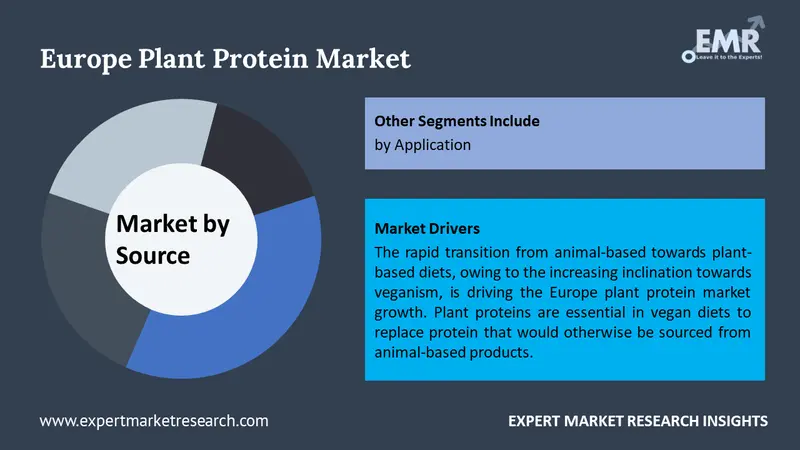
Market Breakup by Source
Key Insight: The Europe plant protein market report analyzes the growth trajectory of different sources including pea, soy, wheat, oat, potato, chickpea, rice, algae and others. Soy holds dominance thanks to its scalability, supply maturity, and cost efficiency. Growth of the pea category is backed by texture and clean-label advantages for high-moisture extrusion. Wheat remains essential for bakery, while oat and rice are applied in beverages and hypoallergenic niche food items respectively. Potato and chickpea are chosen for solubility and emulsification in snacks. Algae and specialty proteins address nutritional density and supplement niche categories.
Market Breakup by Application
Key Insight: Food and beverage applications currently dominate the Europe plant protein market revenue through private-label bakery, meat alternatives and beverages requiring functional proteins. Animal feed applications generally incline towards cost-effective concentrates and amino-balance for monogastric nutrition and aquafeed reformulations. Supplements demand high-purity fractions, clinical dossiers, and premium positioning. Other uses include bioplastics, specialty adhesives, and lab-grown media where protein functionality is secondary to cost or niche performance.
Market Breakup by Region
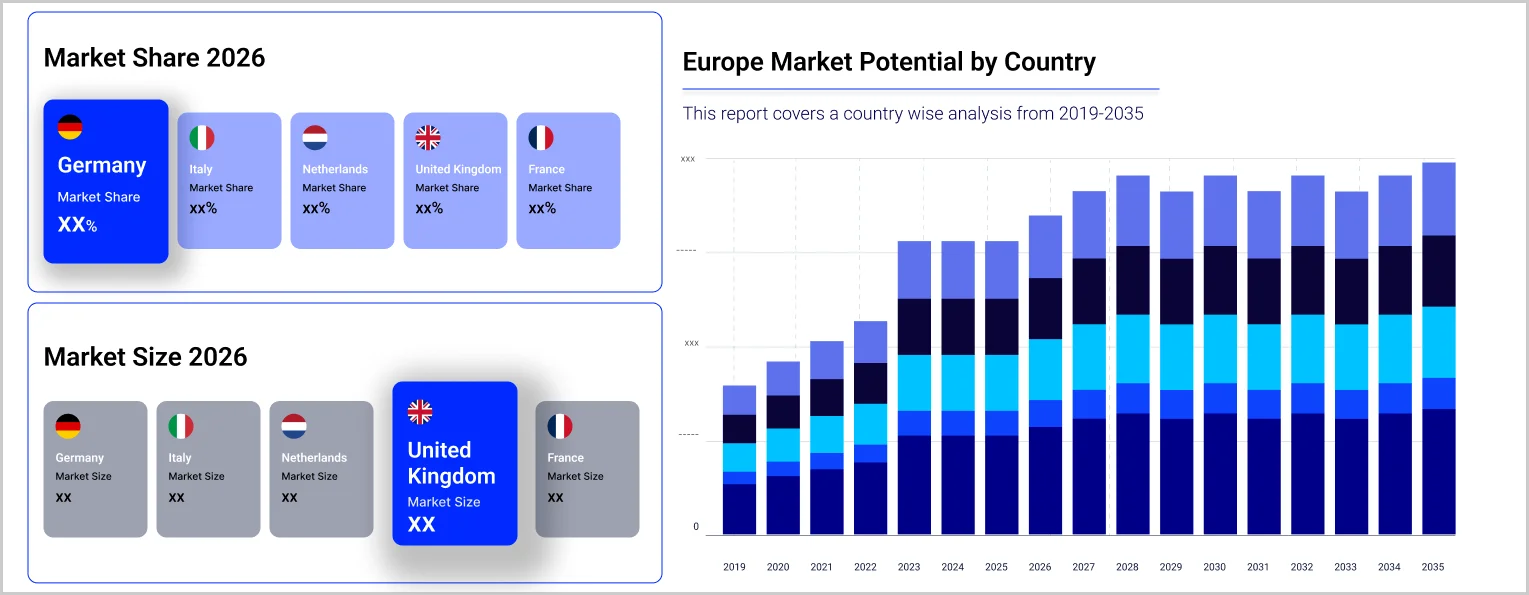
Key Insight: While the market in the United Kingdom leans on private-label retailers and nutrition brands, Germany boasts scalability, extrusion expertise, and rigorous specifications. France emphasizes farmer partnerships and legume crop programs, on the other hand, Italy prioritizes culinary textures for value-added foods. Poland is expanding its share in the Europe plant protein market, capitalizing on cost-competitive fractionation and export pipelines. Netherlands functions as an innovation and pilot hub with co-funded labs. Belgium’s ports and logistics ease ingredient flow. Russia supplies bulk raw material where geopolitics allow. Other markets like the Nordics demand low-carbon sourcing and traceability.
By source, soy retains its dominant position in the market owing to continuous demand and supply maturity
Soy remains the dominant plant protein source in Europe because of broad processing infrastructure, established trader networks, and low per-kilogram ingredient cost that aligns with the requirements posed by most food manufacturers. Industrial soy isolates and concentrates continue to be the go-to options for bakery mixes, dairy alternatives, and high-protein ready meals where price sensitivity matters. In March 2025, Protealis' soybean varieties PRO Taranaki (000 group) and PRO Denali (00 group) were formally approved and registered in both Germany and Belgium. Major suppliers like ADM and Avara supply certified non-GM lines and traceability packages which retail buyers require.
Pea protein observes fast growth in the Europe plant protein market as manufacturers prioritize clean-label, neutral flavor, and strong water-holding properties for meat alternatives and bakery reformulations. Suppliers such as Roquette and Cosucra have ramped up their industrial fractionation capacity to deliver more consistent isolates and textured concentrates for high-moisture extrusion. Process stability has become a key requirement for securing commercial contracts because large-scale food processors reject batch-to-batch variability.
By application, the food and beverage sector accounts for the largest share of the market revenue
Food and beverage applications continue to be the dominant application across the Europe plant protein market dynamics because it absorbs the largest volumes, from high-protein bakery mixes to meat alternatives, dairy alternatives and fortified beverages. Retailers and private-label manufacturers demand predictable functionality, stable supply cycles, and clean labels. Ingredient suppliers win contracts by offering tailored concentrates, pre-blends, and process guides for industrial ovens and extruders. Co-development labs between buyers and ingredient firms compress reformulation timelines and secure multi-year listings.
Supplements and sports nutrition emerge to be the fastest-growing application as brands seek high-protein powders with superior amino profiles, digestibility, and label simplicity. Ingredient providers create concentrated fractions and hydrolysates tailored for shakes, RTD sports formulations, and clinical nutrition. In May 2025, Edible Garden launched the brand called Kick Sports Nutrition, that offers plant-based and whey protein powders, with plans to expand into a full line of pre-workout, post-workout, and hydration products. Algae and fermentation-derived proteins command premium positioning where micronutrient density matters.
Germany accounts for the largest market share owing to its vast food manufacturing base
Germany is the dominant regional market due to its vast food manufacturing base, advanced extrusion capacity, and major retailer networks that set private-label specifications. Ingredient suppliers with local fractionation plants reduce lead times and appeal to procurement teams handling complex assortments. German buyers value technical service, audit-ready traceability, and supplier involvement in process optimization at plant level. R&D partnerships with technical universities and trade clusters accelerate application validation for meat alternatives and bakery.
Poland emerges to be the fastest-growing regional submarket as domestic legume farming expands, and local fractionation projects attract investor interest. Lower land and processing costs make Poland attractive for building mid-scale fractionation plants that serve Central and Eastern European processors, accelerating the overall growth in the Europe plant protein market. EU cohesion funds and agri-diversification incentives reduce capex risk, prompting ingredient firms to set up pilot lines near grain hubs.
Prominent Europe plant protein market players are concentrating on application-specific functionality, scale reliability, and hybrid ingredient systems that blend fermentation-derived proteins with legume fractions. They are investing in co-development labs, pilot extrusion lines, and traceable farmer partnerships to win large retailer listings. They can find opportunities in high-protein bakery, clinical nutrition, and private-label meat alternatives where texture predictability matters.
Unique innovations include enzymatically modified whey-pea hybrids, precision fermentation micro-fractions for amino balancing, and water-soluble pea isolates for ready-to-drink beverages. Europe plant protein companies offering bundled services including trials, regulatory dossiers, and in-plant training, are securing multi-year contracts. Margin pressure is easing for suppliers that can prove lower processing loss and faster line yields. Strategic M&A and joint ventures focused on pilot capacity in the Netherlands and Poland are enabling rapid scalability.
DuPont de Nemours Inc, established in 1802 and headquartered in Delaware, United States, is shifting focus into biosciences and advanced proteins, applying enzyme and fermentation know-how to textured vegetable proteins and functional isolates. DuPont sells tailored solutions for food manufacturers, supplying clinical-grade protein fractions and extrusion support to reduce scale-up risk.
BENEO GmbH was established in 2007 and is headquartered in Mannheim, Germany. The firm specializes in rice and other plant fractions to create highly digestible protein concentrates and functional starches. BENEO is targeting bakery and clinical nutrition markets with texturized rice proteins and micronutrient-integrated fractions that reduce grittiness and improve bite.
ADM Specialty Ingredients (Europe) B.V was incorporated in 2002 and is headquartered in Amsterdam, Netherlands. As part of ADM, the unit leverages crushing, fermentation and fractionation expertise to supply soy and pea isolates at scale. The business offers certified non-GM streams, fermentation co-manufacturing and logistics bundles for food manufacturers.
Arla Foods Ingredients Group P/S is part of Arla Foods, founded in the year 2000, and is headquartered in Denmark. The unit is converting dairy streams into whey proteins and pea blends, creating hybrid dairy-plant systems that improve amino scores and reduce ingredient footprint. Arla Ingredients offers whey-pea blends and enzymatically modified fractions for infant nutrition and sports markets.
*Please note that this is only a partial list; the complete list of key players is available in the full report. Additionally, the list of key players can be customized to better suit your needs.*
Other key players in the market include Cargill Inc., Ingredion Germany GmbH, Genencor International B.V., Kerry Group, and Roquette, among others.
Unlock the latest insights with our Europe plant protein market trends 2026 report. Discover regional growth patterns, consumer preferences, and key industry players. Stay ahead of competition with trusted data and expert analysis. Download your free sample report today and drive informed decisions in the market.
Australia Plant Protein Market


Upto 15% Off
USD
$2999 $2699
$4399 $3959
$5599 $4759
$6659 $5660


*While we strive to always give you current and accurate information, the numbers depicted on the website are indicative and may differ from the actual numbers in the main report. At Expert Market Research, we aim to bring you the latest insights and trends in the market. Using our analyses and forecasts, stakeholders can understand the market dynamics, navigate challenges, and capitalize on opportunities to make data-driven strategic decisions.*
The market is projected to grow at a CAGR of 6.90% between 2026 and 2035.
The market is estimated to witness a healthy growth in the forecast period of 2026-2035 to reach a value of USD 5.63 billion by 2035.
Building farmer partnerships, investing in pilot fermentation capacity, launching co-development labs, providing audit-ready dossiers, bundling logistics and training, and negotiating long-term offtake agreements are strengthening supplier positions and accelerating growth.
The key trends in the market include the thriving e-commerce sector and growing sale of premium packaged plant protein products such as bars, smoothies, and bakery and confectionary items.
Algae, soy, wheat, pea, potato, oat, chickpea, and rice, among others, are the various sources of plant protein in the market.
Food and beverages, animal feed, and supplements, among others, are the different applications of plant protein in the market.
Plant protein contain essential amino acids which are good for health and are overall a rich source of nutrition.
The benefits of plant proteins include lower risk of cardiovascular disease, reduced risk of cancer, higher intake of fibre, and better body weight management, among others.
The significant countries in the plant protein market in Europe are the United Kingdom, Germany, France, Italy, Poland, the Netherlands, Russia, and Belgium, among others.
The key players in the market include DuPont de Nemours Inc., BENEO GmbH, ADM Specialty Ingredients (Europe) B.V., Arla Foods Ingredients Group P/S, Cargill Inc., Ingredion Germany GmbH, Genencor International B.V., Kerry Group, and Roquette, among others.
In 2025, the market reached an approximate value of USD 2.89 Billion.
Supply volatility, regulatory complexity, and scaling fermentation processes are raising costs while audit burdens increase. Traceability demands and commodity swings force narrower margins and longer procurement cycles for ingredient suppliers.
Explore our key highlights of the report and gain a concise overview of key findings, trends, and actionable insights that will empower your strategic decisions.
| REPORT FEATURES | DETAILS |
| Base Year | 2025 |
| Historical Period | 2019-2025 |
| Forecast Period | 2026-2035 |
| Scope of the Report |
Historical and Forecast Trends, Industry Drivers and Constraints, Historical and Forecast Market Analysis by Segment:
|
| Breakup by Source |
|
| Breakup by Application |
|
| Breakup by Region |
|
| Market Dynamics |
|
| Competitive Landscape |
|
| Companies Covered |
|
Datasheet
One User
USD 2,999
USD 2,699
tax inclusive*
Single User License
One User
USD 4,399
USD 3,959
tax inclusive*
Five User License
Five User
USD 5,599
USD 4,759
tax inclusive*
Corporate License
Unlimited Users
USD 6,659
USD 5,660
tax inclusive*
*Please note that the prices mentioned below are starting prices for each bundle type. Kindly contact our team for further details.*
Flash Bundle
Small Business Bundle
Growth Bundle
Enterprise Bundle
*Please note that the prices mentioned below are starting prices for each bundle type. Kindly contact our team for further details.*
Flash Bundle
Number of Reports: 3
20%
tax inclusive*
Small Business Bundle
Number of Reports: 5
25%
tax inclusive*
Growth Bundle
Number of Reports: 8
30%
tax inclusive*
Enterprise Bundle
Number of Reports: 10
35%
tax inclusive*
How To Order

Select License Type
Choose the right license for your needs and access rights.

Click on ‘Buy Now’
Add the report to your cart with one click and proceed to register.

Select Mode of Payment
Choose a payment option for a secure checkout. You will be redirected accordingly.
Strategic Solutions for Informed Decision-Making
Gain insights to stay ahead and seize opportunities.

Get insights & trends for a competitive edge.

Track prices with detailed trend reports.

Analyse trade data for supply chain insights.

Leverage cost reports for smart savings

Enhance supply chain with partnerships.

Connect For More Information
Our expert team of analysts will offer full support and resolve any queries regarding the report, before and after the purchase.
Our expert team of analysts will offer full support and resolve any queries regarding the report, before and after the purchase.
We employ meticulous research methods, blending advanced analytics and expert insights to deliver accurate, actionable industry intelligence, staying ahead of competitors.
Our skilled analysts offer unparalleled competitive advantage with detailed insights on current and emerging markets, ensuring your strategic edge.
We offer an in-depth yet simplified presentation of industry insights and analysis to meet your specific requirements effectively.




