

Consumer Insights
Uncover trends and behaviors shaping consumer choices today
Procurement Insights
Optimize your sourcing strategy with key market data
Industry Stats
Stay ahead with the latest trends and market analysis.
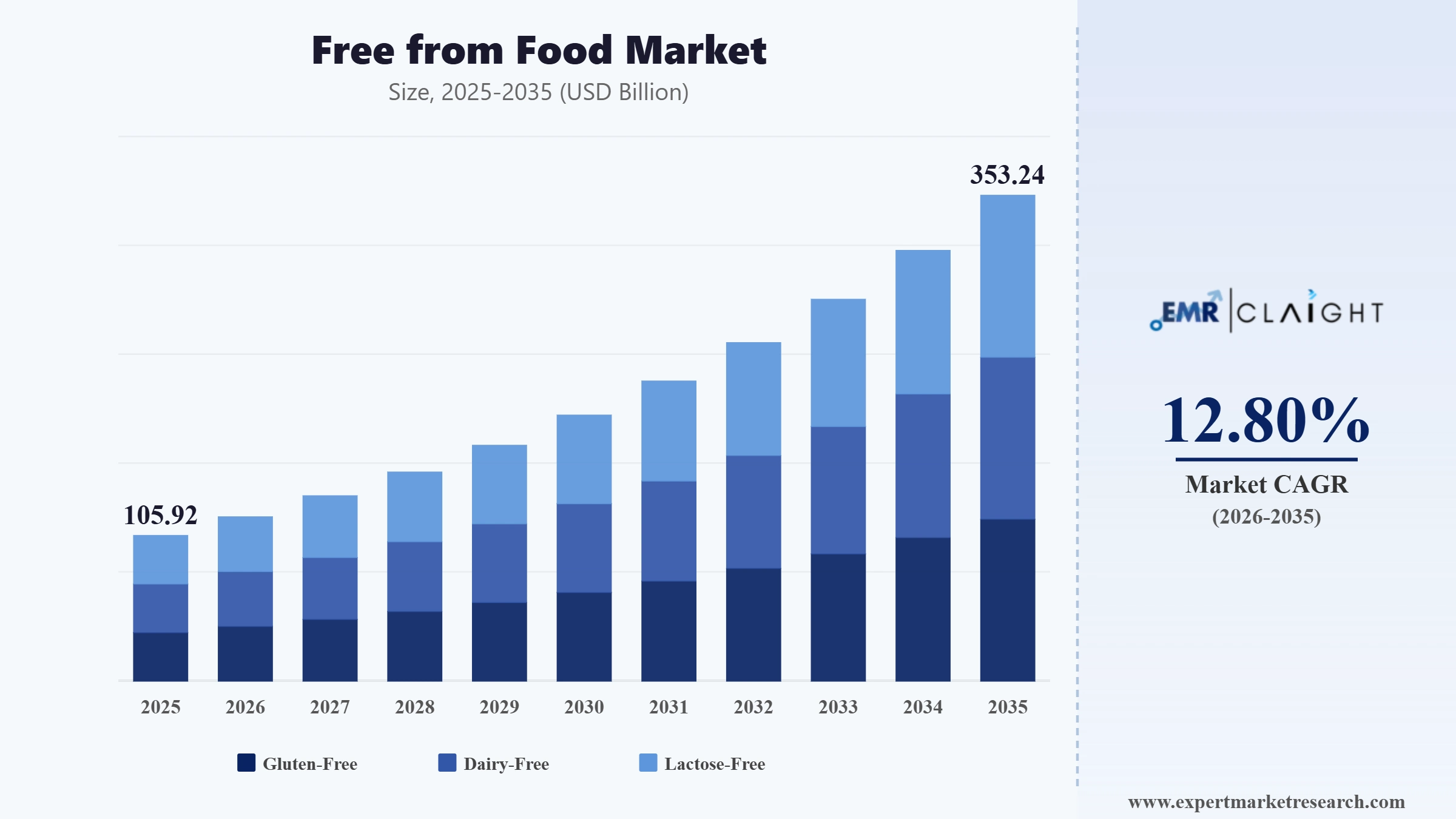
The global free from food market attained a value of USD 105.92 Billion in 2025 and is projected to expand at a CAGR of 12.80% through 2035. The market is further expected to achieve USD 353.24 Billion by 2035. Rising health consciousness, increasing awareness of food allergies and intolerances, and growing demand for clean-label products continue to support adoption of gluten-free, dairy-free, and lactose-free foods across supermarkets, convenience stores, and online distribution channels.
Rising health consciousness continues to anchor steady demand across the free from food market, as consumers increasingly seek alternatives to common allergens to manage chronic and autoimmune conditions. Manufacturers are also investing in plant-based protein innovation, reflecting the industry's ongoing pursuit of products that combine allergen-free formulation with functional nutritional benefits such as added protein and fibre.
The free from food market is witnessing further developments as established manufacturers expand high-protein, plant-based product lines to capture rising consumer demand. Danone launched Silk Protein nationally in January 2026, a refrigerated plant-based milk delivering 13 grams of complete plant protein per serving, positioned as the highest-protein refrigerated plant-based milk available in US grocery stores. This shift toward protein-fortified, allergen-free products is concentrated among manufacturers with sufficient research and development scale, while smaller specialists continue to compete on niche dietary certifications and regional distribution.
In addition, established manufacturers are increasingly extending allergen-free product platforms across multiple categories beyond their original launch format, reflecting the industry's recognition that a single successful formulation increasingly justifies expansion into adjacent product types such as yogurt and ready-to-drink shakes. In July 2026, Conagra Brands unveiled an extensive innovation lineup spanning breakfast, frozen meals, plant-based options, and pantry staples, including new gluten-free Stubb's Baked Beans varieties, illustrating how a single manufacturer extends allergen-free formulations across genuinely distinct product categories rather than a single format. Such platform extension activity is reshaping competitive positioning across the wider free from food market as manufacturers with proven cross-category extension capabilities increasingly differentiate themselves from competitors confined to single-format product lines.
Read more about this report - REQUEST FREE SAMPLE COPY IN PDF
Beyond Meat launched Phytosphere, a comprehensive nutrition platform combining powders, bars, beverages, and center-of-plate offerings that lets consumers stack plant protein, fibre, and other nutrients throughout the day. Companies can consolidate previously separate product lines into a single integrated nutrition platform to simplify cross-category purchasing for health-focused consumers.
Hain Celestial reported its fiscal 2026 fourth quarter and full-year results, announcing a definitive agreement to sell its international business while noting organic net sales growth in yogurt offset by softness in plant-based meat internationally. Companies can divest underperforming international segments to concentrate resources on higher-growth core categories such as functional yogurt and snacks.
Danone expanded its Silk Protein platform beyond milk into plant-based yogurt and ready-to-drink shakes, building on the early success of the January 2026 milk launch to widen the brand's reach across breakfast, snacking, and recovery occasions. Companies can extend a successful single-format launch into adjacent product categories within the same fiscal year to capture broader consumption occasions.
Beyond Meat launched Beyond Immerse, its first functional beverage line, into the New York metro area through a distribution agreement providing access to more than 26,000 retail and foodservice outlets. Companies can partner with established regional beverage distributors to accelerate market entry for new functional product categories beyond their core protein offering.
Established manufacturers continue launching integrated nutrition platforms spanning multiple product formats. In September 2026, Beyond Meat launched a comprehensive platform combining powders, bars, beverages, and center-of-plate offerings that lets consumers stack nutrients throughout the day across the free from food market. Such platform consolidation reflects manufacturers' recognition that integrating previously separate product lines under one nutritional framework increasingly simplifies purchasing decisions for health-conscious consumers.
Manufacturers continue divesting underperforming international and category segments to concentrate resources on higher-growth core categories. In September 2026, Hain Celestial announced a definitive agreement to sell its international business while reporting continued organic growth in its core yogurt category. Such strategic divestiture reflects manufacturers' recognition that concentrating capital and management attention on proven growth categories increasingly outweighs the diversification benefits of maintaining underperforming international operations.
Manufacturers continue extending successful single-format product launches into adjacent categories within the same year. In July 2026, Danone expanded its high-protein Silk Protein platform beyond its original milk format into yogurt and ready-to-drink shakes. Such rapid category extension reflects manufacturers' recognition that capitalising quickly on early launch momentum increasingly outperforms a more cautious, single-category rollout strategy.
Manufacturers continue partnering with established regional distributors to accelerate entry into new functional product categories. In June 2026, Beyond Meat launched its first functional beverage line into a major metro market through a distribution agreement providing access to tens of thousands of retail and foodservice outlets. Such distributor partnerships reflect manufacturers' recognition that leveraging established regional distribution networks increasingly accelerates market entry compared with building direct retail relationships independently.
Diversified food groups continue to apply nutritional and formulation research developed across their broader consumer food portfolios to increasingly sophisticated free from product development. Established multi-category food manufacturers continue to develop gluten-free, dairy-free, and lactose-free products drawing on broader flavour science, protein fortification, and clean-label research spanning multiple dietary categories beyond free from food alone. Such cross-portfolio research investment gives diversified food groups a technical foundation that narrower free-from-only specialists must build through more limited, single-category development.
This Expert Market Research Report titled "Free From Food Market Report and Forecast 2026-2035" offers a detailed analysis of the market based on the following segments:
Market Breakup by Type
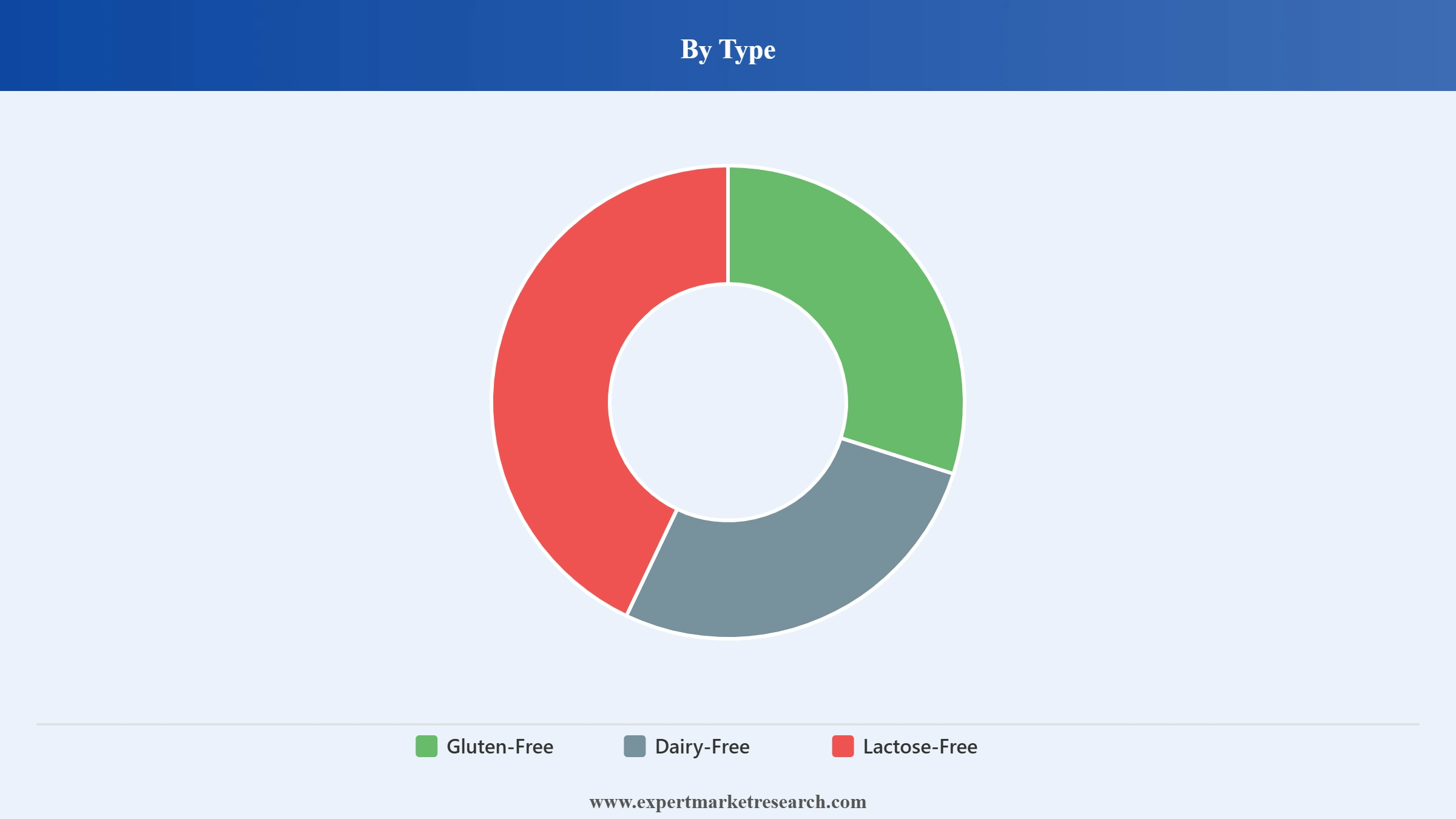
Key Insight: Gluten-Free accounts for the largest share of the free from food market, reflecting its established position across bakery, snack, and beverage categories with the widest retail penetration. Dairy-Free is growing at the fastest pace as plant-based protein innovation continues to expand, illustrated by Danone's January 2026 national Silk Protein launch delivering 13 grams of complete plant protein per serving. Lactose-Free continues to serve a distinct consumer base seeking dairy alternatives without full plant-based substitution, with other types rounding out the remaining category.
Market Breakup by End Product
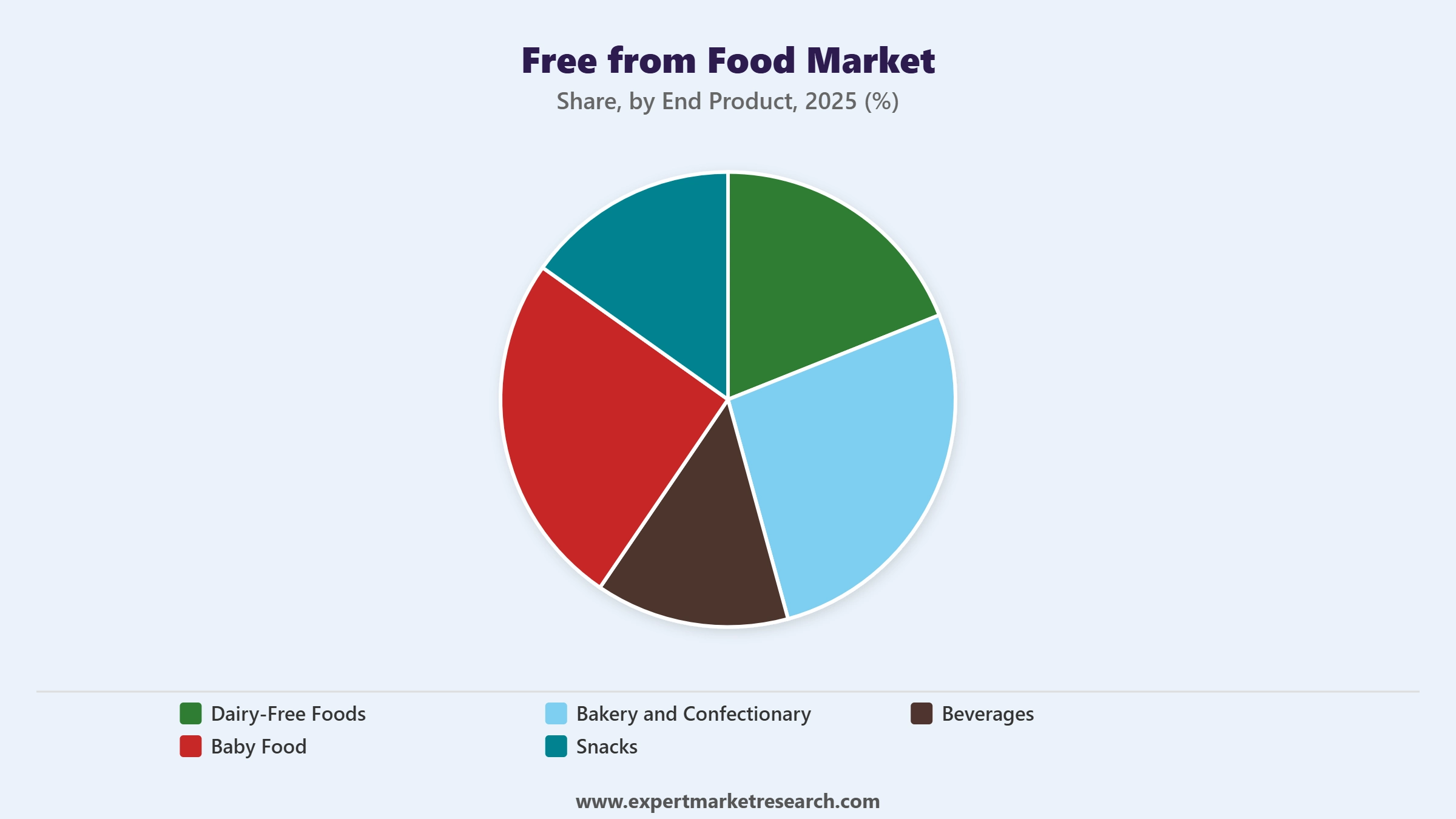
Key Insight: Bakery and Confectionary accounts for the largest share of the free from food market, reflecting sustained gluten-free demand across bread, cakes, and baked snack categories. Dairy-Free Foods continues to represent substantial and rapidly growing demand as plant-based milk, yogurt, and cheese alternatives expand, illustrated by Danone's July 2026 extension of Silk Protein into yogurt and shakes. Beverages, Baby Food, and Snacks each serve distinct dietary requirements, with other end products rounding out the remaining category.
Market Breakup by Distribution Channel
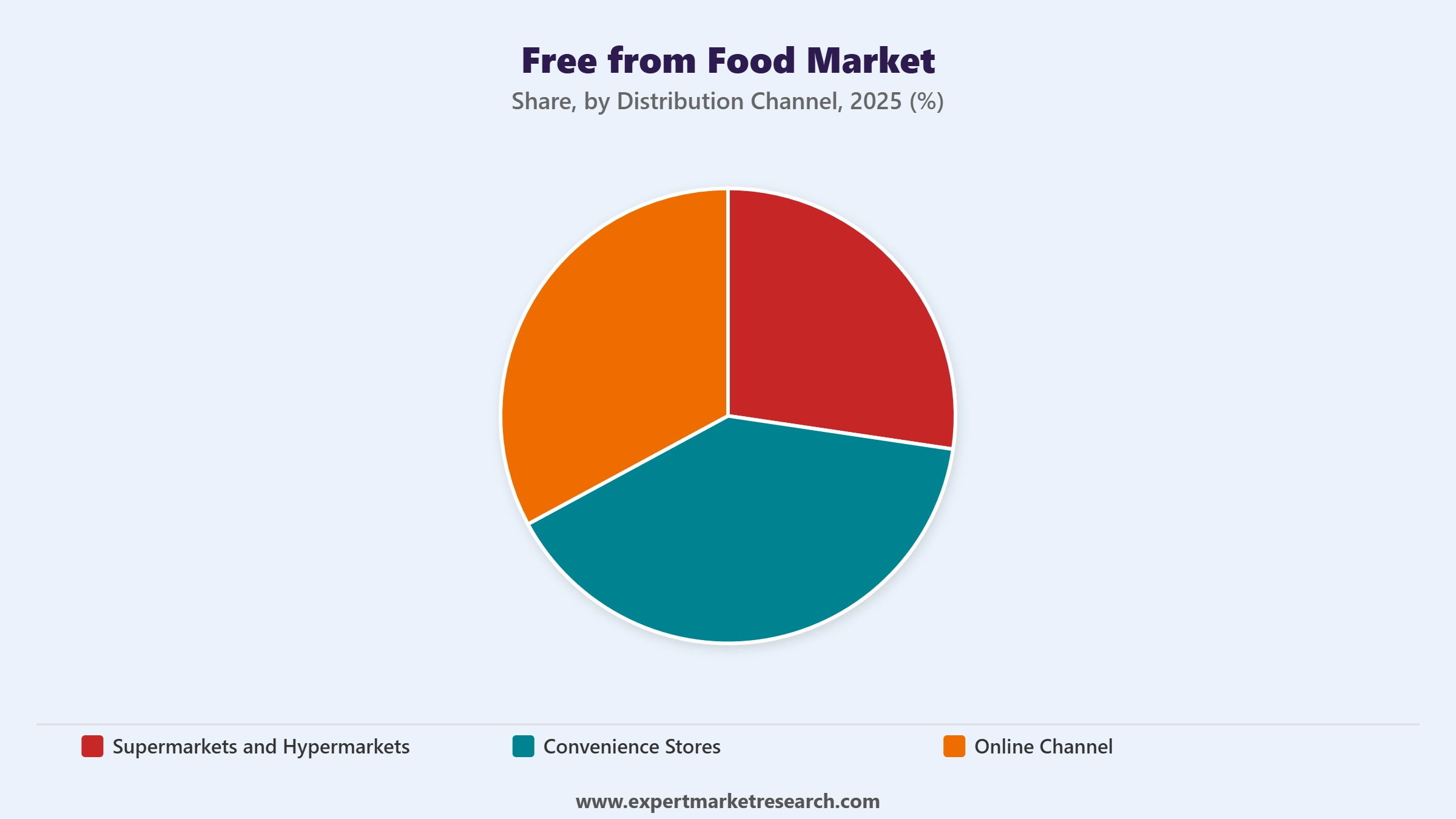
Key Insight: Supermarkets and Hypermarkets account for the largest share of the free from food market, reflecting their established role as the primary destination for free from grocery shopping given wide product assortment. Online Channel is growing at the fastest pace as direct-to-consumer platforms and subscription models increasingly let consumers access specialised dietary products unavailable in conventional retail. Convenience Stores continue to serve time-constrained shoppers seeking accessible free from snack options, with other channels rounding out the remaining category.
Market Breakup by Region
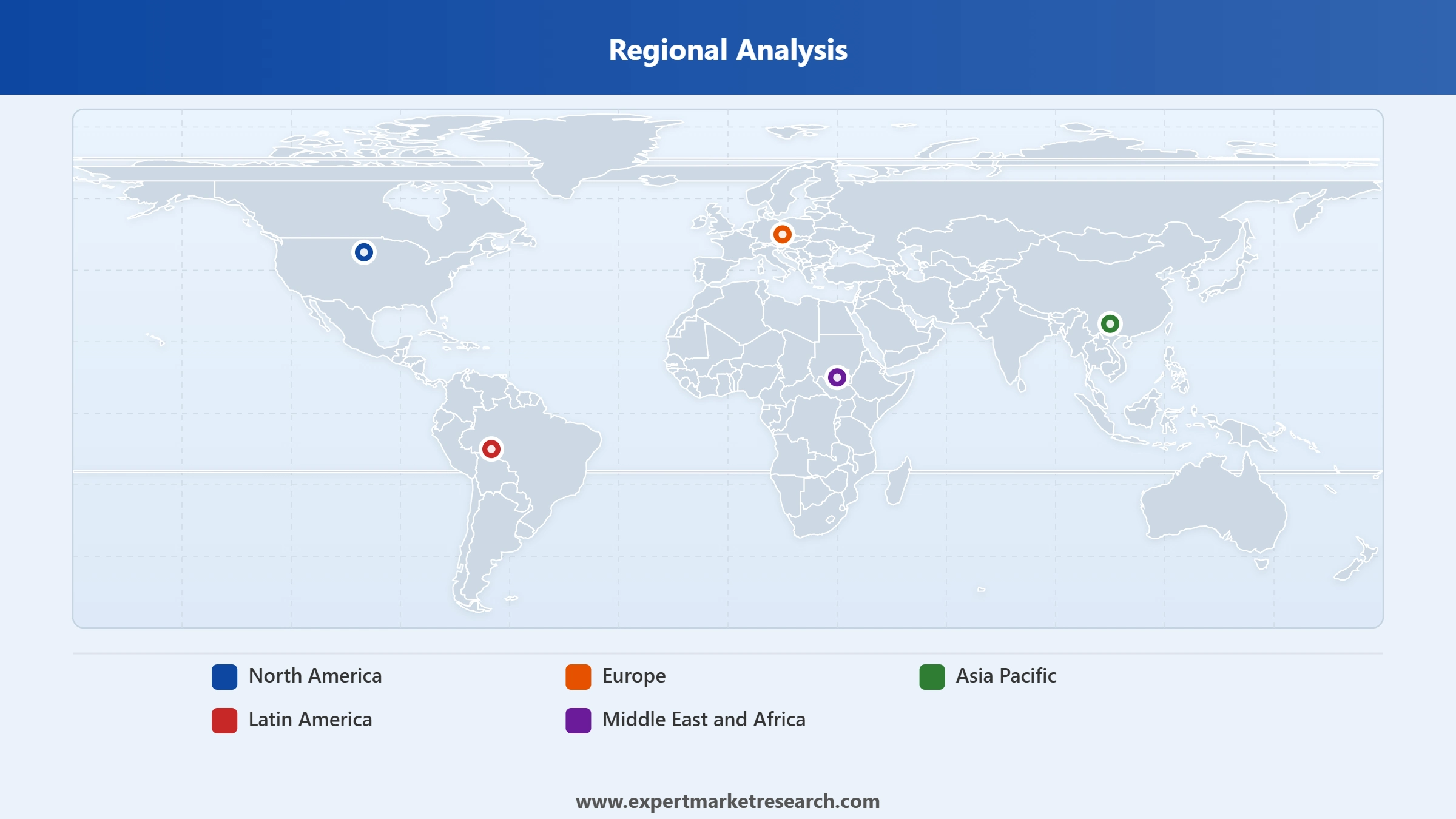
Key Insight: North America accounts for the largest share of the free from food market, supported by the region's established allergen-conscious consumer base and mature free from retail infrastructure. Asia Pacific is emerging as a key growth market as rising disposable incomes and increasing diagnosis of food intolerances continue to drive adoption. Europe, Latin America, and the Middle East and Africa each continue to serve distinct regional dietary and retail patterns.
By type, gluten-free leads the market while dairy-free grows fastest given plant-based protein innovation
Gluten-Free continues to account for the largest share of the market, reflecting its established position across bakery, snack, and beverage categories with the widest retail penetration. Established gluten-free product ranges continue to anchor steady demand as manufacturers maintain proven formulations across successive product generations.
Read more about this report - REQUEST FREE SAMPLE COPY IN PDF
Dairy-Free is growing at the fastest pace across the free from food market as plant-based protein innovation continues to expand beyond traditional alternatives. In September 2026, Beyond Meat launched an integrated nutrition platform spanning plant-based beverages, bars, and powders to capture rising dairy-free demand.
By end product, bakery and confectionary leads the market while dairy-free foods grows fastest given expanding plant-based platforms
Bakery and Confectionary continues to account for the largest share of the market, reflecting sustained gluten-free demand across bread, cakes, and baked snack categories. Established bakery and confectionary product lines continue to anchor steady demand as manufacturers maintain proven recipes across successive retail cycles.
Read more about this report - REQUEST FREE SAMPLE COPY IN PDF
Dairy-Free Foods is growing at the fastest pace across the free from food market as plant-based milk, yogurt, and cheese alternatives continue to expand. In July 2026, Danone extended its Silk Protein platform beyond milk into yogurt and ready-to-drink shakes to widen its dairy-free foods reach.
By distribution channel, supermarkets and hypermarkets lead the market while online channel grows fastest given expanding direct-to-consumer platforms
Supermarkets and Hypermarkets continue to account for the largest share of the market, reflecting their established role as the primary destination for free from grocery shopping given wide product assortment. Established supermarket distribution relationships continue to anchor steady demand as manufacturers maintain proven retail partnerships across successive product launch cycles.
Read more about this report - REQUEST FREE SAMPLE COPY IN PDF
Online Channel is growing at the fastest pace across the free from food market as manufacturers increasingly launch products through direct-to-consumer websites ahead of retail rollout. Beyond Steak Filet launched on Beyond Meat's direct-to-consumer site in October 2025, becoming the site's top-selling product before its June 2026 retail debut at major grocery chains.
Read more about this report - REQUEST FREE SAMPLE COPY IN PDF
North America commands the largest share of the market through its established allergen-conscious consumer base
North America holds the largest share of the free from food market, supported by the region's established allergen-conscious consumer base and mature free from retail infrastructure. Regional manufacturers continue to expand protein-fortified and plant-based product lines to meet sustained consumer demand for functional, allergen-free nutrition.
Asia Pacific is emerging as a key growth market as rising disposable incomes and increasing diagnosis of food intolerances continue to drive adoption across the region. Continued manufacturer platform launches throughout 2026 underscored sustained global investment in free from product innovation extending well beyond North America's traditional market concentration.
Read more about this report - REQUEST FREE SAMPLE COPY IN PDF
The global industry is fragmented, with free from food market companies ranging from diversified global food and beverage groups spanning multiple consumer categories to specialist free from food manufacturers competing across type, end product, and distribution channel segments. Established players operate across the full free from food value chain, from allergen-free formulation and ingredient sourcing through complete product manufacturing and distribution for retail and foodservice customers.
Competitive dynamics among free from food players are increasingly shaped by the pace of protein-fortified product innovation, the scale of cross-category platform extension, and the race to divest underperforming segments in favour of proven growth categories. Manufacturers are investing in plant-based protein technology, integrated nutrition platforms, and regional distribution partnerships to differentiate their offering and secure long-term consumer loyalty.
Founded in 1919 and headquartered in Chicago, Illinois, United States, Conagra Brands manufactures packaged foods including gluten-free and allergen-free products across its frozen, snack, and grocery portfolios. The company serves retail and foodservice customers across North America. Conagra's extensive frozen food distribution infrastructure differentiates its offering from competitors focused solely on shelf-stable free from products.
Founded in 1919 and headquartered in Paris, France, Danone manufactures dairy-free and plant-based products including its Silk brand of plant-based milk, yogurt, and beverages. In January 2026, the company launched Silk Protein nationally, delivering 13 grams of complete plant protein per serving. Danone's combined dairy and plant-based nutrition research differentiates its offering from competitors focused solely on plant-based formulation.
Founded in 1866 and headquartered in Minneapolis, Minnesota, United States, General Mills manufactures gluten-free cereals, snacks, and baking products across brands including Cascadian Farm and Chex. The company serves retail customers across North America and international markets. General Mills' extensive cereal and snack manufacturing scale differentiates its offering from smaller, specialist free from producers.
Founded in 2009 and headquartered in El Segundo, California, United States, Beyond Meat manufactures plant-based meat alternatives and, more recently, functional nutrition products under its Phytosphere platform. In September 2026, the company launched Phytosphere, an integrated nutrition platform spanning powders, bars, beverages, and center-of-plate offerings. Beyond Meat's dedicated plant-based protein research differentiates its offering from diversified food groups treating free from products as one category among many.
Other key players in the free from food market include Mondelez International, Campbell Soup Company, The Hain Celestial Group, Unilever Plc, Chr. Hansen Holding A/S, Abbott Laboratories, Alpro UK Limited, Doves Farm Foods Limited, Dr. Schar AG/SpA, Ener-G Foods Inc., and GreenSpace Brands Inc, among others.
*Please note that this is only a partial list; the complete list of key players is available in the full report. Additionally, the list of key players can be customized to better suit your needs.*
Unlock the latest insights with our free from food market trends 2026 report. Discover regional growth patterns, type and end product trends, and key industry players. Stay ahead of competition with trusted data and expert analysis. Download your free sample report today and drive informed decisions in the market.


Upto 15% Off
USD
$2499 $2249
$3999 $3599
$4999 $4249
$5999 $5099


*While we strive to always give you current and accurate information, the numbers depicted on the website are indicative and may differ from the actual numbers in the main report. At Expert Market Research, we aim to bring you the latest insights and trends in the market. Using our analyses and forecasts, stakeholders can understand the market dynamics, navigate challenges, and capitalize on opportunities to make data-driven strategic decisions.*
The market is projected to grow at a CAGR of 12.80% between 2026 and 2035.
Drivers include rising health awareness. Restraints are high costs, and opportunities lie in expanding product offerings and plant-based innovations.
The key trends fuelling the growth of the market include increasing celebrity endorsements and collaborations for product promotion and rising prevalence of various diseases and disorders.
The major regions in the market are North America, Europe, the Asia Pacific, Latin America, and the Middle East and Africa.
The significant end uses include dairy-free foods, bakery and confectionery, beverages, baby food, and snacks, among others.
Supermarkets, online platforms, and convenience stores make up distribution channels, with online platforms experiencing significant growth.
The significant types include gluten-free, dairy-free, and lactose-free, among others.
The key players in the market include Conagra Brands, Inc, Danone S.A., Mondelez International, General Mills, Inc., Campbell Soup Company, The Hain Celestial Group, Unilever Plc, Chr. Hansen Holding A/S, Abbott Laboratories, Beyond Meat, Inc., Alpro UK Limited, Doves Farm Foods Limited, Dr. Schar AG/SpA, Ener-G Foods Inc., and GreenSpace Brands Inc, among others.
The UK, USA, Germany, and Japan represent the most attractive markets, driven by growing health-conscious populations and dietary preferences.
The market is divided into gluten-free, dairy-free, sugar-free, and other categories, with gluten-free dominating the market share.
The market features both established companies and new entrants, with intense competition focused on product innovation, pricing, and quality.
In 2025, the market reached an approximate value of USD 105.92 Billion.
The market is estimated to witness healthy growth in the forecast period of 2026-2035 to reach a value of around USD 353.24 Billion by 2035.
Manufacturers face higher production costs for allergen-free formulation and certification, price sensitivity limiting adoption among cost-conscious consumers, and intensifying competition to differentiate products beyond basic allergen removal toward added functional nutrition.
Launching protein-fortified plant-based products, extending successful single-format launches into adjacent categories such as yogurt and beverages, and divesting underperforming segments to concentrate resources on proven growth categories.
Explore our key highlights of the report and gain a concise overview of key findings, trends, and actionable insights that will empower your strategic decisions.
| REPORT FEATURES | DETAILS |
| Base Year | 2025 |
| Historical Period | 2019-2025 |
| Forecast Period | 2026-2035 |
| Scope of the Report |
Historical and Forecast Trends, Industry Drivers and Constraints, Historical and Forecast Market Analysis by Segment:
|
| Breakup by Type |
|
| Breakup by End Product |
|
| Breakup by Distribution Channel |
|
| Breakup by Region |
|
| Market Dynamics |
|
| Competitive Landscape |
|
| Companies Covered |
|
Datasheet
One User
USD 2,499
USD 2,249
tax inclusive*
Single User License
One User
USD 3,999
USD 3,599
tax inclusive*
Five User License
Five User
USD 4,999
USD 4,249
tax inclusive*
Corporate License
Unlimited Users
USD 5,999
USD 5,099
tax inclusive*
*Please note that the prices mentioned below are starting prices for each bundle type. Kindly contact our team for further details.*
Flash Bundle
Small Business Bundle
Growth Bundle
Enterprise Bundle
*Please note that the prices mentioned below are starting prices for each bundle type. Kindly contact our team for further details.*
Flash Bundle
Number of Reports: 3
20%
tax inclusive*
Small Business Bundle
Number of Reports: 5
25%
tax inclusive*
Growth Bundle
Number of Reports: 8
30%
tax inclusive*
Enterprise Bundle
Number of Reports: 10
35%
tax inclusive*
How To Order

Select License Type
Choose the right license for your needs and access rights.

Click on ‘Buy Now’
Add the report to your cart with one click and proceed to register.

Select Mode of Payment
Choose a payment option for a secure checkout. You will be redirected accordingly.
Strategic Solutions for Informed Decision-Making
Gain insights to stay ahead and seize opportunities.

Get insights & trends for a competitive edge.

Track prices with detailed trend reports.

Analyse trade data for supply chain insights.

Leverage cost reports for smart savings

Enhance supply chain with partnerships.

Connect For More Information
Our expert team of analysts will offer full support and resolve any queries regarding the report, before and after the purchase.
Our expert team of analysts will offer full support and resolve any queries regarding the report, before and after the purchase.
We employ meticulous research methods, blending advanced analytics and expert insights to deliver accurate, actionable industry intelligence, staying ahead of competitors.
Our skilled analysts offer unparalleled competitive advantage with detailed insights on current and emerging markets, ensuring your strategic edge.
We offer an in-depth yet simplified presentation of industry insights and analysis to meet your specific requirements effectively.




