

Consumer Insights
Uncover trends and behaviors shaping consumer choices today
Procurement Insights
Optimize your sourcing strategy with key market data
Industry Stats
Stay ahead with the latest trends and market analysis.
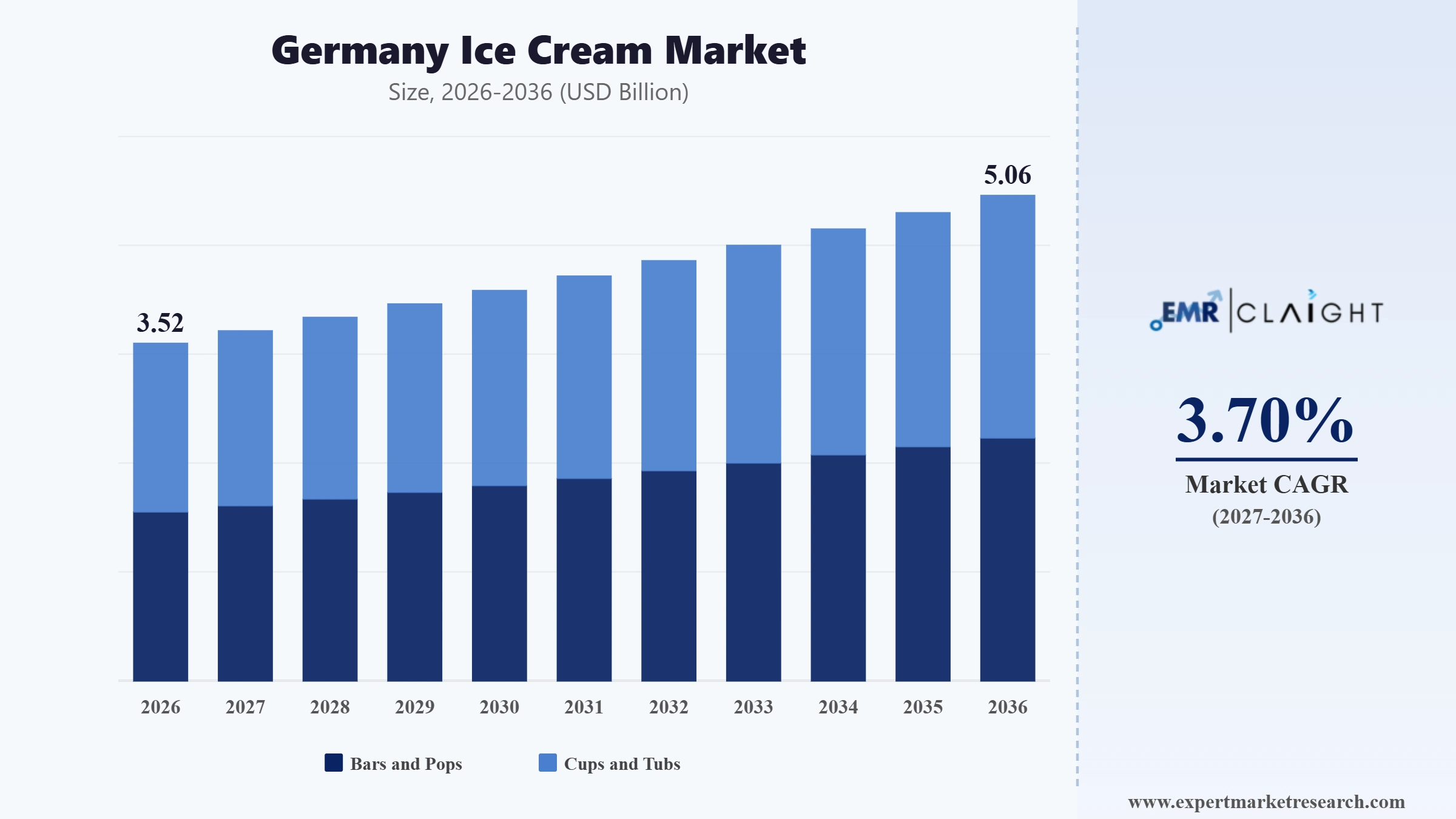
The Germany ice cream market attained a value of USD 3.39 Billion in 2025 and is projected to expand at a CAGR of 3.70% through 2035. The market is further expected to achieve USD 4.88 Billion by 2035. A notable opportunity lies in reducing the industry's reliance on summer-led demand cycles. A BDSI industry publication reports that around 80% of Germans consume ice cream throughout the year, with fruit-forward varieties preferred during summer and creamier profiles favored during winter. This creates scope for manufacturers to build season-specific production and procurement schedules, rather than concentrating capacity around warmer months. Suppliers can develop winter-oriented flavors, limited editions, and foodservice formats while manufacturers can better balance freezer utilization and raw-material purchasing across the year. The shift also supports more consistent retail programming beyond traditional summer promotions
The proliferation of branded, premium, and licensed offerings has enabled manufacturers to capture attention beyond the usual flavor war. For example, DMK’s licensing model, for instance, has resulted in consumer brands being turned into ice creams such as Landliebe and Almdudler for the 2025 season without affecting their Häagen-Dazs licensing deal in Germany. At the same time, plant-based purchasing has become commercially more scalable. In 2025, according to ProVeg, plant-based items cost 5% less than animal-derived equivalents, marking a shift from the 52% premium experienced in 2022. This makes it easier for manufacturers of ice cream to offer more vegan SKUs, thereby boosting the Germany ice cream market value.
Artificial intelligence is emerging as a practical tool for optimizing ice cream refrigeration and inventory decisions. The Magnum Ice Cream Company has identified AI-powered cabinet forecasting as part of its technology-enabled growth strategy, linking freezer performance with demand planning. Beyond forecasting, research published in 2026 found that ice-storage-assisted commercial refrigeration could achieve 29.75% peak-load shifting and reduce electricity costs by 21.98% under optimized conditions. For German manufacturers and retailers, combining predictive demand data with smart refrigeration controls could reduce unnecessary cooling loads, improve cabinet utilization, and support more efficient frozen distribution networks.
The ice cream sector in Germany is becoming increasingly vulnerable to weather interruptions in terms of agricultural input, energy demands, and production processes. According to the German confectionery industry organization BDSI, the heat wave experienced between June 17-30, 2026 resulted in economic damages amounting to €6.3 billion due to effects felt from agriculture to the logistics. Disruptions in sugar, dairy, fruits, or packaging may complicate procurement and production planning. Companies can mitigate this challenge by qualifying multiple suppliers, maintaining strategic inventories of critical ingredients, and developing flexible formulations that allow ingredient substitution without materially changing product quality. Regional sourcing and stronger supplier monitoring can further reduce exposure to weather-driven supply interruptions, thereby boosting the Germany ice cream market developments.
Read more about this report - REQUEST FREE SAMPLE COPY IN PDF
The Magnum Ice Cream Company commissioned a new Ben & Jerry’s pint production line at its Heppenheim factory in Germany as part of the site’s ongoing €30 million expansion programme. The line produces products including Cookie Dough and Chocolate Fudge Brownie for European markets. Heppenheim, spanning 100,000 square metres, is the company’s largest European factory and is also receiving investments in logistics, cold storage and energy infrastructure. The expansion increases regional manufacturing capacity and brings production closer to European consumers.
Arla Foods and DMK Group officially combined on June 1, 2026, operating under the Arla name and creating a farmer-owned dairy cooperative with approximately 11,200 farmers, 28,800 employees and an annual milk pool of 19.4 billion kg. DMK previously operated businesses spanning dairy, plant-based products and ice cream. The combination increases the scale of the combined organisation and is intended to strengthen operational resilience, innovation capabilities and food-production capacity across Europe, with potential implications for dairy-based frozen-dessert supply chains.
General Mills expanded its international Häagen-Dazs innovation programme in 2026 with new premium formats and flavours for selected overseas markets. The portfolio includes Dark Belgian Chocolate Stick Bars for North Asia and Belgian Chocolate Stick Bars for Southeast Asia and Latin America, alongside other flavour launches such as Mango Coconut with Grapefruit and Strawberry with Yuzu. General Mills also introduced Belgian Chocolate ice cream made with 72% cocoa across international markets outside the United States, Canada and Japan, thus shaping the trends of the Germany ice cream market.
Froneri introduced a dedicated Lotus Biscoff ice cream portfolio in March 2026 following its strategic licensing agreement. The range includes an indulgent stick format available individually and in three-packs, featuring creamy ice cream, Biscoff biscuit pieces and a coating containing real Biscoff biscuits. The formulation combines contrasting textures with the caramelised taste associated with the brand. The launch strengthens Froneri’s branded premium offering and gives retailers a differentiated proposition within the indulgent ice cream and snacking categories.
Germany's position as the EU's largest ice cream producer allows manufacturers to use domestic plants as multi-market supply platforms rather than serving only German demand. This is particularly relevant for companies operating across neighboring European markets, where shared production can reduce formulation and procurement complexity. Manufacturers can develop common ice cream bases, then modify flavors, inclusions, pack sizes, language panels, and nutritional declarations according to destination-market requirements. Ingredient suppliers can benefit by supplying scalable stabilizer, flavor, coating, and inclusion systems suitable for several formulations. This model also supports private-label producers seeking flexible volumes across multiple European retail customers.
The narrowing price gap between plant-based and conventional products is changing how retailers evaluate vegan freezer propositions. With plant-based alternatives becoming 5% cheaper than comparable animal-based products in ProVeg's 2025 assessment, manufacturers have greater scope to position vegan ice cream within mainstream price architecture rather than treating it exclusively as a premium alternative. High availability at major German retailers also provides manufacturers with established distribution pathways. For B2B suppliers, the opportunity extends beyond finished products to oat, soy, pea, coconut, and other plant-derived bases, alongside stabilizers and texture systems capable of reproducing creaminess while maintaining commercially viable formulations.
Brand licensing enables ice cream manufacturers to access established consumer recognition without building awareness entirely from scratch. DMK's Landliebe and Almdudler launches demonstrate how brands originating outside traditional frozen desserts can be translated into distinct ice cream architectures. For manufacturers, licensing can support rapid portfolio diversification while allowing existing production infrastructure to be adapted for new concepts. Retailers can simultaneously use recognizable names to create differentiated freezer assortments. The approach also creates opportunities for ingredient suppliers, packaging converters, and co-manufacturers to develop specialized components around licensed concepts. Future opportunities are likely to center on brands with strong regional recognition and clear flavor associations, thus boosting the Germany ice cream market dynamics and trends.
Premiumization is increasingly being achieved through product architecture rather than simply increasing ingredient costs or pack sizes. Froneri's Lotus Biscoff portfolio demonstrates how manufacturers can combine ice cream, biscuit pieces, coatings, and recognizable flavor profiles within one SKU to create multiple sensory stages. Such formulations require closer coordination between ingredient suppliers, process engineers, and manufacturers because inclusions and coatings must remain stable during frozen storage and distribution. This creates opportunities for suppliers specializing in chocolate coatings, biscuit inclusions, sauces, emulsifiers, and stabilizer systems. For manufacturers, layered textures also provide a mechanism for premium positioning while creating stronger differentiation from conventional single-texture products.
Germany's expanding online retail environment creates a distinct operational opportunity for ice cream manufacturers, but success depends on adapting products and packaging to frozen fulfillment rather than simply listing conventional SKUs online. Multipacks, assortment boxes, premium bundles, and limited-edition combinations can be designed specifically for digital channels, where manufacturers have greater control over product presentation and basket composition. Insulated secondary packaging and temperature-management solutions become important for maintaining product integrity during delivery. Suppliers can therefore target e-commerce-specific packaging, cold-chain monitoring, and fulfillment solutions alongside finished ice cream. Manufacturers can also use online-exclusive formats to test new flavors before wider physical-retail distribution.
The Expert Market Research’s report titled "Germany Ice Cream Market Report and Forecast 2026-2035” offers a detailed analysis of the market based on the following segments:
Market Breakup by Product Type
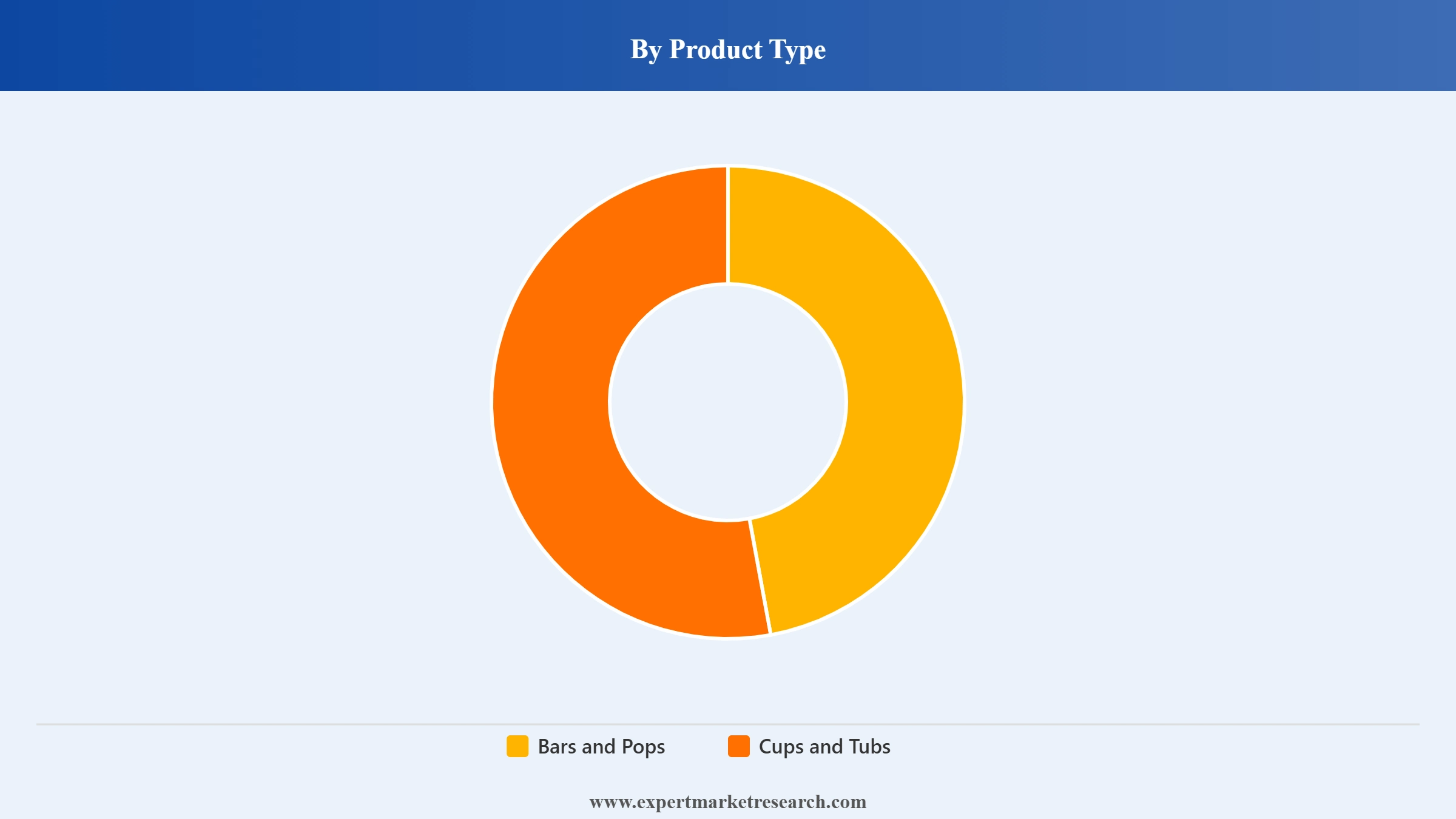
Key Insight: The German product landscape is divided between Bars and Pops, Cups and Tubs, and Others, reflecting distinct impulse, household, and foodservice occasions. BDSI classifies impulse ice cream as including sticks, cones, sandwiches, bars, and small tubs, while household packs generally begin at 300 ml and are designed for home consumption. Cups and tubs therefore provide manufacturers with greater room for multi-serving formats, inclusions, premium recipes, and retailer private labels, whereas bars and pops offer portion-controlled impulse consumption. The increasing importance of licensed and premium products is also encouraging manufacturers to use both formats within one brand architecture, allowing suppliers to address supermarket freezer, convenience, and foodservice requirements without relying on a single pack format.
Market Breakup by Type
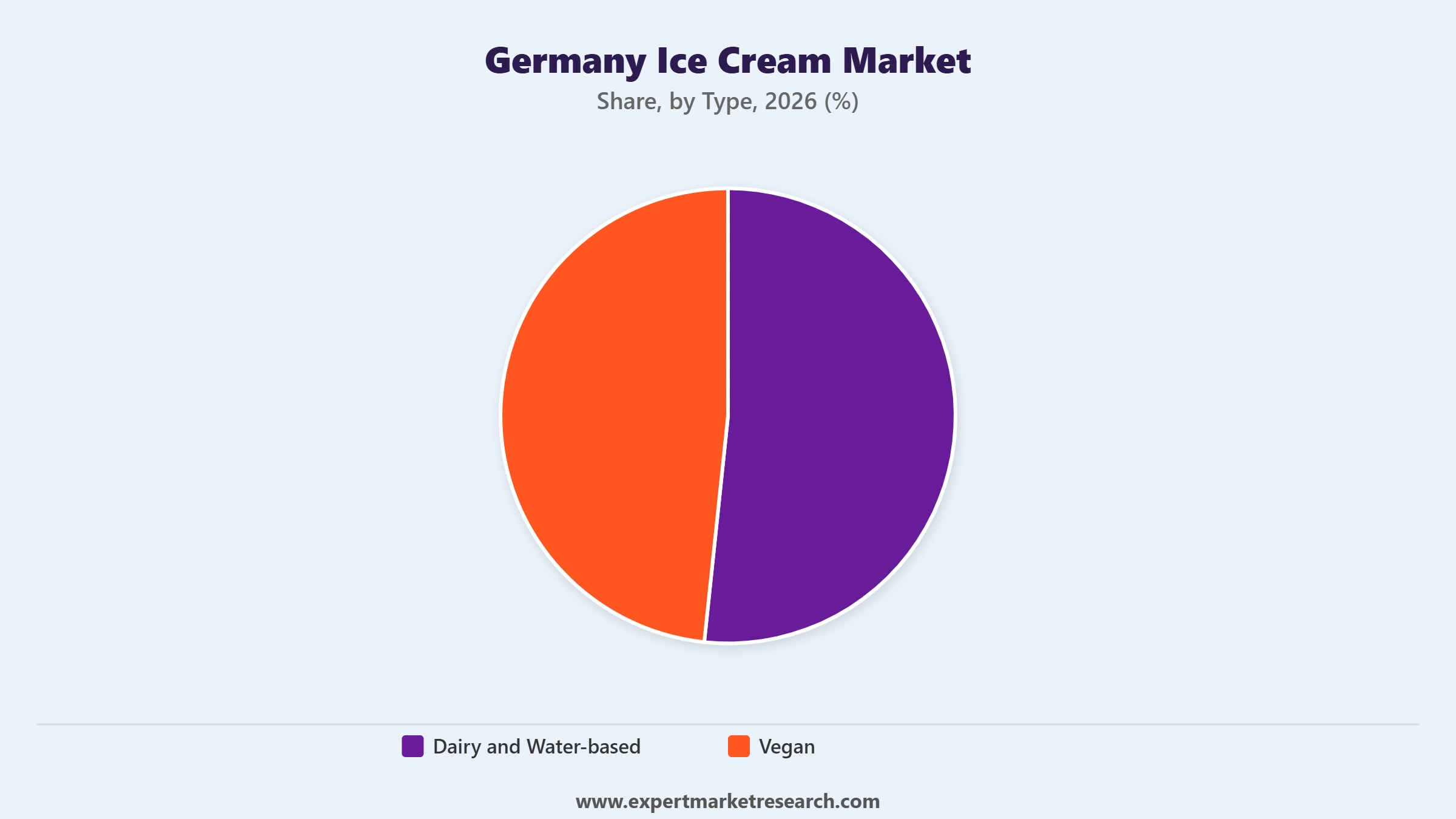
Key Insight: The Germany ice cream market includes Dairy and Water-based products and Vegan products. Dairy and water-based products continue to form the industrial foundation of the category because Germany has a mature dairy-processing infrastructure and large-scale frozen-dessert manufacturing base. At the same time, vegan formulations are becoming increasingly commercially viable as plant-based products move toward price parity with conventional alternatives. ProVeg's 2025 research found that plant-based alternatives were already 5% cheaper than animal-based alternatives across its measured basket, while four in ten Germans regularly choose plant-based options. This creates a stronger business case for manufacturers to develop vegan ice cream for mainstream retail rather than limiting it to specialist consumers.
Market Breakup by Flavour
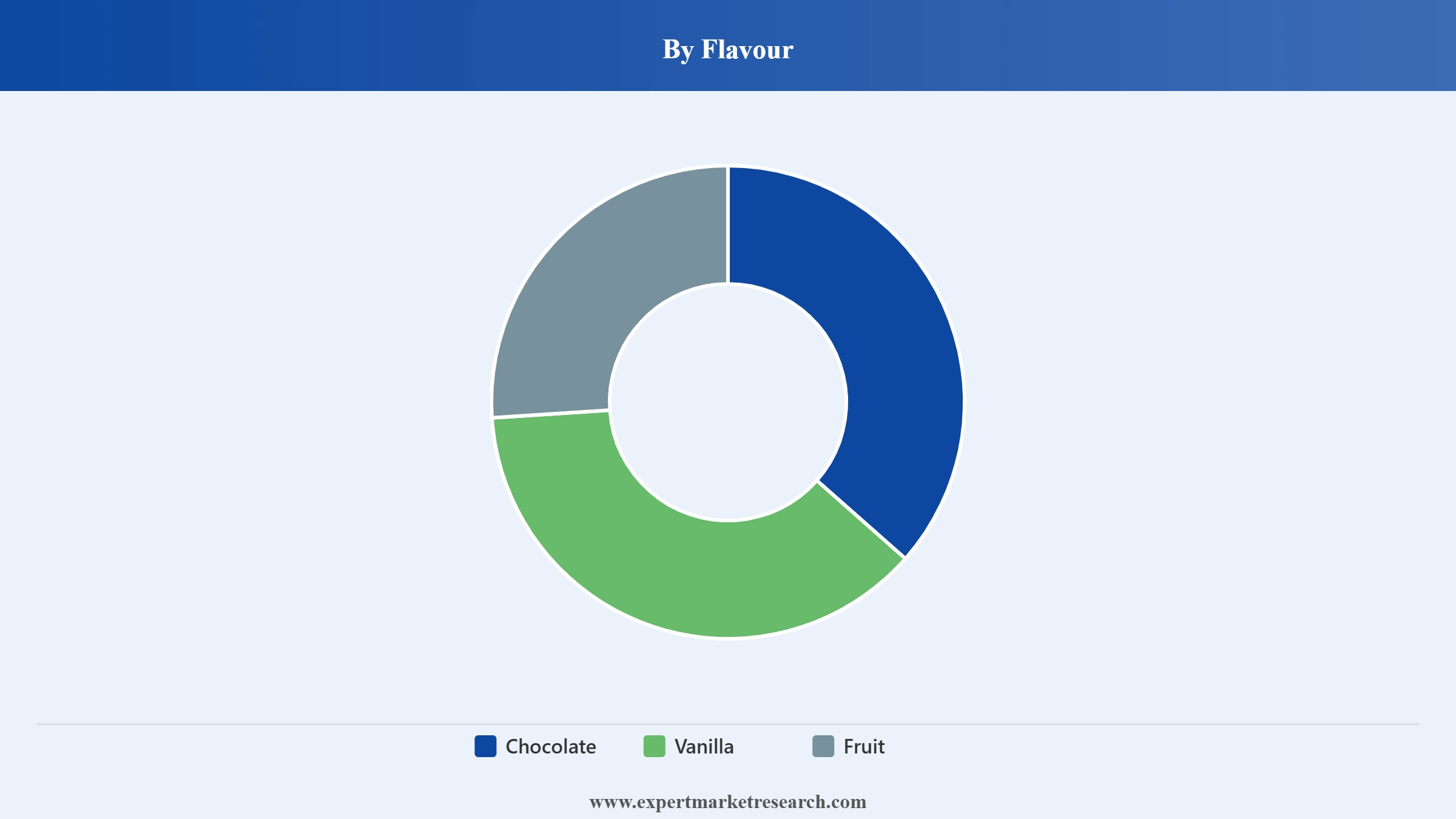
Key Insight: Flavor competition in Germany combines established profiles with premium and international experimentation. BDSI identifies vanilla, chocolate, nut, and stracciatella as longstanding consumer favorites, followed by cherry and strawberry. The persistence of these flavors provides manufacturers with dependable platforms for large-scale production, while more experimental combinations create opportunities for premium positioning. For industrial suppliers, the commercial opportunity lies in developing a modular flavor system in which familiar bases can be combined with sauces, inclusions, coatings, fruit preparations, or seasonal ingredients. This enables manufacturers to extend a proven base into multiple SKUs while reducing the complexity associated with entirely new formulations, thus driving the demand in the Germany ice cream market.
Market Breakup by Distribution Channel
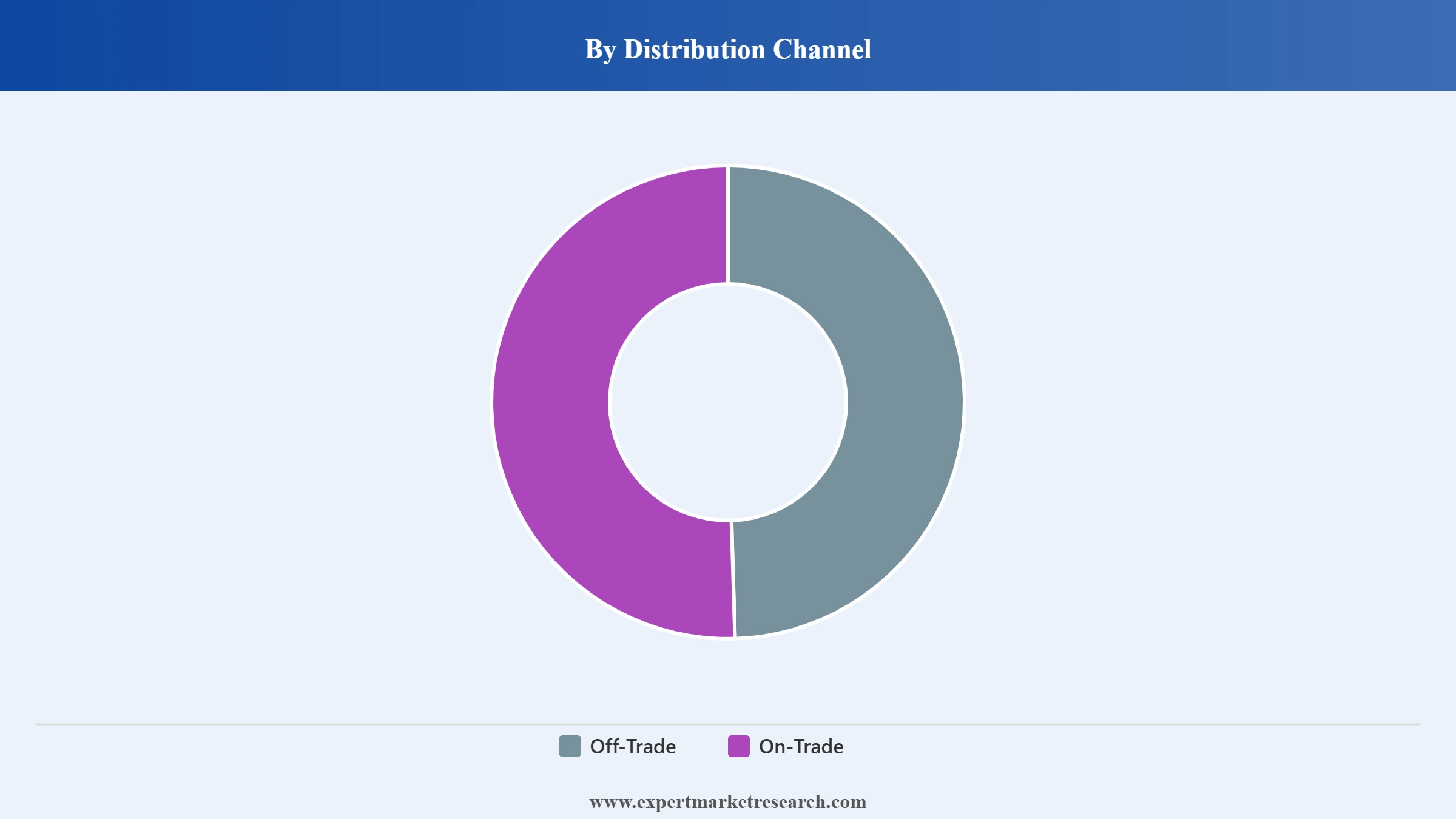
Key Insight: The distribution landscape consists of Off-Trade, including supermarkets and hypermarkets, convenience stores, online retail, and other channels, alongside On-Trade outlets. Off-trade channels benefit from Germany's extensive frozen-food infrastructure and the ability of retailers to offer branded, private-label, multipack, and household formats in one location. Online retail is developing additional relevance as German internet and mail-order sales expanded by 10.8% in nominal terms during January-November 2025. For manufacturers, channel-specific pack sizes and delivery-resistant packaging can support differentiated strategies across physical and digital retail.
Market Breakup by Region
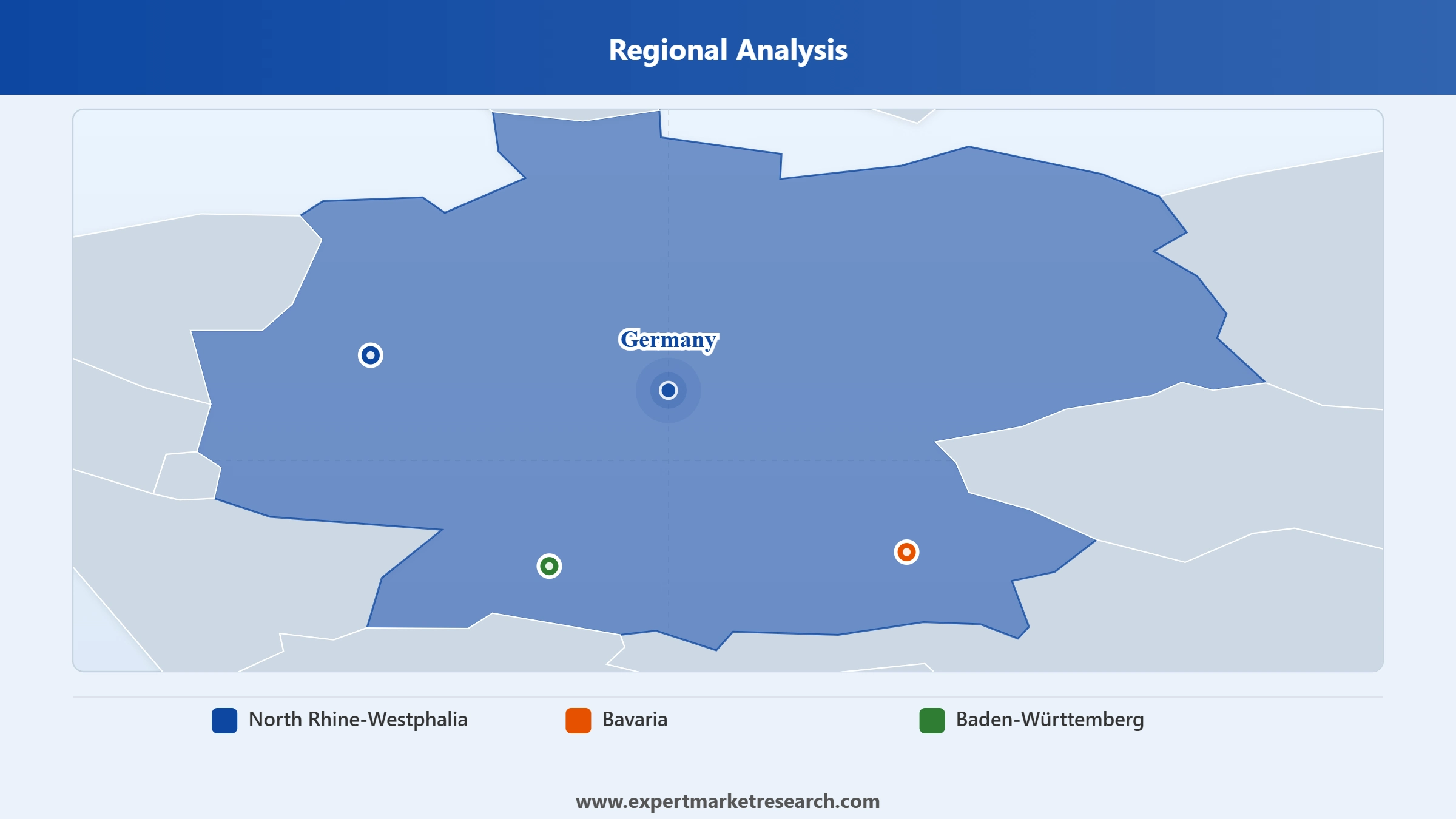
Key Insight: Among the covered regions, North Rhine-Westphalia, Bavaria, and Baden-Württemberg provide three substantial demand and distribution centers. North Rhine-Westphalia has the largest population of the three, while Bavaria combines a large consumer base with the strongest 2025 net migration balance among these regions. Baden-Württemberg offers another sizeable industrial and consumer market with a comparatively high foreign-population share. For ice cream manufacturers, regional strategy should therefore combine population scale with retail density, tourism, foodservice activity, manufacturing clusters, and demographic diversity rather than applying one national assortment uniformly across all territories.
Read more about this report - REQUEST FREE SAMPLE COPY IN PDF
Cups and tubs are positioned as the dominant product format because household packs provide manufacturers with greater scope for premium formulations, family consumption, and multipurpose dessert applications. The BDSI identifies household packs as classic ice cream containers of 300 ml or more, reinforcing their established role in the German freezer category. The format also supports high-value inclusions, sauces, layered recipes, and branded collaborations. The expansion of Ben & Jerry's pint production in Heppenheim in 2026 further demonstrates continuing investment in packaged take-home formats for European demand. Such developments will thus boost Germany ice cream market trends in the long run.
Read more about this report - REQUEST FREE SAMPLE COPY IN PDF
Bars and pops are positioned for rapid expansion because they combine single-serve convenience with strong opportunities for premium coatings, fillings, and visual differentiation. Froneri's 2026 Lotus Biscoff stick format demonstrates how the category is evolving beyond conventional frozen bars through layered textures and branded inclusions. The format is particularly suited to convenience retail, impulse merchandising, and multipacks. Its relatively compact structure also allows manufacturers to create multiple price points from one product platform, supporting retailer segmentation and seasonal launches while maintaining recognizable brand architecture across channels.
Dairy and water-based products remain the dominant type because the category is supported by established industrial manufacturing, broad consumer familiarity, and extensive freezer infrastructure. BDSI reports that industrially manufactured ice cream represents more than 80% of Germany's overall ice cream market, covering impulse, multipack, household, and foodservice applications. This manufacturing depth provides dairy-based producers with advantages in procurement, processing, product development, and distribution. Water-based products also broaden the category beyond traditional dairy recipes, particularly for fruit-oriented and refreshing formats.
Read more about this report - REQUEST FREE SAMPLE COPY IN PDF
Vegan ice cream has considerable expansion potential as plant-based products become more accessible in German retail. ProVeg's 2025 research found plant-based products were 5% cheaper than comparable animal-based alternatives, while overall plant-based availability across assessed German retailers reached 75%. Kaufland and REWE recorded the highest availability at 94%, creating extensive retail access for manufacturers capable of meeting mainstream formulation, price, and supply requirements. This environment supports new vegan ice cream launches across tubs, bars, and water-based products rather than confining them to specialist stores.
Vanilla remains the leading flavor owing to its broad application across take-home ice cream, impulse formats, desserts, toppings, and mix-in products. BDSI also identifies vanilla among Germany's longstanding favorite flavors, demonstrating its established consumer recognition. Germany produced approximately 607.7 million litres of ice cream in 2025, according to Destatis, highlighting the substantial production base serving diverse flavour applications. From a B2B perspective, vanilla offers manufacturers considerable formulation flexibility because it can operate as a standalone flavor or as a neutral base for sauces, fruit, chocolate inclusions, and bakery components. This versatility supports both branded and private-label product development, thereby shaping the demand in the Germany ice cream market.
Read more about this report - REQUEST FREE SAMPLE COPY IN PDF
Fruit flavors are positioned for faster development as manufacturers increasingly use fruit preparations to differentiate refreshing and water-based products. Froneri's Pirulo portfolio, for example, emphasizes fruit juices, fruit purees, and natural flavors, with many products suitable for vegan consumers. Its 2026 Fruit Explosion launch adds a liquid sauce center, demonstrating how fruit profiles can be combined with textural features to create more differentiated products. Such concepts provide manufacturers with opportunities to combine fruit flavors with portion control, playful positioning, and seasonal merchandising.
Supermarkets and hypermarkets represent the dominant distribution segment because they combine high shopper traffic with dedicated frozen-food infrastructure and broad SKU coverage. German industrial ice cream is sold through supermarkets alongside restaurants and kiosks, while BDSI's classification shows the category spans household packs, multipacks, and impulse products. This makes large-format grocery retail particularly important for manufacturers seeking simultaneous exposure across multiple consumption occasions. The channel also offers private-label opportunities, promotional freezer space, seasonal displays, and premium branded ranges within the same purchasing environment.
Read more about this report - REQUEST FREE SAMPLE COPY IN PDF
Online retail is the fastest-developing distribution opportunity because Germany's wider internet and mail-order retail segment recorded 10.8% nominal growth during January-November 2025. Frozen desserts require specialized fulfillment, but improvements in insulated packaging and local delivery networks can help manufacturers address this constraint. Online channels also allow brands to sell multipacks, mixed flavor boxes, premium bundles, and limited editions without depending entirely on physical freezer facings. For B2B suppliers, this creates opportunities for packaging systems specifically engineered for short-duration temperature-controlled delivery.
North Rhine-Westphalia represents the largest addressable market among the regions covered in the report, with 17.99 million residents at the end of 2025. Its population base provides manufacturers with considerable scope for supermarket, convenience, foodservice, and impulse distribution. Bavaria followed with 13.25 million residents, while Baden-Württemberg recorded 11.24 million. The three states together therefore provide a substantial concentration of Germany's consumer demand, thereby directly boosting the Germany ice cream market regional growth.
Read more about this report - REQUEST FREE SAMPLE COPY IN PDF
Bavaria provides an important emerging opportunity because its 2025 net migration balance of 31,036 exceeded the corresponding balances in North Rhine-Westphalia and Baden-Württemberg. Baden-Württemberg also remains commercially relevant, with more than 11.2 million residents and a foreign-population share of 18.2%, supporting a diverse consumer environment. Manufacturers can use differentiated regional portfolios: high-volume mainstream products in North Rhine-Westphalia, premium and tourism-oriented concepts in Bavaria, and multicultural and premium assortments in Baden-Württemberg.
Leading Germany ice cream market players are primarily aiming to broaden premiumisation, strengthen brand differentiation, and respond to evolving consumer preferences. Companies are expanding portfolios with indulgent flavours, higher-quality ingredients, portion-controlled formats and innovative textures, while also increasing the availability of plant-based, reduced-sugar and other alternative formulations. Established brands are using limited-edition launches and collaborations to maintain consumer interest and generate incremental demand. At the same time, manufacturers are strengthening relationships with supermarkets, discounters, convenience retailers and foodservice operators to improve product availability. Private-label manufacturing also remains important, particularly for companies supplying retailers with customised products.
Germany ice cream companies are seeking to optimise cold-chain distribution, manufacturing costs and packaging while responding to sustainability expectations. Digital marketing, social-media engagement and seasonal campaigns are being used to reach younger consumers and encourage trial. Overall, market participants are balancing premium product development with affordability, broad distribution and sustainable production to maintain competitiveness in Germany.
Established in 1929, Unilever Plc is headquartered in London, United Kingdom. Historically, its German ice cream portfolio included well-known brands such as Langnese, Magnum, Ben & Jerry’s and Cornetto, covering impulse products, tubs and premium offerings. However, following the completion of the ice cream demerger in December 2025, these brands moved into The Magnum Ice Cream Company. Therefore, for a current Germany ice cream market assessment, Unilever should be treated primarily as the former parent company rather than the current owner of these ice cream offerings.
Established in 1856 through its predecessor businesses and headquartered in Minneapolis, Minnesota, United States, General Mills operates a major premium ice cream business through Häagen-Dazs. In Germany, the brand offers premium ice cream in formats including pints, Mini Cups and Selection Packs, with flavours such as Cookies & Cream, Mango & Raspberry and Macadamia Nut Brittle. General Mills has marketed Häagen-Dazs in Germany since 1987, while the company has held the brand rights outside the United States and Canada since 2002.
Established in 2011 through the merger of Humana and NORDMILCH, DMK Deutsches Milchkontor is headquartered in Zeven, Germany. Its wholly owned DMK Ice Cream business develops and manufactures ice cream for food retailers, co-branding partners and home-delivery services. Its portfolio includes diverse ice cream creations, private-label products and customer-specific formulations, covering formats such as stick ice cream and other frozen desserts. DMK Ice Cream has more than 60 years of ice cream-making experience, supporting its position in Germany’s domestic ice cream supply chain.
Froneri was established in 2016 as a joint venture between Nestlé and R&R Ice Cream, with its headquarters in Leeming Bar, North Yorkshire, United Kingdom. In Germany, its portfolio includes Schöller, Mövenpick, Nuii, Pirulo, Milka, Oreo and Daim ice cream products, alongside private-label offerings. The company’s German heritage extends to Schöller, founded in 1937, while Froneri introduced Nuii in 2019. Its German operations were consolidated under the “One-Germany” structure in 2023.
Other key players in the Germany ice cream market include Gelato Classico - Die Eismanufaktur GmbH, and Süd-Eis GmbH & Co KG, among others.
*Please note that this is only a partial list; the complete list of key players is available in the full report. Additionally, the list of key players can be customized to better suit your needs.*
Access the latest Germany Ice Cream Market trends 2026 and gain a detailed understanding of market size, competitive developments, product opportunities, regional dynamics, and emerging demand patterns. Request a sample of the Germany Ice Cream Market forecast 2026-2035 to evaluate segment-level insights and identify commercially relevant opportunities across Germany's evolving ice cream industry.
United Kingdom Ice Cream Market


Upto 15% Off
USD
$2499 $2249
$3999 $3599
$4999 $4249
$5999 $5099


*While we strive to always give you current and accurate information, the numbers depicted on the website are indicative and may differ from the actual numbers in the main report. At Expert Market Research, we aim to bring you the latest insights and trends in the market. Using our analyses and forecasts, stakeholders can understand the market dynamics, navigate challenges, and capitalize on opportunities to make data-driven strategic decisions.*
In 2025, the market reached an approximate value of USD 3.39 Billion.
The market is projected to grow at a CAGR of 3.70% between 2026 and 2035.
The market is estimated to witness a healthy growth during 2026-2035 to reach around USD 4.88 Billion by 2035.
Key strategies include premium product launches, seasonal and limited-edition flavours, healthier formulations with reduced sugar, plant-based alternatives, sustainable packaging, digital marketing, retail partnerships, private-label expansion, product innovation, and targeted foodservice distribution to capture changing consumer preferences and strengthen brand differentiation.
The key trends aiding the market include the rising trend of small-size cups or small bars, the trend of customisation and personalisation, and rising demand for seasonal flavours.
Regions considered in the market are North Rhine-Westphalia, Bavaria, and Baden-Württemberg.
Based on product type, market segmentations include bars and pops and cups and tubs, among others.
Various flavours are chocolate, vanilla, and fruit, among others.
Key players in the market are Unilever Plc, General Mills, Inc., DMK Deutsches Milchkontor GmbH, Froneri International Limited, Gelato Classico - Die Eismanufaktur GmbH, and Süd-Eis GmbH & Co KG, among others.
Key challenges in the Germany ice cream market include rising dairy, sugar and energy costs, price-sensitive consumers, stringent food safety and labelling requirements, seasonal demand fluctuations, cold-chain expenses, intense private-label competition, and growing pressure to offer healthier, sustainable, and environmentally responsible products.
Explore our key highlights of the report and gain a concise overview of key findings, trends, and actionable insights that will empower your strategic decisions.
| REPORT FEATURES | DETAILS |
| Base Year | 2025 |
| Historical Period | 2019-2025 |
| Forecast Period | 2026-2035 |
| Scope of the Report |
Historical and Forecast Trends, Industry Drivers and Constraints, Historical and Forecast Market Analysis by Segment:
|
| Breakup by Product Type |
|
| Breakup by Type |
|
| Breakup by Flavour |
|
| Breakup by Distribution Channel |
|
| Breakup by Region |
|
| Market Dynamics |
|
| Competitive Landscape |
|
| Companies Covered |
|
Datasheet
One User
USD 2,499
USD 2,249
tax inclusive*
Single User License
One User
USD 3,999
USD 3,599
tax inclusive*
Five User License
Five User
USD 4,999
USD 4,249
tax inclusive*
Corporate License
Unlimited Users
USD 5,999
USD 5,099
tax inclusive*
*Please note that the prices mentioned below are starting prices for each bundle type. Kindly contact our team for further details.*
Flash Bundle
Small Business Bundle
Growth Bundle
Enterprise Bundle
*Please note that the prices mentioned below are starting prices for each bundle type. Kindly contact our team for further details.*
Flash Bundle
Number of Reports: 3
20%
tax inclusive*
Small Business Bundle
Number of Reports: 5
25%
tax inclusive*
Growth Bundle
Number of Reports: 8
30%
tax inclusive*
Enterprise Bundle
Number of Reports: 10
35%
tax inclusive*
How To Order

Select License Type
Choose the right license for your needs and access rights.

Click on ‘Buy Now’
Add the report to your cart with one click and proceed to register.

Select Mode of Payment
Choose a payment option for a secure checkout. You will be redirected accordingly.
Strategic Solutions for Informed Decision-Making
Gain insights to stay ahead and seize opportunities.

Get insights & trends for a competitive edge.

Track prices with detailed trend reports.

Analyse trade data for supply chain insights.

Leverage cost reports for smart savings

Enhance supply chain with partnerships.

Connect For More Information
Our expert team of analysts will offer full support and resolve any queries regarding the report, before and after the purchase.
Our expert team of analysts will offer full support and resolve any queries regarding the report, before and after the purchase.
We employ meticulous research methods, blending advanced analytics and expert insights to deliver accurate, actionable industry intelligence, staying ahead of competitors.
Our skilled analysts offer unparalleled competitive advantage with detailed insights on current and emerging markets, ensuring your strategic edge.
We offer an in-depth yet simplified presentation of industry insights and analysis to meet your specific requirements effectively.




