

Consumer Insights
Uncover trends and behaviors shaping consumer choices today
Procurement Insights
Optimize your sourcing strategy with key market data
Industry Stats
Stay ahead with the latest trends and market analysis.
The India vegetable oil market was estimated to reach a volume of 38.31 MMT in 2025. The market is expected to grow at a CAGR of 14.30% during the forecast period of 2026-2035 to reach a volume of 145.81 MMT by 2035. Expanding usage of vegetable oils in nutraceutical formulations drives demand growth, reflecting health-focused consumption and offering manufacturers opportunities to diversify portfolio into high-value fortified oil categories.
The market is largely driven by rising domestic demand coupled with shifting consumption preferences. A major trend reshaping the sector is the surge in soybean oil utilization, supported by India’s push for reducing import dependence. According to the India vegetable oil market analysis, the country imported over 16.5 million tons of vegetable oil in 2023, making it one of the largest global buyers. Government programs like the National Mission on Edible Oils – Oil Palm (NMEO-OP), launched with a budget of nearly INR 11,000 crore, in August 2021, are signaling policy-level intent to increase local production capacities and strengthen supply resilience.
Another critical development is the growing industrial application of vegetable oils across processed food, cosmetics, and nutraceutical industries. The evolving India vegetable oil market dynamics reflects both rising per capita consumption and expansion into non-food applications. The government’s blending program for biofuels is further reshaping the demand profile, particularly palm and rice bran oil, that find increasing integration into sustainable energy.
Compound Annual Growth Rate
14.3%
Value in MMT
2026-2035
To improve transparency and control, the Indian government announced a new framework for the edible oil sector that places more stringent registration and reporting requirements on producers. The new regulatory framework enhances supply chain transparency, pushing refiners and producers toward compliance-driven operations and improving investor confidence in the India vegetable oil market.
KRBL announced plans to introduce a new line of edible oils under a different brand name. KRBL’s entry into edible oils diversifies competition, signaling portfolio expansion strategies that strengthen domestic supply and create new B2B partnerships in retail and processing.
In keeping with its larger plan to increase its presence lower down the value chain, Louis Dreyfus Company (LDC), a prominent international merchant and processor of agricultural products, announced the relaunch of Vibhor, its consumer-facing edible oil brand in India. This development reflects global players’ deeper push into India’s downstream consumer oil segment, intensifying branding battles with established domestic companies.
A retail bag of refined cottonseed oil with a fixed price of Rs 100 was introduced by Gujarat Cooperative Milk Marketing Federation Ltd. (GCMMF), a prominent cooperative that sells edible oils. This India vegetable oil market development underscores cooperative-led affordability initiatives, reshaping competitive pricing strategies.
India’s heavy reliance on imports has pushed policymakers toward self-reliance initiatives. The NMEO-OP targets expanding oil palm cultivation to 10 lakh hectares by 2025-2026. This is critical, as palm oil alone accounts for nearly 60% of total edible oil imports. By scaling domestic cultivation, India expects to reduce annual import bills. Investments are being funneled into Andhra Pradesh, Telangana, and Northeast regions where climatic suitability exists. Such government-backed projects are enabling supply diversification, reducing vulnerability to global trade disruptions, and strengthening domestic oil seed processing industries, accelerating further growth in the India vegetable oil market. For B2B stakeholders, this translates into new investment opportunities across agritech, contract farming, and refining capacities.
Consumer health awareness is spurring demand for sunflower, rice bran, and mustard oil, perceived as healthier alternatives due to their unsaturated fat profile. Leading companies are now focusing on fortifying oils with vitamins A and D, aligning with Food Safety and Standards Authority of India (FSSAI) mandates. Companies like Adani Wilmar and Cargill have diversified into premium blends, targeting urban wellness-conscious buyers, propelling the India vegetable oil market expansion. For B2B players in food retail and processing, these preferences create opportunities for co-branding, differentiated product lines, and partnerships with nutraceutical companies.
India’s ethanol blending program and exploration of biodiesel have unlocked opportunities for vegetable oil application in energy transition. In May 2021, the Ministry of Petroleum announced steps to evaluate used cooking oil (UCO) and palm oil derivatives as biofuel feedstock. The Ministry of Oil, Petroleum, and Natural Gas established suggested blending targets of 1% by 2027 and 2% by 2028 on November 25, 2023. According to the India vegetable oil market analysis, this would necessitate around 100 million liters of biojet fuel annually, which would probably originate from vegetable oils or residue produced on marginal land. This shift is drawing interest from both energy companies and oil refiners, who see diversification potential beyond traditional food applications.
Modernization of refining facilities has become a critical trend, ensuring efficiency and compliance with global safety standards. Several Indian refiners are adopting continuous degumming and enzymatic interesterification technologies that enhance yields while lowering environmental impact. Packaging innovations such as biodegradable pouches are also gaining traction. Such upgrades align with sustainability targets and consumer preference for eco-friendly packaging, propelling demand in the India vegetable oil market.
Though India is a net importer, export potential in niche vegetable oils is increasing. Mustard oil, for instance, has seen rising exports to Bangladesh and the Middle East, driven by ethnic consumption. As per mustard oil export data from India, India exported 4,885,437 metric tons of mustard oil worth INR 15,370 crore in 2023–2024. Rice bran oil, recognized for its cholesterol-lowering properties, is increasingly exported to Japan and Southeast Asia. This growing outbound trade, aided by trade agreements, gives Indian processors a chance to tap into premium categories.
Read more about this report - REQUEST FREE SAMPLE COPY IN PDF
The EMR’s report titled “India Vegetable Oil Market Report and Forecast 2026-2035” offers a detailed analysis of the market based on the following segments:
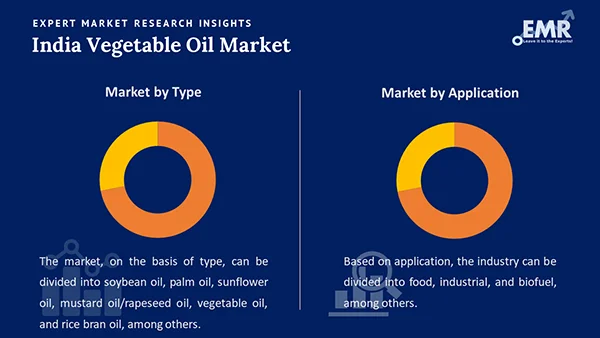
Market Breakup by Type
Key Insight: The vegetable oil market in India remains categorized across soybean, palm, sunflower, mustard, rice bran, and others. Soybean oil retains leadership owing to reliable domestic output. Palm oil is expanding its market share rapidly due to import reliance and policy-backed cultivation. Sunflower and mustard oil command preference for health-conscious demographics, while rice bran oil exoeriences niche positioning in nutraceuticals and biofuel. Other oils, including blends, serve regional consumption needs.
Market Breakup by Application
Key Insight: Across all applications, food maintains dominance in the India vegetable oil market due to consistent household and industrial consumption. Biofuel, on the other hand, is gaining momentum as India enforces green energy mandates. Industrial applications including lubricants and cosmetics create niche demand channels, while other applications such as pharmaceutical formulations highlight diversification opportunities.
Market Breakup by Region
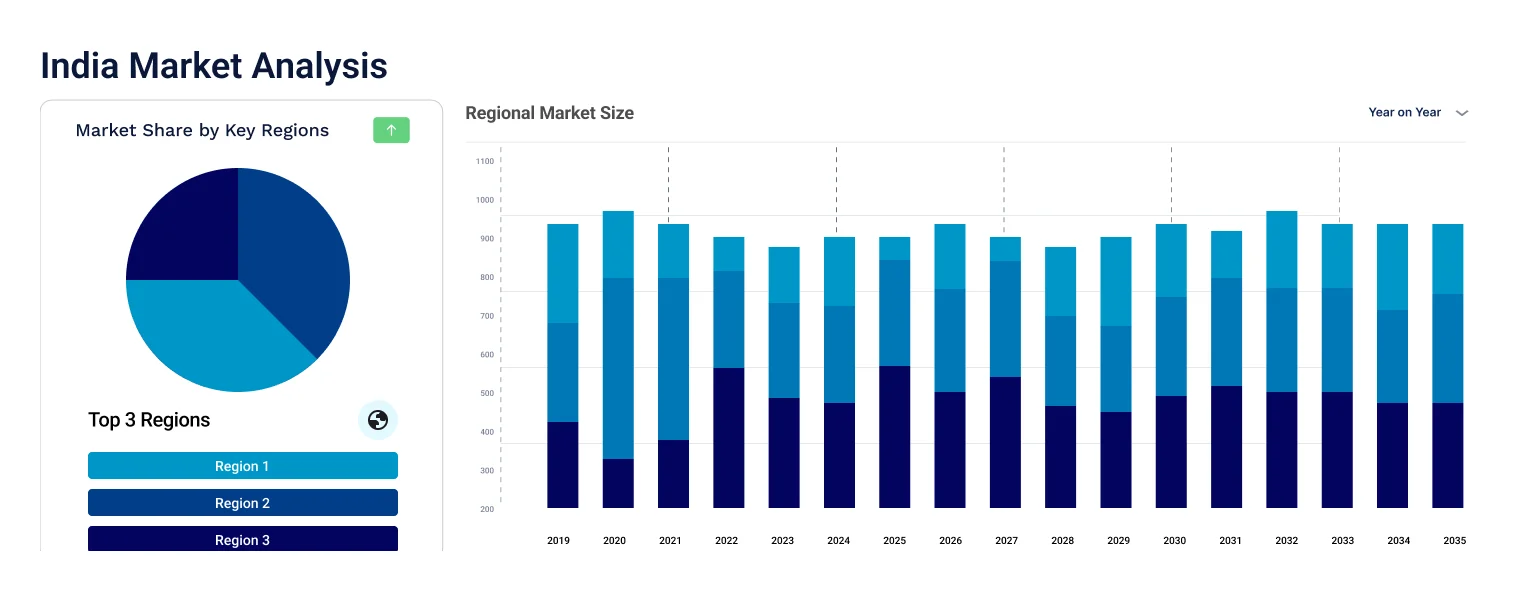
Key Insight: In North India, mustard oil holds dominance due to cultural loyalty and regional rapeseed cultivation. East India is emerging as a hub for rice bran oil, driven by abundant paddy milling and health-oriented positioning. West India relies heavily on soybean oil, supported by strong oilseed production and established refining clusters. South India leans toward palm oil, aided by plantation suitability and proximity to refining ports. All these regional trends in the India vegetable oil market highlight diverse consumption behaviors, raw material linkages, and market opportunities tailored to local strengths.
Read more about this report - REQUEST FREE SAMPLE COPY IN PDF
By type, soybean oil dominates the market due to domestic production strength
Soybean oil has emerged as the most dominant category, owing to steady domestic cultivation and consistent supply chain integration. India produces more than 12 million tons of soybean annually, supporting edible oil extraction at scale. The growing demand from both urban and semi-urban households makes soybean oil a household staple. Furthermore, government-backed initiatives to improve oilseed yields through improved seed varieties ensure stable growth in the India vegetable oil market revenue.
Palm oil is witnessing accelerated growth, fueled by India’s NMEO-OP program and its heavy import dependence. Despite being the largest import category, government subsidies to promote local cultivation are boosting supply resilience. Palm oil’s versatility across food manufacturing, bakery, and industrial applications further propels demand. In 2024, imports of palm oil exceeded 9 million tons, reflecting its integral role in India’s edible oil industry.
By application, food sector commands the largest share due to everyday consumption
Food remains the largest application category, anchored in India’s rising per capita edible oil consumption, which crossed 17 kg in 2017. With household cooking, restaurant chains, and packaged food industries driving demand, oils like soybeans and sunflowers continue to dominate volumes. Expansion of quick-service restaurants (QSRs) and urban processed food culture is further accelerating vegetable oil consumption in India. Government schemes to mandate fortified edible oils for tackling malnutrition are also reinforcing demand.
Biofuel has emerged as the fastest-growing application, aligning with India’s green energy ambitions. The government’s plan to achieve 20% ethanol blending by 2025 has indirectly increased interest in vegetable oils like palm, rice bran, and UCO for biodiesel production. While food-grade oils dominate consumption, industrial players are increasingly channeling investments into biofuel-linked refining capacities. In May 2021, Indian Oil Corporation announced plans to set up facilities for converting UCO into biodiesel, highlighting this trend. For B2B stakeholders, biofuel application is not merely a diversification avenue but also a sustainable business model aligned with national energy transition goals.
North India leads in consumption due to a strong culinary preference for mustard oil
Mustard oil remains the dominant edible oil in North India, where traditional diets and widespread rapeseed cultivation anchor its consumption. Rajasthan, Uttar Pradesh, and Haryana form the pillar of supply chains, supported by agro-climatic suitability. The oil’s cultural significance in cooking and medicinal uses sustains steady household demand, while bulk buyers in foodservice prefer it for its pungent flavor and frying stability. Farmers benefit from organized procurement through cooperatives, ensuring raw material availability for refiners.
The East India vegetable oil market is benefiting from its close link with paddy processing clusters. States like West Bengal and Odisha have an abundance of rice mills, ensuring continuous bran availability for oil extraction. Its reputation as a heart-friendly oil with functional health benefits makes it attractive for packaged food manufacturers and urban households. Refiners are increasingly catering to institutional buyers who seek fortified oils for mass catering.
The competitive landscape in the market is intensifying as legacy refiners, multinationals and agile startups are competing on cost efficiency, product differentiation and sustainability credentials. Key focus areas of the India vegetable oil market players include upgrading refining tech to improve yields and energy efficiency, vertical integration from seed to retail to secure margins, and launching fortified and premium SKUs targeting urban health-conscious consumers.
Unique opportunities are appearing in certified sustainable palm supply chains, co-manufacturing for nutraceuticals, UCO-based biodiesel projects and digital B2B marketplaces that connect bulk processors with institutional buyers seeking traceable ingredient lots. Equipment suppliers, cold-press solution providers and traceability-platform vendors are finding new B2B demand. For India vegetable oil companies, partnering across the value chain, investing in traceability and capturing premium fortified categories are the best strategies to convert scale into profitability while meeting regulatory and sustainability requirements.
Adani Wilmar Limited, established in 1999 and headquartered in Ahmedabad, is a leading edible oil and consumer goods conglomerate blending local sourcing with global refining expertise. The company is focusing on vertical integration, branded edible oil growth, port-adjacent refining and fortification programs, while piloting digital traceability for private-labels.
Ruchi Soya Industries Limited, founded in 1986 and headquartered in Mumbai, is one of India’s largest oilseed processors focusing on palm and soybean refining, specialty fats and branded edible oils. The company is modernizing refineries, expanding refinery-backed branded offerings and entering co-manufacturing for fortified oils.
Bunge Ltd., tracing roots to 1818 and now headquartered in the United States, is a global agribusiness leader in oilseed origination, processing and ingredients. The company supplies edible oil intermediates, specialty oils and bulk commodities to Indian refiners and food manufacturers, leveraging its global sourcing networks and advanced fractionation capabilities.
Marico Limited, founded in 1990 and headquartered in Mumbai, is a consumer goods company known for edible oils and health-focused brands like Saffola alongside personal care. In edible oils, Marico is emphasizing health positioning, premium blends, fortified products and HORECA partnerships. Its strategy includes ingredient innovation, co-packing for regional retailers and exporting niche branded oils.
*Please note that this is only a partial list; the complete list of key players is available in the full report. Additionally, the list of key players can be customized to better suit your needs.*
Other key players in the market are Cargill Incorporated, Patanjali Ayurved Limited, Emami Agrotech Ltd., and Mother Dairy Fruit & Vegetable Pvt. Ltd., among others.
Explore the latest trends shaping the India vegetable oil market 2026-2035 with our in-depth report. Gain strategic insights, future forecasts, and key market developments that can help you stay competitive. Download a free sample report or contact our team for customized consultation on India vegetable oil market trends 2026.


Upto 15% Off
USD
$2499 $2249
$3999 $3599
$4999 $4249
$5999 $5099


*While we strive to always give you current and accurate information, the numbers depicted on the website are indicative and may differ from the actual numbers in the main report. At Expert Market Research, we aim to bring you the latest insights and trends in the market. Using our analyses and forecasts, stakeholders can understand the market dynamics, navigate challenges, and capitalize on opportunities to make data-driven strategic decisions.*
In 2025, the India vegetable oil market reached an approximate volume of 38.31 MMT.
The market is projected to grow at a CAGR of 14.30% between 2026 and 2035.
The market is estimated to witness a healthy growth in the forecast period of 2026-2035 to reach about 145.81 MMT by 2035.
Stakeholders are adopting contract farming, investing in enzymatic refining, piloting traceability systems, co-developing fortified blends, forming biodiesel partnerships, and scaling cold-press premium lines to capture higher margins and diversifying channels.
The industry is expected to be aided by the growing demand for healthy vegetable oils, the growing adoption of sustainable production methods of oilseeds, and the increasing investments in sustainable production of vegetable oils.
The major regions in the industry in India are North India, West India, South India, and East India.
The major types of vegetable oil in the industry are soybean oil, palm oil, sunflower oil, mustard oil/rapeseed oil, vegetable oil, and rice bran oil, among others.
The significant applications in the market are food, industrial, and biofuel, among others.
The key players in the market include Adani Wilmar Limited, Ruchi Soya Industries Limited, Bunge Ltd., Marico Limited, Cargill Incorporated, Patanjali Ayurved Limited, Emami Agrotech Ltd., and Mother Dairy Fruit & Vegetable Pvt. Ltd., among others.
Companies are facing import dependence, raw-material price volatility, fragmented smallholder supplies, rising certification costs, logistics bottlenecks, regulatory compliance for fortification, and competition from low-cost imports and biofuel demand shifts.
Explore our key highlights of the report and gain a concise overview of key findings, trends, and actionable insights that will empower your strategic decisions.
| REPORT FEATURES | DETAILS |
| Base Year | 2025 |
| Historical Period | 2019-2025 |
| Forecast Period | 2026-2035 |
| Scope of the Report |
Historical and Forecast Trends, Industry Drivers and Constraints, Historical and Forecast Market Analysis by Segment:
|
| Breakup by Type |
|
| Breakup by Application |
|
| Breakup by Region |
|
| Market Dynamics |
|
| Competitive Landscape |
|
| Companies Covered |
|
| Report Price and Purchase Option | Explore our purchase options that are best suited to your resources and industry needs. |
| Delivery Format | Delivered as an attached PDF and Excel through email, with an option of receiving an editable PPT, according to the purchase option. |
Datasheet
One User
USD 2,499
USD 2,249
tax inclusive*
Single User License
One User
USD 3,999
USD 3,599
tax inclusive*
Five User License
Five User
USD 4,999
USD 4,249
tax inclusive*
Corporate License
Unlimited Users
USD 5,999
USD 5,099
tax inclusive*
*Please note that the prices mentioned below are starting prices for each bundle type. Kindly contact our team for further details.*
Flash Bundle
Small Business Bundle
Growth Bundle
Enterprise Bundle
*Please note that the prices mentioned below are starting prices for each bundle type. Kindly contact our team for further details.*
Flash Bundle
Number of Reports: 3
20%
tax inclusive*
Small Business Bundle
Number of Reports: 5
25%
tax inclusive*
Growth Bundle
Number of Reports: 8
30%
tax inclusive*
Enterprise Bundle
Number of Reports: 10
35%
tax inclusive*
How To Order

Select License Type
Choose the right license for your needs and access rights.

Click on ‘Buy Now’
Add the report to your cart with one click and proceed to register.

Select Mode of Payment
Choose a payment option for a secure checkout. You will be redirected accordingly.
Strategic Solutions for Informed Decision-Making
Gain insights to stay ahead and seize opportunities.

Get insights & trends for a competitive edge.

Track prices with detailed trend reports.

Analyse trade data for supply chain insights.

Leverage cost reports for smart savings

Enhance supply chain with partnerships.

Connect For More Information
Our expert team of analysts will offer full support and resolve any queries regarding the report, before and after the purchase.
Our expert team of analysts will offer full support and resolve any queries regarding the report, before and after the purchase.
We employ meticulous research methods, blending advanced analytics and expert insights to deliver accurate, actionable industry intelligence, staying ahead of competitors.
Our skilled analysts offer unparalleled competitive advantage with detailed insights on current and emerging markets, ensuring your strategic edge.
We offer an in-depth yet simplified presentation of industry insights and analysis to meet your specific requirements effectively.




