

Consumer Insights
Uncover trends and behaviors shaping consumer choices today
Procurement Insights
Optimize your sourcing strategy with key market data
Industry Stats
Stay ahead with the latest trends and market analysis.
The Latin America biochar market attained a value of USD 335.21 Million in 2025and is projected to expand at a CAGR of 12.60% through 2035. The market is further expected to achieve USD 1098.25 Million by 2035. Abundant agricultural residues, climate policies, carbon-removal demand, and sustainable farming initiatives are accelerating biochar adoption across Latin America.
The Latin America biochar market is emerging as an important component of the region’s agricultural decarbonization, circular-bioeconomy, and carbon-removal landscape. Biochar, produced primarily through the thermochemical conversion of agricultural and forestry residues, can improve soil quality, retain water and nutrients, and provide a pathway for durable carbon sequestration. The market is expected to expand rapidly as producers increasingly monetize both agricultural applications and carbon-removal credits.
The increasing production of biochar from coffee waste is fast becoming a potential driving force behind the Latin American biochar market. The company, NetZero, operates industrial biochar production plants from coffee waste sourced from the local farmers who are also provided with biochar to enrich their soils. The Lajinha project of the company involves more than 400 farmers involved in the production of coffee, whereas carbon removal credits offer an additional stream of income. Such a circular approach not only tackles waste problems but also helps improve soil fertility and productivity of the farmers, thus boosting the Latin America biochar market value.
Furthermore, there is great potential to produce biochar from bagasse and cane leaves due to the vast amounts of sugarcane produced by Brazil. NetZero announced in September 2025 the construction of a plant to produce biochar in Campina Verde, Minas Gerais, that will use sugarcane waste as feedstock. Not only will this approach solve a big problem related to waste disposal but also will produce biochar which can be used in agriculture and as a carbon sink. Such an approach might stimulate sugar mills to introduce pyrolysis technology in their business activities., thereby boosting the Latin America biochar market developments.
Compound Annual Growth Rate
12.6%
Value in USD Million
2026-2035
Read more about this report - REQUEST FREE SAMPLE COPY IN PDF
Embrapa Acre began evaluating coffee-processing residues, including coffee husks, as feedstock for biochar production and agricultural applications. The initiative aims to reduce dependence on costly chemical fertilizers while creating value from locally available biomass. This could support Latin America’s biochar market by establishing coffee residues as a scalable feedstock, encouraging decentralized production and creating new applications among coffee-growing communities, thereby leveraging trends in the Latin America biochar market.
A study published in Environmental Research Letters identified biochar as a significant opportunity for Brazil’s circular economy, agricultural productivity, carbon sequestration and residue management. The findings can help biochar market players identify high-potential feedstocks, target agricultural applications, and develop region-specific production models. Greater emphasis on R&D, supportive regulation and carbon-market integration could also improve investment conditions, enabling producers to scale capacity, strengthen partnerships with farmers and agro-industrial companies, and develop additional revenue streams from both biochar sales and carbon-removal credits.
Brazil’s MAPA published a proposed decree to implement the 2024 Bioinputs Law, as discussions on the regulatory framework continued throughout March. The proposal includes measures supporting research, innovation, commercialization, traceability, and expanded bioinput production. Greater regulatory clarity could help biochar producers seeking agricultural-input applications, reduce market-entry uncertainty, and encourage investment in bio-based soil amendments.
NetZero has entered into a joint venture with a Brazilian sugarcane producer called Atvos to develop a new biochar project based on sugarcane residues. This joint venture is indicative of increasing involvement of big agricultural companies in producing biochar and removing carbon through biomass waste. Such activities will help in the faster commercialization of biochar projects as well, thereby bolstering the Latin America biochar market revenues.
Producers of biochar are increasingly relying on both product sales and certified carbon removal credits, making their projects more economically viable and thus attracting institutional investments. Such a revenue-generating approach allows investment into commercial facilities, especially those located in areas with significant amounts of agricultural residue, thus boosting the Latin America biochar market dynamics and trends.
The country’s agriculture, biomass resources, and industries allow the development of commercial biochar facilities. Several large-scale plants and R&D centers are boosting the efficiency, flexibility, and stability of the process of production. The presence of technologies, infrastructure and specialists makes Brazil the main center for developing biochar technologies in the region.
Public funding, agricultural-input regulation and climate programmes are improving market certainty for biochar developers. Brazil’s cooperation programme with Embrapa supports research, policy development and agricultural adoption, while regulatory updates can clarify product classification and market-entry requirements. Greater institutional support is expected to facilitate procurement, investment approvals and integration into sustainable agriculture programmes, thereby boosting the trends in the Latin America biochars market.
Coffee husk, sugarcane bagasse, cocoa waste, coconut shells, forest waste and nut shells are becoming lucrative biochar feedstocks. Decentralized processing systems allow lower transportation costs and provide a means for biochar producers to sell their product back to nearby farmers. Such an approach facilitates efficient use of feedstocks, builds up rural supply chains and increases margins through integrated waste management and agricultural inputs.
Mexico’s agricultural residues, soil-restoration needs and climate-policy commitments create a strong foundation for biochar market development. Local pyrolysis activity demonstrates emerging technical capability, while the 2026-2030 climate programme supports broader decarbonisation and land-management objectives. Growing climate finance and demand for high-integrity removals could make Mexico a leading expansion market outside Brazil.
The Expert Market Research’s report titled “Latin America Biochar Market Report and Forecast 2026-2035” offers a detailed analysis of the market based on the following segments:
Market Breakup by Technology
Key Insight: In Latin America, pyrolysis is the emerging technology due to its efficiency in converting readily available agricultural and forest residues into biochar, producing useful co-products in the process. The gasification technology has been getting some attention from the agro-industrial operators who are looking for a dual biochar-energy model due to the syngas produced during the process. Other forms of technology, such as hydrothermal carbonization, may also be able to attract attention for wet biomass that needs drying before undergoing pyrolysis, thereby opening up new opportunities and boosting the growth of the Latin America biochar market.
Market Breakup by Application
Key Insight: Across Latin America, agriculture remains a key application as biochar is increasingly used to improve soil fertility, nutrient retention, moisture management and crop productivity, particularly in Brazil’s intensive farming systems. Animal farming is gaining particularly strong traction through livestock-feed additives and manure management, with applications targeting methane and ammonia reduction. Industrial uses are emerging in areas such as mining, metallurgy, filtration and construction, creating higher-value outlets beyond agriculture. Other applications, including water, air and soil remediation, are expanding as producers diversify biochar products for environmental-management uses and carbon-removal projects.
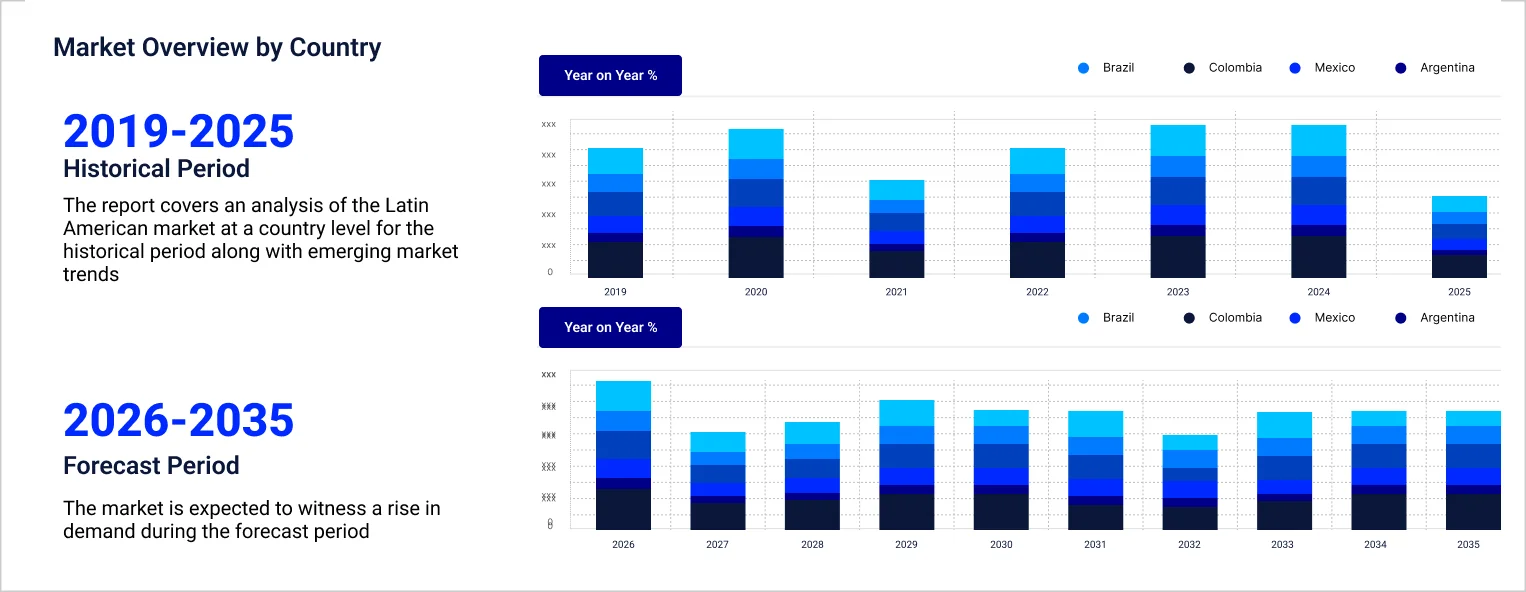
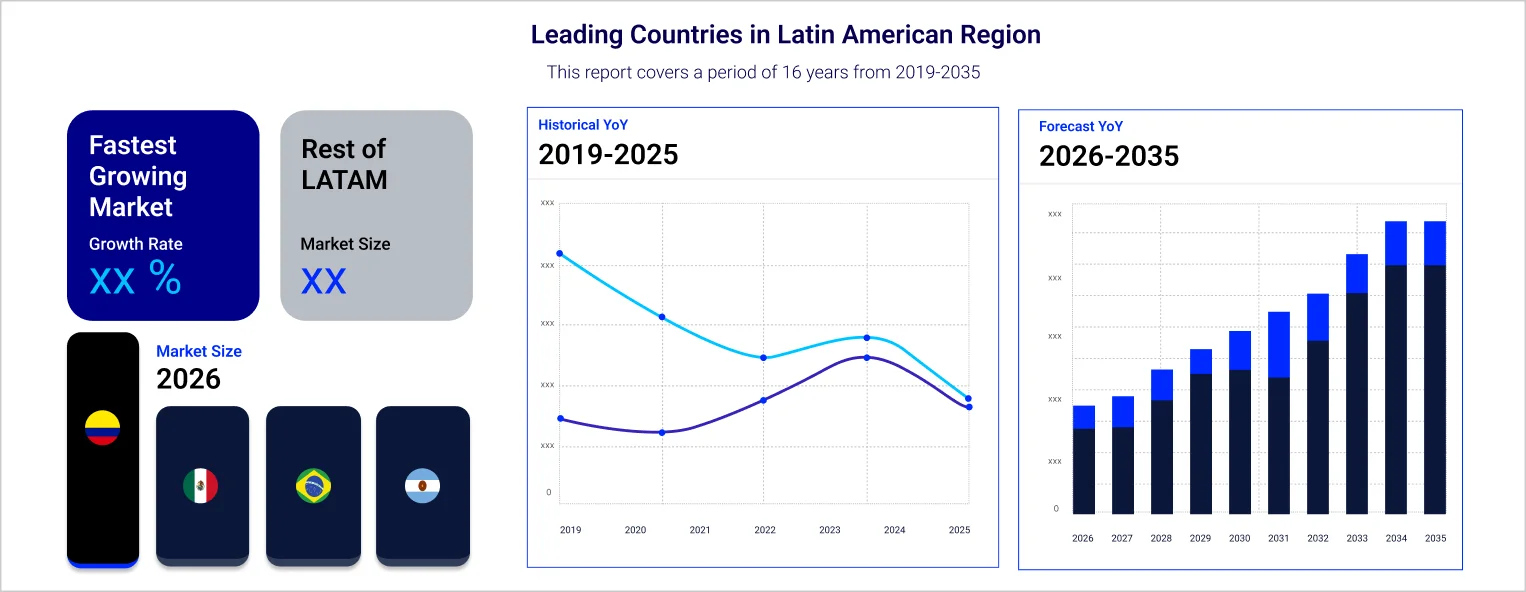
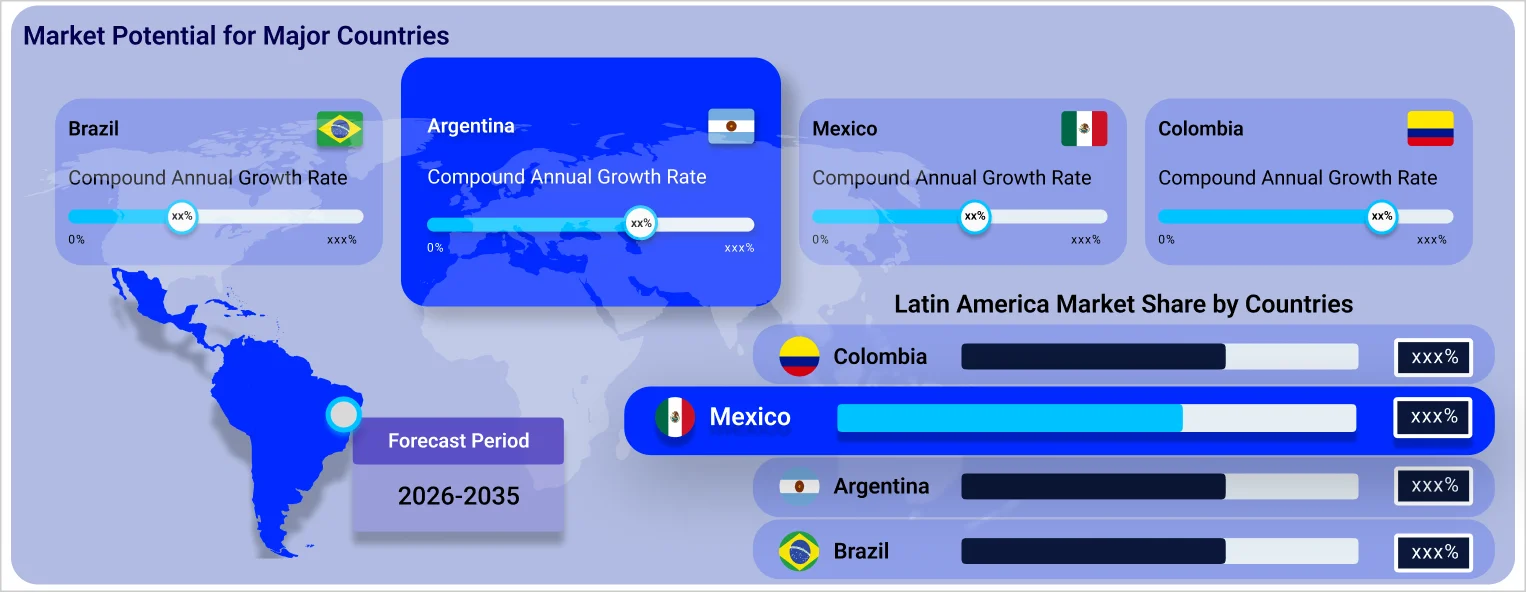
Market Breakup by Country
Key Insight: Brazil is the leading player in the Latin American biochar market, driven by the country’s extensive agriculture and forestry industry, large amount of waste material from sugarcane and coffee, biomass processing facilities, and increasing carbon removal activities. Mexico is becoming a rising player in the Latin American biochar market due to the efforts made by agricultural producers to use biochar as a soil amendment, for retaining nutrients and water, while the availability of significant crop residues is an added advantage. Argentina is another emerging market in this region, based on research activities for agricultural and soil improvement purposes.
By technology, pyrolysis is expected to remain the dominant and fastest-growing technology segment in the Latin America biochar market.
Pyrolysis converts agricultural and forest residue into stable biochar while generating heat, syngas and possibly bio-oil. The modularity of this system makes it appropriate for Latin America where agriculture is spread across multiple regions, making it possible for firms to build factories close to coffee, sugarcane, forestry, and nut processing plants. This will cut transportation costs of feedstocks as well as increase margins of the projects. Moreover, pyrolysis can enable producers to make profits not only from selling biochar but also from carbon removal credits and renewable energy, thus boosting the overall Latin America biochar market development.
Gasification can be useful for Latin American agro-industrial companies converting constant flows of biomass into energy and at the same time preserving a carbon-enriched solid fraction of products for use as soil enhancer or in industry. It can be used by sugar factories, forestry processors, food producers, and big farms to cut waste disposal expenses and increase energy independence. Gasification development will be dependent on demonstrating that the produced solid material corresponds to biochar specifications and can have carbon removal value.
By application, agriculture is expected to remain the largest application segment
Biochar can help Latin American farmers improve nutrient efficiency, water retention and soil structure while reducing dependence on costly external inputs. Manufacturers can boost demand by providing specialized formulations, application instructions and demonstration sites that show tangible yield or resilience gains. The use of carbon-removal credits for biochar sales can help reduce costs for farmers through shared income. Coffee, sugarcane, maize, soybean, horticulture and degraded-land reclamation present immense commercial potential. Local manufacturing further helps by establishing connections between agricultural waste suppliers and nearby consumers, and hence bolstering the Latin America biochar market revenues.
Manure management is an area where livestock farmers can employ biochar in order to reduce odors, nutrient losses and to create stable soil amendments. This creates large-scale access for biochar producers to the cattle, poultry and swine industries while solving waste management problems. Producers can create integrated solutions involving biochar, manure management and fertilizer products, generating recurring demands as opposed to individual sales. Regulatory approval and feedstock safety become critical, especially when it comes to feed applications. Brazil, Mexico and Argentina present good prospects since livestock and crop production are closely connected geographically.
Read more about this report - REQUEST FREE SAMPLE COPY IN PDF
Brazil is expected to remain the leading Latin American biochar market and register the region's highest growth rate through the forecast period.
Brazil’s extensive coffee, sugarcane, forestry, livestock and agricultural industries provide both abundant feedstocks and large end-use markets. Companies can scale faster by locating plants near concentrated residue streams and selling biochar back to surrounding farms. The country’s industrial infrastructure also supports larger facilities, technology development and carbon-credit certification. Public research programmes and evolving agricultural-input regulations can reduce market uncertainty. Brazil’s combination of feedstock availability, technical expertise and carbon-removal potential makes it the region’s most attractive base for producers seeking scale and international investment.
Mexico biochar market offers opportunities for decentralised biochar plants serving pecan, coffee, fruit, forestry and food-processing value chains. Companies can address soil degradation and water stress while converting residues that might otherwise be burned or discarded. Climate-policy implementation may improve access to public programmes and sustainability-linked finance. Local carbon-removal projects can also supply multinational companies seeking credible credits. Developers that combine farmer education, feedstock contracts and crop-specific products will be better positioned to build demand. Mexico’s manufacturing sector provides additional opportunities for industrial and engineered biochar applications.
The Latin America biochar market is transitioning from a fragmented collection of pilot projects toward a more commercialised competitive environment. Competition is centred on feedstock access, pyrolysis efficiency, plant scalability, biochar quality, carbon-credit certification and the ability to establish long-term offtake agreements, thus opening new scopes for the Latin America biochar market players.
Latin America biochar companies are increasingly adopting vertically integrated business models. NetZero combines industrial production with agricultural supply chains, using local agricultural residues and returning biochar to farmers. As of 2026, it operates four commercial-scale Brazilian sites and is preparing to expand its NetZero One model and Gen2 technology to additional tropical markets from 2027.
Founded in 2021, NetZero S.A.S. is headquartered in Paris, France and operates extensively in Brazil. Its Latin American offering centres on industrial biochar systems, carbon-removal solutions and sustainable agricultural applications. As of 2026, it operates four commercial-scale Brazilian sites, primarily using coffee husks to produce biochar for local farmers, alongside an industrial-scale R&D facility.
Established in the 1970s, with the Brazilian company incorporated in 1974, Aperam BioEnergia is headquartered in Timóteo, Minas Gerais, Brazil. Its biochar offering is linked to its sustainable forestry and charcoal operations, using renewable eucalyptus biomass. The company produces and commercialises charcoal and biochar alongside forestry-related technologies, seedlings and seeds, supporting agricultural and circular-bioeconomy applications.
Genesis Enterprises, Inc., operating as Genesis Biochar, is a US-based biochar producer with operations in Montana. Its exact establishment year is not clearly stated on the company’s current website. Its portfolio includes wood-based biochar, biochar-compost blends and bulk products for soil enhancement, carbon sequestration and environmental applications. The company produces biochar from forest biomass and sawmill waste through pyrolysis.
*Please note that this is only a partial list; the complete list of key players is available in the full report. Additionally, the list of key players can be customized to better suit your needs.*
Discover the opportunities shaping the Latin America biochar market trends 2026 with Expert Market Research's detailed industry analysis. The report provides valuable insights into Latin America biochar market size, competitive developments, technology trends and country-level opportunities. Download the sample report to explore the Latin America biochar market forecast report, identify high-growth applications, and understand the strategic opportunities emerging across Brazil, Mexico, Argentina and the wider region.


Upto 15% Off
USD
$3999 $3599
$2499 $2249
$4999 $4249
$5999 $5099


*While we strive to always give you current and accurate information, the numbers depicted on the website are indicative and may differ from the actual numbers in the main report. At Expert Market Research, we aim to bring you the latest insights and trends in the market. Using our analyses and forecasts, stakeholders can understand the market dynamics, navigate challenges, and capitalize on opportunities to make data-driven strategic decisions.*
The market was valued at nearly USD 335.21 Million in 2025.
The market is projected to grow at a CAGR of 12.60% between 2026 and 2035.
The market is assessed to witness a healthy growth in the forecast period to reach around USD 1098.25 Million in 2035.
The different technologies for generation of biochar in the market include pyrolysis and gasification, among others.
The different applications of biochar include agriculture, animal farming, and industrial uses, among others.
The major regions in the market are Brazil, Mexico, and Argentina, among others.
The key market players are NetZero S.A.S., Aperam Bioenergia Ltda, and Genesis Enterprises, Inc., among others.
High production and transportation costs, limited technical expertise, inconsistent feedstock supply, lack of standardized quality and certification frameworks, regulatory uncertainty, limited farmer awareness, and insufficient financing and carbon-market infrastructure continue to constrain large-scale biochar adoption across Latin America.
Key strategies include integrating biomass feedstock with production, deploying modular pyrolysis systems near farms and mills, monetising carbon-removal credits, forming agro-industrial partnerships, and developing application-specific biochar products for agriculture, livestock and industrial uses.
Explore our key highlights of the report and gain a concise overview of key findings, trends, and actionable insights that will empower your strategic decisions.
| REPORT FEATURES | DETAILS |
| Base Year | 2025 |
| Historical Period | 2019-2025 |
| Forecast Period | 2026-2035 |
| Scope of the Report |
Historical and Forecast Trends, Industry Drivers and Constraints, Historical and Forecast Market Analysis by Segment:
|
| Breakup by Technology |
|
| Breakup by Application |
|
| Breakup by Region |
|
| Market Dynamics |
|
| Competitive Landscape |
|
| Companies Covered |
|
Single User License
One User
USD 3,999
USD 3,599
tax inclusive*
Datasheet
One User
USD 2,499
USD 2,249
tax inclusive*
Five User License
Five User
USD 4,999
USD 4,249
tax inclusive*
Corporate License
Unlimited Users
USD 5,999
USD 5,099
tax inclusive*
*Please note that the prices mentioned below are starting prices for each bundle type. Kindly contact our team for further details.*
Flash Bundle
Small Business Bundle
Growth Bundle
Enterprise Bundle
*Please note that the prices mentioned below are starting prices for each bundle type. Kindly contact our team for further details.*
Flash Bundle
Number of Reports: 3
20%
tax inclusive*
Small Business Bundle
Number of Reports: 5
25%
tax inclusive*
Growth Bundle
Number of Reports: 8
30%
tax inclusive*
Enterprise Bundle
Number of Reports: 10
35%
tax inclusive*
How To Order

Select License Type
Choose the right license for your needs and access rights.

Click on ‘Buy Now’
Add the report to your cart with one click and proceed to register.

Select Mode of Payment
Choose a payment option for a secure checkout. You will be redirected accordingly.
Strategic Solutions for Informed Decision-Making
Gain insights to stay ahead and seize opportunities.

Get insights & trends for a competitive edge.

Track prices with detailed trend reports.

Analyse trade data for supply chain insights.

Leverage cost reports for smart savings

Enhance supply chain with partnerships.

Connect For More Information
Our expert team of analysts will offer full support and resolve any queries regarding the report, before and after the purchase.
Our expert team of analysts will offer full support and resolve any queries regarding the report, before and after the purchase.
We employ meticulous research methods, blending advanced analytics and expert insights to deliver accurate, actionable industry intelligence, staying ahead of competitors.
Our skilled analysts offer unparalleled competitive advantage with detailed insights on current and emerging markets, ensuring your strategic edge.
We offer an in-depth yet simplified presentation of industry insights and analysis to meet your specific requirements effectively.




