

Consumer Insights
Uncover trends and behaviors shaping consumer choices today
Procurement Insights
Optimize your sourcing strategy with key market data
Industry Stats
Stay ahead with the latest trends and market analysis.
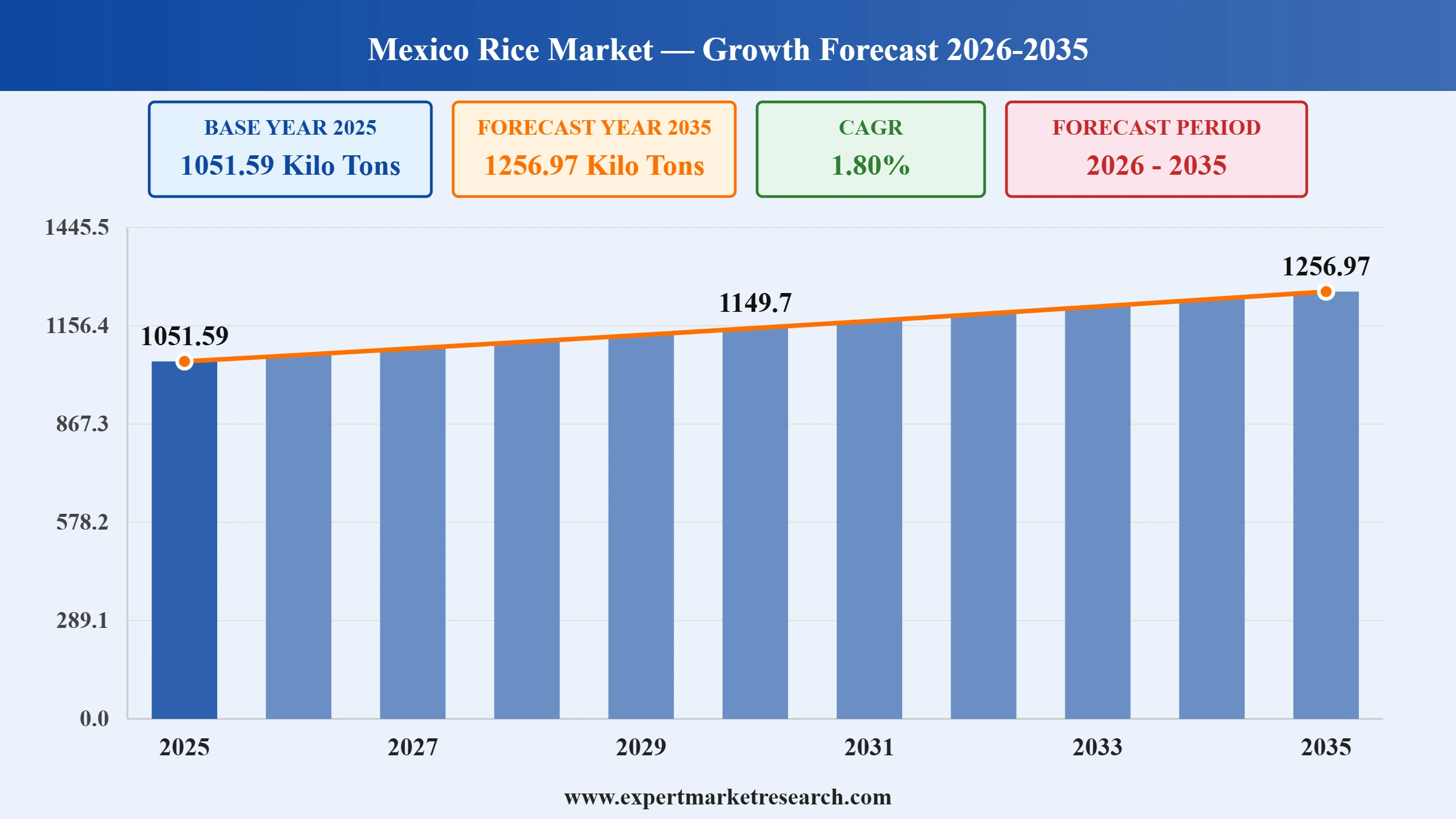
The Mexico rice market attained a volume of 1051.59 Kilo Tons in 2025 and is projected to expand at a CAGR of 1.80% through 2035. The market is further expected to achieve 1256.97 Kilo Tons by 2035. Mexico’s push to reduce structural dependence on imported rice is pushing demand for domestic production and associated agricultural inputs. Government programmes aim to raise national rice output, while initiatives in Campeche are expanding planted areas, improving irrigation infrastructure, distributing improved seeds, and strengthening farmer–mill agreements, supporting long-term domestic supply development.
The Mexico rice market is driven by rising rice consumption, supported by population growth and demand for affordable staple foods, alongside high import dependence resulting from limited domestic production, climatic challenges, water constraints, and elevated production costs. These factors are sustaining opportunities for international rice suppliers, importers, processors, and distributors while encouraging investments in domestic cultivation, improved productivity, climate-resilient varieties, and agricultural technologies to strengthen Mexico’s rice supply chain and reduce its reliance on imports.
In July 2026, the INIFAP and CIMMYT of Mexico signed an agreement involving the transfer of 123 advanced rice breeding lines, after their evaluation was completed in the State of Morelos. These lines have been developed from materials in Asia and the Philippines and are currently used in developing rice varieties that are high yielding, disease resistant, and resilient to the climate in Mexico. Such a development is expected to enhance the domestic production of rice in Mexico and may help the country achieve its plans for self-sufficiency, thereby boosting the Mexico rice market value.
In January 2026, Mexico introduced a 200,000-tonne tariff-rate quota for duty-free paddy rice imports from Brazil and other countries without free-trade agreements. Imports exceeding the quota are subject to a 9% MFN tariff. The measure is significant because Mexico is forecast to import around 895,000 tonnes of rice in 2025/26, covering most domestic consumption. The quota is also likely to influence supplier competition, particularly for Brazil, whose paddy rice shipments to Mexico reached 161,962 tonnes in 2025. The policy could reshape sourcing patterns while supporting Mexico’s efforts to balance import availability with domestic production objectives, thus aiming more towards the Mexico rice market developments.
Read more about this report - REQUEST FREE SAMPLE COPY IN PDF
USA Rice led a trade mission involving the United States growers, merchants, and industry representatives, meeting Mexican importers including Grupo Schettino and Promexa. The initiative focused on strengthening customer relationships and understanding Mexico’s changing sourcing preferences amid growing competition from South American suppliers, thereby affecting the Mexico rice market growth.
USA Rice was part of a Mexico City celebration tied to the FIFA World Cup, where it offered around 5,100 samples of rice. The marketing drive sought to raise awareness about United States rice in Mexico, one of the biggest markets for United States rice imports.
CIMMYT provided 123 rice breeding materials to INIFAP for evaluation across Mexico. The initiative supports the development of improved rice varieties suited to Mexican conditions, potentially improving yields, resilience, and domestic production while reducing import dependence.
Mexico established a 200,000-tonne tariff-rate quota for paddy rice for 2026, with imports exceeding the quota subject to a 9% tariff. The policy could alter supplier competitiveness and create opportunities for non-FTA exporters, including Brazil, thereby bolstering the Mexico rice market revenues.
Mexico’s rice market is becoming less reliant on imports from the United States. In 2025, the country imported 1.088 million tonnes, of which the United States share was 49%, Uruguay’s 30%, and Brazil’s 18%. In January 2026, Mexico set a 200,000-tonne paddy-rice tariff quota, explicitly targeting supplier diversification, intensified competition and pricing stability. It creates opportunities for Brazilian, Uruguayan, and other exporters, thus affecting the Mexico rice market dynamics and trends.
By December 2025, Mexico produced 234,000 tonnes of paddy rice, that is 16% more year-on-year, but despite this, domestic production provided just 21% of 2025 apparent consumption. The production growth creates opportunities for processors to buy increasing quantities of local rice, especially in Nayarit, Jalisco, Campeche, Veracruz, Morelos, and Michoacán regions and develop the range of Mexican origin and traceable rice products.
The imports of milled rice in Mexico grew 86% between 2021 and 2024 to 244,249 tonnes, due to the demand of the low-cost retail segment and competitive pricing. Long-grain rice represents the largest share of the imports in this category, and leading suppliers are from the United States and Uruguay. It creates opportunities for exporters and Mexican brands to deliver competitively priced consistent long-grain rice to retailers, thereby boosting the trends in the Mexico rice market.
Profeco’s August 2026 monitoring found 900-gram rice priced at MXN 13.90 for Precíssimo, MXN 14.00 for Aurrera, and as high as MXN 23.90 for Schettino. The spread illustrates how private-label/value brands compete aggressively against established processors. This creates a niche opportunity for companies to differentiate through pack size, quality claims, convenience formats, or premium varieties rather than price alone.
Mexico’s rice market is expanding beyond conventional white rice into brown, aromatic, sushi, Arborio, and other specialty varieties. Brown rice held a significant market share in 2025 and is projected to grow as consumers seek higher-fibre, minimally processed alternatives. Meanwhile, growing interest in Asian cuisines supports demand for sushi and fragrant varieties. This gives brands opportunities to command higher prices through differentiated, health-oriented, and internationally positioned rice products.
The Expert Market Research’s report titled “Mexico Rice Market Report and Forecast 2026-2035” offers a detailed analysis of the market based on the following segments:
Market Breakup by Rice Type
Key Insight: In Mexico, long-grain rice is gaining the strongest traction, accounting for most milled-rice imports; Thai long-grain shipments expanded as competitive pricing supported low-cost retail demand. Medium-grain rice remains a smaller niche, largely linked to specialty and international cuisines rather than mainstream consumption. Short-grain rice similarly occupies a limited specialty segment, supported by demand for sushi and Asian-style preparations. USDA data show milled rice represented about 15–20% of Mexico’s rice imports, with long-grain varieties dominating this category. Meanwhile, specialty imports from Japan, Italy, and India indicate opportunities for medium- and short-grain products in premium culinary applications, thereby opening up new opportunities and boosting the growth of the Mexico rice market.
Market Breakup by Processing Type
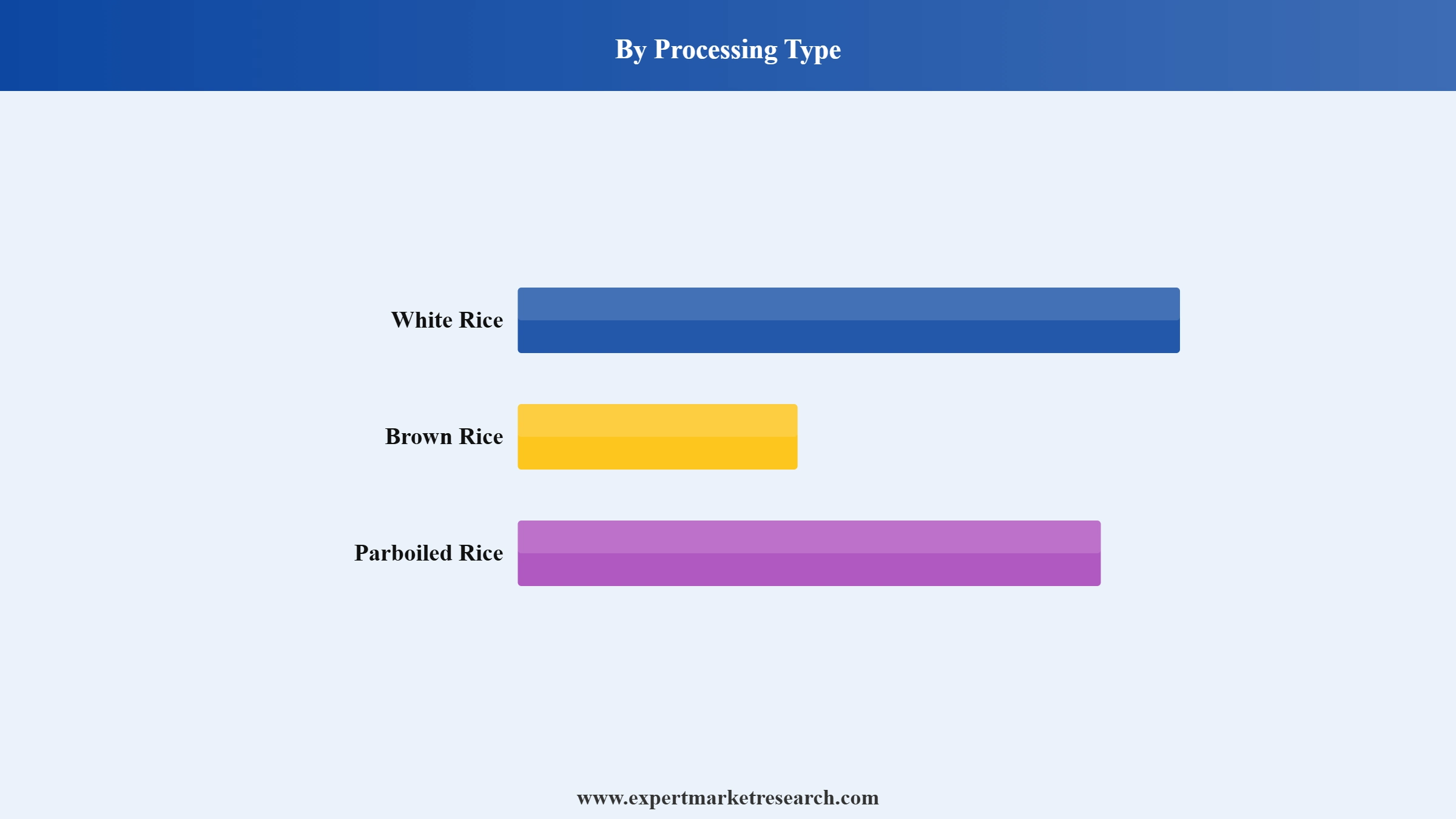
Key Insight: White Rice continues to dominate as the main processing segment in Mexico because of its significance in consumption by the domestic population and large import needs of milled rice in the nation. In June 2026, Mexico made imports worth US$ 18.7 million of milled or wholly milled rice. Brown rice is a minor segment due to the importation of US$ 1.95 million worth of husked or brown rice in 2024, most of which was sourced from the USA. Parboiled rice is a minor but quickly growing segment because according to USDA sources, it is consuming at the highest rate among other processing forms.
Market Breakup by End Use
Key Insight: Food & beverages remains the core end-use segment, with rice increasingly positioned as an ingredient across both savoury and sweet applications. At Expo ANTAD 2026, USA Rice showcased rice horchata, poke bowls, and rice-pudding macarons, demonstrating demand beyond conventional meals. Retail remains highly important, with Mexico’s 2026/27 rice consumption forecast at 1.04 million tonnes, supported by population growth and stable imported-rice prices. Industrial use is comparatively niche, but rice-based ingredients, broken rice, and processed applications provide opportunities for food manufacturers, particularly as domestic milled-rice consumption is expected to increase, thus bolstering the Mexico rice demand.
Market Breakup by Region
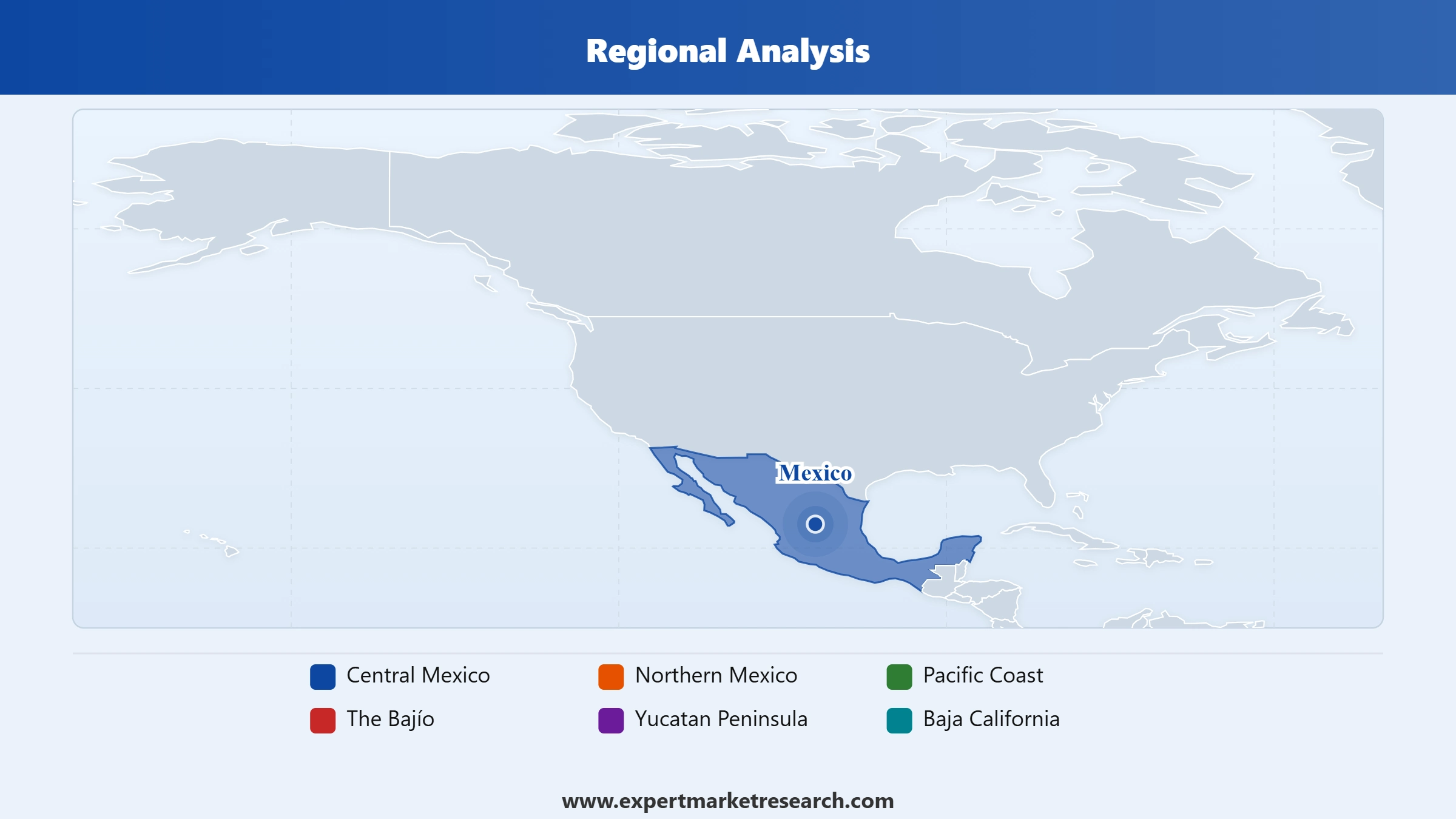
Key Insight: Central Mexico represents the most important demand and distribution zone, supported by Mexico City and surrounding states. Northern Mexico is strategically important because Nuevo León recorded US$ 101 million in rice imports in 2024, making the region a major commercial gateway. Pacific Coast has greater relevance for domestic cultivation, particularly through Nayarit and Jalisco, while The Bajío benefits from its concentration of food-processing and agricultural activity. Yucatán Peninsula offers a distinct consumption pocket supported by tourism and foodservice demand, whereas Baja California is influenced by proximity to the United States supply chain and cross-border trade.
Read more about this report - REQUEST FREE SAMPLE COPY IN PDF
By rice type, long-grain rice dominates Mexico’s rice market through mainstream consumption and imports
Long-grain rice dominates Mexico's imported rice structure owing to the fact that this is the most common form consumed in Mexico and suits the current system in Mexico where paddies are transformed into milled rice. The USDA explains that almost 85% of Mexico's imports of rice are paddies, and long-grain types of rice are essential to production in the country, since in Campeche, about 70% of production is long-grain rice including Aztecas, thus boosting the overall Mexico rice market development.
Short-grain rice is emerging from a small base through Mexico’s expanding specialty-food segment, particularly Japanese and Asian cuisine. Unlike long grain, which is deeply embedded in everyday consumption, short grain benefits from its specific cooking characteristics for sushi and other sticky-rice applications. Mexico’s growing availability of imported specialty rice gives restaurants, foodservice operators, and premium retailers more scope to stock short-grain varieties, making this segment particularly attractive for differentiated products.
Read more about this report - REQUEST FREE SAMPLE COPY IN PDF
By processing type, white rice leads processing due to widespread conventional consumption and imports
White rice is still the dominant processing form owing to the Mexican trade pattern’s heavy dependence on fully milled rice as well as paddy imports which get processed in the country. The imports of milled or wholly milled rice in Mexico reached US$ 253 million, out of which $107 million is the export from Thailand to Mexico. The massive import flow shows the depth of the traditional white rice supply chain catering to Mexican wholesalers, retailers, food service providers, and packaged food brands, and hence bolstering the Mexico rice market revenues.
Parboiled rice offers a specialized growth opportunity when it comes to processing formats, especially considering its processing attributes, which make it suitable for food service and prepared foods which require cooked rice that remains firm even after reheating. The other thing that makes it more suitable is the large-scale import infrastructure in Mexico, which enables international players to offer different processed forms. Parboiled rice holds much more potential than brown rice, which was imported in Mexico worth only US$ 1.95 million in 2024.
By end use, retail dominates end-use demand through widespread household rice purchasing across Mexico
Retail remains the dominant end-use channel because rice is a staple packaged food purchased directly by Mexican households through supermarkets, wholesalers, and value-oriented grocery outlets. The breadth of imported milled rice supports this channel: Mexico purchased US$253 million of milled or wholly milled rice in 2024. Jalisco, Puebla, Mexico City, Veracruz, and Baja California were the largest state import destinations, indicating substantial retail and distribution activity across multiple consumption centres, thereby boosting the Mexico rice consumption as well.
The food and beverages industry has a greater potential to become a niche market for rice as rice expands from being a household staple to becoming a product that can be used in restaurants, prepared food and beverages. For instance, USA Rice promoted horchata, poke bowls, and rice pudding products in its 2026 promotion campaign in Mexico showing that suppliers target foodservice markets for rice applications. These rice applications will create demands for certain grain characteristics.
Read more about this report - REQUEST FREE SAMPLE COPY IN PDF
Central Mexico leads regionally due to population concentration and distribution infrastructure
Central Mexico remains the leading consumption and distribution zone because it combines Mexico City with major surrounding population and commercial centres. The region also absorbs significant volumes through wholesale and retail networks serving densely populated markets. Mexico City alone imported US$ 44.8 million of rice in 2024, while Puebla imported another US$ 54.3 million, illustrating the scale of rice flows into central-market distribution systems and reinforcing Central Mexico’s commercial importance. Such factors are directly boosting the Mexico rice market regional growth.
The Bajío presents strong expansion potential owing to its manufacturing and food-processing base that can support greater institutional and ingredient demand for rice. Jalisco, commonly linked to the broader Bajío/West-Central commercial corridor, imported US$ 78.7 million of rice in 2024, including US$ 67.7 million of milled rice, the highest state-level milled-rice import value recorded. This makes the corridor particularly attractive for processors, distributors, and suppliers targeting industrial and foodservice customers.
Mexico rice market players are mainly trying to enhance supply reliability and differentiate their packaged products. The importers and processors are looking at varied sourcing and better quality controls, whereas existing brands are venturing beyond regular rice to precooked, flavored, sushi, brown-rice, and rice-quinoa varieties. For instance, Verde Valle, at present, is offering regular rice as well as a wide range of precooked rice products such as Mexican style, tomato, garden-style, and flavored varieties.
On the other hand, the Mexico rice companies are focusing on the higher-value consumers through better retail presence via food safety, convenience, variety, and branding. As per Verde Valle, it is FSSC 22000 certified in terms of its processing and e-grain testing, while its product range covers rice, ingredients, superfoods, and prepared foods.
Established in 1957 and headquartered in Orizaba, Veracruz, Schettino offers polished white, brown, Arborio, Basmati, and parboiled rice, alongside rice flour and bran. Its portfolio includes Schettino, Gran Cosecha Schettino, El Águila, and Chop, serving Mexico’s retail and foodservice markets.
Established in 1996 and headquartered in Cortazar, Guanajuato, Arrocera del Bajío specialises in rice milling, processing, packaging, and commercialization. Its offerings include whole, broken, and polished rice, supplying central Mexican markets through an established processing and distribution network.
Established in 1994 and headquartered in Salinas Victoria, Nuevo León, Mexicana de Arroz focuses on paddy-rice milling and commercialization. Its consumer portfolio includes Patria Super Extra, Los Paisas Extra, Paisa Super Extra, and Paisa Extra rice in multiple retail pack sizes.
Headquartered in Zapopan, Jalisco, Verde Valle offers conventional, specialty, and precooked rice products. Its portfolio includes white, brown, sushi, integral, thick-grain, and instant rice formats, alongside broader offerings such as beans, lentils, grains, seeds, and other food ingredients.
*Please note that this is only a partial list; the complete list of key players is available in the full report. Additionally, the list of key players can be customized to better suit your needs.*
Discover the opportunities shaping the Mexico rice market during the forecast period with Expert Market Research’s detailed industry analysis. The report provides valuable insights into Mexico rice market size, trends, competitive developments, domestic production, import dynamics, consumption patterns, and emerging opportunities. Download the sample report to explore the Mexico rice market forecast, identify high-growth segments, evaluate competitive positioning, and understand strategic opportunities across Mexico’s evolving rice industry.


Upto 15% Off
USD
$2499 $2249
$3999 $3599
$4999 $4249
$5999 $5099


*While we strive to always give you current and accurate information, the numbers depicted on the website are indicative and may differ from the actual numbers in the main report. At Expert Market Research, we aim to bring you the latest insights and trends in the market. Using our analyses and forecasts, stakeholders can understand the market dynamics, navigate challenges, and capitalize on opportunities to make data-driven strategic decisions.*
In 2025, the market reached an approximate volume of 1051.59 Kilo Tons.
The market is estimated to grow at a CAGR of 1.80% between 2026 and 2035.
The market is estimated to witness a healthy growth during 2026-2035 to reach around 1256.97 Kilo Tons by 2035.
Key strategies include diversifying import sources, strengthening domestic rice productivity, adopting improved farming technologies, expanding value-added and specialty varieties, improving processing efficiency, and strengthening retail and foodservice distribution networks.
The key trends aiding the market include rising demand for international cuisine, sustainable agricultural practices, and growing innovations in farming methods.
Regions considered in the market are Central Mexico, Northern Mexico, Pacific Coast, The Bajío, Yucatan Peninsula, and Baja California.
Based on processing type, market segmentations include white rice, brown rice, and parboiled rice.
Various end uses are food and beverages, retail, and industrial, among others.
Key challenges include high import dependence, limited domestic production, water scarcity, climate variability, rising input costs, fragmented farming, price competition, and vulnerability to international rice-price fluctuations.
The key players in the market include Schettino Hermanos, S. de R.L. de C.V, Arrocera del Bajío SA de CV, Mexicana de Arroz, SA de CV, and PRODUCTOS VERDE VALLE, SA de CV, among others.
Explore our key highlights of the report and gain a concise overview of key findings, trends, and actionable insights that will empower your strategic decisions.
| REPORT FEATURES | DETAILS |
| Base Year | 2025 |
| Historical Period | 2019-2025 |
| Forecast Period | 2026-2035 |
| Scope of the Report |
Historical and Forecast Trends, Industry Drivers and Constraints, Historical and Forecast Market Analysis by Segment:
|
| Breakup by Rice Type |
|
| Breakup by Processing Type |
|
| Breakup by End Use |
|
| Breakup by Region |
|
| Market Dynamics |
|
| Competitive Landscape |
|
| Companies Covered |
|
Datasheet
One User
USD 2,499
USD 2,249
tax inclusive*
Single User License
One User
USD 3,999
USD 3,599
tax inclusive*
Five User License
Five User
USD 4,999
USD 4,249
tax inclusive*
Corporate License
Unlimited Users
USD 5,999
USD 5,099
tax inclusive*
*Please note that the prices mentioned below are starting prices for each bundle type. Kindly contact our team for further details.*
Flash Bundle
Small Business Bundle
Growth Bundle
Enterprise Bundle
*Please note that the prices mentioned below are starting prices for each bundle type. Kindly contact our team for further details.*
Flash Bundle
Number of Reports: 3
20%
tax inclusive*
Small Business Bundle
Number of Reports: 5
25%
tax inclusive*
Growth Bundle
Number of Reports: 8
30%
tax inclusive*
Enterprise Bundle
Number of Reports: 10
35%
tax inclusive*
How To Order

Select License Type
Choose the right license for your needs and access rights.

Click on ‘Buy Now’
Add the report to your cart with one click and proceed to register.

Select Mode of Payment
Choose a payment option for a secure checkout. You will be redirected accordingly.
Strategic Solutions for Informed Decision-Making
Gain insights to stay ahead and seize opportunities.

Get insights & trends for a competitive edge.

Track prices with detailed trend reports.

Analyse trade data for supply chain insights.

Leverage cost reports for smart savings

Enhance supply chain with partnerships.

Connect For More Information
Our expert team of analysts will offer full support and resolve any queries regarding the report, before and after the purchase.
Our expert team of analysts will offer full support and resolve any queries regarding the report, before and after the purchase.
We employ meticulous research methods, blending advanced analytics and expert insights to deliver accurate, actionable industry intelligence, staying ahead of competitors.
Our skilled analysts offer unparalleled competitive advantage with detailed insights on current and emerging markets, ensuring your strategic edge.
We offer an in-depth yet simplified presentation of industry insights and analysis to meet your specific requirements effectively.




