

Consumer Insights
Uncover trends and behaviors shaping consumer choices today
Procurement Insights
Optimize your sourcing strategy with key market data
Industry Stats
Stay ahead with the latest trends and market analysis.
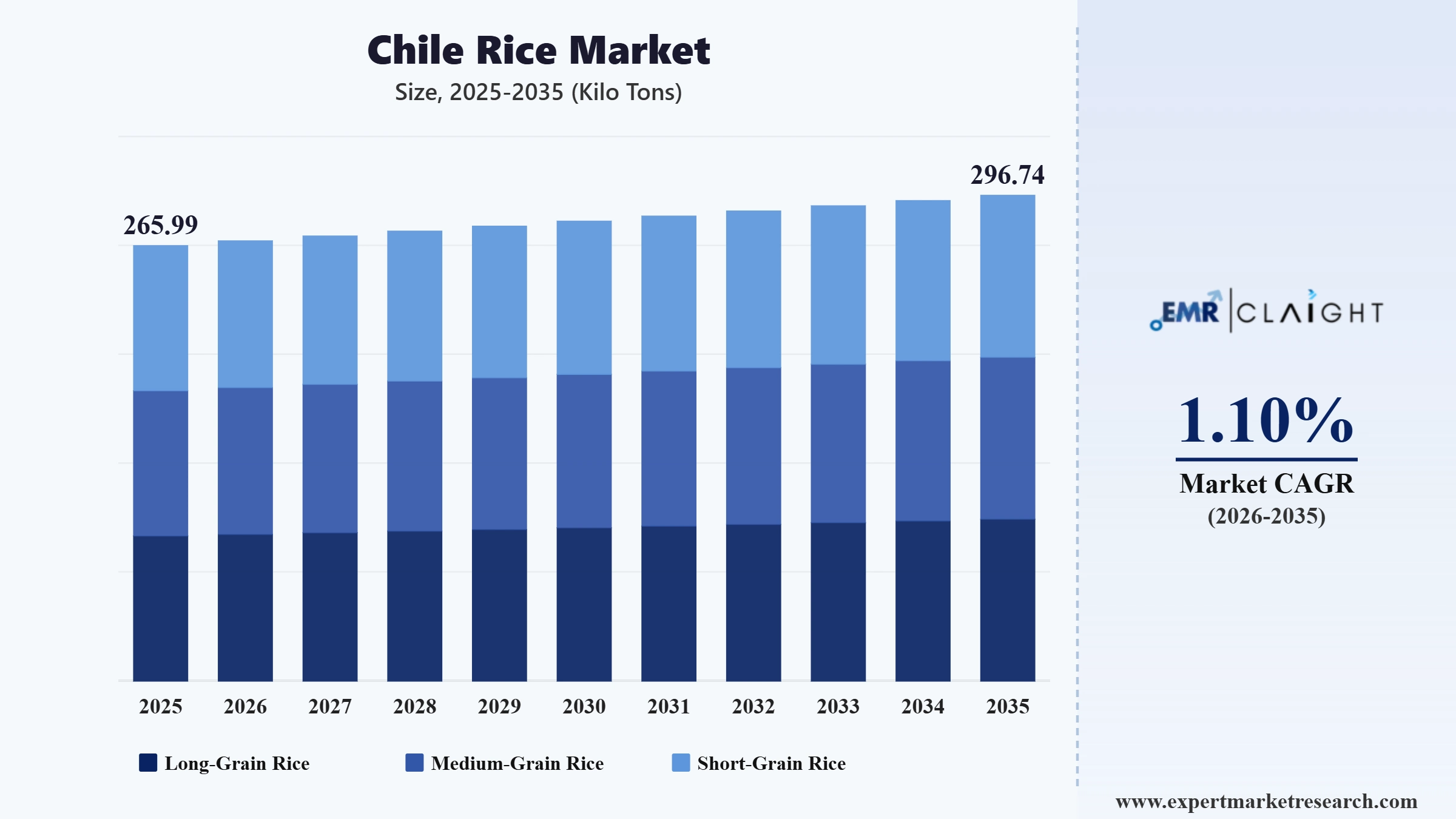
The Chile rice market attained a volume of 265.99 Kilo Tons in 2025 and is projected to expand at a CAGR of 1.10% through 2035. The market is further expected to achieve 296.74 Kilo Tons by 2035. Chile’s growing adoption of water-saving rice cultivation technologies is creating a niche opportunity for the domestic rice market. INIA’s System of Rice Intensification (SRI) replaces continuous flooding with intermittent irrigation and can reduce water consumption by around 50% while maintaining yields. This supports climate-resilient production amid increasing water constraints.
The Chile rice market is a strategically important segment of the country’s food supply chain, linking domestic cultivation, milling, imports, branded packaged products, foodservice and industrial processing. Rice production is concentrated primarily in the Maule and Ñuble regions, where climatic conditions, irrigation infrastructure and established agricultural expertise support commercial cultivation. Office of Agricultural Studies and Policies (ODEPA), Chile, agricultural-area data should be used to distinguish planted area from harvested area and to confirm whether reported figures are preliminary or final.
The increasing demand for specialty types of rice has led to the emergence of a niche segment within the Chilean market for rice. Basmati, arborio, jasmine and carnaroli rice are consistently found among the imports, although accounting for a small percentage of the total. The country has not produced any of these specialties domestically, and therefore their imports have become inevitable for this particular segment. This will enable importers and food processing firms to exploit premium rice markets and increase the value of the market through culinary uses of rice, thus boosting the Chile rice market value.
Furthermore, persistent reliance on imported rice is a distinctive driving factor of Chile rice market, with imports accounting for 64% of domestic consumption in 2020, according to ODEPA. This structural supply gap makes Chile highly sensitive to international rice prices, freight costs and availability from key suppliers such as Argentina, Paraguay and Uruguay. The continued role of imports creates opportunities for overseas suppliers and Chilean distributors to expand market share, while fluctuations in global prices can directly influence domestic rice prices and purchasing decisions. ODEPA’s 2025 analysis further confirms the close relationship between Chilean rice import costs and global prices., thereby boosting the Chile rice market developments.
Read more about this report - REQUEST FREE SAMPLE COPY IN PDF
ODEPA’s July 2026 cereal bulletin reported lower projected U.S. rice production and a 28% month-on-month reduction in projected U.S. ending stocks for 2026/27, alongside a higher producer-price outlook. Tighter international availability could increase import-cost pressure for Chile, where imported rice is important, potentially raising procurement costs and influencing domestic rice prices, thereby affecting the Chile rice market growth.
INIA hosted a Chile–Indonesia seminar on climate-smart rice production, bringing together agricultural institutions and specialists to share Chilean research and innovation. The project is meant to enhance resource management and climate-smart practices in the cultivation of rice. Increased use of efficient production methods by Chilean farmers could result in reduced resource demands and climate risks associated with cultivation, hence improved output and efficiency in production. This might make the country's rice production more competitive.
The INIA conducted a Chile–Indonesia seminar on climate smart rice production where institutions and specialists discussed the innovations in rice production in Chile. Exchange of knowledge between countries could lead to accelerated adoption of technologies resilient to climate in Chile. This will be beneficial in increasing productivity and efficiency, hence helping producers maintain rice cultivation despite climatic challenges.
INIA announced that the new Jaspe FL INIA variety would be available for the 2026/27 planting season in Ñuble and Maule. It offers a shorter cycle, high yields and approximately 50% lower methane emissions. Commercial adoption could improve farm productivity, reduce climate-related production risks and strengthen Chile’s domestic rice supply while lowering environmental costs, thereby bolstering the Chile rice market revenues.
The rice production in Chile is highly concentrated in the Maule and Ñuble regions. In the 2024-25 season, Maule region produced 14,788 hectares and 102,629 tonnes of rice, while Ñuble produced 4,368 hectares and 27,799 tonnes of rice. Together, these two regions account for almost all of the national rice crop. This makes the geographical concentration highly useful for specialized harvest, milling and procurement operations but also exposes Chile to certain supply chain issues linked to water availability and weather, thus affecting the Chile rice market dynamics and trends.
Chile’s rice market is structurally import-oriented. Domestic production in 2024-25 covered only around 30% of internal consumption, according to ODEPA. Chile therefore remains particularly exposed to international rice prices and supplier-country conditions. Argentina, Paraguay and Uruguay are especially relevant sourcing markets. For example, ODEPA projected their 2025-26 rice production to decline 19.6%, 2.6% and 3.5%, respectively. Such shifts can directly affect Chilean procurement costs and domestic pricing.
Chile is developing rice varieties with consideration of its water shortage and short growth period. In April 2026, INIA released Jaspe FL INIA, whose crop cycle was shortened by 25–30 days and the use of water reduced by 50%. The release of this variety into the market makes the adaptation measure available for producers, and not only a research idea. Its greater application may help to increase flexibility and competitiveness of rice cultivation in Chile, thereby boosting the trends in the Chile rice market.
Chile’s rice import basket is not limited to one uniform product category. ODEPA data show imports of milled rice across different broken-grain specifications, alongside broken rice. In 2024, Chile imported 162,763 tonnes of semi- or fully milled rice, including 47,412 tonnes with more than 15% broken grain. Such diversification provides opportunities to optimize the sourcing according to different grain grades, quality and application.
Chile’s small domestic production base means processors must balance local paddy procurement with imported milled rice. In 2024-25, domestic output reached 130,428 tonnes, while ODEPA estimated domestic production supplied only about 30% of consumption. This creates a distinctive competitive requirement: processors need flexible sourcing, inventory planning and quality management rather than relying solely on domestic harvests. Companies capable of switching between local and imported supply can better manage harvest variability, international prices and customer specifications.
The Expert Market Research’s report titled “Chile Rice Market Report and Forecast 2026-2035” offers a detailed analysis of the market based on the following segments:
Market Breakup by Rice Type
Key Insight: Long-grain rice dominates the Chile rice industry owing to its significance in imported milled-rice volumes and mainstream consumption. Medium-grain rice holds a secondary specialized position because of its relevance in Chile’s diverse import basket and cooking needs. Short-grain rice is the least prevalent type of rice, with use limited to applications that require stickier consistency. The total amount of milled-rice imports in 2024 as documented by ODEPA was 162,763 tonnes, showing the significance of imported rice in influencing Chile’s type-wise availability and product portfolio, thereby opening up new opportunities and boosting the growth of the Chile rice market.
Market Breakup by Processing Type
Key Insight: White rice remains the core processed format, reflecting Chile’s preference for conventional milled rice and its dominant role in everyday consumption. Brown rice occupies a more specialised segment, benefiting from its whole-grain positioning and availability through health-oriented retail channels. Parboiled rice represents another differentiated format, offering firmer grains and reduced stickiness after cooking, which suits specific household and foodservice applications. Notably, ODEPA’s 2025 import data show parboiled and other processed rice formats within Chile’s broader imported-rice basket, indicating continued product diversification.
Market Breakup by End Use
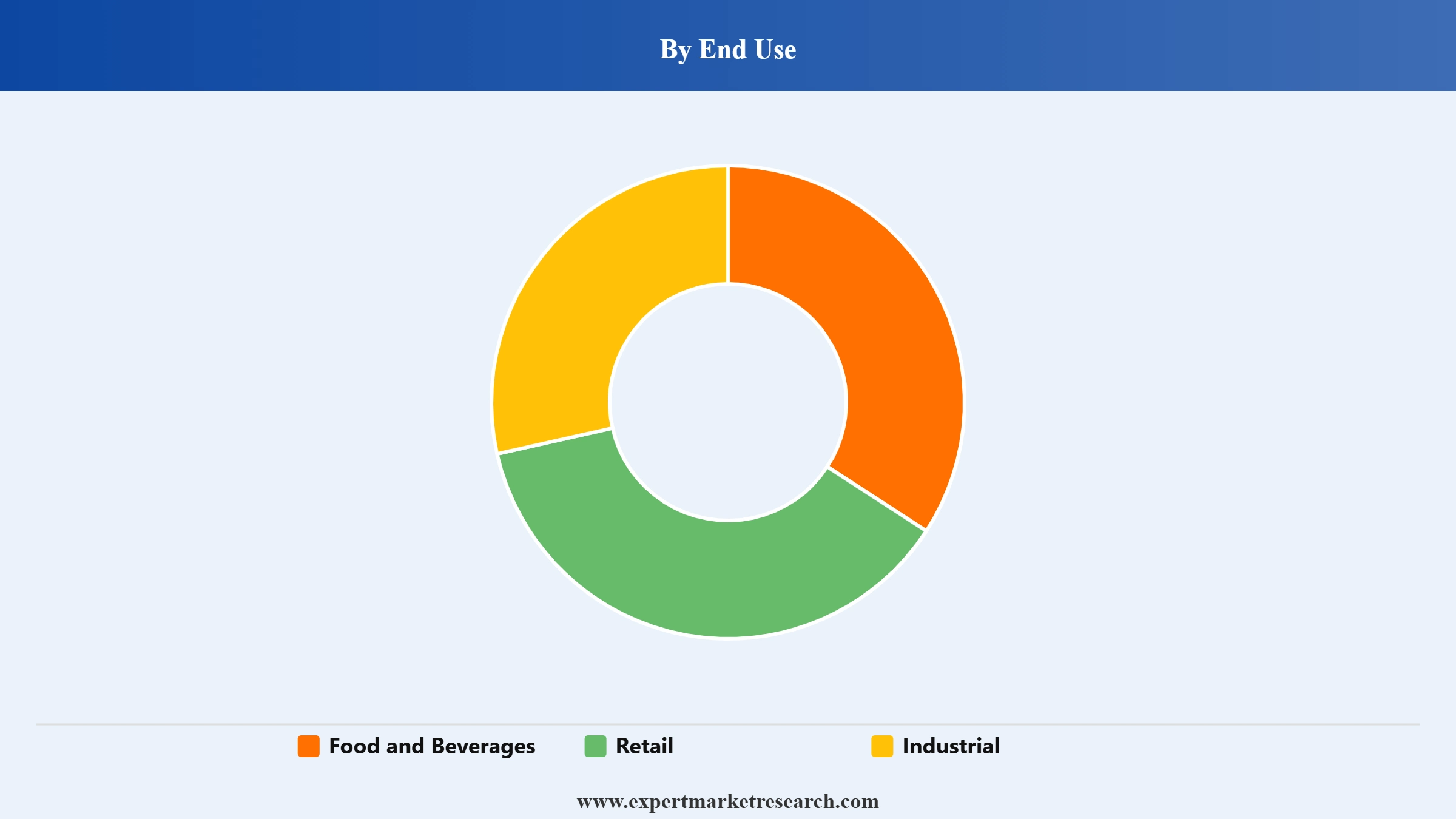
Key Insight: Food and Beverages represents the broadest consumption channel, covering household meals and foodservice demand, while Chile’s established rice-processing chain supplies both domestic and imported rice to these users. Packaged rice is still an important item within the retail trade and there is differentiation according to grain quality and processing. The industrial use of rice is quite specialized; with rice being used in food manufacturing and processed foods. In its market-chain analysis, ODEPA identifies distinct channels of consumers, processors and imports.
By rice type, long-grain rice is the dominant segment, supported by its broad everyday consumption and established retail availability
Long-grain rice is the dominant type in Chile, supported by its position as an everyday accompaniment and its extensive supermarket availability. Miraflores, for example, describes its Largo Ancho range as one of the most consumed rice formats in Chile and sells G1 and G2 variants in 500-g and 1-kg packs. Current Chilean retail listings also show Banquete Premium Grano Largo y Ancho and Cuisine & Co long-grain products, demonstrating competition across branded and private-label offerings, thus boosting the overall Chile rice market development.
Short-grain rice is coming from a lower base due to food-based demand, specifically for sushi and risotto uses. The brand Miraflores clearly states that the shorter and starchier varieties suit sushi and risotto dishes and highlights dishes such as the California roll and risotto. It even has separate products in its range called Risotto. This illustrates how Chilean brands are linking their rice variety to occasions and not just selling rice as a staple product.
By processing type, white rice is the dominant processing format, reflecting its established role in Chile’s conventional rice consumption
White rice continues to be the preferred processing form due to its widespread accessibility within traditional retail channels. For example, Miraflores offers Largo Ancho G1 and G2 varieties of white rice products. Chilean retailers offer Banquete Premium and Cuisine & Co long grain white rice products. It is evident from the competition within the various domestic brands, retailer own label brands and different quality grade rice. Consequently, white rice continues to gain advantage from consumer habits and wide availability on shelves. Differentiation among white rice products is done using grain grade, cooking properties, package size and price., and hence bolstering the Chile rice market revenues.
Parboiled rice has strong growth potential because Chilean brands are positioning it around preparation convenience. Miraflores Pregraneado is explicitly identified as parboiled rice and is marketed as having firm, separated grains, requiring no sautéing and offering faster, simpler preparation. The brand sells both 500-g and 1-kg formats. Cuisine & Co also offers a 1-kg pregrained product in Chilean retail, indicating that convenience-oriented parboiled rice is extending beyond one brand.
Read more about this report - REQUEST FREE SAMPLE COPY IN PDF
By end use, household consumption is the dominant end use, with rice remaining a regular component of Chilean diets
Supermarkets and hypermarkets are the dominant distribution channel, with extensive rice assortments spanning national brands, private labels and specialty products. Jumbo’s current Chilean online assortment, for example, lists Miraflores, Banquete, Cuisine & Co, Tucapel, Taj Mahal and Máxima, demonstrating substantial brand and price-tier competition within modern grocery stores. This channel is particularly important because consumers can compare grain grades, pack sizes and prices in one location. Its breadth also gives retailers significant influence over visibility and product positioning.
Read more about this report - REQUEST FREE SAMPLE COPY IN PDF
Maule dominates, while Ñuble is advancing water-efficient, climate-smart rice cultivation.
Maule is Chile’s dominant rice-producing region, accounting for roughly 80% of national rice production according to industry estimates. The region is now moving beyond conventional flooded cultivation. In January 2025, INIA demonstrated Jaspe FLAR in Linares, a short-cycle variety capable of being grown without traditional flooding and reducing water consumption by around 50%. The trials are particularly significant because they could allow rice to enter crop rotations with maize, wheat and beans, improving land-use flexibility and strengthening Maule’s long-term rice competitiveness. Such factors are directly boosting the Chile rice market regional growth.
However, Ñuble represents the fastest developing regional opportunity despite being smaller than the Maule region. The most innovative practices were observed in San Carlos and Chillan, where the INIA is conducting research on climate-smart rice growing. At the international sustainable rice conference held in Chillan in March 2025, a discussion took place on the possibilities of eliminating flooding and the use of irrigation and subsurface drip irrigation technologies. Moreover, according to the reports by INIA, the introduction of new technologies will provide for rice cultivation on less water-retentive soils.
Chile rice market players are increasingly aiming to secure supply while improving production resilience. A key example is the public-private development of Jaspe FL INIA, involving INIA, FLAR, Tucapel, Carozzi and producers. This particular variety aims at decreasing the duration of the crop cycle by 25-30 days, as well as its water consumption by up to 50%. This can help food processors and brands to safeguard domestic sources of production from droughts, increase farmers’ productivity and establish a more sustainable raw material supply chain.
New scaling strategies by the Chile rice companies are focusing on technology-led production expansion rather than simply increasing conventional acreage. INIA is testing Jaspe under drip irrigation and non-flooded systems, including experimental cultivation in Africa and Parinacota, where rice has traditionally been unsuitable because of water scarcity. The trials use drip and underground irrigation and aim to test whether rice can be produced in new territories. If commercially successful, such systems could expand Chile’s production frontier while reducing dependence on conventional flooded cultivation.
Founded in 1993, Farpal Rice Mill SpA is headquartered in Parral, Maule, Chile, a major rice-producing area. Its Chilean rice offering is centred on milled rice and rice flour, supported by domestic processing and procurement activities. The company primarily serves the processing and supply side of the market rather than competing through a broad consumer-facing branded portfolio.
Arrocera Flor de Ñiquén is headquartered in Parral, Maule, Chile, with operations focused on rice processing. Its portfolio includes Grade 1 and Grade 2 long-grain/long-wide rice, pre-grained rice, imported packaged rice and rice flour (harinilla). These offerings allow the company to address mainstream household consumption alongside convenience-oriented and ingredient applications. A reliable public source does not establish its founding year.
Miraflores, owned by Empresas Carozzi, is headquartered through its parent company in San Bernardo, Santiago, Chile. Its rice portfolio includes Grade 1 and Grade 2 long-grain rice, integral rice, pre-grained/parboiled rice, risotto and prepared rice such as paella, curry and chaufán. Carozzi identifies Miraflores as its principal rice brand and reports strong positioning in Chile’s rice category.
Established in 1945, Tucapel is headquartered in Santiago, Chile and operates extensively across the domestic rice market. Its portfolio includes long-grain Grade 1 and Grade 2 rice, Blue Bonnet, Gran Selección, integral, pre-grained and culinary rice formats. Tucapel also operates alongside the Banquete brand in Chile. Camil identifies Tucapel as a leading Chilean rice brand, with industrial plants in Santiago, Retiro and San Carlos.
*Please note that this is only a partial list; the complete list of key players is available in the full report. Additionally, the list of key players can be customized to better suit your needs.*
Discover the opportunities shaping the Chile rice market during 2026 with Expert Market Research's detailed industry analysis. The report provides valuable insights into Chile rice market size, market trends, competitive developments, production dynamics, import patterns and emerging opportunities. Download the sample report to explore the Chile rice market forecast, identify high-growth segments and understand the strategic opportunities emerging across Maule, Ñuble and the wider Chilean rice industry.


Upto 15% Off
USD
$3999 $3599
$2499 $2249
$4999 $4249
$5999 $5099


*While we strive to always give you current and accurate information, the numbers depicted on the website are indicative and may differ from the actual numbers in the main report. At Expert Market Research, we aim to bring you the latest insights and trends in the market. Using our analyses and forecasts, stakeholders can understand the market dynamics, navigate challenges, and capitalize on opportunities to make data-driven strategic decisions.*
In 2025, the market reached an approximate volume of 265.99 Kilo Tons.
The market is estimated to grow at a CAGR of 1.10% between 2026 and 2035.
The market is estimated to witness a healthy growth during 2026-2035 to reach around 296.74 Kilo Tons by 2035.
Key strategies include adoption of water-efficient and short-cycle varieties, investment in climate-smart cultivation, strengthening domestic rice supply chains, improving genetic productivity, differentiating national rice from imports, and expanding technology transfer.
The key trends aiding the market include a shift towards premium and speciality rice varieties, the growing importance of sustainable agriculture, and innovations in rice production.
Based on rice type, market segmentations include long-grain rice, medium-grain rice, and short-grain rice, among others.
Various end uses include food and beverages, retail, and industrial.
The major players in the market are Farpal Rice Mill SpA, Flordeniquen, Miraflores, and Tucapel, among others.
Key challenges include water scarcity and climate variability, declining domestic cultivation, dependence on imported rice and exposure to global prices, rising production costs, and supply-chain vulnerability from concentrated production in Maule and Ñuble.
Explore our key highlights of the report and gain a concise overview of key findings, trends, and actionable insights that will empower your strategic decisions.
| REPORT FEATURES | DETAILS |
| Base Year | 2025 |
| Historical Period | 2019-2025 |
| Forecast Period | 2026-2035 |
| Scope of the Report |
Historical and Forecast Trends, Industry Drivers and Constraints, Historical and Forecast Market Analysis by Segment:
|
| Breakup by Rice Type |
|
| Breakup by Processing Type |
|
| Breakup by End Use |
|
| Market Dynamics |
|
| Competitive Landscape |
|
| Companies Covered |
|
Single User License
One User
USD 3,999
USD 3,599
tax inclusive*
Datasheet
One User
USD 2,499
USD 2,249
tax inclusive*
Five User License
Five User
USD 4,999
USD 4,249
tax inclusive*
Corporate License
Unlimited Users
USD 5,999
USD 5,099
tax inclusive*
*Please note that the prices mentioned below are starting prices for each bundle type. Kindly contact our team for further details.*
Flash Bundle
Small Business Bundle
Growth Bundle
Enterprise Bundle
*Please note that the prices mentioned below are starting prices for each bundle type. Kindly contact our team for further details.*
Flash Bundle
Number of Reports: 3
20%
tax inclusive*
Small Business Bundle
Number of Reports: 5
25%
tax inclusive*
Growth Bundle
Number of Reports: 8
30%
tax inclusive*
Enterprise Bundle
Number of Reports: 10
35%
tax inclusive*
How To Order

Select License Type
Choose the right license for your needs and access rights.

Click on ‘Buy Now’
Add the report to your cart with one click and proceed to register.

Select Mode of Payment
Choose a payment option for a secure checkout. You will be redirected accordingly.
Strategic Solutions for Informed Decision-Making
Gain insights to stay ahead and seize opportunities.

Get insights & trends for a competitive edge.

Track prices with detailed trend reports.

Analyse trade data for supply chain insights.

Leverage cost reports for smart savings

Enhance supply chain with partnerships.

Connect For More Information
Our expert team of analysts will offer full support and resolve any queries regarding the report, before and after the purchase.
Our expert team of analysts will offer full support and resolve any queries regarding the report, before and after the purchase.
We employ meticulous research methods, blending advanced analytics and expert insights to deliver accurate, actionable industry intelligence, staying ahead of competitors.
Our skilled analysts offer unparalleled competitive advantage with detailed insights on current and emerging markets, ensuring your strategic edge.
We offer an in-depth yet simplified presentation of industry insights and analysis to meet your specific requirements effectively.




