

Consumer Insights
Uncover trends and behaviors shaping consumer choices today
Procurement Insights
Optimize your sourcing strategy with key market data
Industry Stats
Stay ahead with the latest trends and market analysis.
The Colombia rice market attained a volume of 2057.39 Kilo Tons in 2025 and is projected to expand at a CAGR of 1.10% through 2035. The market is further expected to achievea volume of 2295.24 Kilo Tons by 2035. Precision irrigation, seed resistant to climatic changes, and farm management technologies are becoming the key driving factor behind decreasing input inefficiencies, more stable yields, and improved margins for the country’s rice producers.
Increased use of water saving irrigation technologies and varieties are becoming more popular across the Colombia rice market scope due to growing weather instability and its impact on the cost of production. Increased capacity of rice processing facilities allows managing spikes in harvests, cutting down post-harvest losses, and improving inventory management. This situation stimulates suppliers to develop their focus towards integrated farm services, technology solutions, and production assistance, while rice processing plants look for quality and processing capacity.
The Colombia rice market is leaning towards technology-driven cost-cutting among producers, millers, and Fedearroz due to the reduced margin of profit and uncertain supply. In this regard, in April 2024, Fedearroz rolled out its Amortización Masiva de Tecnología (AMTEC) programs and its Intelligent Irrigation Management Platform, which is geared towards efficient water use and decision-making. It is commercially significant since farms are demonstrating lower rice production costs than the national average, reflecting the program’s focus on improving productivity and reducing production costs. This is an indication of potential for seed companies, irrigation service providers, and others for efficient production.
Furthermore, players in the Colombia rice market are increasingly investing in post-harvest facilities. This year, Fedearroz was granted an approval for projects funded through Col-Rice, which include technical assistance and increased capacity for drying, storage, and milling. Furthermore, in July 2025, 4,968 small-scale rice producers from Tolima, Colombia, signed a commercial agreement to sell 1,644 tons of milled rice annually, marking a significant expansion of market access for the region’s farmers. Under the agreement, 1,404 tons will be exported to Cuba, while another 240 tons will supply social programs operated by public institutions in Colombia.
Compound Annual Growth Rate
1.1%
Value in Kilo Tons
2026-2035
Read more about this report - REQUEST FREE SAMPLE COPY IN PDF
Ecuador reached an agreement for export of 30,000 tons of rice to Colombia, thereby resuming trade operations following months of disruption caused by problems at the borders. Logistics firms and traders can enhance their cross-border rice sourcing capabilities with the stabilization of trade flows, propelling growth in the Colombia rice market.
Cibus and Interoc outlined a plan for potential introduction of herbicide tolerant rice technologies in 2027 for Colombia and Ecuador. Seed firms and agricultural technology companies can formulate solutions to manage resistant weeds, thereby widening the Colombia rice market scope.
USA Rice planned expansion of marketing in Colombia following consultations with rice millers, producers, and importers on how to capitalize on potential opportunities for importing high-quality and competitively priced rice.
Clean Crop established a system that linked up rice farmers in India using alternate wetting and drying technique with premium buyers interested in verified sustainable rice. Colombia’s rice firms can follow a similar system to establish low-emission rice supply chains.
Precision farming is becoming increasingly important as a competitive factor among the Colombia rice market players trying to reduce costs and ensure consistent yield levels. Fedearroz’s AMTEC program consists of soil preparation, irrigation, monitoring, and technical support activities aimed at enhancing efficiency of cultivation practices. In April 2026, FMC secured Peru’s first global registration for Keenali, a new herbicide targeting resistant weeds in rice cultivation. Under the approval of Agriculture Ministry for the renewal of Col-Rice program funds, vendors of irrigation equipment, sensors, machinery, and farm management technologies are gaining new business opportunities throughout Colombia’s rice-growing regions.
Development of new varieties is becoming an increasingly important aspect of the Colombia’s rice strategy amid rising temperatures, increasing risk of disease outbreaks and water scarcity issues. For example, in October 2025, Alliance, Semillas del Huila, and BAFSA launched Sicalis SH CL, Colombia’s new herbicide-resistant rice variety for weed management, accelerating the Colombia rice market expansion. Fedearroz is working on developing new varieties that have good yield potential, climate adaptation traits, disease tolerance, lodging resistance, and milling properties based on field trials. Between July 2023 to September 2023, its Piedra Pintada experimental center in Huila demonstrated several promising materials along with their agronomical performance in the region. Certified varieties such as Fedearroz 67, 70, 75, 2020 and Ibis CL are also getting promoted through technical demonstrations.
Investments in post-harvest infrastructure are becoming a huge priority considering increased attempts to manage peaks of harvests and rice commercialization by the Colombian government. Under the approval of the Ministry of Agriculture, Fedearroz continued working on Col-Rice-funded projects aimed at provisioning technical assistance and building additional drying and storage capacity as well as milling facilities. Aligning with such trends in the Colombia rice market, in June 2025, Bühler opened a state-of-the-art Milling Academy, offering advanced training and technology for milling professionals. These investments would serve as a stimulus for manufacturers of equipment, millers, transporters, and technological firms to focus on automatic handling, testing of the quality, and integration of commercial operations.
Government regulation is changing the strategy of commercial operations along the rice value chain in the country due to price volatility and competition in the supplies. Demonstrating this shift in the Colombia rice market, in August 2026, Cibus expanded rice partnerships, advancing herbicide-tolerant traits toward Latin American commercialization, with Colombia launch targeted for 2028. Such regulatory and technological developments are encouraging producers to adopt improved seed varieties and enhance productivity. They also help manage input costs and strengthen competitiveness amid evolving market conditions and supply-chain pressures.
Maintaining domestic rice production against the influx of non-systematic imports and smuggling is becoming a priority strategy for the agricultural agencies, redefining the entire Colombia rice market dynamics. In July 2025, the Ministry of Agriculture declared the implementation of coordinated controls of the agricultural products being imported from Ecuador, with particular focus on rice and other products that have been exposed to illegal practices, competition and inadequate sanitary conditions. This approach was justified by the government as an important element in producer income maintenance and food security. Meanwhile, the national policy focused on maintaining domestic production and manufacturing capabilities. For processing and distribution companies, such controls are increasing the importance of tracing, proper sourcing, quality control, and procurement.
The Expert Market Research's report titled “Colombia Rice Market Report and Forecast 2026-2035” offers a detailed analysis of the market based on the following segments:
Market Breakup by Rice Type
Key Insight: The long grain variety continues to be more popular due to the cooking properties, look of the grain, and the capability of using the rice in traditional milling systems. The medium grain rice finds its use in applications that need softness of the texture and higher moisture content, retaining its demand in the Colombia rice market. Short-grain rice occupies a more specialized position due to its suitability for dishes requiring a sticky texture and other culinary applications. The parboiled rice is also gaining more attention because processors can distinguish their products by higher firmness, nutrient content, and cooking consistency.
Market Breakup by Processing Type
Key Insight: White rice is the primary processing format due to its established cooking attributes and wide versatility as required by consumers in Colombia. Brown rice enjoys the advantage of the growing need for whole grain products, nutritional distinction, and premium product positioning, which motivate processors to ensure the retention of bran during processing. In September 2025, Riviana Foods launched two new Carolina Rice Ready-to-Heat varieties, expanding convenient microwaveable rice options for consumers, further propelling the Colombia rice market development. The need for firmer grains and better cooking attributes motivates the use of parboiled rice, giving it relevance in food service and processed meals. Thus, there is an inherent motivation for processors to combine high volume production of white rice alongside brown and parboiled rice.
Market Breakup by End Use
Key Insight: The food and beverages end-use sector continues to dominate the Colombia rice market revenue growth owing to the significant role played by rice in domestic consumption, food preparations in restaurants and institutions, and packaging of meals. Consumer needs are catered for by brands of rice and rice products where competition among rice producers is on basis of consistency of rice grain, package sizes, quality levels, and positioning of the product. The industrial sector becomes more strategically significant as rice processors seek additional profits from by-products such as bran, husk, broken rice, rice flour, among others. This trend creates a need for rice processors to adopt an integrated production approach.
Read more about this report - REQUEST FREE SAMPLE COPY IN PDF
Long-grain rice leads the market due to Colombian culinary and processing preferences
Long-grain rice is the predominant rice variety that is generating maximum demand in the Colombia rice market due to the similarity between its kernels, cooking ability, and adaptability to daily consumption meals. The preference of local millers is characterized by varieties providing homogeneous grains, low breakage, and good cooking qualities, which is favorable for packaging and distribution. Long-grain rice also allows for processors' flexibility in their applications, as it can be used both for home, foodservice, and institutional dishes. Productivity, milling ability, and adaptation to Colombian growing zones continue to be priorities in varietal development work of Fedearroz, contributing to long-grain rice's competitive advantages. In December 2025, RiceTec and Horizon Ag announced new ACCase rice variety launches for 2026, expanding herbicide-resistant options for growers.
Parboiled rice is becoming the fastest growing rice variety as processors are increasingly looking for products with differentiated cooking qualities and better positioning from the nutrition standpoint. The parboiling process partially precooks paddy in order to preserve nutrients and increase kernel firmness and reduce breakage at cooking stage, thereby sustaining demand growth in the Colombia rice market. Parboiled rice variety is applicable for Colombian food producers for preparing institutional meals, foodservice dishes, and packaged convenience products where consistency of texture has commercial importance. Increasing demand for value-added products prompts processors to consider special parboiling, drying, and packaging technologies.
By processing type, white rice dominates the market due to its everyday household consumption
White rice holds dominance in the Colombia rice market shares since it continues to be the most prevalent type used in households, restaurants, institutions, and packaging food products. The process of milling involves stripping the husk and bran from grains to obtain the recognizable look and cookery properties. Moreover, the existing infrastructure allows millers to develop standardized processes of grading, polishing, packing, and delivering to markets. As Fedearroz indicates, measurements of the rice consumption in Colombia include only milled white rice which emphasizes its significant place in domestic demand. Consumption patterns make investment in the development of efficient processes of drying, milling, quality control, and packaging feasible. In June 2025, IRRI launched a five-year strategy focused on transforming rice-based agri-food systems through sustainability, resilience, innovation, and inclusive growth.
The consumption of brown rice is growing fast in the country as a result of processors' attempts to offer new products for consumers who value naturalness and healthful properties of foods. Keeping the bran layer results in unique nutritional and textural qualities which can be emphasized by brands while positioning their product as different from the typical staple foods. This trend in the Colombia rice market offers business-to-business players chances to provide special milling, cleaning, grading, and packing equipment that protects kernels. Retailers and manufacturers can also use brown rice in premium foods and product lines.
By end use, food and beverage applications dominate the market due to staple food demand
The food and beverages category is the leading end-use application since the rice is well embedded into the diet and the food preparations in the homes, restaurants and also in the institutional catering. The demand in the form of rice formulations, side dishes, pre-cooked food, and other processed food comes from the food manufacturing industry. According to Colombia rice market research, as of 2023, the annual consumption of the white rice in the country is 42.9 kilograms per person indicating the significance of food consumption to the value chain. This demand gives the encouragement to the millers to focus on the consistent grain quality, reliability, packaging, processing and processing capacities which can service the large volume of food buyers.
Industrial applications are becoming more prominent with the increasing tendency of rice processing mills to generate economic value from the bran, the husk, the broken rice, the rice flour and other milling by-products. The integrated processing concept of Fedearroz provides the motivation for the producers in the Colombia rice market to keep generating additional revenue besides polished rice. Broken rice and rice flour can be used by the ingredient manufacturers while husks and bran by animal feed and other industries. This is motivating the millers to improve the separation, storing, handling and processing technology. In February 2025, FMC began commercial production of Dodhylex, advancing a new rice herbicide toward global launches planned for 2026.
Productivity, supply chain management, and ability to withstand import and price pressures are becoming a defining feature of the market. The key Colombia rice market players are working towards enhancing their milling capabilities, making the procurement process more efficient, developing their storage capabilities and adopting new technologies that reduce their production costs. Fedearroz is continuing with its efforts to promote AMTEC, precision agriculture, better varieties and milling, drying and storing operations, creating opportunities for equipment manufacturers, seed developers, irrigation technology firms and agricultural inputs providers.
In addition, the competitive landscape includes major Colombia rice companies including Organización Roa Florhuila, Diana Corporación, Arrocera La Esmeralda and Agroindustrial Molino Sonora with opportunities arising out of differentiation in rice varieties, processing and enhanced procurement capability from farmers. Government policies are creating new dynamics for competition through price regulation, promotion of commercialization and imports restrictions requiring companies to be more conscious of their costs and supply chain management. Adaptation to climatic changes, efficiency in cultivation, processing automation, traceability and byproducts exploitation could be seen as a differentiation tool for market participants.
Founded in 2007 and based in Bogotá, Colombia, Grupo Diana is one of the largest companies in Colombia engaged in food and agribusiness. The firm’s operations encompass cultivation support, milling, packaging, and distribution of products such as Arroz Diana, Caribe, and Castellano, supporting the Colombia rice market growth. The company is further planning to implement circular economy strategies such as electricity production using rice husks.
Founded in 1958 and headquartered in Colombia, ORF S.A. provides an integrated rice platform that covers processing, marketing, distribution, and farm inputs. The Roa, Florhuila, and Doña Pepa brands provide products to various market segments while their farmers receive technical support, seeds, fertilizer, and other farm inputs.
Arroz Sonora was founded in 1978 and has its headquarters located in Colombia and specializes in the manufacturing and packing of rice on an agro-industrial basis for private label and institutional clients. The Aguazul unit of the firm is characterized as being one of the most modern processing units, and the product line-up features Sonora Premium, Excelso Pinillar, Alcaraván Bonguero and Valle Grande products.
Founded in 1991 and having its headquarters based in Colombia, the Unión de Arroceros specializes in the Arroz Supremo business in terms of cultivation linked procurement, milling and marketing. The company utilizes four modern processing units that are located in Tolima and Casanare.
Other key players in the market include Fedearroz, Blanquita, and G&C Granos & Cereales, among others.
*Please note that this is only a partial list; the complete list of key players is available in the full report. Additionally, the list of key players can be customized to better suit your needs.*
Unlock the latest insights with our Colombia rice market trends 2026 report. Discover regional growth patterns, consumer preferences, and key industry players. Stay ahead of competition with trusted data and expert analysis. Download your free sample report today and drive informed decisions in the market.


Upto 15% Off
USD
$3999 $3599
$2499 $2249
$4999 $4249
$5999 $5099


*While we strive to always give you current and accurate information, the numbers depicted on the website are indicative and may differ from the actual numbers in the main report. At Expert Market Research, we aim to bring you the latest insights and trends in the market. Using our analyses and forecasts, stakeholders can understand the market dynamics, navigate challenges, and capitalize on opportunities to make data-driven strategic decisions.*
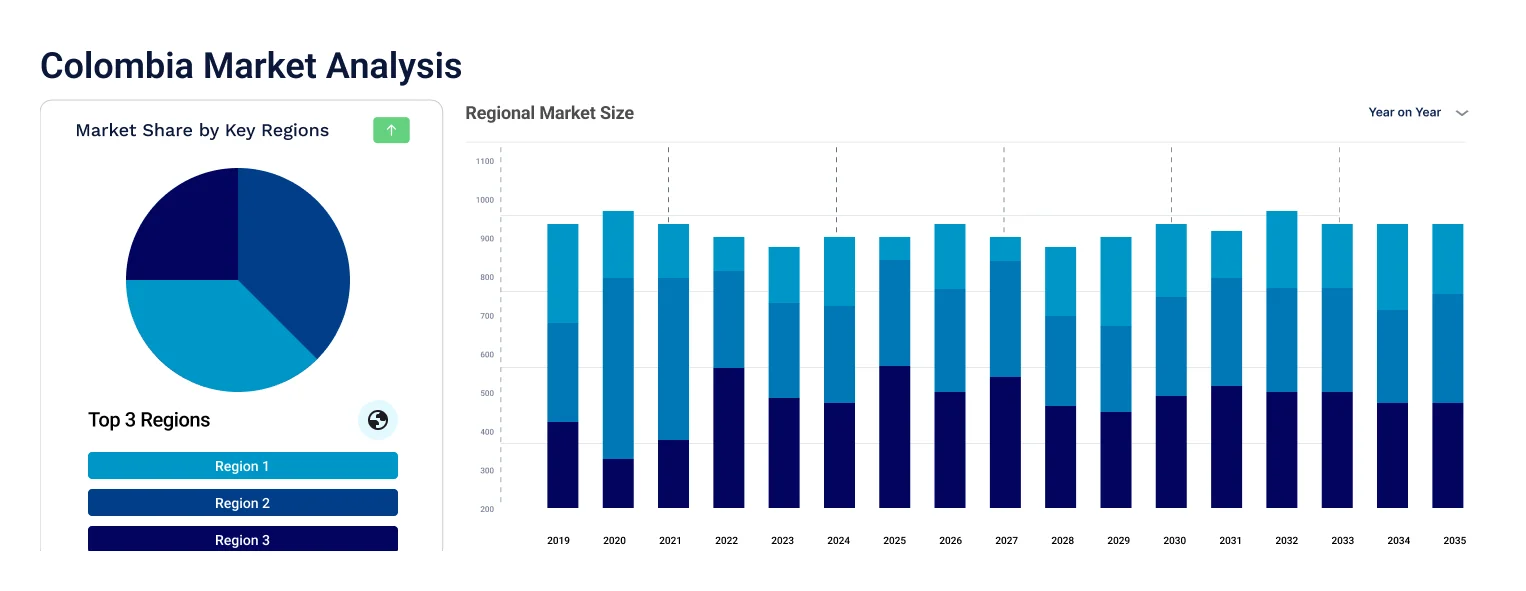
In 2025, the market reached an approximate volume of 2057.39 Kilo Tons.
The market is estimated to grow at a CAGR of 1.10% between 2026 and 2035.
The rice market in Colombia is estimated to witness a healthy growth during 2026-2035 to reach around 2295.24 Kilo Tons by 2035.
Stakeholders are adopting precision farming, expanding storage, improving milling automation, developing differentiated rice products, strengthening farmer partnerships, increasing by-product utilization, and investing in traceability and climate-resilient production.
The key trends aiding the market include the demand for traceability in rice products, the growing popularity of value-added rice, and the implementation of sustainable farming methods.
Based on rice type, market segmentations include long-grain rice, medium-grain rice, and short-grain rice.
Different end uses are food and beverages, retail, and industrial.
Companies are facing volatile paddy prices, climate-related yield risks, import competition, high logistics costs, water constraints, and pressure to modernize milling operations while maintaining affordable consumer prices and reliable farmer procurement.
The key players in the market include Grupo Diana, ORF S.A. Organización Roa Florhuila, Arroz Sonora, Unión de Arroceros S.A.S., Fedearroz, Blanquita, G&C Granos & Cereales among others.
Explore our key highlights of the report and gain a concise overview of key findings, trends, and actionable insights that will empower your strategic decisions.
| REPORT FEATURES | DETAILS |
| Base Year | 2025 |
| Historical Period | 2019-2025 |
| Forecast Period | 2026-2035 |
| Scope of the Report |
Historical and Forecast Trends, Industry Drivers and Constraints, Historical and Forecast Market Analysis by Segment:
|
| Breakup by Rice Type |
|
| Breakup by Processing Type |
|
| Breakup by End Use |
|
| Market Dynamics |
|
|
Competitive Landscape |
|
|
Companies Covered |
|
Single User License
One User
USD 3,999
USD 3,599
tax inclusive*
Datasheet
One User
USD 2,499
USD 2,249
tax inclusive*
Five User License
Five User
USD 4,999
USD 4,249
tax inclusive*
Corporate License
Unlimited Users
USD 5,999
USD 5,099
tax inclusive*
*Please note that the prices mentioned below are starting prices for each bundle type. Kindly contact our team for further details.*
Flash Bundle
Small Business Bundle
Growth Bundle
Enterprise Bundle
*Please note that the prices mentioned below are starting prices for each bundle type. Kindly contact our team for further details.*
Flash Bundle
Number of Reports: 3
20%
tax inclusive*
Small Business Bundle
Number of Reports: 5
25%
tax inclusive*
Growth Bundle
Number of Reports: 8
30%
tax inclusive*
Enterprise Bundle
Number of Reports: 10
35%
tax inclusive*
How To Order

Select License Type
Choose the right license for your needs and access rights.

Click on ‘Buy Now’
Add the report to your cart with one click and proceed to register.

Select Mode of Payment
Choose a payment option for a secure checkout. You will be redirected accordingly.
Strategic Solutions for Informed Decision-Making
Gain insights to stay ahead and seize opportunities.

Get insights & trends for a competitive edge.

Track prices with detailed trend reports.

Analyse trade data for supply chain insights.

Leverage cost reports for smart savings

Enhance supply chain with partnerships.

Connect For More Information
Our expert team of analysts will offer full support and resolve any queries regarding the report, before and after the purchase.
Our expert team of analysts will offer full support and resolve any queries regarding the report, before and after the purchase.
We employ meticulous research methods, blending advanced analytics and expert insights to deliver accurate, actionable industry intelligence, staying ahead of competitors.
Our skilled analysts offer unparalleled competitive advantage with detailed insights on current and emerging markets, ensuring your strategic edge.
We offer an in-depth yet simplified presentation of industry insights and analysis to meet your specific requirements effectively.




