

Consumer Insights
Uncover trends and behaviors shaping consumer choices today
Procurement Insights
Optimize your sourcing strategy with key market data
Industry Stats
Stay ahead with the latest trends and market analysis.
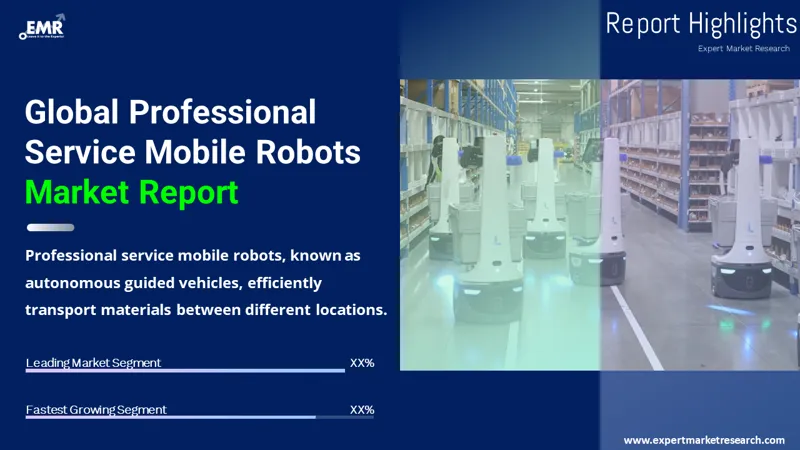
The global professional service mobile robots market was valued at USD 19.50 Billion in 2025. The market is expected to grow at a CAGR of 14.80% during the forecast period of 2026-2035 to reach a value of USD 77.53 Billion by 2035. Growing labor shortages, increasing automation across commercial facilities, and rising demand for autonomous material handling and service operations are some of the factors driving the overall growth in the market. Healthcare, logistics, hospitality, retail, and security organizations are deploying mobile robots to improve operational efficiency and reduce repetitive manual tasks. Advances in artificial intelligence, navigation, computer vision, and sensor technologies are further supporting adoption.
Geekplus marked the US debut of its Geek+ Brain embodied intelligence platform at MODEX 2026 in Atlanta from April 13 to 16, according to a company announcement carried on GlobeNewswire. The launch reflects rising commercial momentum, with new American orders climbing more than 50 percent year-on-year in 2025. This shift signals deeper enterprise adoption of professional service mobile robots across grocery, retail, and third-party logistics operations.
CBS News reported that Moxi, an autonomous Mobile Robot developed by Diligent Robotics, is supporting nursing staff across roughly 25 American hospitals, including Cedars-Sinai in Los Angeles. The robot fetches lab samples, delivers supplies, and rides elevators independently, freeing clinicians to focus on patient care. This expanding deployment underscores how professional service mobile robots are moving from pilot projects into mainstream healthcare workflows, addressing chronic staffing pressure.
There are two major factors behind the positive trend in the professional service mobile robots market. One of the primary factors is the growing labor shortage in industries with an aging workforce, where robots are increasingly being deployed to perform highly repetitive tasks with consistent and reliable results. The second factor is related to lower costs of sensors and AI-based computations, which enable the implementation of better navigation capabilities and multi-floor mobility.
The professional service mobile robots market is experiencing a significant shift towards the emergence of autonomous and highly specialized robots to perform logistics, inspection, healthcare support, and other on-site operations. Companies like Boston Dynamics are scaling up their robots to be used for inspecting industrial sites in cases of repetitive and dangerous operations in the energy and manufacturing sectors. Such moves are highlighting the growing tendency in enterprises to consider mobile robots as infrastructure elements aimed at increasing productivity rather than experimental items. Enterprises that operate mobile robots for inspections are focusing on improving downtime management and employee redeployment in potentially dangerous areas because of the thermal sensing and gas detection capabilities as well as the necessity of robotic movement. Aligning with this trend, in August 2025, HITEK AI partnered with SoftBank Robotics launching Robot-as-a-Service solutions, advancing automated facility management and smart cleaning technologies.
Innovations in the professional service mobile robots market are increasingly focused on specific application cases rather than on technical specifications. Companies strive to create robots that combine the features of AI vision, software fleet orchestration, predictive navigation, and payload capability. These mobile robots can be used in hospitals, airport sites, warehousing, and hospitality venues. For example, in February 2026, Roboworx added AI-powered predictive analytics to Robot Service Manager, improving preventive maintenance and reducing robotic operational downtime significantly.
Compound Annual Growth Rate
14.8%
Value in USD Billion
2026-2035
Read more about this report - REQUEST FREE SAMPLE COPY IN PDF
| Global Professional Service Mobile Robots Market Report Summary | Description | Value |
| Base Year | USD Billion | 2025 |
| Historical Period | USD Billion | 2019-2025 |
| Forecast Period | USD Billion | 2026-2035 |
| Market Size 2025 | USD Billion | 19.50 |
| Market Size 2035 | USD Billion | 77.53 |
| CAGR 2019-2025 | Percentage | XX% |
| CAGR 2026-2035 | Percentage | 14.80% |
| CAGR 2026-2035 - Market by Region | Asia Pacific | 20.6% |
| CAGR 2026-2035 - Market by Country | China | 19.7% |
| CAGR 2026-2035 - Market by Country | Brazil | 17.8% |
| CAGR 2026-2035 - Market by Type | Services | 13.6% |
| CAGR 2026-2035 - Market by End Use | Logistics and Warehousing | 14.1% |
| Market Share by Country 2025 | Australia | 2.3% |
Inbolt created robot programming with a vision that connects computer aided design programs with robotics on the production floor for more efficient implementation. This type of development opens professional service mobile robots market opportunities for companies to incorporate their own AI-based robot programming, smart manufacturing, and automation services.
Robot.com rolled out R-Ads, the first network that transforms self-service robots into advertising vehicles in all commercial settings around the globe. Innovations such as these pushes companies to consider robotics-based advertising options and smart retail automation strategies, boosting the professional service mobile robots market value.
Flexiv demonstrated new-age robots that exhibited enhanced adaptability, smart automation technology, and enhanced collaborative performance. Such innovations suggest possibilities for companies to explore collaborative robotics, automated processes enabled by artificial intelligence, and adaptive services for robots.
Fort Robotics acquired Mapless AI to enhance remote management, autonomous driving capabilities, and active safety technology in their robotic trust platforms. Such innovations allow companies to develop autonomous safety technology, remote robot management, and smart fleet supervision.
As buyers demand robots that possess the ability of dynamic trajectory adjustment, object detection and autonomous operations, artificial intelligence is becoming an important trend in the professional service mobile robots market. Organizations in hospitals, airports, and manufacturing campuses are implementing professional service mobile robots that can navigate using environmental interpretation rather than using static navigation aids. Organizations like Locus Robotics and ABB Ltd. are now considering artificial intelligence mobility and fleet management. On the other hand, in December 2025, Aptiv and Vecna Robotics partnered to develop next-generation autonomous mobile robots, enhancing scalable warehouse automation and intelligent material handling.
Demand in the professional service mobile robots market is increasing through healthcare establishments as these robots cater to medication delivery, cleaning, telepresence, and patient support services. Aging population and staff shortage in hospitals are making healthcare facilities adopt robots that can help in the internal logistics process. Professional service mobile robots fitted with UV disinfectants, medicines, and telecommunication devices are now being deployed in healthcare organizations. Companies like Omron Corporation and Panasonic Holdings Corporation are engaging in robotic activities in their healthcare facilities. In addition, in May 2026, NTU Singapore scientists developed seed-sized surgical robots supporting precision procedures, targeted drug delivery, and minimally invasive healthcare innovation.
While costly hardware investments are an initial deterrent to the application of robotics technology, the new robotics-as-a-service approaches are altering procurement practices. Companies in the professional service mobile robots market are engaging in service-based procurement, which involves reduced capital expenses on hardware procurement, thus making robot implementation flexible. It becomes especially appealing in the areas of hospitality services, logistics, and commercial janitorial services. Companies such as Brain Corp are collaborating with hardware developers to make robotic cleaning machines available through ongoing service subscriptions. In November 2025, OTSAW signed a nine-year Robot-as-a-Service agreement, expanding autonomous healthcare robotics deployment and long-term hospital automation capabilities.
Robotic devices are being incorporated into large-scale infrastructure sites to improve asset inspection and surveillance services and enhance cargo handling services. Large-scale infrastructure spaces, including airports, warehouses, ports, and utilities, are considered to be the key locations for the integration of autonomous mobile robots since they require repetitive actions, long distance traveling, and uptime efficiency. Plans by government agencies to automate infrastructures are indirectly boosting growth in the professional service mobile robots market. In April 2026, Locus Robotics launched Locus Array autonomous fulfillment robots, enabling AI-driven warehouse operations with reduced manual labor and continuous productivity.
Professional service mobile robots are now adopting LiDAR, infrared cameras, depth sensing systems, and edge computing technologies in order to enhance their safety performance when operating around people at work or customers in general. Human-centric robotic technology has become an important purchasing consideration for retailers, healthcare providers, and facility management companies. These robots can detect obstacles and navigate safely around people owing to their technological advancements, thereby accelerating the overall professional service mobile robots market penetration. Companies such as Aethon Inc. and MiR are now equipping robots with better sensor fusion features for use in the indoor enterprise environment. In May 2026, RoboSense reported 1,458.8% LiDAR shipment growth, strengthening robotics perception systems and autonomous navigation technology leadership.
Read more about this report - REQUEST FREE SAMPLE COPY IN PDF
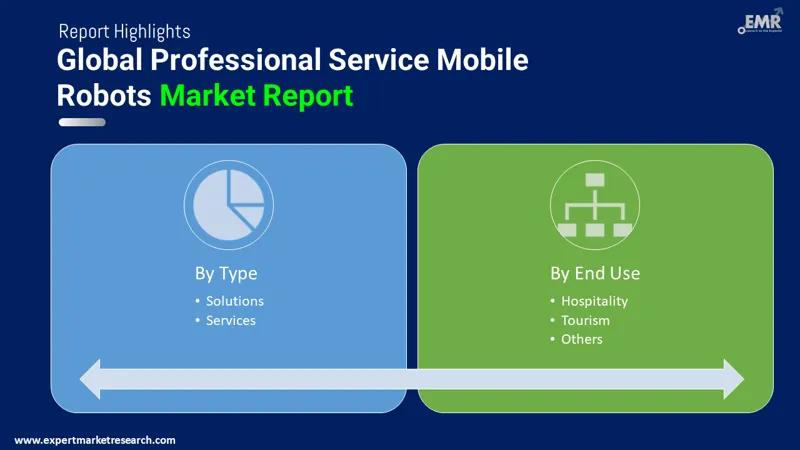
The Expert Market Research's report titled “Global Professional Service Mobile Robots Market Report and Forecast 2026-2035” offers a detailed analysis of the market based on the following segments:
Market Breakup by Type
Key Insight: The solutions segment dominates the professional service mobile robots market as customers want integrated robots that make the process of automation more efficient. The effectiveness of these solutions is driven by their reliance on integrated navigation systems, advanced sensors, and intelligent software technologies. The services segment is growing more rapidly due to the fact that businesses need not only robotic units but also lifecycle management, tuning of AI systems, maintenance plans, and staff training programs. The services segment helps operators avoid many technical challenges by outsourcing work when there are few specialists who know how to use robots within their companies.
Market Breakup by End Use
Key Insight: Robotics adoption is increasing in the logistics and warehousing sector due to repetitive tasks, route optimization needs, and automation efficiency benefits. Robotics are being increasingly adopted in agriculture due to robots' ability to inspect farmlands and facilitate transportation of harvested crops. In mining, robotics are used in mobile robot technology that helps with monitoring and operating in hazardous conditions. In healthcare and medical sectors, robots can help with sanitation and material handling within the facility. The use of robots is increasing in the tourism and hospitality sector as robots assist in delivering efficient housekeeping. Capitalizing on such professional service mobile robots market trends, in January 2026, Serve Robotics acquired Diligent Robotics, expanding physical AI capabilities into hospitals, and autonomous indoor healthcare service robotics.
Market Breakup by Region
Key Insight: The main reasons for the continuous dominance of the North American professional service mobile robots market include advanced automation ecosystems, software integration, and enterprise adoption of robotic workflows. Industrial precision and automated systems are contributing to Europe’s development, along with advanced infrastructure facilities. Rapid growth of Asia Pacific can be attributed to manufacturing scale, urban infrastructure development, and cost-effective robotics. In May 2026, Chinese robotics firm, GigaAI announced plans for affordable home robot launch by 2027, advancing consumer-focused autonomous domestic assistance technologies. Latin America, on the other hand, is developing with increased logistics modernization and warehouse management efficiency. Infrastructure modernization projects, hospitality automation solutions, and industrial monitoring needs are creating new opportunities in the Middle East and African market.
Read more about this report - REQUEST FREE SAMPLE COPY IN PDF
By type, solutions account for the largest market share due to integrated automation demand
The solutions category dominates the professional service mobile robots market since companies prefer comprehensive solutions involving hardware, software, fleet coordination, and AI-based mobility. Hospitals, warehouses, and airports are buying integrated robotics platforms because of faster implementation and higher visibility in operations. Companies are designing modular robots that perform delivery, inspection, sanitation, and surveillance through a single interface. For example, in April 2026, Movigo Robotics launched a mobile robot technology platform supporting autonomous navigation, industrial automation, and scalable robotic fleet management solutions.
Services are growing at the fastest pace due to the need for consulting, software updating, maintenance services, and training operations. The robotics-as-a-service approach is common in the professional service mobile robots market where companies are buying robots along with service packages for technical support in long term engagements. Service firms are extending their capabilities in terms of fleet tracking, analytics, and diagnostic services. In March 2026, Hyundai Motor Group launched MoBed Alliance, accelerating commercialization of advanced modular mobile robot platform technologies.
By end use, the logistics and warehousing category secures the leading market position due to repetitive movement automation
The leading end-use category continues to be represented by the logistics and warehousing sector due to mobile robots' ability to handle picking activities, material handling, transportation, and route optimization. The use of robots in warehouses is becoming more important due to congestion, efficiency, labor management, and increased volumes of activities in a facility. Leveraging such trends, in April 2026, MoviGo Robotics launched modular warehouse robots supporting autonomous logistics, fleet management, and customizable industrial material handling operations.
The medical and healthcare sectors experience rapid growth in the professional service mobile robots market as hospitals embrace mobile robots for medicine transportation, waste handling, sterilization, and logistics near patients. Infection control and the optimization of procedures are becoming critical in healthcare facilities, where there is always a need for consistency and less strain on employees.




Read more about this report - REQUEST FREE SAMPLE COPY IN PDF
North America secures the leading position in the market due to mature robotics commercialization infrastructure
Factors like high enterprise automation maturity, AI integration, and early adoption across logistics, healthcare, and commercial facilities play a major role in sustaining the dominance of the North American professional service mobile robots market. Companies operating within this region spend extensively on robotic testing, fleet management software, and industrial mobility solutions. The high costs of labor are resulting in quicker adoption of robots for completing repetitive tasks in various services sectors. Collaboration between robotics vendors, software providers, and infrastructure providers is also fostering adoption. In January 2026, Zeroth Robotics launched the Zeroth Bot platform, supporting AI-powered autonomous robotics development and intelligent automation applications.
Asia Pacific represents the fastest-growing regional professional service mobile robots market due to expanding industrial automation, rising smart facility investments, and stronger robotic manufacturing ecosystems. Applications like warehousing, healthcare, hospitality, and agriculture are driving the adoption process in Asia Pacific economies where the rapid pace of urbanization is evident. Enterprises are focusing on deploying affordable autonomous mobility options in labor-intensive settings. Robotic manufacturers operating in this region are developing application-specific robots for cleaning, transport, and inspection purposes.
The global industry is becoming more innovation-intensive whereby professional service mobile robot companies are differentiating themselves by designing mobility platforms specific to their products, using artificial intelligence in navigation, and designing automation solutions specific to sectors like hospitals, warehouses, hotels, and factories, for tasks related to moving objects, cleaning, inspecting, and guest interaction.
The major area of focus for professional service mobile robots market players is developing robots that offer modular designs enabling organizations to add different types of cargo loads, sensors, and software systems depending on the task at hand. Additionally, there are efforts to develop improved fleet intelligence systems that optimize robotic fleet management and maintenance operations. The robotics-as-a-service model is bringing a new business opportunity for companies aiming to reach customers that do not want high initial capital outlays. Another significant opportunity in the robotics market lies in developing robots that enable safer and more effective human-robot interaction through the integration of LiDAR, vision systems, and advanced obstacle-detection technologies for indoor environments.
Clearpath Robotics is an organization established in 2009, headquartered in Canada. This firm concentrates on developing autonomous mobile robotic platforms used in industries and research institutions. Clearpath supports the use of unmanned navigation, robust robotic mobility, and warehouse automation. Its core competence in the market is providing flexible robotic platforms.
Midea Group is an organization established in 1968 and operates from Foshan, China. It mainly focuses on robotics, intelligent automation, and smart industrial mobility. Midea Group concentrates on improving the efficiency of robots using automation to aid the market growth.
Omron Corporation was founded in 1933 in Kyoto, Japan and provides its services in the professional services mobile robots category by means of transport, sensing, and automation technology solutions. The company provides solutions in the field of healthcare, logistics, and smart manufacturing. Precision sensing and navigation are the distinguishing factors of the company's robotics.
Founded in 2013 in California, United States, Savioke specializes in indoor mobile robots for the field of hospitality and healthcare. The organization serves the market through autonomous robots used for the purpose of improving guest services and reducing repetitive labor among other benefits of operating contactless indoors.
Other key players in the market include Singapore Technologies Engineering Ltd., and Teradyne Inc., among others.
*Please note that this is only a partial list; the complete list of key players is available in the full report. Additionally, the list of key players can be customized to better suit your needs.*
Unlock the latest insights with our professional service mobile robots market trends 2026 report. Discover regional growth patterns, consumer preferences, and key industry players. Stay ahead of competition with trusted data and expert analysis. Download your free sample report today and drive informed decisions in the market.


Upto 15% Off
USD
$2499 $2249
$3999 $3599
$4999 $4249
$5999 $5099


*While we strive to always give you current and accurate information, the numbers depicted on the website are indicative and may differ from the actual numbers in the main report. At Expert Market Research, we aim to bring you the latest insights and trends in the market. Using our analyses and forecasts, stakeholders can understand the market dynamics, navigate challenges, and capitalize on opportunities to make data-driven strategic decisions.*
The global professional service mobile robots market is projected to grow at a CAGR of 14.80% between 2026 and 2035.
The major drivers of the industry, such as the rising overall population and the increasing focus of vendors on technological advancements and R&D investments, are expected to aid the market growth.
The key market trend guiding the industry growth includes the rising demand from the emerging economies.
The major regions in the industry are North America, Latin America, the Middle East and Africa, Europe, and the Asia Pacific.
Solutions and services are the leading types of the product in the industry.
Logistics and warehousing, agriculture, mining, medical and healthcare, hospitality, and tourism, among others, are the significant end-uses of professional service mobile robots.
The major players in the industry are Clearpath Robotics, Inc., Midea Group Co. Ltd., Omron Corporation, Savioke Inc., Singapore Technologies Engineering Ltd., and Teradyne Inc., among others.
In 2025, the global professional service mobile robots market reached an approximate value of USD 19.50 Billion.
The market is expected to attain approximately USD 77.53 Billion by 2035.
Explore our key highlights of the report and gain a concise overview of key findings, trends, and actionable insights that will empower your strategic decisions.
| REPORT FEATURES | DETAILS |
| Base Year | 2025 |
| Historical Period | 2019-2025 |
| Forecast Period | 2026-2035 |
| Scope of the Report |
Historical and Forecast Trends, Industry Drivers and Constraints, Historical and Forecast Market Analysis by Segment
|
| Breakup by Type |
|
| Breakup by End Use |
|
| Breakup by Region |
|
| Market Dynamics |
|
| Competitive Landscape |
|
| Companies Covered |
|
| Report Price and Purchase Option | Explore our purchase options that are best suited to your resources and industry needs. |
| Delivery Format | Delivered as an attached PDF and Excel through email, with an option of receiving an editable PPT, according to the purchase option. |
Datasheet
One User
USD 2,499
USD 2,249
tax inclusive*
Single User License
One User
USD 3,999
USD 3,599
tax inclusive*
Five User License
Five User
USD 4,999
USD 4,249
tax inclusive*
Corporate License
Unlimited Users
USD 5,999
USD 5,099
tax inclusive*
*Please note that the prices mentioned below are starting prices for each bundle type. Kindly contact our team for further details.*
Flash Bundle
Small Business Bundle
Growth Bundle
Enterprise Bundle
*Please note that the prices mentioned below are starting prices for each bundle type. Kindly contact our team for further details.*
Flash Bundle
Number of Reports: 3
20%
tax inclusive*
Small Business Bundle
Number of Reports: 5
25%
tax inclusive*
Growth Bundle
Number of Reports: 8
30%
tax inclusive*
Enterprise Bundle
Number of Reports: 10
35%
tax inclusive*
How To Order

Select License Type
Choose the right license for your needs and access rights.

Click on ‘Buy Now’
Add the report to your cart with one click and proceed to register.

Select Mode of Payment
Choose a payment option for a secure checkout. You will be redirected accordingly.
Strategic Solutions for Informed Decision-Making
Gain insights to stay ahead and seize opportunities.

Get insights & trends for a competitive edge.

Track prices with detailed trend reports.

Analyse trade data for supply chain insights.

Leverage cost reports for smart savings

Enhance supply chain with partnerships.

Connect For More Information
Our expert team of analysts will offer full support and resolve any queries regarding the report, before and after the purchase.
Our expert team of analysts will offer full support and resolve any queries regarding the report, before and after the purchase.
We employ meticulous research methods, blending advanced analytics and expert insights to deliver accurate, actionable industry intelligence, staying ahead of competitors.
Our skilled analysts offer unparalleled competitive advantage with detailed insights on current and emerging markets, ensuring your strategic edge.
We offer an in-depth yet simplified presentation of industry insights and analysis to meet your specific requirements effectively.




