

Consumer Insights
Uncover trends and behaviors shaping consumer choices today
Procurement Insights
Optimize your sourcing strategy with key market data
Industry Stats
Stay ahead with the latest trends and market analysis.
The oral biologic drug delivery technologies market was valued at USD 2.86 Billion in 2025 and is projected to reach USD 11.08 Billion by 2035, growing at a CAGR of 14.50%. Growth is supported by the rising burden of type 2 diabetes and obesity, patient demand for needle-free dosing, approvals of oral peptide drugs and the maturing of permeation enhancer and ingestible device platforms.
Patent activity has built steadily since 2020, with filings concentrated in permeation enhancer formulations, ingestible injection capsules, enzyme inhibitor co-delivery and nanoparticle carriers. Regulatory validation from oral semaglutide, oral octreotide, the first oral PCSK9 inhibitor and the first oral IL-23 receptor peptide has widened the commercial case for new filings.
This Oral Biologic Drug Delivery Technologies Patent Landscape Analysis Report maps assignees, jurisdictions and technology clusters to support portfolio, partnering and freedom-to-operate decisions.
The oral biologic drug delivery technologies market is experiencing strong growth, driven by rising prevalence of type 2 diabetes and obesity, patient preference for needle-free dosing, and approvals of oral peptide therapies. The FDA approval of the Wegovy pill in December 2025 and of icotrokinra in March 2026 showed that oral peptides can reach large primary-care and dermatology populations.
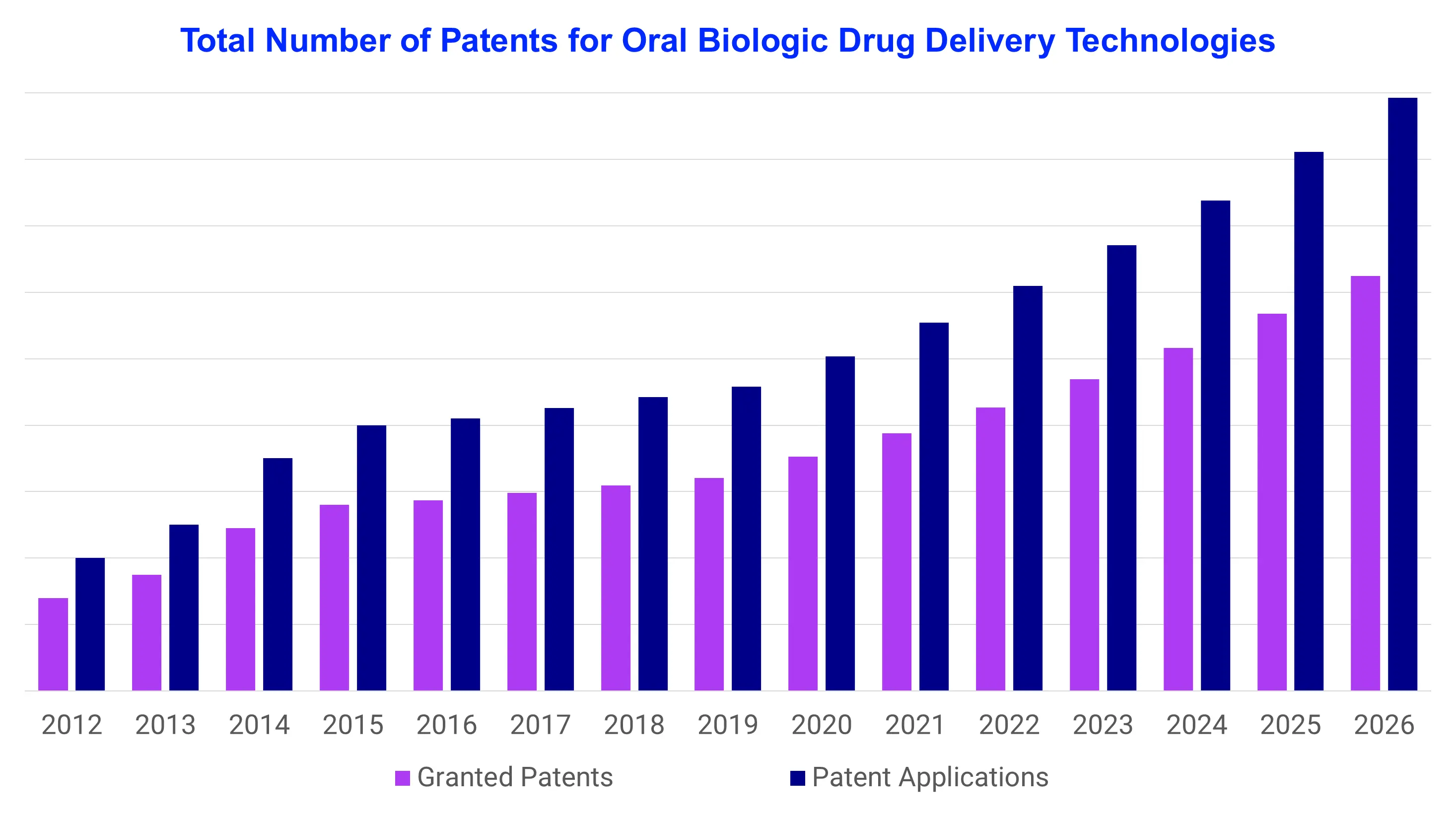
Patent activity is accelerating, with 300+ oral biologic drug delivery technologies patents granted in 2025, reflecting strong innovation momentum in intestinal permeation enhancer formulations, ingestible needle and injection capsules, enzyme-protected nanoparticle carriers, and pH-triggered targeted release coatings.
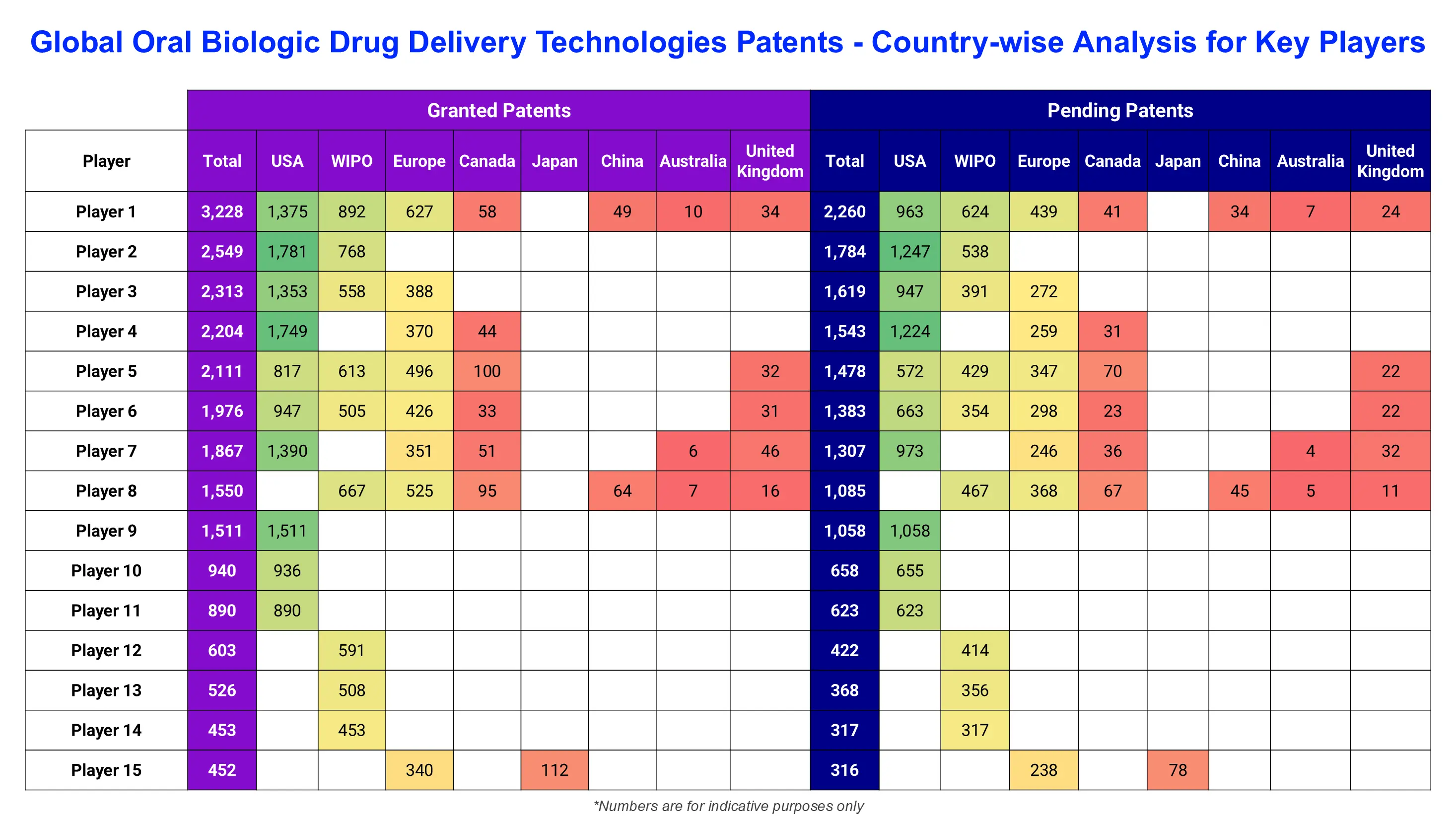
Top assignees in the oral biologic drug delivery technologies patent landscape include Novo Nordisk, Merck, Eli Lilly, Johnson & Johnson, and Rani Therapeutics, with the United States, China, and Europe as the dominant patent jurisdictions.
Oral delivery of biologics addresses one of the oldest barriers in pharmaceutical science: peptides and proteins degrade in gastric acid, meet digestive enzymes and cross the intestinal wall poorly. Developers now combine absorption enhancers, enzyme protection, protective coatings and ingestible devices to raise bioavailability from fractions of a percent toward clinically useful levels. Demand is strongest in chronic conditions where patients take lifelong injections, such as diabetes, obesity, osteoporosis and acromegaly.
The market growth is driven by the commercial success of oral semaglutide, which showed that a peptide tablet can serve a mass-market chronic indication. Roughly 590 million adults live with diabetes worldwide according to the International Diabetes Federation, and the FDA approved the Wegovy pill in December 2025.
The FDA approval of Merck's oral PCSK9 inhibitor enlicitide in July 2026 matters because cardiovascular risk reduction involves tens of millions of statin-treated patients, which enlarges the addressable base for oral peptide platforms. Johnson & Johnson's icotrokinra, approved in March 2026 for plaque psoriasis, extended the model into immunology and invites similar programmes against other cytokine receptors. North America leads because payers there reimburse the first approved products, and each approval lowers perceived technical risk for the next licensing deal.
Read more about this report - REQUEST FREE SAMPLE COPY IN PDF
Patent filings in oral biologic drug delivery are driven by the success of permeation enhancer tablets and by the search for delivery routes for obesity and cardiovascular peptides. Filers pursue formulation claims, device claims and method-of-use claims, so a single product often sits behind several overlapping families. Oral peptide programmes at large pharmaceutical companies have raised annual filing counts since 2020.
The report identifies about 6,740+ patent families, with filings peaking in 2022 to 2024 as oral GLP-1 and macrocyclic peptide programmes advanced into late-stage trials. The 2025 grant count of 300+ reflects the earlier filing wave moving through examination. Primary jurisdiction patents number about 2,930+.
Commercial proof from oral semaglutide, oral octreotide and enlicitide has directed new filings toward permeation enhancers, ingestible devices and enzyme-protected carriers.
The study covers patents and published applications on delivery systems that carry peptides, proteins, antibody fragments, insulin and selected nucleic acid biologics through the oral route. It spans permeation enhancers, enzyme inhibitors, nanoparticle and lipid carriers, mucoadhesive systems, ingestible injection devices and targeted release coatings.
Coverage runs from early filings to 2026 and includes granted patents, pending applications and family-level status in major jurisdictions. Each family is classified by delivery technology, biologic class and therapeutic area, which allows comparison of filing intensity across clusters.
The analysis profiles pharmaceutical companies, biotechnology developers, contract development organisations, academic institutes and specialty delivery firms that hold oral biologic delivery families.
The report will cover the following sections in detail:
Analysis by Delivery Technology
Analysis by Biologic Class
Analysis by Therapeutic Area
Oral Biologic Drug Delivery Technologies Patent Filing Trend Analysis
Filings for oral biologic drug delivery technologies grew at an estimated 11% a year across 2020 to 2024. The rise followed positive phase 3 data for oral semaglutide and the entry of macrocyclic peptide programmes into cardiovascular and immunology trials. Pharmaceutical companies account for most of the growth, with biotechnology firms adding device-focused families.
Growth is strongest in permeation enhancer formulations and in ingestible injection capsules, where Rani Therapeutics reported positive phase 1 data for its RT-114 obesity candidate in 2025. Nanoparticle carriers and mucoadhesive patches show slower but steady filing gains, since most programmes remain in preclinical and early clinical work.
Among the players with oral biologic drug delivery technologies patent families, new entrants have been identified, which can be either established companies or startups developing novel technology in the field. Some of the major companies mentioned in this report (a non-exhaustive list) are as follows:
Novo Nordisk holds the broadest commercial position in oral peptide delivery, built on the sodium salcaprozate (SNAC) absorption technology gained with the Emisphere acquisition in 2020. Its portfolio covers SNAC-to-peptide ratios, tablet composition, dosing regimens and new indications for oral semaglutide. Rybelsus has been marketed for type 2 diabetes since 2019, and the Wegovy pill received FDA approval for weight management in December 2025. The company files layered families around formulation, dose and use, which extends exclusivity beyond the base compound patents. Novo Nordisk positions oral dosing as a route to the large primary-care obesity and diabetes population.
Merck concentrates its oral biologic filings on macrocyclic peptides that survive gastric and intestinal conditions, led by enlicitide decanoate, an oral PCSK9 inhibitor. The FDA approved the product as Lipfendra in July 2026 after the CORALreef phase 3 programme reported large LDL cholesterol reductions. The portfolio spans peptide structures, salt forms, permeation-assisted tablet formulations and dosing methods in cardiovascular risk reduction. Merck pairs compound claims with formulation claims so that the tablet and the active peptide are protected together. The company positions the product against injectable PCSK9 antibodies in the statin-treated population.
Other companies include Eli Lilly, Johnson & Johnson, and Rani Therapeutics.
Novo Nordisk and Merck hold the largest portfolios, together representing a leading share of the top-assignee families. Eli Lilly, Johnson & Johnson and Rani Therapeutics follow with targeted holdings in oral peptide formulations, immunology peptides and ingestible devices. The balance of the field is spread across biotechnology firms, universities and contract developers.
*Please note that this is only a partial list; the complete list of key players is available in the full report. Additionally, the list of key players can be customized to better suit your needs.*
The report assesses patent activity across major jurisdictions, including:
The United States leads in filing volume, supported by the commercial oral peptide products approved by the FDA and the concentration of large pharmaceutical applicants. China ranks second as domestic developers and universities file on oral insulin, peptide carriers and nanoparticle systems. Europe follows through European Patent Office filings from Danish, German and Swiss applicants.
Read more about this report - REQUEST FREE SAMPLE COPY IN PDF
The report segments patent activity by the following technology areas:
Among these, permeation enhancer systems hold the largest share of patent families, supported by the commercial record of SNAC-based oral semaglutide and the enhancer formulation behind oral octreotide.
Competition centres on companies that hold a clinical product alongside formulation families. Novo Nordisk leads through its SNAC-based oral semaglutide franchise, while Merck has built a position in oral macrocyclic peptides. Smaller firms such as Rani Therapeutics and Entera Bio compete through device and enhancer technology licensed to larger partners.
Companies are focusing on:
Emerging innovation themes include ingestible capsules that inject biologics into the intestinal wall, oral delivery of antibody fragments for inflammatory bowel disease, and machine-learning design of permeation enhancer libraries. Bile-salt and ionic-liquid carriers are attracting early filings for oral insulin. Co-formulation of peptides with enzyme inhibitors in a single tablet is also advancing, with emphasis on lower dose variability between patients.
The field combines mature enhancer technology with a fast-growing set of device and carrier concepts. Large pharmaceutical companies hold the commercial anchors, and licensing from platform firms supplies new formulation and device options. Gaps remain in oral antibodies and large proteins, where bioavailability is still low and few families reach late-stage trials.
Technology segments, assignee portfolios and jurisdiction trends in oral biologic delivery are mapped in this report. The report provides actionable intelligence supporting:
The study draws on patent records from the USPTO, the European Patent Office, the China National Intellectual Property Administration, the Japan Patent Office and the WIPO PATENTSCOPE database. Searches combine keywords with CPC classes such as A61K 9/00, A61K 47/00, A61K 38/00 and A61K 9/48.
Retrieved records are screened for relevance, consolidated into simple families and classified by delivery technology, biologic class and therapeutic area. Assignee names are normalised to parent companies, and legal status is checked at the family level.
The market side draws on FDA and EMA approval records, company filings, ClinicalTrials.gov entries and peer-reviewed literature on oral peptide bioavailability. These sources link patent activity to clinical progress and commercial adoption.
Oral Proteins and Peptides Market
Glucagon-like Peptide-1 (GLP-1) Agonists Market
Smart Insulin Delivery Devices Patent Landscape Analysis Report


Upto 15% Off
USD
$2699 $2429
$4299 $3869
$5799 $4949
$6999 $5949


*While we strive to always give you current and accurate information, the numbers depicted on the website are indicative and may differ from the actual numbers in the main report. At Expert Market Research, we aim to bring you the latest insights and trends in the market. Using our analyses and forecasts, stakeholders can understand the market dynamics, navigate challenges, and capitalize on opportunities to make data-driven strategic decisions.*
EMR’s Oral Biologic Drug Delivery Technologies Patent Landscape Analysis provides a comprehensive assessment of patent filings, innovation clusters, assignee portfolios, and geographic filing patterns across the oral biologic drug delivery technologies landscape. The report identifies 6,740+ patent families, evaluates leading jurisdictions including the United States, China, and Europe, and profiles the top assignees by portfolio size.
The global oral biologic drug delivery technologies market was valued at USD 2.86 Billion in 2025. The market is projected to reach USD 11.08 Billion by 2035, expanding at a CAGR of 14.50% during 2026 - 2035.
The report analyses approximately 6,740+ patent families related to oral biologic drug delivery technologies. These include filings from the United States, China, Europe, and international WIPO filings.
Key companies operating within the landscape include Novo Nordisk, Merck, Eli Lilly, Johnson & Johnson, and Rani Therapeutics, among others. These organisations collectively account for a significant portion of patent activity analysed in this report.
The report evaluates patent activity across the United States, Europe, China, Japan, South Korea, India, and international WIPO filings. The United States leads oral biologic drug delivery patent activity, supported by FDA-approved oral peptide products and a large base of pharmaceutical applicants.
Yes. The report scope can be customised based on geography, technology segment, assignee selection, time period, or specific innovation cluster focus. Please connect with the EMR team to define the customisation scope.
Patent landscape analysis helps organisations understand innovation trends, competitive activity, technology whitespace, and IP risk across a defined domain. For oral biologic drug delivery technologies, this report supports strategic decisions in R&D prioritisation, licensing evaluation, competitive benchmarking, and market entry planning.
Explore our key highlights of the report and gain a concise overview of key findings, trends, and actionable insights that will empower your strategic decisions.
|
Scope of the Report |
Details |
|
Analysis by Delivery Technology |
|
|
Analysis by Biologic Class |
|
|
Analysis by Therapeutic Area |
|
|
Analysis by End User |
|
|
Key Players Mentioned |
|
|
Geographies Covered |
|
Mini Report
One User
USD 2,699
USD 2,429
tax inclusive*
Single User License
One User
USD 4,299
USD 3,869
tax inclusive*
Five User License
Five User
USD 5,799
USD 4,949
tax inclusive*
Corporate License
Unlimited Users
USD 6,999
USD 5,949
tax inclusive*
*Please note that the prices mentioned below are starting prices for each bundle type. Kindly contact our team for further details.*
Flash Bundle
Small Business Bundle
Growth Bundle
Enterprise Bundle
*Please note that the prices mentioned below are starting prices for each bundle type. Kindly contact our team for further details.*
Flash Bundle
Number of Reports: 3
20%
tax inclusive*
Small Business Bundle
Number of Reports: 5
25%
tax inclusive*
Growth Bundle
Number of Reports: 8
30%
tax inclusive*
Enterprise Bundle
Number of Reports: 10
35%
tax inclusive*
How To Order

Select License Type
Choose the right license for your needs and access rights.

Click on ‘Buy Now’
Add the report to your cart with one click and proceed to register.

Select Mode of Payment
Choose a payment option for a secure checkout. You will be redirected accordingly.
Strategic Solutions for Informed Decision-Making
Gain insights to stay ahead and seize opportunities.

Get insights & trends for a competitive edge.

Track prices with detailed trend reports.

Analyse trade data for supply chain insights.

Leverage cost reports for smart savings

Enhance supply chain with partnerships.

Connect For More Information
Our expert team of analysts will offer full support and resolve any queries regarding the report, before and after the purchase.
Our expert team of analysts will offer full support and resolve any queries regarding the report, before and after the purchase.
We employ meticulous research methods, blending advanced analytics and expert insights to deliver accurate, actionable industry intelligence, staying ahead of competitors.
Our skilled analysts offer unparalleled competitive advantage with detailed insights on current and emerging markets, ensuring your strategic edge.
We offer an in-depth yet simplified presentation of industry insights and analysis to meet your specific requirements effectively.




