

Consumer Insights
Uncover trends and behaviors shaping consumer choices today
Procurement Insights
Optimize your sourcing strategy with key market data
Industry Stats
Stay ahead with the latest trends and market analysis.
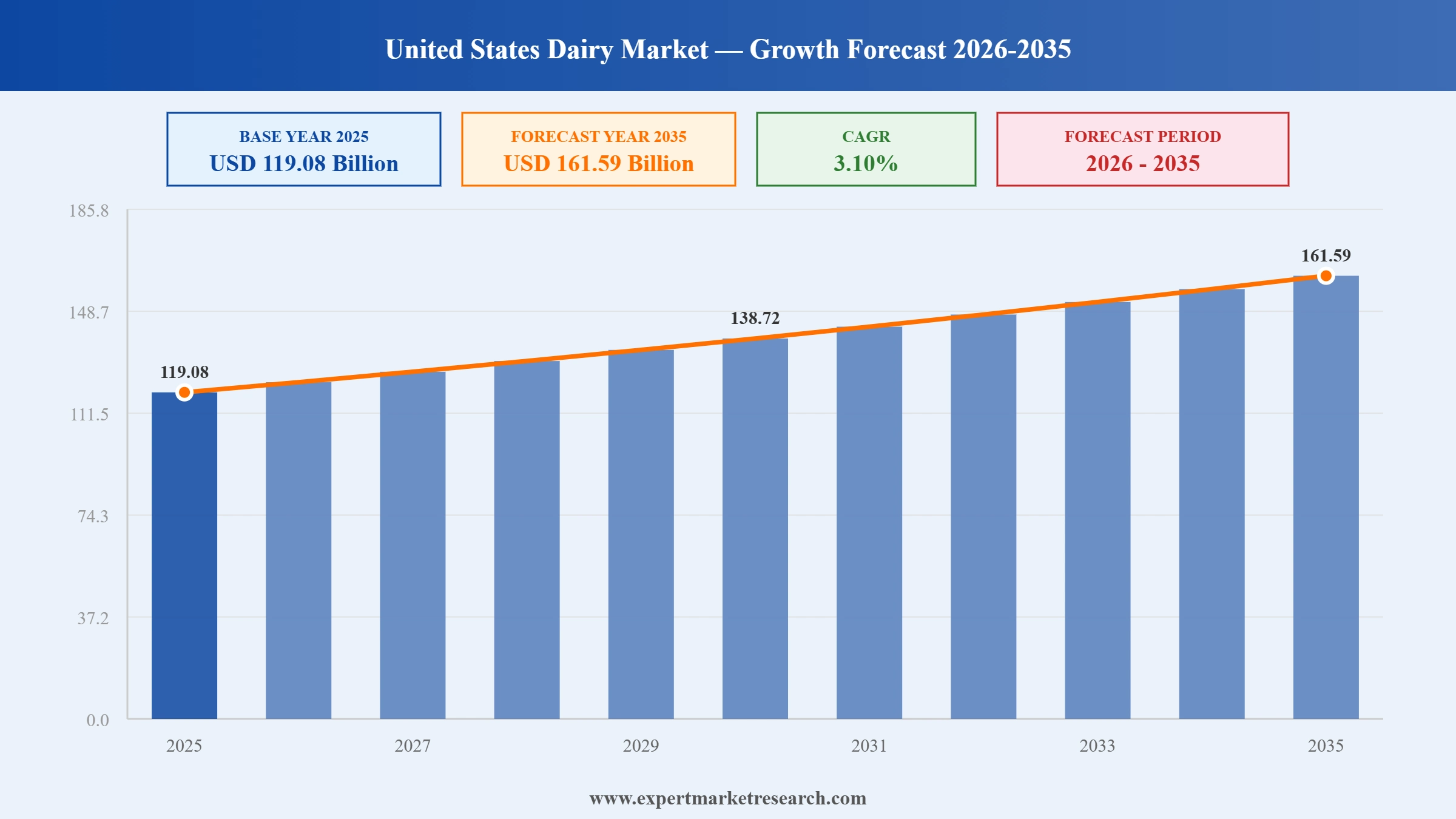
The United States dairy market attained a value of USD 119.08 Billion in 2025 and is projected to expand at a CAGR of 3.10% through 2035. The market is further expected to achieve USD 161.59 Billion by 2035. Increasing demands from food manufacturers for dairy products rich in protein and exportable are compelling dairy processors to invest in filtration, whey production, formulation, and production infrastructure.
Increasing commercialization of dairy functional foods is compelling dairy product manufacturers to provide differentiation to their established product categories by means of nutrition-based differentiation. For instance, Meadow Gold Protein+ provides 15 grams of protein per serving. On the other hand, diversification into export business is providing another dimension for growth.
In the United States dairy market, the major players are increasingly reworking on traditional categories such as protein density, lactose removal, convenience, and specialty products. For example, in May 2026, Dairy Farmers of America launched protein-based dairy products using Alta Dena and Meadow Gold, each offering 15 grams of protein per serving. The regional brands are leveraged to introduce unique products in the market.
On the other hand, in June 2026, Dairy Farmers of America boosted the trend of value-added dairy innovations by launching Kemps Protein+ Milk, an ultra-filtered product free from lactose with 13 grams of protein and 50% less sugar content per serving. The innovation not only adds a shelf life of up to 120 days but also gives flexibility to retailers and foodservice distributors while focusing on premium nutritional consumption. It is an indication of the growing trend of high-functioning dairy. As per the United States dairy market analysis, the export sector witnessed a 4% increase in volume in 2025, and 6% rise in volume of high-protein whey.
Read more about this report - REQUEST FREE SAMPLE COPY IN PDF
A taste technology platform was introduced by Edlong which enables companies to create authentic flavoring solutions for dairy and non-dairy flavors in innovative food and beverages. Companies may be able to utilize their knowledge of taste technology and create hybrid dairy products that can cater to the current demand in the United States dairy market.
Coca-Cola Company and Fairlife marked the expansion of their USD 650 million dairy facility, increasing their capacity for producing ultrafiltered milk. Dairy companies may invest in processing plants and high-value-added milk products owing to the growing demand for such products.
Patanjali Dairy USA bought out Harrisburg Dairies, thereby increasing their manufacturing capacity in the United States. Companies can make strategic acquisitions of an existing facility so as to rapidly increase their manufacturing capacity and penetrate new markets within the region.
The Dairy Checkoff launched the Dairy Does More campaign, which is aimed at showcasing the nutrition, functionality, and other aspects of dairy products. Companies in the United States dairy market can engage in consumer campaigns that focus on the benefits of dairy products.
Product innovation based on proteins is one of the primary driving factors for growth as dairy companies innovate their existing products for sports nutrition, wellness, and premium positioning in the retail market. In April 2026, MULU launched the first national cottage cheese brand, expanding access to protein-rich dairy products through nationwide retail distribution. The firm also offers Alta Dena Protein with 15 grams of protein per serving. Moreover, innovation in the United States dairy market is expected to continue as USDA allocated over USD 11 million in January 2026 for product development, production, marketing, and distribution through the Dairy Business Innovation Initiatives.
Growth opportunities for processors continue to arise with the development of lactose-free and ultra-filtered products as dairy processors can utilize advanced filtration techniques to enhance protein density, reduce sugar content, and commercialize their products. In July 2026, Philadelphia launched lactose-free cream cheese, expanding accessibility, and meeting growing consumer demand for inclusive, convenient dairy products. This trend in the United States dairy market enables greater flexibility for inventory managers at retailers and distributors. USDA's Dairy Business Innovation Initiatives are designed to facilitate modernization, specialization, packaging, and value chain innovation.
The growing international demand is increasingly motivating the development of export-oriented cheese, butterfat, and high-protein ingredients portfolio in United States. The high-protein whey export volume increased by 6% to 77,811 metric tons. This indicates potential for businesses engaged in the production of high-value ingredients to invest in their processing capabilities. USDA reported record volume of dairy export in the first quarter of 2026, driven by the growing demand for cheese, butter, dry skim products, and dry whey. Aligning with such trends in the United States dairy market, in July 2026, Tropical Cheese acquired Pineland Farms Dairy’s Bangor plant, expanding cheese production capacity and strengthening its manufacturing footprint.
Growing supply of milk makes companies inclined towards investments into their processing capacities and innovations which might allow converting large quantities of milk into valuable products. According to the United States dairy market analysis, milk production in the country is expected to reach 236.6 billion pounds in 2026. According to USDA, the output of milk has grown by 62% since 1985 as a result of improvements in genetics, technology, and industry consolidation. Following such trends, in June 2026, Darigold opened its Pasco facility, the Northwest’s largest dairy processing plant, expanding regional production capacity and efficiency. The existing market conditions create opportunities for the development of automation, membrane filtration, cheese capacity, whey fractionation, and manufacturing capabilities.
Firms in the United States dairy market are turning to their regional brand names as part of efforts to market their functional foods, taking advantage of their local supply chains and current distribution networks. In November 2025, Arla Foods Ingredients unveiled new high-protein concepts, showcasing innovative formulations and expertise to address evolving consumer nutrition demands. This case shows how the processor can expand its business using its premium formulas and brand name.
The Expert Market Research's report titled “United States Dairy Market Report and Forecast 2026-2035” offers a detailed analysis of the market based on the following segments:
Market Breakup by Product
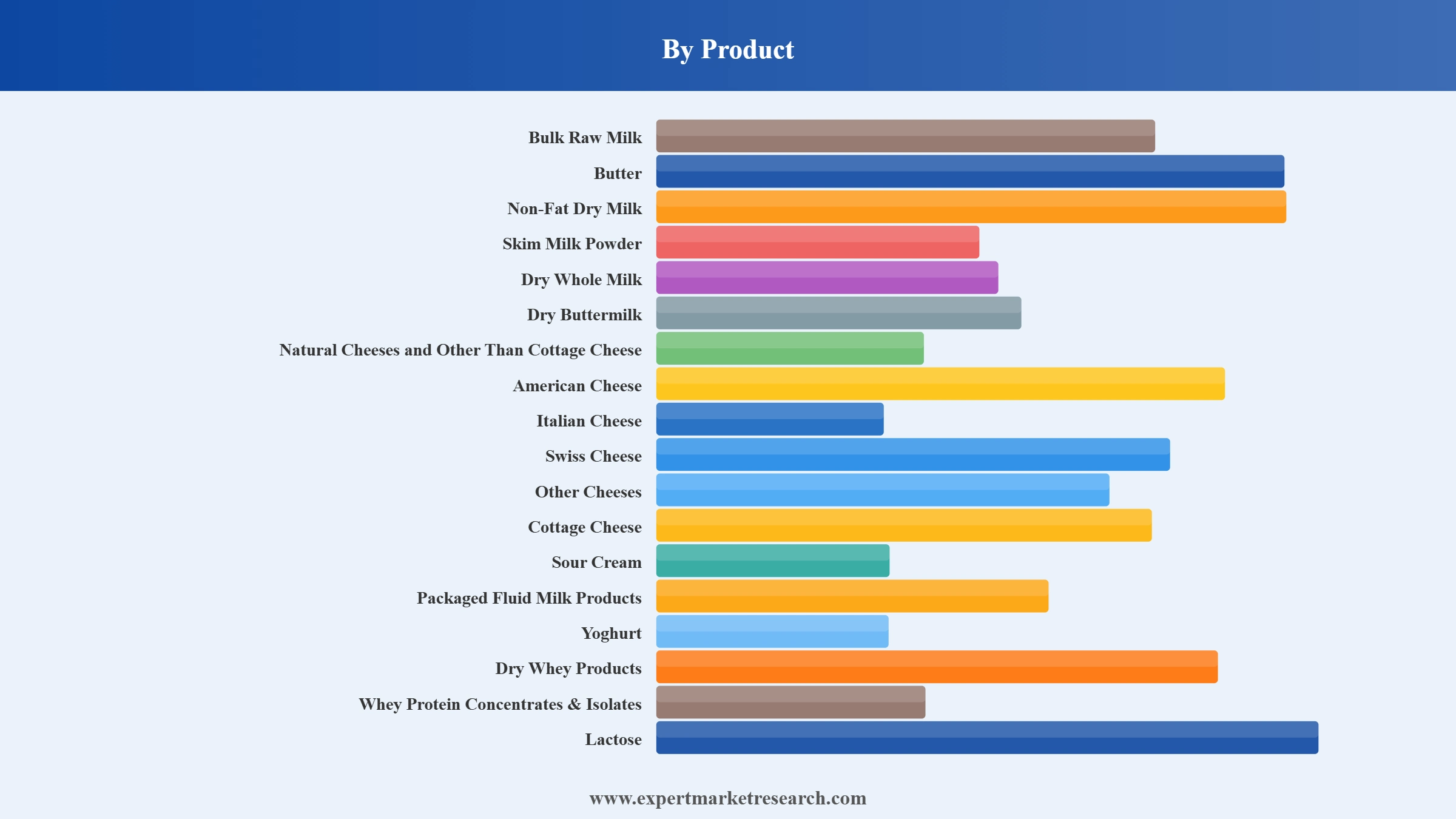
Key Insight: As per the United States dairy market report, bulk raw milk continues to be important in the downstream processing process, enabled by standard procurement processes in all dairy plants. Butter is useful in food processing and foodservice formulations, whereas non-fat dry milk and skim milk powder are needed in formulations and ingredients. Dry whole milk and dry buttermilk have applications in special bakery and processed food formulations. Natural cheeses, American cheese, Italian cheese, Swiss cheese, specialty cheese, and cottage cheese need culinary formulations and product differentiation. Sour cream and bottled fluid milk have applications in convenience formulations, while yogurt has nutritional applications.
Market Breakup by Structure
Key Insight: Growth of the co-operative dairies is more centered around integrated systems of farmer supplies, joint purchasing capacity, and multiple processing options to optimize the use of milk in all product categories. Private dairies revolve around higher product development flexibility, specialized manufacturing, premiumization and customization of the product. In November 2025, Remilk and Gad Dairies launched “The New Milk,” a cow-free dairy beverage combining tradition with innovative technology. The co-operatives concentrate on economies of scale, supply chain safety and value addition through cooperation of their member producers while the private dairies concentrate on speed, differentiated portfolio, strategic alliances and investments. Both these structures in the United States dairy market are important to create competition with their development being dependent upon processing efficiencies, added value products and consistent sources of supply.
Market Breakup by Region
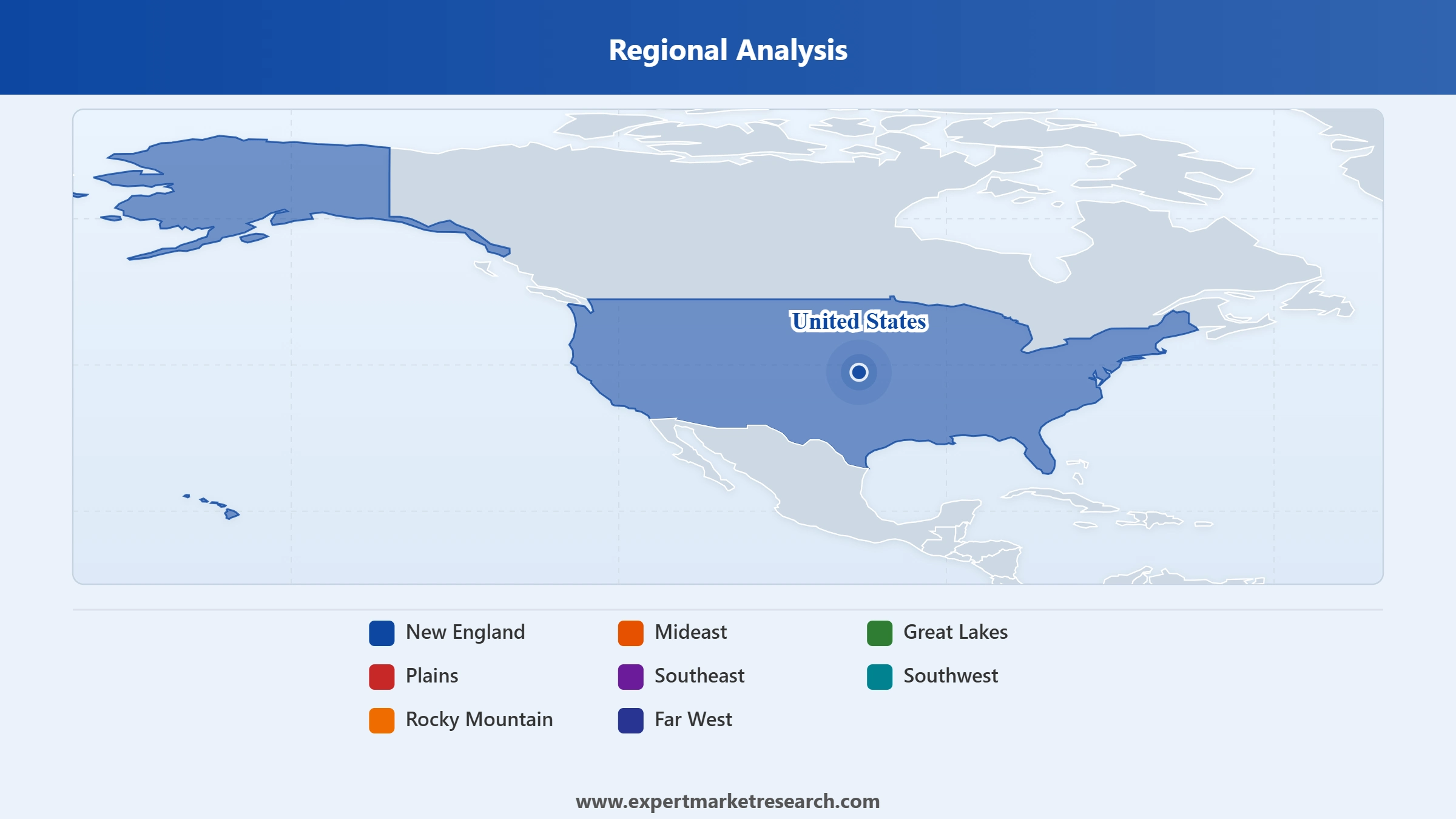
Key Insight: New England operates on the basis of premium regional and specialty dairy positioning, while the Mideast enjoys the advantage of proximity to large-scale consumer and foodservice markets. The Great Lakes is positioned through high density of milk production, expertise in cheese and process integration. The Plains enjoys an advantage of efficient large-scale production systems, while the Southeast United States dairy market runs on population growth and regional distribution. The Southwest is advantaged through growing investment in milk production and processing. The Rocky Mountains enjoy prospects in specialty and regional dairy products. The Far West is vital for large-scale milk production and processing, as well as exporting and manufacturing.
By product, natural cheese registers the largest share of the market due to widespread foodservice integration and strong retail demand
Natural cheese leads the United States dairy market growth owing to their wide use in retail, foodservice, and food manufacturing industries. Processors have an opportunity to capitalize on premiumization, shredded cheese, snack products, and ingredients for pizza and prepared foods. Different varieties of American, Italian, Swiss, and specialty cheeses provide diversification of the products line. At the same time, the aging process, blending, and regional sourcing allow for product differentiation. Processors can utilize the flexibility of these cheeses to serve both consumer and commercial markets. In August 2026, Sargento introduced two new product lines, expanding its cheese portfolio with innovative options targeting evolving consumer preferences.
Read more about this report - REQUEST FREE SAMPLE COPY IN PDF
The development of whey protein concentrates and isolates is rapidly taking place owing to the conversion of by-products of cheese production into special ingredients. Demand in the United States dairy market is led by protein fortification in beverages, nutritional drinks, bars, clinical formulas, and ready-to-eat products. Membrane filtration and fractionation capacities are used by producers to get high-purity and customized functional ingredients. This product segment is especially promising for ingredient producers who can offer solubility, flavor improvement, and special protein content to manufacturers. In December 2025, FrieslandCampina acquired Wisconsin Whey Protein, strengthening its global protein portfolio and expanding specialized dairy ingredient production capabilities.
By structure, co-operative dairies account for the largest share of the market due to integrated milk procurement networks and farmer-owned processing infrastructure
Co-operative dairies dominate the United States dairy market with their ability to directly access the milk produced by members, as well as systems that link milk supply at the farm level to processing and distribution. The business structure of co-operatives enables large scale purchase of milk, balance of regional milk supply, and multiple investments in different dairy categories. Co-operatives have an opportunity to allocate member milk into cheese, butter, fluid, powder and ingredients under various conditions of demand. An integrated approach is useful for traceability programs, farmer services and joint investment that will help co-operatives keep utilization of processing and diversified revenue from domestic and foreign consumers. In March 2024, Amul partnered with Michigan Milk Producers Association to launch branded milk products, expanding its presence in the United States.
Private dairies are gaining popularity across the United States dairy market scope as they react quickly to specialized demand in such dairy categories as high protein, lactose-free, organic, premium and convenient products. Private dairies' ownership allows them to make quick decisions related to product reformulation, brand acquisition, processing and capacity expansion. Private dairies are interested in differentiation of margins more than in commodity volume, investing in packaging and processing technologies. The scope of opportunities increases for those companies which provide retailers, food service chains, and ingredient buyers with their products with special packaging, private label production, and regionally diversified dairy portfolio.
Read more about this report - REQUEST FREE SAMPLE COPY IN PDF
Great Lakes secures the leading position of the market due to dense dairy farming, processing capacity, and cheese manufacturing ecosystems
Great Lakes leads the United States dairy market growth through a large number of dairy farms, milk-processing facilities, and cheese making abilities. The Wisconsin and neighboring production regions offer processors easy access to milk supplies and dairy processing knowledge. The region allows for fully-integrated cheese, butter, whey ingredients, and fluid dairy production operations, which offers efficiency in procurement and manufacturing. In addition, the existing supplier base helps in providing equipment, ingredients, and packaging companies with their advantages. Proximity to the population centers ensures efficient delivery to retail, foodservice, and industrial customers. In June 2026, Good Culture partnered with Michigan Milk Producers Association to invest in a new dairy production facility.
The Southwest is positioned as the region with the most rapidly growing potential owing to large-scale and efficient dairy facilities and significant investments in the development of new milk processing infrastructure. States such as Texas and New Mexico are attracting capacity additions as processors have a chance to get access to increasing milk supplies and serve both domestic and export-focused markets. Companies in the United States dairy market are looking for facilities that will be able to handle high production volumes and manufacture cheese, powders, butter and specialty ingredients.
Read more about this report - REQUEST FREE SAMPLE COPY IN PDF
The competitive landscape in the industry is evolving towards innovations in value addition, production volume, and specialization of portfolio. Some of the United States dairy companies taking leadership positions in the industry include Dairy Farmers of America, Saputo, Lactalis USA, Danone North America, Schreiber Foods and Agropur, which are focused on high protein, lactose-free, functional and convenience products, together with efficient production and ingredients innovation.
Leading United States dairy market players are becoming more interested in product formulation rather than product category. New opportunities exist in membrane filtration, whey proteins, premium cheese, aseptic packaging, manufacturing of private label dairy products, and export-focused ingredients.
Founded in 1866 and operating from Vevey, Switzerland, Nestlé S.A. serves the United States dairy industry through brands such as Coffee mate and NIDO, besides developing its advanced nutrition and dairy solutions. The company is pursuing advanced nutritional offerings, convenience products, and scientifically backed offerings. Innovation capabilities and broad manufacturing capabilities for foods provide possibilities for functional ingredients and specialty dairy products.
Founded in 1998 and based in Kansas, United States, Dairy Farmers of America is reaching out to consumers using a farmer-owned supply chain and an array of fluid milk, cheese, butter, and ingredients products.
Founded in 1999 and with headquarters in Laval, France, Lactalis Group provides its services in the United States dairy market via brands such as Galbani, President, Stonyfield Organic, and Kraft Natural Cheese companies. The company aims at building its operations in cheese, yogurt, organic dairy, and branded items. The business strategy involves scale development through acquisitions while focusing on premiumization, regional production, and specific category of products.
Founded in 1919 and with headquarters in Spain, Danone S.A. provides its services in the United States market via dairy and nutrition brands, including Oikos and Activia. The company is focused on high-protein yoghurt, digestive health, and convenient nutrition products. The innovations of Oikos, which include protein-rich products, are used by Danone for developing functional dairy products.
Other key players in the market include Land O’Lakes, Inc., The Kraft Heinz Company, Schreiber Foods Inc., and California Dairies Inc., among others.
*Please note that this is only a partial list; the complete list of key players is available in the full report. Additionally, the list of key players can be customized to better suit your needs.*
Unlock the latest insights with our United States dairy market trends 2026 report. Discover regional growth patterns, consumer preferences, and key industry players. Stay ahead of competition with trusted data and expert analysis. Download your free sample report today and drive informed decisions in the market.


Upto 15% Off
USD
$2499 $2249
$3999 $3599
$4999 $4249
$5999 $5099


*While we strive to always give you current and accurate information, the numbers depicted on the website are indicative and may differ from the actual numbers in the main report. At Expert Market Research, we aim to bring you the latest insights and trends in the market. Using our analyses and forecasts, stakeholders can understand the market dynamics, navigate challenges, and capitalize on opportunities to make data-driven strategic decisions.*
In 2025, the market reached an approximate value of USD 119.08 Billion.
Stakeholders are investing in protein technologies, expanding lactose-free portfolios, upgrading filtration capacity, developing export-ready ingredients, improving supply resilience, using regional brands strategically, and building partnerships with retailers and food manufacturers.
The declining dairy demand from China, bringing in buyers from Southeast Asia, is expected to be a key trend guiding the growth of the industry.
The regional markets for United States dairy industry are New England, Mideast, Great Lakes, Plains, Southeast, Southwest, Rocky Mountain, and Far West.
The product types of dairy available are bulk raw milk, butter, non-fat dry milk, skim milk powder, dry whole milk, dry buttermilk, natural cheeses and other than cottage cheese, American cheese, Italian cheese, swiss cheese, other (specialty) cheeses, cottage cheese, sour cream, packaged fluid milk products, yoghurt, dry whey products, whey protein concentrates and isolates, and lactose.
The key players in the market include Nestlé S.A., Dairy Farmers of America, Inc., Lactalis Group, Danone S.A., Land O’Lakes, Inc., The Kraft Heinz Company, Schreiber Foods Inc., and California Dairies Inc., among others.
The market is estimated to witness a healthy growth in the forecast period of 2026-2035 to reach about USD 161.59 Billion by 2035.
The market is projected to grow at a CAGR of 3.10% between 2026 and 2035.
Companies are facing volatile milk and feed costs, labor shortages, processing constraints, retailer pricing pressure, changing nutrition preferences, environmental compliance requirements, and intense competition from specialized functional and plant-based products.
Explore our key highlights of the report and gain a concise overview of key findings, trends, and actionable insights that will empower your strategic decisions.
| REPORT FEATURES | DETAILS |
| Base Year | 2025 |
| Historical Period | 2019-2025 |
| Forecast Period | 2026-2035 |
| Scope of the Report |
Historical and Forecast Trends, Industry Drivers and Constraints, Historical and Forecast Market Analysis by Segment:
|
| Breakup by Product |
|
| Breakup by Structure |
|
| Breakup by Region |
|
| Market Dynamics |
|
| Competitive Landscape |
|
| Companies Covered |
|
| Report Price and Purchase Option | Explore our purchase options that are best suited to your resources and industry needs. |
| Delivery Format | Delivered as an attached PDF and Excel through email, with an option of receiving an editable PPT, according to the purchase option. |
Datasheet
One User
USD 2,499
USD 2,249
tax inclusive*
Single User License
One User
USD 3,999
USD 3,599
tax inclusive*
Five User License
Five User
USD 4,999
USD 4,249
tax inclusive*
Corporate License
Unlimited Users
USD 5,999
USD 5,099
tax inclusive*
*Please note that the prices mentioned below are starting prices for each bundle type. Kindly contact our team for further details.*
Flash Bundle
Small Business Bundle
Growth Bundle
Enterprise Bundle
*Please note that the prices mentioned below are starting prices for each bundle type. Kindly contact our team for further details.*
Flash Bundle
Number of Reports: 3
20%
tax inclusive*
Small Business Bundle
Number of Reports: 5
25%
tax inclusive*
Growth Bundle
Number of Reports: 8
30%
tax inclusive*
Enterprise Bundle
Number of Reports: 10
35%
tax inclusive*
How To Order

Select License Type
Choose the right license for your needs and access rights.

Click on ‘Buy Now’
Add the report to your cart with one click and proceed to register.

Select Mode of Payment
Choose a payment option for a secure checkout. You will be redirected accordingly.
Strategic Solutions for Informed Decision-Making
Gain insights to stay ahead and seize opportunities.

Get insights & trends for a competitive edge.

Track prices with detailed trend reports.

Analyse trade data for supply chain insights.

Leverage cost reports for smart savings

Enhance supply chain with partnerships.

Connect For More Information
Our expert team of analysts will offer full support and resolve any queries regarding the report, before and after the purchase.
Our expert team of analysts will offer full support and resolve any queries regarding the report, before and after the purchase.
We employ meticulous research methods, blending advanced analytics and expert insights to deliver accurate, actionable industry intelligence, staying ahead of competitors.
Our skilled analysts offer unparalleled competitive advantage with detailed insights on current and emerging markets, ensuring your strategic edge.
We offer an in-depth yet simplified presentation of industry insights and analysis to meet your specific requirements effectively.




