

Consumer Insights
Uncover trends and behaviors shaping consumer choices today
Procurement Insights
Optimize your sourcing strategy with key market data
Industry Stats
Stay ahead with the latest trends and market analysis.
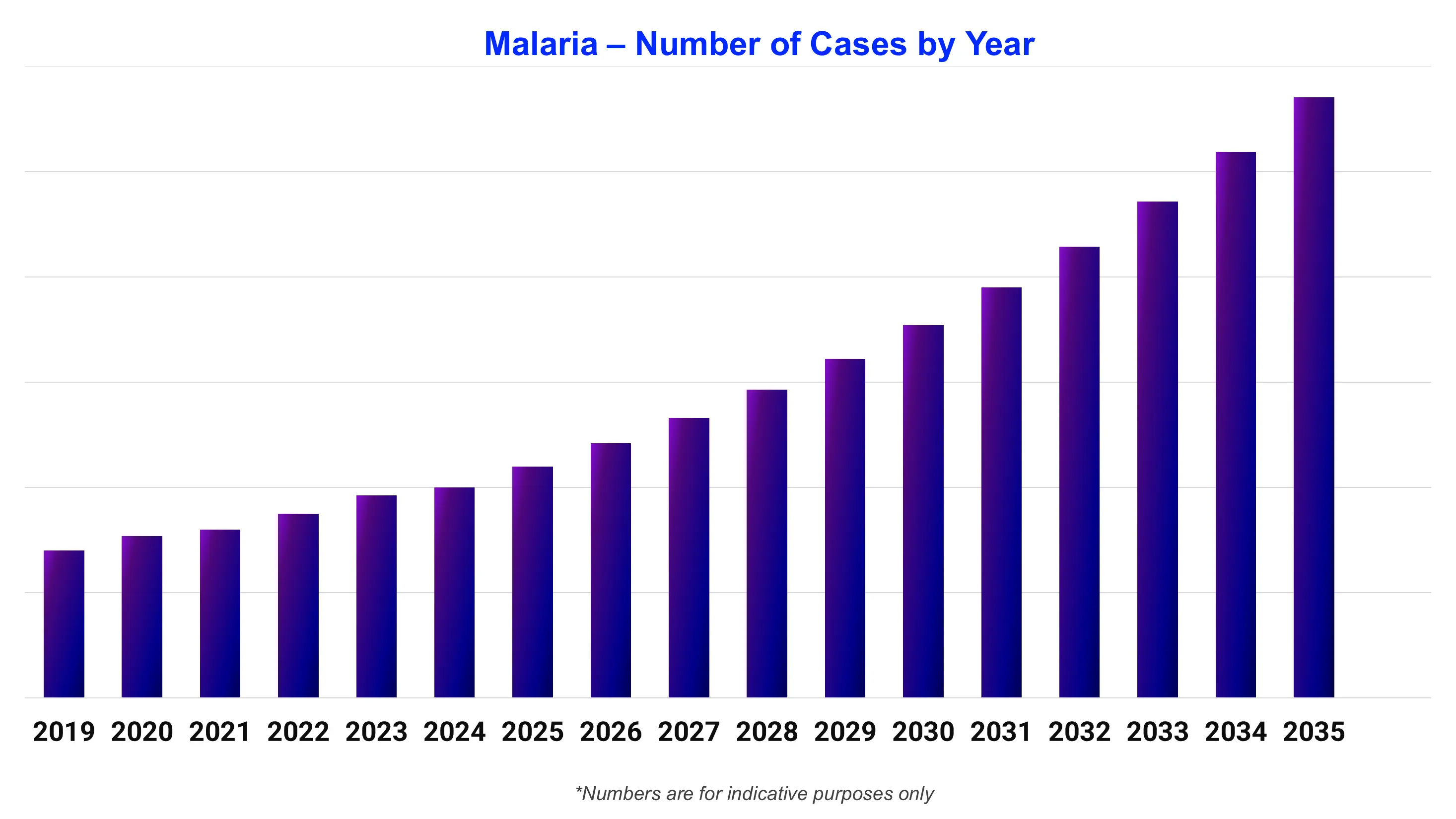
Malaria is a life-threatening parasitic disease transmitted to humans through the bites of infected female Anopheles mosquitoes. According to the World Health Organization (WHO), an estimated 282 million cases and 610,000 deaths occurred globally in 2024, highlighting the substantial burden of this mosquito-borne disease. As per the malaria epidemiology forecast by Expert Market Research, malaria remains a significant global public health concern.
Base Year
Historical Period
Forecast Period
Read more about this report - Request a Free Sample
Expert Market Research's “Malaria Epidemiology Forecast Report 2026-2035” offers comprehensive information on the prevalence and demographics of malaria. It projects the future incidence and prevalence rates of malaria cases across various populations. The study covers age, gender, and type as major determinants of the malaria population. The report highlights patterns in the prevalence of malaria over time and projects future trends based on multiple variables.
The report provides a comprehensive overview of the disease, as well as historical and projected data on the epidemiology of malaria in the 8 major markets.
Regions Covered
Malaria is a life-threatening infectious disease caused by Plasmodium parasites and transmitted to humans through the bites of infected female Anopheles mosquitoes. The major species responsible for human malaria include Plasmodium falciparum, Plasmodium vivax, Plasmodium malariae, Plasmodium ovale, and Plasmodium knowlesi. The infection primarily affects red blood cells and can cause fever, chills, headache, fatigue, and anemia. Severe cases may lead to organ dysfunction and death, particularly among young children, pregnant women, and individuals with limited immunity. Malaria epidemiology varies considerably across regions depending on transmission intensity and prevention measures.
|
Parameter |
Insight |
|
Largest Patient Pool |
India |
|
Fastest Growing Region |
India |
|
High-Risk Population |
Children under five, pregnant women, and individuals with limited immunity or exposure to malaria-endemic areas. |
|
Key Diagnostic Method |
Blood smear microscopy, supported by rapid diagnostic tests (RDTs) and molecular testing when indicated. |
|
Major Risk Factor |
Exposure to infected female Anopheles mosquitoes, particularly in malaria-endemic areas. |
|
Major gap in the market |
Delayed diagnosis, limited access to timely testing in some endemic settings, and inadequate recognition of imported malaria in non-endemic countries. |
The malaria epidemiology division offers information on the patient pool from history to the present as well as the projected trend for each of the 8 major markets. Expert Market Research provides both current and predicted trends for the malaria epidemiology scenario by examining a wide range of studies. Additionally, the report covers the diagnosed patient pool for malaria and their trends. The data is broken down into specific categories, such as total prevalent cases in males and females, and total diagnosed cases across different age groups and patient pools.
|
Epidemiology Segment |
Key Insights |
|
Diagnosed Prevalent Cases of the Disease |
According to the World Health Organization, an estimated 282 million malaria cases were reported across 80 countries in 2024, representing an increase of approximately 9 million cases compared with 2023. The global burden remains concentrated in the African region. |
|
Gender-Specific Cases of the Disease |
As per Abebaw Setegn et al. (2025), a study involving 528 participants found malaria prevalence of 17.6% among males (48 of 273) and 14.5% among females (37 of 255). These findings reflect the study population rather than global gender-specific prevalence. |
|
Age-Specific Cases of the Disease |
According to Abebaw Setegn et al. (2025), participants aged 15–24 years had the highest malaria prevalence at 25.2%, followed by those aged 6–14 years at 22.6%. Participants aged 45 years and older had the lowest prevalence, at 6.9%. |
|
Ethnicity-Wise Cases of the Disease |
Malaria burden varies geographically with exposure to transmission, travel patterns, and access to preventive measures. According to Fissha Brhane Mesele et al. (2025), sub-Saharan Africa bears a disproportionately high share of global cases, although ethnicity-specific prevalence figures were not provided in the supplied information. |
|
Mortality and Survival Analysis of the Disease |
According to the World Health Organization, malaria caused an estimated 610,000 deaths globally in 2024, compared with 598,000 in 2023. Children younger than five years accounted for approximately 75% of malaria deaths in the African region, highlighting their substantial mortality burden. |
|
Disease type |
Prevalence |
|
Plasmodium falciparum |
Identified as the more virulent malaria species in the information provided by Abebaw Setegn et al. (2025). It is also the most frequently diagnosed species in Spain, according to Malaria en España et al. (2024). |
|
Plasmodium vivax |
Identified as one of the main malaria species associated with complications, according to Abebaw Setegn et al. (2025). |
|
Plasmodium ovale |
Recognized as one of the five Plasmodium species known to infect humans, according to Abebaw Setegn et al. (2025). |
|
Plasmodium malariae |
Recognized as a malaria-causing species in the information provided by Abebaw Setegn et al. (2025). |
|
Plasmodium knowlesi |
Recognized as a malaria-causing species in the information provided by Abebaw Setegn et al. (2025). |
Read more about this report - Request a Free Sample
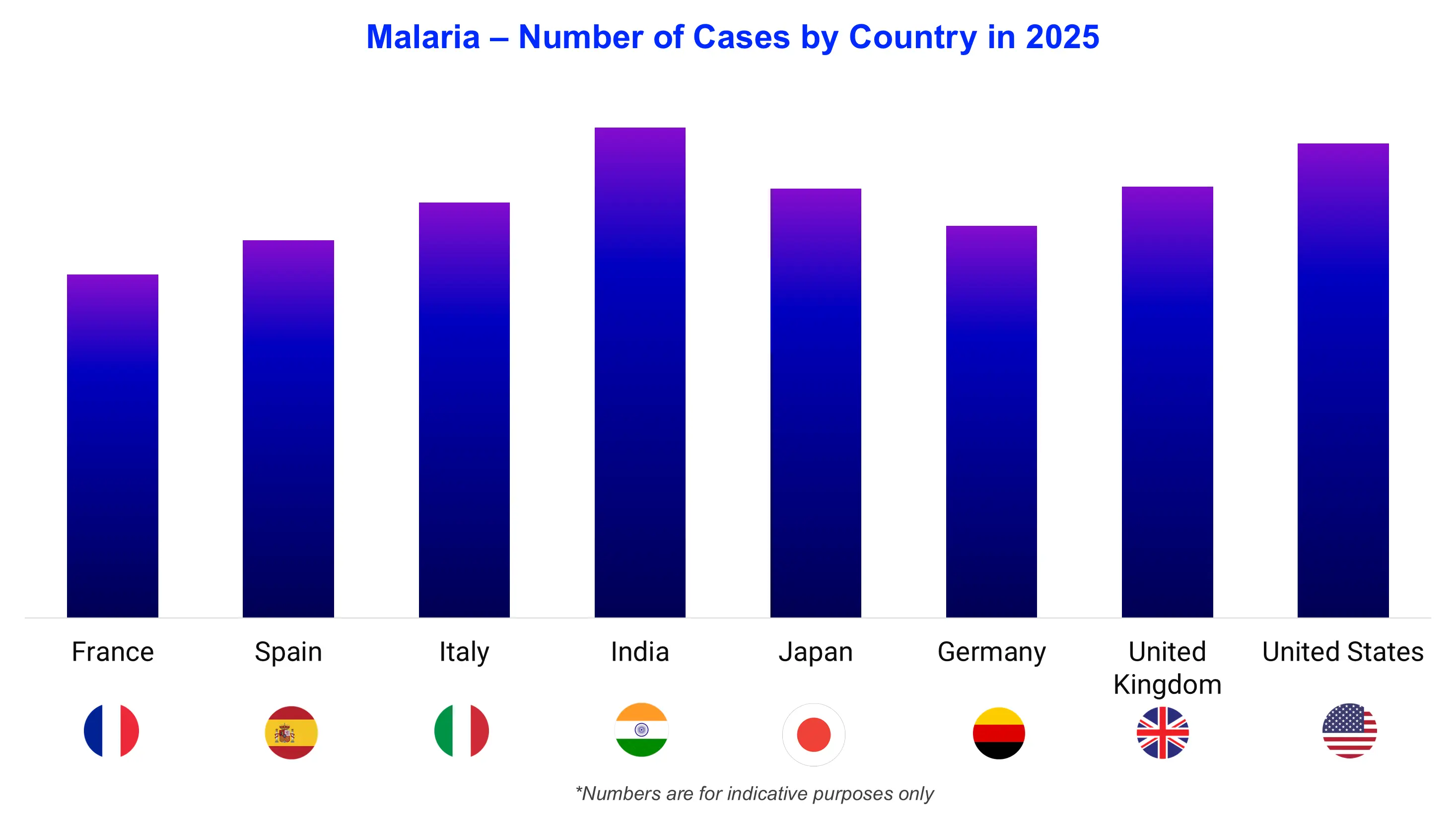
The malaria epidemiology data and findings for the United States, Germany, Spain, Italy, France, the United Kingdom, Japan, and India are also provided in the epidemiology section.
|
Country |
Key Insights |
|
United States |
According to the Centers for Disease Control and Prevention, approximately 2,000 malaria cases are reported annually, with nearly seven deaths per year on average during 2007–2022. |
|
Germany |
According to Ravishtaashini Vanitha et al. (2025), Germany recorded an annual average of 827.10 confirmed malaria cases over the period analyzed. |
|
France |
As per Ravishtaashini Vanitha et al. (2025), France accounted for 34.16% of confirmed malaria cases in Europe, averaging 2,391.70 cases annually over the analyzed period. |
|
Italy |
According to the Severe Malaria Observatory, Italy is not malaria-endemic, but approximately 600–700 imported cases are detected annually. |
|
Spain |
According to Malaria en España et al. (2024), Spain reports approximately 800 imported malaria cases annually, with Plasmodium falciparum the most frequently diagnosed species. |
|
United Kingdom |
According to Jo Salkeld et al. (2024), the United Kingdom reported 2,093 malaria cases in 2023, the highest annual total in 25 years. |
|
Japan |
According to Mitsunobu Toyosaki et al. (2025), Japan reports approximately 50–100 imported malaria cases annually, with no recent locally transmitted cases. |
|
India |
According to Data for India, an estimated 4.5 million new malaria cases occurred in 2023, down from approximately 33 million in 1990. |
Across the selected countries, malaria epidemiology differs considerably between endemic India and countries where cases are predominantly associated with international travel. In India, opportunities include strengthening early diagnosis, expanding access to rapid diagnostic tests, improving surveillance, and addressing gaps in prevention and treatment in affected communities. In the United States, Germany, France, Italy, Spain, the United Kingdom, and Japan, greater clinical awareness of travel-associated malaria and access to prompt laboratory confirmation remain important priorities. Improved diagnostic readiness and timely species-specific treatment can help reduce complications and prevent avoidable deaths.
Malaria treatment depends on the infecting Plasmodium species, disease severity, geographic location, and local drug resistance patterns. Artemisinin-based combination therapies are recommended for uncomplicated P. falciparum malaria in many endemic settings. Chloroquine remains an option for infections caused by susceptible parasites, while severe malaria generally requires intravenous artesunate followed by a complete oral treatment course. P. vivax and P. ovale infections may require primaquine or tafenoquine for radical cure to eliminate dormant liver-stage parasites, following appropriate glucose-6-phosphate dehydrogenase deficiency testing. Antimalarial therapy is supported by early diagnosis, appropriate drug selection, and adherence to treatment guidelines.


Upto 15% Off
USD
$2699 $2429
$4299 $3869
$5799 $4949
$6999 $5949


*While we strive to always give you current and accurate information, the numbers depicted on the website are indicative and may differ from the actual numbers in the main report. At Expert Market Research, we aim to bring you the latest insights and trends in the market. Using our analyses and forecasts, stakeholders can understand the market dynamics, navigate challenges, and capitalize on opportunities to make data-driven strategic decisions.*
Explore our key highlights of the report and gain a concise overview of key findings, trends, and actionable insights that will empower your strategic decisions.
|
Report Features |
Details |
|
Base Year |
2025 |
|
Historical Period |
2019-2025 |
|
Forecast Period |
2026-2035 |
|
Epidemiology Statistics Provided |
|
|
Segmentation Provided |
|
|
Geographies Covered |
|
Datasheet
One User
USD 2,699
USD 2,429
tax inclusive*
Single User License
One User
USD 4,299
USD 3,869
tax inclusive*
Five User License
Five User
USD 5,799
USD 4,949
tax inclusive*
Corporate License
Unlimited Users
USD 6,999
USD 5,949
tax inclusive*
*Please note that the prices mentioned below are starting prices for each bundle type. Kindly contact our team for further details.*
Flash Bundle
Small Business Bundle
Growth Bundle
Enterprise Bundle
*Please note that the prices mentioned below are starting prices for each bundle type. Kindly contact our team for further details.*
Flash Bundle
Number of Reports: 3
20%
tax inclusive*
Small Business Bundle
Number of Reports: 5
25%
tax inclusive*
Growth Bundle
Number of Reports: 8
30%
tax inclusive*
Enterprise Bundle
Number of Reports: 10
35%
tax inclusive*
How To Order

Select License Type
Choose the right license for your needs and access rights.

Click on ‘Buy Now’
Add the report to your cart with one click and proceed to register.

Select Mode of Payment
Choose a payment option for a secure checkout. You will be redirected accordingly.
Strategic Solutions for Informed Decision-Making
Gain insights to stay ahead and seize opportunities.

Get insights & trends for a competitive edge.

Track prices with detailed trend reports.

Analyse trade data for supply chain insights.

Leverage cost reports for smart savings

Enhance supply chain with partnerships.

Connect For More Information
Our expert team of analysts will offer full support and resolve any queries regarding the report, before and after the purchase.
Our expert team of analysts will offer full support and resolve any queries regarding the report, before and after the purchase.
We employ meticulous research methods, blending advanced analytics and expert insights to deliver accurate, actionable industry intelligence, staying ahead of competitors.
Our skilled analysts offer unparalleled competitive advantage with detailed insights on current and emerging markets, ensuring your strategic edge.
We offer an in-depth yet simplified presentation of industry insights and analysis to meet your specific requirements effectively.




