

Consumer Insights
Uncover trends and behaviors shaping consumer choices today
Procurement Insights
Optimize your sourcing strategy with key market data
Industry Stats
Stay ahead with the latest trends and market analysis.
The AI-based histopathology analysis market was valued at USD 0.34 Billion in 2025 and is projected to reach USD 3.14 Billion by 2035, registering a CAGR of 24.90%. Demand is driven by a persistent shortage of pathologists against rising biopsy volumes, the spread of whole slide scanning in hospital and reference laboratories, growing use of slide-derived biomarkers in oncology drug trials, and regulatory acceptance of software that supports diagnosis.
Patent activity reflects the same momentum, with filings concentrated in tumour detection and grading models, biomarker and mutation prediction from stained slides, slide level foundation models, cell and nuclei segmentation, stain normalisation and quality control, and weakly supervised learning from slide labels. Validation signals include the 2017 FDA clearance of the first whole slide imaging system for primary diagnosis and the 2021 FDA De Novo authorisation of an artificial intelligence prostate cancer detection software, followed by pharmaceutical collaborations that use slide algorithms for trial biomarker scoring.
This AI-Based Histopathology Analysis Patent Landscape Analysis Report provides an evidence-based view of filing trends, leading assignees, jurisdictions, technology segments and competitive positioning across algorithms that analyse stained tissue slide images.
Executive Snapshot
The AI-based histopathology analysis market is experiencing strong growth, driven by pathologist shortages, rising biopsy volumes, and expanding use of slide algorithms in oncology drug development. The 2021 FDA De Novo authorisation of an artificial intelligence prostate cancer detection software showed that regulators will authorise algorithm-based diagnostic support in routine pathology.
Patent activity is accelerating, with 160+ AI-based histopathology analysis patents granted in 2025, reflecting strong innovation momentum in tumour detection and grading models, biomarker and mutation prediction from stained slides, slide level foundation models, and cell and nuclei segmentation.
Top assignees in the AI-based histopathology analysis patent landscape include PathAI, Paige, F. Hoffmann-La Roche, Owkin, and Aiforia, with the United States, China, and Europe as the dominant patent jurisdictions.
Histopathology remains the reference standard for diagnosing cancer, yet the specialty faces a widening gap between the number of tissue samples and the pathologists available to read them. Biopsy volumes are rising with population ageing, organised screening programmes for breast, prostate, colorectal and lung cancer, and the growth of targeted therapies that require tissue-based biomarker confirmation. Artificial intelligence applied to digitised slides gives laboratories a way to triage cases, standardise grading and quantify features that are hard to assess consistently by eye. Hospitals and pathology laboratories are the main buyers, while pharmaceutical and biotechnology companies and contract research organisations use the same algorithms to score biomarkers in clinical trials. Demand is shaped as much by digital workflow readiness as by algorithm accuracy.
Market growth is driven by the rapid adoption of whole slide imaging in hospital and reference laboratories, which creates the digital archives and scanning infrastructure that slide algorithms need to run at scale. Recent global estimates put new cancer cases at about 20 million a year, and nearly every case involves at least one tissue diagnosis, so the diagnostic workload rises with incidence. Regulatory events have also lowered adoption risk: the FDA cleared the first whole slide imaging system for primary diagnosis in 2017, and a prostate cancer detection software received De Novo authorisation in 2021, setting a precedent for algorithm-assisted diagnosis.
Prostate cancer accounts for roughly 1.5 million new diagnoses a year, and diagnosis depends on examining several needle biopsy cores per patient, so a single case can generate a dozen or more slides. That multiplication of workload explains why prostate was the first tissue type to gain authorisation for an algorithm. Breast cancer, at around 2.3 million new cases annually, adds a large volume of biopsies and tissue tests for hormone receptor and HER2 status, where quantitative scoring has a clear role. Commercial demand also comes from drug development, where algorithms score biomarkers across thousands of trial slides faster than panels of pathologists, shortening readout times for sponsors. Rising incidence, multi-core biopsy workloads and trial demand together sustain procurement of slide analysis software.
Read more about this report - REQUEST FREE SAMPLE COPY IN PDF
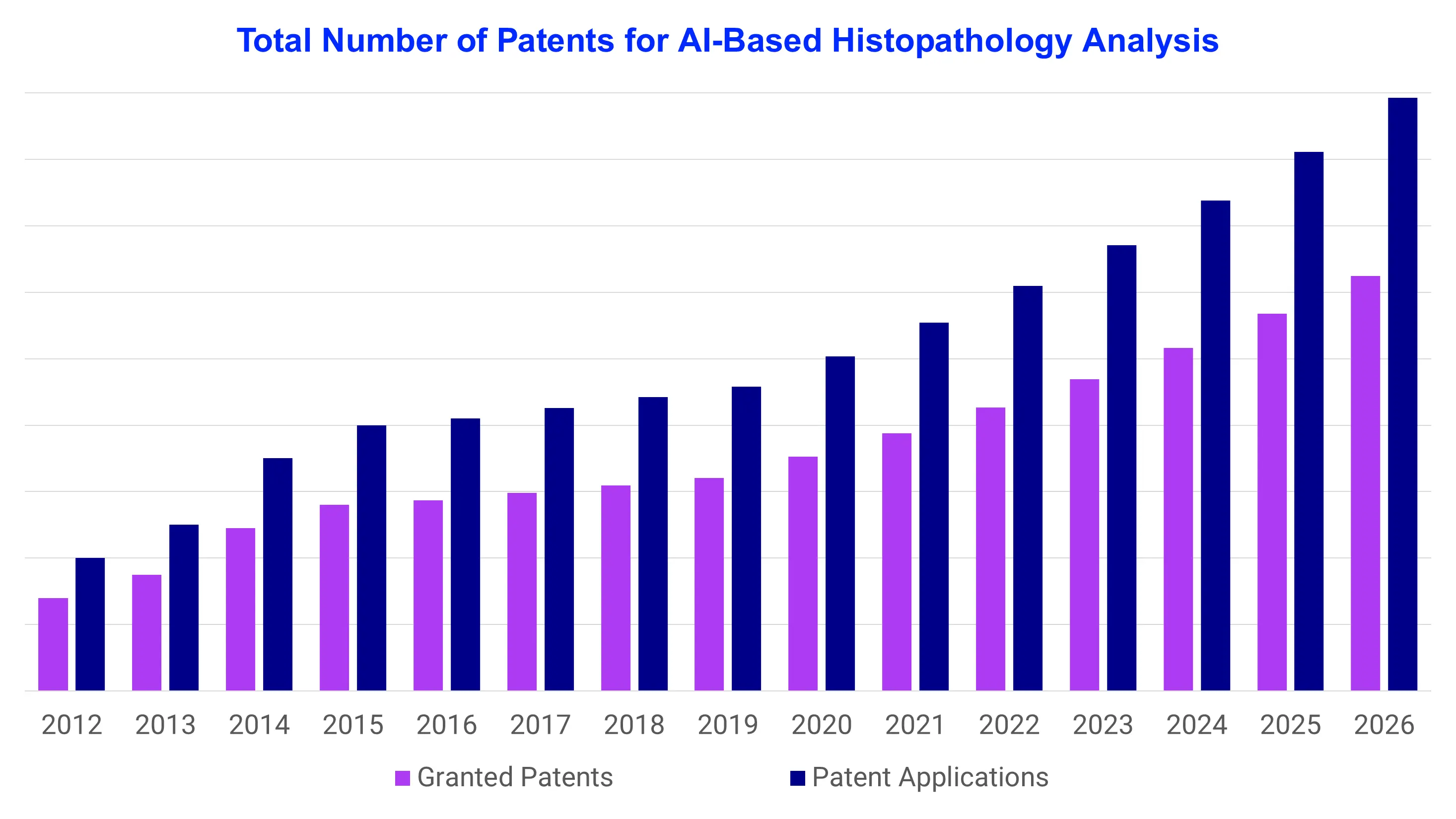
Filing intensity in AI-based histopathology analysis has climbed in step with venture funding, scanner installations and pharmaceutical collaboration. Start-ups that raised capital to build annotated slide libraries filed early on model training methods and tissue-specific applications, while diagnostics and imaging groups added claims that tie algorithms to scanners, stains and laboratory information systems. Granting activity shows the same direction, with 160+ patents granted in 2025. Applicants increasingly pair core claims on image analysis with claims on workflow integration, quality control and companion diagnostic use, which signals that commercial deployment, and not only research, now drives filing decisions.
Approximately 2600+ patent families related to AI-based histopathology analysis were identified, with filing volumes peaking between 2022 and 2024. Tumour detection and grading models make up the largest group of families, followed by biomarker and mutation prediction from stained slides and slide level foundation models. Cell and nuclei segmentation, stain normalisation and quality control, and weakly supervised learning from slide labels form the remaining main clusters. Foundation model filings are the newest group and grew fastest in recent years, as developers began pretraining on millions of slide images and adapting one model to many diagnostic tasks.
Growing demand for faster, more consistent cancer diagnosis and for slide-based trial biomarkers has translated directly into wider patent coverage of tumour grading, biomarker prediction and foundation model technologies.
This report analyses patent activity and market trends in AI-based histopathology analysis across the United States, Europe, China, Japan, South Korea, India and international filings made through the World Intellectual Property Organization. Coverage extends to hospitals, pathology laboratories, pharmaceutical and biotechnology companies, contract research organisations, and academic and research institutes that buy or develop slide analysis software. Patent records are examined by priority year, jurisdiction, assignee and technology cluster, and are read alongside regulatory milestones such as FDA clearances and CE marking of digital pathology products, which show how protection builds around commercial launches.
The scope covers algorithms for tumour detection and grading, biomarker prediction from stained slides, cell and nuclei segmentation, stain normalisation and quality control, and prognosis and outcome prediction. Algorithm types include convolutional neural networks, vision transformers, weakly supervised learning models and foundation models for slide images. Tissue applications span prostate, breast, gastrointestinal and lung histopathology as well as dermatopathology. Whole slide scanners, image management software and digital workflows that carry these algorithms are included, together with the methods that keep models consistent across laboratories, scanners and staining protocols.
The analysis includes patent activity from specialist pathology software companies such as PathAI, Paige, Owkin and Aiforia, from diagnostics and imaging groups such as F. Hoffmann-La Roche that supply scanners, stains and companion diagnostics, and from pharmaceutical sponsors that file on biomarker scoring methods. Start-ups building foundation models, university spin-outs, academic medical centres and cancer institutes are also covered where they hold families on slide analysis methods. Clinical laboratories and hospital networks that co-develop algorithms with vendors appear as applicants or collaborators in a growing number of records.
The report will cover the following sections in detail:
Analysis by Analysis Task
Analysis by Algorithm Type
Analysis by Tissue Application
AI-Based Histopathology Analysis Patent Filing Trend Analysis
Filings in AI-based histopathology analysis were few before the mid-2010s, when deep learning first matched pathologists on benchmark slide classification tasks. Early families covered convolutional networks for mitosis counting and cancer detection in breast and prostate tissue. After the 2017 FDA clearance of a whole slide imaging system for primary diagnosis, claims shifted towards clinical workflows, scanner integration and laboratory deployment. Recent years show movement towards weak supervision, which trains on slide level labels instead of pixel level annotation, and towards pretraining on very large slide collections.
Patent filings increased at an estimated annual growth rate of approximately 30% between 2020 and 2024. Growth was driven by the move from research prototypes to regulated products, the spread of vision transformers and foundation models, and heavy venture investment in start-ups with large slide libraries. Pandemic-era demand for remote slide reading raised scanner installations, which enlarged the digital archives available for training. Pharmaceutical interest in tissue biomarkers added a further stream of applications covering trial scoring and companion diagnostics.
Among the players with AI-based histopathology analysis patent families, new entrants have been identified, which can be either established companies or startups developing novel technology in the field. Some of the major companies mentioned in this report (a non-exhaustive list) are as follows:
PathAI holds a portfolio built around machine learning models that read stained tissue slides, covering tumour and cell classification, tissue region segmentation and quantitative scoring for clinical research. Its commercial offering includes the AISight image management platform for digital pathology workflows and algorithm products for liver disease assessment in drug trials, which have been taken through regulatory qualification discussions with agencies. Diagnostic use is positioned under laboratory and in vitro diagnostic pathways, and the company has also built a clinical laboratory services arm in the United States. Intellectual property strategy appears to combine filings on model architectures and training methods with protection of workflow tools, while proprietary labelled slide libraries are kept as trade secrets. Commercially, PathAI is positioned as a pharmaceutical-facing specialist that is extending into clinical diagnostics.
Paige built its portfolio on a large archive of digitised cancer slides licensed from Memorial Sloan Kettering Cancer Center, with filings on tumour detection, grading and pan-cancer analysis. Its Paige Prostate software received FDA De Novo authorisation in 2021, the first for an artificial intelligence pathology product, and its products are also available in markets that accept CE marking. The company has extended into large foundation models pretrained on millions of slides, marketed under the Virchow name, and into software that supports biomarker prediction. Patenting centres on model training approaches, clinical workflow integration and specific cancer applications, supported by regulatory exclusivity that few competitors can match in prostate pathology. Commercially, Paige is positioned as a diagnostic software supplier that sells to health systems and laboratories and partners with scanner and pharmaceutical companies.
Other companies include F. Hoffmann-La Roche, Owkin, and Aiforia.
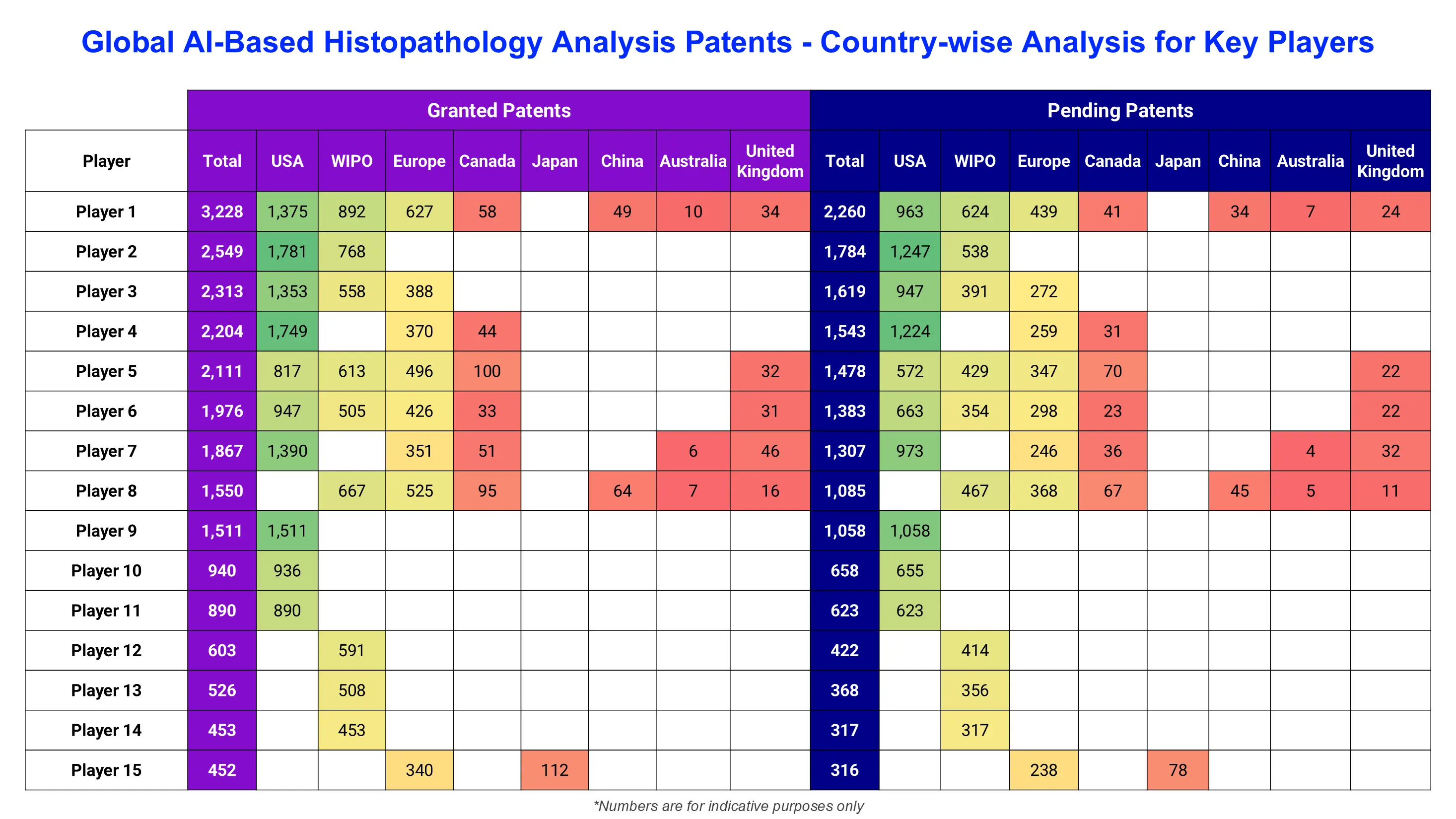
PathAI, Paige, F. Hoffmann-La Roche, Owkin and Aiforia hold a visible share of analysed patent activity, though the wider field remains moderately fragmented because many university groups and start-ups file in narrow areas. PathAI and Paige concentrate on model methods and clinical applications that follow their software products. Roche couples algorithms with its scanners, staining platforms and companion diagnostics, which gives its claims a hardware and assay dimension. Owkin emphasises federated learning and multimodal prediction that links slides with clinical and genomic data. Aiforia protects tools that let laboratories build and deploy their own slide models.
*Please note that this is only a partial list; the complete list of key players is available in the full report. Additionally, the list of key players can be customized to better suit your needs.*
The report assesses patent activity across major jurisdictions, including:
The United States is the largest patent filing hub, supported by early regulatory clearances, venture-backed pathology software companies and large academic cancer centres. China follows with fast-growing filings from technology firms, hospitals and universities that apply deep learning to large domestic biopsy volumes. Europe contributes through applicants in France, Germany, Finland, the Netherlands and the United Kingdom, with the CE marking route shaping product-linked filings. Japan holds a steady share through imaging and diagnostics groups. South Korea adds activity from medical software developers, India shows rising filings tied to pathologist shortages and low-cost scanning, and WIPO filings reflect applicants seeking protection across several markets at once.
Read more about this report - REQUEST FREE SAMPLE COPY IN PDF
Patent activity in AI-based histopathology analysis is organised into five technology segments:
Tumour detection and grading models lead patent activity, because cancer detection and grading are the first tasks that regulators have authorised and the ones that most directly relieve pathologist workload. Biomarker and mutation prediction is growing quickly as drug developers seek low-cost alternatives to molecular tests, while slide level foundation models show the sharpest rise in recent filings.
The AI-based histopathology analysis market is competitive, with software specialists, scanner makers, diagnostics groups and research-led start-ups pursuing overlapping patent positions. Established diagnostics companies protect the link between algorithm, scanner and assay, whereas software firms protect model architectures and training pipelines. Partnerships between algorithm developers and pharmaceutical sponsors are common, and many assignees file in the United States, Europe and China at the same time to secure commercial access. Entry by large technology companies publishing slide foundation models has added pressure on smaller developers to show clinical validation.
Companies are focusing on:
Emerging innovation themes include slide foundation models that adapt to many tissue types with few labels, multimodal models that combine histology with genomic and clinical records, and virtual staining that predicts special stains from routine slides. Federated learning allows hospitals to train shared models without moving patient data. Explainable outputs that highlight the regions driving a prediction are being added to meet clinical and regulatory expectations, and models that predict response to treatment from slide features are drawing growing interest from oncology drug developers.
AI-based histopathology analysis now brings together digital scanning, deep learning, laboratory informatics and companion diagnostics, and patent records show where those fields meet. Areas with strong filing growth and visible regulatory progress, such as prostate and breast applications and biomarker scoring for trials, point to near-term commercial demand. Families that appear sparser in dermatopathology, gastrointestinal tissue and prognosis modelling mark where freedom to operate may be easier to secure and where partnerships could create value.
The patent landscape provides actionable intelligence for the following applications:
The patent landscape for AI-based histopathology analysis is developed through structured searches of global patent databases, including records from the United States, Europe, China, Japan, South Korea, India and WIPO. Search strings combine terms for whole slide images, stained tissue, tumour grading, biomarker prediction, segmentation, foundation models and stain normalisation with relevant classification codes in image analysis, computing and diagnostics. Results are grouped into patent families so that one invention filed in several jurisdictions is counted once.
Patent records are screened, refined, categorised and consolidated to ensure relevance to the defined topic. Duplicate families and filings with no connection to tissue slide analysis are removed. Each remaining family is classified by analysis task, algorithm type, tissue application, assignee and jurisdiction, and assignee names are harmonised across subsidiaries, acquired companies and spelling variants. Legal status, grant year and priority year are recorded so that filing and grant trends can be tracked consistently.
Market analysis is supported through secondary research, including regulatory databases, company filings, peer-reviewed literature, clinical trial registries and industry publications on digital pathology adoption. Regulatory clearances, commercial launches and partnership announcements are matched to patent activity so that filing trends can be read against real commercial developments. Estimates are cross-checked against reported laboratory digitisation rates and cancer incidence data.


Upto 15% Off
USD
$2699 $2429
$4299 $3869
$5799 $4949
$6999 $5949


*While we strive to always give you current and accurate information, the numbers depicted on the website are indicative and may differ from the actual numbers in the main report. At Expert Market Research, we aim to bring you the latest insights and trends in the market. Using our analyses and forecasts, stakeholders can understand the market dynamics, navigate challenges, and capitalize on opportunities to make data-driven strategic decisions.*
EMR's AI-Based Histopathology Analysis Patent Landscape Analysis provides a comprehensive assessment of patent filings, innovation clusters, assignee portfolios, and geographic filing patterns across the AI-based histopathology analysis landscape. The report identifies 2600+ patent families, evaluates leading jurisdictions including the United States, China, and Europe, and profiles the top assignees by portfolio size.
The global AI-based histopathology analysis market was valued at USD 0.34 Billion in 2025. The market is projected to reach USD 3.14 Billion by 2035, expanding at a CAGR of 24.90% during 2026 - 2035.
The report analyses approximately 2600+ patent families related to AI-based histopathology analysis. These include filings from the United States, China, Europe, and international WIPO filings.
Key companies operating within the landscape include PathAI, Paige, F. Hoffmann-La Roche, Owkin, and Aiforia, among others. These organisations collectively account for a significant portion of patent activity analysed in this report.
The report evaluates patent activity across the United States, Europe, China, Japan, South Korea, India, and international WIPO filings. The United States is the largest single jurisdiction in the AI-based histopathology analysis patent landscape, with 2,200+ patents associated with it.
Yes. The report scope can be customised based on geography, technology segment, assignee selection, time period, or specific innovation cluster focus. Yes, the EMR team can be contacted through the report page or the sales team to scope a customised study that adds specific jurisdictions, assignees, tissue types or technology clusters to the AI-based histopathology analysis patent landscape.
Patent landscape analysis helps organisations understand innovation trends, competitive activity, technology whitespace, and IP risk across a defined domain. For AI-based histopathology analysis, this report supports strategic decisions in R&D prioritisation, licensing evaluation, competitive benchmarking, and market entry planning.
Explore our key highlights of the report and gain a concise overview of key findings, trends, and actionable insights that will empower your strategic decisions.
|
Scope of the Report |
Details |
|
Analysis by Analysis Task |
|
|
Analysis by Algorithm Type |
|
|
Analysis by Tissue Application |
|
|
Analysis by End User |
|
|
Key Players Mentioned |
|
|
Geographies Covered |
|
Mini Report
One User
USD 2,699
USD 2,429
tax inclusive*
Single User License
One User
USD 4,299
USD 3,869
tax inclusive*
Five User License
Five User
USD 5,799
USD 4,949
tax inclusive*
Corporate License
Unlimited Users
USD 6,999
USD 5,949
tax inclusive*
*Please note that the prices mentioned below are starting prices for each bundle type. Kindly contact our team for further details.*
Flash Bundle
Small Business Bundle
Growth Bundle
Enterprise Bundle
*Please note that the prices mentioned below are starting prices for each bundle type. Kindly contact our team for further details.*
Flash Bundle
Number of Reports: 3
20%
tax inclusive*
Small Business Bundle
Number of Reports: 5
25%
tax inclusive*
Growth Bundle
Number of Reports: 8
30%
tax inclusive*
Enterprise Bundle
Number of Reports: 10
35%
tax inclusive*
How To Order

Select License Type
Choose the right license for your needs and access rights.

Click on ‘Buy Now’
Add the report to your cart with one click and proceed to register.

Select Mode of Payment
Choose a payment option for a secure checkout. You will be redirected accordingly.
Strategic Solutions for Informed Decision-Making
Gain insights to stay ahead and seize opportunities.

Get insights & trends for a competitive edge.

Track prices with detailed trend reports.

Analyse trade data for supply chain insights.

Leverage cost reports for smart savings

Enhance supply chain with partnerships.

Connect For More Information
Our expert team of analysts will offer full support and resolve any queries regarding the report, before and after the purchase.
Our expert team of analysts will offer full support and resolve any queries regarding the report, before and after the purchase.
We employ meticulous research methods, blending advanced analytics and expert insights to deliver accurate, actionable industry intelligence, staying ahead of competitors.
Our skilled analysts offer unparalleled competitive advantage with detailed insights on current and emerging markets, ensuring your strategic edge.
We offer an in-depth yet simplified presentation of industry insights and analysis to meet your specific requirements effectively.




