

Consumer Insights
Uncover trends and behaviors shaping consumer choices today
Procurement Insights
Optimize your sourcing strategy with key market data
Industry Stats
Stay ahead with the latest trends and market analysis.
The wearable rehabilitation devices market was valued at USD 1.03 Billion in 2025 and is projected to reach USD 6.87 Billion by 2035, growing at a CAGR of 20.90% during 2026-2035. Growth is driven by the rising number of stroke and spinal cord injury survivors, new Medicare payment pathways for powered orthoses, falling actuator and battery costs, and the move of gait and arm therapy from clinics into homes.
Patent activity has expanded steadily since 2020, led by powered hip and knee exoskeletons, soft textile exosuits, electromyography-controlled orthoses and wearable functional electrical stimulation. Filings from China, the United States and Japan dominate, and recent clearances such as the ReWalk 7 in April 2025 show commercial validation of the underlying claims.
This Wearable Rehabilitation Devices Patent Landscape Analysis Report maps assignee concentration, technology clusters, jurisdiction trends and white spaces across the global filing base.
The wearable rehabilitation devices market is experiencing strong growth, driven by rising stroke and spinal cord injury survivorship, expanding insurer reimbursement for powered orthoses, and shortage of therapist hours for high-repetition training. Medicare fee schedules for powered upper-limb orthoses and personal exoskeletons took effect in April 2024, and Myomo recognised revenue on 182 MyoPro units in the first quarter of 2025, which shows reimbursement converting patient demand into device placements.
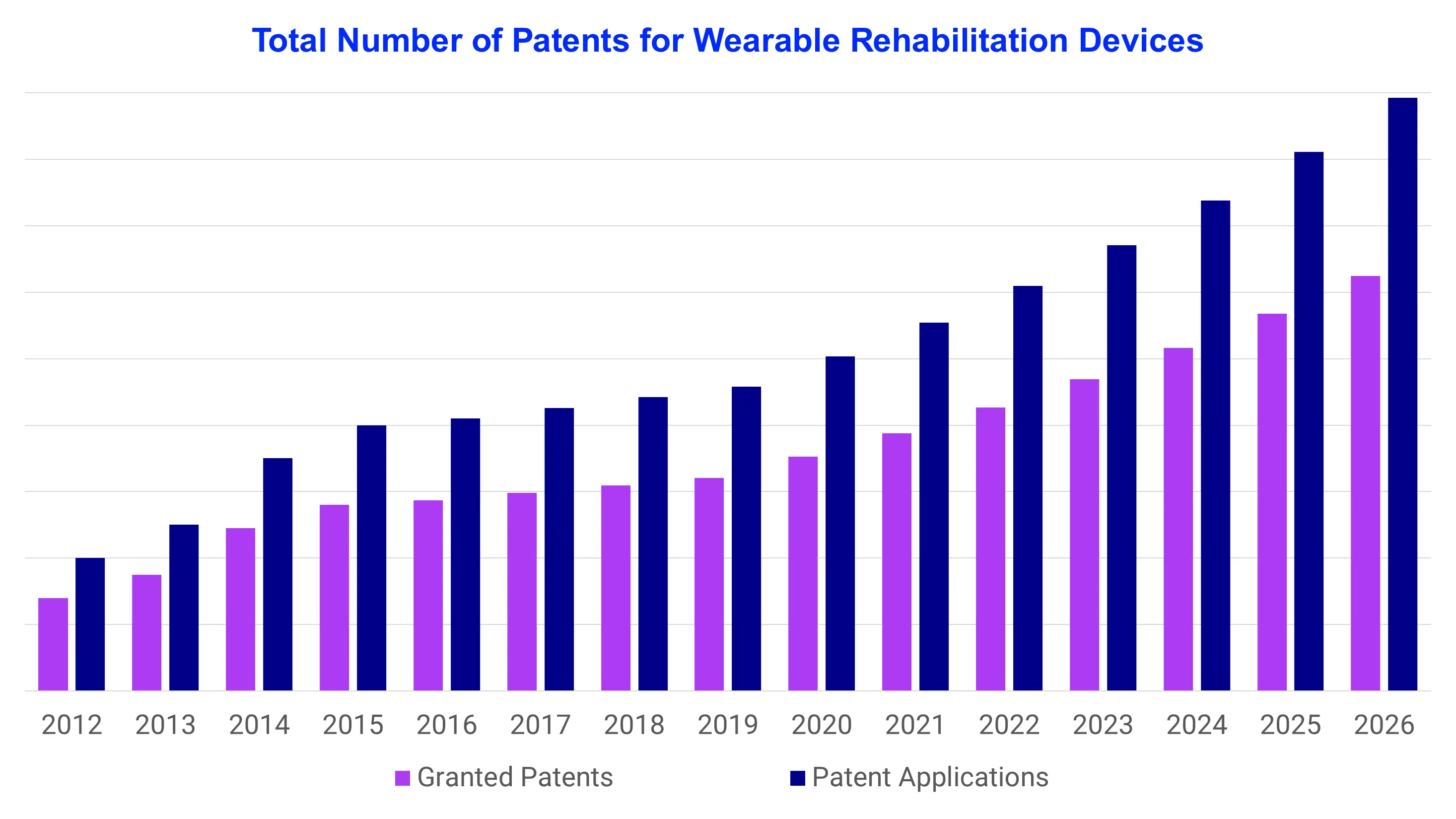
Patent activity is accelerating, with 95+ wearable rehabilitation devices patents granted in 2025, reflecting strong innovation momentum in powered hip and knee exoskeletons, soft textile exosuits, electromyography-controlled orthoses, and wearable functional electrical stimulation.
Top assignees in the wearable rehabilitation devices patent landscape include Samsung Electronics, Honda, Hyundai Motor, Ekso Bionics, and Harvard, with China, the United States, and Japan as the dominant patent jurisdictions.
Wearable rehabilitation devices move therapy from the clinic gym to the patient, using worn actuators, stimulation electrodes and motion sensors to support repetitive movement practice. Demand comes from neurological injury, orthopaedic recovery and ageing populations. Hospitals, outpatient clinics and increasingly households adopt these devices as therapist time becomes the limiting resource. Product forms range from powered hip and knee exoskeletons to soft exosuits, sensor gloves and stimulation sleeves.
The market growth is driven by the large pool of stroke and spinal cord injury survivors who need high-repetition gait and arm training that therapist capacity struggles to supply. The World Stroke Organization estimates 12.2 million new strokes each year, and WHO reports that about 2.4 billion people live with a condition that benefits from rehabilitation.
Reimbursement has turned clinical need into purchasing. Medicare fee schedules for powered upper-limb orthoses and personal exoskeletons began in April 2024, and Myomo recognised revenue on 182 MyoPro units in the first quarter of 2025 at an average selling price near USD 54,000, with Medicare Part B contributing 59% of revenue. That mix shows payer coverage lifting unit volumes and per-device revenue together, which explains why developers now file on home-use features such as fall detection and remote therapist dashboards.
Read more about this report - REQUEST FREE SAMPLE COPY IN PDF
Filing activity in wearable rehabilitation devices has shifted from laboratory prototypes to application-specific engineering. Claims now address torque profiles that adapt to gait phase, battery packs integrated into the frame, textile actuators and electrode placement for stimulation during walking. Universities and hospitals contribute early-stage families, while industrial groups file continuation claims on control algorithms.
The dataset contains more than 6,410 patent families, with filings peaking between 2022 and 2024. Applications for 2025 remain partly unpublished because of the 18-month publication delay. China accounts for the fastest growth in new filings, followed by the United States and Japan.
Rising reimbursement and home-use demand have pulled patent activity toward lightweight, battery-efficient and remotely supervised wearable rehabilitation devices.
This analysis covers patents and published applications on wearable devices that deliver, assist or monitor rehabilitation of the lower limb, upper limb, hand, hip and trunk. Included technologies are powered exoskeletons, soft exosuits, electromyography-controlled orthoses, wearable functional electrical stimulation, sensor gloves and wearable biofeedback systems.
Clinical indications examined include stroke, spinal cord injury, neurodegenerative disorders, orthopaedic and post-surgical recovery, and age-related mobility decline. The core scope centres on worn devices, and industrial load-carrying exoskeletons or stationary rehabilitation robots enter the analysis where claims extend to wearable rehabilitation use.
Assignees assessed include consumer electronics groups, automotive manufacturers, specialist exoskeleton developers, universities and rehabilitation hospitals, and wearable sensor companies.
The report will cover the following sections in detail:
Analysis by Technology
Analysis by Body Region
Analysis by Clinical Indication
Wearable Rehabilitation Devices Patent Filing Trend Analysis
Filings in wearable rehabilitation devices grew at an estimated 14% annually between 2020 and 2024. Growth came from Chinese universities and device makers, Korean and Japanese hip-assist programmes, and United States start-ups commercialising exosuits and orthoses. Falling costs of brushless motors and lithium cells widened the design space for wearable actuators.
Grant volumes followed the same direction, with roughly 95 patents granted in 2025 across the major offices. Claim themes shifted from mechanical joint design toward control software, gait-event detection and remote clinician monitoring. Stroke-specific claims increased after payers in the United States began covering selected devices.
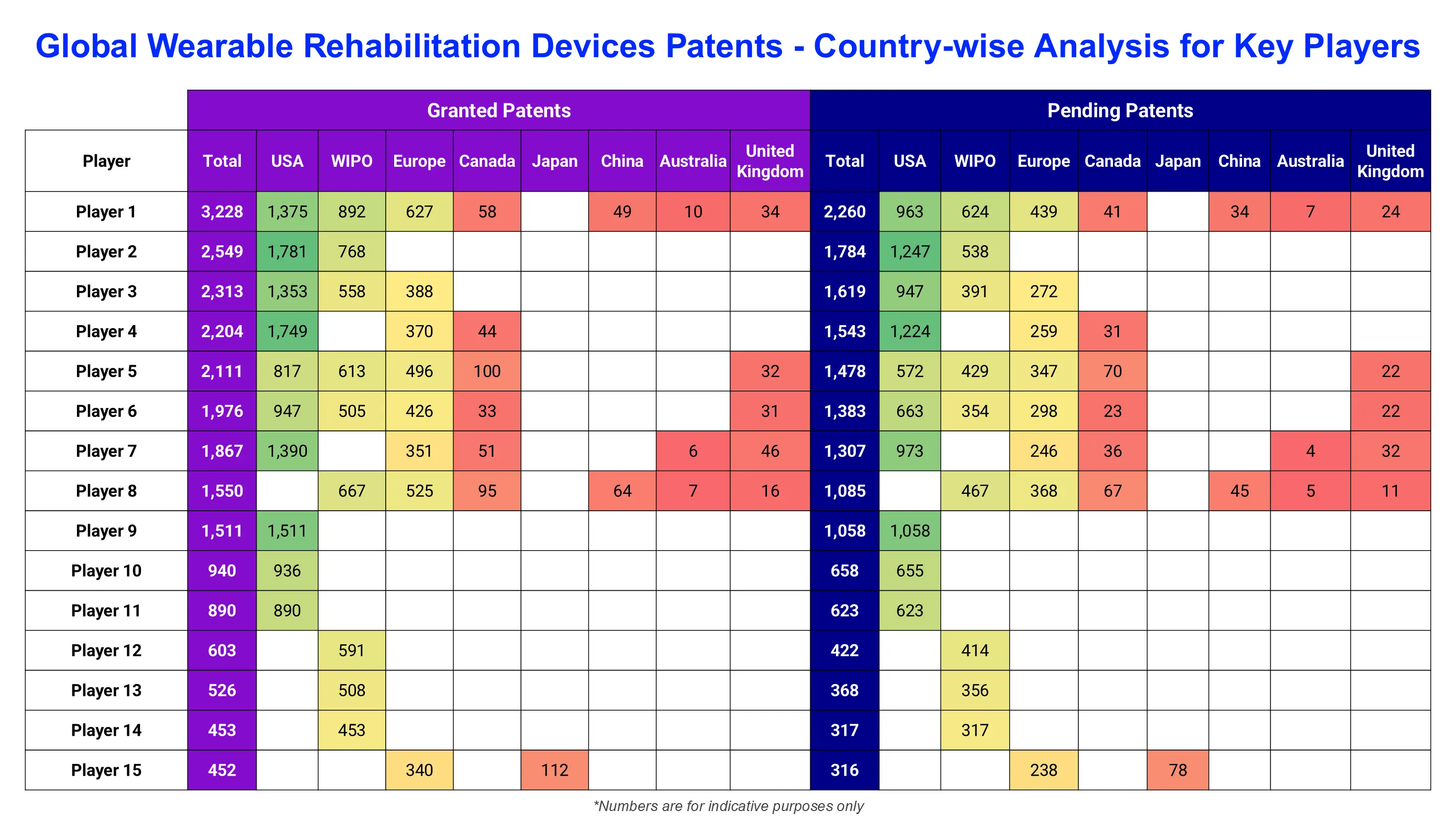
Among the players with wearable rehabilitation devices patent families, new entrants have been identified, which can be either established companies or startups developing novel technology in the field. Some of the major companies mentioned in this report (a non-exhaustive list) are as follows:
Samsung Electronics holds the largest wearable rehabilitation devices portfolio, built around hip-worn walking assist systems that estimate gait phase and apply torque through a lightweight frame. Its filings cover motion assist apparatus, torque control, walking-state recognition and battery placement, with families extended across Korea, the United States, Europe, Japan and China. The Gait Enhancing and Motivating System, shown as GEMS Hip in 2019 and later offered as Bot Fit, carries these claims into products. In early 2024 the first Bot Fit units reportedly went to fitness and wellness business clients, which places the company at the boundary between consumer wellness and clinical gait training. Samsung relies on dense continuation filings around control algorithms and sensor fusion, which give it broad coverage of the software layer.
Honda has filed on walking assist technology since the early 2000s, and its portfolio centres on the Walking Assist device and the Stride Management Assist, both worn at the hips with thigh-mounted actuators. Claims address leg swing timing, hip joint angle tracking, stride length control and lightweight frames for older adults and stroke patients. The company has used long-lived Japanese priority filings, followed by selective extension into the United States, Europe and China. Rehabilitation hospitals and nursing care providers in Japan have been the main clinical users, supported by gait training studies with stroke survivors. Honda positions the technology as a mobility support product, and its licensing posture is selective compared with start-up peers.
Other companies include Hyundai Motor, Ekso Bionics, and Harvard.
The five leading assignees hold an estimated 22% of the families, which indicates a moderately fragmented field with a long tail of universities and start-ups. Samsung Electronics and Honda together account for roughly 11%, driven by sustained hip-assist programmes. Ekso Bionics and Harvard hold smaller portfolios with high citation influence on exoskeleton and exosuit control.
*Please note that this is only a partial list; the complete list of key players is available in the full report. Additionally, the list of key players can be customized to better suit your needs.*
The report assesses patent activity across major jurisdictions, including:
China leads in filing volume, supported by university programmes and domestic exoskeleton manufacturers. The United States ranks second and carries the strongest clinical and reimbursement linkage, while Japan retains a mature base from walking assist programmes at Honda, Toyota, Panasonic and Cyberdyne.
Read more about this report - REQUEST FREE SAMPLE COPY IN PDF
The report analyses patents by technology cluster, covering the following segments:
Among these, powered hip and knee exoskeletons hold the largest share of filings, supported by long-running programmes at Samsung Electronics, Honda and Hyundai Motor.
Competition spans consumer electronics, automotive and specialist rehabilitation firms. Samsung Electronics and Honda lead on hip-assist torque control, while Ekso Bionics concentrates on clinical exoskeleton gait training and Harvard on soft exosuit actuation. In December 2025 Ekso Bionics signed a non-binding term sheet with Applied Digital and continues to explore a sale of its exoskeleton business, which may shift ownership of its patent family.
Companies are focusing on:
Emerging innovation themes include self-balancing personal exoskeletons for users with severe paralysis, adaptive control trained on large gait datasets, and hybrid systems that pair stimulation with light actuators. Wandercraft raised USD 75 million in June 2025 and reported its Atalante X in more than 100 hospitals and rehabilitation centres. Its Eve personal exoskeleton is in clinical evaluation with a United States launch anticipated in 2026.
The field is led by a few large hardware groups and a wider set of clinical specialists, with start-ups licensing university inventions. White spaces appear in upper-limb and hand therapy, paediatric devices and tele-rehabilitation data. Lifeward received FDA clearance for the ReWalk 7 in April 2025 and reported more than 20 units installed by mid-2025.
Technology segments, body regions and clinical indications are assessed for filing intensity, and the report provides actionable intelligence supporting:
The study searched patent databases of the United States Patent and Trademark Office, the European Patent Office, the China National Intellectual Property Administration, the Japan Patent Office, the Korean Intellectual Property Office and WIPO PATENTSCOPE. Queries combined keywords with Cooperative Patent Classification codes such as A61H 3/00, A61H 1/02, A61F 2/72, A61N 1/36, B25J 9/0006 and A61B 5/11.
Records were screened manually for relevance, then consolidated into simple families to remove duplicate publications. Assignee names were harmonised across subsidiaries, former names and transliterations, and legal status was taken from register data at each office.
The market side draws on regulatory clearances, company filings, clinical trial registries, reimbursement schedules and peer-reviewed literature on stroke and spinal cord injury rehabilitation. Patent counts are rounded approximations built from the search strategy and should be read as orders of magnitude.


Upto 15% Off
USD
$2699 $2429
$4299 $3869
$5799 $4949
$6999 $5949


*While we strive to always give you current and accurate information, the numbers depicted on the website are indicative and may differ from the actual numbers in the main report. At Expert Market Research, we aim to bring you the latest insights and trends in the market. Using our analyses and forecasts, stakeholders can understand the market dynamics, navigate challenges, and capitalize on opportunities to make data-driven strategic decisions.*
EMR’s Wearable Rehabilitation Devices Patent Landscape Analysis provides a comprehensive assessment of patent filings, innovation clusters, assignee portfolios, and geographic filing patterns across the wearable rehabilitation devices landscape. The report identifies 6,410+ patent families, evaluates leading jurisdictions including China, the United States, and Japan, and profiles the top assignees by portfolio size.
The global wearable rehabilitation devices market was valued at USD 1.03 Billion in 2025. The market is projected to reach USD 6.87 Billion by 2035, expanding at a CAGR of 20.90% during 2026 - 2035.
The report analyses approximately 6,410+ patent families related to wearable rehabilitation devices. These include filings from China, the United States, Japan, and international WIPO filings.
Key companies operating within the landscape include Samsung Electronics, Honda, Hyundai Motor, Ekso Bionics, and Harvard, among others. These organisations collectively account for a significant portion of patent activity analysed in this report.
The report evaluates patent activity across the United States, Europe, China, Japan, South Korea, India, and international WIPO filings. China leads wearable rehabilitation devices patent activity, accounting for an estimated 35% of filings, ahead of the United States and Japan.
Yes. The report scope can be customised based on geography, technology segment, assignee selection, time period, or specific innovation cluster focus. Please connect with the EMR team to define the customisation scope.
Patent landscape analysis helps organisations understand innovation trends, competitive activity, technology whitespace, and IP risk across a defined domain. For wearable rehabilitation devices, this report supports strategic decisions in R&D prioritisation, licensing evaluation, competitive benchmarking, and market entry planning.
Explore our key highlights of the report and gain a concise overview of key findings, trends, and actionable insights that will empower your strategic decisions.
|
Scope of the Report |
Details |
|
Analysis by Technology |
|
|
Analysis by Body Region |
|
|
Analysis by Clinical Indication |
|
|
Analysis by End User |
|
|
Key Players Mentioned |
|
|
Geographies Covered |
|
Mini Report
One User
USD 2,699
USD 2,429
tax inclusive*
Single User License
One User
USD 4,299
USD 3,869
tax inclusive*
Five User License
Five User
USD 5,799
USD 4,949
tax inclusive*
Corporate License
Unlimited Users
USD 6,999
USD 5,949
tax inclusive*
*Please note that the prices mentioned below are starting prices for each bundle type. Kindly contact our team for further details.*
Flash Bundle
Small Business Bundle
Growth Bundle
Enterprise Bundle
*Please note that the prices mentioned below are starting prices for each bundle type. Kindly contact our team for further details.*
Flash Bundle
Number of Reports: 3
20%
tax inclusive*
Small Business Bundle
Number of Reports: 5
25%
tax inclusive*
Growth Bundle
Number of Reports: 8
30%
tax inclusive*
Enterprise Bundle
Number of Reports: 10
35%
tax inclusive*
How To Order

Select License Type
Choose the right license for your needs and access rights.

Click on ‘Buy Now’
Add the report to your cart with one click and proceed to register.

Select Mode of Payment
Choose a payment option for a secure checkout. You will be redirected accordingly.
Strategic Solutions for Informed Decision-Making
Gain insights to stay ahead and seize opportunities.

Get insights & trends for a competitive edge.

Track prices with detailed trend reports.

Analyse trade data for supply chain insights.

Leverage cost reports for smart savings

Enhance supply chain with partnerships.

Connect For More Information
Our expert team of analysts will offer full support and resolve any queries regarding the report, before and after the purchase.
Our expert team of analysts will offer full support and resolve any queries regarding the report, before and after the purchase.
We employ meticulous research methods, blending advanced analytics and expert insights to deliver accurate, actionable industry intelligence, staying ahead of competitors.
Our skilled analysts offer unparalleled competitive advantage with detailed insights on current and emerging markets, ensuring your strategic edge.
We offer an in-depth yet simplified presentation of industry insights and analysis to meet your specific requirements effectively.




