

Consumer Insights
Uncover trends and behaviors shaping consumer choices today
Procurement Insights
Optimize your sourcing strategy with key market data
Industry Stats
Stay ahead with the latest trends and market analysis.
The wireless implantable sensor technologies market was valued at USD 2.30 Billion in 2025 and is projected to reach USD 9.47 Billion by 2035, advancing at a CAGR of 15.20%. Growth is supported by pressure-guided remote management of heart failure, the maturing of battery-free inductive and ultrasound powering, steadily smaller sensor packages that open new implant sites, and clinical evidence linking continuous remote data to fewer hospital admissions.
Patent activity mirrors this momentum, with more than 47,000 patent families spanning inductive and radio frequency passive sensor powering, ultrasound based wireless power and data transfer, low-power short-range radio links and antennas, hermetic miniaturised sensor packaging, pressure and strain sensing elements, and secure data transmission and remote monitoring platforms. Validation signals include the 2014 FDA approval of a wireless pulmonary artery pressure sensor for heart failure management, a later expansion of its indication, and the arrival of further pulmonary artery sensor developers in the years since.
This Wireless Implantable Sensor Technologies Patent Landscape Analysis Report provides a structured view of patent filing trends, competitive positioning, jurisdiction analysis and key company profiles across powering, wireless link, sensing and packaging technologies, segmented by wireless technology, sensing parameter, clinical application and end user.
The wireless implantable sensor technologies market is experiencing strong growth, driven by pressure-guided remote management of heart failure, advances in battery-free powering, and smaller sensor packages that suit new anatomical sites. A wireless pulmonary artery pressure sensor approved by the FDA in 2014 was tested in the CHAMPION trial of 550 patients, where sensor-guided care reduced heart failure hospitalisations by about 28 percent over six months, giving clinicians and payers a concrete outcome benchmark for the category.
Patent activity is accelerating, with 5390+ wireless implantable sensor technologies patents granted in 2025, reflecting strong innovation momentum in inductive and radio frequency passive sensor powering, ultrasound based wireless power and data transfer, low-power short-range radio links and antennas, and hermetic miniaturised sensor packaging.
Top assignees in the wireless implantable sensor technologies patent landscape include Abbott Laboratories, Medtronic, Biotronik, Boston Scientific, and Integer Holdings, with the United States, Europe, and China as the dominant patent jurisdictions.
Wireless implantable sensors give clinicians a direct physiological reading from inside the body without percutaneous leads, onboard batteries or repeated clinic visits. The category centres on devices that are powered or interrogated across tissue, most often through inductive coupling, radio frequency backscatter or ultrasound, and that report pressure, strain, temperature or similar signals to an external reader or connected hub. Heart failure management is the most established use, while intracranial, intraocular, urological and musculoskeletal monitoring are developing behind it. Demand is shaped by hospitals seeking to reduce readmissions, health systems expanding remote patient monitoring, and patients who prefer measurement at home to scheduled visits. Buyers place long-term accuracy and drift stability at the centre of purchasing decisions, since an implant is expected to perform for years.
Market growth is driven by pressure-guided heart failure management, which lets clinicians adjust therapy before congestion leads to admission. More than 55 million people live with heart failure worldwide and about 6.7 million adults are affected in the United States, so even a small share of eligible patients translates into substantial implant volumes. Hospital readmission is the costliest event in the disease, which is why trial evidence of fewer admissions has become the basis for payer coverage. Glaucoma, affecting an estimated 70 million people or more, adds a second long-term demand pool for intraocular pressure sensors.
Clinical evidence explains most of the commercial trajectory. The CHAMPION trial enrolled 550 patients and reported about 28 percent fewer heart failure hospitalisations at six months with sensor-guided care, a result that supported the 2014 FDA approval of the first wireless pulmonary artery pressure sensor. A later study, GUIDE-HF, randomised roughly 3,600 patients and is generally seen as having informed the broader US indication issued in 2022, which enlarges the eligible pool and the number of centres able to justify implant programmes. Battery-free design links these outcomes to engineering, because a sensor with no power source avoids replacement surgery and can be built for the patient's lifetime. That lifetime requirement is also why drift stability and hermetic packaging appear so often in the filing record.
Read more about this report - REQUEST FREE SAMPLE COPY IN PDF
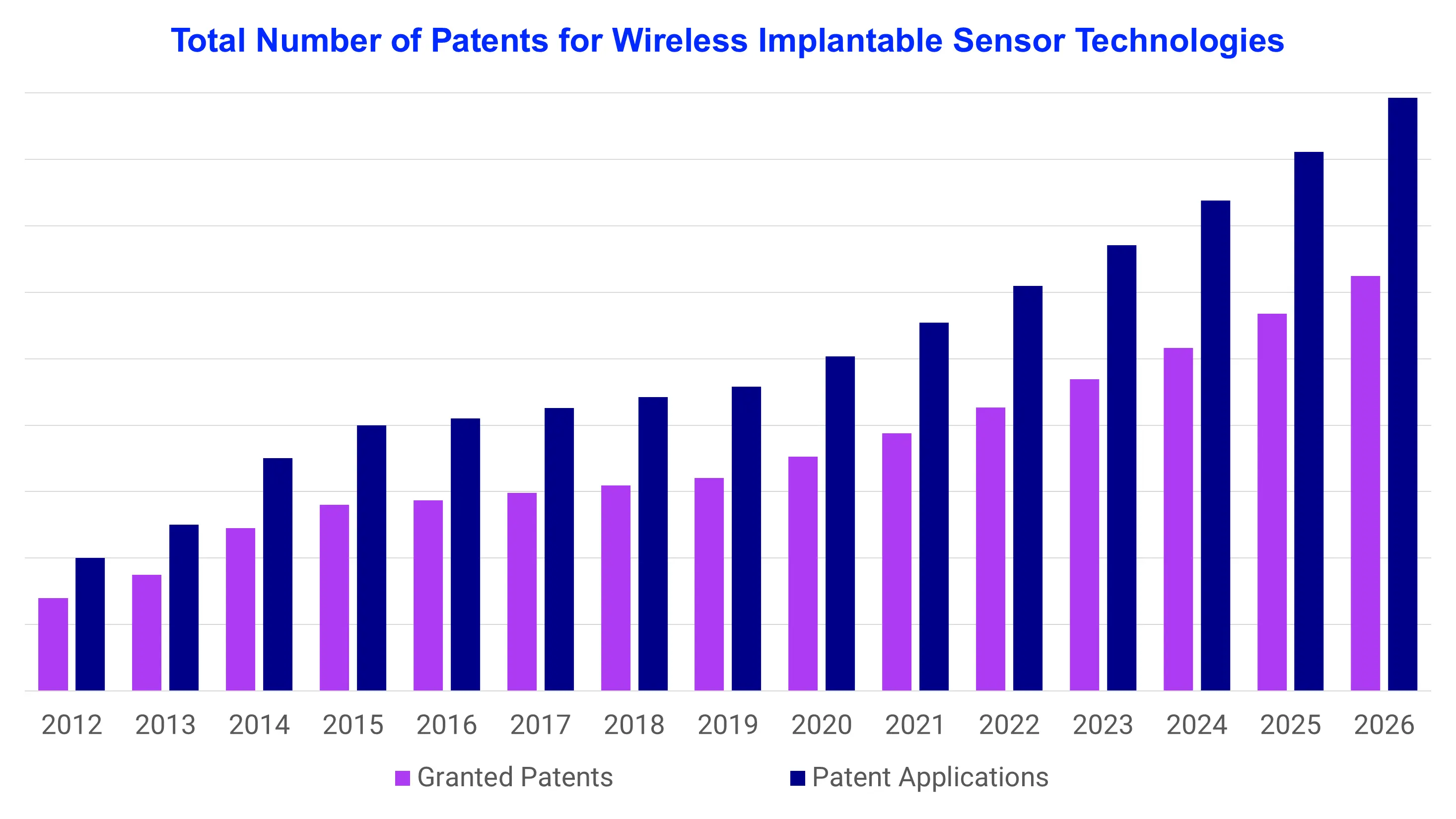
Filing intensity has followed commercial investment in implanted sensing closely. More than 5390 patents were granted in 2024, a figure that combines continuing prosecution of earlier families with new applications from device makers, component suppliers and university spin-outs. Clinical programmes for pulmonary artery sensors, together with venture funding for ultrasound powered and miniaturised platforms, have pulled applications toward powering, packaging and secure data transfer. Groups with established remote monitoring networks tend to protect the sensor, the delivery system and the data pathway at the same time, which lengthens individual family size. Smaller developers more often concentrate on a single enabling feature, such as a ceramic or silicon package, an antenna design or an ultrasound transducer array.
The landscape contains more than 47,000 patent families. Filing activity peaked at roughly 2019 to 2023 on an analyst estimate, a window that coincides with next-generation pulmonary artery sensors entering clinical trials and with wider use of low-power radios in implants. Inductive and radio frequency passive sensor powering and hermetic miniaturised sensor packaging form the largest clusters. Ultrasound based wireless power and data transfer is the fastest growing group, while low-power short-range radio links and antennas, pressure and strain sensing elements, and secure data transmission and remote monitoring platforms complete the main technology clusters.
Rising clinical adoption of pressure-guided heart failure care, and the extension of battery-free sensing into intracranial, ocular and musculoskeletal monitoring, are widening the commercial case that applicants protect through new filings.
Geographic coverage spans patent families filed in the United States, Europe, China, South Korea and India, together with international filings made through the World Intellectual Property Organization (WIPO). Market coverage is organised around implanted sensors that transmit data without a transcutaneous lead, across heart failure, orthopedic and musculoskeletal, neurological and intracranial, ophthalmic, and urological and gastrointestinal monitoring. Sensing chemistry for glucose and metabolites belongs to the implantable biosensor technologies report, and load-sensing joint hardware belongs to the smart orthopedic implants report, so both are treated here only as scope boundaries.
Technology scope covers inductive and radio frequency systems, ultrasound-based systems, Bluetooth Low Energy and short-range radio, near-field communication systems, and optical and magnetic telemetry. Sensing parameters examined are pressure, chemical and glucose, temperature, strain and force, and electrophysiological signals, with chemical sensing included only where powering or wireless link claims are the focus. Product scope includes passive resonant sensors read by an external reader, battery-assisted implants with periodic radio uplinks, ultrasound-interrogated motes, and the antennas, hermetic housings, delivery tools and cloud platforms that support them.
Entities covered include implantable cardiac device manufacturers with remote monitoring networks, specialist developers of pulmonary artery, intracranial and intraocular pressure sensors, contract manufacturers of hermetic housings and feedthroughs, semiconductor and antenna suppliers, and early-stage companies working on ultrasound-powered and magnetic telemetry platforms. Academic and clinical institutions are also included, among them university engineering departments, heart failure and neurosurgery centres, and research hospitals that run first-in-human studies. Assignee types range from large corporate groups to mid-sized device makers and individual inventors.
The report will cover the following sections in detail:
Analysis by Wireless Technology
Analysis by Sensing Parameter
Analysis by Clinical Application
Wireless Implantable Sensor Technologies Patent Filing Trend Analysis
Annual filings show a steady upward path since the mid-2010s, with a visible step after the first pulmonary artery sensor approvals showed that a wireless implant could secure regulatory clearance and reimbursement. Early filings concentrated on resonant circuit design and delivery catheters. Later applications moved toward packaging, antenna efficiency and data security as developers addressed long-term reliability and cybersecurity expectations for connected implants. Application volumes in China have risen faster than in other regions in recent years, reflecting domestic sensor development and academic output.
Estimated annual filing growth from 2020 to 2024 is approximately 9 percent, with some softening in the final year because of publication lag. Growth was driven by ultrasound powered sensors moving from academic proofs of concept to company-backed programmes, by miniaturised pressure packages aimed at intracranial and ocular use, and by Bluetooth Low Energy links added to implants that previously relied on proprietary radios. Remote monitoring platform filings contributed as health systems standardised on cloud-based data review.
Among the players with wireless implantable sensor technologies patent families, new entrants have been identified, which can be either established companies or startups developing novel technology in the field. Some of the major companies mentioned in this report (a non-exhaustive list) are as follows:
Abbott Laboratories holds one of the most clinically established portfolios in wireless implantable sensing, centred on the CardioMEMS HF System for pulmonary artery pressure monitoring. The sensor is a battery-free resonant device read by an external electronics unit, and the system received FDA approval in 2014 for heart failure management, with a broader indication following in 2022. Abbott gained the platform through its 2017 acquisition of St. Jude Medical, and it also maintains implantable cardiac rhythm products and remote monitoring software that complement the sensor. Its IP strategy appears to layer protection across the sensor design, the delivery catheter and the data pathway, which makes the CardioMEMS family difficult to design around. Commercially, Abbott is the reference player in this landscape because it has the longest record of real-world use and a large body of trial evidence.
Medtronic maintains a broad implantable device portfolio in which wireless sensing and telemetry support cardiac rhythm management and diagnostic monitoring. Reveal LINQ insertable cardiac monitors and Micra leadless pacemakers illustrate its experience in miniaturised, hermetically sealed devices that communicate wirelessly with clinic programmers and the CareLink remote monitoring network. The company has also studied implantable haemodynamic sensing, including the Chronicle monitor evaluated in the COMPASS-HF trial, although that product did not become a broad commercial platform. Its IP strategy relies on large, overlapping families covering telemetry, antenna design, power management and device housings, with continuing filings on Bluetooth-enabled connectivity. Regulatory approvals across its implant range are held in the United States, Europe and other major markets. In this landscape Medtronic acts as a scale player whose communication and packaging patents touch many sensor developers.
Other companies include Biotronik, Boston Scientific, and Integer Holdings.
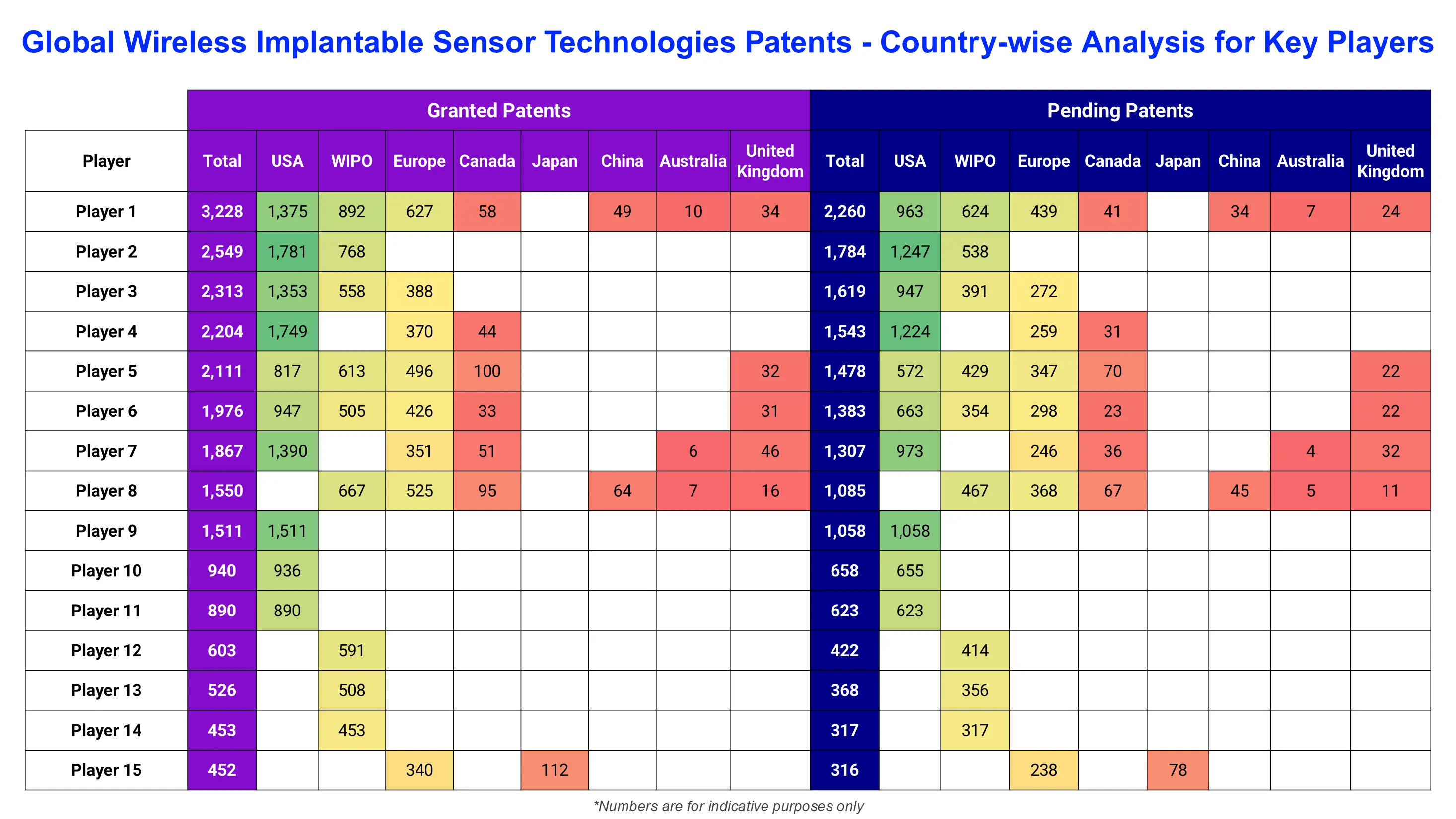
The five leading assignees, Abbott Laboratories, Medtronic, Biotronik, Boston Scientific and Integer Holdings, account for an estimated one fifth of families, which points to a fragmented field with a long tail of specialist and academic applicants. Abbott Laboratories holds a focused portfolio around pulmonary artery pressure sensing and its delivery and monitoring system. Medtronic and Biotronik pair implantable monitoring and cardiac rhythm devices with established telemetry and remote follow-up networks, so their filings emphasise connectivity and data handling. Boston Scientific protects cardiac rhythm and sensing technologies that overlap with wireless links. Integer Holdings, as a contract manufacturer, is associated with hermetic packaging, feedthroughs and miniaturised components that serve several device makers.
*Please note that this is only a partial list; the complete list of key players is available in the full report. Additionally, the list of key players can be customized to better suit your needs.*
The report assesses patent activity across major jurisdictions, including:
The United States is the largest jurisdiction, helped by the FDA pathway for implanted pressure sensors and the concentration of heart failure device developers. Europe follows, with filings through the European Patent Office led by applicants from Germany, France, the Netherlands and Switzerland, where implant and sensor engineering capability is well established. China has increased its share, driven by university and device-maker applications in ultrasound powering and sensor packaging. South Korea contributes filings that draw on semiconductor and short-range radio expertise, India shows early-stage activity from academic institutes and small developers, and WIPO filings indicate where applicants intend to seek protection across several markets at once.
Read more about this report - REQUEST FREE SAMPLE COPY IN PDF
Patent activity in wireless implantable sensor technologies is grouped into five technology segments:
Inductive and radio frequency passive sensors lead patent activity, because the resonant circuit approach underlies the longest-running clinical use in heart failure, needs no battery and relies on well-understood external read-out hardware. Ultrasound-based systems rank second by volume and are growing fastest, as they reach deeper tissue than radio frequency links and suit smaller sensors. Bluetooth Low Energy and near-field communication filings are typically tied to battery-assisted or wearable-linked designs.
Competition is shaped by a small number of cardiovascular device groups with clinically validated sensor platforms, a wider set of specialist developers, and component suppliers whose hermetic packages make long implant life possible. Pulmonary artery pressure monitoring is the most contested clinical area, with an FDA approved sensor from 2014 and a newer pulmonary artery sensor from Endotronix reported to have received FDA approval in 2024. Companies differentiate through sensor stability, ease of implantation, reader ergonomics and integration with heart failure clinic workflows. Patent positions around delivery systems and data analytics often matter as much as sensor design when licensing or acquisition is considered.
Companies are focusing on:
Emerging themes include ultrasound transducer arrays that power and read out several sensors from one external patch, and magnetic and optical telemetry for sites where radio frequency signals attenuate strongly. Developers are also applying artificial intelligence to pressure waveforms so that trends can be flagged before clinicians review them. Cybersecurity claims for connected implants are increasing as regulators ask for secure update and authentication mechanisms. Temporary sensors designed to dissolve after a monitoring period remain at an early stage, and they sit mainly in academic filings.
The wireless implantable sensor technologies patent landscape maps who is filing, where, and around which technical problems, from powering and radio links to packaging and data platforms. It connects filing clusters with clinical applications such as heart failure, intracranial pressure and intraocular pressure monitoring, so that technology choices can be read against commercial relevance. Jurisdiction, assignee and cluster views are combined to show where protection is crowded, where it is thin, and which applicants hold the enabling claims for battery-free sensing.
The patent landscape provides actionable intelligence for the following nine uses:
Patent research for this report was carried out across major patent databases, including national and regional offices and WIPO publications. Search strategies combined classification codes for implantable medical devices, wireless power and telemetry with keywords for battery-free, passive, ultrasound and inductive sensing. Results were grouped into patent families so that equivalent filings across jurisdictions were counted once.
Retrieved records were screened for relevance to implanted sensors with a wireless link, and records limited to external wearables, implanted drug delivery or purely chemical biosensing were excluded. Each remaining family was classified by wireless technology, sensing parameter, clinical application, assignee and jurisdiction. Technology clusters were then defined from the claim language and assessed for filing timing and ownership.
Market analysis was used alongside the patent work to place filing activity in commercial context. Clinical, regulatory and company information was reviewed to link patent clusters with product development, approvals and adoption. Market figures were compiled separately and are used to interpret the direction of patent activity rather than to count it. Findings were reviewed for consistency across sections before the final classification of clusters, assignees and jurisdictions was fixed.


Upto 15% Off
USD
$2699 $2429
$4299 $3869
$5799 $4949
$6999 $5949


*While we strive to always give you current and accurate information, the numbers depicted on the website are indicative and may differ from the actual numbers in the main report. At Expert Market Research, we aim to bring you the latest insights and trends in the market. Using our analyses and forecasts, stakeholders can understand the market dynamics, navigate challenges, and capitalize on opportunities to make data-driven strategic decisions.*
EMR's Wireless Implantable Sensor Technologies Patent Landscape Analysis provides a comprehensive assessment of patent filings, innovation clusters, assignee portfolios, and geographic filing patterns across the wireless implantable sensor technologies landscape. The report identifies 47,000+ patent families, evaluates leading jurisdictions including the United States, Europe, and China, and profiles the top assignees by portfolio size.
The global wireless implantable sensor technologies market was valued at USD 2.30 Billion in 2025. The market is projected to reach USD 9.47 Billion by 2035, expanding at a CAGR of 15.20% during 2026 - 2035.
The report analyses approximately 47,000+ patent families related to wireless implantable sensor technologies. These include filings from the United States, Europe, China, and international WIPO filings.
Key companies operating within the landscape include Abbott Laboratories, Medtronic, Biotronik, Boston Scientific, and Integer Holdings, among others. These organisations collectively account for a significant portion of patent activity analysed in this report.
The report evaluates patent activity across the United States, Europe, China, Japan, South Korea, India, and international WIPO filings. The United States is the largest single jurisdiction in the landscape, with more than 3,500 wireless implantable sensor technologies patents, reflecting the FDA pathway for implanted pressure sensors and the concentration of heart failure device developers there.
Yes. The report scope can be customised based on geography, technology segment, assignee selection, time period, or specific innovation cluster focus. Readers who need a narrower view, such as a single sensing modality, clinical application or jurisdiction, can contact the EMR team to scope a customised study around their own priorities.
Patent landscape analysis helps organisations understand innovation trends, competitive activity, technology whitespace, and IP risk across a defined domain. For wireless implantable sensor technologies, this report supports strategic decisions in R&D prioritisation, licensing evaluation, competitive benchmarking, and market entry planning.
Explore our key highlights of the report and gain a concise overview of key findings, trends, and actionable insights that will empower your strategic decisions.
|
Scope of the Report |
Details |
|
Analysis by Wireless Technology |
|
|
Analysis by Sensing Parameter |
|
|
Analysis by Clinical Application |
|
|
Analysis by End User |
|
|
Key Players Mentioned |
|
|
Geographies Covered |
|
Mini Report
One User
USD 2,699
USD 2,429
tax inclusive*
Single User License
One User
USD 4,299
USD 3,869
tax inclusive*
Five User License
Five User
USD 5,799
USD 4,949
tax inclusive*
Corporate License
Unlimited Users
USD 6,999
USD 5,949
tax inclusive*
*Please note that the prices mentioned below are starting prices for each bundle type. Kindly contact our team for further details.*
Flash Bundle
Small Business Bundle
Growth Bundle
Enterprise Bundle
*Please note that the prices mentioned below are starting prices for each bundle type. Kindly contact our team for further details.*
Flash Bundle
Number of Reports: 3
20%
tax inclusive*
Small Business Bundle
Number of Reports: 5
25%
tax inclusive*
Growth Bundle
Number of Reports: 8
30%
tax inclusive*
Enterprise Bundle
Number of Reports: 10
35%
tax inclusive*
How To Order

Select License Type
Choose the right license for your needs and access rights.

Click on ‘Buy Now’
Add the report to your cart with one click and proceed to register.

Select Mode of Payment
Choose a payment option for a secure checkout. You will be redirected accordingly.
Strategic Solutions for Informed Decision-Making
Gain insights to stay ahead and seize opportunities.

Get insights & trends for a competitive edge.

Track prices with detailed trend reports.

Analyse trade data for supply chain insights.

Leverage cost reports for smart savings

Enhance supply chain with partnerships.

Connect For More Information
Our expert team of analysts will offer full support and resolve any queries regarding the report, before and after the purchase.
Our expert team of analysts will offer full support and resolve any queries regarding the report, before and after the purchase.
We employ meticulous research methods, blending advanced analytics and expert insights to deliver accurate, actionable industry intelligence, staying ahead of competitors.
Our skilled analysts offer unparalleled competitive advantage with detailed insights on current and emerging markets, ensuring your strategic edge.
We offer an in-depth yet simplified presentation of industry insights and analysis to meet your specific requirements effectively.




