

Consumer Insights
Uncover trends and behaviors shaping consumer choices today
Procurement Insights
Optimize your sourcing strategy with key market data
Industry Stats
Stay ahead with the latest trends and market analysis.
The AI chatbots in healthcare market was valued at USD 0.86 Billion in 2025 and is forecast to reach USD 7.88 Billion by 2035, advancing at a CAGR of 24.80% during 2026-2035. Demand is supported by the global shortage of clinical staff, pressure on health systems to automate scheduling, intake and benefits enquiries, the maturing of large language models that can hold fluent clinical conversation, and rising consumer expectations for round-the-clock digital access to care. Hospitals, payers, telehealth providers and pharmaceutical companies are moving from pilot scripts to production deployments in symptom assessment, mental health support and medication adherence.
Patent activity has accelerated since late 2022, when general purpose large language model chatbots reached mass adoption and health systems began testing them for patient messaging, documentation and triage. The landscape of more than 2,600 patent families is concentrated in symptom checking and triage dialogue, large language model grounding and safety guardrails, mental health support conversation, medication adherence and reminders, voice assistants for patient intake, and handoff to clinicians and escalation logic. Validation signals include CE-marked symptom assessment engines, an FDA Breakthrough Device designation granted to a mental health chatbot in 2022, and health system rollouts of drafting assistants for patient message replies.
This AI Chatbots in Healthcare Patent Landscape Analysis Report provides a structured view of filing trends, leading assignees, jurisdiction coverage, technology segmentation and company profiles across conversational agents for patients and clinicians.
The AI chatbots in healthcare market is experiencing strong growth, driven by clinical workforce shortages, health system demand for administrative automation, and the arrival of large language models tuned for clinical conversation. Google reported in 2023 that its Med-PaLM 2 model scored around 86 percent on questions styled after the United States medical licensing examination, and health systems have since started using drafting assistants for patient portal messages.
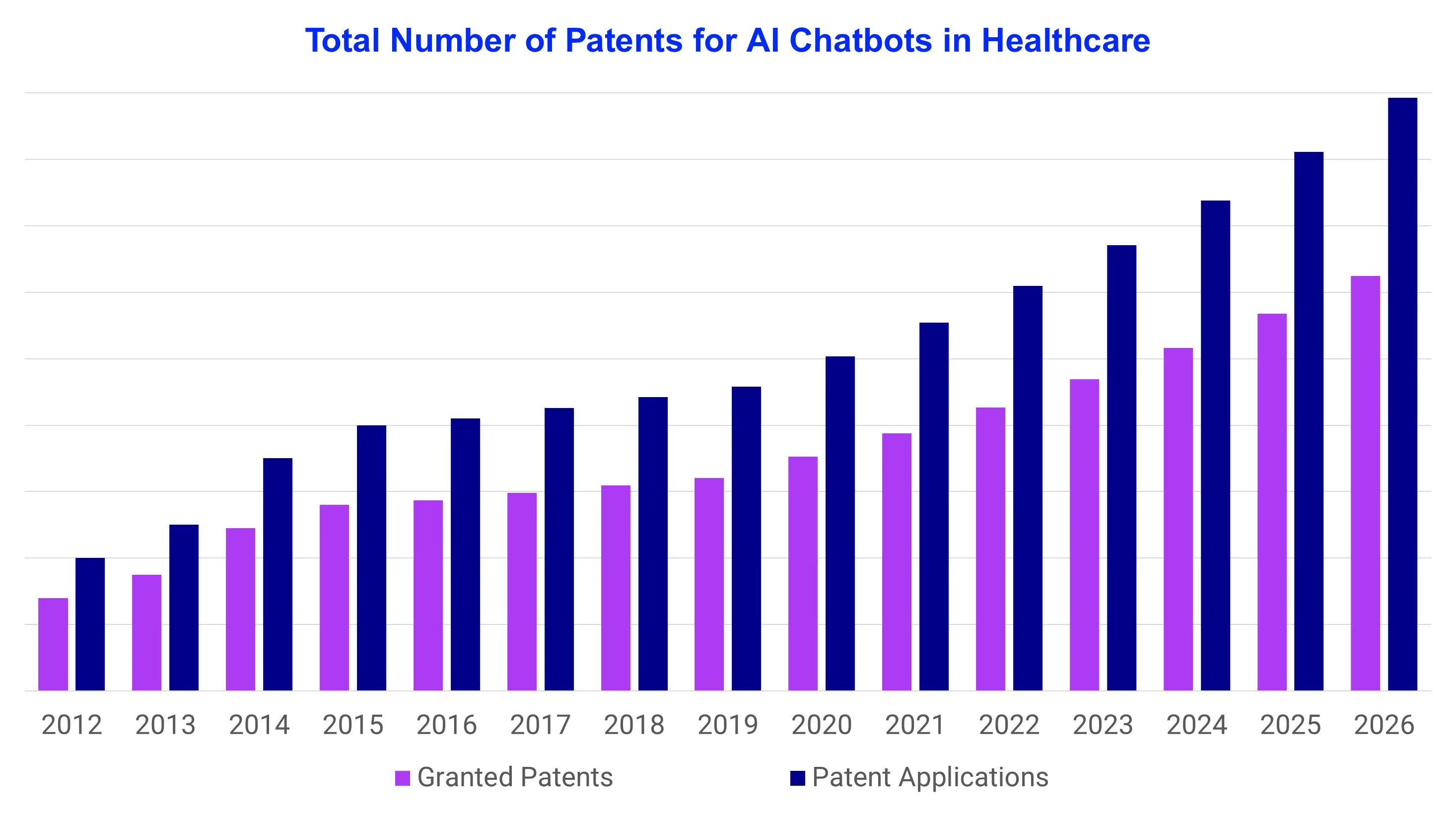
Patent activity is accelerating, with 340+ AI Chatbots in Healthcare patents granted in 2025, reflecting strong innovation momentum in symptom checking and triage dialogue, large language model grounding and safety guardrails, mental health support conversation, and medication adherence and reminders.
Top assignees in the AI Chatbots in Healthcare patent landscape include Microsoft, International Business Machines, Google, Ada Health, and Infermedica, with the United States, China, and Europe as the dominant patent jurisdictions.
Conversational agents have moved from scripted decision trees that answered frequently asked questions to systems that hold open-ended dialogue about symptoms, medications and benefits. Health systems face persistent staffing gaps, high call volumes into contact centres and growing patient expectations for after-hours access, which makes automated first-line interaction commercially attractive. Demand is strongest where conversations are repetitive and rule bound, such as scheduling, intake and refill reminders, while clinical uses such as triage and mental health support require tighter safety controls and clinician oversight. Buyers include hospitals, insurers, telehealth providers and pharmaceutical companies, each seeking lower cost per interaction and higher engagement. Regulation, data privacy obligations and concern about inaccurate answers shape which deployments scale first.
Market growth is driven by the spread of large language models tuned for clinical conversation, which allow a single assistant to handle symptom questions, administrative requests and follow-up messages that previously needed separate scripted tools. General purpose chatbots reached mass use from late 2022, and health systems responded by piloting drafting assistants for patient portal replies, which shortened the path from experiment to procurement. The World Health Organization estimates a shortfall of about 11 million health workers by 2030, a gap that automated first-line interaction partly addresses. Mental health adds to demand, since about one in eight people worldwide lives with a mental disorder and chatbots offer low-cost, always available support with escalation to clinicians.
Roughly half of patients with chronic conditions in high-income countries are estimated not to take medicines as prescribed, which gives adherence reminders and follow-up conversations a clear clinical and financial rationale for payers and pharmaceutical companies. Hypertension affects more than a billion adults and diabetes more than 500 million, so chronic disease management generates a large volume of routine check-ins that conversational agents can handle at low marginal cost. A 2023 study in JAMA Internal Medicine found that evaluators preferred chatbot answers to physician answers for public medical questions in about 79 percent of comparisons, which indicates that fluency is no longer the barrier and that attention has turned to accuracy, safety and accountability. That shift explains why filings increasingly cover grounding, guardrails and escalation logic.
Read more about this report - REQUEST FREE SAMPLE COPY IN PDF
Filing intensity rose sharply after 2022 as large language models turned conversational products into a priority for cloud providers, electronic health record vendors and digital health companies. Applicants moved from narrow dialogue-flow claims to system-level claims covering retrieval from clinical knowledge bases, output verification and safety filtering. The pattern tracks commercial investment, since technology companies bought or built clinical documentation and patient messaging products, and venture-backed specialists in symptom assessment widened licensing arrangements with health systems and insurers. Large platform companies file in volume, while specialists file fewer, more targeted families tied to a single clinical workflow.
The landscape comprises more than 2,600 patent families, with filing activity peaking between 2022 and 2024 on analyst estimates. Main technology clusters are symptom checking and triage dialogue, large language model grounding and safety guardrails, and mental health support conversation. Medication adherence and reminders, voice assistants for patient intake, and handoff to clinicians and escalation logic form a second group that is growing from a smaller base. Family counts lean towards software and system claims, with a minority covering devices that embed a voice interface or connect to monitoring equipment.
Rising demand for automated first-line care, administrative relief and clinical conversation support has translated directly into patent expansion, as applicants protect the dialogue, grounding and escalation methods that make deployment acceptable to health systems and regulators.
This report covers patent filings and granted patents across the United States, China, Europe, South Korea, India and international filings through the World Intellectual Property Organization, together with the global market for conversational agents deployed in healthcare. Coverage spans consumer-facing applications used by patients and plan members, and enterprise tools used inside hospitals, payers, telehealth providers and pharmaceutical companies. Market sizing reflects deployments across North America, Europe, Asia Pacific, Latin America and the Middle East and Africa, with regional differences in privacy law, reimbursement and language support shaping adoption. Filings from 2015 onwards are included to capture the shift from scripted systems to language model based assistants.
Technology and product scope covers chatbot types including Symptom Checker and Triage Chatbots, Patient Engagement and Support Chatbots, Mental Health Chatbots, Administrative and Scheduling Chatbots, and Clinician Assistant Chatbots. Underlying technologies range from Rule-Based and Decision Tree Systems and Natural Language Processing Models to Large Language Models and Voice and Speech Interfaces. Applications include Symptom Assessment and Triage, Chronic Disease Management, Mental Health Support, Medication Adherence, and Appointment and Administrative Support. Claims reviewed address dialogue management, knowledge base grounding, safety filtering, speech recognition, personalisation, integration with electronic health records and escalation to clinicians.
Entities in scope include large technology companies with conversational platforms, electronic health record vendors, specialist symptom assessment and triage providers, mental health and digital therapeutics start-ups, telehealth operators, health insurers running member assistants, and pharmaceutical companies funding adherence programmes. Academic medical centres and university groups contribute filings on clinical safety, evaluation methods and language model adaptation for medicine, and clinical institutions appear as co-applicants where assistants are developed alongside care pathways. Leading assignees such as Microsoft, International Business Machines, Google, Ada Health and Infermedica sit alongside many smaller applicants.
The report will cover the following sections in detail:
Analysis by Chatbot Type
Analysis by Underlying Technology
Analysis by Application
AI Chatbots in Healthcare Patent Filing Trend Analysis
Annual patent filings in the field have grown steadily since the mid-2010s, when intent classification and dialogue management matured, and stepped up after the public release of general purpose large language model chatbots in late 2022. Publication lags mean the most recent filing years are still being completed. Granted patents reached more than 340 in 2025, a sign that earlier dialogue and symptom assessment families are now clearing examination.
Annual filing growth is estimated at approximately 20 percent between 2020 and 2024. The increase was driven first by symptom assessment engines deployed during the pandemic telehealth surge, then by language model grounding and safety filings after late 2022. Mental health conversation and voice intake families added further volume as employers, insurers and health systems purchased support tools. Growth was strongest in the United States and China, where platform companies and well-funded start-ups file continuously.
Among the players with AI chatbots in healthcare patent families, new entrants have been identified, which can be either established companies or startups developing novel technology in the field. Some of the major companies mentioned in this report (a non-exhaustive list) are as follows:
Microsoft holds a broad conversational artificial intelligence portfolio that spans dialogue management, speech recognition, language model orchestration and clinical documentation. Its healthcare offerings include the Azure Health Bot service for building symptom triage and scheduling assistants, and the Nuance clinical documentation products, including the DAX ambient documentation line, which arrived through the acquisition of Nuance Communications completed in 2022. The Nuance speech heritage gives the company patent depth in voice interfaces used for patient intake and clinician dictation. Healthcare bot software is delivered as a configurable service rather than a cleared medical device, so regulatory status depends on how each customer deploys it. Microsoft relies on large, cross-domain filing programmes in natural language processing and speech, supported by cloud distribution through health system and electronic health record partnerships. In the landscape it acts as a platform provider whose filings underpin both patient-facing and clinician-facing assistants.
International Business Machines built its conversational healthcare position on the Watson question answering and dialogue work, and its portfolio still covers intent classification, dialogue management and enterprise knowledge retrieval. Its Watson Assistant product, now offered within the watsonx family, is used by insurers, providers and contact centres to handle member and patient enquiries. The company sold its Watson Health data and analytics assets in 2022, which narrowed its direct clinical offering and shifted emphasis to horizontal platforms and governance tooling. Enterprise conversational software of this kind is generally not a cleared medical device, so regulatory exposure sits mainly with the deploying organisation. Its IP strategy combines a large defensive portfolio with selective licensing, and it is positioned as an enterprise platform supplier to payers and hospitals rather than a consumer symptom checker.
Other companies include Google, Ada Health, and Infermedica.
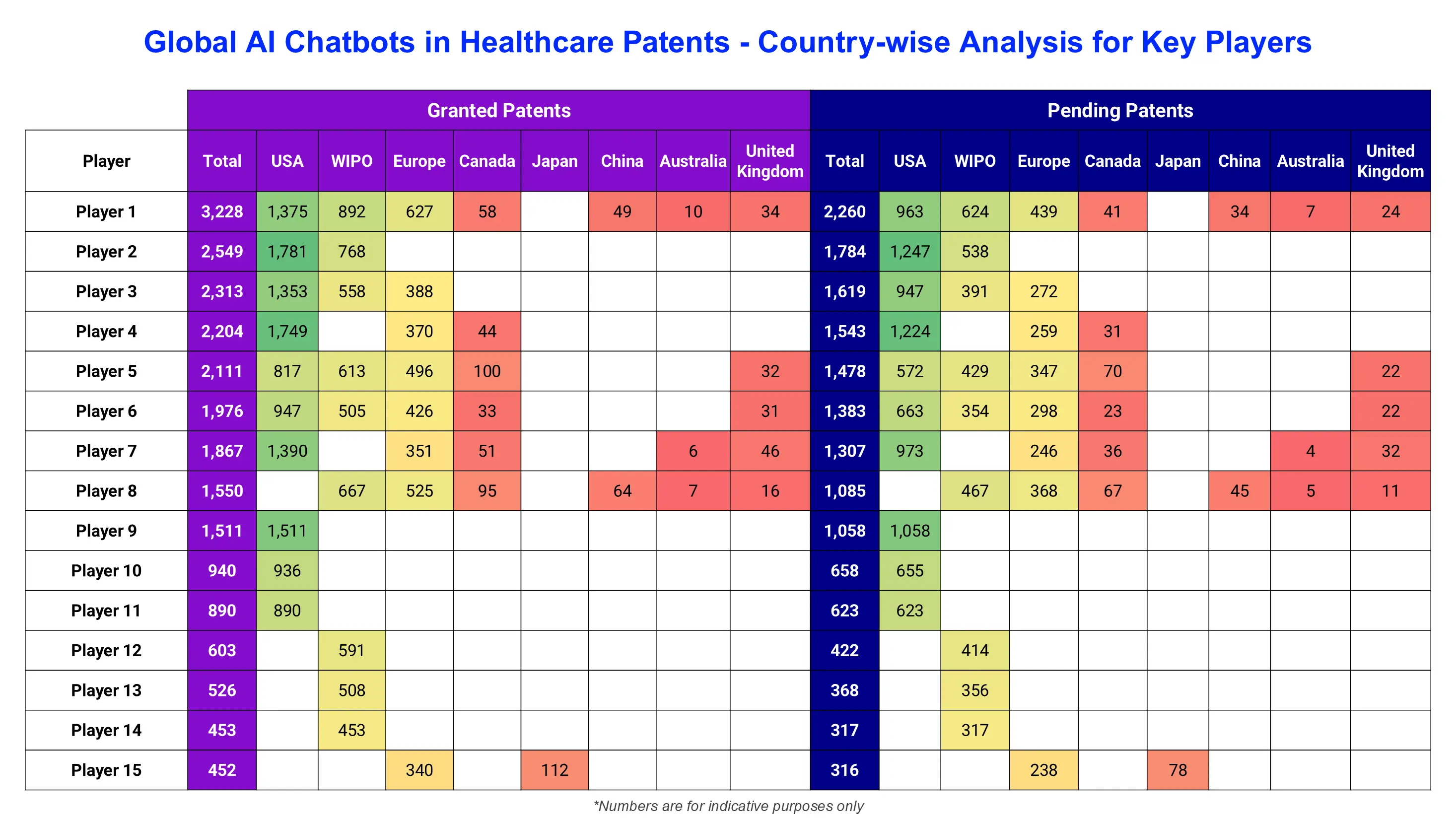
Leading assignees are concentrated among technology platform companies and specialist symptom assessment providers. Microsoft combines speech, dialogue and clinical documentation filings, helped by the Nuance portfolio. International Business Machines holds a long-standing question answering and dialogue portfolio that predates the current language model cycle. Google files on language model training for medical question answering and conversational reasoning. Ada Health and Infermedica hold smaller but highly targeted portfolios on probabilistic symptom assessment, interview logic and triage safety, and both have reported CE marking for their symptom assessment products. The three large technology groups account for a disproportionate share of volume, while the two specialists show high clinical relevance per family.
*Please note that this is only a partial list; the complete list of key players is available in the full report. Additionally, the list of key players can be customized to better suit your needs.*
The report assesses patent activity across major jurisdictions, including:
The United States is the leading jurisdiction, reflecting the concentration of platform companies, health system buyers and FDA oversight of software that supports clinical decisions. China ranks second, supported by large domestic internet and technology companies, national programmes for internet hospitals and strong activity in voice and language processing. Europe follows, with filings from symptom assessment specialists and from applicants responding to the European Union medical device and artificial intelligence regulations. South Korea contributes through electronics and platform groups working on voice interfaces, India through service companies and health technology start-ups, and WIPO filings indicate where applicants plan multi-country protection.
Read more about this report - REQUEST FREE SAMPLE COPY IN PDF
Patent activity in the field is organised around five technology segments:
Large language model grounding and safety guardrails leads patent activity, as applicants seek to make generative output reliable enough for clinical use. Claims cover retrieval from curated medical knowledge bases, citation of sources, detection of unsafe or unsupported answers, refusal behaviour and logging for audit. Symptom checking and triage dialogue holds the largest older base of families, but newer filings increasingly combine triage logic with a language model front end. Health systems and regulators ask for evidence of safety before deployment, which makes these controls the most commercially valuable claims.
Competition spans three groups. Technology platform companies such as Microsoft, International Business Machines and Google compete on infrastructure, language models and distribution through cloud and electronic health record channels. Specialist providers such as Ada Health and Infermedica compete on clinical validity, certification and integration with health system workflows. A third group of mental health, adherence and administrative automation start-ups competes on engagement outcomes in narrow use cases. Partnerships between platform companies and health systems are common, and acquisitions of speech and documentation companies have reshaped the field since 2022.
Companies are focusing on:
Emerging themes include agentic assistants that complete tasks such as booking, prior authorisation queries and refill requests, ambient clinical documentation that links consultation audio to structured notes, and privately hosted language models for sensitive data. Applicants are also filing on evaluation methods, including benchmark sets, clinician review loops and drift monitoring, because regulators in the United States and the European Union expect post-deployment performance evidence. Personalisation using wearable and medical record data, and multimodal conversation that accepts images, are early-stage areas with growing filing counts.
The patent landscape for AI chatbots in healthcare shows how ownership, claim focus and geographic coverage are distributed across more than 2,600 patent families. Platform companies hold broad dialogue and language model claims, specialists hold clinically validated triage logic, and new entrants file on safety, escalation and vertical use cases. Read together, these positions indicate where freedom to operate is constrained, where licensing is likely and which technical gaps remain open.
The landscape provides actionable intelligence for the following uses:
Patent research covered major patent databases and registers, including those of the United States Patent and Trademark Office, the European Patent Office, the China National Intellectual Property Administration, the Korean Intellectual Property Office, the Indian patent office and the World Intellectual Property Organization. Searches combined keywords with Cooperative Patent Classification codes relevant to conversational agents, dialogue systems, symptom assessment, speech interfaces and clinical language models, and were run for patent families with priority dates from 2015 onwards. Results were consolidated at the family level so that one invention filed in several jurisdictions was counted once.
Screening removed duplicate families and filings with no relevance to healthcare conversation, such as general customer service bots with no clinical or health insurance application. Remaining families were reviewed on titles, abstracts and claims, then classified by chatbot type, underlying technology, application and technology cluster. Assignee names were harmonised across subsidiaries and name variants, and legal status was recorded to separate granted patents from pending applications.
Market analysis drew on company disclosures, regulatory databases, clinical literature and published health system deployments to size demand and link patent activity to commercial adoption. Regulatory milestones, including device clearances, CE marking and breakthrough designations, were tracked alongside partnerships and acquisitions. Patent counts beyond the headline figures are approximate and indicate relative scale rather than exact totals.


Upto 15% Off
USD
$2699 $2429
$4299 $3869
$5799 $4949
$6999 $5949


*While we strive to always give you current and accurate information, the numbers depicted on the website are indicative and may differ from the actual numbers in the main report. At Expert Market Research, we aim to bring you the latest insights and trends in the market. Using our analyses and forecasts, stakeholders can understand the market dynamics, navigate challenges, and capitalize on opportunities to make data-driven strategic decisions.*
EMR's AI Chatbots in Healthcare Patent Landscape Analysis provides a comprehensive assessment of patent filings, innovation clusters, assignee portfolios, and geographic filing patterns across the AI chatbots in healthcare landscape. The report identifies 2,600+ patent families, evaluates leading jurisdictions including the United States, China, and Europe, and profiles the top assignees by portfolio size.
The global AI chatbots in healthcare market was valued at USD 0.86 Billion in 2025. The market is projected to reach USD 7.88 Billion by 2035, expanding at a CAGR of 24.80% during 2026 - 2035.
The report analyses approximately 2,600+ patent families related to AI chatbots in healthcare. These include filings from the United States, China, Europe, and international WIPO filings.
Key companies operating within the landscape include Microsoft, International Business Machines, Google, Ada Health, and Infermedica, among others. These organisations collectively account for a significant portion of patent activity analysed in this report.
The report evaluates patent activity across the United States, Europe, China, Japan, South Korea, India, and international WIPO filings. The United States is the largest single jurisdiction in the landscape, with more than 3,300 patents associated with it, ahead of China and Europe.
Yes. The report scope can be customised based on geography, technology segment, assignee selection, time period, or specific innovation cluster focus. Readers can contact the EMR team to scope a customised study that extends the coverage to additional jurisdictions, companies or conversational care use cases.
Patent landscape analysis helps organisations understand innovation trends, competitive activity, technology whitespace, and IP risk across a defined domain. For AI chatbots in healthcare, this report supports strategic decisions in R&D prioritisation, licensing evaluation, competitive benchmarking, and market entry planning.
Explore our key highlights of the report and gain a concise overview of key findings, trends, and actionable insights that will empower your strategic decisions.
|
Scope of the Report |
Details |
|
Analysis by Chatbot Type |
|
|
Analysis by Underlying Technology |
|
|
Analysis by Application |
|
|
Analysis by End User |
|
|
Key Players Mentioned |
|
|
Geographies Covered |
|
Mini Report
One User
USD 2,699
USD 2,429
tax inclusive*
Single User License
One User
USD 4,299
USD 3,869
tax inclusive*
Five User License
Five User
USD 5,799
USD 4,949
tax inclusive*
Corporate License
Unlimited Users
USD 6,999
USD 5,949
tax inclusive*
*Please note that the prices mentioned below are starting prices for each bundle type. Kindly contact our team for further details.*
Flash Bundle
Small Business Bundle
Growth Bundle
Enterprise Bundle
*Please note that the prices mentioned below are starting prices for each bundle type. Kindly contact our team for further details.*
Flash Bundle
Number of Reports: 3
20%
tax inclusive*
Small Business Bundle
Number of Reports: 5
25%
tax inclusive*
Growth Bundle
Number of Reports: 8
30%
tax inclusive*
Enterprise Bundle
Number of Reports: 10
35%
tax inclusive*
How To Order

Select License Type
Choose the right license for your needs and access rights.

Click on ‘Buy Now’
Add the report to your cart with one click and proceed to register.

Select Mode of Payment
Choose a payment option for a secure checkout. You will be redirected accordingly.
Strategic Solutions for Informed Decision-Making
Gain insights to stay ahead and seize opportunities.

Get insights & trends for a competitive edge.

Track prices with detailed trend reports.

Analyse trade data for supply chain insights.

Leverage cost reports for smart savings

Enhance supply chain with partnerships.

Connect For More Information
Our expert team of analysts will offer full support and resolve any queries regarding the report, before and after the purchase.
Our expert team of analysts will offer full support and resolve any queries regarding the report, before and after the purchase.
We employ meticulous research methods, blending advanced analytics and expert insights to deliver accurate, actionable industry intelligence, staying ahead of competitors.
Our skilled analysts offer unparalleled competitive advantage with detailed insights on current and emerging markets, ensuring your strategic edge.
We offer an in-depth yet simplified presentation of industry insights and analysis to meet your specific requirements effectively.




