

Consumer Insights
Uncover trends and behaviors shaping consumer choices today
Procurement Insights
Optimize your sourcing strategy with key market data
Industry Stats
Stay ahead with the latest trends and market analysis.
The AI in clinical decision support market was valued at USD 1.80 Billion in 2025 and is projected to reach USD 12.52 Billion by 2035, advancing at a CAGR of 21.40%. Demand is supported by near-universal adoption of electronic health records, which supplies the structured data that prediction models need, and by clinician workload and diagnostic error burdens that hospitals want to reduce. Clearer regulatory guidance from the FDA, together with the arrival of language models able to retrieve guidelines and literature at the point of care, adds further commercial momentum.
Patent activity reflects this demand, with more than 12,200 patent families analysed and more than 1,180 patents granted in 2025. Filing clusters centre on differential diagnosis and diagnostic suggestion, risk stratification and deterioration scores, medication safety and interaction alerting, guideline and literature retrieval, alert fatigue reduction and prioritisation, and explainability and model monitoring. Validation signals include the FDA final guidance on clinical decision support software of September 2022, the December 2024 final guidance on predetermined change control plans, and the FDA authorisation of a machine learning sepsis diagnostic in 2024.
This AI in Clinical Decision Support Patent Landscape Analysis Report provides a structured view of patent filing trends, leading assignees, jurisdictions, technology clusters and competitive positioning across diagnostic, treatment, medication safety, risk stratification and guideline navigation software.
The AI in clinical decision support market is experiencing strong growth, driven by near-universal health record adoption, rising clinician workload and diagnostic error burden, and clearer regulatory guidance for decision support software. The FDA published its final guidance on clinical decision support software in September 2022, and its public list of artificial intelligence enabled medical devices now holds more than 1,000 authorised entries.
Patent activity is accelerating, with 1,180+ AI in clinical decision support patents granted in 2025, reflecting strong innovation momentum in differential diagnosis and diagnostic suggestion, risk stratification and deterioration scores, medication safety and interaction alerting, and guideline and literature retrieval.
Top assignees in the AI in clinical decision support patent landscape include International Business Machines, Epic Systems, Koninklijke Philips, Siemens Healthineers, and Wolters Kluwer, with the United States, Europe, and China as the dominant patent jurisdictions.
Clinical decision support has moved from rule-based reminders and drug interaction pop-ups to systems that learn from large volumes of patient data and published evidence. Health systems face rising patient complexity, workforce shortages and a steady stream of new guidelines that no individual clinician can track unaided, which creates sustained demand for tools that present the right information at the moment a decision is made. Demand is strongest where delay or error carries a high cost, including sepsis recognition, medication ordering, cancer treatment selection and emergency triage. Buyers increasingly expect software to sit inside the health record workflow rather than in a separate window, which favours vendors that control the clinical interface and the underlying data.
Market growth is driven by the spread of machine learning risk scores and diagnostic suggestion engines inside certified health record systems, which turns existing structured data into point-of-care recommendations. In the United States, more than 90 percent of non-federal acute care hospitals operate a certified electronic health record, giving vendors a ready distribution channel for new decision support modules. Sepsis alone affects at least 1.7 million adults in the United States each year, and that burden explains why early warning scores remain among the most commercially advanced use cases. The FDA final guidance of September 2022 clarified which decision support functions are regulated as devices, which reduced uncertainty for developers planning submissions.
Alert fatigue illustrates the commercial pressure behind newer products. Studies of medication alerts have reported clinician override rates that often exceed half of all alerts, which means that a large share of warnings carries no clinical effect and that vendors able to rank or suppress low-value alerts gain an advantage with hospital pharmacy and informatics teams. Preventable adverse drug events are estimated at roughly 1.5 million a year in the United States, a figure that keeps medication safety near the top of hospital purchasing priorities and links directly to spending on interaction checking and dose guidance. Diagnostic error adds a second pressure, since a 2015 report from the National Academies concluded that most people will experience at least one diagnostic error in their lifetime, which supports demand for differential diagnosis tools.
Read more about this report - REQUEST FREE SAMPLE COPY IN PDF
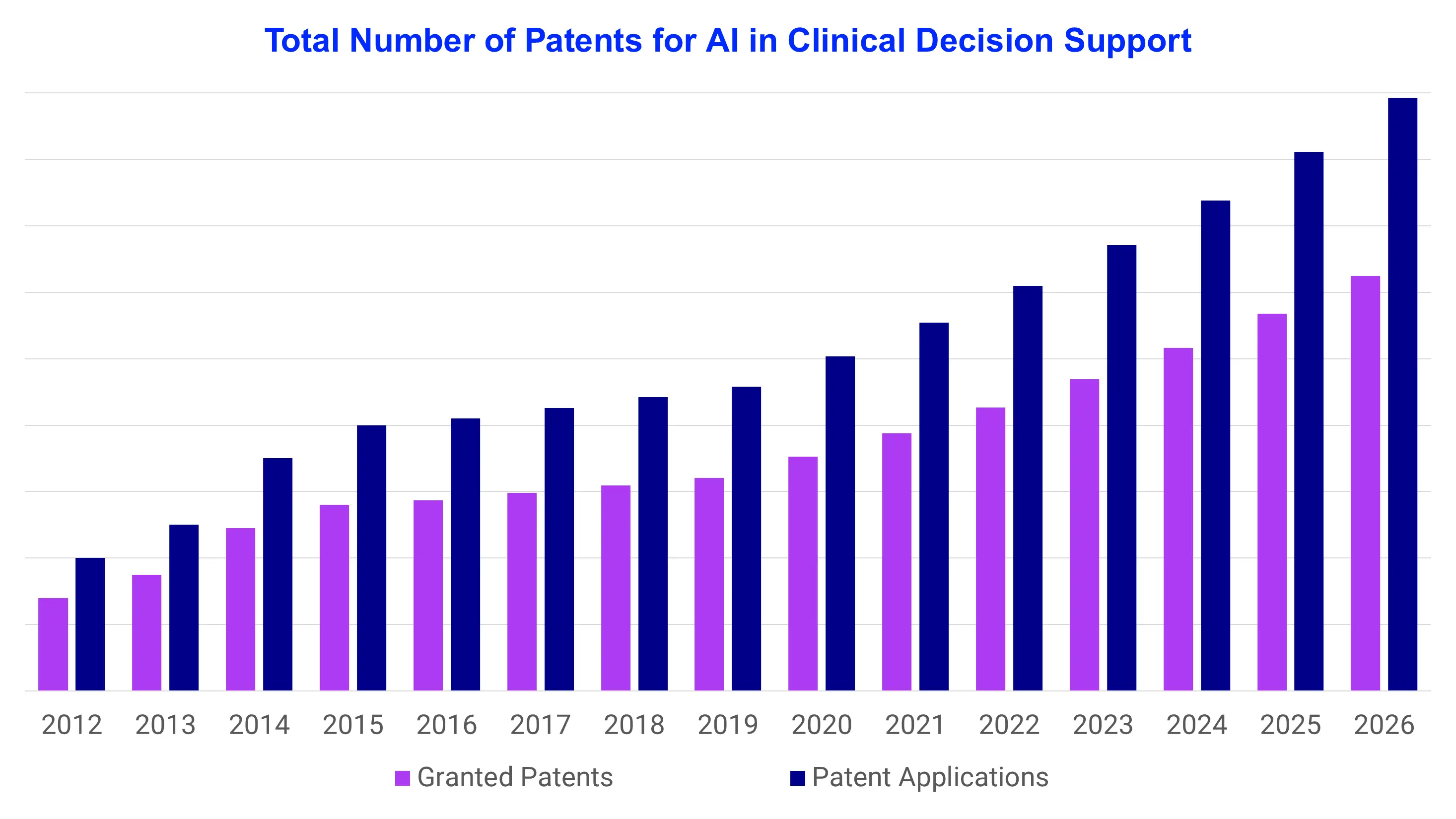
Filing intensity in clinical decision support software has followed hospital investment in electronic health records and, more recently, in generative language models. Enterprise vendors and equipment makers file continuously to protect workflow integration, scoring methods and data pipelines, while health systems and universities add filings around specific clinical prediction models. Commercial spending on early warning scores, medication safety modules and language model assistants has therefore translated into steady growth in applications, with filings concentrated in the United States, Europe and China, where enterprise software procurement and reimbursement structures support sales.
The landscape covers more than 12,200 patent families, grouped into six technology clusters: differential diagnosis and diagnostic suggestion, risk stratification and deterioration scores, medication safety and interaction alerting, guideline and literature retrieval, alert fatigue reduction and prioritisation, and explainability and model monitoring. Filing activity peaked between 2021 and 2024, when machine learning risk models matured and language models opened a new route to guideline retrieval. The more than 1,180 patents granted in 2025 are among the highest annual grant totals of the period.
Rising demand for sepsis detection, medication safety and diagnostic support at the point of care is matched by a corresponding expansion in patent filings that protect the models, alert logic and health record integrations behind those products.
This report covers patent families on AI in clinical decision support filed worldwide, with the United States, Europe and China as the main jurisdictions and additional coverage of South Korea, India, Japan and filings made through WIPO. Market coverage spans software that supports clinician decisions at the point of care, from diagnostic suggestion and treatment recommendation to medication safety alerting, risk stratification and guideline navigation. Granted patents and pending applications are both counted, and family-level grouping prevents the same invention filed in several offices from being counted more than once.
Technology and product scope runs across five support types: diagnostic decision support, treatment and therapy recommendation, medication safety and alerting, risk stratification and early warning, and clinical guideline navigation. These functions reach users through four integration modes, namely modules embedded in health record systems, standalone software platforms, mobile and point-of-care applications, and application programming interface services. Clinical domains include cardiology, oncology, critical and emergency care, primary care and neurology, and the underlying methods range from machine learning classifiers and deep learning models to language models, knowledge graphs and rule engines.
Entities in the landscape include enterprise health record vendors, diagnostic and monitoring equipment makers, clinical knowledge publishers, large technology companies, specialist decision support start-ups and academic medical centres. Established names such as International Business Machines, Epic Systems, Koninklijke Philips, Siemens Healthineers and Wolters Kluwer hold large portfolios, while university hospitals and research institutes contribute filings on validated prediction models for sepsis, cardiac events and cancer treatment selection. Start-ups tend to file narrowly around a single clinical use case, such as sepsis detection or stroke triage, and several have pursued FDA authorisation to support commercial adoption.
The report will cover the following sections in detail:
Analysis by Support Type
Analysis by Integration Mode
Analysis by Clinical Domain
AI in Clinical Decision Support Patent Filing Trend Analysis
Patent filings in clinical decision support software have climbed steadily since the mid-2010s. Early patents centred on rule engines and drug interaction logic, then shifted to statistical risk models and later to deep learning classifiers and language models. Examination backlogs mean that grants lag filings by two to four years in most offices, so the grant counts for 2024 still reflect applications submitted in the early 2020s and are likely to keep rising behind the filing curve.
Annual filings grew at an estimated 16 percent between 2020 and 2024 (an approximate figure), driven by three factors. Hospitals accelerated adoption of predictive scores during and after the pandemic, health record vendors began embedding models directly in clinician workflows, and the arrival of large language models in 2023 opened a new family of applications in guideline retrieval and recommendation drafting. Regulatory clarity from the 2022 FDA guidance also encouraged developers to protect functions that fall under device oversight, and patents granted in 2024 numbered more than 1,450 as a result.
Among the players with AI in clinical decision support patent families, new entrants have been identified, which can be either established companies or startups developing novel technology in the field. Some of the major companies mentioned in this report (a non-exhaustive list) are as follows:
International Business Machines holds a long-standing portfolio in clinical reasoning, natural language processing, evidence retrieval and healthcare data analytics, built through its Watson research programme and the former Watson Health business. The Watson Health data and analytics assets were sold to Francisco Partners in 2022 and became Merative, so the company now positions its healthcare work around the watsonx platform for enterprise language models and around partnerships with health systems. Most of its decision support software is offered as information to clinicians rather than as a regulated device, which keeps regulatory approval a secondary question for the portfolio. Its IP strategy relies on broad method claims for language understanding, knowledge extraction and reasoning over medical text, with continued filing to support research collaborations. In the landscape it acts as a technology supplier and research partner rather than a direct health record vendor.
Epic Systems is a privately held developer of electronic health record software used by a large share of hospitals in the United States, and its filings concentrate on embedding decision support inside clinician workflows. Its platform carries Best Practice Advisories, the Epic Sepsis Model, a deterioration index, and language model features for drafting messages and summaries that it has developed with Microsoft. An external validation study published in 2021 reported weaker sepsis model performance than the company had described, and the model has since been updated, which has made monitoring and transparency a visible theme for the company. Regulatory treatment depends on the function, and individual features are judged against the FDA guidance of September 2022 on which software is regulated as a device. Epic files selectively on scoring, alert routing and workflow integration methods and combines patents with proprietary data and trade secrets. Because orders, notes and results sit in one system, it holds a distribution advantage over standalone decision support vendors.
Other companies include Koninklijke Philips, Siemens Healthineers, and Wolters Kluwer.
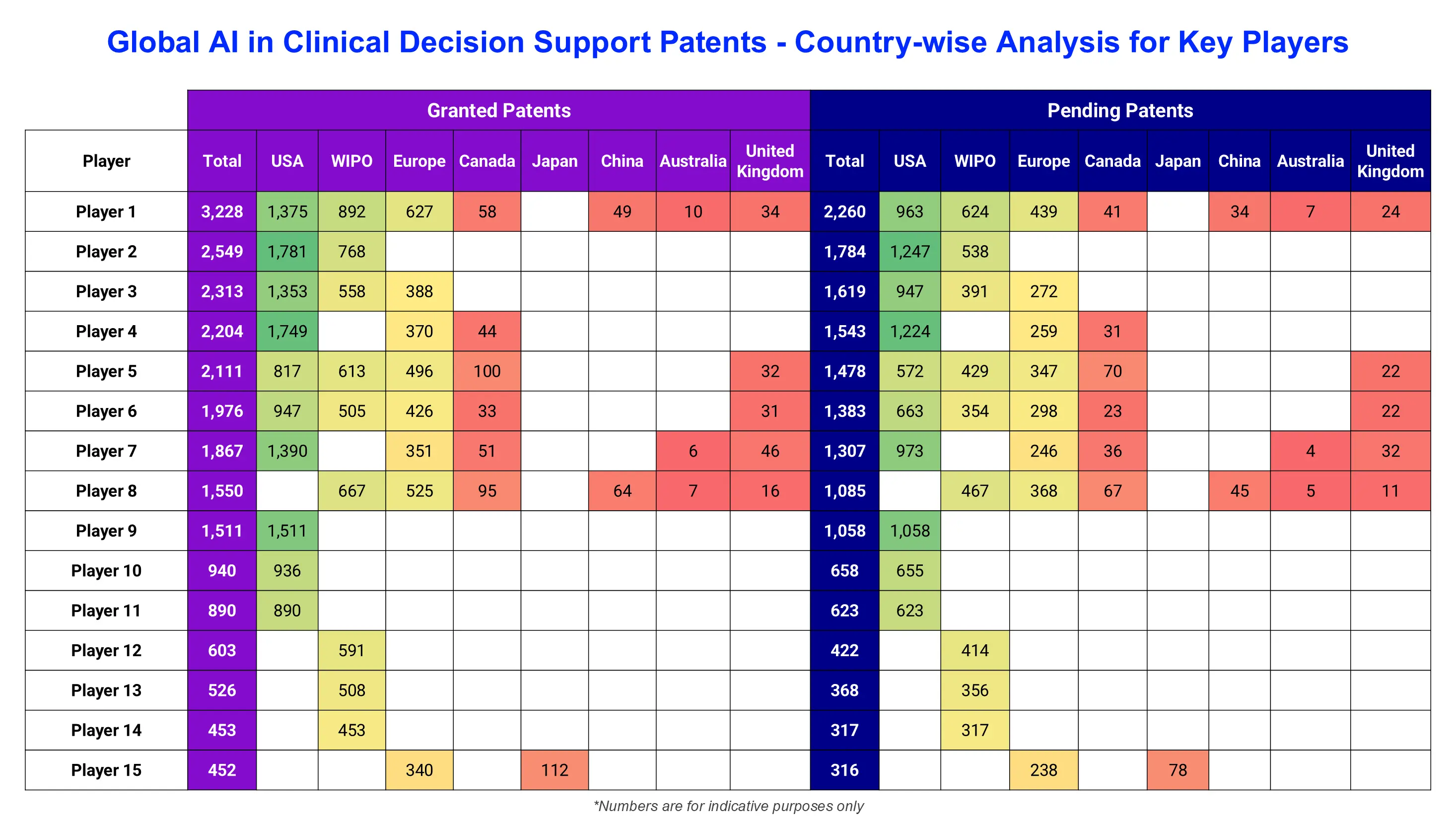
Patent ownership is moderately concentrated among five groups. International Business Machines holds a legacy portfolio built around clinical reasoning, natural language processing and evidence retrieval, while Epic Systems files on health record embedded scoring, alert routing and order-entry logic. Koninklijke Philips and Siemens Healthineers draw on monitoring and imaging data, with claims that tie physiological signals and imaging findings to patient-level risk assessment and workflow prompts. Wolters Kluwer protects clinical knowledge content and drug database logic that sit behind medication alerts and point-of-care reference tools. Together these groups hold a meaningful minority of families, and the long tail is made up of hospitals, universities and specialist developers.
*Please note that this is only a partial list; the complete list of key players is available in the full report. Additionally, the list of key players can be customized to better suit your needs.*
The report assesses patent activity across major jurisdictions, including:
The United States is the largest filing jurisdiction, supported by high electronic health record penetration, an active FDA pathway for decision support software and the presence of the leading health record vendors. Europe follows, with filings shaped by the Medical Device Regulation and the EU Artificial Intelligence Act, both of which place documentation and oversight duties on clinical software. China has grown quickly through hospital information system projects and domestic technology companies, while South Korea and India show smaller but expanding activity tied to hospital digitisation and local developers. WIPO filings made under the Patent Cooperation Treaty are used by multinationals seeking protection across several of these markets.
Read more about this report - REQUEST FREE SAMPLE COPY IN PDF
Patent activity in the landscape is organised around five technology segments:
Predictive risk and deterioration scoring currently leads patent activity, because early warning of sepsis, cardiac events and readmission can be built from routinely collected vital signs and laboratory results and carries a clear value case for hospitals. Diagnostic suggestion engines and medication safety logic follow closely, while language model retrieval has been the fastest growing segment from a small base since 2023. Explainability and monitoring filings are rising as regulators and hospital governance committees ask for evidence that deployed models stay accurate over time.
Competition is split between enterprise health record vendors, medical technology groups, clinical knowledge publishers and technology companies. Health record vendors hold a distribution advantage because decision support modules reach clinicians without separate integration, while equipment makers such as Koninklijke Philips and Siemens Healthineers combine monitoring and imaging data with scoring logic. Wolters Kluwer and International Business Machines draw on curated clinical content and language processing, and start-ups compete in narrow indications such as sepsis, stroke triage and oncology treatment matching. Publicly disclosed cross-licensing remains limited, and most companies rely on defensive filings and trade secrets around training data.
Companies are focusing on:
Emerging themes include generative language models that summarise guidelines and patient records at the point of care, agent-style tools that draft orders for clinician review, and multimodal models that combine notes, laboratory values, waveforms and images in a single risk estimate. Developers are also filing on model monitoring, bias detection and change control, in line with the FDA final guidance of December 2024 on predetermined change control plans for artificial intelligence enabled device software functions. Federated learning and privacy-preserving training attract smaller but growing interest among multi-hospital networks.
The patent landscape for AI in clinical decision support shows a field where protection is spread across software methods, data pipelines and workflow integration rather than a single device. More than 12,200 families reflect work by vendors, medical technology groups, hospitals and universities, with claims covering model training, alert logic, user interface behaviour and integration with health records. Knowing which clusters are crowded and which remain open gives developers and investors a basis for judging freedom to operate and the defensibility of new products.
The landscape provides actionable intelligence for the following nine uses:
Patent research drew on global databases including the United States Patent and Trademark Office, the European Patent Office, the China National Intellectual Property Administration, the Korean Intellectual Property Office, the Indian patent office and WIPO PATENTSCOPE. Searches combined keyword strings with CPC classes, including group G16H 50 for healthcare informatics supporting diagnosis and risk assessment, to capture clinical decision support, risk scoring, medication alerting and guideline retrieval. Records were grouped into families so that one invention filed in several offices counts once.
Screening removed duplicate families, filings with no relevance to the topic and records without a clear clinical decision function. Remaining families were classified by technology cluster, support type, integration mode and clinical domain, and then by assignee, jurisdiction and filing year. A manual review of a sample of records was used to confirm that cluster assignments were applied consistently.
Market analysis support came from regulatory databases, company filings, clinical literature and public product documentation, which were used to connect patent activity with commercial adoption. FDA authorisation records, CE marking information and published validation studies helped identify the products that reached clinical use. These inputs informed the assessment of leading assignees and the growth outlook for each technology cluster.


Upto 15% Off
USD
$2699 $2429
$4299 $3869
$5799 $4949
$6999 $5949


*While we strive to always give you current and accurate information, the numbers depicted on the website are indicative and may differ from the actual numbers in the main report. At Expert Market Research, we aim to bring you the latest insights and trends in the market. Using our analyses and forecasts, stakeholders can understand the market dynamics, navigate challenges, and capitalize on opportunities to make data-driven strategic decisions.*
EMR's AI in Clinical Decision Support Patent Landscape Analysis provides a comprehensive assessment of patent filings, innovation clusters, assignee portfolios, and geographic filing patterns across the AI in clinical decision support landscape. The report identifies 12,200+ patent families, evaluates leading jurisdictions including the United States, Europe, and China, and profiles the top assignees by portfolio size.
The global AI in clinical decision support market was valued at USD 1.80 Billion in 2025. The market is projected to reach USD 12.52 Billion by 2035, expanding at a CAGR of 21.40% during 2026 - 2035.
The report analyses approximately 12,200+ patent families related to AI in clinical decision support. These include filings from the United States, Europe, China, and international WIPO filings.
Key companies operating within the landscape include International Business Machines, Epic Systems, Koninklijke Philips, Siemens Healthineers, and Wolters Kluwer, among others. These organisations collectively account for a significant portion of patent activity analysed in this report.
The report evaluates patent activity across the United States, Europe, China, Japan, South Korea, India, and international WIPO filings. With more than 5,400 patents associated with it, the United States is the largest single jurisdiction in the AI in clinical decision support patent landscape, reflecting high health record adoption, an established FDA pathway for decision support software and the presence of the leading health record vendors.
Yes. The report scope can be customised based on geography, technology segment, assignee selection, time period, or specific innovation cluster focus. Readers who want a customised study, for example a deeper review of a specific technology cluster, clinical domain or competitor portfolio, can contact the Expert Market Research team to scope the work.
Patent landscape analysis helps organisations understand innovation trends, competitive activity, technology whitespace, and IP risk across a defined domain. For AI in clinical decision support, this report supports strategic decisions in R&D prioritisation, licensing evaluation, competitive benchmarking, and market entry planning.
Explore our key highlights of the report and gain a concise overview of key findings, trends, and actionable insights that will empower your strategic decisions.
|
Scope of the Report |
Details |
|
Analysis by Support Type |
|
|
Analysis by Integration Mode |
|
|
Analysis by Clinical Domain |
|
|
Analysis by End User |
|
|
Key Players Mentioned |
|
|
Geographies Covered |
|
Mini Report
One User
USD 2,699
USD 2,429
tax inclusive*
Single User License
One User
USD 4,299
USD 3,869
tax inclusive*
Five User License
Five User
USD 5,799
USD 4,949
tax inclusive*
Corporate License
Unlimited Users
USD 6,999
USD 5,949
tax inclusive*
*Please note that the prices mentioned below are starting prices for each bundle type. Kindly contact our team for further details.*
Flash Bundle
Small Business Bundle
Growth Bundle
Enterprise Bundle
*Please note that the prices mentioned below are starting prices for each bundle type. Kindly contact our team for further details.*
Flash Bundle
Number of Reports: 3
20%
tax inclusive*
Small Business Bundle
Number of Reports: 5
25%
tax inclusive*
Growth Bundle
Number of Reports: 8
30%
tax inclusive*
Enterprise Bundle
Number of Reports: 10
35%
tax inclusive*
How To Order

Select License Type
Choose the right license for your needs and access rights.

Click on ‘Buy Now’
Add the report to your cart with one click and proceed to register.

Select Mode of Payment
Choose a payment option for a secure checkout. You will be redirected accordingly.
Strategic Solutions for Informed Decision-Making
Gain insights to stay ahead and seize opportunities.

Get insights & trends for a competitive edge.

Track prices with detailed trend reports.

Analyse trade data for supply chain insights.

Leverage cost reports for smart savings

Enhance supply chain with partnerships.

Connect For More Information
Our expert team of analysts will offer full support and resolve any queries regarding the report, before and after the purchase.
Our expert team of analysts will offer full support and resolve any queries regarding the report, before and after the purchase.
We employ meticulous research methods, blending advanced analytics and expert insights to deliver accurate, actionable industry intelligence, staying ahead of competitors.
Our skilled analysts offer unparalleled competitive advantage with detailed insights on current and emerging markets, ensuring your strategic edge.
We offer an in-depth yet simplified presentation of industry insights and analysis to meet your specific requirements effectively.




