

Consumer Insights
Uncover trends and behaviors shaping consumer choices today
Procurement Insights
Optimize your sourcing strategy with key market data
Industry Stats
Stay ahead with the latest trends and market analysis.
The AI in clinical trial optimisation market was valued at USD 1.15 Billion in 2025 and is projected to reach USD 9.73 Billion by 2035, growing at a CAGR of 23.80% during 2026-2035. Demand is supported by the need to shorten patient enrolment timelines, rising protocol complexity, wider use of electronic health record and real-world data, and growing regulatory openness to synthetic control arms.
Patent activity is rising in step with this demand, with more than 430 patent families identified and more than 20 patents granted in 2025. Filings cluster in patient identification and eligibility matching, site selection and enrolment forecasting, protocol design and simulation, synthetic and digital twin control arms, risk based monitoring and data quality checks, and decentralised trial data capture. Validation signals include a 2022 qualification opinion from the European Medicines Agency on a digital twin based covariate adjustment method, the adoption of ICH E6(R3) good clinical practice in 2025, and draft FDA guidance on artificial intelligence in regulatory decision making published in 2025.
This AI in Clinical Trial Optimisation Patent Landscape Analysis Report provides an assessment of patent filing trends, leading assignees, jurisdictions, technology segments and competitive positioning, alongside the commercial context that shapes demand for trial design and execution software.
The AI in clinical trial optimisation market is experiencing strong growth, driven by the need to shorten patient enrolment timelines, rising protocol complexity, and regulatory acceptance of synthetic and digital twin control arms. Sponsors now use machine learning to rank investigator sites by predicted enrolment speed because many sites enrol fewer participants than planned, and each month of delay postpones the revenue of a successful medicine.
Patent activity is accelerating, with 20+ AI in clinical trial optimisation patents granted in 2025, reflecting strong innovation momentum in patient identification and eligibility matching, site selection and enrolment forecasting, protocol design and simulation, and synthetic and digital twin control arms.
Top assignees in the AI in clinical trial optimisation patent landscape include IQVIA, Medidata Solutions, Pfizer, Unlearn.AI, and Saama Technologies, with the United States, Europe, and China as the dominant patent jurisdictions.
Clinical development remains slow and expensive, and difficulty in finding eligible patients is among the most common reasons trials fall behind schedule. Sponsors, contract research organisations and trial sites therefore look to machine learning to read health records, forecast enrolment and simulate protocols before a study opens. The commercial setting favours these tools: late-stage studies have grown more complex, eligibility criteria have lengthened, and every month saved on a successful medicine adds to the period of market exclusivity. Demand also reflects wider data availability, since electronic health records, claims data and wearable streams now give algorithms enough volume to support practical decisions on design and execution.
Market growth is driven by pressure to shorten enrolment, which turns patient matching and site selection models into direct contributors to the timeline of a development programme. Slow enrolment is a leading cause of trial delay, and industry surveys have long reported that many sites miss their enrolment targets. In 2022 the European Medicines Agency issued a qualification opinion for a prognostic covariate adjustment method based on digital twins, which signalled that regulators will consider machine learning derived information in confirmatory trials. ICH E6(R3) good clinical practice, adopted in 2025, encourages proportionate and risk based quality management, and that supports monitoring tools which direct reviewers to the data that matter most.
The cost of delay explains much of the spending. Drug development programmes commonly run for ten years or more, so a few months saved at the enrolment stage brings revenue forward and preserves exclusivity time. Pfizer's pivotal COVID-19 vaccine study enrolled approximately 44,000 participants, which showed that very large trials can recruit quickly when digital tools and many sites work together, and it raised sponsor expectations for speed in other programmes. Decentralised trial elements gained ground over the same period, and FDA final guidance on decentralised clinical trials in 2024 gave sponsors a clearer basis for remote data capture. Greater use of remote capture enlarges the pool of data that matching and monitoring models can learn from, which in turn reinforces demand.
Read more about this report - REQUEST FREE SAMPLE COPY IN PDF
Patent filing intensity follows the money that sponsors, contract research organisations and software vendors have put into clinical data platforms. The 2017 combination of Quintiles and IMS Health into IQVIA and the 2019 acquisition of Medidata Solutions by Dassault Systèmes brought data assets and software teams together, and applications on patient matching and trial orchestration followed. Venture funding for start-ups building digital twin and natural language tools added a further stream of filings, often made early to secure priority before a first sponsor partnership. Filing volumes therefore mirror commercial commitments and not academic output alone.
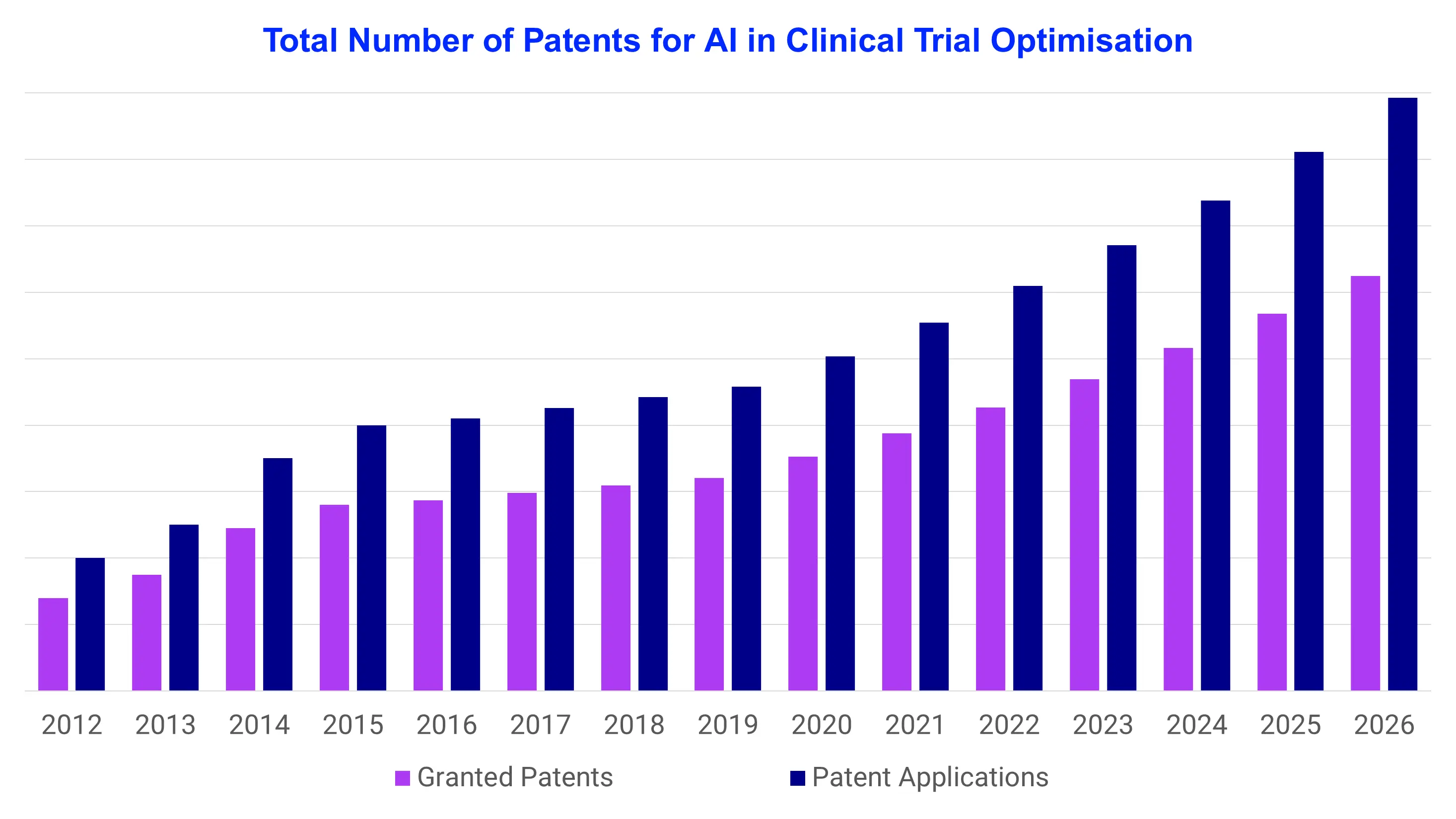
More than 430 patent families were identified for the landscape, with filing activity accelerating after 2018 and reaching its highest annual volumes in roughly 2021 to 2024 (approximate, based on analyst estimates). Patient identification and eligibility matching and site selection and enrolment forecasting form the two largest technology clusters, followed by protocol design and simulation. Synthetic and digital twin control arms are a smaller but faster growing cluster. Risk based monitoring and data quality checks and decentralised trial data capture contribute a steady flow of applications tied to platform software.
Rising demand for faster, cheaper and more predictable trials has translated directly into wider patent coverage, as each commercial pressure point, from enrolment delay to monitoring cost, has attracted its own cluster of filings.
This report examines patent activity and market trends for AI in clinical trial optimisation across the United States, Europe, China, Japan, South Korea, India and international filings made through the World Intellectual Property Organization (WIPO). Coverage includes granted patents and published applications grouped into families, together with the market context for the trial design and execution software, services and data products used in studies from Phase I to Phase IV. Regional commercial conditions, such as regulatory expectations for electronic data capture and the pace of digital adoption among sponsors, are considered alongside filing patterns.
Technology and product scope spans protocol design and simulation, patient identification and recruitment, site selection and feasibility, synthetic and digital twin control arms, and trial monitoring and risk management. Trial phases covered run from Phase I studies and Phase II studies through Phase III studies to Phase IV and real-world studies. The underlying techniques include machine learning prediction, natural language processing, generative models, and causal inference and simulation, delivered as software platforms, analytics services and data products. Duplicate families and filings with no relevance to clinical trials are removed during screening.
Entities covered include pharmaceutical and biotechnology sponsors that file on their own trial methods, contract research organisations that operate large trial networks, and clinical software vendors that supply data capture and analytics platforms. Specialist firms building digital twin generators, patient matching engines and data quality tools are included, as are health data companies that supply the records on which models are trained. Academic and research institutes, university hospitals and trial sites that file on recruitment, monitoring and statistical methods complete the group.
The report will cover the following sections in detail:
Analysis by Trial Function
Analysis by Trial Phase
Analysis by AI Technology
AI in Clinical Trial Optimisation Patent Filing Trend Analysis
Early filings, before about 2015, centred on electronic data capture and rule based patient screening. Machine learning entered claims in the middle of that decade, first to predict enrolment and later to read free text in clinical notes. Natural language processing and generative models then widened the claim base, and digital twin and synthetic control inventions appeared from about 2018 as regulators began to discuss external controls. Recent filings increasingly combine several of these techniques in a single trial platform.
Patent filings increased at an estimated annual growth rate of approximately 17% between 2020 and 2024. Disruption to site visits during the COVID-19 pandemic pushed sponsors towards remote data capture and centralised monitoring, and that work generated a wave of applications. Regulatory signals, including guidance on decentralised trials and risk based quality management, gave companies more confidence to protect their methods. Continued venture funding for digital twin and language model start-ups sustained growth after pandemic conditions eased.
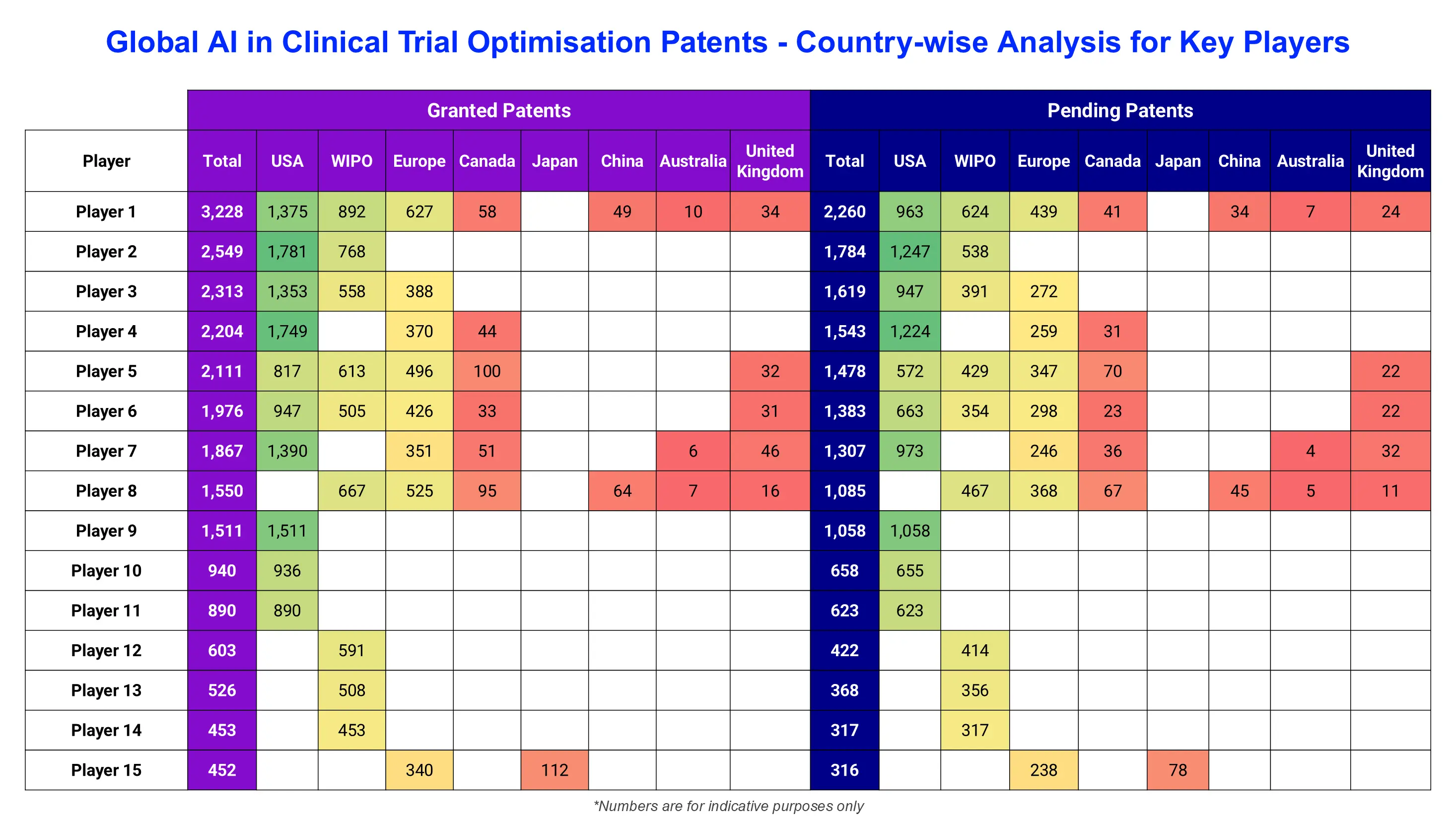
Among the players with AI in clinical trial optimisation patent families, new entrants have been identified, which can be either established companies or startups developing novel technology in the field. Some of the major companies mentioned in this report (a non-exhaustive list) are as follows:
IQVIA holds one of the broadest portfolios in the landscape, covering patient identification from health data, site selection and feasibility scoring, trial orchestration, and analytics for study monitoring. The company was formed in 2017 through the combination of Quintiles and IMS Health, which gave it both a contract research operation and a large health data asset base. Its commercial offerings include the Orchestrated Clinical Trials and Connected Intelligence families, which bundle machine learning models with services delivered to pharmaceutical and biotechnology sponsors. Because these products are software and services used within trials rather than diagnostic devices, they are generally deployed under good clinical practice and data integrity requirements instead of requiring device clearance. Its IP approach combines patent filings on data processing and matching methods with trade secret protection over proprietary datasets, and its position rests on pairing algorithms with access to patients and sites.
Medidata Solutions, part of Dassault Systèmes since 2019, builds its portfolio around the Medidata Clinical Cloud, including Rave electronic data capture, Patient Cloud for participant-facing data collection, and analytics for trial design, data quality and risk based monitoring. The company also markets a synthetic control arm offering that reuses historical trial data to reduce the number of participants assigned to comparator groups. Its software is designed to meet good clinical practice and electronic records requirements, and its outputs have been used in sponsor discussions with regulators, although acceptance is assessed study by study. Patent filings centre on data capture workflows, anomaly detection in site data, and models trained on large pools of past studies. The platform's installed base across sponsors and contract research organisations gives it a distribution advantage that few specialist entrants can match.
Other companies include Pfizer, Unlearn.AI, and Saama Technologies.
The five leading assignees, IQVIA, Medidata Solutions, Pfizer, Unlearn.AI and Saama Technologies, hold a visible but not dominant share of analysed families, which points to a moderately fragmented field with a long tail of universities, other sponsors and software vendors. IQVIA and Medidata Solutions file around platform workflows and large-scale data processing. Pfizer files as a sponsor and protects methods tied to its own development programmes. Unlearn.AI concentrates on digital twin generation and covariate adjustment, while Saama Technologies focuses on analytics for clinical data review.
*Please note that this is only a partial list; the complete list of key players is available in the full report. Additionally, the list of key players can be customized to better suit your needs.*
The report assesses patent activity across major jurisdictions, including:
The United States is the largest filing hub, supported by the concentration of sponsors, contract research organisations and trial software vendors and by FDA openness to novel trial designs. Europe follows, helped by the EMA qualification opinion of 2022 and the application of the Clinical Trials Regulation from 2022, which standardised submissions across member states. China shows the fastest growth in domestic filings, driven by technology companies, hospital networks and large patient pools. South Korea and India contribute smaller volumes tied to hospital groups and contract research and IT services firms, while WIPO filings show how multinational vendors keep options open in several markets.
Read more about this report - REQUEST FREE SAMPLE COPY IN PDF
The patent landscape is divided into five technology segments that show where inventive effort in AI in clinical trial optimisation is concentrated:
Patient identification and eligibility matching accounts for the largest share of patent activity, at roughly one quarter to one third of families by analyst estimate. Electronic health records and clinical notes offer abundant training data, natural language processing has matured enough to read eligibility criteria, and the technique applies across every therapeutic area. Deployment also requires less regulatory scrutiny than control arm methods, because a matching tool supports a recruiter and does not replace trial data.
Competition combines contract research organisations, clinical software vendors, pharmaceutical sponsors and venture-backed specialists, each approaching trial optimisation from a different asset base. IQVIA draws on health data and site networks, Medidata Solutions on a large installed base of data capture software, and Unlearn.AI on regulatory engagement around digital twins. Sponsors such as Pfizer file on methods developed inside their own programmes, which sometimes surface later as vendor partnerships. Filings concentrate in a handful of assignees, but new entrants continue to appear in generative protocol drafting and data quality tooling.
Companies are focusing on:
Emerging themes include large language models that draft protocols, informed consent documents and clinical study reports, and that read eligibility criteria directly from protocol text. Causal inference methods are being applied to build external controls from real-world data, while federated learning allows models to train across hospital systems without moving patient records. Automated resolution of data queries and central statistical monitoring are drawing interest as ICH E6(R3) places weight on risk proportionate oversight. Draft FDA guidance on artificial intelligence in regulatory decision making, issued in 2025, adds pressure for transparent model validation.
The patent record for AI in clinical trial optimisation shows a field moving from isolated prediction tools towards connected platforms that span design, recruitment, conduct and analysis. Filings on matching and site selection are the most mature, while control arm and generative design patents are younger and carry more regulatory uncertainty. Ownership is spread across software vendors, contract research organisations, sponsors and start-ups, so freedom to operate depends on the specific trial function and technique. Companies that pair clinical data access with validated models hold the strongest positions.
The patent landscape provides actionable intelligence for the following uses:
The patent landscape for AI in clinical trial optimisation is developed through structured searches of patent databases covering the United States, Europe, China, Japan, South Korea, India and WIPO records. Queries combine Cooperative Patent Classification (CPC) codes, controlled keywords and assignee names related to protocol design, patient matching, site selection, control arms and trial monitoring. Records are collected as published applications and granted patents and grouped into patent families.
Patent records are screened, refined, categorised and consolidated to ensure relevance to clinical trial optimisation. Duplicate families and filings with no relevance to the topic are removed. Retained families are classified by trial function, trial phase and artificial intelligence technique, and assignee names are harmonised so that subsidiaries and acquired companies are counted together. Segment totals are then reconciled against the full family count, and borderline records are reviewed manually for technical relevance.
The market analysis is supported through secondary research, including regulatory publications, company disclosures, clinical trial registries, peer-reviewed literature and industry publications. Findings are cross-checked against filing trends to confirm that patent growth corresponds to commercial and regulatory developments. Estimates that cannot be verified from public records are presented as approximate, and company profiles rely on published product and regulatory information.


Upto 15% Off
USD
$2699 $2429
$4299 $3869
$5799 $4949
$6999 $5949


*While we strive to always give you current and accurate information, the numbers depicted on the website are indicative and may differ from the actual numbers in the main report. At Expert Market Research, we aim to bring you the latest insights and trends in the market. Using our analyses and forecasts, stakeholders can understand the market dynamics, navigate challenges, and capitalize on opportunities to make data-driven strategic decisions.*
EMR's AI in Clinical Trial Optimisation Patent Landscape Analysis provides a comprehensive assessment of patent filings, innovation clusters, assignee portfolios, and geographic filing patterns across the AI in clinical trial optimisation landscape. The report identifies 430+ patent families, evaluates leading jurisdictions including the United States, Europe, and China, and profiles the top assignees by portfolio size.
The global AI in clinical trial optimisation market was valued at USD 1.15 Billion in 2025. The market is projected to reach USD 9.73 Billion by 2035, expanding at a CAGR of 23.80% during 2026 - 2035.
The report analyses approximately 430+ patent families related to AI in clinical trial optimisation. These include filings from the United States, Europe, China, and international WIPO filings.
Key companies operating within the landscape include IQVIA, Medidata Solutions, Pfizer, Unlearn.AI, and Saama Technologies, among others. These organisations collectively account for a significant portion of patent activity analysed in this report.
The report evaluates patent activity across the United States, Europe, China, Japan, South Korea, India, and international WIPO filings. The United States is the largest single jurisdiction in the landscape, with more than 1,700 AI in clinical trial optimisation patents associated with it, reflecting the concentration of sponsors, contract research organisations and software vendors in that market.
Yes. The report scope can be customised based on geography, technology segment, assignee selection, time period, or specific innovation cluster focus. Readers who want a customised study, for example a narrower focus on a single trial function, phase or jurisdiction, can contact the EMR team to scope the work and agree deliverables.
Patent landscape analysis helps organisations understand innovation trends, competitive activity, technology whitespace, and IP risk across a defined domain. For AI in clinical trial optimisation, this report supports strategic decisions in R&D prioritisation, licensing evaluation, competitive benchmarking, and market entry planning.
Explore our key highlights of the report and gain a concise overview of key findings, trends, and actionable insights that will empower your strategic decisions.
|
Scope of the Report |
Details |
|
Analysis by Trial Function |
|
|
Analysis by Trial Phase |
|
|
Analysis by AI Technology |
|
|
Analysis by End User |
|
|
Key Players Mentioned |
|
|
Geographies Covered |
|
Mini Report
One User
USD 2,699
USD 2,429
tax inclusive*
Single User License
One User
USD 4,299
USD 3,869
tax inclusive*
Five User License
Five User
USD 5,799
USD 4,949
tax inclusive*
Corporate License
Unlimited Users
USD 6,999
USD 5,949
tax inclusive*
*Please note that the prices mentioned below are starting prices for each bundle type. Kindly contact our team for further details.*
Flash Bundle
Small Business Bundle
Growth Bundle
Enterprise Bundle
*Please note that the prices mentioned below are starting prices for each bundle type. Kindly contact our team for further details.*
Flash Bundle
Number of Reports: 3
20%
tax inclusive*
Small Business Bundle
Number of Reports: 5
25%
tax inclusive*
Growth Bundle
Number of Reports: 8
30%
tax inclusive*
Enterprise Bundle
Number of Reports: 10
35%
tax inclusive*
How To Order

Select License Type
Choose the right license for your needs and access rights.

Click on ‘Buy Now’
Add the report to your cart with one click and proceed to register.

Select Mode of Payment
Choose a payment option for a secure checkout. You will be redirected accordingly.
Strategic Solutions for Informed Decision-Making
Gain insights to stay ahead and seize opportunities.

Get insights & trends for a competitive edge.

Track prices with detailed trend reports.

Analyse trade data for supply chain insights.

Leverage cost reports for smart savings

Enhance supply chain with partnerships.

Connect For More Information
Our expert team of analysts will offer full support and resolve any queries regarding the report, before and after the purchase.
Our expert team of analysts will offer full support and resolve any queries regarding the report, before and after the purchase.
We employ meticulous research methods, blending advanced analytics and expert insights to deliver accurate, actionable industry intelligence, staying ahead of competitors.
Our skilled analysts offer unparalleled competitive advantage with detailed insights on current and emerging markets, ensuring your strategic edge.
We offer an in-depth yet simplified presentation of industry insights and analysis to meet your specific requirements effectively.




