

Consumer Insights
Uncover trends and behaviors shaping consumer choices today
Procurement Insights
Optimize your sourcing strategy with key market data
Industry Stats
Stay ahead with the latest trends and market analysis.
The AI in digital therapeutics market was valued at USD 0.95 Billion in 2025 and is projected to reach USD 8.57 Billion by 2035, advancing at a CAGR of 24.60%. Growth rests on four primary drivers: the shift from clinic-bound care to software-based treatment for depression, insomnia, diabetes and substance use disorder; expanding payer and pharmaceutical partnerships; the ability of machine learning to personalise therapy content and predict disengagement; and clearer regulatory and reimbursement routes in the United States and Germany.
Patent activity centres on adaptive therapy content and personalisation, engagement and adherence prediction, outcome prediction and dose optimisation, conversational coaching in therapeutic software, digital biomarker capture from phones and wearables, and clinical evidence generation and regulatory submission tools. More than 3,700 patent families have been identified, and more than 150 patents were granted in 2025, which points to sustained innovation momentum. Commercial validation includes FDA marketing clearance for prescription software treating major depressive disorder and for software treating chronic insomnia in 2024, together with the German DiGA reimbursement route created in 2019.
This AI in Digital Therapeutics Patent Landscape Analysis Report provides a structured view of patent filing trends, leading assignees, jurisdictions, technology clusters and company profiles that shape competitive positioning in software-based treatment.
The AI in digital therapeutics market is experiencing strong growth, driven by the need for scalable treatment of mental health and chronic conditions, growing payer and pharmaceutical partnerships, and personalisation through machine learning. Germany's DiGA route, introduced in 2019, lets physicians prescribe reimbursed software, and FDA clearance of prescription software for major depressive disorder in 2024 confirmed that regulators will authorise treatment software developed with a pharmaceutical partner.
Patent activity is accelerating, with 150+ AI in digital therapeutics patents granted in 2025, reflecting strong innovation momentum in adaptive therapy content and personalisation, engagement and adherence prediction, outcome prediction and dose optimisation, and conversational coaching in therapeutic software.
Top assignees in the AI in digital therapeutics patent landscape include Click Therapeutics, Big Health, Welldoc, Teladoc Health, and Otsuka Pharmaceutical, with the United States, Europe, and China as the dominant patent jurisdictions.
Software-based treatment has moved from an experimental idea to a prescribed or reimbursed option in a growing number of health systems. Clinicians increasingly look for interventions that reach patients between visits, particularly in mental health, insomnia, diabetes and substance use disorder, where therapist capacity and appointment access limit care. Machine learning adds the ability to tailor therapy content to each patient, anticipate disengagement and adjust the intensity of an intervention using outcome data. Demand comes from health systems seeking scalable treatment, payers looking for measurable outcomes, and pharmaceutical companies pairing medicines with software that supports adherence. Reimbursement and evidence requirements decide which products reach scale, so commercial adoption depends as much on clinical proof as on technical design.
Market growth is driven by the integration of machine learning into prescription and clinically validated software, which adjusts content, dose and engagement support for each patient and strengthens the outcome case presented to payers. FDA authorised the first prescription digital therapeutic for substance use disorder in 2017, and the first video game based treatment for attention deficit hyperactivity disorder followed in 2020, which showed that regulators accept software as a treatment. Germany created its DiGA fast-track reimbursement route in 2019, giving manufacturers a defined path to statutory insurance coverage.
Mental health disorders affect roughly one in eight people worldwide according to World Health Organization estimates, a treatment gap that clinician-delivered therapy cannot close alone and that favours scalable software. About 537 million adults were living with diabetes in 2021 according to the International Diabetes Federation, and the need for daily self-management support in this group explains payer and employer interest in chronic disease software with automated coaching. Several early leaders restructured or entered bankruptcy between 2023 and 2024, which showed that regulatory clearance alone does not secure revenue and moved business models toward pharmaceutical partnerships and payer contracts. Reimbursement therefore remains the main barrier, and companies able to show outcome gains and lower utilisation are better placed to win coverage.
Read more about this report - REQUEST FREE SAMPLE COPY IN PDF
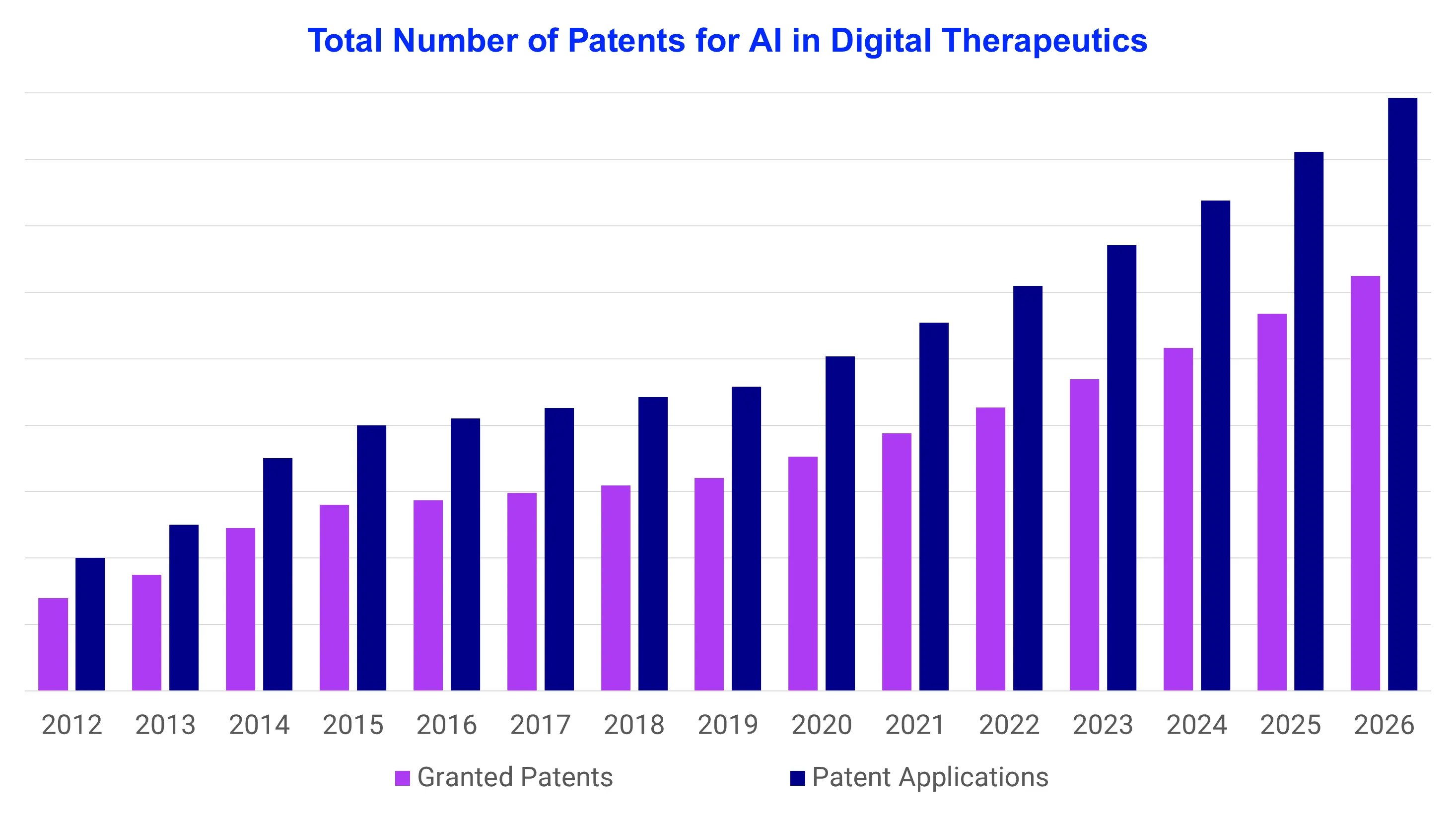
Filing intensity for AI in digital therapeutics has tracked venture funding, pharmaceutical partnerships and regulatory clearances, because each commercial milestone tends to be followed by further filings on content personalisation, engagement and outcome measurement. Applicants file early to protect adaptive algorithms and therapy architectures before pivotal trials begin, and they continue filing as real-world data shows which design features improve adherence. Companies with pharmaceutical partners often extend their portfolios around specific indications such as depression, insomnia and schizophrenia. Activity at some firms is estimated to have slowed after the restructurings of 2023 and 2024, while the largest portfolios kept growing through continuation and divisional filings.
More than 3,700 patent families have been identified for AI in digital therapeutics. Filing peaked between 2021 and 2024, a period that combined pandemic-era demand for remote care, new FDA clearances and the first reimbursed prescriptions in Germany. Adaptive therapy content and personalisation, and engagement and adherence prediction, account for the largest share of families, an estimated four in ten, since both apply to every therapy type. Outcome prediction and dose optimisation, conversational coaching, digital biomarker capture and clinical evidence generation tools make up the remainder, with conversational coaching the fastest-growing cluster in recent years.
Rising payer interest, pharmaceutical partnerships and regulatory acceptance have turned clinical demand for scalable treatment into a steady expansion of patent families, particularly where software must demonstrate personalised benefit.
Coverage extends to patent families published worldwide, with detailed analysis of filings at the United States Patent and Trademark Office, the European Patent Office, the China National Intellectual Property Administration, the Japan Patent Office, the Korean Intellectual Property Office, the Indian Patent Office and the World Intellectual Property Organization. Market coverage spans prescription software, clinically validated programmes for consumers, and software delivered through hospital, payer, employer and pharmaceutical channels in North America, Europe, Asia Pacific and the rest of the world. Filing years from 2010 to 2025 are included, and patent families rather than individual publications form the unit of count.
Technology scope covers cognitive behavioural therapy software, chronic disease management software, cognitive training and neurorehabilitation software, substance use disorder software and digital physical rehabilitation software. Artificial intelligence functions include personalisation and adaptive content, engagement and adherence prediction, conversational coaching, and outcome prediction and dose optimisation, together with digital biomarker capture and tools for clinical evidence generation and regulatory submission. Conditions covered are mental health disorders, diabetes and metabolic disorders, neurological disorders, cardiovascular conditions and respiratory conditions. Claims on algorithms, therapy content architecture, user interfaces, data pipelines and clinical decision support are included when they relate to a treatment delivered through software.
The entities examined include developers of prescription and clinically validated software, large pharmaceutical companies that co-develop or acquire software with their medicines, and telehealth and chronic care providers that deliver software-based programmes at scale. Specialist digital health start-ups, medical device manufacturers, consumer technology companies and language model developers also hold relevant filings. Academic medical centres and university spin-outs contribute claims on behavioural protocols, digital biomarkers and neurorehabilitation methods, and hospitals and research institutes appear as applicants where trials have produced patentable methods. Duplicate families and filings with no relevance to treatment software were removed during screening.
The report will cover the following sections in detail:
Analysis by Therapy Type
Analysis by AI Function
Analysis by Condition
AI in Digital Therapeutics Patent Filing Trend Analysis
Annual filings for AI in digital therapeutics rose steadily through the late 2010s and gained pace after 2019, when Germany opened its reimbursement route and the pandemic increased demand for remote treatment. Grant volumes followed with a lag, and more than 150 patents were granted in 2025. The rise reflects a change in focus from basic mobile application design toward machine learning that personalises content, forecasts dropout and estimates the dose of therapy a patient needs.
Annual patent filings grew at an estimated 14 percent between 2020 and 2024, with the strongest gains in engagement prediction, conversational coaching and digital biomarker capture. Growth was supported by larger clinical datasets, falling costs of model training and new FDA guidance on software that updates over time. The pace moderated in 2023 and 2024 as funding tightened and several early developers restructured, although pharmaceutical-backed programmes continued to file at a steady rate.
Among the players with AI in digital therapeutics patent families, new entrants have been identified, which can be either established companies or startups developing novel technology in the field. Some of the major companies mentioned in this report (a non-exhaustive list) are as follows:
Click Therapeutics develops prescription software treatments for psychiatric, neurological and chronic conditions on a proprietary platform used to design, test and update digital interventions. Its best-known product is Rejoyn, developed with Otsuka Pharmaceutical for adults with major depressive disorder and cleared by the FDA in 2024 as an adjunct to antidepressant medication. A schizophrenia programme developed with Boehringer Ingelheim has been reported to be in late-stage clinical development. The portfolio emphasises adaptive content, engagement mechanics and outcome measurement within therapeutic software, a combination suited to a business model built on pharmaceutical partnerships rather than direct consumer sales. Click Therapeutics pairs platform-level claims with indication-specific filings, which lets partners commercialise individual programmes while the core technology stays under common control. Within the landscape it is one of the most closely followed developers of prescription software.
Big Health develops digital cognitive behavioural therapy programmes, with Sleepio for insomnia and Daylight for anxiety as its core products. The prescription versions, SleepioRx and DaylightRx, received FDA marketing clearance in 2024, and Sleepio has been recommended for use in the National Health Service in England following review by the National Institute for Health and Care Excellence. Its portfolio covers automated delivery of therapy through an animated therapist, personalisation of sessions to each user's sleep and mood data, and measurement of outcomes. The company has published randomised trials for its programmes, and that evidence base supports contracts with health systems, insurers and employers. Its IP strategy combines patent filings on adaptive therapy delivery with trade marks and clinical data that are difficult for new entrants to reproduce.
Other companies include Welldoc, Teladoc Health, and Otsuka Pharmaceutical.
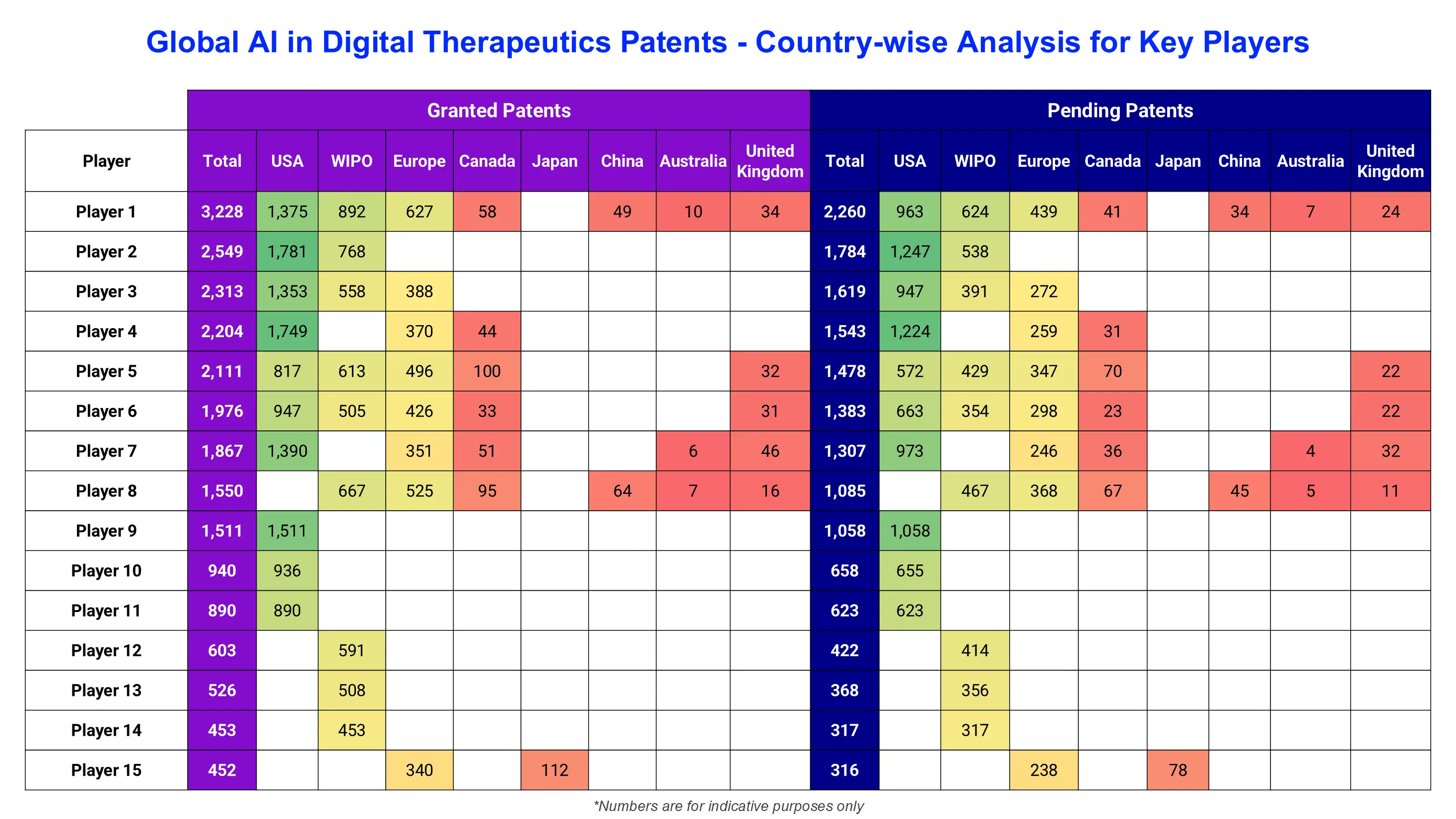
Patent ownership is moderately concentrated, with the five leading assignees holding a minority of families in a field that includes many start-ups, universities and technology companies. Click Therapeutics builds portfolios around partnered prescription programmes, and Big Health concentrates on automated cognitive behavioural therapy for insomnia and anxiety supported by randomised trial data. Welldoc holds filings on chronic disease coaching and diabetes decision support, while Teladoc Health combines claims inherited through acquisitions in diabetes management and mental health with its large telehealth base. Otsuka Pharmaceutical approaches the field as a medicine maker and files on software that accompanies its drugs, including programmes developed with Click Therapeutics.
*Please note that this is only a partial list; the complete list of key players is available in the full report. Additionally, the list of key players can be customized to better suit your needs.*
The report assesses patent activity across major jurisdictions, including:
The United States leads filing activity, supported by FDA authorisation routes for software treatments and a deep base of venture-funded developers. Europe follows, shaped by the German DiGA route, CE marking and national assessments in the United Kingdom and France. China is expanding quickly through filings from hospitals, universities and technology companies that target chronic disease and mental health. South Korea has created a dedicated approval pathway for digital therapeutics and produces a steady stream of filings on insomnia and neurological software. India contributes a growing volume from start-ups and research institutes serving large patient populations, and WIPO filings reflect applicants seeking protection across several markets at once.
Read more about this report - REQUEST FREE SAMPLE COPY IN PDF
Technology activity in the field is organised into five segments:
Adaptive therapy content leads patent activity, since personalisation sits at the core of every therapy type and is the feature most often claimed as a point of difference. Engagement and adherence prediction follows closely, because dropout is the main cause of poor outcomes in unguided software and prediction models give developers a measurable way to improve completion rates. Conversational coaching is the segment growing fastest from a smaller base.
Competition in AI in digital therapeutics is spread across specialist developers, pharmaceutical companies, telehealth providers and technology firms. Developers such as Click Therapeutics and Big Health compete on clinical evidence and regulatory clearances, while Welldoc and Teladoc Health compete on reach into chronic disease management through employer, payer and health system contracts. Pharmaceutical companies such as Otsuka Pharmaceutical use software to extend the value of their medicines. Consolidation after the 2023 and 2024 restructurings has left fewer independent prescription software companies, so partnerships and licensing arrangements now shape competitive position as much as the number of patents held.
Companies are focusing on:
Emerging themes include the use of large language models for coaching under clinical safeguards, closed-loop systems that adjust therapy from passive sensing on phones and wearables, and combination products that link a medicine with treatment software. Developers are also designing algorithms to fit FDA guidance on predetermined change control, so that models can be updated without a new submission for every revision. Another theme is evidence generation, where machine learning supports trial recruitment, real-world outcome tracking and the economic data payers ask for before they grant coverage.
The patent landscape for AI in digital therapeutics describes who is protecting what, where, and how quickly. It links filing clusters to named assignees, jurisdictions and technology segments, and it shows how portfolios align with regulatory clearances and partnership announcements. Readers can see where activity is crowded, where claims are sparse, and which applicants are building positions around adaptive content, engagement prediction, dose optimisation and conversational coaching. The result is a structured evidence base for decisions on investment, licensing and product development in software-based treatment.
The landscape provides actionable intelligence for the following nine uses:
Patent research was carried out across global patent databases, including the United States Patent and Trademark Office, the European Patent Office, the China National Intellectual Property Administration, the Japan Patent Office, the Korean Intellectual Property Office, the Indian Patent Office and the World Intellectual Property Organization. Searches combined keyword strings and Cooperative Patent Classification codes for treatment software, adaptive content, engagement prediction, coaching and outcome modelling, covering filing years from 2010 to 2025.
Retrieved records were grouped into patent families, and duplicate families and filings with no relevance to treatment software were removed. Each remaining family was reviewed and classified by technology cluster, therapy type, artificial intelligence function, condition, assignee and jurisdiction. Assignee names were harmonised across subsidiaries, former names and acquired companies so that portfolio sizes could be compared consistently.
Market analysis was used to place patent activity in commercial context. Regulatory clearances, reimbursement decisions, clinical trial publications, partnership announcements and company disclosures were reviewed alongside the patent records. Estimates for filing growth, peak periods and technology shares are analyst approximations derived from the classified family set and are rounded to reflect the uncertainty in classification.


Upto 15% Off
USD
$2699 $2429
$4299 $3869
$5799 $4949
$6999 $5949


*While we strive to always give you current and accurate information, the numbers depicted on the website are indicative and may differ from the actual numbers in the main report. At Expert Market Research, we aim to bring you the latest insights and trends in the market. Using our analyses and forecasts, stakeholders can understand the market dynamics, navigate challenges, and capitalize on opportunities to make data-driven strategic decisions.*
EMR's AI in Digital Therapeutics Patent Landscape Analysis provides a comprehensive assessment of patent filings, innovation clusters, assignee portfolios, and geographic filing patterns across the AI in digital therapeutics landscape. The report identifies 3,700+ patent families, evaluates leading jurisdictions including the United States, Europe, and China, and profiles the top assignees by portfolio size.
The global AI in digital therapeutics market was valued at USD 0.95 Billion in 2025. The market is projected to reach USD 8.57 Billion by 2035, expanding at a CAGR of 24.60% during 2026 - 2035.
The report analyses approximately 3,700+ patent families related to AI in digital therapeutics. These include filings from the United States, Europe, China, and international WIPO filings.
Key companies operating within the landscape include Click Therapeutics, Big Health, Welldoc, Teladoc Health, and Otsuka Pharmaceutical, among others. These organisations collectively account for a significant portion of patent activity analysed in this report.
The report evaluates patent activity across the United States, Europe, China, Japan, South Korea, India, and international WIPO filings. The United States is the largest single jurisdiction in the landscape, with more than 2,500 AI in digital therapeutics patents associated with it.
Yes. The report scope can be customised based on geography, technology segment, assignee selection, time period, or specific innovation cluster focus. Readers who want a customised study, such as a narrower therapy area, a named competitor set or a freedom-to-operate review, can contact the EMR team to scope the requirements and timeline.
Patent landscape analysis helps organisations understand innovation trends, competitive activity, technology whitespace, and IP risk across a defined domain. For AI in digital therapeutics, this report supports strategic decisions in R&D prioritisation, licensing evaluation, competitive benchmarking, and market entry planning.
Explore our key highlights of the report and gain a concise overview of key findings, trends, and actionable insights that will empower your strategic decisions.
|
Scope of the Report |
Details |
|
Analysis by Therapy Type |
|
|
Analysis by AI Function |
|
|
Analysis by Condition |
|
|
Analysis by End User |
|
|
Key Players Mentioned |
|
|
Geographies Covered |
|
Mini Report
One User
USD 2,699
USD 2,429
tax inclusive*
Single User License
One User
USD 4,299
USD 3,869
tax inclusive*
Five User License
Five User
USD 5,799
USD 4,949
tax inclusive*
Corporate License
Unlimited Users
USD 6,999
USD 5,949
tax inclusive*
*Please note that the prices mentioned below are starting prices for each bundle type. Kindly contact our team for further details.*
Flash Bundle
Small Business Bundle
Growth Bundle
Enterprise Bundle
*Please note that the prices mentioned below are starting prices for each bundle type. Kindly contact our team for further details.*
Flash Bundle
Number of Reports: 3
20%
tax inclusive*
Small Business Bundle
Number of Reports: 5
25%
tax inclusive*
Growth Bundle
Number of Reports: 8
30%
tax inclusive*
Enterprise Bundle
Number of Reports: 10
35%
tax inclusive*
How To Order

Select License Type
Choose the right license for your needs and access rights.

Click on ‘Buy Now’
Add the report to your cart with one click and proceed to register.

Select Mode of Payment
Choose a payment option for a secure checkout. You will be redirected accordingly.
Strategic Solutions for Informed Decision-Making
Gain insights to stay ahead and seize opportunities.

Get insights & trends for a competitive edge.

Track prices with detailed trend reports.

Analyse trade data for supply chain insights.

Leverage cost reports for smart savings

Enhance supply chain with partnerships.

Connect For More Information
Our expert team of analysts will offer full support and resolve any queries regarding the report, before and after the purchase.
Our expert team of analysts will offer full support and resolve any queries regarding the report, before and after the purchase.
We employ meticulous research methods, blending advanced analytics and expert insights to deliver accurate, actionable industry intelligence, staying ahead of competitors.
Our skilled analysts offer unparalleled competitive advantage with detailed insights on current and emerging markets, ensuring your strategic edge.
We offer an in-depth yet simplified presentation of industry insights and analysis to meet your specific requirements effectively.




