

Consumer Insights
Uncover trends and behaviors shaping consumer choices today
Procurement Insights
Optimize your sourcing strategy with key market data
Industry Stats
Stay ahead with the latest trends and market analysis.
The global AI in hospital workflow automation market was valued at USD 2.40 Billion in 2025 and is projected to reach USD 18.41 Billion by 2035, growing at a CAGR of 22.60% during 2026-2035. Demand is driven by persistent nurse and clinician shortages, margin pressure on hospitals, the high cost of unused operating room time, and the administrative burden of claims and prior authorisation. Software that forecasts admissions, schedules theatres and staff, and automates coding is moving from pilot programmes to enterprise deployments across large health systems.
Patent activity is rising in step with commercial deployment, with filings concentrated in patient flow and bed capacity forecasting, operating room and staff scheduling, revenue cycle and claims automation, and supply chain and inventory prediction. Command centre dashboards and orchestration, together with clinical task automation and routing, form further clusters. Commercial validation is visible in the scaling of specialist vendors such as Qventus and LeanTaaS, the move of GE HealthCare, Koninklijke Philips and Oracle into hospital operations software, and federal steps toward electronic prior authorisation in the United States.
This AI in Hospital Workflow Automation Patent Landscape Analysis Report provides a structured assessment of patent families, leading assignees, jurisdictions and technology clusters, together with market context to support innovation, competitive and investment decisions.
The AI in hospital workflow automation market is experiencing strong growth, driven by hospital staffing shortages, margin pressure, and the cost of idle operating room capacity. Large health systems that have introduced capacity command centres report faster bed assignment and shorter emergency department boarding, which has encouraged wider adoption across multi-hospital networks.
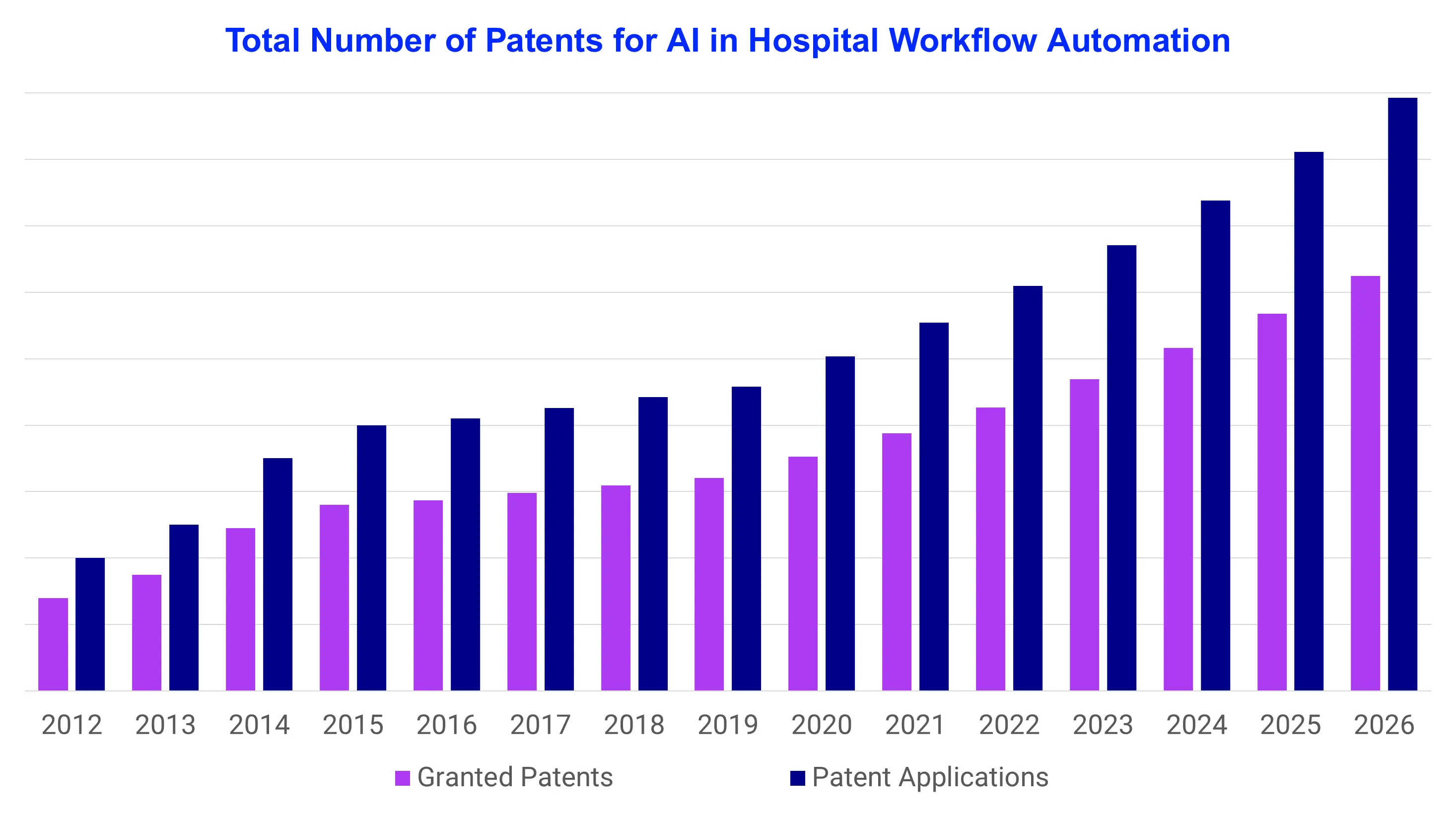
Patent activity is accelerating, with 180+ AI in hospital workflow automation patents granted in 2025, reflecting strong innovation momentum in patient flow and bed capacity forecasting, operating room and staff scheduling, revenue cycle and claims automation, and supply chain and inventory prediction.
Top assignees in the AI in hospital workflow automation patent landscape include GE HealthCare, Koninklijke Philips, Qventus, LeanTaaS, and Oracle, with the United States, China, and Europe as the dominant patent jurisdictions.
Hospitals run on tightly coupled resources: beds, operating rooms, clinical staff, supplies and payer paperwork. Shortages of nurses and allied health workers, together with thin operating margins, have made the coordination of those resources a board-level concern rather than an administrative detail. Software that predicts demand, sequences work and removes manual handoffs is therefore being bought as operational infrastructure. Buyers range from large integrated systems that run central command rooms to community hospitals that want automated scheduling and coding without adding headcount. Demand is shaped by the need to shorten emergency department waits, release inpatient capacity earlier in the day, and reduce denials that arise from incomplete documentation. Procurement increasingly favours platforms that connect to existing electronic health record systems rather than standalone tools.
The market growth is driven by pressure to raise operating room and bed utilisation, which lets hospitals treat more patients without building new capacity. Operating room time is commonly valued at tens of dollars per minute, so small gains in utilisation carry a material margin effect. A federal interoperability and prior authorisation rule finalised in the United States in January 2024 requires payers to adopt electronic prior authorisation, which pushes providers toward automated request handling.
Administrative functions are estimated to absorb roughly a quarter of hospital spending in the United States, which indicates that back-office automation addresses a large and measurable cost pool rather than a marginal one. Command centre programmes introduced at several large health systems from the late 2010s showed that predictive models could be tied to daily bed and transfer decisions, and that evidence encouraged multi-hospital rollouts. Staffing shortages reinforce this trend, because each hour of nurse time released from telephone coordination and manual rostering can return to patient care, which supports the business case for task routing tools. Payers follow a similar logic: faster electronic authorisation lowers handling cost per request and shortens the wait before scheduled procedures can proceed.
Read more about this report - REQUEST FREE SAMPLE COPY IN PDF
Filing intensity in this field has followed the flow of venture and enterprise investment into hospital operations software. Specialist vendors such as Qventus and LeanTaaS have raised substantial funding rounds, while GE HealthCare, Koninklijke Philips and Oracle have added operations capabilities through internal development and acquisition, and each move tends to be followed by continuation and divisional filings. Patent applications concentrate on forecasting models, scheduling optimisation and event-driven orchestration, where a small improvement in prediction accuracy converts directly into measurable utilisation gains. Large health systems that co-develop tools with vendors also contribute filings, which broadens the applicant base beyond software companies.
More than 1,400 patent families were identified across the landscape, covering filings published through 2024. Filing activity peaked between 2021 and 2024, when pandemic-era strain on beds and staff accelerated demand for forecasting and scheduling tools. The largest groups of families relate to patient flow and bed capacity forecasting, operating room and staff scheduling, and revenue cycle and claims automation. Smaller but fast-growing groups address supply chain and inventory prediction, command centre dashboards and orchestration, and clinical task automation and routing. Many families combine two or more of these functions, reflecting vendor strategies built around integrated operations platforms.
The rise in patent families tracks the shift of hospital operations software from pilot projects to enterprise purchasing, as capacity, scheduling and claims tools that prove their value in early deployments attract continuing filings on improved models and wider workflow coverage.
This report examines patent activity and market development in AI in hospital workflow automation across the United States, Europe, China, Japan, South Korea, India and international filings through the World Intellectual Property Organization (WIPO). Coverage spans hospital operations software sold to Public and Private Hospitals, Integrated Health Systems, Outpatient Surgical Centers, Academic Medical Centers, and Health Insurers and Payers. Filings are examined by jurisdiction, filing year and applicant type to show where innovation is concentrated and where commercial deployments are expanding. The market view covers vendors, regional adoption and procurement patterns that shape demand.
The technology scope includes predictive analytics, intelligent process automation, natural language processing, computer vision and optimisation algorithms applied to hospital operations. Product coverage extends across patient flow and bed management, operating room and staff scheduling, revenue cycle and claims automation, supply chain and inventory management, and clinical documentation and task automation. Applications are mapped to hospital functions including emergency department operations, perioperative services, inpatient units, administrative and back office work, and pharmacy and laboratory services. Patents covering command centre dashboards, demand forecasting engines and task routing logic are included alongside those describing the underlying models.
The entities analysed include hospital software and electronic health record vendors, medical technology manufacturers with informatics divisions, specialist operations analytics firms, and start-ups building scheduling, coding and prior authorisation tools. Established names such as GE HealthCare, Koninklijke Philips and Oracle sit alongside Qventus and LeanTaaS, as well as Epic Systems and Microsoft, which contribute through embedded workflow and documentation features. Academic and clinical institutions appear as applicants where hospital-developed forecasting and scheduling methods have been patented. Health insurers and claims processors are also included as filers on authorisation and adjudication automation.
The report will cover the following sections in detail:
Analysis by Workflow Area
Analysis by Technology
Analysis by Hospital Function
AI in Hospital Workflow Automation Patent Filing Trend Analysis
Early filings in this field, from the 2000s and early 2010s, centred on statistical bed occupancy models and rules-based operating room scheduling. Machine learning approaches to demand forecasting entered the record from the mid-2010s, followed by natural language processing for documentation and coding and, more recently, event-driven orchestration that triggers tasks automatically. Command centre programmes at large health systems from the late 2010s gave applicants real operational data to refine their specifications, which is visible in the growing share of filings that describe deployed workflows rather than concept designs.
Patent filings increased at an estimated annual growth rate of approximately 14% between 2020 and 2024. Growth was driven by the strain placed on bed capacity and staffing during the pandemic, by wider availability of cloud-based hospital data, and by payer demand for automated authorisation. Applications on revenue cycle and claims automation and on operating room scheduling expanded fastest, while patient flow forecasting remained the largest cluster by volume. The pace of 2023 and 2024 filings suggests that the field has moved beyond pilot-driven interest into sustained product development.
Among the players with AI in hospital workflow automation patent families, new entrants have been identified, which can be either established companies or startups developing novel technology in the field. Some of the major companies mentioned in this report (a non-exhaustive list) are as follows:
GE HealthCare holds one of the broadest hospital operations portfolios among the leading assignees, spanning capacity and patient flow forecasting, command centre orchestration, and workflow tools linked to its imaging and monitoring installed base. Its Command Center platform, first deployed with academic systems such as Johns Hopkins in the mid-2010s, combines predictive models with real-time dashboards for bed assignment, transfers and discharge planning. Because this software is administrative rather than diagnostic, it is generally sold as enterprise operations technology and is not cleared as a medical device, although the company's imaging and monitoring products carry FDA clearances and CE marks. GE HealthCare became an independent listed company in January 2023 and files on combined hardware and software workflow claims, with family coverage across the United States, Europe and China. Commercially, it positions command centre technology as a route to deeper enterprise relationships with health systems that already operate its equipment.
Koninklijke Philips maintains a sizeable hospital operations and patient flow portfolio that sits alongside its patient monitoring, imaging and informatics franchises. Its enterprise informatics and care coordination offerings, including capacity management and tele-intensive care programmes, are supported by acquisitions such as Capsule Technologies in 2021, which extended medical device integration into clinical workflows. Software of this kind is mostly administrative, so regulatory status varies by function, while connected monitoring and diagnostic products carry FDA clearance and CE marking. The company's IP approach is to file broad system-level claims around data aggregation, alerting and workflow routing, and to protect them across Europe, the United States and China. Commercially, it targets health systems seeking to link bedside monitoring data with operational decisions on staffing and patient placement.
Other companies include Qventus, LeanTaaS, and Oracle.
The five leading assignees, GE HealthCare, Koninklijke Philips, Qventus, LeanTaaS and Oracle, together hold an estimated 20 to 25 percent of analysed families, which points to a moderately fragmented field in which hospital systems and software firms also file. GE HealthCare and Koninklijke Philips build on large installed bases of imaging and monitoring equipment and file system-level claims. Qventus and LeanTaaS concentrate on predictive scheduling and capacity optimisation, with narrower but deeper portfolios. Oracle, through its Oracle Health business, protects electronic health record workflows, revenue cycle logic and documentation automation.
*Please note that this is only a partial list; the complete list of key players is available in the full report. Additionally, the list of key players can be customized to better suit your needs.*
The report assesses patent activity across major jurisdictions, including:
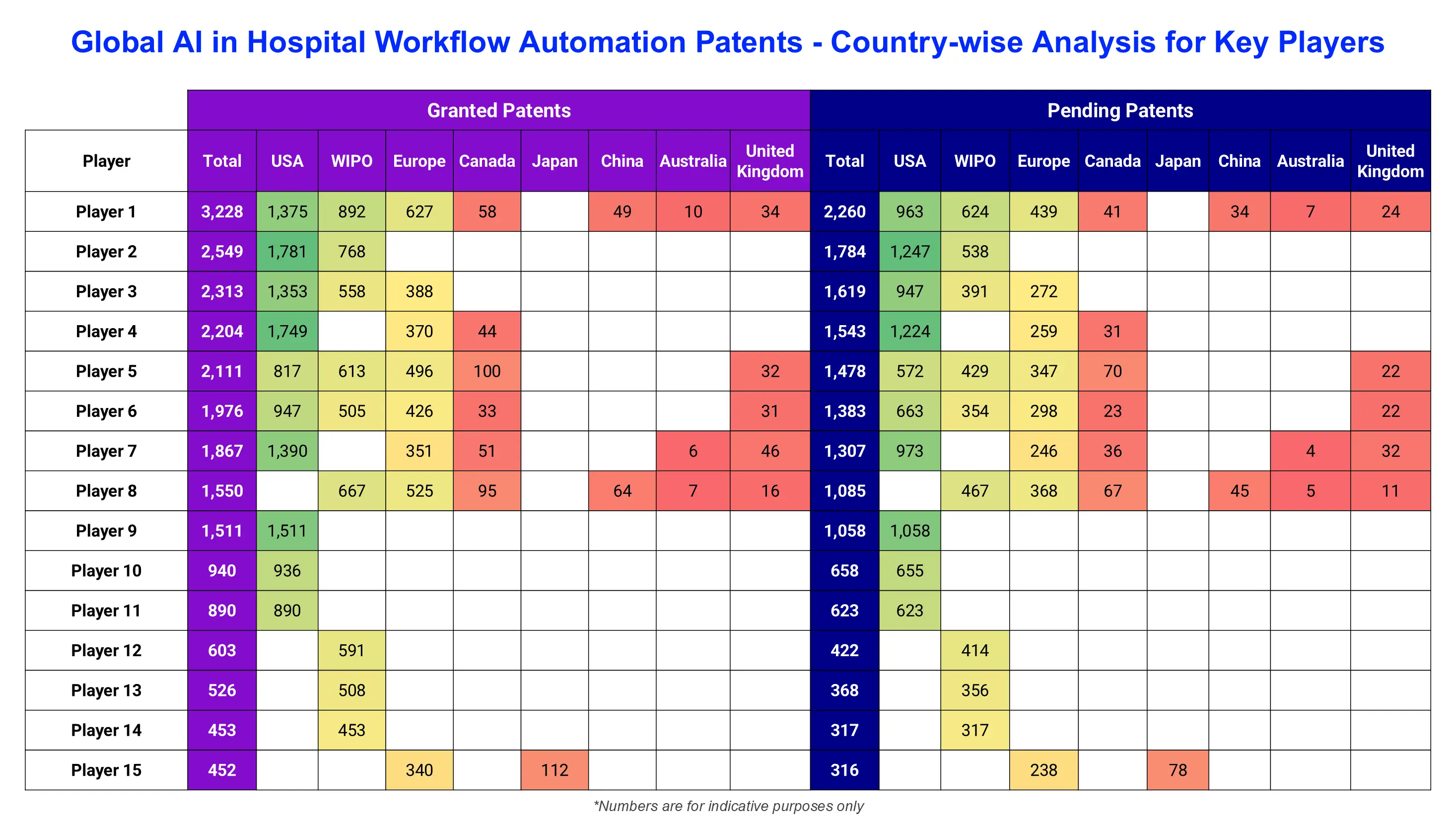
The United States is the largest filing jurisdiction, reflecting its hospital software market, payer-driven administrative complexity and the concentration of leading vendors. China ranks second on application volume, supported by hospital digitisation programmes and domestic technology companies working on scheduling, triage and claims review. Europe contributes through European Patent Office filings from Koninklijke Philips and other groups, with a focus on interoperability and data governance. South Korea adds filings from electronics and hospital information system firms, India is emerging through health technology start-ups, and WIPO filings show vendors seeking multi-country coverage for platforms sold to health systems internationally.
Read more about this report - REQUEST FREE SAMPLE COPY IN PDF
The patent landscape is segmented into five technology categories associated with AI in hospital workflow automation:
Among these, patient flow and bed capacity forecasting accounts for the largest share of patent activity, because bed availability governs emergency department throughput, elective admissions and discharge timing, and because forecasting models can run on data already held in hospital systems. Operating room scheduling follows closely, supported by clear utilisation metrics and strong demand from perioperative leaders. Revenue cycle and claims automation shows the steepest recent growth as payers and providers adopt electronic authorisation.
Competition combines diversified healthcare technology groups, enterprise software providers and venture-funded specialists. GE HealthCare and Koninklijke Philips extend hardware and informatics relationships into operations, Oracle builds on its electronic health record base, and Qventus and LeanTaaS compete with single-purpose platforms that integrate with existing record systems. Epic Systems adds native forecasting and scheduling features, which narrows the space available to point solutions and encourages them to deepen specialisation or seek partnerships. Rising filing counts, rapid product release cycles and health system contracts that span many hospitals indicate a market in which scale and integration depth increasingly decide outcomes.
Companies are focusing on:
Emerging innovation themes include ambient documentation that feeds coding and billing directly, autonomous software agents that complete prior authorisation submissions and status checks, and generative language models that draft appeals and summarise discharge needs. Digital twins of hospital capacity are being tested to simulate surge scenarios, while computer vision applied to room and equipment tracking supports turnover and sterile processing. Pharmacy and laboratory scheduling, together with supply replenishment triggered by predicted case volumes, form a further area of early filings. Governance themes such as audit trails, clinician override and bias monitoring are appearing in claims as buyers ask for transparency.
The landscape shows hospital operations moving from retrospective reporting to forecasting and automated action. Patent filings increasingly describe closed loops in which a prediction triggers a task, such as a transfer request, a staffing adjustment or a coding query, and the result feeds back into the model. This convergence of data integration, machine learning and workflow engines raises barriers for new entrants, since claims often cover the combination rather than any single component. Clusters with strong patent growth and visible hospital adoption, notably scheduling and claims automation, indicate where commercial value is being secured.
The patent landscape provides actionable intelligence for organisations assessing AI in hospital workflow automation, supporting the following strategic uses:
Patent research was conducted across major patent databases, including those of the United States Patent and Trademark Office, the European Patent Office, the China National Intellectual Property Administration and WIPO, using keyword strings and Cooperative Patent Classification codes linked to hospital scheduling, patient flow, claims processing, supply forecasting and clinical task automation. Search strategies were refined iteratively against known company portfolios and published product documentation to improve coverage. Patents were grouped into families to avoid counting the same invention filed in several jurisdictions.
Patent records were screened for relevance to the defined scope, with duplicate families and filings with no relevance to hospital operations removed. Retained records were classified by workflow area, technology, hospital function, assignee, jurisdiction and filing year, and consolidated into a single analytical database. Estimated growth rates and shares were derived from the classified families and are reported as approximate values.
Market analysis is supported through secondary research, including company filings and annual reports, regulatory notices, hospital association publications, peer-reviewed literature and vendor announcements. Findings were cross-checked against patent trends to confirm that filing activity corresponds to commercial deployments. Qualitative inputs on adoption barriers, procurement patterns and regulatory developments were incorporated to place the patent data in market context.


Upto 15% Off
USD
$2699 $2429
$4299 $3869
$5799 $4949
$6999 $5949


*While we strive to always give you current and accurate information, the numbers depicted on the website are indicative and may differ from the actual numbers in the main report. At Expert Market Research, we aim to bring you the latest insights and trends in the market. Using our analyses and forecasts, stakeholders can understand the market dynamics, navigate challenges, and capitalize on opportunities to make data-driven strategic decisions.*
EMR's AI in Hospital Workflow Automation Patent Landscape Analysis provides a comprehensive assessment of patent filings, innovation clusters, assignee portfolios, and geographic filing patterns across the AI in hospital workflow automation landscape. The report identifies 1,400+ patent families, evaluates leading jurisdictions including the United States, China, and Europe, and profiles the top assignees by portfolio size.
The global AI in hospital workflow automation market was valued at USD 2.40 Billion in 2025. The market is projected to reach USD 18.41 Billion by 2035, expanding at a CAGR of 22.60% during 2026 - 2035.
The report analyses approximately 1,400+ patent families related to AI in hospital workflow automation. These include filings from the United States, China, Europe, and international WIPO filings.
Key companies operating within the landscape include GE HealthCare, Koninklijke Philips, Qventus, LeanTaaS, and Oracle, among others. These organisations collectively account for a significant portion of patent activity analysed in this report.
The report evaluates patent activity across the United States, Europe, China, Japan, South Korea, India, and international WIPO filings. The United States is the largest single jurisdiction in the landscape, with more than 2,900 patents associated with it, within a landscape of more than 1,400 patent families.
Yes. The report scope can be customised based on geography, technology segment, assignee selection, time period, or specific innovation cluster focus. Readers can contact the EMR team to discuss their requirements and scope a customised study, with adjustments to geography, assignee coverage, technology focus or reporting depth.
Patent landscape analysis helps organisations understand innovation trends, competitive activity, technology whitespace, and IP risk across a defined domain. For AI in hospital workflow automation, this report supports strategic decisions in R&D prioritisation, licensing evaluation, competitive benchmarking, and market entry planning.
Explore our key highlights of the report and gain a concise overview of key findings, trends, and actionable insights that will empower your strategic decisions.
|
Scope of the Report |
Details |
|
Analysis by Workflow Area |
|
|
Analysis by Technology |
|
|
Analysis by Hospital Function |
|
|
Analysis by End User |
|
|
Key Players Mentioned |
|
|
Geographies Covered |
|
Mini Report
One User
USD 2,699
USD 2,429
tax inclusive*
Single User License
One User
USD 4,299
USD 3,869
tax inclusive*
Five User License
Five User
USD 5,799
USD 4,949
tax inclusive*
Corporate License
Unlimited Users
USD 6,999
USD 5,949
tax inclusive*
*Please note that the prices mentioned below are starting prices for each bundle type. Kindly contact our team for further details.*
Flash Bundle
Small Business Bundle
Growth Bundle
Enterprise Bundle
*Please note that the prices mentioned below are starting prices for each bundle type. Kindly contact our team for further details.*
Flash Bundle
Number of Reports: 3
20%
tax inclusive*
Small Business Bundle
Number of Reports: 5
25%
tax inclusive*
Growth Bundle
Number of Reports: 8
30%
tax inclusive*
Enterprise Bundle
Number of Reports: 10
35%
tax inclusive*
How To Order

Select License Type
Choose the right license for your needs and access rights.

Click on ‘Buy Now’
Add the report to your cart with one click and proceed to register.

Select Mode of Payment
Choose a payment option for a secure checkout. You will be redirected accordingly.
Strategic Solutions for Informed Decision-Making
Gain insights to stay ahead and seize opportunities.

Get insights & trends for a competitive edge.

Track prices with detailed trend reports.

Analyse trade data for supply chain insights.

Leverage cost reports for smart savings

Enhance supply chain with partnerships.

Connect For More Information
Our expert team of analysts will offer full support and resolve any queries regarding the report, before and after the purchase.
Our expert team of analysts will offer full support and resolve any queries regarding the report, before and after the purchase.
We employ meticulous research methods, blending advanced analytics and expert insights to deliver accurate, actionable industry intelligence, staying ahead of competitors.
Our skilled analysts offer unparalleled competitive advantage with detailed insights on current and emerging markets, ensuring your strategic edge.
We offer an in-depth yet simplified presentation of industry insights and analysis to meet your specific requirements effectively.




