

Consumer Insights
Uncover trends and behaviors shaping consumer choices today
Procurement Insights
Optimize your sourcing strategy with key market data
Industry Stats
Stay ahead with the latest trends and market analysis.
The AI in pathology market is valued at USD 0.62 Billion in 2025 and is forecast to reach USD 5.50 Billion by 2035, advancing at a CAGR of 24.40% over the forecast period. Demand is shaped by rising cancer biopsy volumes, persistent pathologist shortages, the move of laboratories to fully digital workflows, and the need for reproducible biomarker scoring in precision oncology and pharmaceutical trials. Growth is also supported by a market that starts from a small installed base of algorithms, which lets each new regulatory clearance and laboratory deployment lift the rate of expansion noticeably.
Patent activity reflects the same momentum, with filings concentrated in whole slide scanning and image quality control, tumour detection and grading models, biomarker and immunohistochemistry scoring, cytology screening support, digital pathology workflow and laboratory system integration, and molecular and genomic pathology reporting. Regulatory milestones, including the 2017 FDA clearance of the first whole slide imaging system for primary diagnosis and the 2021 De Novo authorisation of an artificial intelligence prostate cancer detection software, gave applicants a defined route to market. Commercial validation has followed through national digital pathology programmes, reference laboratory rollouts and pharmaceutical collaborations on companion diagnostic scoring.
This AI in Pathology Patent Landscape Analysis Report provides a structured view of filing trends, leading assignees, jurisdictions, technology clusters and strategic opportunities across scanners, analysis software, cytology and molecular pathology support, and laboratory workflow platforms.
The AI in pathology market is experiencing strong growth, driven by rising cancer biopsy volumes, persistent pathologist shortages, and the move of laboratories to fully digital workflows. Since the FDA cleared the first whole slide imaging system for primary diagnosis in 2017, hospital networks and national programmes have converted large parts of their histopathology services to digital reading, creating the image archives that detection and scoring algorithms require.
Patent activity is accelerating, with 800+ AI in pathology patents granted in 2025, reflecting strong innovation momentum in whole slide scanning and image quality control, tumour detection and grading models, biomarker and immunohistochemistry scoring, and cytology screening support.
Top assignees in the AI in pathology patent landscape include F. Hoffmann-La Roche, Koninklijke Philips, Leica Biosystems, Hamamatsu Photonics, and Proscia, with the United States, China, and Europe as the dominant patent jurisdictions.
Pathology sits at the centre of cancer diagnosis, and the work is changing as laboratories replace glass slides with digital images that software can read. Pathologist workforces have not kept pace with biopsy volumes, so laboratories are looking for tools that triage cases, flag suspicious regions and standardise the scoring of stained tissue. Adoption has moved from pilot projects in academic centres to routine use in hospital networks and large reference laboratories, helped by regulatory clearance of whole slide imaging systems for primary diagnosis. Pharmaceutical sponsors add a second source of demand, since quantitative tissue analysis supports patient selection and trial endpoints. Cytology screening, molecular reporting and laboratory system integration extend the opportunity beyond histology alone.
Market growth is driven by the shift of laboratories to digital workflows, which creates the scanned image archives that algorithms need and allows cases to be routed across sites without moving glass slides. The FDA cleared the first whole slide imaging system for primary diagnosis in 2017, and an artificial intelligence prostate cancer detection software received De Novo authorisation in 2021, which together showed that a regulated path exists for both image capture and algorithmic assistance. Global cancer incidence of roughly 20 million new cases in 2022 keeps biopsy and resection workloads rising, and every added specimen brings slides that need expert review. Growth runs high for a diagnostics segment because the installed base of clinical algorithms is still small, so each new clearance adds proportionally more.
Cervical cancer accounted for around 660,000 new cases and about 350,000 deaths worldwide in 2022, and because most deaths occur where cytology screening is limited, algorithm-assisted slide reading is attractive for under-resourced programmes. Prostate cancer, with about 1.5 million new diagnoses a year, generates large volumes of core needle biopsies in which tumour may occupy only a few millimetres, which explains why prostate detection software became an early regulatory target. Breast cancer, at roughly 2.3 million new cases annually, drives demand for HER2, oestrogen receptor and Ki-67 scoring, where variation between readers can change treatment selection. Each of these workloads rewards software that reads slides consistently, and laboratories that digitise for one use tend to buy scanners, platforms and analysis licences together.
Read more about this report - REQUEST FREE SAMPLE COPY IN PDF
Filing intensity has risen steadily as scanner makers, diagnostics companies and software developers protect work on image acquisition, model training and laboratory integration. Roche, Philips, Leica Biosystems and Hamamatsu Photonics pair instrument portfolios with software claims, while Proscia and other platform vendors file on case management and algorithm hosting. Commercial investment is visible in large reference laboratory deployments, pharmaceutical partnerships for companion diagnostic scoring and venture funding of pathology start-ups. New filings have typically followed those investments within one to two years.
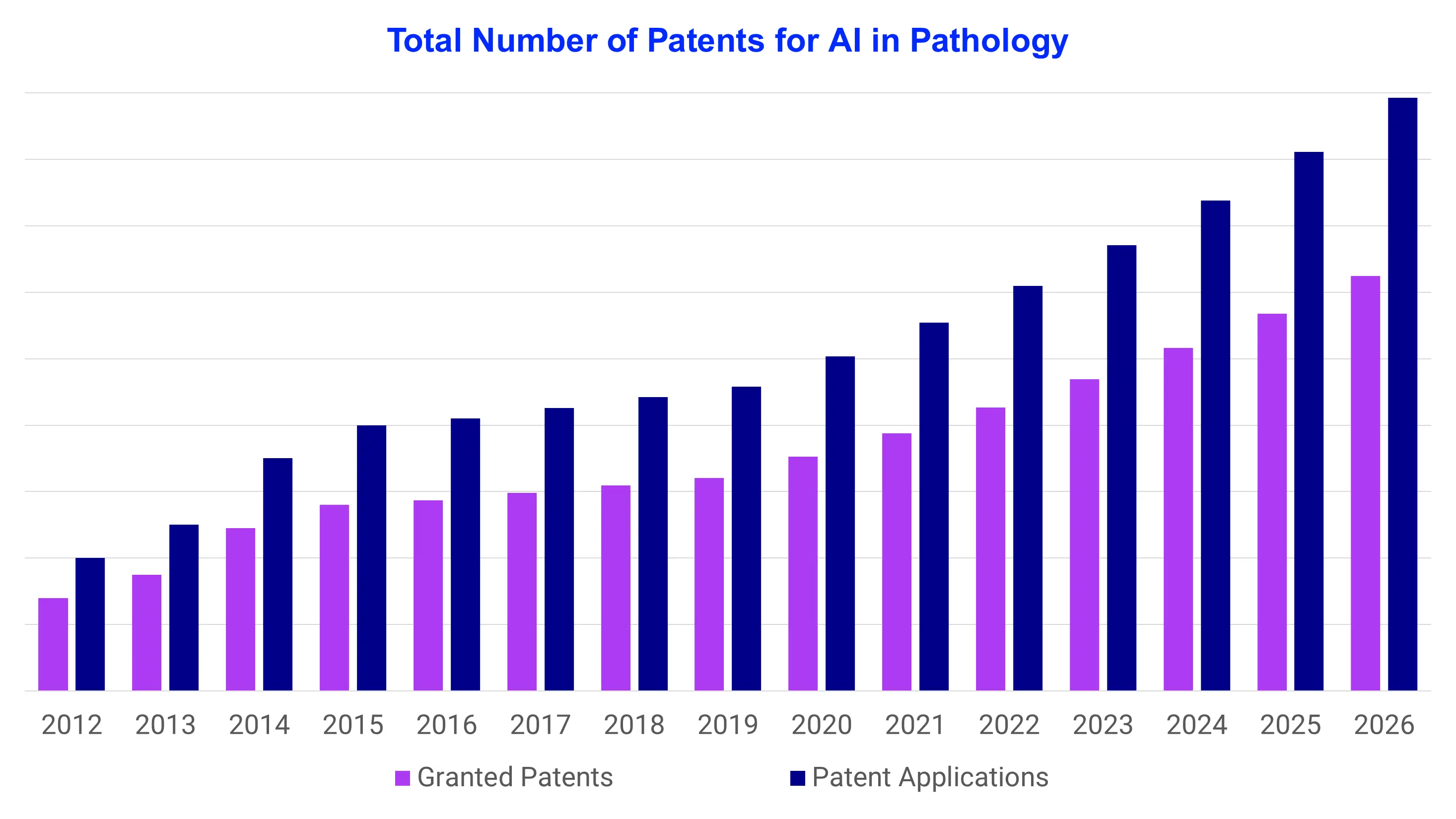
The landscape comprises more than 4,300 patent families, with filing activity peaking between roughly 2021 and 2024 as digital pathology programmes expanded and regulatory clearances accumulated. Leading technology clusters are whole slide scanning and image quality control, tumour detection and grading models, and biomarker and immunohistochemistry scoring. Cytology screening support, digital pathology workflow and laboratory system integration, and molecular and genomic pathology reporting form a second tier that has grown fastest in recent years.
Rising biopsy volumes, pathologist shortages and the spread of digital laboratories have created paying demand for scanners, platforms and diagnostic algorithms, and patent filings have expanded in step with that demand.
The scope covers patent filings at the United States, European, Chinese, Japanese, South Korean and Indian offices and through the WIPO Patent Cooperation Treaty route, together with commercial activity in North America, Europe, Asia Pacific, Latin America, and the Middle East and Africa. Market coverage runs from 2025 through 2035 and includes software licences, scanner-embedded algorithms and integration services sold to hospitals, laboratories and research organisations. Filings are grouped by pathology discipline, solution type and application, and by the six technology clusters identified for the field.
Technology coverage spans Anatomic and Surgical Pathology, Cytopathology, Molecular Pathology, Haematopathology and Clinical Laboratory Pathology. Product coverage includes Whole Slide Imaging Analysis Software, Digital Pathology Workflow Platforms, Slide Scanners with Embedded Algorithms and Laboratory Information System Integration Tools. Applications examined range from Primary Diagnosis Support and Tumour Grading and Biomarker Scoring to Quality Assurance and Second Opinion, Pharmaceutical Research and Trials, and Pathology Education and Training. Methods include deep learning for tumour detection, automated immunohistochemistry quantification, cytology slide triage, and reporting that links tissue findings with genomic results.
Entities include scanner and instrument manufacturers such as Roche, Philips, Leica Biosystems and Hamamatsu Photonics, and digital pathology software specialists such as Proscia. Computational pathology start-ups developing cancer detection and biomarker models, and diagnostics companies that integrate image analysis with assays, are also represented. Academic medical centres, cancer research institutes and clinical laboratories contribute method patents and validation studies, and pharmaceutical and biotechnology companies appear where tissue image analysis supports trial endpoints and companion diagnostics.
The report will cover the following sections in detail:
Analysis by Pathology Discipline
Analysis by Solution Type
Analysis by Application
AI in Pathology Patent Filing Trend Analysis
Annual filings have grown consistently since the first whole slide imaging clearances in the United States, with the strongest acceleration coming after laboratories began to digitise at scale. Early patents concentrated on scanner optics, focus control and image compression. Later filings moved toward trained models, stain normalisation, case routing and links between image findings and laboratory records, reflecting a field that has shifted from hardware to software value.
Annual patent filing growth between 2020 and 2024 is estimated at approximately 18 percent. Several factors drove it: the pandemic-era acceleration of remote slide review, regulatory clearances for primary diagnosis, wider availability of annotated slide archives, and pharmaceutical demand for quantitative biomarker scoring. Deep learning methods for tumour detection and grading contributed the largest share of the additional filings.
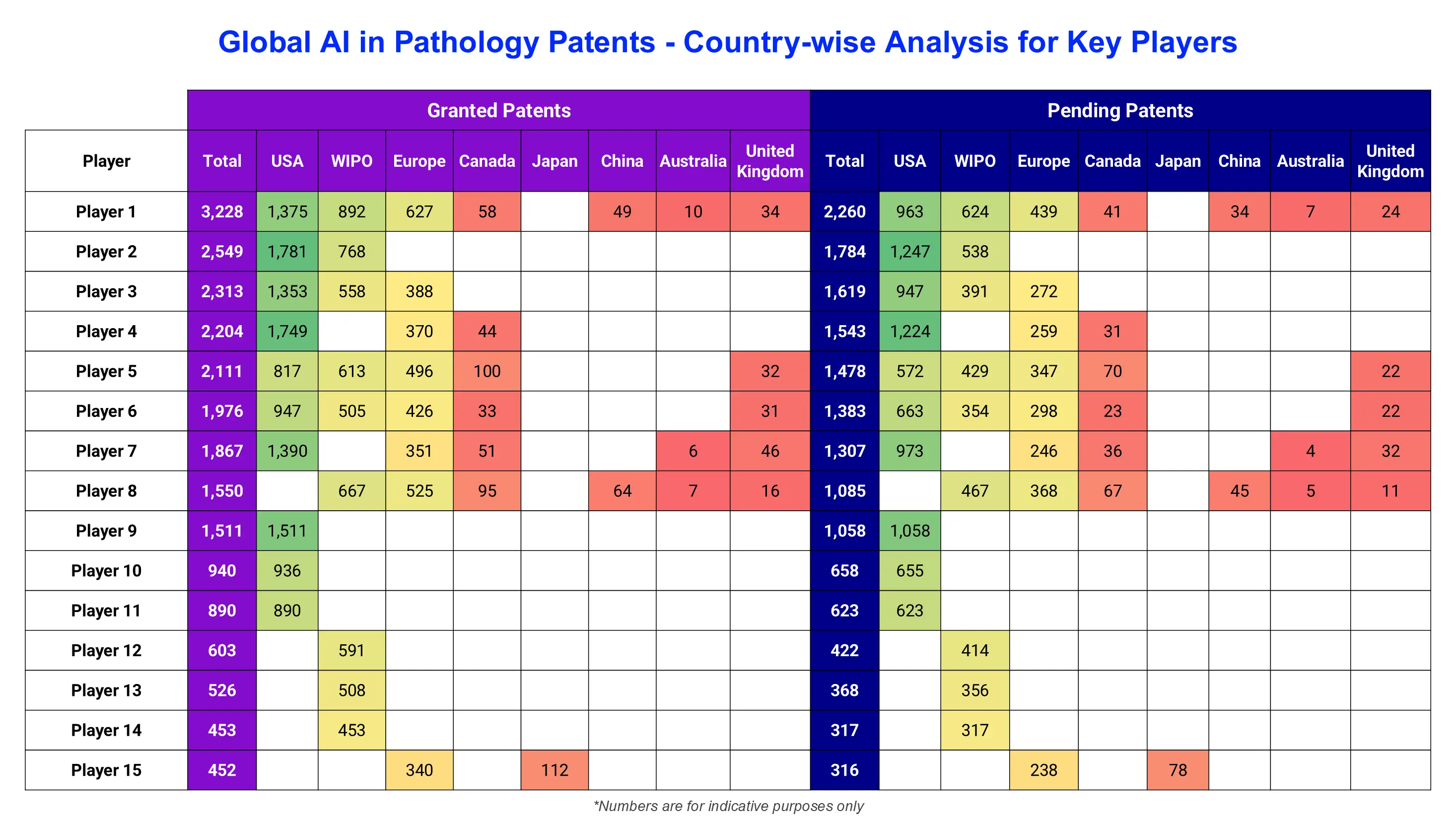
Among the players with AI in pathology patent families, new entrants have been identified, which can be either established companies or startups developing novel technology in the field. Some of the major companies mentioned in this report (a non-exhaustive list) are as follows:
F. Hoffmann-La Roche holds one of the broadest portfolios in the landscape, reaching from slide staining and scanning to image management and algorithm-based scoring. Its Roche Diagnostics division, which absorbed Ventana Medical Systems in 2008, markets the VENTANA DP 200 and DP 600 slide scanners, the navify Digital Pathology software, and a large menu of VENTANA immunohistochemistry and in situ hybridisation assays such as HER2 and PD-L1. The VENTANA DP 200 scanner has received regulatory clearance for primary diagnosis in the United States, and navify Digital Pathology is offered in markets that accept CE-marked in vitro diagnostic software. Roche files across scanner hardware, stain-and-image workflows, and computational scoring methods, and it works with external algorithm developers through its navify environment instead of relying only on in-house models. That combination of assay ownership installed instruments and an open software environment gives the company a strong commercial position in companion diagnostic pathology.
Koninklijke Philips built its digital pathology position around the IntelliSite Pathology Solution, which combines an ultra fast slide scanner, an image management system and a diagnostic viewer. In 2017 the FDA granted De Novo authorisation to this system as the first whole slide imaging platform for primary diagnosis, a decision that set the regulatory template later followed by other scanner makers. Philips also acquired the Belfast software developer PathXL in 2016 to add tissue analysis and image viewing tools. Its patent filings cover scan acquisition, image compression and streaming, viewing, and the connection of pathology images to hospital information systems. Large academic hospitals and national health service laboratories in Europe form the core of its customer base, and the company positions the platform as an enterprise imaging tool that can host third-party algorithms.
Other companies include Leica Biosystems, Hamamatsu Photonics, and Proscia.
Concentration among the leading assignees is moderate, with the five largest groups holding a meaningful but not dominant share of the more than 4,300 families. Roche builds on stains, scanners and navify software, protecting the link between assays and image scoring. Philips emphasises scanner, viewer and enterprise imaging claims, and Leica Biosystems files on scanner hardware, slide handling and image management. Hamamatsu Photonics draws on its optical and detector expertise for scanner patents, while Proscia concentrates on platform software and algorithm hosting. A long tail of start-ups and universities holds narrower claims on specific cancers and stains.
*Please note that this is only a partial list; the complete list of key players is available in the full report. Additionally, the list of key players can be customized to better suit your needs.*
The report assesses patent activity across major jurisdictions, including:
The United States leads on filing volume because of its early regulatory clearances, large laboratory networks and active computational pathology start-ups. China ranks second, with rapid growth in hospital-led and university-led filings on tumour detection, cytology screening and slide scanning. Europe, including the European Patent Office and national offices in Germany, the Netherlands and the United Kingdom, reflects the strength of Philips, Roche and Leica Biosystems and several national digital pathology programmes. South Korea contributes filings from companies working on cancer detection software, India shows growing activity linked to large laboratory chains and screening programmes, and WIPO filings indicate applicants seeking protection in several regions at once.
Read more about this report - REQUEST FREE SAMPLE COPY IN PDF
Patent activity in the field falls into five technology segments:
Tumour detection and grading algorithms lead patent activity, because cancer diagnosis is the main clinical use of digitised slides and the first area in which regulators cleared algorithmic assistance. Applicants file on convolutional and transformer-based models, annotation methods and performance claims for cancers such as prostate, breast and lung. Biomarker scoring ranks next, supported by commercial demand from companion diagnostic programmes.
Competition combines established diagnostics and imaging groups with specialist software developers. Roche, Philips, Leica Biosystems and Hamamatsu Photonics supply scanners and bundle them with image management, while Proscia and similar vendors compete on platform flexibility and algorithm marketplaces. Computational pathology start-ups focus on narrow clinical claims, often for prostate, breast or lung cancer, and partner with scanner makers for distribution. Companies with regulatory clearance for primary diagnosis hold an advantage in hospital tenders, because buyers prefer systems that are validated end to end.
Companies are focusing on:
Emerging themes include foundation models trained on very large collections of unlabelled slides, which reduce the annotation effort needed for each new task. Virtual staining, which predicts special stains from routine haematoxylin and eosin images, is attracting claims aimed at saving laboratory time and reagents. Multimodal models that combine tissue images with genomic and clinical data are gaining attention in oncology, and federated learning methods address the difficulty of sharing slides across institutions. FDA guidance on predetermined change control plans for software that learns over time is also shaping how applicants draft claims on model updating.
Patent data on this field shows how scanner makers, diagnostics groups and software developers are dividing territory across image capture, analysis and workflow. Filing patterns indicate which cancers, stains and laboratory tasks attract the most protection, and which jurisdictions applicants consider commercially important. Readers can trace the position of each leading assignee, the pace of new entrants and the areas where claims are still sparse.
The patent landscape provides actionable intelligence for the following nine strategic uses:
Patent research was conducted across the major patent databases, including the United States Patent and Trademark Office, the European Patent Office, the China National Intellectual Property Administration, the Japan Patent Office, the Korean Intellectual Property Office, the Indian patent office and WIPO. Searches combined cooperative patent classification codes, keywords and assignee names relating to pathology image analysis, slide scanning, cytology, immunohistochemistry scoring and laboratory workflow software. Patent families were assembled so that each invention was counted once across jurisdictions.
Retrieved records were screened for relevance to pathology, and duplicate families and filings with no connection to tissue, cell or laboratory specimen analysis were removed. Remaining families were classified by pathology discipline, solution type, application and technology cluster, and assigned to assignees after harmonising company names and subsidiaries. Filing years, grant status and jurisdiction were recorded for each family to support trend and concentration measures.
Market analysis drew on published regulatory clearances, company disclosures, clinical literature and cancer statistics to relate patent activity to commercial demand. Estimates for growth rates, peak filing periods and relative shares are analyst approximations built from the classified patent set. Findings were checked for consistency between market projections and observed filing trends before the final assessment.


Upto 15% Off
USD
$2699 $2429
$4299 $3869
$5799 $4949
$6999 $5949


*While we strive to always give you current and accurate information, the numbers depicted on the website are indicative and may differ from the actual numbers in the main report. At Expert Market Research, we aim to bring you the latest insights and trends in the market. Using our analyses and forecasts, stakeholders can understand the market dynamics, navigate challenges, and capitalize on opportunities to make data-driven strategic decisions.*
EMR's AI in Pathology Patent Landscape Analysis provides a comprehensive assessment of patent filings, innovation clusters, assignee portfolios, and geographic filing patterns across the AI in pathology landscape. The report identifies 4,300+ patent families, evaluates leading jurisdictions including the United States, China, and Europe, and profiles the top assignees by portfolio size.
The global AI in pathology market was valued at USD 0.62 Billion in 2025. The market is projected to reach USD 5.50 Billion by 2035, expanding at a CAGR of 24.40% during 2026 - 2035.
The report analyses approximately 4,300+ patent families related to AI in pathology. These include filings from the United States, China, Europe, and international WIPO filings.
Key companies operating within the landscape include F. Hoffmann-La Roche, Koninklijke Philips, Leica Biosystems, Hamamatsu Photonics, and Proscia, among others. These organisations collectively account for a significant portion of patent activity analysed in this report.
The report evaluates patent activity across the United States, Europe, China, Japan, South Korea, India, and international WIPO filings. The United States is the largest single jurisdiction in the landscape, with more than 1,900 AI in pathology patents associated with it, set against more than 4,300 patent families analysed overall.
Yes. The report scope can be customised based on geography, technology segment, assignee selection, time period, or specific innovation cluster focus. Readers who need a customised study can contact the Expert Market Research team to scope the jurisdictions, assignees and technology clusters most relevant to their pathology programme.
Patent landscape analysis helps organisations understand innovation trends, competitive activity, technology whitespace, and IP risk across a defined domain. For AI in pathology, this report supports strategic decisions in R&D prioritisation, licensing evaluation, competitive benchmarking, and market entry planning.
Explore our key highlights of the report and gain a concise overview of key findings, trends, and actionable insights that will empower your strategic decisions.
|
Scope of the Report |
Details |
|
Analysis by Pathology Discipline |
|
|
Analysis by Solution Type |
|
|
Analysis by Application |
|
|
Analysis by End User |
|
|
Key Players Mentioned |
|
|
Geographies Covered |
|
Mini Report
One User
USD 2,699
USD 2,429
tax inclusive*
Single User License
One User
USD 4,299
USD 3,869
tax inclusive*
Five User License
Five User
USD 5,799
USD 4,949
tax inclusive*
Corporate License
Unlimited Users
USD 6,999
USD 5,949
tax inclusive*
*Please note that the prices mentioned below are starting prices for each bundle type. Kindly contact our team for further details.*
Flash Bundle
Small Business Bundle
Growth Bundle
Enterprise Bundle
*Please note that the prices mentioned below are starting prices for each bundle type. Kindly contact our team for further details.*
Flash Bundle
Number of Reports: 3
20%
tax inclusive*
Small Business Bundle
Number of Reports: 5
25%
tax inclusive*
Growth Bundle
Number of Reports: 8
30%
tax inclusive*
Enterprise Bundle
Number of Reports: 10
35%
tax inclusive*
How To Order

Select License Type
Choose the right license for your needs and access rights.

Click on ‘Buy Now’
Add the report to your cart with one click and proceed to register.

Select Mode of Payment
Choose a payment option for a secure checkout. You will be redirected accordingly.
Strategic Solutions for Informed Decision-Making
Gain insights to stay ahead and seize opportunities.

Get insights & trends for a competitive edge.

Track prices with detailed trend reports.

Analyse trade data for supply chain insights.

Leverage cost reports for smart savings

Enhance supply chain with partnerships.

Connect For More Information
Our expert team of analysts will offer full support and resolve any queries regarding the report, before and after the purchase.
Our expert team of analysts will offer full support and resolve any queries regarding the report, before and after the purchase.
We employ meticulous research methods, blending advanced analytics and expert insights to deliver accurate, actionable industry intelligence, staying ahead of competitors.
Our skilled analysts offer unparalleled competitive advantage with detailed insights on current and emerging markets, ensuring your strategic edge.
We offer an in-depth yet simplified presentation of industry insights and analysis to meet your specific requirements effectively.




