

Consumer Insights
Uncover trends and behaviors shaping consumer choices today
Procurement Insights
Optimize your sourcing strategy with key market data
Industry Stats
Stay ahead with the latest trends and market analysis.
The antibody fragment therapeutics market was valued at USD 5.20 Billion in 2025 and is projected to reach USD 13.73 Billion by 2035, advancing at a CAGR of 10.20%. Demand is supported by recurring intravitreal treatment of retinal disease, the continued use of PEGylated Fab products in chronic inflammatory conditions, the clinical maturation of nanobody medicines in hematology and autoimmune programmes, and falling production costs from microbial and cell-free expression.
Patent activity is concentrated in Fab and PEGylated Fab fragments for ophthalmic and inflammatory use, single-chain variable fragment engineering and stability, single-domain antibodies and nanobodies including multivalent formats, fragment half-life extension, and expression and purification systems. Regulatory validation comes from approved products such as ranibizumab, certolizumab pegol, brolucizumab, caplacizumab and idarucizumab. Commercial validation is visible in the long-running licensing of fragment technology and in large-company acquisitions of nanobody platforms.
This Antibody Fragment Therapeutics Patent Landscape Analysis Report provides a structured view of patent filing trends, leading assignees, jurisdiction coverage, technology clusters and company positioning across Fab, single-chain variable fragment, single-domain antibody, diabody and minibody therapeutics.
The antibody fragment therapeutics market is experiencing strong growth, driven by sustained demand for intravitreal retinal treatments, expanding use of PEGylated Fab products in chronic inflammatory disease, and the clinical maturation of nanobody medicines. Caplacizumab, the first approved nanobody, received European authorisation in 2018 and United States approval in 2019 for acquired thrombotic thrombocytopenic purpura, showing that single-domain formats can reach routine hospital use.
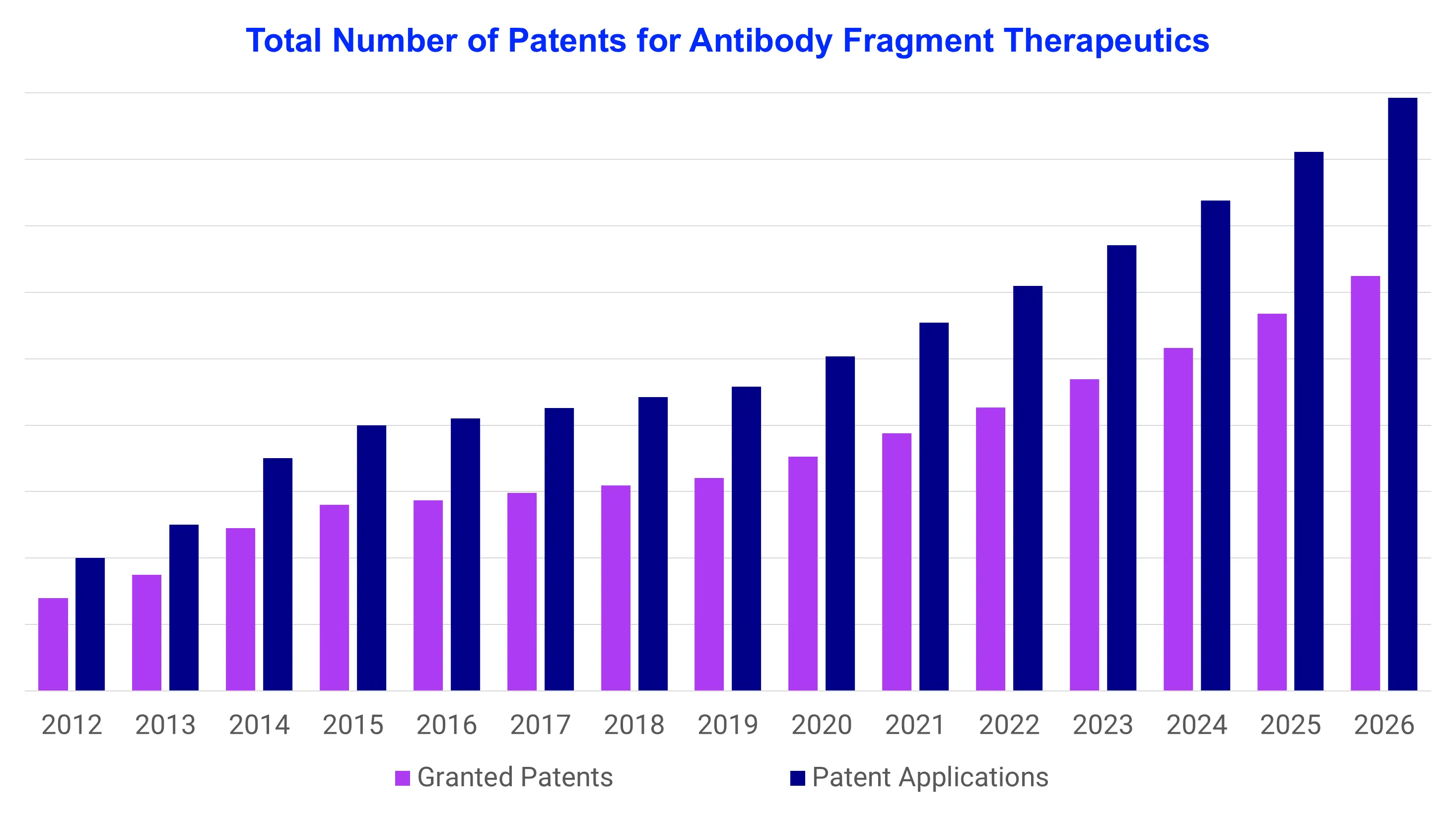
Patent activity is accelerating, with 230+ antibody fragment therapeutics patents granted in 2025, reflecting strong innovation momentum in Fab and PEGylated Fab fragments for ophthalmic and inflammatory use, single-chain variable fragment engineering and stability, single-domain antibodies and nanobodies including multivalent formats, and microbial, yeast and cell-free expression and purification.
Top assignees in the antibody fragment therapeutics patent landscape include Genentech, UCB, Novartis, Sanofi, and Boehringer Ingelheim, with the United States, Europe, and China as the dominant patent jurisdictions.
Antibody fragments hold a distinct place among biologic modalities. Removing the Fc region gives Fab, single-chain variable fragment and single-domain formats better tissue penetration, no Fc-mediated effector activity and simpler production in microbial hosts, at the price of faster clearance from the circulation. Ophthalmology is the commercial anchor, because intravitreal injection delivers a small dose to the eye while the quick systemic clearance of a fragment limits exposure elsewhere in the body. Inflammatory disease follows, where a PEGylated Fab can be dosed every two to four weeks without Fc activity. Demand is therefore shaped by route of administration, dosing interval and cost of goods rather than by potency alone, and these factors guide how developers choose between formats.
Market growth is driven by new indications and formats, particularly nanobodies and locally delivered fragments, which offset the slower value growth of the legacy ranibizumab base as biosimilar pricing resets revenues. Age-related macular degeneration affects an estimated 200 million people worldwide, a population large enough to sustain recurring intravitreal treatment for decades. Caplacizumab's European authorisation in 2018 opened the first commercial route for a nanobody, which gave regulators and investors a precedent for further single-domain candidates.
Ranibizumab biosimilars have been available in the United States since 2021, and the resulting price competition has compressed the revenue of the original Fab product. Newer intravitreal agents add to that pressure, since brolucizumab, a single-chain variable fragment approved in 2019, was developed to extend the interval between injections. Developers have responded with delivery innovation; the ocular implant approved for ranibizumab in 2021 allows refill intervals of around six months, which reduces clinic visits for patients and retinal centers. In inflammatory disease, certolizumab pegol keeps a steady position because its dosing every two or four weeks and its Fc-free structure suit specific patient groups. Together these developments move value from volume-driven legacy products toward differentiated formats and delivery routes.
Read more about this report - REQUEST FREE SAMPLE COPY IN PDF
Filing intensity in antibody fragment therapeutics has tracked commercial investment in retinal disease and chronic inflammatory biologics. Applicants file around each approved product to protect formats, linkers, formulations and manufacturing routes, so a launch tends to generate a wave of follow-on families. Ranibizumab and certolizumab pegol each attracted numerous secondary filings on dosing, stability and production, and the same pattern is now visible around nanobody candidates after caplacizumab reached the market. Rising participation from China-based developers has added breadth, particularly in single-domain antibodies and in expression systems that lower cost per gram.
The landscape covers 15,500+ patent families, with filing activity peaking between roughly 2018 and 2022 as scFv stabilisation, multivalent nanobody constructs and intravitreal formulations were all being developed at the same time. Fab and PEGylated Fab fragments for ophthalmic and inflammatory use form the largest cluster, followed by single-chain variable fragment engineering and stability and by single-domain antibodies and nanobodies including multivalent formats. Filings on microbial, yeast and cell-free expression and purification make up a smaller but steadily growing group.
Demand for longer-acting retinal treatments, new nanobody indications and lower-cost manufacture is converting directly into patent expansion across fragment formats, half-life extension and local delivery.
Geographic coverage in this report spans patent families filed in the United States, Europe and China, together with South Korea, India and filings made through the World Intellectual Property Organization. Market coverage includes ophthalmology, inflammatory and autoimmune disease, oncology, hematology and cardiovascular disease, and infectious disease and toxin neutralization. The scope also follows the commercial path of fragment therapeutics from discovery through approved products, with end users such as hospitals, ophthalmology clinics and retinal centers, biopharmaceutical companies, contract development and manufacturing organizations, and academic and research institutes.
Technology and product scope covers Fab and Fab prime fragments, single-chain variable fragments, single-domain antibodies and nanobodies, diabodies and minibodies, and PEGylated and half-life extended fragments. Expression systems within scope include microbial expression, mammalian cell expression, yeast and other eukaryotic systems, and cell-free expression. Delivery technologies such as intravitreal and local formulations are included where the claims are specific to a fragment. Full-length bispecific antibodies and other Fc-based formats fall outside the boundary, as do small-molecule and peptide alternatives.
Entities covered include large pharmaceutical companies with approved fragment products, such as Genentech, UCB, Novartis, Sanofi and Boehringer Ingelheim, and specialist biotechnology firms that develop nanobody and scFv platforms. Contract development and manufacturing organizations with microbial and cell-free capabilities appear as filers on expression and purification. Start-ups working on multivalent single-domain constructs and local delivery are included, as are universities, research hospitals and public research institutes that originate early-stage fragment engineering and file jointly or through licensing.
The report will cover the following sections in detail:
Analysis by Fragment Format
Analysis by Therapeutic Area
Analysis by Expression System
Antibody Fragment Therapeutics Patent Filing Trend Analysis
Patent filings in antibody fragment therapeutics show a pattern typical of a mature modality that is diversifying. Fab and PEGylated Fab families provide a stable base built around approved ophthalmic and inflammatory products, while single-domain antibodies, multivalent formats and fragment delivery systems supply most of the new growth. Granted patents reached 230+ in 2025, which indicates that applications filed in the middle of the previous decade are now converting into enforceable rights. The share of families that combine a fragment with a half-life extension or local delivery feature has risen steadily.
Annual filing growth for 2020 to 2024 is estimated at approximately 7 percent, a steady rate that sits below the pace seen in newer modalities. The main drivers were nanobody developers extending claims to multivalent and tissue-targeted constructs, applicants seeking to extend dosing intervals through PEGylation and albumin binding, and rising filings from China-based companies in single-chain variable fragments and expression. Interest in intravitreal depots and implants added a further group of delivery-focused families during the period.
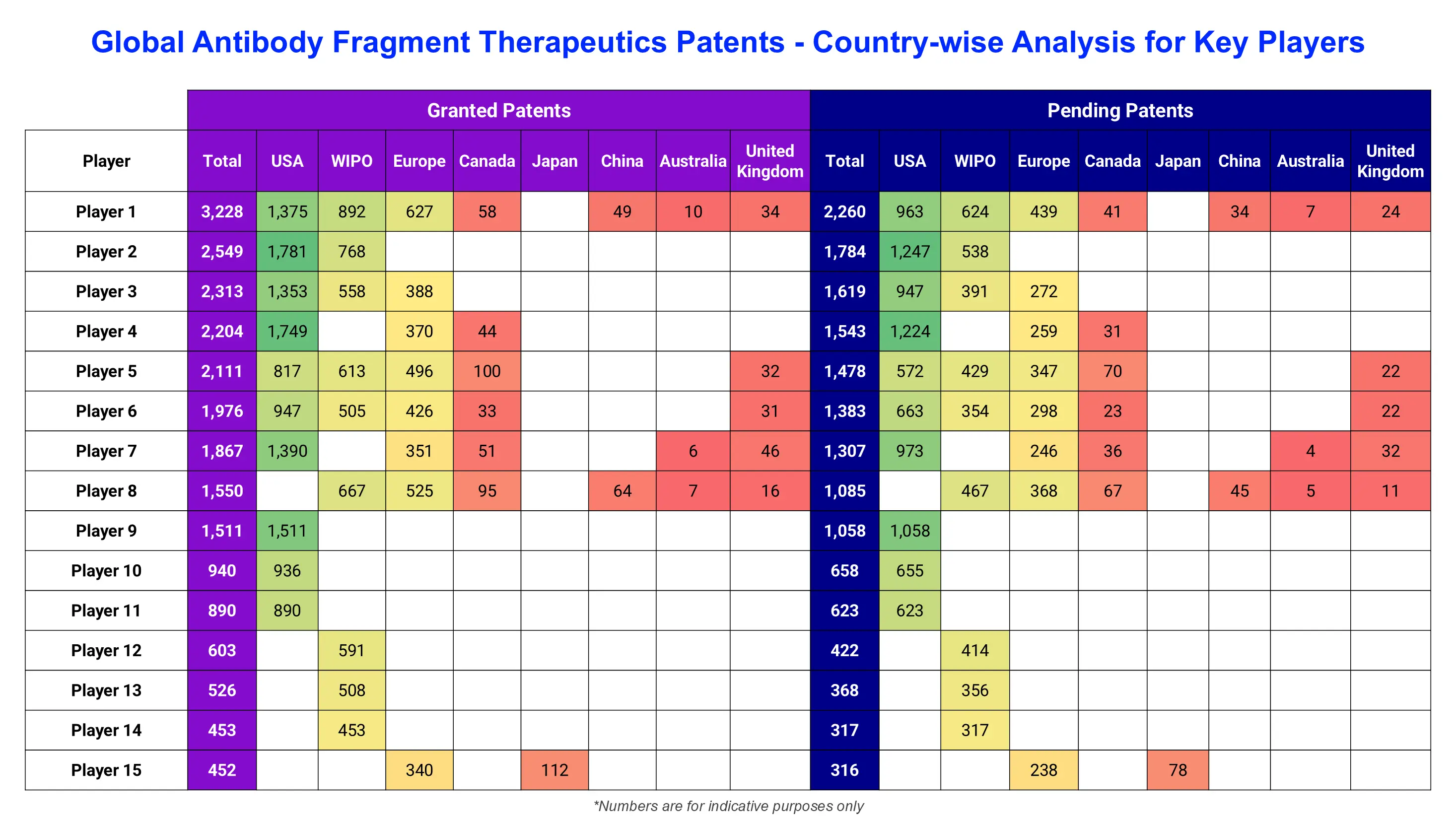
Among the players with antibody fragment therapeutics patent families, new entrants have been identified, which can be either established companies or startups developing novel technology in the field. Some of the major companies mentioned in this report (a non-exhaustive list) are as follows:
Genentech holds one of the longest-standing portfolios in antibody fragment therapeutics, built around the Fab format that became ranibizumab. Lucentis (ranibizumab) was approved by the United States Food and Drug Administration in 2006 for neovascular age-related macular degeneration and later extended to diabetic macular edema and retinal vein occlusion. Susvimo, a ranibizumab formulation delivered through a refillable ocular implant, was approved in 2021 and reflects the company's interest in extending the dosing interval for a short-lived fragment. As a member of the Roche Group, Genentech generally protects its fragment franchise through layered filings covering sequences, affinity-matured variants, formulations, delivery devices and manufacturing in microbial hosts. Its commercial position is now defined by lifecycle management as ranibizumab biosimilars enter the market.
UCB is the principal owner of the PEGylated Fab approach, a position that traces back to the Celltech business it acquired in 2004. Cimzia (certolizumab pegol), an Fc-free PEGylated Fab fragment produced in bacterial hosts, is approved for Crohn's disease, rheumatoid arthritis, psoriatic arthritis, axial spondyloarthritis and plaque psoriasis, among other uses. Lacking an Fc region, the molecule shows limited placental transfer, which UCB has used to support its positioning in women of child-bearing age. The company's patent estate spans Fab frameworks, PEGylation chemistry, dosing regimens and bacterial manufacturing processes. UCB competes in the landscape as a specialist in half-life extended fragments for chronic inflammatory disease.
Other companies include Novartis, Sanofi, and Boehringer Ingelheim.
Genentech, UCB, Novartis, Sanofi and Boehringer Ingelheim lead the landscape and together hold an estimated one fifth of all families, which signals moderate concentration in a field with many smaller filers. Genentech and Novartis concentrate on ophthalmic Fab and scFv products and delivery, while UCB protects PEGylated Fab chemistry and manufacture for inflammatory disease. Sanofi's portfolio draws on the nanobody platform it gained with the 2018 acquisition of Ablynx, and Boehringer Ingelheim is associated with the Fab reversal agent idarucizumab and with fragment expression know-how. Beyond this group the field is fragmented, with a long tail of academic and start-up applicants.
*Please note that this is only a partial list; the complete list of key players is available in the full report. Additionally, the list of key players can be customized to better suit your needs.*
The report assesses patent activity across major jurisdictions, including:
The United States leads in volume, followed by Europe and China, which together account for the bulk of filings. Europe benefits from the long-standing nanobody research base and from UCB and Sanofi activity, and China has shown the fastest growth in applicants, particularly in single-chain variable fragments and cost-efficient expression. South Korea contributes through biopharmaceutical and contract manufacturing firms, India through developers of lower-cost biologics and biosimilar fragments, and WIPO filings through the Patent Cooperation Treaty route show which families applicants intend to take into several markets.
Read more about this report - REQUEST FREE SAMPLE COPY IN PDF
The landscape divides into five technology segments, each at a different stage of maturity:
Fab and PEGylated Fab fragments lead patent activity because they underpin the approved ophthalmic and inflammatory products and keep attracting filings on dosing, formulation and manufacture. Single-domain antibodies and nanobodies are the fastest-growing segment, helped by the approval of caplacizumab and by multivalent constructs that combine targets in a single small molecule. Single-chain variable fragments follow, supported by brolucizumab and by stability engineering that addresses aggregation.
The competitive field combines large pharmaceutical groups that own approved fragment products with specialist platform companies and a growing set of China-based developers. Genentech and Novartis defend retinal franchises against ranibizumab biosimilars, UCB protects its PEGylated Fab, and Sanofi extends nanobody work beyond caplacizumab. Competition is increasingly decided by dosing interval, delivery route and cost of manufacture rather than by target alone, and licensing of platform technology is common because few companies hold every format.
Companies are focusing on:
Emerging themes include nanobodies directed to intracellular and tissue-restricted targets, fragments fused to albumin-binding domains to extend circulation without PEGylation, and inhaled or topical formulations that exploit the small size of single-domain antibodies. Cell-free expression is attracting attention for rapid screening and for producing fragments with defined conjugation sites, while yeast systems are being refined to reduce process cost. Fragment-based reversal agents and toxin-neutralizing products, a line that includes idarucizumab, show how the format can serve acute care as well as chronic disease.
The patent landscape for antibody fragment therapeutics links a mature set of approved products with a younger layer of nanobody, delivery and expression innovation. Roughly 15,500+ families map the technology boundaries of each format and show where protection is dense, such as ophthalmic Fab, and where it is still open, such as tissue-targeted single-domain constructs. Readers can see which assignees control key claims and which jurisdictions carry the most enforceable rights.
The landscape provides actionable intelligence for the following uses:
Patent research drew on international patent databases, including the United States Patent and Trademark Office, the European Patent Office, the China National Intellectual Property Administration and WIPO records, searched with keyword strings and Cooperative Patent Classification codes for antibody fragments, Fab, single-chain variable fragments, single-domain antibodies and related formats. Queries were run on both granted patents and published applications and grouped into patent families to avoid double counting.
Records were screened to remove documents where a fragment is mentioned only as an alternative to a full-length antibody. Each family was then assigned to a fragment format, therapeutic area and expression system, and to one of the technology clusters. Assignee names were normalised to combine subsidiaries and acquired entities, and legal status was checked to separate granted patents from pending applications.
Market analysis was supported by review of regulatory approvals, clinical trial registries, company disclosures and published scientific literature. Filing counts were compared with product launches, licensing events and clinical milestones to link filing trends to commercial activity. Figures that are not directly reported in public records are analyst estimates and are described as approximate.


Upto 15% Off
USD
$2699 $2429
$4299 $3869
$5799 $4949
$6999 $5949


*While we strive to always give you current and accurate information, the numbers depicted on the website are indicative and may differ from the actual numbers in the main report. At Expert Market Research, we aim to bring you the latest insights and trends in the market. Using our analyses and forecasts, stakeholders can understand the market dynamics, navigate challenges, and capitalize on opportunities to make data-driven strategic decisions.*
EMR's Antibody Fragment Therapeutics Patent Landscape Analysis provides a comprehensive assessment of patent filings, innovation clusters, assignee portfolios, and geographic filing patterns across the antibody fragment therapeutics landscape. The report identifies 15,500+ patent families, evaluates leading jurisdictions including the United States, Europe, and China, and profiles the top assignees by portfolio size.
The global antibody fragment therapeutics market was valued at USD 5.20 Billion in 2025. The market is projected to reach USD 13.73 Billion by 2035, expanding at a CAGR of 10.20% during 2026 - 2035.
The report analyses approximately 15,500+ patent families related to antibody fragment therapeutics. These include filings from the United States, Europe, China, and international WIPO filings.
Key companies operating within the landscape include Genentech, UCB, Novartis, Sanofi, and Boehringer Ingelheim, among others. These organisations collectively account for a significant portion of patent activity analysed in this report.
The report evaluates patent activity across the United States, Europe, China, Japan, South Korea, India, and international WIPO filings. More than 8,900 antibody fragment therapeutics patents are associated with the United States, which makes it the largest single jurisdiction in the landscape, supported by the home bases of Genentech and a large share of fragment-focused biotechnology developers.
Yes. The report scope can be customised based on geography, technology segment, assignee selection, time period, or specific innovation cluster focus. Readers who want a customised study, for example a deeper review of a single fragment format or a freedom-to-operate view for a specific indication, can contact the Expert Market Research team to scope the work.
Patent landscape analysis helps organisations understand innovation trends, competitive activity, technology whitespace, and IP risk across a defined domain. For antibody fragment therapeutics, this report supports strategic decisions in R&D prioritisation, licensing evaluation, competitive benchmarking, and market entry planning.
Explore our key highlights of the report and gain a concise overview of key findings, trends, and actionable insights that will empower your strategic decisions.
|
Scope of the Report |
Details |
|
Analysis by Fragment Format |
|
|
Analysis by Therapeutic Area |
|
|
Analysis by Expression System |
|
|
Analysis by End User |
|
|
Key Players Mentioned |
|
|
Geographies Covered |
|
Mini Report
One User
USD 2,699
USD 2,429
tax inclusive*
Single User License
One User
USD 4,299
USD 3,869
tax inclusive*
Five User License
Five User
USD 5,799
USD 4,949
tax inclusive*
Corporate License
Unlimited Users
USD 6,999
USD 5,949
tax inclusive*
*Please note that the prices mentioned below are starting prices for each bundle type. Kindly contact our team for further details.*
Flash Bundle
Small Business Bundle
Growth Bundle
Enterprise Bundle
*Please note that the prices mentioned below are starting prices for each bundle type. Kindly contact our team for further details.*
Flash Bundle
Number of Reports: 3
20%
tax inclusive*
Small Business Bundle
Number of Reports: 5
25%
tax inclusive*
Growth Bundle
Number of Reports: 8
30%
tax inclusive*
Enterprise Bundle
Number of Reports: 10
35%
tax inclusive*
How To Order

Select License Type
Choose the right license for your needs and access rights.

Click on ‘Buy Now’
Add the report to your cart with one click and proceed to register.

Select Mode of Payment
Choose a payment option for a secure checkout. You will be redirected accordingly.
Strategic Solutions for Informed Decision-Making
Gain insights to stay ahead and seize opportunities.

Get insights & trends for a competitive edge.

Track prices with detailed trend reports.

Analyse trade data for supply chain insights.

Leverage cost reports for smart savings

Enhance supply chain with partnerships.

Connect For More Information
Our expert team of analysts will offer full support and resolve any queries regarding the report, before and after the purchase.
Our expert team of analysts will offer full support and resolve any queries regarding the report, before and after the purchase.
We employ meticulous research methods, blending advanced analytics and expert insights to deliver accurate, actionable industry intelligence, staying ahead of competitors.
Our skilled analysts offer unparalleled competitive advantage with detailed insights on current and emerging markets, ensuring your strategic edge.
We offer an in-depth yet simplified presentation of industry insights and analysis to meet your specific requirements effectively.




