

Consumer Insights
Uncover trends and behaviors shaping consumer choices today
Procurement Insights
Optimize your sourcing strategy with key market data
Industry Stats
Stay ahead with the latest trends and market analysis.
The digital biomarker technologies market was valued at USD 6.20 Billion in 2025 and is projected to reach USD 43.47 Billion by 2035, growing at a CAGR of 21.50%. Growth is driven by decentralised clinical trials, regulator-cleared consumer wearables, rising chronic disease monitoring needs and machine learning models that convert sensor streams into clinical measures.
Patent activity is concentrated in wrist-worn sensing, smartphone-based testing and signal processing. Regulatory validation, including the 2023 European primary endpoint qualification of stride velocity 95th centile and the 2025 US clearance of hypertension notifications on a smartwatch, has led assignees to protect algorithms, validation methods and data pipelines.
This Digital Biomarker Technologies Patent Landscape Analysis Report maps ownership, technology clusters and jurisdictional activity to support research, licensing and partnership decisions.
The digital biomarker technologies market is experiencing strong growth, driven by decentralised clinical trial adoption, regulator-recognised digital endpoints, and consumer wearables with cleared health features. The European Medicines Agency accepted stride velocity 95th centile as a primary endpoint in ambulatory Duchenne muscular dystrophy trials in 2023, and the US FDA cleared hypertension notifications on a mainstream smartwatch in September 2025.
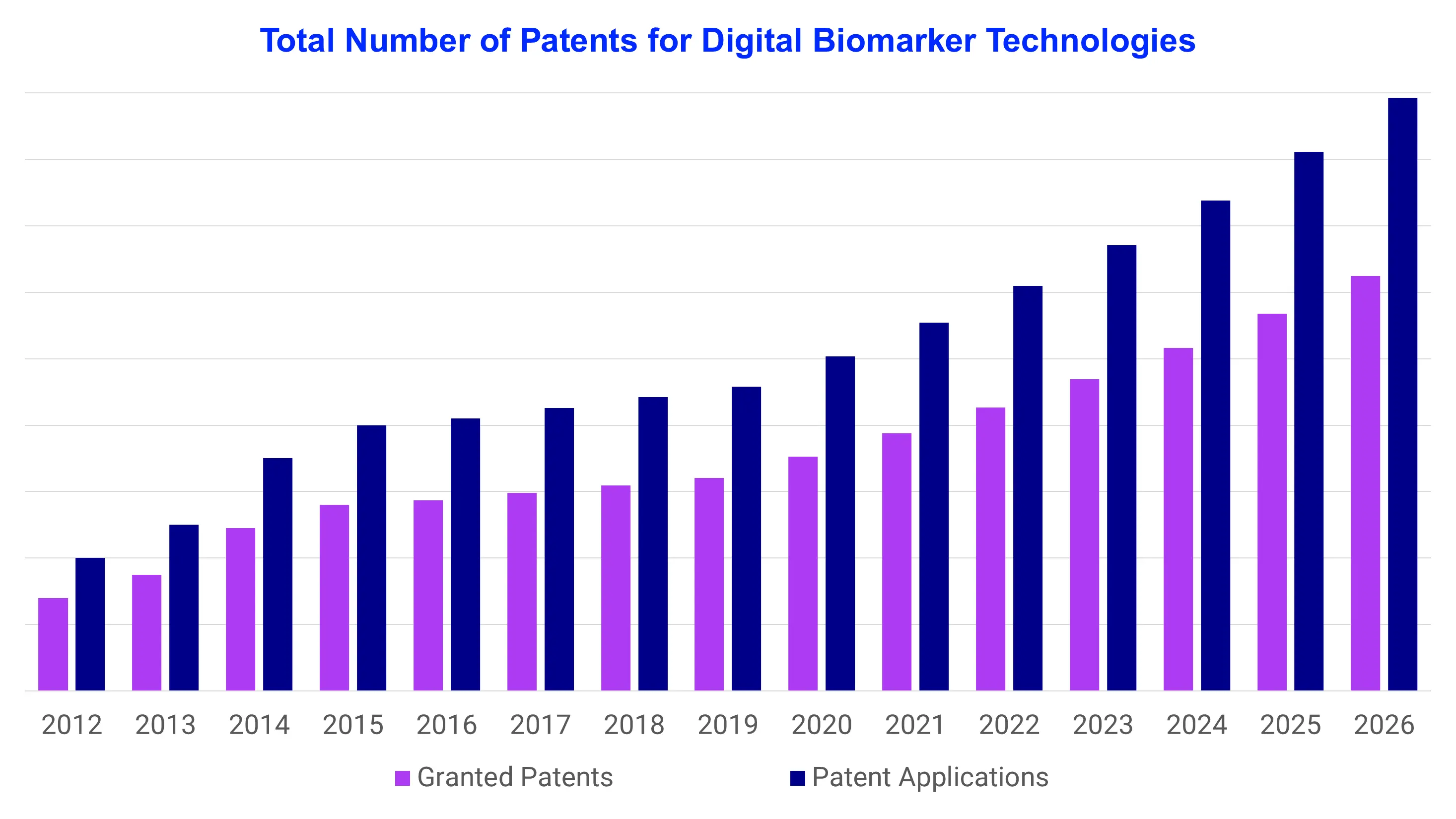
Patent activity is accelerating, with 175+ digital biomarker technologies patents granted in 2025, reflecting strong innovation momentum in wearable sensor signal acquisition, smartphone-based motor and cognitive testing, machine learning feature extraction, and clinical validation of digital endpoints.
Top assignees in the digital biomarker technologies patent landscape include Samsung Electronics, Apple, Philips, Roche, and Google, with the United States, China, and Europe as the dominant patent jurisdictions.
Digital biomarkers are objective, sensor-derived measures of physiology and behaviour collected through wearables, smartphones and home devices. Pharmaceutical sponsors use them to track disease progression between clinic visits, health systems use them to flag deterioration early, and consumer device makers use them to add screening features. Demand spans neurology, cardiology, respiratory, sleep and mental health, which gives the field several commercial entry points.
The market growth is driven by sponsors adopting sensor-derived endpoints in decentralised and rare disease trials, where continuous home measurement shortens site visits. A published review counted more than 130 sponsors using over 1,300 digital endpoints between 2008 and 2022, mostly as secondary measures.
The European Medicines Agency qualified stride velocity 95th centile as a secondary endpoint in 2019 and as a primary endpoint for ambulatory Duchenne muscular dystrophy in 2023, which shows that wearable-derived measures can support registration trial decisions once validation is complete. In September 2025 the US FDA cleared hypertension notifications on the Apple Watch, placing a cuff-free blood pressure signal on a mass consumer device. Larger consumer datasets improve model training, and better models raise the value of protected algorithms.
Read more about this report - REQUEST FREE SAMPLE COPY IN PDF
Filing activity grew steadily after 2019 as remote monitoring programmes moved from pilots into routine trial and care workflows. Applicants shifted from describing single sensors to claiming full pipelines that cover data capture, feature extraction, validation and clinical interpretation. Smartphone-based tests of tapping, speech and gait appeared in a rising share of new applications.
The dataset contains roughly 6,140 patent families, with filings peaking in 2021 and 2022 as pandemic-era remote assessment matured into trial-grade tooling. About 175 patents were granted in 2025. Consumer electronics firms, medtech companies and pharmaceutical sponsors all appear among the leading applicants.
Rising regulatory acceptance of digital endpoints and consumer clearances gives applicants a clear commercial reason to extend claims from sensors to validated clinical outputs.
This report covers granted patents and published applications on sensors, algorithms, software platforms and validation methods that generate digital biomarkers from wearable, smartphone, ambient and implantable data sources. Coverage includes physiological, motor, cognitive, sleep and speech measures used for diagnosis, monitoring and clinical trial endpoints.
Patent families are consolidated by priority, and legal status is assigned at family level. Technology, biomarker type, sensing modality and application tags are applied to each family, and assignee names are harmonised across subsidiaries and acquired entities.
Entities covered include consumer electronics companies, medtech manufacturers, pharmaceutical sponsors, digital health developers, universities and research hospitals.
The report will cover the following sections in detail:
Analysis by Biomarker
Analysis by Sensing Modality
Analysis by Application
Digital Biomarker Technologies Patent Filing Trend Analysis
Filings in digital biomarker technologies grew at an estimated 13% per year between 2020 and 2024. Growth came from smartwatch features with cleared claims, smartphone-based neurological testing and the use of machine learning to derive clinical scores from free-living data.
Annual grants follow filings with a lag of about two to three years, so recent application peaks translate into grant growth through 2026 and 2027. Claims increasingly specify clinical context and validation criteria, which reflects the need to match regulatory expectations for fit-for-purpose evidence.
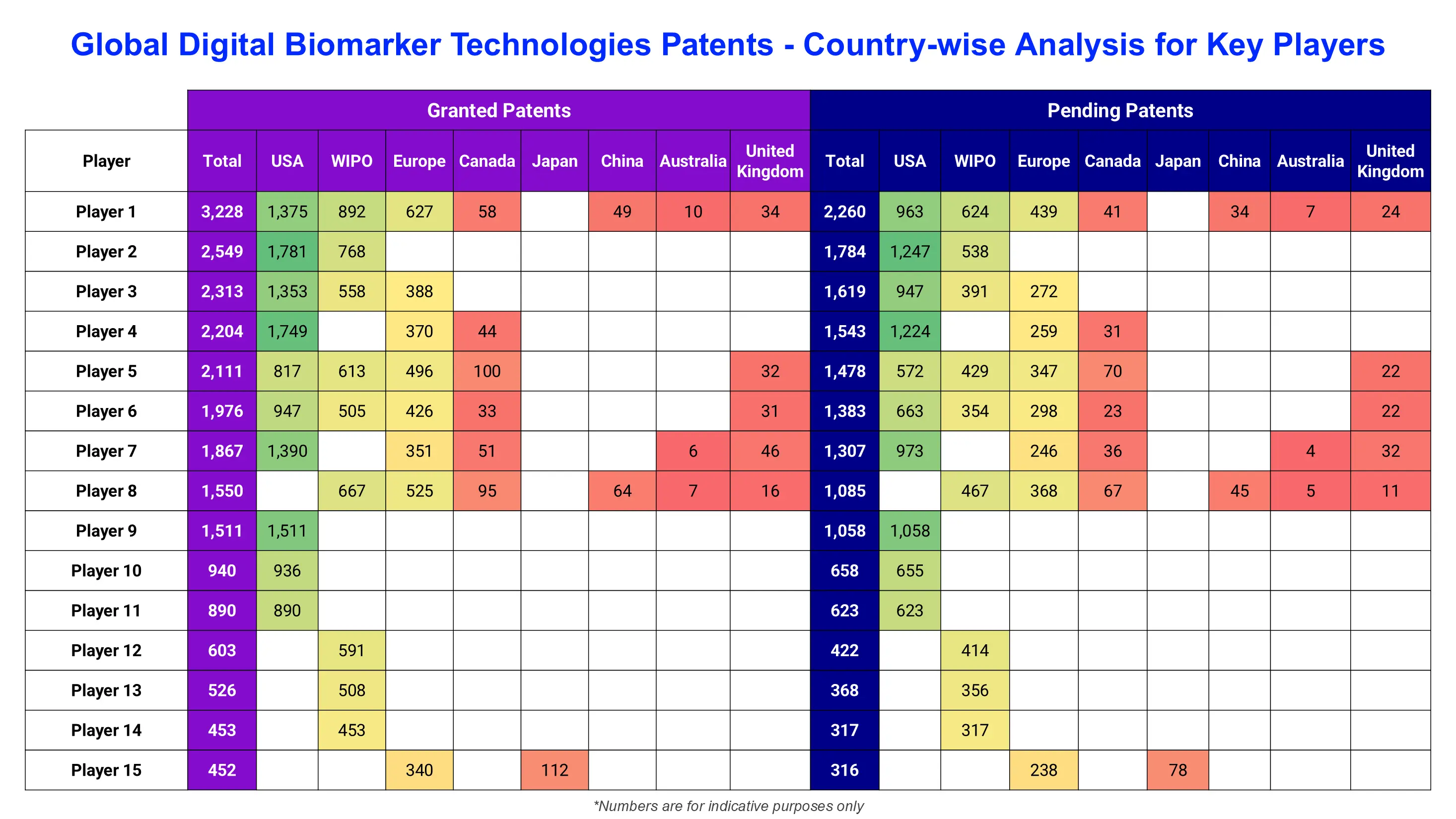
Among the players with digital biomarker technologies patent families, new entrants have been identified, which can be either established companies or startups developing novel technology in the field. Some of the major companies mentioned in this report (a non-exhaustive list) are as follows:
Samsung Electronics holds a broad portfolio covering photoplethysmography, electrocardiography and bioimpedance sensing in wrist-worn devices, together with the signal processing that turns raw waveforms into health indicators. Its Galaxy Watch platform and Samsung Health Monitor application carry electrocardiogram and blood pressure features in selected markets. The company obtained US FDA authorisation for a sleep apnea feature on Galaxy Watch in February 2024 and extended it to Europe through CE marking. Filings cluster around hardware sensor design, on-device algorithms and smartphone-watch data fusion, with heavy protection in South Korea, the United States and China. Commercial positioning relies on a large installed base of consumer devices that supplies the longitudinal data needed to refine detection models.
Apple maintains a large portfolio on wearable sensing, motion analytics and algorithmic detection of physiological events on Apple Watch and iPhone. Its electrocardiogram application and irregular rhythm notifications established the regulatory route for consumer cardiac features, and hypertension notifications received US FDA clearance in September 2025. The Apple Heart and Movement Study and the Health application provide a research and data layer for mobility, walking steadiness and cardiovascular measures. Filings favour sensor fusion, user interface of health alerts and on-device machine learning, with a US-first filing pattern followed by selective extension to Europe and China. Commercial positioning centres on an integrated hardware, software and privacy-controlled ecosystem that links consumers to clinicians and research partners.
Other companies include Philips, Roche, and Google.
The leading five assignees together hold an estimated 15% to 18% of families, which indicates a fragmented field with many universities, device makers and software firms. Samsung Electronics and Apple lead through large sensor and algorithm portfolios, while Philips and Roche concentrate on clinical-grade monitoring and disease-specific measures.
*Please note that this is only a partial list; the complete list of key players is available in the full report. Additionally, the list of key players can be customized to better suit your needs.*
The report assesses patent activity across major jurisdictions, including:
The United States holds the largest share of filings, supported by its clinical trial base, consumer device market and active regulatory pathway for digital health technologies. China follows with fast growth in wearable hardware and artificial intelligence applications. Europe ranks third, with activity linked to the European Patent Office route and the regulatory work of the European Medicines Agency.
Read more about this report - REQUEST FREE SAMPLE COPY IN PDF
The report segments patent activity by biomarker type, sensing modality and application, including:
Among these, machine learning feature extraction and classification holds the largest share of filings, because applicants protect the models that convert raw signals into clinically meaningful scores.
Competition spans three groups. Consumer electronics firms such as Samsung Electronics, Apple and Google protect sensors and detection features at scale, medtech companies such as Philips protect clinical monitoring systems, and Roche protects disease-specific digital measures used in neurology trials. Universities and start-ups contribute validation methods and novel markers that larger firms later license or acquire.
Companies are focusing on:
Emerging innovation themes include cuffless blood pressure estimation, speech markers of cognitive decline, foundation models trained on wearable data, device-agnostic calibration and passive digital endpoints for rare disease trials. Applicants are also filing on data integrity, privacy-preserving analytics and regulatory documentation methods.
The landscape combines consumer-scale sensor ownership with clinical validation expertise held by medtech and pharmaceutical groups. White space remains in device-agnostic calibration, paediatric and rare disease measures and standardised validation workflows, where filing density is lower than in cardiac and sleep applications.
Technology segments, assignee positions and jurisdictional trends are mapped in this report. The report provides actionable intelligence supporting:
Patent data was collected from the United States Patent and Trademark Office, the European Patent Office, the China National Intellectual Property Administration, the Japan Patent Office, the Korean Intellectual Property Office and WIPO PATENTSCOPE. Records were harmonised at family level and legal status was verified.
Queries combined keywords with Cooperative Patent Classification codes such as A61B 5/00, A61B 5/11, A61B 5/16, G16H 50/20, G16H 50/30 and G06N 20/00. Results were screened manually to remove records that claim a general-purpose sensor without a biomarker output.
Market context draws on regulatory filings, company disclosures, clinical trial registries, qualification opinions from regulators and peer-reviewed literature. Segment assignment follows claim-level reading of independent claims.
Biosensor Patent Landscape Report
Artificial Intelligence in Healthcare Patent Landscape Report


Upto 15% Off
USD
$2699 $2429
$4299 $3869
$5799 $4949
$6999 $5949


*While we strive to always give you current and accurate information, the numbers depicted on the website are indicative and may differ from the actual numbers in the main report. At Expert Market Research, we aim to bring you the latest insights and trends in the market. Using our analyses and forecasts, stakeholders can understand the market dynamics, navigate challenges, and capitalize on opportunities to make data-driven strategic decisions.*
EMR’s Digital Biomarker Technologies Patent Landscape Analysis provides a comprehensive assessment of patent filings, innovation clusters, assignee portfolios, and geographic filing patterns across the digital biomarker technologies landscape. The report identifies 6,140+ patent families, evaluates leading jurisdictions including the United States, China, and Europe, and profiles the top assignees by portfolio size.
The global digital biomarker technologies market was valued at USD 6.20 Billion in 2025. The market is projected to reach USD 43.47 Billion by 2035, expanding at a CAGR of 21.50% during 2026 - 2035.
The report analyses approximately 6,140+ patent families related to digital biomarker technologies. These include filings from the United States, China, Europe, and international WIPO filings.
Key companies operating within the landscape include Samsung Electronics, Apple, Philips, Roche, and Google, among others. These organisations collectively account for a significant portion of patent activity analysed in this report.
The report evaluates patent activity across the United States, Europe, China, Japan, South Korea, India, and international WIPO filings. The United States leads with roughly 44% of patent families carrying a filing in the jurisdiction, followed by China and Europe.
Yes. The report scope can be customised based on geography, technology segment, assignee selection, time period, or specific innovation cluster focus. Please connect with the EMR team to define the customisation scope.
Patent landscape analysis helps organisations understand innovation trends, competitive activity, technology whitespace, and IP risk across a defined domain. For digital biomarker technologies, this report supports strategic decisions in R&D prioritisation, licensing evaluation, competitive benchmarking, and market entry planning.
Explore our key highlights of the report and gain a concise overview of key findings, trends, and actionable insights that will empower your strategic decisions.
|
Scope of the Report |
Details |
|
Analysis by Biomarker |
|
|
Analysis by Sensing Modality |
|
|
Analysis by Application |
|
|
Analysis by End User |
|
|
Key Players Mentioned |
|
|
Geographies Covered |
|
Mini Report
One User
USD 2,699
USD 2,429
tax inclusive*
Single User License
One User
USD 4,299
USD 3,869
tax inclusive*
Five User License
Five User
USD 5,799
USD 4,949
tax inclusive*
Corporate License
Unlimited Users
USD 6,999
USD 5,949
tax inclusive*
*Please note that the prices mentioned below are starting prices for each bundle type. Kindly contact our team for further details.*
Flash Bundle
Small Business Bundle
Growth Bundle
Enterprise Bundle
*Please note that the prices mentioned below are starting prices for each bundle type. Kindly contact our team for further details.*
Flash Bundle
Number of Reports: 3
20%
tax inclusive*
Small Business Bundle
Number of Reports: 5
25%
tax inclusive*
Growth Bundle
Number of Reports: 8
30%
tax inclusive*
Enterprise Bundle
Number of Reports: 10
35%
tax inclusive*
How To Order

Select License Type
Choose the right license for your needs and access rights.

Click on ‘Buy Now’
Add the report to your cart with one click and proceed to register.

Select Mode of Payment
Choose a payment option for a secure checkout. You will be redirected accordingly.
Strategic Solutions for Informed Decision-Making
Gain insights to stay ahead and seize opportunities.

Get insights & trends for a competitive edge.

Track prices with detailed trend reports.

Analyse trade data for supply chain insights.

Leverage cost reports for smart savings

Enhance supply chain with partnerships.

Connect For More Information
Our expert team of analysts will offer full support and resolve any queries regarding the report, before and after the purchase.
Our expert team of analysts will offer full support and resolve any queries regarding the report, before and after the purchase.
We employ meticulous research methods, blending advanced analytics and expert insights to deliver accurate, actionable industry intelligence, staying ahead of competitors.
Our skilled analysts offer unparalleled competitive advantage with detailed insights on current and emerging markets, ensuring your strategic edge.
We offer an in-depth yet simplified presentation of industry insights and analysis to meet your specific requirements effectively.




