

Consumer Insights
Uncover trends and behaviors shaping consumer choices today
Procurement Insights
Optimize your sourcing strategy with key market data
Industry Stats
Stay ahead with the latest trends and market analysis.
The hospital-at-home technologies market was valued at USD 9.30 Billion in 2025 and is expected to reach USD 40.32 Billion by 2035, growing at a CAGR of 15.80%. Growth is driven by pressure on inpatient bed capacity, payer support for home episodes, wearable biosensor advances and the multi-year extension of the United States waiver.
Patent activity covers more than 7,380 families, led by wearable vital signs sensing, deterioration prediction and connected infusion, with filings peaking in 2021 and 2023. Validation comes from about 400 approved United States hospitals and from consolidation among operators such as DispatchHealth and Medically Home.
This Hospital-at-Home Technologies Patent Landscape Analysis Report maps assignees, jurisdictions and innovation clusters for sensing, analytics, infusion and orchestration technologies that deliver acute care in the home.
The hospital-at-home technologies market is experiencing strong growth, driven by acute care bed capacity pressure, payer and Medicare waiver support, and advances in wearable biosensors. The United States waiver programme reached about 400 approved hospitals across more than 140 health systems by July 2025, and its extension to 2030 supports continued capital commitments in home sensing and software.
Patent activity is accelerating, with 285+ hospital-at-home technologies patents granted in 2025, reflecting strong innovation momentum in continuous wireless vital signs sensing, early warning and deterioration algorithms, connected home infusion systems, and remote care orchestration software.
Top assignees in the hospital-at-home technologies patent landscape include Philips, Medtronic, Masimo, GE HealthCare, and Baxter, with the United States, China, and Europe as the dominant patent jurisdictions.
Hospital-at-home technologies let health systems deliver acute, inpatient-level care in a patient's residence by combining wearable sensors, connected devices, clinical software and delivery logistics. Demand comes from hospitals with constrained bed capacity, payers seeking lower-cost episodes and patients who recover well in familiar surroundings. Adoption concentrates in conditions with predictable treatment paths, such as heart failure, pneumonia, cellulitis and exacerbations of chronic obstructive pulmonary disease.
The market growth is driven by the Acute Hospital Care at Home waiver in the United States, which had approved about 400 hospitals across more than 140 health systems by July 2025. The waiver lapsed briefly in late 2025 and was then extended through 30 September 2030, giving health systems a multi-year horizon for spending on sensors, hubs and software.
DispatchHealth and Medically Home announced a merger in March 2025 that spans 50 metropolitan areas and nearly 40 health systems, which shows operators consolidating logistics and clinical platforms to reach scale. A 2020 randomised trial in Annals of Internal Medicine reported 30-day readmissions of 7% for home patients against 23% for hospital patients, and this evidence continues to support payer coverage of home episodes. Every new programme needs sensing, escalation logic and supply coordination, so patent filings expand with enrolment.
Read more about this report - REQUEST FREE SAMPLE COPY IN PDF
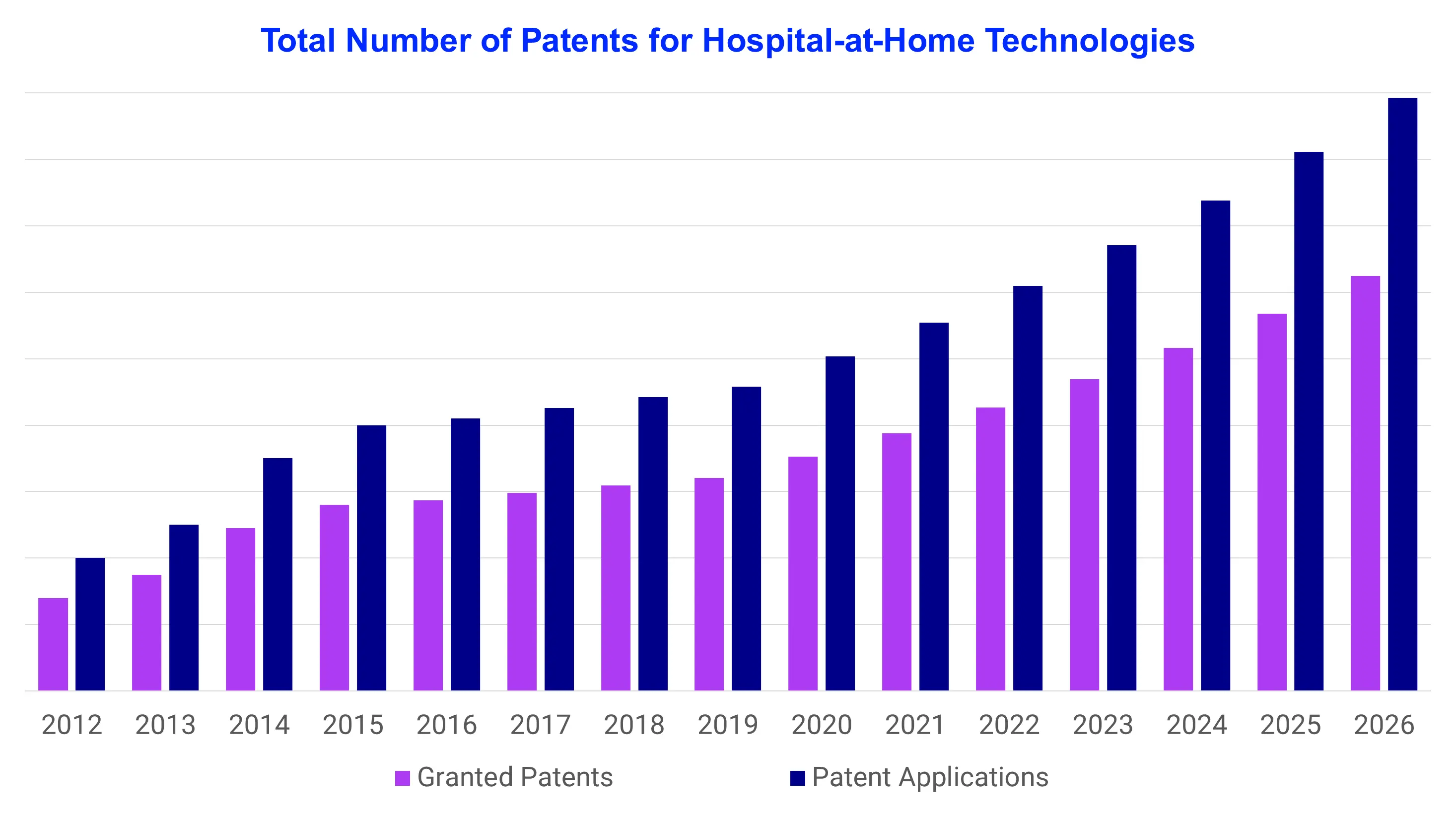
Patent filings in hospital-at-home technologies rose with each wave of programme enrolment after the November 2020 waiver launch. Applicants file first in the United States, where the waiver created the earliest reimbursable pathway, then in China and Europe.
The dataset identifies about 7,380 patent families, with filing peaks in 2021 and 2023 as wearable biosensor and care orchestration applications multiplied. Granted patents exceeded 285 in 2025, and roughly 2,970 patents are associated with the United States.
Each approved programme creates demand for sensors, escalation logic and in-home logistics, and that demand shows up as steady growth in family counts.
The study covers granted patents and published applications that protect technologies used to deliver acute, hospital-level care at a patient's residence. These include wireless vital signs sensors, deterioration scoring software, connected infusion systems, in-home diagnostics and clinical command-centre platforms.
General video visit software, home health staffing tools and bedside equipment designed for inpatient wards form the outer boundary. Such documents enter the dataset when their claims address a home acute care workflow.
Entities analysed include medical device manufacturers, consumer electronics groups, health information technology vendors, hospital systems, universities and specialised hospital-at-home operators.
The report will cover the following sections in detail:
Analysis by Technology
Analysis by Clinical Application
Analysis by Device Type
Hospital-at-Home Technologies Patent Filing Trend Analysis
Patent filings grew at an estimated 14% per year between 2020 and 2024, led by remote sensing and software claims. The 2020 public health emergency and the CMS waiver introduced in November 2020 pulled forward investment in wearable monitoring and remote clinical workflows.
Growth since 2023 comes from cellular-connected hubs, machine learning models for early deterioration detection and infusion systems with remote clinician control. Health systems and operators now file from a small base as they protect care protocols and logistics inventions.
Among the players with hospital-at-home technologies patent families, new entrants have been identified, which can be either established companies or startups developing novel technology in the field. Some of the major companies mentioned in this report (a non-exhaustive list) are as follows:
Philips holds one of the largest portfolios in connected patient monitoring, spanning IntelliVue bedside monitors, wearable biosensors and the eICU tele-critical-care programme. Its 2021 purchase of BioTelemetry added ambulatory cardiac monitoring and a remote service network that health systems reuse for home episodes. Patent families cluster around sensor-to-cloud data pipelines, patient deterioration scoring and tele-ICU workflows. Many of its monitoring devices carry FDA 510(k) clearance and CE marking, which lets one hardware family serve hospital and home settings. Philips sells under multi-year enterprise agreements and positions its monitoring stack as the sensing layer for virtual care. Its filing approach favours broad system claims backed by dense continuation families.
Medtronic builds its home-relevant portfolio on Nellcor pulse oximetry, Microstream capnography, BIS depth-of-anaesthesia monitoring and the LINQ II insertable cardiac monitor. Patent families protect sensor design, signal processing and algorithms that flag arrhythmia or respiratory compromise, with CareLink supplying remote data review. Most products hold FDA clearance or approval and CE marking, and several have long clinical track records in acute care. The company files continuation and divisional applications around legacy platforms, which keeps its sensing claims in force for many years. Commercial positioning centres on hospital procurement contracts, where Medtronic supplies sensors and monitors that health systems extend into home programmes.
Other companies include Masimo, GE HealthCare, and Baxter.
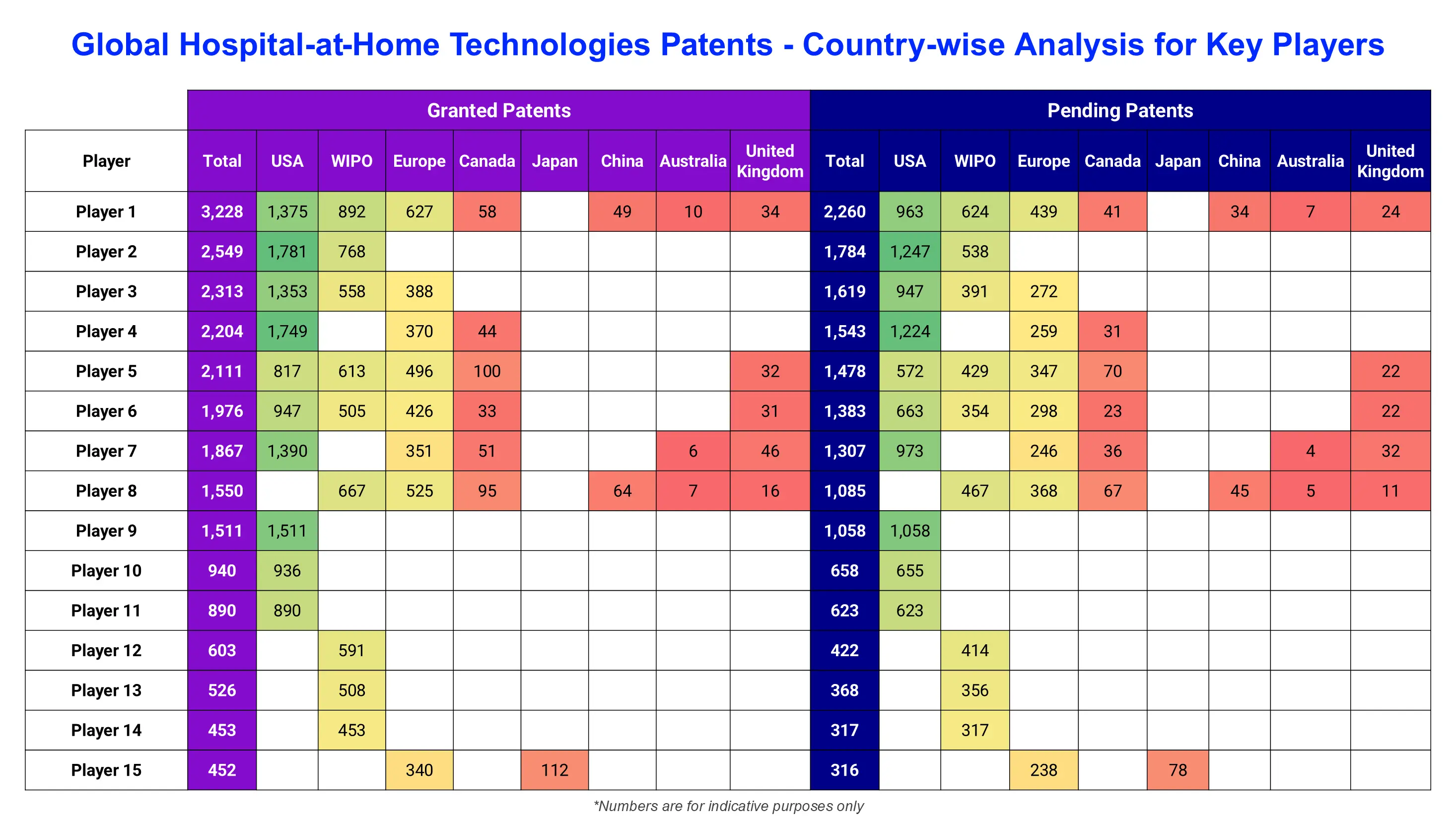
The top five assignees hold an estimated quarter of identified families, which leaves a long tail of start-ups, universities and health systems. Philips leads on patient monitoring and tele-critical-care families, and Medtronic is strong in pulse oximetry, capnography and implantable cardiac monitoring. Masimo has grown its share through wearable oximetry and medical watch filings.
*Please note that this is only a partial list; the complete list of key players is available in the full report. Additionally, the list of key players can be customized to better suit your needs.*
The report assesses patent activity across major jurisdictions, including:
The United States leads filing volume because of the Medicare waiver and a large base of hospital programmes. China follows as home-based acute care pilots expand, and Europe ranks third, supported by virtual ward programmes in the United Kingdom, Germany and the Nordic countries.
Read more about this report - REQUEST FREE SAMPLE COPY IN PDF
The report segments hospital-at-home technology patents into the following innovation areas:
Among these, wireless wearable vital signs sensing holds the largest share of patent families, since every approved programme depends on continuous physiological data.
Competition spans medical device groups, consumer electronics firms, software vendors and care operators. Philips, Medtronic and Masimo defend sensing hardware, and platform companies such as Current Health, DispatchHealth and Biofourmis protect workflow and analytics claims. Best Buy sold Current Health back to its co-founder in 2025, a sign that ownership of the home care technology stack is still shifting.
Companies are focusing on:
Emerging innovation themes include multimodal deterioration models that merge wearable, camera and voice data, infusion pumps rated for home use, autonomous medication dispensing with remote pharmacist verification, and generative documentation for home visits. Applicants also file on interoperability gateways that stream home data into electronic health records.
The field combines regulated medical hardware with fast-moving software, so freedom-to-operate reviews need both device and software claim analysis. Hardware families from established monitoring companies stay in force for many years, while software families from operators and start-ups carry shorter commercial horizons. Health systems running programmes at scale are beginning to build their own filings.
Technology segments, assignee portfolios and jurisdictional trends are mapped in this report, which provides actionable intelligence supporting:
The study searched the USPTO, the European Patent Office, the China National Intellectual Property Administration, the Japan Patent Office, Espacenet and the WIPO PCT collection. Queries combined CPC and IPC classes such as A61B 5/00, G16H 40/67, G16H 80/00, A61M 5/142 and G08B 21/04 with keywords on home acute care, virtual wards and remote inpatient care.
Records were screened for relevance, deduplicated and consolidated at patent family level. Legal status, grant year, assignee and jurisdiction were normalised, and assignee names were merged across subsidiaries and acquired companies.
The market side draws on CMS and FDA documents, company disclosures, clinical trial registries and peer-reviewed literature, including randomised trials of acute home care. Patent counts are rounded approximations as of October 2026.
AI in Remote Patient Monitoring Market
Prenatal Monitoring Devices Patent Landscape Analysis Report


Upto 15% Off
USD
$2699 $2429
$4299 $3869
$5799 $4949
$6999 $5949


*While we strive to always give you current and accurate information, the numbers depicted on the website are indicative and may differ from the actual numbers in the main report. At Expert Market Research, we aim to bring you the latest insights and trends in the market. Using our analyses and forecasts, stakeholders can understand the market dynamics, navigate challenges, and capitalize on opportunities to make data-driven strategic decisions.*
EMR’s Hospital-at-Home Technologies Patent Landscape Analysis provides a comprehensive assessment of patent filings, innovation clusters, assignee portfolios, and geographic filing patterns across the hospital-at-home technologies landscape. The report identifies 7,380+ patent families, evaluates leading jurisdictions including the United States, China, and Europe, and profiles the top assignees by portfolio size.
The global hospital-at-home technologies market was valued at USD 9.30 Billion in 2025. The market is projected to reach USD 40.32 Billion by 2035, expanding at a CAGR of 15.80% during 2026 - 2035.
The report analyses approximately 7,380+ patent families related to hospital-at-home technologies. These include filings from the United States, China, Europe, and international WIPO filings.
Key companies operating within the landscape include Philips, Medtronic, Masimo, GE HealthCare, and Baxter, among others. These organisations collectively account for a significant portion of patent activity analysed in this report.
The report evaluates patent activity across the United States, Europe, China, Japan, South Korea, India, and international WIPO filings. The United States leads with roughly two-fifths of identified hospital-at-home technology patent families, followed by China and Europe.
Yes. The report scope can be customised based on geography, technology segment, assignee selection, time period, or specific innovation cluster focus. Please connect with the EMR team to define the customisation scope.
Patent landscape analysis helps organisations understand innovation trends, competitive activity, technology whitespace, and IP risk across a defined domain. For hospital-at-home technologies, this report supports strategic decisions in R&D prioritisation, licensing evaluation, competitive benchmarking, and market entry planning.
Explore our key highlights of the report and gain a concise overview of key findings, trends, and actionable insights that will empower your strategic decisions.
|
Scope of the Report |
Details |
|
Analysis by Technology |
|
|
Analysis by Clinical Application |
|
|
Analysis by Device Type |
|
|
Analysis by End User |
|
|
Key Players Mentioned |
|
|
Geographies Covered |
|
Mini Report
One User
USD 2,699
USD 2,429
tax inclusive*
Single User License
One User
USD 4,299
USD 3,869
tax inclusive*
Five User License
Five User
USD 5,799
USD 4,949
tax inclusive*
Corporate License
Unlimited Users
USD 6,999
USD 5,949
tax inclusive*
*Please note that the prices mentioned below are starting prices for each bundle type. Kindly contact our team for further details.*
Flash Bundle
Small Business Bundle
Growth Bundle
Enterprise Bundle
*Please note that the prices mentioned below are starting prices for each bundle type. Kindly contact our team for further details.*
Flash Bundle
Number of Reports: 3
20%
tax inclusive*
Small Business Bundle
Number of Reports: 5
25%
tax inclusive*
Growth Bundle
Number of Reports: 8
30%
tax inclusive*
Enterprise Bundle
Number of Reports: 10
35%
tax inclusive*
How To Order

Select License Type
Choose the right license for your needs and access rights.

Click on ‘Buy Now’
Add the report to your cart with one click and proceed to register.

Select Mode of Payment
Choose a payment option for a secure checkout. You will be redirected accordingly.
Strategic Solutions for Informed Decision-Making
Gain insights to stay ahead and seize opportunities.

Get insights & trends for a competitive edge.

Track prices with detailed trend reports.

Analyse trade data for supply chain insights.

Leverage cost reports for smart savings

Enhance supply chain with partnerships.

Connect For More Information
Our expert team of analysts will offer full support and resolve any queries regarding the report, before and after the purchase.
Our expert team of analysts will offer full support and resolve any queries regarding the report, before and after the purchase.
We employ meticulous research methods, blending advanced analytics and expert insights to deliver accurate, actionable industry intelligence, staying ahead of competitors.
Our skilled analysts offer unparalleled competitive advantage with detailed insights on current and emerging markets, ensuring your strategic edge.
We offer an in-depth yet simplified presentation of industry insights and analysis to meet your specific requirements effectively.




