

Consumer Insights
Uncover trends and behaviors shaping consumer choices today
Procurement Insights
Optimize your sourcing strategy with key market data
Industry Stats
Stay ahead with the latest trends and market analysis.
The implantable drug delivery pumps market was valued at USD 2.67 Billion in 2025 and is expected to reach USD 5.06 Billion by 2035, growing at a CAGR of 6.60%. Demand is driven by intractable chronic pain and severe spasticity caseloads, the rising prevalence of diabetes, regional chemotherapy for liver tumours, and the shift toward programmable, telemetry-enabled pumps.
Patent activity has expanded steadily, with more than 4,730 families and filings concentrated in refill-port design, micropump actuation, dosing software and sensor-linked control. Regulatory validation such as the 2023 FDA approval of a third-generation intrathecal system and the 2025 label expansion of a refillable ocular implant keeps assignees investing in the category.
This Implantable Drug Delivery Pumps Patent Landscape Analysis Report maps leading assignees, jurisdictions, technology clusters and white spaces to support R&D, licensing and freedom-to-operate decisions.
The implantable drug delivery pumps market is experiencing strong growth, driven by rising chronic pain and spasticity caseloads, refillable programmable pump platforms, and closed-loop insulin and regional chemotherapy delivery. Medtronic received FDA approval for its SynchroMed III intrathecal system in October 2023, extending an installed base that treats chronic pain, cancer pain and severe spasticity through refillable programmable pumps.
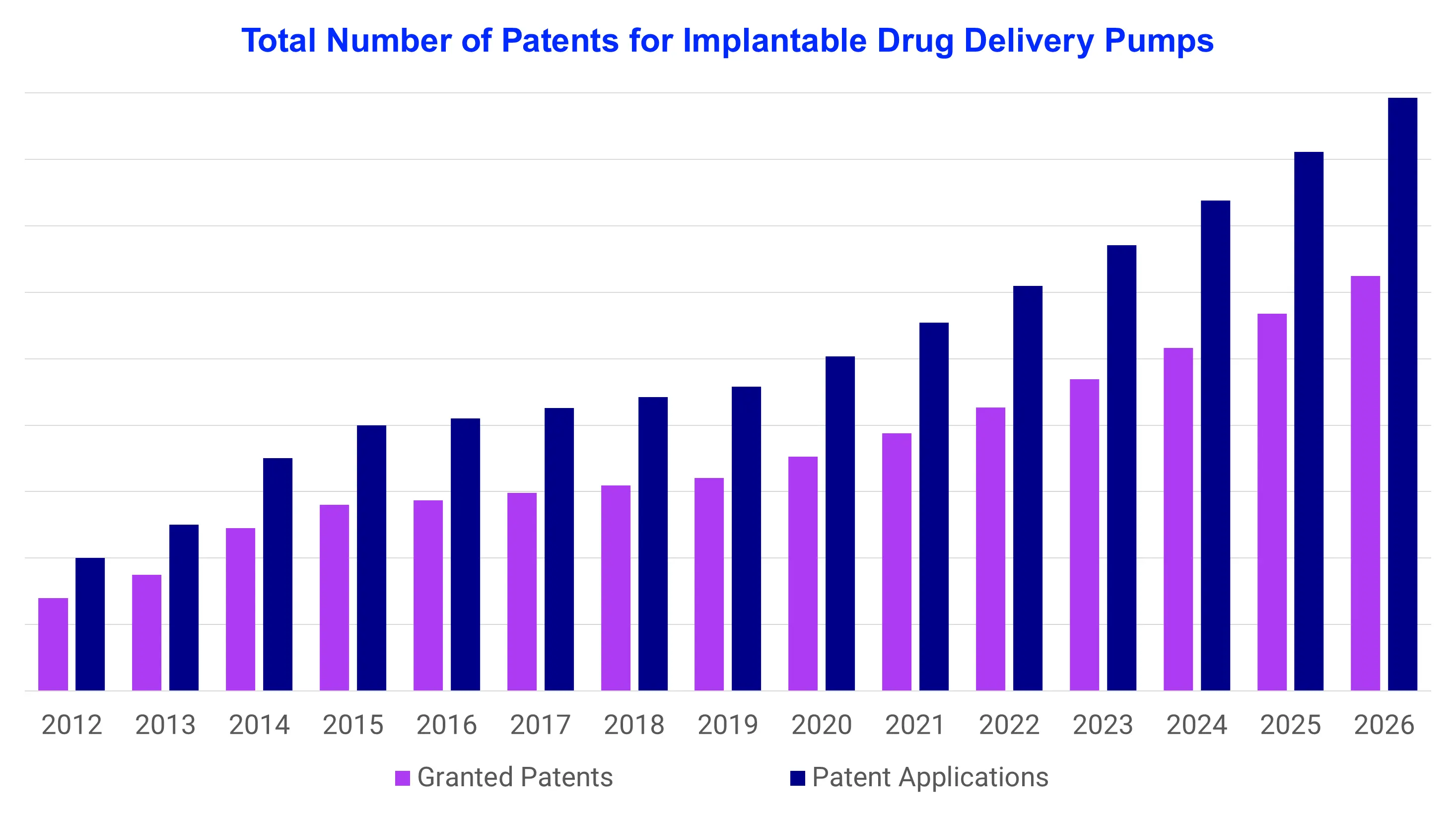
Patent activity is accelerating, with 560+ implantable drug delivery pumps patents granted in 2025, reflecting strong innovation momentum in refillable reservoir and catheter access designs, micropump actuation mechanisms, closed-loop dosing algorithms, and wireless telemetry and clinician programming.
Top assignees in the implantable drug delivery pumps patent landscape include Medtronic, Johnson & Johnson, Roche, Boston Scientific, and Flowonix Medical, with the United States, Europe, and China as the dominant patent jurisdictions.
Implantable drug delivery pumps place a drug reservoir, a pumping engine and a catheter inside the body, so that small doses reach the intrathecal space, an artery, a vein or subcutaneous tissue at programmed rates. Clinical use centres on intractable pain, severe spasticity, insulin delivery and regional oncology. Demand grows in step with specialist implanting centres, since each therapy depends on a trained team for implantation, refill and programming.
Market growth is driven by the large pool of patients whose pain or spasticity no longer responds to oral therapy, and by pump platforms that cut clinic visits through longer battery life and remote programming. The US Centers for Disease Control and Prevention reported that about 21% of US adults lived with chronic pain in 2021, and the International Diabetes Federation estimated 589 million adults with diabetes in 2024.
Chronic pain prevalence of that scale widens the eligible pool for intrathecal therapy, yet only a small fraction of patients reach implantation, which keeps volumes tied to specialist capacity. Diabetes burden sustains research into implantable insulin routes, although external pumps and sensors hold most of the installed base today. The growth rate stays moderate because implantation needs surgery, device replacement follows battery cycles, and neuromodulation competes for the same refractory pain patients. Reimbursement for refills and trialling procedures supports steady expansion.
Read more about this report - REQUEST FREE SAMPLE COPY IN PDF
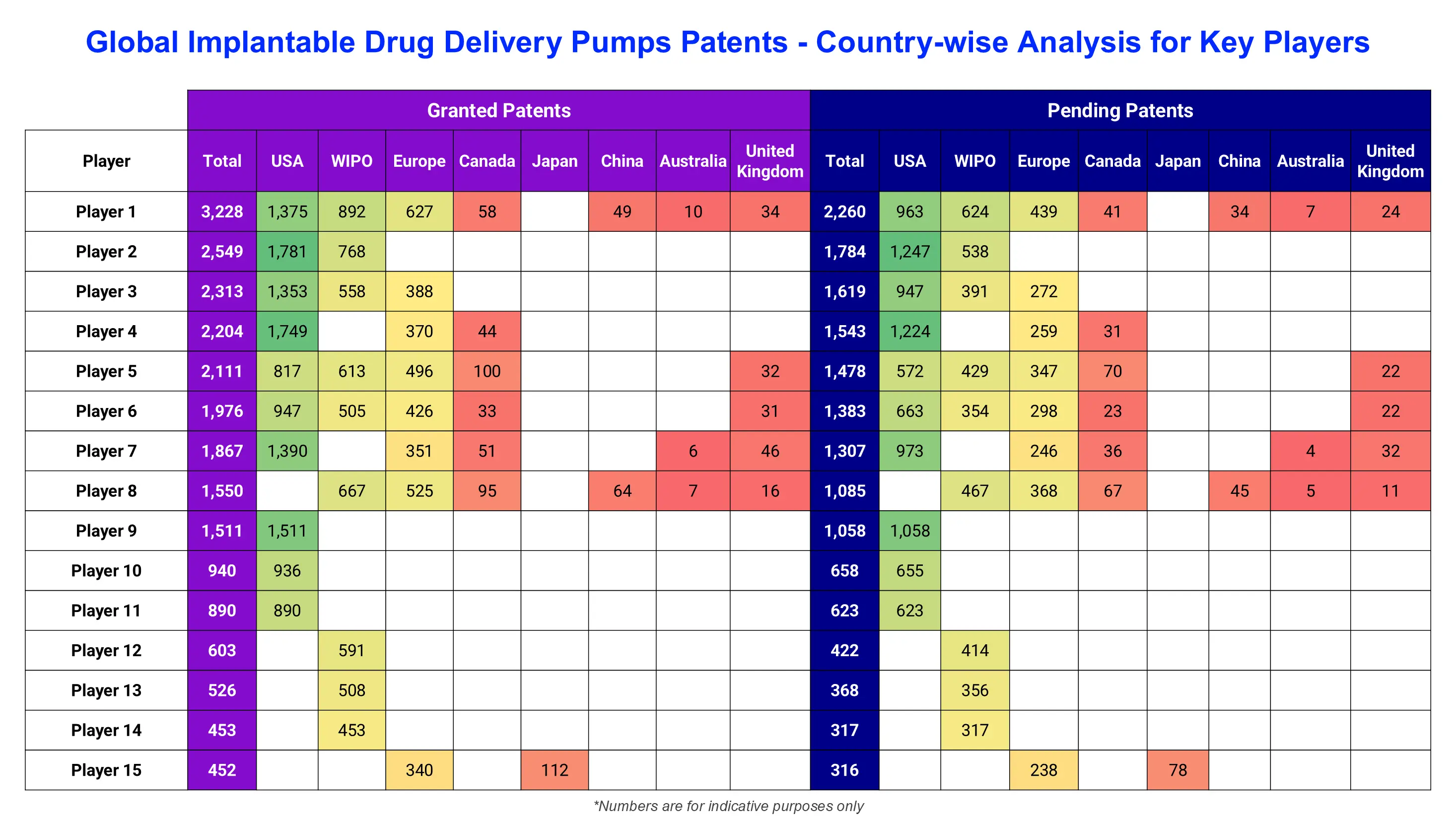
Patent filings for implantable drug delivery pumps are led by United States applicants, with Europe and China forming the next two filing blocs. China records the fastest rise in filings from device makers and universities working on micropump chips and low-cost programmable pumps.
The dataset covers more than 4,730 patent families, with filing peaks between 2021 and 2023 as telemetry, closed-loop control and MEMS pump claims increased. Granted counts reached roughly 560 in 2025. Filings concentrate on reservoir and catheter hardware, dosing firmware, occlusion alarms and drug-compatible materials.
Rising refractory pain, spasticity and diabetes caseloads give assignees a commercial reason to protect pump hardware, dosing software and sensor links across several jurisdictions.
The report covers patents on implantable and fully implanted pump systems that deliver liquid drugs from a refillable or replaceable reservoir through a catheter or direct tissue interface. It includes intrathecal, intravascular, subcutaneous, intraocular and intraperitoneal pump designs, together with their refill ports, catheters, controllers and programming software.
The analysis spans applications in pain, spasticity, diabetes, oncology and neurological or ocular therapy. It tracks granted patents and published applications, family consolidation, legal status, citation patterns and assignee positions across key patent offices.
Entities assessed include device manufacturers, pharmaceutical companies with delivery programmes, micropump and MEMS specialists, hospitals and research institutes, and universities holding pump-related patents.
The report will cover the following sections in detail:
Analysis by Pump Mechanism
Analysis by Therapeutic Application
Analysis by Control Architecture
Implantable Drug Delivery Pumps Patent Filing Trend Analysis
Filings for implantable drug delivery pumps grew at an estimated annual rate of about 5 to 6% over 2020 to 2024. Growth came from MEMS micropump designs, wireless programming and the pairing of pumps with glucose or pressure sensors.
Grant activity shows a steady pipeline, with about 560 patents granted in 2025 across the major offices. Software and telemetry claims form a growing share of new families, while mechanical pump claims from the earlier generation continue to expire.
Among the players with implantable drug delivery pumps patent families, new entrants have been identified, which can be either established companies or startups developing novel technology in the field. Some of the major companies mentioned in this report (a non-exhaustive list) are as follows:
Medtronic holds the largest implantable pump portfolio, built around the SynchroMed family of programmable peristaltic intrathecal pumps. The SynchroMed III system received FDA approval in October 2023 for chronic pain, cancer pain and severe spasticity. Its patents cover roller-pump mechanics, catheter and refill-port access, reservoir sensing, motor stall detection and wireless clinician programmers. Filing strategy favours continuation families that wrap each hardware generation in software and telemetry claims. Commercial positioning rests on a large installed base of implanting centres and a recurring flow of refill visits and replacements.
Johnson & Johnson carries implantable delivery intellectual property through the osmotic implant heritage of ALZA and the former Codman neurosurgery pump and catheter business. Osmotic engine and flow-restrictor claims form the older core of the portfolio, and many of those families have reached expiry. Recent activity concentrates on catheter access, connectors and fluid-path safety features that apply across pump types. Regional hepatic arterial infusion catheters used with programmable pumps remain a clinical niche linked to this lineage. The group licenses and enforces selectively, with deal-making steered by its MedTech and pharmaceutical divisions.
Other companies include Roche, Boston Scientific, and Flowonix Medical.
The top five assignees together hold a large share of the dataset, with Medtronic far ahead on programmable intrathecal pump families. Johnson & Johnson and Roche follow through osmotic and insulin pump heritage, while smaller specialists such as Flowonix Medical hold narrow but active positions.
*Please note that this is only a partial list; the complete list of key players is available in the full report. Additionally, the list of key players can be customized to better suit your needs.*
The report assesses patent activity across major jurisdictions, including:
The United States leads by filing volume, supported by a dense implanting-centre network and strong reimbursement for intrathecal therapy. Europe follows through the European Patent Office, with German and Swiss device makers active in programmable pumps. China ranks third and shows the quickest growth in micropump and low-cost pump applications.
Read more about this report - REQUEST FREE SAMPLE COPY IN PDF
The report segments patents across the following technology areas:
Among these, refill ports, catheter access and programmable pump actuation account for the largest share of patent families, reflecting the long-standing intrathecal pump base.
Competition centres on a handful of device manufacturers with decades of intrathecal and infusion experience. Medtronic anchors the field with the SynchroMed family, while specialists such as Flowonix Medical offer alternative programmable pumps. New entrants file around micropump chips, miniature reservoirs and sensor-linked control to enter insulin and ocular niches.
Companies are focusing on:
Emerging innovation themes include rechargeable power for longer pump life, sensor-linked closed-loop dosing, MEMS micropumps for ocular and neurological targets, and refill-free reservoir designs. Refillable ocular implants, such as the one approved for diabetic retinopathy in 2025, show how reservoir-based delivery is spreading beyond the spine.
The landscape combines mature mechanical pump patents with a fast-growing layer of software, telemetry and sensor claims. Expiring first-generation families open space for generic-style pump designs, and newer filings direct attention to connectivity and drug-device compatibility.
Technology segments, assignee positions and jurisdiction trends are mapped so that the report provides actionable intelligence supporting:
The study draws on patent databases and offices including the USPTO, EPO, WIPO PATENTSCOPE, CNIPA, JPO and KIPO. Searches combine CPC classes A61M 5/142, A61M 5/168, A61M 39/02, A61M 2205 and A61M 2205/50 with keyword strings on implantable, refillable and programmable pumps.
Retrieved records undergo screening for relevance and consolidation into simple families, followed by legal-status checks and assignee name normalisation. Subsidiary and acquired entities are merged into parent portfolios where ownership is documented.
The market side draws on regulatory databases, company annual reports, clinical trial registries and peer-reviewed literature. Patent counts are rounded and reflect search cut-off dates.
Smart Implantable Pumps Market
Implantable Medical Devices Market
Smart Insulin Delivery Devices Patent Landscape Analysis Report


Upto 15% Off
USD
$2699 $2429
$4299 $3869
$5799 $4949
$6999 $5949


*While we strive to always give you current and accurate information, the numbers depicted on the website are indicative and may differ from the actual numbers in the main report. At Expert Market Research, we aim to bring you the latest insights and trends in the market. Using our analyses and forecasts, stakeholders can understand the market dynamics, navigate challenges, and capitalize on opportunities to make data-driven strategic decisions.*
EMR’s Implantable Drug Delivery Pumps Patent Landscape Analysis provides a comprehensive assessment of patent filings, innovation clusters, assignee portfolios, and geographic filing patterns across the implantable drug delivery pumps landscape. The report identifies 4,730+ patent families, evaluates leading jurisdictions including the United States, Europe, and China, and profiles the top assignees by portfolio size.
The global implantable drug delivery pumps market was valued at USD 2.67 Billion in 2025. The market is projected to reach USD 5.06 Billion by 2035, expanding at a CAGR of 6.60% during 2026 - 2035.
The report analyses approximately 4,730+ patent families related to implantable drug delivery pumps. These include filings from the United States, Europe, China, and international WIPO filings.
Key companies operating within the landscape include Medtronic, Johnson & Johnson, Roche, Boston Scientific, and Flowonix Medical, among others. These organisations collectively account for a significant portion of patent activity analysed in this report.
The report evaluates patent activity across the United States, Europe, China, Japan, South Korea, India, and international WIPO filings. The United States leads implantable drug delivery pump patent activity, holding the largest single-jurisdiction share of families and grants.
Yes. The report scope can be customised based on geography, technology segment, assignee selection, time period, or specific innovation cluster focus. Please connect with the EMR team to define the customisation scope.
Patent landscape analysis helps organisations understand innovation trends, competitive activity, technology whitespace, and IP risk across a defined domain. For implantable drug delivery pumps, this report supports strategic decisions in R&D prioritisation, licensing evaluation, competitive benchmarking, and market entry planning.
Explore our key highlights of the report and gain a concise overview of key findings, trends, and actionable insights that will empower your strategic decisions.
|
Scope of the Report |
Details |
|
Analysis by Pump Mechanism |
|
|
Analysis by Therapeutic Application |
|
|
Analysis by Control Architecture |
|
|
Analysis by End User |
|
|
Key Players Mentioned |
|
|
Geographies Covered |
|
Mini Report
One User
USD 2,699
USD 2,429
tax inclusive*
Single User License
One User
USD 4,299
USD 3,869
tax inclusive*
Five User License
Five User
USD 5,799
USD 4,949
tax inclusive*
Corporate License
Unlimited Users
USD 6,999
USD 5,949
tax inclusive*
*Please note that the prices mentioned below are starting prices for each bundle type. Kindly contact our team for further details.*
Flash Bundle
Small Business Bundle
Growth Bundle
Enterprise Bundle
*Please note that the prices mentioned below are starting prices for each bundle type. Kindly contact our team for further details.*
Flash Bundle
Number of Reports: 3
20%
tax inclusive*
Small Business Bundle
Number of Reports: 5
25%
tax inclusive*
Growth Bundle
Number of Reports: 8
30%
tax inclusive*
Enterprise Bundle
Number of Reports: 10
35%
tax inclusive*
How To Order

Select License Type
Choose the right license for your needs and access rights.

Click on ‘Buy Now’
Add the report to your cart with one click and proceed to register.

Select Mode of Payment
Choose a payment option for a secure checkout. You will be redirected accordingly.
Strategic Solutions for Informed Decision-Making
Gain insights to stay ahead and seize opportunities.

Get insights & trends for a competitive edge.

Track prices with detailed trend reports.

Analyse trade data for supply chain insights.

Leverage cost reports for smart savings

Enhance supply chain with partnerships.

Connect For More Information
Our expert team of analysts will offer full support and resolve any queries regarding the report, before and after the purchase.
Our expert team of analysts will offer full support and resolve any queries regarding the report, before and after the purchase.
We employ meticulous research methods, blending advanced analytics and expert insights to deliver accurate, actionable industry intelligence, staying ahead of competitors.
Our skilled analysts offer unparalleled competitive advantage with detailed insights on current and emerging markets, ensuring your strategic edge.
We offer an in-depth yet simplified presentation of industry insights and analysis to meet your specific requirements effectively.




