

Consumer Insights
Uncover trends and behaviors shaping consumer choices today
Procurement Insights
Optimize your sourcing strategy with key market data
Industry Stats
Stay ahead with the latest trends and market analysis.
The smart orthopedic implants with sensors market was valued at USD 0.35 Billion in 2025 and is projected to reach USD 2.45 Billion by 2035, advancing at a CAGR of 21.50%. Growth is supported by rising volumes of knee, hip and spine procedures, demand for objective post-operative data in place of patient self-reporting, the shift toward value-based and bundled payment models, and the falling cost of miniature low-power sensing electronics. The steep rate reflects a very small commercial base, since only a handful of sensor-equipped implants are on the market today.
Patent activity is concentrated in embedded inertial and load sensors in joint implants, battery-free and energy harvesting power, wireless data transfer to a patient app and clinician portal, fracture and fusion healing monitoring, infection and temperature sensing, and machine learning analysis of implant data. Validation signals include the FDA De Novo authorisation granted to a smart knee implant in 2021, the commercial rollout of that system alongside a cloud analytics platform, and a growing number of clinical evaluation programmes in hip, spine and fracture fixation.
This Smart Orthopedic Implants with Sensors Patent Landscape Analysis Report provides a structured view of filing trends, leading assignees, jurisdiction activity, technology clusters and competitive positioning across implants that sense motion, load, healing and infection.
The smart orthopedic implants with sensors market is experiencing strong growth, driven by rising joint replacement and spinal fusion volumes, growing demand for objective recovery data, and the move toward value-based care. A smart knee implant developed by Zimmer Biomet and Canary Medical received FDA De Novo authorisation in 2021, and its readings reach clinicians through a patient app and portal, giving surgeons measured gait and mobility data in place of self-reported scores.
Patent activity is accelerating, with 240+ smart orthopedic implants with sensors patents granted in 2025, reflecting strong innovation momentum in embedded inertial and load sensors in joint implants, battery-free and energy harvesting power for implants, wireless data transfer to a patient app and clinician portal, and fracture and fusion healing monitoring.
Top assignees in the smart orthopedic implants with sensors patent landscape include Zimmer Biomet, Canary Medical, Stryker, Smith & Nephew, and Medacta International, with the United States, Europe, and China as the dominant patent jurisdictions.
Orthopedic implants have long been judged by what surgeons see on an X-ray and what patients report at a follow-up visit, which leaves months between a problem starting and a problem being found. Smart implants with embedded sensors address that gap by measuring motion, load, temperature and healing directly at the surgical site. Demand comes from surgeons who want evidence on recovery, hospitals under pressure to shorten stays and avoid revision surgery, and payers moving toward outcome-linked contracts. The category is still at an early commercial stage, with one authorised smart knee system and several hip, spine and fracture programmes working through clinical evaluation. Adoption therefore depends as much on evidence and reimbursement as on engineering.
Market growth is driven by the spread of sensor-equipped knee implants into routine arthroplasty practice, which converts a small number of pilot sites into a repeatable hospital purchase. An estimated 1.4 million knee and hip replacements are performed each year in the United States, so even a modest share moving to smart versions creates a large addressable pool. Roughly one in five total knee patients report dissatisfaction with the result, and objective gait data gives surgeons a way to identify those patients early.
Revision surgery is the cost that smart implants aim to reduce. Implant loosening, infection and stiffness account for a large share of revisions, and each revision typically costs far more than the primary procedure, so earlier detection has a direct financial value to hospitals under bundled payments. The FDA De Novo authorisation of a smart knee in 2021 matters because it set a regulatory route that later sensor-equipped devices can reference, which lowers uncertainty for developers. Data volume adds a second layer, since continuous readings from thousands of patients can train machine learning models that flag abnormal recovery, and that analytics service gives manufacturers a recurring revenue stream beyond the implant sale.
Read more about this report - REQUEST FREE SAMPLE COPY IN PDF
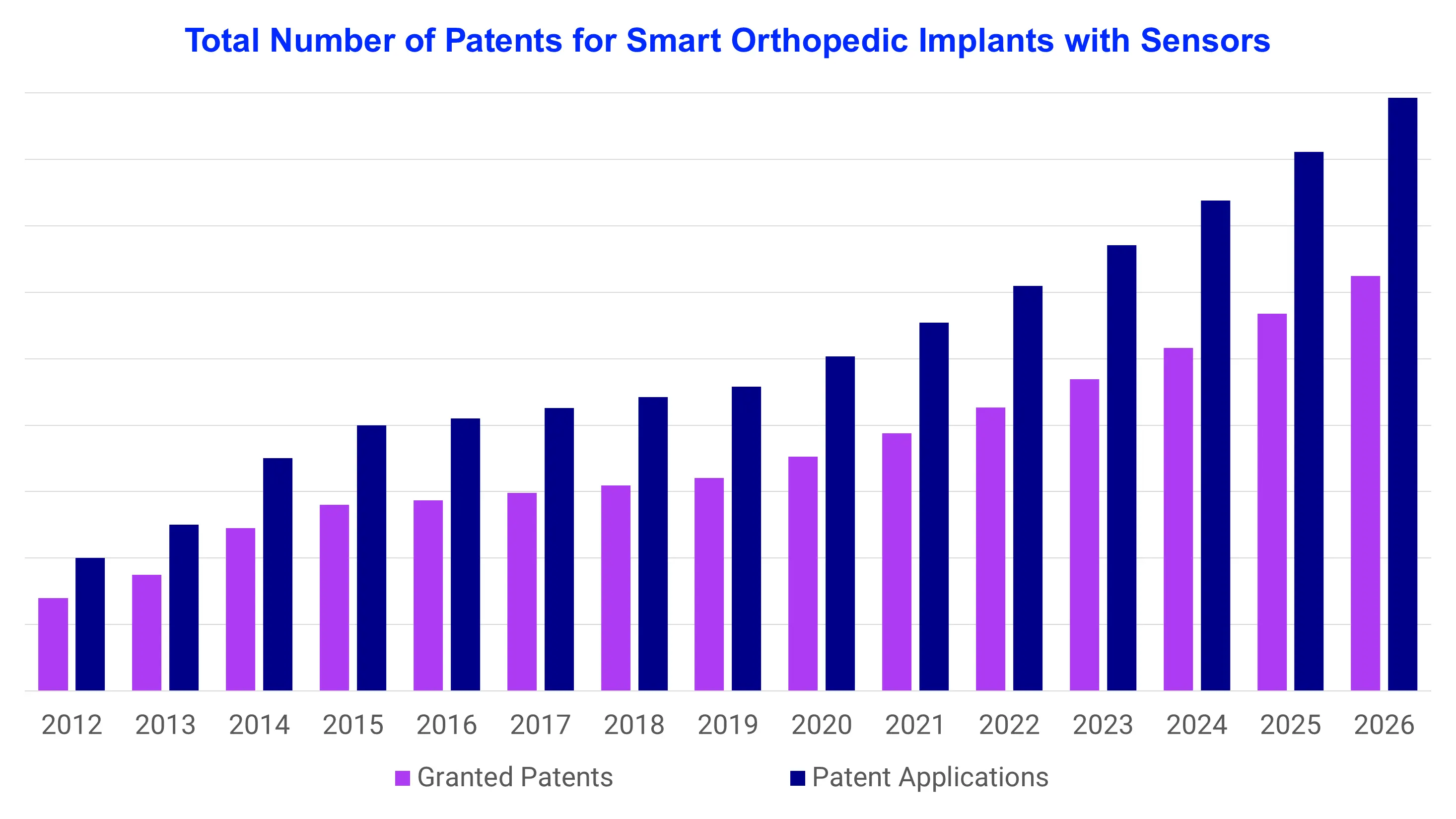
Filing intensity in smart orthopedic implants with sensors has risen in step with commercial investment by large joint reconstruction companies and venture-backed sensor specialists. Applications increasingly pair a conventional implant design with a sensing module, a power source and a communication path, which shows that companies treat sensing as part of the implant platform and not as an accessory. Collaboration between implant makers and electronics firms has widened the pool of applicants, and growth in granted patents, at more than 240 in 2025, indicates that many earlier filings have now cleared examination.
The landscape covers approximately 1,400+ patent families. Filing activity has been strongest from the early 2020s onward, following the 2021 FDA decision on a smart knee and a wave of investment in connected orthopedic care. The largest clusters cover embedded inertial and load sensors in joint implants, battery-free and energy harvesting power, and wireless data transfer to patient apps and clinician portals, while fracture and fusion healing monitoring, infection and temperature sensing, and machine learning analysis make up a growing second tier.
Rising demand for objective recovery data and fewer revisions is pulling patent filings toward sensing, powering and analytics inventions that can turn a passive implant into a measurement device.
The patent landscape covers filings published across major patent offices and through the WIPO international route, with focus on the United States, Europe and China, and further coverage of South Korea, India and Japan. Market coverage spans developed arthroplasty markets with high procedure volumes and emerging markets where joint replacement is expanding quickly. The scope includes granted patents and pending applications grouped into patent families, so that a single invention filed in several countries is counted once when assessing portfolio size.
Technology scope covers orthopedic implants that carry embedded sensors, by implant type: smart knee implants, smart hip implants, smart spinal implants and smart fracture fixation devices. Sensor types include inertial and motion sensors, load and strain sensors, temperature and infection sensors, pressure sensors and bioelectrical sensors. Clinical uses range from post-operative recovery tracking and implant loosening and failure detection to fracture and fusion healing monitoring, infection surveillance and rehabilitation guidance. Standard joint replacement implants without sensing, and wireless sensing technology used outside orthopedics, sit outside the boundary.
Entities in the landscape include large joint reconstruction and spine manufacturers, specialist sensor and analytics firms, electronics and semiconductor suppliers, and start-ups developing battery-free or energy harvesting power modules. Academic and clinical institutions form another group, with university engineering groups and teaching hospitals contributing filings on strain sensing, bone healing biomarkers and rehabilitation analytics. Contract manufacturers and digital health companies appear as applicants where they supply miniaturised electronics or patient-facing software.
The report will cover the following sections in detail:
Analysis by Implant Type
Analysis by Sensor Type
Analysis by Clinical Use
Smart Orthopedic Implants with Sensors Patent Filing Trend Analysis
Patent filings in smart orthopedic implants with sensors show a steady rise over the past decade, with a clear step up after the first smart knee authorisation in 2021. Early filings focused on basic sensor placement in knee and hip components, while later applications address power, data security, calibration and clinical interpretation. The shift from hardware claims to data and analytics claims signals a maturing field in which differentiation moves toward software and services.
Annual filing growth between 2020 and 2024 is estimated at roughly 12 to 15 percent, a pace that outstrips filings for conventional implant designs. Three factors drove it: the 2021 regulatory precedent, which gave developers a defined path to market, falling costs for low-power sensors and wireless chips, and growing interest in machine learning on implant data. Spine and fracture fixation applications grew from a low base and now account for a larger share of new filings than at the start of the period.
Among the players with smart orthopedic implants with sensors patent families, new entrants have been identified, which can be either established companies or startups developing novel technology in the field. Some of the major companies mentioned in this report (a non-exhaustive list) are as follows:
Zimmer Biomet holds one of the broadest portfolios in the landscape, covering knee, hip, extremity and spine implants together with sensor, data and software inventions linked to them. Its connected care offering includes the Persona IQ smart knee, developed with Canary Medical, and the mymobility digital care platform that pairs a patient app with clinician dashboards. The smart knee system received FDA De Novo authorisation in 2021, which made it the first implant of its kind to reach the market in the United States. Zimmer Biomet builds its position through a large base of core implant patents, then adds sensing, wireless and analytics claims around those designs through internal development and collaboration. Its commercial strength lies in an installed base of surgeons and hospitals that already use its joint systems, which shortens the path for sensor-equipped versions.
Canary Medical is a specialist developer of implantable sensors and cloud analytics for orthopedic devices, and its portfolio centres on sensor modules, low-power electronics and data processing for implants. Its Canturio te tibial extension, used within the Persona IQ smart knee system with Zimmer Biomet, received FDA De Novo authorisation in 2021 and is paired with the CanaryQ analytics platform. The company has also pursued sensor programmes for hip and spinal implants and has described plans for fracture-related monitoring, though most of these remain in clinical evaluation. Its IP strategy relies on a focused set of platform patents covering how sensor data is captured, transmitted and interpreted, which it licenses into partner implants rather than building a full implant range itself. This makes it a technology supplier and a central reference point for smart knee filings.
Other companies include Stryker, Smith & Nephew, and Medacta International.
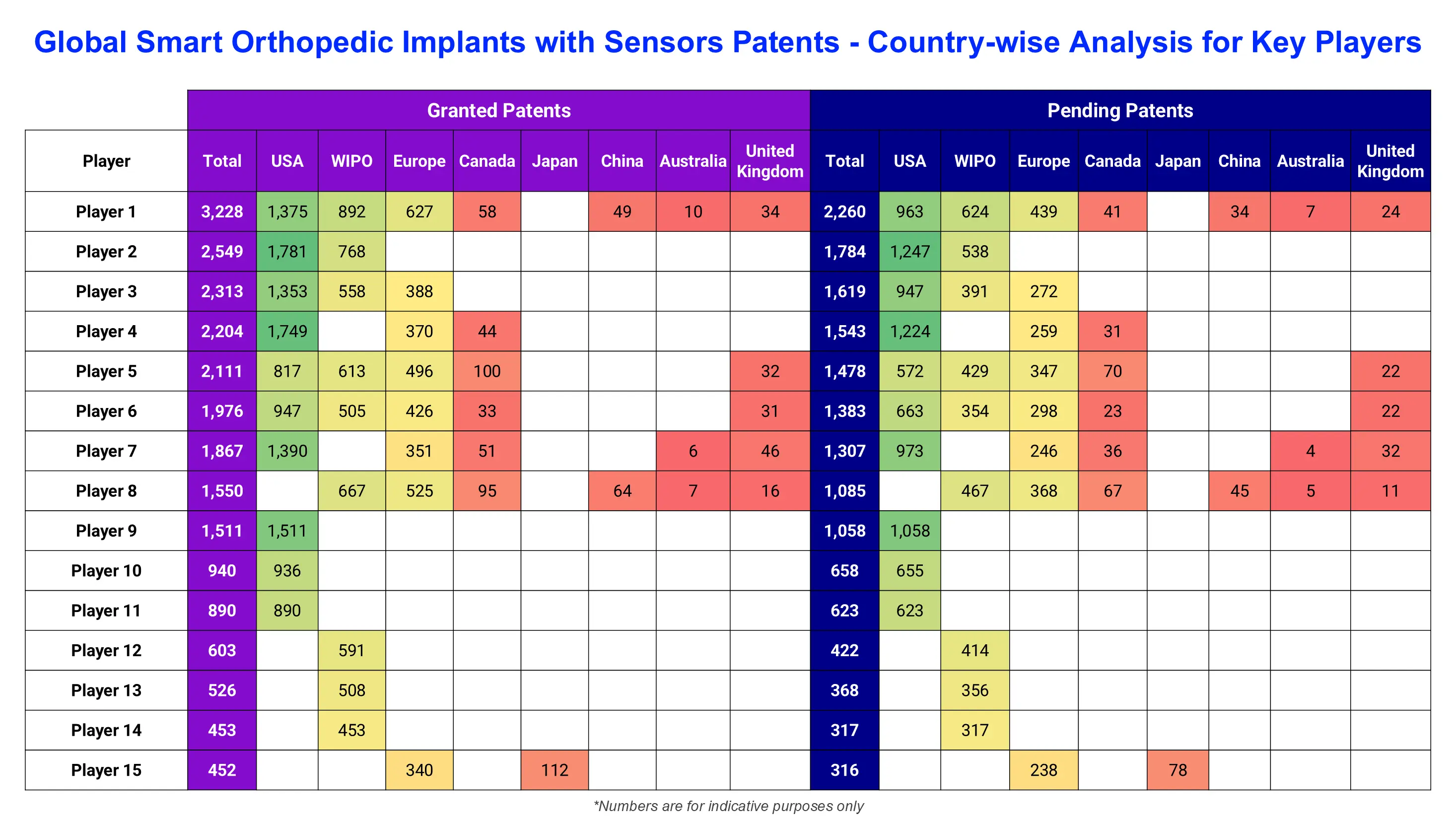
Patent ownership is moderately concentrated among five leading assignees. Zimmer Biomet combines a large implant base with sensor claims built around its smart knee, while Canary Medical holds a focused platform portfolio in sensor modules and implant data analytics. Stryker and Smith & Nephew file around digital ecosystems and navigation-linked implant systems, adding sensing claims to broad joint portfolios. Medacta International brings a smaller but active set of filings tied to its personalised implant and connected surgery offering. Beyond this group, a long tail of universities, electronics firms and start-ups holds individual filings on specific sensors and power methods.
*Please note that this is only a partial list; the complete list of key players is available in the full report. Additionally, the list of key players can be customized to better suit your needs.*
The report assesses patent activity across major jurisdictions, including:
The United States leads filing activity, supported by the FDA De Novo precedent, a large arthroplasty market and the presence of the main implant makers. Europe follows, with active filers in Germany, Switzerland, France and the United Kingdom, where CE mark routes and strong academic engineering groups support development. China has grown quickly as domestic implant makers and universities file on sensing and rehabilitation analytics. South Korea and India show smaller but rising activity, linked to electronics capability and expanding joint replacement volumes, while WIPO filings give applicants a route to protect inventions across several markets at once.
Read more about this report - REQUEST FREE SAMPLE COPY IN PDF
The technology landscape is grouped into five segments:
Embedded inertial and motion sensing leads patent activity, because it underpins the only authorised smart implant and produces gait, range of motion and activity data that surgeons can use immediately. Load and strain sensing is the next largest group, driven by interest in spinal fusion and fracture healing, where mechanical load changes as bone consolidates. Power and analytics filings are smaller but growing the fastest.
Competition combines scale and specialisation. Large joint reconstruction companies hold the implant portfolios, surgeon relationships and regulatory experience needed to bring a sensor-equipped device to hospitals, while specialist firms hold concentrated sensing and analytics know-how. Partnerships between the two groups, such as the smart knee developed by Zimmer Biomet and Canary Medical, have become the usual route to market. Rivals are building their own digital ecosystems around navigation, patient apps and outcome registries, and many are expected to add sensing once clinical evidence accumulates.
Companies are focusing on:
Emerging themes include passive sensors powered by external readers or body motion, which remove the battery and its replacement problem, and sensors printed directly on implant surfaces or fixation plates. Healing biomarkers such as local temperature, impedance and strain patterns are being studied as early indicators of infection and non-union. On the software side, models that combine implant readings with wearable data and clinical records aim to predict poor recovery weeks before symptoms appear, and these ideas are moving from academic filings into company portfolios.
The patent landscape for smart orthopedic implants with sensors shows a field with a small number of commercial products, a large pipeline of early-stage inventions and clear dependence on partnerships between implant makers and sensor specialists. Filing growth has outpaced that of conventional implants, and the mix is shifting from sensor placement toward power, communication and analytics. For companies deciding where to build, license or acquire, the map of who holds which claims in which jurisdiction is a practical starting point.
The landscape provides actionable intelligence for the following uses:
Patent research was carried out across major patent databases and national office records, covering the United States, Europe, China, South Korea, India, Japan and WIPO filings. Search strategies combined keywords, patent classification codes and assignee names relevant to implants with embedded sensing, and results were deduplicated into patent families. Coverage extends to granted patents and published applications from 2010 onward, with the most recent filings treated as incomplete because of publication delays.
Records were screened for relevance to orthopedic implants that sense motion, load, healing or infection, and filings that only describe conventional implants or general wireless sensing were excluded. Each family was then classified by implant type, sensor type, clinical use, technology cluster, assignee and jurisdiction, with manual review applied to borderline cases. Assignee names were harmonised so that subsidiaries and name variants roll up to a single owner.
Market analysis was supported by regulatory records, clinical trial registries, company disclosures and procedure volume statistics, which were used to relate patent activity to commercial and clinical progress. Patent counts that go beyond the reported totals, including growth rates and relative shares, are analyst estimates and are described as approximate. Figures are rounded and presented as approximate where exact counts depend on database coverage.


Upto 15% Off
USD
$2699 $2429
$4299 $3869
$5799 $4949
$6999 $5949


*While we strive to always give you current and accurate information, the numbers depicted on the website are indicative and may differ from the actual numbers in the main report. At Expert Market Research, we aim to bring you the latest insights and trends in the market. Using our analyses and forecasts, stakeholders can understand the market dynamics, navigate challenges, and capitalize on opportunities to make data-driven strategic decisions.*
EMR's Smart Orthopedic Implants with Sensors Patent Landscape Analysis provides a comprehensive assessment of patent filings, innovation clusters, assignee portfolios, and geographic filing patterns across the smart orthopedic implants with sensors landscape. The report identifies 1,400+ patent families, evaluates leading jurisdictions including the United States, Europe, and China, and profiles the top assignees by portfolio size.
The global smart orthopedic implants with sensors market was valued at USD 0.35 Billion in 2025. The market is projected to reach USD 2.45 Billion by 2035, expanding at a CAGR of 21.50% during 2026 - 2035.
The report analyses approximately 1,400+ patent families related to smart orthopedic implants with sensors. These include filings from the United States, Europe, China, and international WIPO filings.
Key companies operating within the landscape include Zimmer Biomet, Canary Medical, Stryker, Smith & Nephew, and Medacta International, among others. These organisations collectively account for a significant portion of patent activity analysed in this report.
The report evaluates patent activity across the United States, Europe, China, Japan, South Korea, India, and international WIPO filings. The United States is the leading jurisdiction, with more than 850 smart orthopedic implants with sensors patents associated with it, which makes it the largest single jurisdiction in the landscape.
Yes. The report scope can be customised based on geography, technology segment, assignee selection, time period, or specific innovation cluster focus. Readers who need a narrower scope, such as a single implant type, sensor technology or jurisdiction, can contact the EMR team to discuss a customised patent landscape study.
Patent landscape analysis helps organisations understand innovation trends, competitive activity, technology whitespace, and IP risk across a defined domain. For smart orthopedic implants with sensors, this report supports strategic decisions in R&D prioritisation, licensing evaluation, competitive benchmarking, and market entry planning.
Explore our key highlights of the report and gain a concise overview of key findings, trends, and actionable insights that will empower your strategic decisions.
|
Scope of the Report |
Details |
|
Analysis by Implant Type |
|
|
Analysis by Sensor Type |
|
|
Analysis by Clinical Use |
|
|
Analysis by End User |
|
|
Key Players Mentioned |
|
|
Geographies Covered |
|
Mini Report
One User
USD 2,699
USD 2,429
tax inclusive*
Single User License
One User
USD 4,299
USD 3,869
tax inclusive*
Five User License
Five User
USD 5,799
USD 4,949
tax inclusive*
Corporate License
Unlimited Users
USD 6,999
USD 5,949
tax inclusive*
*Please note that the prices mentioned below are starting prices for each bundle type. Kindly contact our team for further details.*
Flash Bundle
Small Business Bundle
Growth Bundle
Enterprise Bundle
*Please note that the prices mentioned below are starting prices for each bundle type. Kindly contact our team for further details.*
Flash Bundle
Number of Reports: 3
20%
tax inclusive*
Small Business Bundle
Number of Reports: 5
25%
tax inclusive*
Growth Bundle
Number of Reports: 8
30%
tax inclusive*
Enterprise Bundle
Number of Reports: 10
35%
tax inclusive*
How To Order

Select License Type
Choose the right license for your needs and access rights.

Click on ‘Buy Now’
Add the report to your cart with one click and proceed to register.

Select Mode of Payment
Choose a payment option for a secure checkout. You will be redirected accordingly.
Strategic Solutions for Informed Decision-Making
Gain insights to stay ahead and seize opportunities.

Get insights & trends for a competitive edge.

Track prices with detailed trend reports.

Analyse trade data for supply chain insights.

Leverage cost reports for smart savings

Enhance supply chain with partnerships.

Connect For More Information
Our expert team of analysts will offer full support and resolve any queries regarding the report, before and after the purchase.
Our expert team of analysts will offer full support and resolve any queries regarding the report, before and after the purchase.
We employ meticulous research methods, blending advanced analytics and expert insights to deliver accurate, actionable industry intelligence, staying ahead of competitors.
Our skilled analysts offer unparalleled competitive advantage with detailed insights on current and emerging markets, ensuring your strategic edge.
We offer an in-depth yet simplified presentation of industry insights and analysis to meet your specific requirements effectively.




