

Consumer Insights
Uncover trends and behaviors shaping consumer choices today
Procurement Insights
Optimize your sourcing strategy with key market data
Industry Stats
Stay ahead with the latest trends and market analysis.
The smart transdermal patches market was valued at USD 0.71 Billion in 2025 and is projected to reach USD 10.98 Billion by 2035, growing at a CAGR of 31.50%. Growth draws on the burden of diabetes, hypertension and Parkinson's disease, maturing microneedle and iontophoretic platforms, sensor-linked dose control and consumer acceptance of adhesive wearables.
Patent activity has accelerated since 2020, with filings concentrated in microneedle array patches, iontophoretic circuits, sensor-linked closed-loop release and printed flexible electronics. Late-stage microneedle trials, closed-loop animal studies published in 2025 and 2026 and the spread of over-the-counter wearable sensors have widened the commercial case for new families.
This Smart Transdermal Patches Patent Landscape Analysis Report maps assignees, jurisdictions and technology clusters to support portfolio, partnering and freedom-to-operate decisions.
The smart transdermal patches market is experiencing strong growth, driven by rising chronic disease burden in diabetes, hypertension and Parkinson's disease, maturing microneedle and iontophoretic delivery platforms, and consumer acceptance of adhesive wearable sensors. Hisamitsu started a phase 3 study of its microneedle product HP-6050 in Japan in August 2025, which moved a needle-array patch from research into late-stage clinical testing.
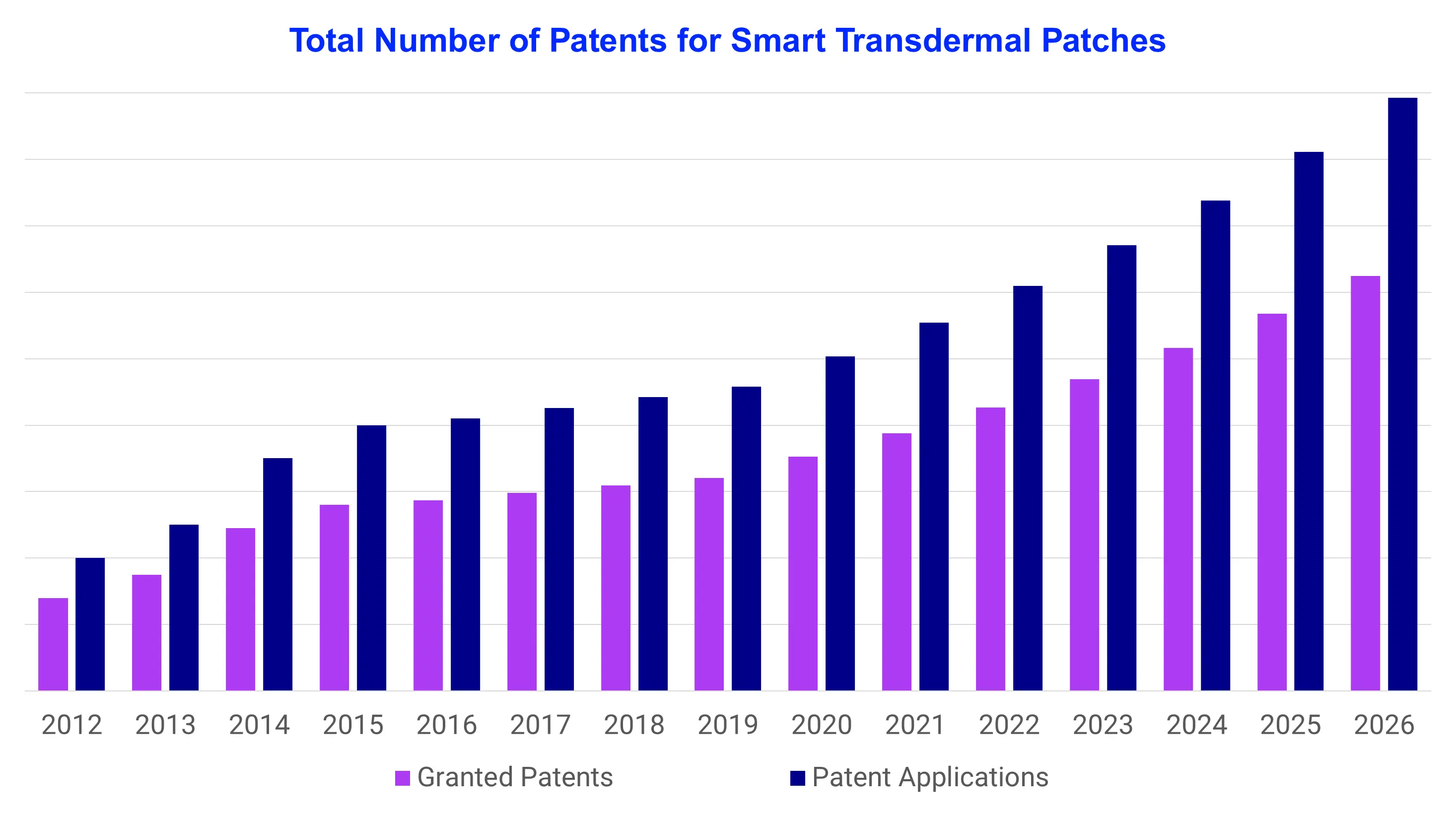
Patent activity is accelerating, with 14+ smart transdermal patches patents granted in 2025, reflecting strong innovation momentum in microneedle arrays with integrated sensors, iontophoretic and electroporation drug release, closed-loop glucose and blood pressure responsive release, and battery-free printed electronics for dose control.
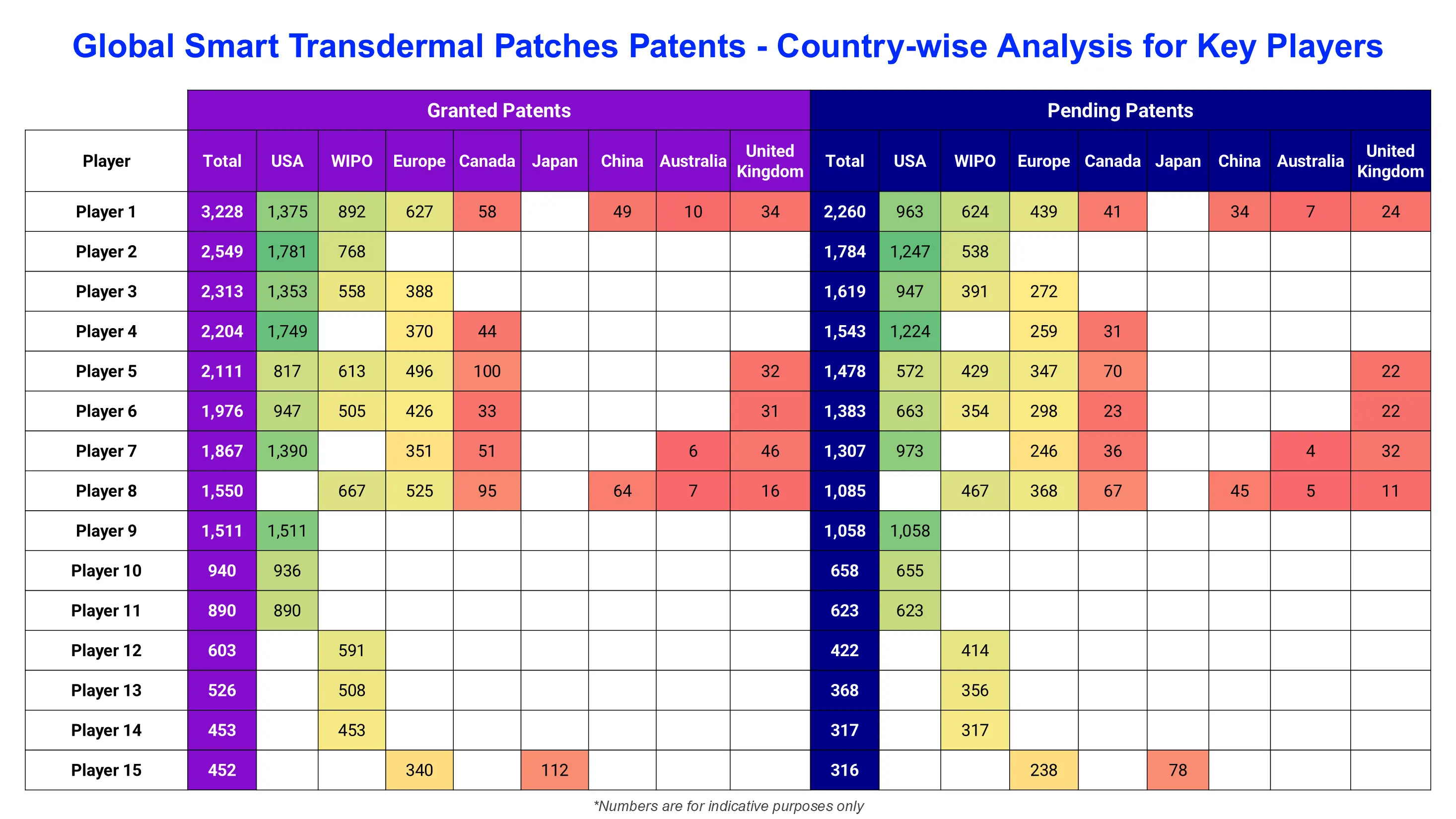
Top assignees in the smart transdermal patches patent landscape include Hisamitsu, Johnson & Johnson, Nitto Denko, 3M, and LTS Lohmann, with China, the United States, and Japan as the dominant patent jurisdictions.
Smart transdermal patches combine a drug reservoir or microneedle array with sensing, electronics or stimulus-responsive materials, so that the dose follows the patient's physiology. Passive patches release drug at a fixed rate for one to seven days, and smart versions add current-driven release, glucose or pressure feedback and wireless dose logging. Demand is strongest in chronic pain, diabetes, Parkinson's disease and hormone therapy, where steady exposure and adherence decide outcomes.
The market growth is driven by maturing microneedle, iontophoretic and sensor-linked platforms that carry insulin, peptides and cardiovascular drugs through skin. The World Health Organization counts more than one billion adults with hypertension, which gives blood-pressure-responsive patches a very large addressable population.
The growth rate is high because sensor-linked and electrically driven patches start from a small revenue base, and each clearance or late-stage trial moves a segment from prototype to billing. Dexcom's Stelo, cleared as an over-the-counter glucose sensor in March 2024, showed that consumers accept adhesive wearables, which lowers the barrier for drug-delivering versions. A PNAS study from UC San Diego in July 2026 described a battery-free fingertip patch that tracks levodopa in sweat, which points to dose-adjusting patches for the roughly 10 million people living with Parkinson's disease.
Read more about this report - REQUEST FREE SAMPLE COPY IN PDF
Patent filings in smart transdermal patches follow two streams. Established patch makers extend adhesive, matrix and microneedle claims, while device and academic teams file on sensors, circuits and closed-loop control. Chinese universities have added volume since 2020, and each new peer-reviewed demonstration is usually followed by a family within twelve months.
The report identifies about 7,300+ patent families, with filings peaking in 2022 to 2024 as microneedle and closed-loop programmes moved into animal and early clinical studies. The 2025 grant count of 14+ reflects that wave moving through examination. Primary jurisdiction patents number about 2,950+.
Late-stage microneedle trials in Japan and closed-loop demonstrations in pigs have directed new filings toward electrode design, feedback sensing and flexible power modules.
The study covers patents and published applications on transdermal patches that add active or responsive functions. These include microneedle arrays, iontophoretic and electroporation circuits, thermal permeation, sensor-linked release control, printed electronics and stimulus-responsive matrices.
Coverage runs from early filings to 2026 and includes granted patents, pending applications and family-level status in major jurisdictions. Each family is classified by technology, drug class and application, which allows comparison of filing intensity across clusters.
The analysis profiles patch manufacturers, pharmaceutical companies, medical device makers, contract manufacturers and universities that hold smart transdermal patch families.
The report will cover the following sections in detail:
Analysis by Technology
Analysis by Drug Class
Analysis by Application
Smart Transdermal Patches Patent Filing Trend Analysis
Filings for smart transdermal patches grew at an estimated 16% a year across 2020 to 2024. Growth followed the entry of microneedle products into phase 3 and a surge of closed-loop and wearable-electronics research in China, the United States and Japan.
Universities account for an estimated 40% of recent families in China, while patch manufacturers and device companies lead in the United States and Japan. Claims have moved from adhesive and matrix chemistry toward electrodes, sensors and wireless dose logging.
Among the players with smart transdermal patches patent families, new entrants have been identified, which can be either established companies or startups developing novel technology in the field. Some of the major companies mentioned in this report (a non-exhaustive list) are as follows:
Hisamitsu is the largest Japanese patch specialist, with a portfolio spanning adhesive matrix design, drug-in-adhesive formulations and, more recently, microneedle systems. Its Salonpas range sells widely in the United States and Asia, and the US subsidiary Noven in Miami markets prescription patches including Secuado, the asenapine patch approved by the FDA for schizophrenia in 2019. A phase 3 study of the microneedle product HP-6050 for delirium and agitation began in Japan in August 2025, and a patch for chronic low back pain, HP-3150US, is being prepared for phase 3 in North America. Hisamitsu protects each product with layered families on adhesive composition, drug load and use. The company positions itself as a vertically integrated patch developer, and a new Miami line began Salonpas production in August 2025.
Johnson & Johnson holds electrotransport and controlled-release patch families that trace back to the ALZA acquisition in 2001. The E-TRANS iontophoretic platform produced Ionsys, a patient-activated fentanyl system for post-operative pain, which received approval in Europe and the United States in 2006. Janssen continues to sell the Duragesic fentanyl patch, and the company pairs matrix and reservoir claims with claims on electronic dose control and device housings. Smart-patch filings sit mainly in electrode design, current regulation and patient-triggered dosing. Johnson & Johnson positions transdermal delivery as a lifecycle tool for pain and neuroscience medicines.
Other companies include Nitto Denko, 3M, and LTS Lohmann.
The five leading assignees hold an estimated 14% of families, so ownership is spread across manufacturers, device makers and universities. Hisamitsu and Johnson & Johnson lead through long-standing patch and electrotransport families, and academic groups account for a growing share of sensor-linked filings.
*Please note that this is only a partial list; the complete list of key players is available in the full report. Additionally, the list of key players can be customized to better suit your needs.*
The report assesses patent activity across major jurisdictions, including:
China leads in filing volume, driven by university programmes on microneedle and closed-loop patches. The United States ranks second with device, pharmaceutical and academic filers, and Japan ranks third through Hisamitsu and Nitto Denko, which hold deep adhesive and matrix portfolios.
Read more about this report - REQUEST FREE SAMPLE COPY IN PDF
The report segments patent activity by technology, drug class and application, with the technology segments covering:
Among these, microneedle array patches hold the largest share of families, followed by iontophoretic delivery and sensor-linked closed-loop release.
Japanese patch makers hold dense adhesive and matrix families, Johnson & Johnson retains electrotransport claims from the ALZA acquisition, and 3M carries microstructured skin interface patents. LTS Lohmann files on patch design for contract customers, and Central South University and similar institutes lead academic closed-loop filings.
Companies are focusing on:
Emerging innovation themes include closed-loop nitric oxide release linked to cuffless blood pressure sensing, as shown in a 2025 Science Advances study, and sweat-powered levodopa sensors for Parkinson's disease. Patch makers are also filing on microneedle delivery of antipsychotics and printed circuits that replace coin batteries.
The field divides into three groups: patch manufacturers extending proven matrix technology, device companies adding electronics, and universities proving feedback control in animal models. Licensing between these groups is expected to shape ownership of the first fully closed-loop products.
Technology segments, drug classes and applications are tracked at family level, and the report provides actionable intelligence supporting:
The study searched the USPTO, the European Patent Office, the China National Intellectual Property Administration, the Japan Patent Office, the Korean Intellectual Property Office and WIPO PATENTSCOPE for filings through 2026. Queries combined keywords with CPC classes A61K 9/70 for patches, A61M 37/0015 for microneedles, A61N 1/30 for iontophoresis and A61B 5/145 for body-fluid sensing.
Records were screened for relevance, de-duplicated and consolidated into patent families. Each family was classified by technology, drug class, application and assignee, and grant status was recorded by jurisdiction.
The market side draws on FDA submissions and clearances, company disclosures and investor presentations, clinical trial registries and peer-reviewed literature. Patent counts are rounded estimates that reflect database coverage at the time of the search.
Connected Drug Delivery Devices Market


Upto 15% Off
USD
$2699 $2429
$4299 $3869
$5799 $4949
$6999 $5949


*While we strive to always give you current and accurate information, the numbers depicted on the website are indicative and may differ from the actual numbers in the main report. At Expert Market Research, we aim to bring you the latest insights and trends in the market. Using our analyses and forecasts, stakeholders can understand the market dynamics, navigate challenges, and capitalize on opportunities to make data-driven strategic decisions.*
EMR’s Smart Transdermal Patches Patent Landscape Analysis provides a comprehensive assessment of patent filings, innovation clusters, assignee portfolios, and geographic filing patterns across the smart transdermal patches landscape. The report identifies 7,300+ patent families, evaluates leading jurisdictions including China, the United States, and Japan, and profiles the top assignees by portfolio size.
The global smart transdermal patches market was valued at USD 0.71 Billion in 2025. The market is projected to reach USD 10.98 Billion by 2035, expanding at a CAGR of 31.50% during 2026 - 2035.
The report analyses approximately 7,300+ patent families related to smart transdermal patches. These include filings from China, the United States, Japan, and international WIPO filings.
Key companies operating within the landscape include Hisamitsu, Johnson & Johnson, Nitto Denko, 3M, and LTS Lohmann, among others. These organisations collectively account for a significant portion of patent activity analysed in this report.
The report evaluates patent activity across the United States, Europe, China, Japan, South Korea, India, and international WIPO filings. China leads, accounting for an estimated 38% of smart transdermal patches families, followed by the United States and Japan.
Yes. The report scope can be customised based on geography, technology segment, assignee selection, time period, or specific innovation cluster focus. Please connect with the EMR team to define the customisation scope.
Patent landscape analysis helps organisations understand innovation trends, competitive activity, technology whitespace, and IP risk across a defined domain. For smart transdermal patches, this report supports strategic decisions in R&D prioritisation, licensing evaluation, competitive benchmarking, and market entry planning.
Explore our key highlights of the report and gain a concise overview of key findings, trends, and actionable insights that will empower your strategic decisions.
|
Scope of the Report |
Details |
|
Analysis by Technology |
|
|
Analysis by Drug Class |
|
|
Analysis by Application |
|
|
Analysis by End User |
|
|
Key Players Mentioned |
|
|
Geographies Covered |
|
Mini Report
One User
USD 2,699
USD 2,429
tax inclusive*
Single User License
One User
USD 4,299
USD 3,869
tax inclusive*
Five User License
Five User
USD 5,799
USD 4,949
tax inclusive*
Corporate License
Unlimited Users
USD 6,999
USD 5,949
tax inclusive*
*Please note that the prices mentioned below are starting prices for each bundle type. Kindly contact our team for further details.*
Flash Bundle
Small Business Bundle
Growth Bundle
Enterprise Bundle
*Please note that the prices mentioned below are starting prices for each bundle type. Kindly contact our team for further details.*
Flash Bundle
Number of Reports: 3
20%
tax inclusive*
Small Business Bundle
Number of Reports: 5
25%
tax inclusive*
Growth Bundle
Number of Reports: 8
30%
tax inclusive*
Enterprise Bundle
Number of Reports: 10
35%
tax inclusive*
How To Order

Select License Type
Choose the right license for your needs and access rights.

Click on ‘Buy Now’
Add the report to your cart with one click and proceed to register.

Select Mode of Payment
Choose a payment option for a secure checkout. You will be redirected accordingly.
Strategic Solutions for Informed Decision-Making
Gain insights to stay ahead and seize opportunities.

Get insights & trends for a competitive edge.

Track prices with detailed trend reports.

Analyse trade data for supply chain insights.

Leverage cost reports for smart savings

Enhance supply chain with partnerships.

Connect For More Information
Our expert team of analysts will offer full support and resolve any queries regarding the report, before and after the purchase.
Our expert team of analysts will offer full support and resolve any queries regarding the report, before and after the purchase.
We employ meticulous research methods, blending advanced analytics and expert insights to deliver accurate, actionable industry intelligence, staying ahead of competitors.
Our skilled analysts offer unparalleled competitive advantage with detailed insights on current and emerging markets, ensuring your strategic edge.
We offer an in-depth yet simplified presentation of industry insights and analysis to meet your specific requirements effectively.




