

Consumer Insights
Uncover trends and behaviors shaping consumer choices today
Procurement Insights
Optimize your sourcing strategy with key market data
Industry Stats
Stay ahead with the latest trends and market analysis.
The transdermal drug delivery systems market was valued at USD 7.45 Billion in 2025 and is projected to reach USD 15.50 Billion by 2035, growing at a CAGR of 7.60%. Growth is supported by the burden of chronic pain, dementia and hormone-related conditions, reformulation of established molecules into weekly and daily patches, demand for non-oral dosing and wider access to generic patches in emerging economies.
Patent activity has two waves: a large legacy base from the 1980s to 2010s and a renewed rise since 2020 led by Chinese and Japanese applicants. Filings concentrate in drug-in-adhesive matrices, permeation enhancers, abuse-deterrent constructions and gentler adhesives, supported by FDA approvals for donepezil and dextroamphetamine patches in 2022.
This Transdermal Drug Delivery Systems Patent Landscape Analysis Report maps assignees, jurisdictions and technology clusters to support portfolio, licensing and freedom-to-operate decisions.
The transdermal drug delivery systems market is experiencing strong growth, driven by chronic pain and neurological disease burden, new patch formats for established molecules, and patient preference for non-oral dosing. The FDA approvals of the donepezil patch Adlarity and the dextroamphetamine patch Xelstrym in 2022 showed that weekly and daily patches for dementia and attention disorders can still reach the market.
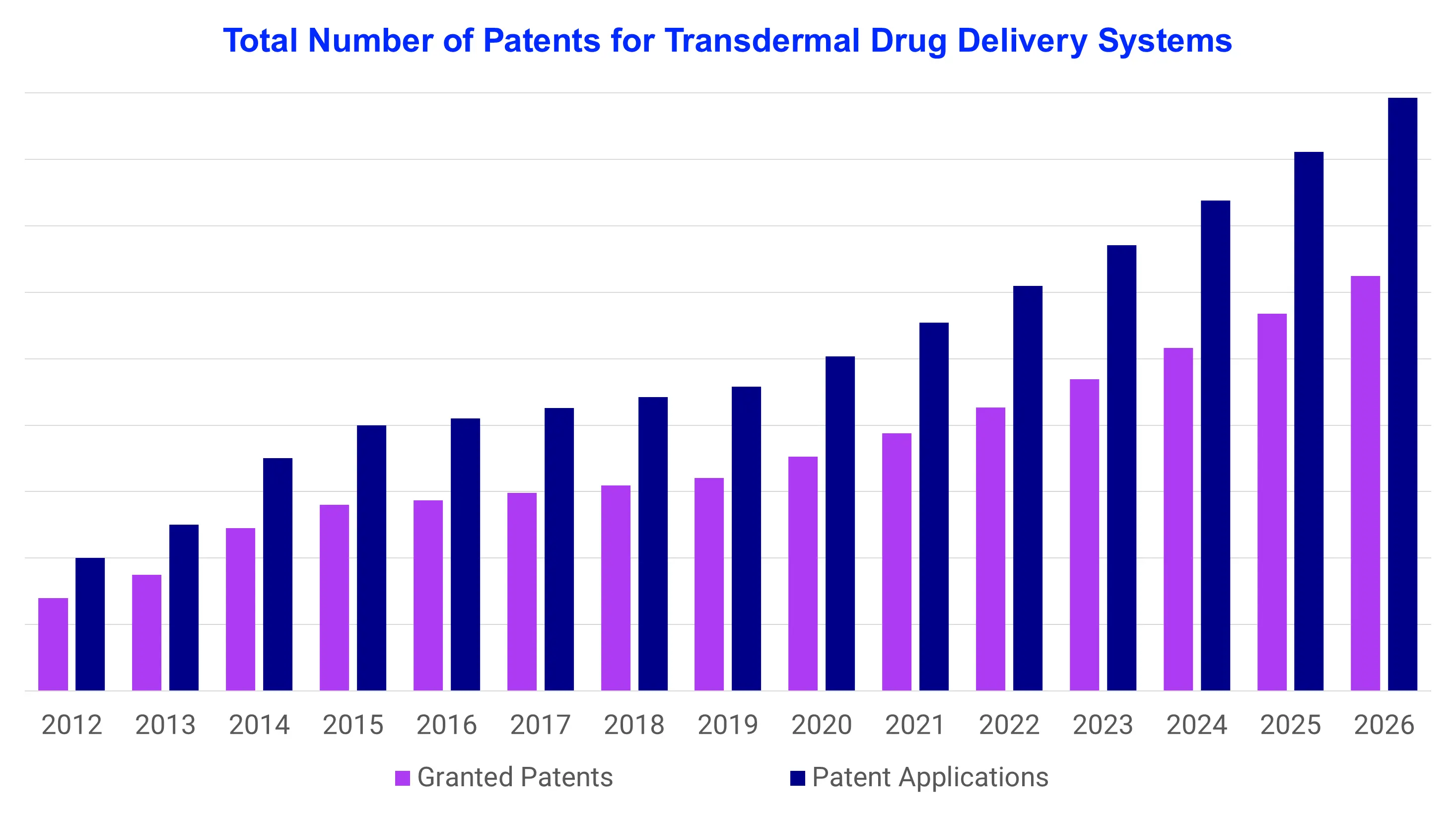
Patent activity is accelerating, with 285+ transdermal drug delivery systems patents granted in 2025, reflecting strong innovation momentum in drug-in-adhesive matrix designs, skin permeation enhancer formulations, abuse-deterrent patch constructions, and skin-friendly multi-day adhesives.
Top assignees in the transdermal drug delivery systems patent landscape include Hisamitsu, Nitto Denko, Johnson & Johnson, Lohmann Therapie-Systeme, and Corium, with the United States, China, and Japan as the dominant patent jurisdictions.
Transdermal drug delivery systems move a drug through intact skin into the bloodstream at a steady rate, which bypasses first-pass liver metabolism and holds plasma levels stable for one to seven days. Only about twenty active ingredients have reached the US market in patch form since scopolamine in 1979, because the molecule must be potent and lipophilic with a small mass. Demand therefore comes from a narrow set of chronic needs: pain, hormone therapy, neurological disease and smoking cessation. Innovation now centres on adhesives, permeation enhancers and new molecules that fit the skin barrier.
The market growth is driven by sustained prescribing of long-acting patches in chronic pain, menopause and neurological disease. About 51.6 million US adults live with chronic pain according to CDC survey data, which keeps lidocaine, fentanyl and buprenorphine patches in routine use. The Alzheimer's Association counts 7.2 million Americans aged 65 and over with Alzheimer's dementia, a population that favours a once-weekly patch over daily tablets when swallowing and adherence decline.
The FDA approved Adlarity (donepezil) and Xelstrym (dextroamphetamine) patches in 2022, which shows that reformulating established molecules into weekly or daily patches still earns approvals and extends product life. Generic competition in fentanyl, estradiol, lidocaine and nicotine patches compresses prices, so the growth rate stays moderate and sits below that of newer biologic delivery formats. North America holds the largest revenue share because of high chronic pain prescribing and an established generic patch industry, while Asia Pacific adds volume through domestic manufacturing and ageing populations.
Read more about this report - REQUEST FREE SAMPLE COPY IN PDF
Transdermal patent filing began with the first scopolamine and nitroglycerin systems in the late 1970s and early 1980s, many of them from Alza. Later waves added hormone patches, nicotine patches and drug-in-adhesive designs that replaced bulky reservoir pouches.
The dataset holds about 8,350+ patent families, with filing peaks around 2008 to 2012 and a second rise after 2019. The recent increase comes from Chinese universities and generic manufacturers filing on enhancer systems, adhesive blends and 505(b)(2)-type reformulations.
Rising demand for dementia, ADHD and pain patches has moved applicants toward adhesives and enhancers that allow longer wear and higher drug loading.
The report analyses patents on transdermal drug delivery systems, covering passive patches with matrix and reservoir designs, enhancer-assisted formulations and active assist methods such as iontophoresis and heat. It tracks drug-in-adhesive layers, rate-controlling membranes, backing and release liner materials, and abuse-deterrent constructions.
Granted patents and pending applications across the United States, China, Japan, Europe and other national offices are consolidated into patent families. The window runs from 2000 to 2025 and links claims to drug classes, therapeutic uses and assignee types.
Entities covered include patch specialists, large pharmaceutical groups, adhesive and materials suppliers, contract developers, generic manufacturers, universities and research institutes.
The report will cover the following sections in detail:
Analysis by Patch Technology
Analysis by Drug Class
Analysis by Therapeutic Application
Transdermal Drug Delivery Systems Patent Filing Trend Analysis
Filings grew at an estimated 5% per year between 2020 and 2024, after a plateau through the mid-2010s. Growth traces to Chinese applicants, new-use patents for established molecules and demand for abuse-deterrent opioid patches after the opioid safety actions of recent years.
Granted patents reached about 285+ in 2025, a share of roughly one in nine families, as many pending Chinese applications moved to grant. Claims have shifted from mechanical patch structure toward adhesive chemistry, solvent systems and wear-time performance, which reflects the maturity of the basic patch format.
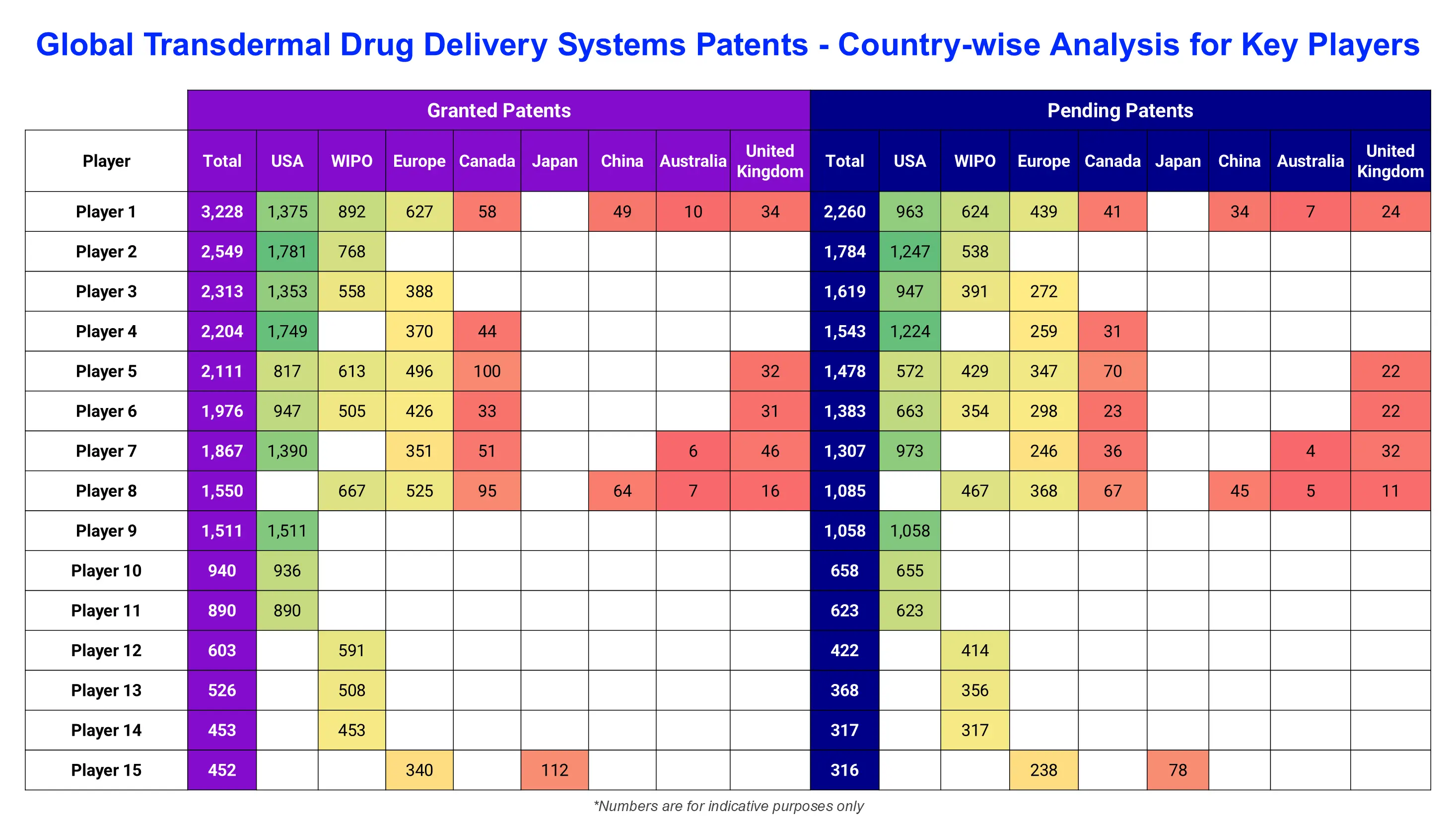
Among the players with transdermal drug delivery systems patent families, new entrants have been identified, which can be either established companies or startups developing novel technology in the field. Some of the major companies mentioned in this report (a non-exhaustive list) are as follows:
Hisamitsu is a Japanese patch specialist with one of the deepest transdermal portfolios, covering adhesive matrices, solubilised drug forms and backing laminates. Its Salonpas and Mohrus brands serve the topical pain market, and its US subsidiary Noven markets Daytrana, Secuado (asenapine) and Xelstrym (dextroamphetamine) after the 2009 acquisition. Recent filings cover patches that combine ropinirole salts with tuned adhesives for Parkinson's disease. The company files families around the drug form, the adhesive composition and the patch layer structure, so one product is protected from several angles. Hisamitsu positions itself as an in-house developer and manufacturer of its own branded products.
Nitto Denko brings industrial tape and polymer science into transdermal products, with filings on acrylic and silicone adhesives, backing films and release liners. Its life science unit develops patches for pharmaceutical partners and supplies medical tapes used in dermal products. The portfolio also reaches into dissolving microneedle arrays, which extends the company from conventional patches to minimally invasive formats. Nitto Denko tends to protect materials and manufacturing processes, so its claims are cited widely by drug owners that license the technology. Commercial positioning centres on partnered development, with the company supplying the patch platform and the partner holding the drug.
Other companies include Johnson & Johnson, Lohmann Therapie-Systeme, and Corium.
The five leading assignees hold roughly a fifth of all families, so the field remains fragmented, with a long tail of generic firms and universities. Hisamitsu leads through its volume of adhesive and formulation filings, followed by Nitto Denko, whose claims centre on materials.
*Please note that this is only a partial list; the complete list of key players is available in the full report. Additionally, the list of key players can be customized to better suit your needs.*
The report assesses patent activity across major jurisdictions, including:
The United States leads with about 3,260+ associated patents, reflecting its large prescription patch market and the filing habits of Alza-era and current developers. China ranks second on the growth of university and generic applications, and Japan ranks third on the strength of Hisamitsu and Nitto Denko.
Read more about this report - REQUEST FREE SAMPLE COPY IN PDF
The report segments patent activity by the following technology areas:
Among these, drug-in-adhesive matrix designs hold the largest share of filings because they give thin, flexible and low-cost patches that most newer products adopt.
Competition combines Japanese patch specialists, global pharmaceutical groups with legacy Alza assets and German or US contract developers. Hisamitsu and Nitto Denko hold the largest portfolios, while Lohmann Therapie-Systeme and Corium serve partners who own the drug. Generic makers file on reformulations and adhesive blends to build differentiated copies of expiring brands.
Companies are focusing on:
Emerging innovation themes include weekly donepezil and rotigotine-class patches for neurological disease, adhesive systems that reduce skin irritation over seven-day wear, abuse-deterrent opioid patches, and enhancer blends that open the field to larger or less lipophilic molecules. Hybrid patches that add short microneedle or heat-assist elements appear in a growing number of Chinese and Japanese applications.
The field is mature and fragmented, with a legacy base from the 1980s and a second filing wave led by Asia. Value sits in adhesive chemistry, enhancer systems and reformulation claims that extend exclusivity on established molecules.
Technology segments, assignee portfolios and jurisdictional patterns in transdermal drug delivery systems are analysed to help stakeholders plan R&D, licensing and market entry. The report provides actionable intelligence supporting:
Patent data is drawn from the USPTO, the European Patent Office, the China National Intellectual Property Administration, the Japan Patent Office and WIPO PATENTSCOPE. Search strings combine keywords such as transdermal, patch and drug-in-adhesive with CPC classes A61K 9/70 and A61K 47 and IPC class A61M 37.
Records are screened for relevance, de-duplicated and consolidated into simple families. Each family is coded for technology cluster, drug class, therapeutic application, assignee and priority jurisdiction.
The market side draws on FDA and EMA approval records, the Orange Book, company filings, clinical trial registries and peer-reviewed literature. Patent counts are rounded and refreshed against the latest database releases.


Upto 15% Off
USD
$2699 $2429
$4299 $3869
$5799 $4949
$6999 $5949


*While we strive to always give you current and accurate information, the numbers depicted on the website are indicative and may differ from the actual numbers in the main report. At Expert Market Research, we aim to bring you the latest insights and trends in the market. Using our analyses and forecasts, stakeholders can understand the market dynamics, navigate challenges, and capitalize on opportunities to make data-driven strategic decisions.*
EMR’s Transdermal Drug Delivery Systems Patent Landscape Analysis provides a comprehensive assessment of patent filings, innovation clusters, assignee portfolios, and geographic filing patterns across the transdermal drug delivery systems landscape. The report identifies 8,350+ patent families, evaluates leading jurisdictions including the United States, China, and Japan, and profiles the top assignees by portfolio size.
The global transdermal drug delivery systems market was valued at USD 7.45 Billion in 2025. The market is projected to reach USD 15.50 Billion by 2035, expanding at a CAGR of 7.60% during 2026 - 2035.
The report analyses approximately 8,350+ patent families related to transdermal drug delivery systems. These include filings from the United States, China, Japan, and international WIPO filings.
Key companies operating within the landscape include Hisamitsu, Nitto Denko, Johnson & Johnson, Lohmann Therapie-Systeme, and Corium, among others. These organisations collectively account for a significant portion of patent activity analysed in this report.
The report evaluates patent activity across the United States, Europe, China, Japan, South Korea, India, and international WIPO filings. The United States leads patent activity with about 3,260+ associated patents, followed by China and Japan.
Yes. The report scope can be customised based on geography, technology segment, assignee selection, time period, or specific innovation cluster focus. Please connect with the EMR team to define the customisation scope.
Patent landscape analysis helps organisations understand innovation trends, competitive activity, technology whitespace, and IP risk across a defined domain. For transdermal drug delivery systems, this report supports strategic decisions in R&D prioritisation, licensing evaluation, competitive benchmarking, and market entry planning.
Explore our key highlights of the report and gain a concise overview of key findings, trends, and actionable insights that will empower your strategic decisions.
|
Scope of the Report |
Details |
|
Analysis by Patch Technology |
|
|
Analysis by Drug Class |
|
|
Analysis by Therapeutic Application |
|
|
Analysis by End User |
|
|
Key Players Mentioned |
|
|
Geographies Covered |
|
Mini Report
One User
USD 2,699
USD 2,429
tax inclusive*
Single User License
One User
USD 4,299
USD 3,869
tax inclusive*
Five User License
Five User
USD 5,799
USD 4,949
tax inclusive*
Corporate License
Unlimited Users
USD 6,999
USD 5,949
tax inclusive*
*Please note that the prices mentioned below are starting prices for each bundle type. Kindly contact our team for further details.*
Flash Bundle
Small Business Bundle
Growth Bundle
Enterprise Bundle
*Please note that the prices mentioned below are starting prices for each bundle type. Kindly contact our team for further details.*
Flash Bundle
Number of Reports: 3
20%
tax inclusive*
Small Business Bundle
Number of Reports: 5
25%
tax inclusive*
Growth Bundle
Number of Reports: 8
30%
tax inclusive*
Enterprise Bundle
Number of Reports: 10
35%
tax inclusive*
How To Order

Select License Type
Choose the right license for your needs and access rights.

Click on ‘Buy Now’
Add the report to your cart with one click and proceed to register.

Select Mode of Payment
Choose a payment option for a secure checkout. You will be redirected accordingly.
Strategic Solutions for Informed Decision-Making
Gain insights to stay ahead and seize opportunities.

Get insights & trends for a competitive edge.

Track prices with detailed trend reports.

Analyse trade data for supply chain insights.

Leverage cost reports for smart savings

Enhance supply chain with partnerships.

Connect For More Information
Our expert team of analysts will offer full support and resolve any queries regarding the report, before and after the purchase.
Our expert team of analysts will offer full support and resolve any queries regarding the report, before and after the purchase.
We employ meticulous research methods, blending advanced analytics and expert insights to deliver accurate, actionable industry intelligence, staying ahead of competitors.
Our skilled analysts offer unparalleled competitive advantage with detailed insights on current and emerging markets, ensuring your strategic edge.
We offer an in-depth yet simplified presentation of industry insights and analysis to meet your specific requirements effectively.




