

Consumer Insights
Uncover trends and behaviors shaping consumer choices today
Procurement Insights
Optimize your sourcing strategy with key market data
Industry Stats
Stay ahead with the latest trends and market analysis.
The virtual nursing technologies market was valued at USD 2.40 Billion in 2025 and is projected to reach USD 14.25 Billion by 2035, growing at a CAGR of 19.50%. Growth rests on registered nurse vacancies, hospital efforts to return bedside time through remote admission and discharge support, wider use of ambient sensing for fall prevention, and electronic health record integrated virtual care workflows.
Patent activity has expanded since 2020, with filings concentrated in bedside video, ambient sensing and artificial intelligence documentation. Deployments such as CommonSpirit's 78 virtual care beds at Baylor St. Luke's in June 2026 and Stryker's September 2024 completion of the care.ai purchase show commercial validation.
This Virtual Nursing Technologies Patent Landscape Analysis Report maps assignees, technology clusters, jurisdictions and filing trends to support R&D, licensing and freedom-to-operate decisions.
The virtual nursing technologies market is experiencing strong growth, driven by registered nurse workforce shortages, remote offloading of admission and discharge tasks, and electronic health record integrated virtual care. Owensboro Health reported that its virtual nurses returned 337 hours to bedside teams in July 2026, equal to about 11 extra hours of direct patient care each day.
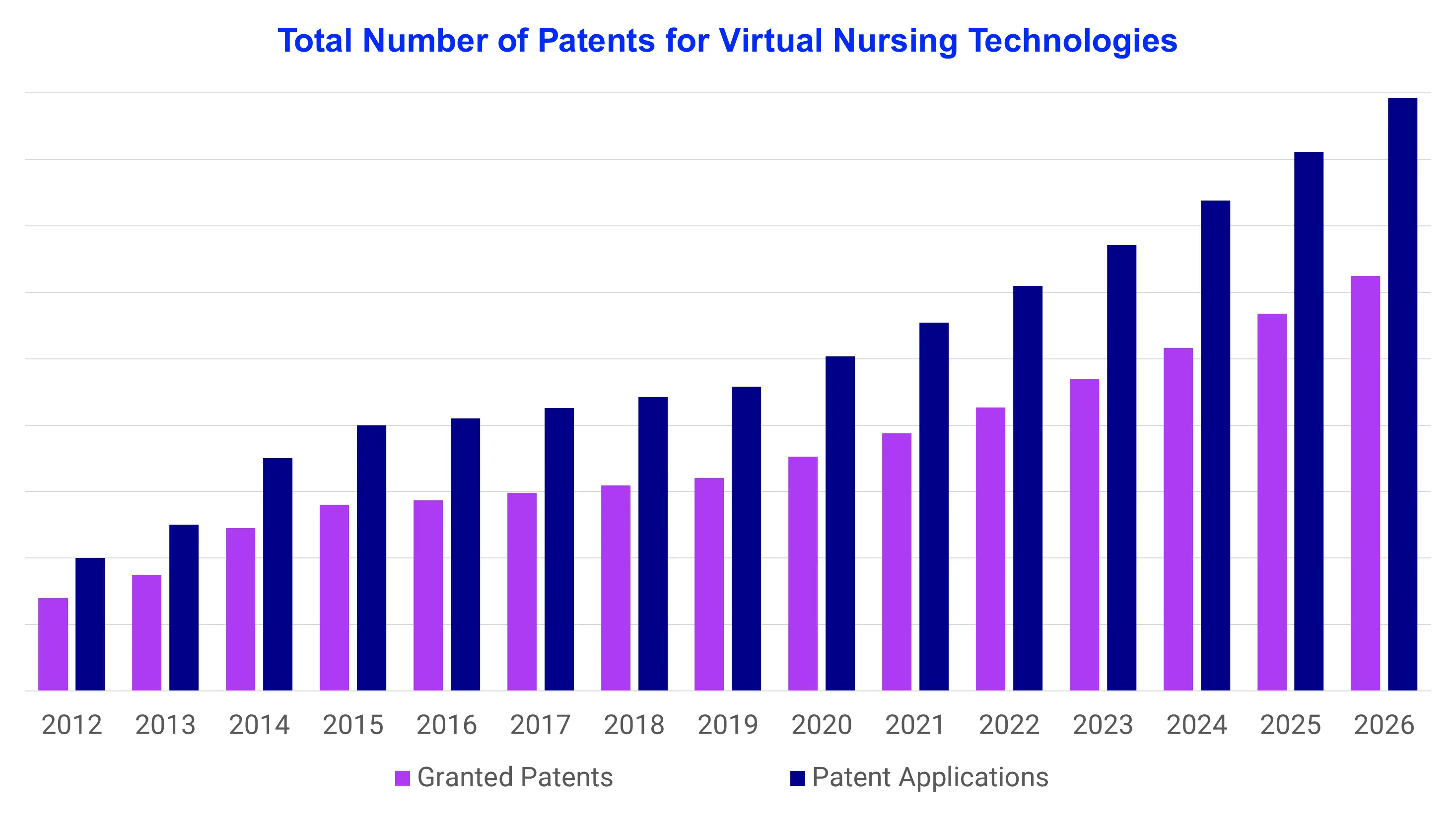
Patent activity is accelerating, with 32+ virtual nursing technologies patents granted in 2025, reflecting strong innovation momentum in bedside two-way video stations, ambient fall and elopement detection, virtual task routing and command centre dashboards, and artificial intelligence charting assistants.
Top assignees in the virtual nursing technologies patent landscape include Philips, Baxter, Oracle, Teladoc Health, and Stryker, with the United States, China, and Europe as the dominant patent jurisdictions.
Virtual nursing technologies connect bedside staff with remote registered nurses through in-room video, sensing and secure messaging. The remote nurse completes admission histories, discharge teaching, medication reconciliation and patient observation, which returns time to the bedside team. Demand is strongest in medical-surgical units and community hospitals, where vacancies and travel-nurse costs press hardest.
The market growth is driven by persistent registered nurse vacancies, which push hospitals to move documentation-heavy and observation tasks to remote staff. The Health Resources and Services Administration projects a national registered nurse shortfall of 10% in 2027, with 24% in non-metro areas against 7% in metro areas. That rural gap explains why critical access and community hospitals are adopting remote staffing models.
Owensboro Health reported that virtual nurses returned 337 hours to bedside teams in July 2026, about 11 hours a day, which shows how a small remote team can ease task load across several units. Henry Ford Jackson Hospital recorded nearly 25,000 completed tasks across more than 200 wired beds in August 2025 and scheduled three further hospitals for late 2025 and 2026, so each early deployment becomes a template for wider rollout. Larger rollouts raise hardware, software and workflow integration needs, which sustains demand for new patented methods.
Read more about this report - REQUEST FREE SAMPLE COPY IN PDF
Patent filings in virtual nursing technologies follow the shift from pilot units to enterprise deployments. Claims concentrate on two-way audio-video stations with privacy controls, ambient sensing that flags falls and elopement, and software that routes tasks between virtual and bedside nurses. Electronic health record integration claims have risen as vendors seek native workflows in major inpatient systems.
The report identifies more than 4,180 patent families, with filing peaks in 2021 and 2023 as hospitals added remote staffing under sustained labour strain. United States applicants lead the count, and Chinese hospital equipment and software firms add a growing set of ambient sensing and nurse call filings.
Hospital demand for remote nurse capacity shapes claim drafting, with new filings tied to specific tasks such as discharge teaching, medication reconciliation and fall prevention.
The analysis covers granted patents and published applications on systems, devices and software that let a remote registered nurse perform or support inpatient nursing tasks. Subject matter spans bedside video endpoints, camera and sensor arrays, virtual task orchestration, documentation assistants and nurse communication platforms.
Home-based physiological monitoring patents enter the dataset when the claims cover a nurse-facing workflow in a facility. Physician telehealth visit patents serve as adjacent reference material for classification.
Entities covered include medical technology manufacturers, electronic health record vendors, telehealth providers, communication hardware firms, hospital systems and universities.
The report will cover the following sections in detail:
Analysis by Technology
Analysis by Application
Analysis by Care Setting
Virtual Nursing Technologies Patent Filing Trend Analysis
Filings grew at an estimated annual rate of 14% between 2020 and 2024, led by ambient sensing and artificial intelligence documentation claims. Nurse staffing pressure and the spread of in-room televisions and cameras drove most of the increase.
Families on bedside video endpoints have matured, while filings on task orchestration and automated charting keep rising. Acquisition activity, including Stryker's completion of the care.ai purchase in September 2024, moved sensing and workflow portfolios into larger medical technology groups.
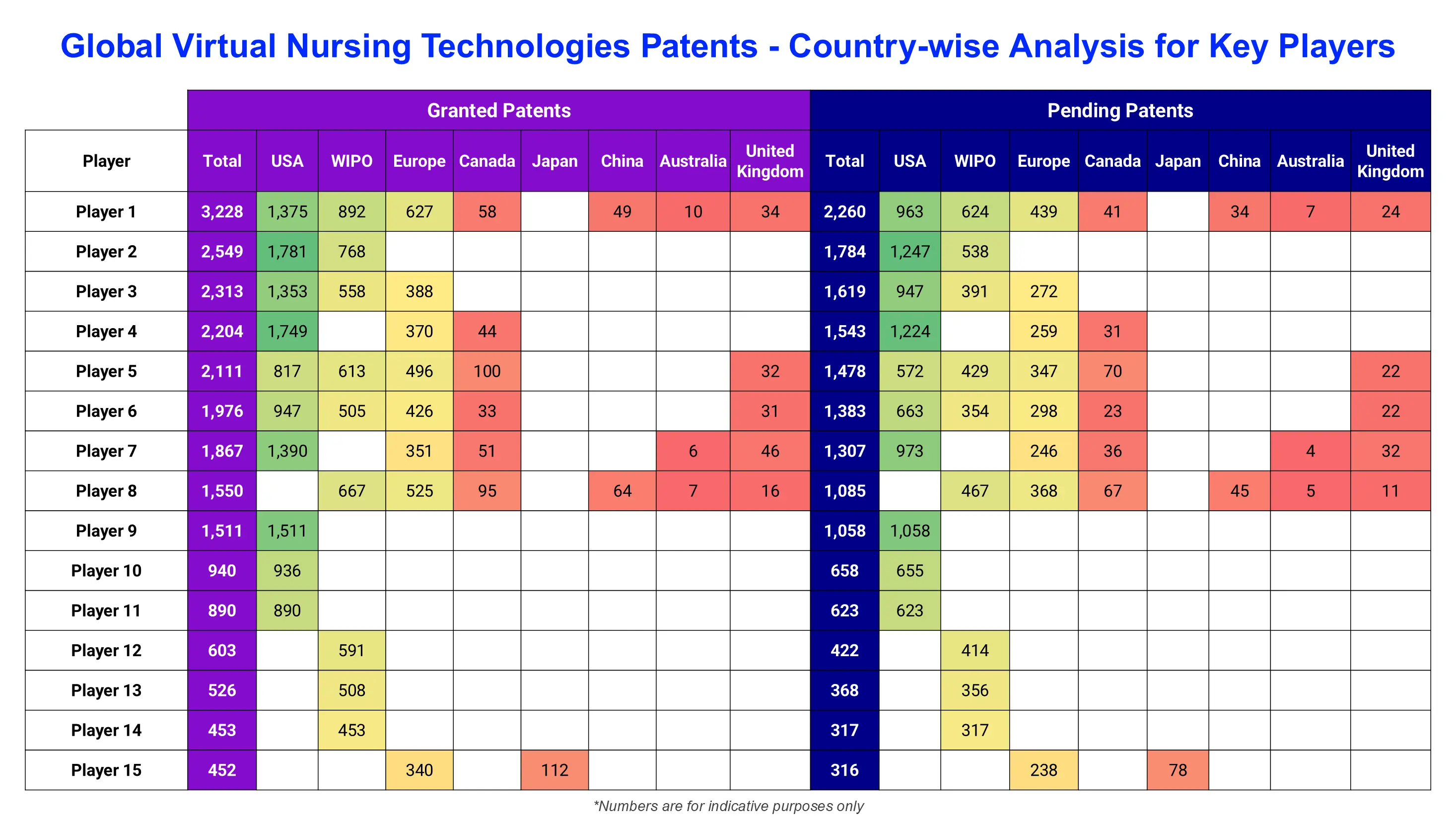
Among the players with virtual nursing technologies patent families, new entrants have been identified, which can be either established companies or startups developing novel technology in the field. Some of the major companies mentioned in this report (a non-exhaustive list) are as follows:
Philips holds one of the largest portfolios in hospital virtual care through the eICU programme, eCareManager software and Capsule Surveillance, which health systems now apply to general ward virtual nursing. Its patents cover remote patient surveillance, early warning scoring, device data aggregation and tele-ICU command centre workflows. CoxHealth in Missouri co-designed a staff-run virtual care programme with Philips for about 700 beds across four hospitals, built on eCareManager and Capsule Surveillance. Philips files continuation families around algorithm updates and integration layers, which extends coverage as products evolve. The company positions itself as an enterprise telehealth partner that combines bedside devices, software and clinical services for health systems.
Baxter built its virtual care portfolio through the 2021 acquisition of Hillrom, announced at USD 10.5 billion, which brought Welch Allyn vital signs devices, Voalte communication tools, smart beds and nurse call systems. Patent families cover nurse call and secure mobile messaging, monitoring connectivity, bed exit sensing and caregiver workflow routing. The large installed base of beds and monitors gives the company a ready path to add virtual nurse functions through its care communications portfolio. Baxter protects interface designs and data exchange methods that link devices to nurse stations and mobile handsets. It positions itself as a connected care supplier that extends existing bedside equipment into remote workflows.
Other companies include Oracle, Teladoc Health, and Stryker.
The five leading assignees hold an estimated 18% to 22% of families, which leaves a long tail of hospital systems, universities and start-ups. Philips and Baxter lead through multi-decade bedside monitoring, nurse call and critical care telehealth portfolios, while Stryker's share grew after its Vocera and care.ai purchases.
*Please note that this is only a partial list; the complete list of key players is available in the full report. Additionally, the list of key players can be customized to better suit your needs.*
The report assesses patent activity across major jurisdictions, including:
The United States holds the largest filing volume, supported by hospital staffing pressure, reimbursement for remote care and a deep base of electronic health record vendors. China ranks second with rising hospital digitalisation filings on sensing and nurse call, and Europe follows with critical care telehealth families led by Philips.
Read more about this report - REQUEST FREE SAMPLE COPY IN PDF
The report segments technology activity into the following clusters:
Among these, bedside audio-video telepresence accounts for the largest share of families, because every virtual nursing deployment starts with an in-room video endpoint.
Competition spans medical device makers, electronic health record vendors, telehealth specialists and communication hardware firms. Device makers hold broad bedside and monitoring claims, while record vendors and smaller specialists file on workflow software and artificial intelligence documentation. Hospital systems such as CommonSpirit have also begun to protect their own care models.
Companies are focusing on:
Emerging innovation themes include ambient charting that drafts nursing notes from room audio, computer vision that scores fall risk before an event, and generative assistants that summarise shift handoffs. Hospital-owned care models, such as CommonSpirit's patented Virtually Integrated Care model, add claims on staffing configurations. Virtual critical care beds, such as the 18 added at Baylor St. Luke's in June 2026, extend the technology into higher-acuity units.
Virtual nursing technologies are moving from stand-alone video carts to platforms that combine sensing, workflow software and electronic health record integration. Licensing and acquisition interest therefore centres on sensing, artificial intelligence documentation and orchestration assets. Listings of Nesa and Caregility in the Epic Toolbox for inpatient virtual care in 2026 show the weight placed on native integration.
Technology segments, jurisdictions and assignee portfolios are assessed so that the report provides actionable intelligence supporting:
Searches covered the United States Patent and Trademark Office, the European Patent Office, the China National Intellectual Property Administration, the Japan Patent Office and the World Intellectual Property Organization. Family data were consolidated from INPADOC records and publication dates were refreshed to the latest available release.
Queries combined CPC classes G16H 40/20 (management of healthcare resources), G16H 40/67 (remote operation of medical devices), G16H 80/00 (telemedicine), H04N 7/14 (two-way television systems) and G08B 21/04 (fall alarms) with keyword sets for virtual nurse, remote nurse, bedside video and command centre. Records were screened manually for relevance and merged by family.
Market-side context draws on federal workforce projections, hospital disclosures, company filings, peer-reviewed nursing and informatics journals, and clinical trial registries.


Upto 15% Off
USD
$2699 $2429
$4299 $3869
$5799 $4949
$6999 $5949


*While we strive to always give you current and accurate information, the numbers depicted on the website are indicative and may differ from the actual numbers in the main report. At Expert Market Research, we aim to bring you the latest insights and trends in the market. Using our analyses and forecasts, stakeholders can understand the market dynamics, navigate challenges, and capitalize on opportunities to make data-driven strategic decisions.*
EMR’s Virtual Nursing Technologies Patent Landscape Analysis provides a comprehensive assessment of patent filings, innovation clusters, assignee portfolios, and geographic filing patterns across the virtual nursing technologies landscape. The report identifies 4,180+ patent families, evaluates leading jurisdictions including the United States, China, and Europe, and profiles the top assignees by portfolio size.
The global virtual nursing technologies market was valued at USD 2.40 Billion in 2025. The market is projected to reach USD 14.25 Billion by 2035, expanding at a CAGR of 19.50% during 2026 - 2035.
The report analyses approximately 4,180+ patent families related to virtual nursing technologies. These include filings from the United States, China, Europe, and international WIPO filings.
Key companies operating within the landscape include Philips, Baxter, Oracle, Teladoc Health, and Stryker, among others. These organisations collectively account for a significant portion of patent activity analysed in this report.
The report evaluates patent activity across the United States, Europe, China, Japan, South Korea, India, and international WIPO filings. The United States leads with close to half of all families, supported by hospital staffing pressure and deep electronic health record adoption.
Yes. The report scope can be customised based on geography, technology segment, assignee selection, time period, or specific innovation cluster focus. Please connect with the EMR team to define the customisation scope.
Patent landscape analysis helps organisations understand innovation trends, competitive activity, technology whitespace, and IP risk across a defined domain. For virtual nursing technologies, this report supports strategic decisions in R&D prioritisation, licensing evaluation, competitive benchmarking, and market entry planning.
Explore our key highlights of the report and gain a concise overview of key findings, trends, and actionable insights that will empower your strategic decisions.
|
Scope of the Report |
Details |
|
Analysis by Technology |
|
|
Analysis by Application |
|
|
Analysis by Care Setting |
|
|
Analysis by End User |
|
|
Key Players Mentioned |
|
|
Geographies Covered |
|
Mini Report
One User
USD 2,699
USD 2,429
tax inclusive*
Single User License
One User
USD 4,299
USD 3,869
tax inclusive*
Five User License
Five User
USD 5,799
USD 4,949
tax inclusive*
Corporate License
Unlimited Users
USD 6,999
USD 5,949
tax inclusive*
*Please note that the prices mentioned below are starting prices for each bundle type. Kindly contact our team for further details.*
Flash Bundle
Small Business Bundle
Growth Bundle
Enterprise Bundle
*Please note that the prices mentioned below are starting prices for each bundle type. Kindly contact our team for further details.*
Flash Bundle
Number of Reports: 3
20%
tax inclusive*
Small Business Bundle
Number of Reports: 5
25%
tax inclusive*
Growth Bundle
Number of Reports: 8
30%
tax inclusive*
Enterprise Bundle
Number of Reports: 10
35%
tax inclusive*
How To Order

Select License Type
Choose the right license for your needs and access rights.

Click on ‘Buy Now’
Add the report to your cart with one click and proceed to register.

Select Mode of Payment
Choose a payment option for a secure checkout. You will be redirected accordingly.
Strategic Solutions for Informed Decision-Making
Gain insights to stay ahead and seize opportunities.

Get insights & trends for a competitive edge.

Track prices with detailed trend reports.

Analyse trade data for supply chain insights.

Leverage cost reports for smart savings

Enhance supply chain with partnerships.

Connect For More Information
Our expert team of analysts will offer full support and resolve any queries regarding the report, before and after the purchase.
Our expert team of analysts will offer full support and resolve any queries regarding the report, before and after the purchase.
We employ meticulous research methods, blending advanced analytics and expert insights to deliver accurate, actionable industry intelligence, staying ahead of competitors.
Our skilled analysts offer unparalleled competitive advantage with detailed insights on current and emerging markets, ensuring your strategic edge.
We offer an in-depth yet simplified presentation of industry insights and analysis to meet your specific requirements effectively.




