

Consumer Insights
Uncover trends and behaviors shaping consumer choices today
Procurement Insights
Optimize your sourcing strategy with key market data
Industry Stats
Stay ahead with the latest trends and market analysis.
The Europe manufactured housing market attained a value of USD 27.10 Billion in 2025 and is projected to expand at a CAGR of 6.30% through 2035. The market is further expected to achieve USD 49.92 Billion by 2035. Housing systems which are standardized and energy efficient are becoming increasingly popular among developers who want to achieve fast construction, decrease labor dependency and ensure high-quality construction in large-scale residential projects.
An aging construction workforce is leading to greater reliance on prefabrication to minimize labor dependency, boosting growth in the Europe manufactured housing market. Secondly, higher performance standards of buildings are motivating developers to purchase homes that were manufactured using the technology of insulation and ventilation and have low-energy systems installed.
There is currently an evolution in the Europe manufactured housing market, with new product platforms being created that provide long-term homes with better energy efficiency and shorter build times. One such example includes TopHat, that extended its offerings for factory-built housing through digitally engineered panels for mid-rise residences, in June 2023, ensuring that construction is easier, and the quality of the buildings is maintained. This is particularly applicable for Europe as there is a constant shortage of housing. European Commission estimates that the region needs more than two million additional homes every year to meet demand.
The Europe manufactured housing market is observing a shift away from one-time prefab construction towards repeated housing units. Manufacturers are creating housing that integrates heat pumps, insulation, airtight structures, and sustainable material solutions in the factory production line. Following this trend, manufacturers can keep up with increasing energy regulation laws and reduce onsite labor. The opportunity for B2B customers lies in purchasing housing packages that can be consistently deployed across social housing, rental properties, workforce housing, and residential developments. The EU housing plan, published in September 2026, targets Airbnb and other short-term rentals, aiming to improve housing affordability and increase long-term rental availability.
Compound Annual Growth Rate
6.3%
Value in USD Billion
2026-2035
Read more about this report - REQUEST FREE SAMPLE COPY IN PDF
Lida Group enhanced its modular construction services for large projects by incorporating all services including design, manufacture, logistics, assembly, and full turnkey delivery services. Manufacturers are able to provide end-to-end modular services, speeding up project completion while focusing on large-scale residential and infrastructure projects, boosting growth in the Europe manufactured housing market.
Victaulic acquired Spain-based Arumani, establishing a European modular construction center of excellence and expanding fully engineered off-site fabrication capabilities. European manufactured housing companies can adopt DfMA and off-site fabrication to reduce labor needs, accelerate delivery, and improve construction certainty.
SyncorAna and STECO commenced a prefabricated housing partnership using their expertise in modular construction to meet the increasing need for affordable residential developments. Companies in the Europe manufactured housing market can develop partnerships integrating manufacturing, engineering, and construction services for affordable prefabricated housing.
The Berlin housing project illustrated the use of industrial modular construction to facilitate a large-scale housing development. Manufacturers can develop standardized housing modules to speed up the process of housing construction and to meet the growing need for housing in Europe.
Demand is being fueled by investment into automated manufacturing facilities that can mass-produce standardized buildings, boosting growth in the Europe manufactured housing market. This is illustrated by industrialized timber apartment construction by Sweden-based Lindbäcks Bygg and the large modular housing manufacturing plant of TopHat in Derbyshire that produces digitally designed housing components. Similarly, in August 2025, Daiwa House Modular Europe offered scalable, sustainable modular solutions addressing housing shortages through faster, industrialized construction. Public policies are supporting these investments, as the United Kingdom government’s Construction Playbook emphasizes modern methods of construction and offsite approaches as measures to increase productivity and delivery certainty. Meanwhile, the European Commission regards the construction sector as an area for increasing resource efficiency in the EU.
Manufacturers are innovating energy performance and low carbon content of housing systems. German manufacturers Bien-Zenker and WeberHaus are introducing highly insulated prefab houses with integrated heat pumps, photovoltaic systems, and smart energy management solutions. Aligning with such trends in the Europe manufactured housing market, in June 2026, EcoFlow launched smart energy products across Europe, including AI energy management, plug-in solar, home storage, and commercial systems. Moreover, the revised EU Energy Performance of Buildings Directive mandates zero-emission buildings and requires that new public buildings achieve that level from 2028, and all buildings from 2030.
The rise of government-sponsored affordable housing programs is enabling manufacturing companies to develop opportunities in the Europe manufactured housing market. In Ireland, the Housing for All initiative by the Irish government plans to provide 300,000 units of housing by 2030, as per government reports published in November 2025. Modular specialist Cairn Homes is using the standardized process in constructing buildings efficiently through various housing projects. Public procurement and development partner collaborations might facilitate more visibility in the production process and factory utilization for manufacturers.
Manufacturers in Europe are increasingly incorporating BIM, digital twin, and design-for-manufacturing practices to facilitate the scalability of housing production. The TopHat platform highlights how manufacturers are intending to shift the design coordination from the construction sites to controlled factory settings to ensure that companies can use standardized components for various housing projects. The European Commission's policy called Digital Decade facilitates digital transformation in industries enhancing the technological environment of industrialized construction, boosting demand in the Europe manufactured housing market. In February 2025, Skanska sold its BoKlok modular housing factory in Sweden to Surewood Housing, supporting renewed production amid persistent housing shortages.
With Europe’s growing need for building renovation due to aging building infrastructure, there are increased prospects outside the manufacturing of new houses. Factory-made wall panels, roof extensions, and volumetric modules can facilitate the contractor to renovate energy buildings in a less disruptive manner. EU’s Renovation Wave strategy seeks to increase the rate of energy renovations by at least double per year by 2030. This trend in the Europe manufactured housing market is expected to open up a huge pipeline of retrofit solutions through industrialization of building renovations. Some companies like De Meeuw which specializes in modular construction in the Netherlands are adopting flexible building systems to meet the fast-growing demand for retrofit solutions. On the other hand, in July 2026, Implenia secured over CHF 180 million in modernization contracts, upgrading properties for energy efficiency, sustainability, and modern residential use across Europe.
The Expert Market Research's report titled “Europe Manufactured Housing Market Report and Forecast 2026-2035” offers a detailed analysis of the market based on the following segments
Market Breakup by Number of Section
Key Insight: Single-section house form responds to the demand for economical housing and where transport simplicity and efficient utilization of land is key, thereby accelerating the Europe manufactured housing market penetration. The double section house forms are gaining prominence as the result of offering space for the family and also maintaining simplicity in construction and installation. The multi section form is becoming increasingly popular in large-scale permanent housing developments that require flexibility and high-quality specifications.
Market Breakup by Location
Key Insight: Private properties are the most prevalent since individual landowners prefer designs that are flexible enough to suit their needs, thereby boosting demand in the Europe manufactured housing market. MH communities are becoming more popular due to the presence of centralized infrastructure and coordinated development efforts, allowing for the development of bigger communities through the use of standardized house models. Commercial strategy differs for each of the two segments, with private property being driven by the need for flexibility, dealership, and site-specific services, while community-based manufacturers need volume orders, standardization, and installations.
Market Breakup by Application
Key Insight: As per the Europe manufactured housing market report, the residential usage is the most prevalent since manufactured housing satisfies the need for energy-efficient, permanent homes that can be built within planned time frames with varied design capabilities. Non-residential uses are increasing in popularity since institutional customers require solutions to be easily replicated and deployed for accommodation, hospitality, health care, and working space needs. Residential manufacturers depend on planning considerations, and overall building efficiency, whereas non-residential manufacturers look at standard room sizes and overall building services.
Market Breakup by Region
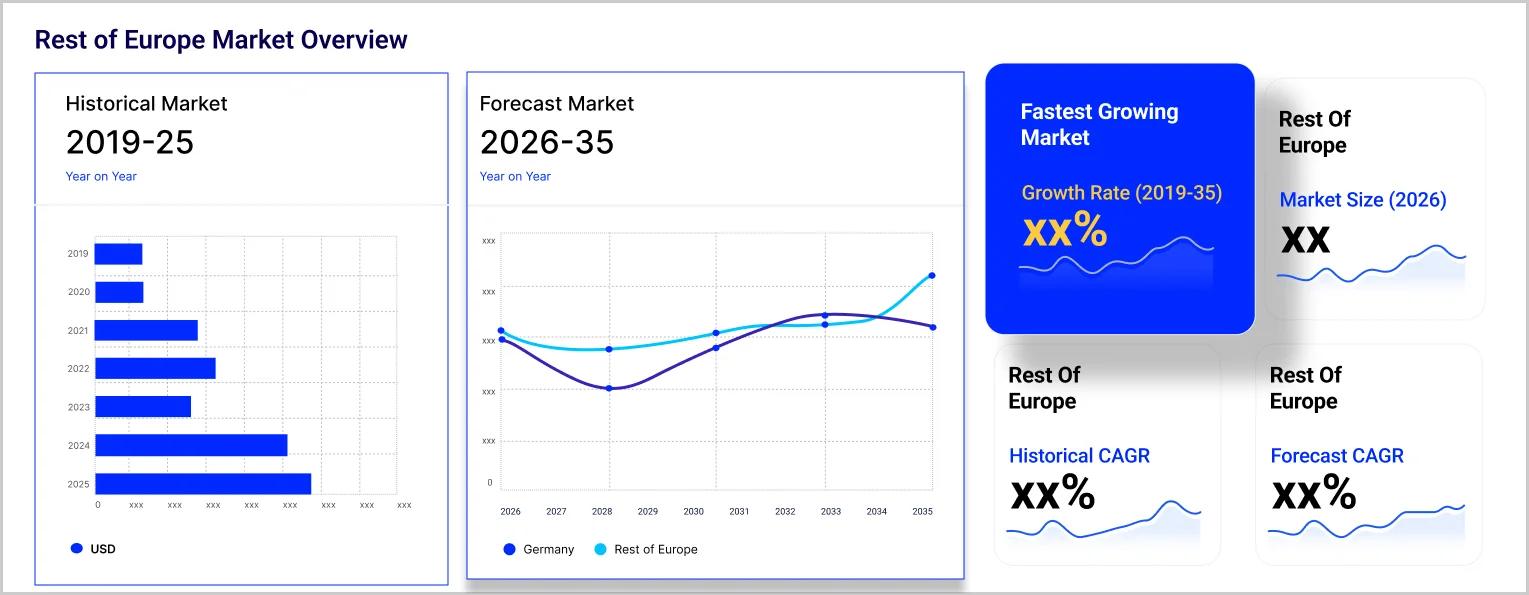
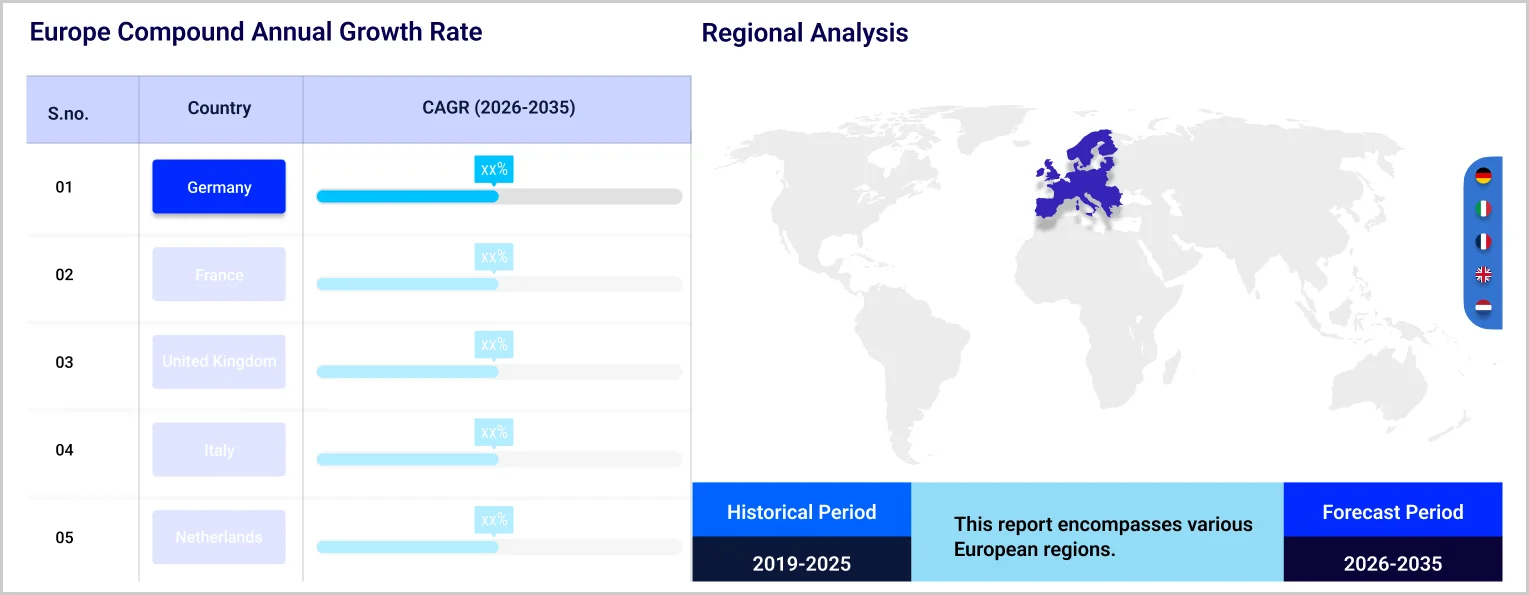
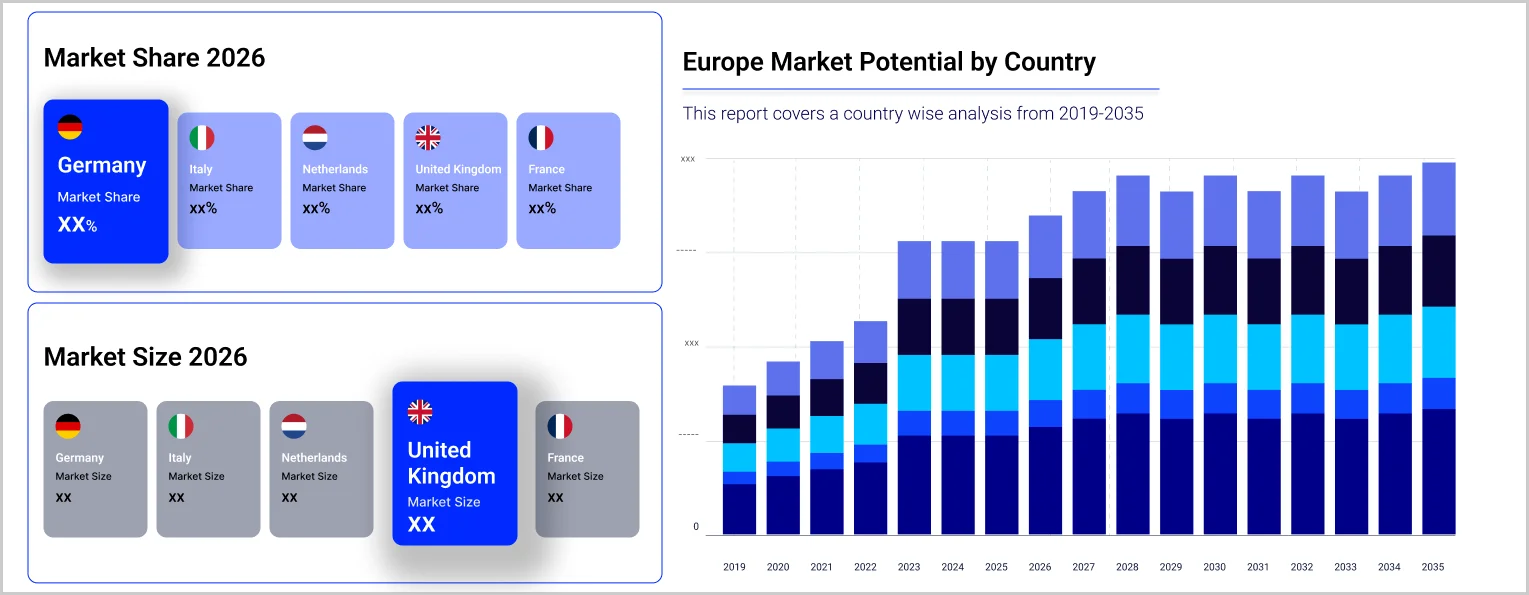
Key Insight: As per the current Europe manufactured housing market dynamics, Germany ranks first due to its experience in prefabrication, engineering, and high demand for energy efficient building systems. In the United Kingdom, rapid growth is seen with developers opting for offsite techniques to make housing production more efficient and cut down labor onsite. France stimulates demand through industrialized construction and affordable housing legislation, and Italy provides scope in energy efficient prefabricated systems as well as building renovations. All other European markets are dictated by local housing shortages, availability of wood, zoning laws, and public procurement.
The multi-section manufactured homes register the largest share of the market due to spacious layouts and developer demand
Multi-section manufactured homes represent the leading segments in the Europe manufactured housing market as they are larger in size, yet retain all the benefits of factory production. The structure is well-suited for permanent housing for families, rental property projects, and structures that have several bedrooms and flexible interior layouts. The European producers are aiming at producing buildings with better architecture, energy systems, and customizing modules in order to bring multi-sections closer to traditional houses. In August 2025, Germany started reviving prefabricated mass housing to address shortages, using standardized factory-built components to reduce construction costs and timelines.
The double-section categories observe notable growth in the Europe manufactured housing market due to the optimal balance between transportation and a reasonable level of living space that allows accommodating a whole family. It is possible to construct wide floor plans using two factory-produced sections and thus avoid complicated construction of multi-section buildings. The producers of double-section buildings are improving customization, insulation, and installing kitchen and bathrooms in order to satisfy higher expectations of buyers while maintaining standardized construction and installation process. In January 2026, Karmod launched its fourth steel-frame housing project in Bulgaria, starting construction in the city of Burgas.
Private property accounts for the largest share of the market due to customization demand and homeowner control
The private property segment is the most prominent in terms of location since manufactured homes can be made to suit individual lots, architecture standards, and preferences of the owner. Demand in the Europe manufactured housing market is driven by buyers looking to get their houses delivered quickly but at the same time preserving the characteristics typical for permanent living, including bigger kitchens, energy-saving systems, customized fronts, and so on. Manufacturers have designs that combine standard construction elements with location-specific exterior finishes.
The MH communities' segment is the fastest growing one since it allows both manufacturers and developers to use repeatable house designs on developed lots featuring shared utilities, boosting growth in the Europe manufactured housing market. These kinds of projects are easier to manage than scattered individual lots with utilities being put in place and individual lots prepared. Developers are actively trying out community-oriented projects for rented houses and workforce housing facilities. In April 2023, Invesco Real Estate launched Homestead Communities, a national manufactured housing platform providing affordable, high-quality homes while improving operational scale and efficiency.
Residential applications secure the largest share of the market due to Europe’s need for faster permanent housing delivery
Residential is the key application area since factory houses are being promoted as permanent structures and not temporary housing by the manufacturing firms. The main types of buildings in demand are detached homes, affordable housing, rental projects, and workforce housing where the time taken for construction is less. Manufacturers are improving their residential products through better thermal characteristics, durability of building materials, current interior designs, and flexible layouts, widening the Europe manufactured housing market scope.
Non-residential use is the fastest growing segment owing to the use of modular construction in sectors such as hotels, student accommodations, health care facilities, office spaces, and temporary operations space. The non-residential projects tend to benefit from factory construction due to the ability to manufacture the repetitive rooms and service modules along with preparing the site for installation. In December 2025, PreFabricated Homes UK, a new prefabricated housing venture, launched modular homes, highlighting scalable construction, faster delivery, and efficient solutions for growing housing demand.
Read more about this report - REQUEST FREE SAMPLE COPY IN PDF
Germany clocks in the leading position in the market due to advanced prefabrication capabilities and energy-efficient construction demand
Germany is the leading the overall Europe manufactured housing market growth owing to the established industry for prefabricated construction, advanced manufacturing capabilities, and focus on energy-efficient housing structures. To compete, manufacturers have to use engineering timber systems, precision manufacturing and energy and heating technologies. Manufacturers can create their product lines by using high-performing building envelopes and modular housing solutions. The maturity of the market is facilitated by the development of the supply chain that allows the automation of production and use of standardized components. In July 2024, Continental launched ContiHome, a modular tiny house offering sustainable materials, flexible design, and enhanced comfort for European vacation parks.
United Kingdom is considered as the most promising Europe manufactured housing market due to the constant demand for housing delivery that compels developers and suppliers to consider the off-site construction solutions that minimize onsite activities. Manufacturers focus on digital design, panelized construction, and volumetric production solutions in order to ensure consistency in delivery. Factory-led housing solutions are becoming popular in larger residential projects that allow repeatable design solutions and production efficiency. In July 2026, Procurement for Housing launched a EUR 943 million modular buildings framework covering permanent, temporary, secure, and consultancy services across Britain.
The industry is experiencing heightened competition as manufacturers shift from merely using prefabrication techniques towards adopting digital designs, sustainable and rapidly deployed housing systems. Europe manufactured housing companies are increasingly concentrating on developing standardized manufacturing platforms while maintaining customizability of designs, aiding developers to balance between designing flexibility and efficient manufacturing processes.
Major areas of opportunity lie in energy-efficient homes, social housing, rental housing, and site-constrained urban developments. Other focus areas for Europe manufactured housing companies include developing integrated products with pre-finished interiors, building utilities, energy technologies, and transportable modules. Koto Design is innovating in architect-designed modular homes, while nHouse is innovating in volumetric homes that can be used in repeat developments. Major construction firms are incorporating off-site construction techniques to enhance delivery coordination and productivity.
Bouygues Construction S.A., founded in 1952 with its headquarters located in France, is offering its services in the form of industrialized and offsite construction for residential projects. The firm is concentrating on innovative construction practices, low-carbon construction material, and project management in digital format. Its engineering capacity is assisting developers in incorporating prefabricated elements in complicated housing project developments, improving delivery coordination, and onsite construction activities.
Koto Design Limited, founded in 2017 with its headquarters in United Kingdom, is offering its services in the form of architect-designed modular homes having distinct Scandinavian and Japanese-influenced architecture. The firm targets consumers who want design-driven houses and not conventional prefab houses. Its factory construction process concentrates on precision engineering and timber-based construction with customized configurations.
nHouse Commercial Ltd., founded in 2016 and based in United Kingdom, is manufacturing housing solutions that facilitate the process of building with repetitive precision. This business is targeting developers and housing solution providers with prefabricated modules with extensive interior finishes carried out before shipment to the site.
Karmod International, founded in 1986 and based in the United Kingdom, is manufacturing prefabricated and modular construction systems for residential, commercial, and institutional buildings. This business is catering to its customers with portable steel-based and containerized constructions facilitating fast assembly on-site. The international experience of this company is facilitating projects needing standardization of construction and coordinated deliveries of building elements.
Other key players in the market include Prefab Homes Ltd., Omar Group Limited, Boutique Modern Limited, Premier Modular Limited, hatch. Homes Accelerator Ltd., and ilke Homes, among others.
*Please note that this is only a partial list; the complete list of key players is available in the full report. Additionally, the list of key players can be customized to better suit your needs.*
Unlock the latest insights with our Europe manufactured housing market trends 2026 report. Discover regional growth patterns, consumer preferences, and key industry players. Stay ahead of competition with trusted data and expert analysis. Download your free sample report today and drive informed decisions in the market.


Upto 15% Off
USD
$2499 $2249
$3999 $3599
$4999 $4249
$5999 $5099


*While we strive to always give you current and accurate information, the numbers depicted on the website are indicative and may differ from the actual numbers in the main report. At Expert Market Research, we aim to bring you the latest insights and trends in the market. Using our analyses and forecasts, stakeholders can understand the market dynamics, navigate challenges, and capitalize on opportunities to make data-driven strategic decisions.*
The market is projected to grow at a CAGR of 6.30% between 2026 and 2035.
The manufactured housing market is categorised according to the section, which includes single section, double section, and multi-section.
The key players are Bouygues Construction S.A., Koto Design Limited, nHouse Commercial Ltd., Karmod International, Prefab Homes Ltd., Omar Group Limited, Boutique Modern Limited, Premier Modular Limited, hatch. Homes Accelerator Ltd., and ilke Homes among others.
Based on the location, the market is divided into private property and MH communities.
The market is broken down into Germany, the United Kingdom, France, Italy, and others.
In 2025, the market reached an approximate value of USD 27.10 Billion.
Companies are facing fragmented regulations, lengthy planning approvals, transport restrictions, high factory investment requirements, uneven order pipelines, and customer concerns surrounding financing, customization, resale values, and manufactured-home quality.
Stakeholders are building developer partnerships, standardizing adaptable designs, investing in digital manufacturing, integrating energy systems, securing long-term order pipelines, and developing localized products that are meeting national planning and certification requirements.
Explore our key highlights of the report and gain a concise overview of key findings, trends, and actionable insights that will empower your strategic decisions.
| REPORT FEATURES | DETAILS |
| Base Year | 2025 |
| Historical Period | 2019-2025 |
| Forecast Period | 2026-2035 |
| Scope of the Report |
Historical and Forecast Trends, Industry Drivers and Constraints, Historical and Forecast Market Analysis by Segment:
|
| Breakup by Number of Section |
|
| Breakup by Location |
|
| Breakup by Application |
|
| Breakup by Region |
|
| Market Dynamics |
|
| Competitive Landscape |
|
| Companies Covered |
|
Datasheet
One User
USD 2,499
USD 2,249
tax inclusive*
Single User License
One User
USD 3,999
USD 3,599
tax inclusive*
Five User License
Five User
USD 4,999
USD 4,249
tax inclusive*
Corporate License
Unlimited Users
USD 5,999
USD 5,099
tax inclusive*
*Please note that the prices mentioned below are starting prices for each bundle type. Kindly contact our team for further details.*
Flash Bundle
Small Business Bundle
Growth Bundle
Enterprise Bundle
*Please note that the prices mentioned below are starting prices for each bundle type. Kindly contact our team for further details.*
Flash Bundle
Number of Reports: 3
20%
tax inclusive*
Small Business Bundle
Number of Reports: 5
25%
tax inclusive*
Growth Bundle
Number of Reports: 8
30%
tax inclusive*
Enterprise Bundle
Number of Reports: 10
35%
tax inclusive*
How To Order

Select License Type
Choose the right license for your needs and access rights.

Click on ‘Buy Now’
Add the report to your cart with one click and proceed to register.

Select Mode of Payment
Choose a payment option for a secure checkout. You will be redirected accordingly.
Strategic Solutions for Informed Decision-Making
Gain insights to stay ahead and seize opportunities.

Get insights & trends for a competitive edge.

Track prices with detailed trend reports.

Analyse trade data for supply chain insights.

Leverage cost reports for smart savings

Enhance supply chain with partnerships.

Connect For More Information
Our expert team of analysts will offer full support and resolve any queries regarding the report, before and after the purchase.
Our expert team of analysts will offer full support and resolve any queries regarding the report, before and after the purchase.
We employ meticulous research methods, blending advanced analytics and expert insights to deliver accurate, actionable industry intelligence, staying ahead of competitors.
Our skilled analysts offer unparalleled competitive advantage with detailed insights on current and emerging markets, ensuring your strategic edge.
We offer an in-depth yet simplified presentation of industry insights and analysis to meet your specific requirements effectively.




