

Consumer Insights
Uncover trends and behaviors shaping consumer choices today
Procurement Insights
Optimize your sourcing strategy with key market data
Industry Stats
Stay ahead with the latest trends and market analysis.
The global high oleic oil market size reached around USD 6388.51 Million in 2025. The market is projected to grow at a CAGR of 6.50% between 2026 and 2035 to reach nearly USD 11992.11 Million by 2035.
Compound Annual Growth Rate
6.5%
Value in USD Million
2026-2035
Read more about this report - REQUEST FREE SAMPLE COPY IN PDF
High-oleic oil is characterised by exceptional oxidative stability, longer shelf life, and the ability to withstand higher temperatures ideal for frying applications.
High oleic vegetable oils have a high percentage of monounsaturated fats and add no trans fats to products. The high quality of monosaturated fats lowers LDL cholesterol reducing the risk of heart disease, attacks, and strokes, proving to be an ideal replacement for trans fatty acids. The high oleic oil market growth is supported by diverse applications of the product in various end use sectors.
Researchers published a study in Scientific Reports in February 2026 examining the physicochemical behaviour of ozonated high-oleic sunflower oil. The research evaluated cold-pressed high-oleic sunflower oil subjected to ozonation and assessed its stability, rheological properties and antioxidant characteristics. The study reported that the ozonated oil maintained stability during six months of storage and demonstrated antioxidant and free-radical-neutralising properties. The researchers identified potential applications in areas such as therapeutic and dermatological products, while noting that further in-vivo research is required. The development expands research interest in high-oleic sunflower oil beyond conventional food applications.
Louis Dreyfus Company announced in January 2026 that it had added a high-oil seed processing line at its Timbúes complex in Santa Fe, Argentina. The line allows the facility to process a wider range of oilseeds including sunflower, canola, camelina and carinata alongside its existing soybean operations. The investment supports greater flexibility in oilseed processing and allows the facility to adapt its raw-material mix according to seasonal availability. The development is relevant to the high-oleic oil supply chain because sunflower and other high-oilseed crops provide important feedstocks for specialty vegetable oil production.
SOYLEIC announced a partnership with Byron Seeds in March 2025 to expand access to its non-GMO high-oleic soybean genetics. The collaboration gives farmers access to soybean varieties incorporating SOYLEIC high-oleic technology while supporting wider cultivation of soybeans producing high-oleic oil and meal. High-oleic soybean oil provides a zero-trans-fat option with lower saturated fat and approximately 75% oleic acid. The partnership also reflects increasing efforts to expand the agricultural supply base supporting high-oleic soybean oil production through collaborations between specialty-trait technology providers and regional seed companies.
Pioneer announced the availability of three new Plenish high-oleic Enlist E3 soybean varieties for the 2025 growing season. The varieties were introduced within Pioneer’s Z-Series genetics and were designed to combine high-oleic oil characteristics with Enlist weed-control technology and improved yield potential. Pioneer also announced plans to advance additional varieties for Michigan, New York and Wisconsin in 2026. The company highlighted growing farmer interest supported by processor-paid premiums for identity-preserved high-oleic soybeans. The varieties are intended for both food applications and emerging uses such as dairy feed, where the high-oleic fatty-acid profile can provide nutritional and production benefits.
Seed developers are expanding access to high oleic soybean genetics as processors and food manufacturers seek oils with greater oxidative stability. Corteva continues to commercialise Plenish high oleic soybeans, which provide high monounsaturated fat content and lower polyunsaturated fat levels. The company also links the crop with processor-paid premiums, creating an economic incentive for growers to participate in identity-preserved programmes. SOYLEIC has similarly expanded its non-GMO high oleic soybean platform through partnerships with seed companies. In March 2025, SOYLEIC partnered with Byron Seeds to increase access to high oleic genetics across the US Midwest.
Foodservice and food manufacturing applications are increasingly focused on oils that maintain performance during repeated heating and extended storage. High oleic soybean oil is suited to these applications because its fatty acid profile provides greater oxidative stability than conventional soybean oil. Corteva states that Plenish oil can support foodservice applications without hydrogenation and can provide longer shelf life in packaged products. Its 2025 sustainability report also notes that the increased stability and oil life demonstrated in restaurant applications can reduce certain environmental impacts compared with conventional oils. This combination of functional performance and formulation requirements is supporting demand for high oleic oils in commercial frying and processed foods.
Non-GMO high oleic oil is becoming a more defined product category as seed developers build dedicated varieties and contracting networks. SOYLEIC promotes a non-GMO high oleic trait that can be incorporated into soybean varieties and supports applications spanning food and livestock feed. Its 2025 partnership with Byron Seeds was intended to broaden farmer access to these genetics. SOYLEIC also introduced a Dairy Air soybean series with Martin Seed in January 2025, demonstrating expansion beyond conventional food oil applications. These developments indicate greater segmentation within the high oleic market, with differentiated genetics, identity preservation and end-use specifications becoming increasingly important.
High oleic soybeans are gaining attention beyond edible oil production because their fatty acid characteristics can support specialised animal nutrition applications. Corteva identifies Plenish soybeans as an option for dairies seeking to maximise milk fat production while reducing some off-farm feed costs. SOYLEIC likewise promotes high oleic soybeans as a whole-fat feed option for dairy producers, combining protein with additional dietary energy. The development of dedicated high oleic soybean lines for dairy markets broadens demand for the crop and creates additional value streams for growers. This diversification can strengthen the commercial case for identity-preserved high oleic soybean production.
High oleic oil production requires greater control over the soybean supply chain because the desired fatty acid profile must be maintained from seed production through harvesting, storage and processing. Corteva’s 2026 product-use guidance specifies identity-preserved contracting for Plenish soybeans and processor-paid incentives for growers. The guidance also describes grain testing through near-infrared technology to verify oil composition at delivery. Such systems are becoming increasingly relevant as high oleic oil moves into specialised food, foodservice and feed applications. Greater segregation, testing and traceability allow processors to maintain consistent specifications while providing growers with differentiated market opportunities.
Around 44% of the US population consider high oleic acid as a healthy way to reduce heart diseases. As per the FDA, daily consumption of around 1 and a half tablespoons of high oleic acid oils, when substituted for fats and oils higher in saturated fat, may minimise the risk of heart diseases. The growing risk of heart disease is likely to propel consumers to shift to healthier food options.
The use of high oleic soybean oil is witnessing a surge in the industrial sector. The market is witnessing a growing trend of high oleic soybean oil being used as an alternative to petroleum in motor oil, tires, asphalt and other products.
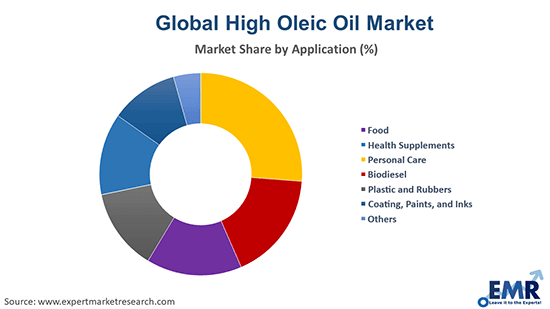
Read more about this report - REQUEST FREE SAMPLE COPY IN PDF
“Global High Oleic Oil Market Report and Forecast 2026-2035” offers a detailed analysis of the market based on the following segments:
Market Breakup by Oil Type
Market Breakup by Source
Market Breakup by Application
Market Breakup by Region
Based on oil type, sunflower oil dominates the high oleic oil market share
High oleic sunflower oil has at least 80% oleic acid against the 20% present in traditional sunflower oil. It has a neutral taste and good stability, meaning it has a lower rate of oxidation, making a great alternative for frying or for application in packaged products.
The growing demand for omega-3 fatty acids is prompting breeders to produce a new omega-3-rich high oleic canola oil that comprises docosahexaenoic acid (DHA). DHA is shown to be important for brain development and function.
There are super high oleic safflower oils produced which are a renewable and biodegradable substitute to petroleum-based raw materials and find application in bio-lubricants, biochemical, and bioplastics sectors.
The food processing sector is a significant contributor to the global high oleic oil market revenue
The consumption of high oleic oil lowers LDL cholesterol without reducing HDL cholesterol levels, thereby resulting in reduced risks of cardiovascular diseases and strokes. Thus, the heightened health consciousness among the global population is catering to a growing demand for food that includes high oleic oil in the ingredients.
The increasing production of biodiesel using high oleic oil, such as soy and canola, is due to the escalating eco-consciousness and the growing use of biodiesel as an alternative, non-toxic and biodegradable fuel that can also be blended with petroleum. Government policies, rising transport fuel demand, and spiking crude oil costs are factors influencing the demand for biodiesel.
Countries such as Germany and France are amongst the key producers of sunflower seeds and the demand for high oleic sunflower oil from hybrid sunflower seeds is rising in the European market.
Rapeseed oil is commonly used as a feedstock for biodiesel production in EU as it mixes well even at a lower temperature when compared to other feedstocks and is a more suitable fuel for colder regions.
To meet the demand for high oleic oils, Asia Pacific highly depends on oil imported from Argentina, North America, and regions in the European Union, among others. High oleic soy oil is preferred for industrial use, to substitute partially hydrogenated vegetable oils and to produce processed foods such as snacks. Moreover, manufacturers in the region have developed organic high-quality sunflower oleic oil that lowers bad cholesterol level.
In North America, the demand for high oleic variety of canola has seen a robust demand in Canada. With the rising mandate for biodiesel, the demand for palm oil has been diverted in its application from leading oil producers such as Malaysia and Indonesia.
The companies in the high oleic oil market are focusing on offering high-quality products that offer superior performance in food applications.
Headquartered in the US, it is one of the largest nutrition companies offering both human and animal nutrition products. It offers a wide range of solutions and services for livestock, aquaculture, and pets.
Cargill, Incorporated is a global food company based in the United States. It is engaged in agriculture, finance, and industrial products business globally.
Established in 1899, Marbacher Ölmühle GmbH is primarily engaged in manufacturing and refining of high-quality vegetable oils.
Headquartered in the US, Adams Group conducts its business through companies such as Adams Grain, Adams Vegetable Oils Inc, Adams Trucking and Adams Seed.
Colorado Mills, based in the US, offers sunflower products such as heart-healthy oil and use the byproducts in its feed and grain.
*Please note that this is only a partial list; the complete list of key players is available in the full report. Additionally, the list of key players can be customized to better suit your needs.*
Manufacturers are upgrading their product portfolios and incorporating the latest capabilities to innovate their offerings and meet the evolving demands of consumers.
Regulations Driving Specialty Oil Adoption
Bio-Lubricants From Specialty Oils
Specialty Oils Market Opportunities


Upto 15% Off
USD
$2499 $2249
$3999 $3599
$4999 $4249
$5999 $5099


*While we strive to always give you current and accurate information, the numbers depicted on the website are indicative and may differ from the actual numbers in the main report. At Expert Market Research, we aim to bring you the latest insights and trends in the market. Using our analyses and forecasts, stakeholders can understand the market dynamics, navigate challenges, and capitalize on opportunities to make data-driven strategic decisions.*
In 2025, the market attained a value of nearly USD 6388.51 Million.
The market is assessed to grow at a CAGR of 6.50% between 2026 and 2035.
The market is estimated to witness a healthy growth in the forecast period of 2026-2035 to reach about USD 11992.11 Million by 2035.
The different types of oil include sunflower oil, canola/rapeseed oil, soybean oil, safflower oil, and others.
The key regional markets are North America, Europe, the Asia Pacific, Latin America, and the Middle East and Africa.
The sources include non-gm/conventional, GM, and organic certified.
The applications include food processing and biofuel, among others.
The key players in the market include Archer Daniels Midland Company, Cargill, Incorporated, Marbacher Ölmühle GmbH, Adams Group, and Colorado Mills LLC, among others.
Explore our key highlights of the report and gain a concise overview of key findings, trends, and actionable insights that will empower your strategic decisions.
| REPORT FEATURES | DETAILS |
| Base Year | 2025 |
| Historical Period | 2019-2025 |
| Forecast Period | 2026-2035 |
| Scope of the Report |
Historical and Forecast Trends, Industry Drivers and Constraints, Historical and Forecast Market Analysis by Segment:
|
| Breakup by Oil Type |
|
| Breakup by Source |
|
| Breakup by Application |
|
| Breakup by Region |
|
| Market Dynamics |
|
| Competitive Landscape |
|
| Companies Covered |
|
| Report Price and Purchase Option | Explore our purchase options that are best suited to your resources and industry needs. |
| Delivery Format | Delivered as an attached PDF and Excel through email, with an option of receiving an editable PPT, according to the purchase option. |
Datasheet
One User
USD 2,499
USD 2,249
tax inclusive*
Single User License
One User
USD 3,999
USD 3,599
tax inclusive*
Five User License
Five User
USD 4,999
USD 4,249
tax inclusive*
Corporate License
Unlimited Users
USD 5,999
USD 5,099
tax inclusive*
*Please note that the prices mentioned below are starting prices for each bundle type. Kindly contact our team for further details.*
Flash Bundle
Small Business Bundle
Growth Bundle
Enterprise Bundle
*Please note that the prices mentioned below are starting prices for each bundle type. Kindly contact our team for further details.*
Flash Bundle
Number of Reports: 3
20%
tax inclusive*
Small Business Bundle
Number of Reports: 5
25%
tax inclusive*
Growth Bundle
Number of Reports: 8
30%
tax inclusive*
Enterprise Bundle
Number of Reports: 10
35%
tax inclusive*
How To Order

Select License Type
Choose the right license for your needs and access rights.

Click on ‘Buy Now’
Add the report to your cart with one click and proceed to register.

Select Mode of Payment
Choose a payment option for a secure checkout. You will be redirected accordingly.
Strategic Solutions for Informed Decision-Making
Gain insights to stay ahead and seize opportunities.

Get insights & trends for a competitive edge.

Track prices with detailed trend reports.

Analyse trade data for supply chain insights.

Leverage cost reports for smart savings

Enhance supply chain with partnerships.

Connect For More Information
Our expert team of analysts will offer full support and resolve any queries regarding the report, before and after the purchase.
Our expert team of analysts will offer full support and resolve any queries regarding the report, before and after the purchase.
We employ meticulous research methods, blending advanced analytics and expert insights to deliver accurate, actionable industry intelligence, staying ahead of competitors.
Our skilled analysts offer unparalleled competitive advantage with detailed insights on current and emerging markets, ensuring your strategic edge.
We offer an in-depth yet simplified presentation of industry insights and analysis to meet your specific requirements effectively.




