

Consumer Insights
Uncover trends and behaviors shaping consumer choices today
Procurement Insights
Optimize your sourcing strategy with key market data
Industry Stats
Stay ahead with the latest trends and market analysis.
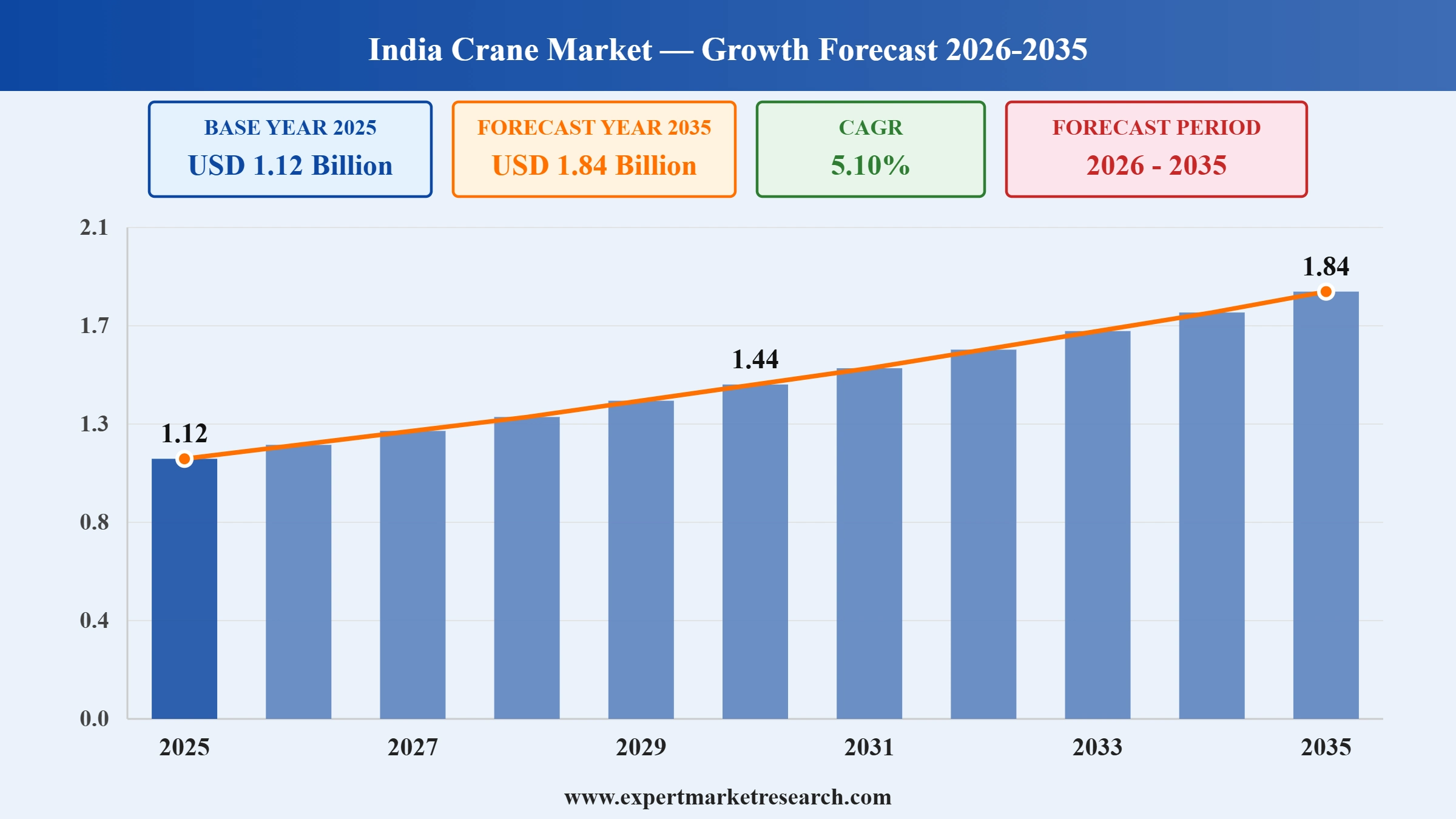
The India crane market attained a value of USD 1.12 Billion in 2025 and is projected to expand at a CAGR of 5.10% through 2035. The market is further expected to achieve USD 1.84 Billion by 2035, supported by sustained infrastructure investment, expanding tower crane demand across urban construction projects, and rising mobile crane adoption for logistics and industrial applications. Growth spans mobile and static mobility formats and OEM and aftermarket sales channels, with manufacturers across North India, South India, and West and Central India competing on premium heavy-crane capability, local manufacturing scale, and aftermarket service depth.
Sustained infrastructure investment continues to anchor demand across the India crane market, as domestic manufacturers pursue joint ventures to strengthen premium heavy-lifting capability. Action Construction Equipment Ltd. disclosed in May 2026 that it achieved its highest-ever quarterly revenue in Q4 FY26, with EBITDA margin expanding to 18.11% from 17.68%, while entering a 50:50 joint venture with KATO WORKS CO., LTD. to strengthen its presence in the premium heavy-crane segment. This type of cross-border partnership reflects a broader pattern among domestic manufacturers seeking faster access to advanced engineering platforms rather than building comparable capability in-house.
The India crane market is witnessing further developments as global manufacturers showcase advanced mobile crane technology at major domestic trade events. Liebherr Group displayed its LTM 1230-5.1 five-axle mobile crane, capable of lifting heights up to 111 metres, at bauma CONEXPO INDIA in September 2026, featuring VarioBallast and VarioBase adaptive systems suited to infrastructure and wind-turbine maintenance projects. This showcase activity highlights growing local demand for internationally engineered, application-specific lifting solutions. Trade events of this scale increasingly serve as a proving ground where manufacturers position new platforms against domestic alternatives, giving buyers a clearer basis for comparison.
In addition, established global lifting equipment manufacturers are reporting record order momentum tied to broader industrial and infrastructure demand. Konecranes reported in July 2026 that its order book reached EUR 3.4 billion, a 15% year-over-year increase and its strongest backlog in three years, with order intake growing 13% in comparable currencies across all three business segments. This sustained backlog growth points to continued global confidence in industrial and infrastructure capital spending. Such multi-year backlog visibility also gives manufacturers greater confidence to commit capital toward expanding regional service and parts-supply networks well ahead of when that demand materialises.
Read more about this report - REQUEST FREE SAMPLE COPY IN PDF
| India Crane Market Report Summary | Description | Value |
| Base Year | USD Billion | 2025 |
| Historical Period | USD Billion | 2019-2025 |
| Forecast Period | USD Billion | 2026-2035 |
| Market Size 2025 | USD Billion | 1.12 |
| Market Size 2035 | USD Billion | 1.84 |
| CAGR 2019-2025 | Percentage | XX% |
| CAGR 2026-2035 | Percentage | 5.10% |
| CAGR 2026-2035 - Market by Region | South India | 5.6% |
| CAGR 2026-2035 - Market by Region | North India | 5.4% |
| CAGR 2026-2035 - Market by Mobility | Mobile | 5.7% |
| CAGR 2026-2035 - Market by Type | Tower Crane | 5.8% |
| 2025 Market Share by Region | North India | 31.2% |
Liebherr displayed its LTM 1230-5.1 five-axle mobile crane at bauma CONEXPO INDIA, highlighting lifting heights of up to 111 metres alongside VarioBallast and VarioBase adaptive systems designed for infrastructure and energy projects, including tower crane erection and wind turbine maintenance. Companies can leverage adaptive mobile crane technology to serve diverse infrastructure and energy-sector lifting applications from a single platform. This kind of platform flexibility also reduces the need for customers to maintain multiple specialised crane types, lowering total fleet ownership costs across projects with varying lift-height and load requirements.
Tata Hitachi presented its next-generation construction equipment lineup at bauma CONEXPO INDIA 2026, reinforcing its manufacturing presence across the country's infrastructure and material-handling equipment segments. The showcase underscored continued investment in domestic engineering and localisation capability. Companies can leverage major domestic trade events to demonstrate localised engineering capability and strengthen dealer and customer relationships nationwide. Sustained participation in these events also helps domestic manufacturers build long-term brand visibility among infrastructure contractors who typically evaluate equipment suppliers over multiple project cycles rather than a single purchase.
Konecranes reported in July 2026 that second-quarter order intake grew 13% in comparable currencies, lifting its order book to EUR 3.4 billion, a 15% year-over-year increase and its strongest backlog in three years, with strength spanning ports, defense, power, and aviation-linked lifting equipment demand. Companies can leverage diversified end-market order strength to sustain backlog growth even amid near-term margin pressure. Diversification of this kind gives equipment manufacturers a buffer against slowdowns in any single end-market, since softness in one sector can often be offset by continued strength in another.
ACE reported its highest-ever quarterly revenue in Q4 FY26, with consolidated net profit rising 1.4% year-over-year to Rs 4,151 million and EBITDA margin expanding to 18.11%, while entering a 50:50 joint venture with Japan's KATO WORKS CO., LTD. to strengthen its position in the premium heavy-crane segment. Companies can leverage international joint ventures to accelerate entry into premium heavy-lifting equipment categories. Partnerships structured this way typically shorten the time needed to bring internationally proven engineering designs to market, compared with developing equivalent heavy-lifting technology entirely through in-house research.
ACE's FY26 results, disclosed in May 2026, showed total income of Rs 33,905 million and EBITDA of Rs 6,140 million, with margins expanding to 18.11% from 17.68% a year earlier, supported by a recommended final dividend of Rs 2.00 per equity share. Companies can leverage margin expansion from premium product mix to fund continued domestic manufacturing capacity investment. This sustained margin performance reflects the company's growing mix of premium, higher-value crane products within its overall sales base. A richer product mix of this kind typically supports steadier profitability across demand cycles, since higher-value equipment tends to carry stronger service and spare-parts attachment over its lifecycle.
At bauma CONEXPO INDIA in September 2026, Tata Hitachi highlighted its next-generation construction and material-handling equipment portfolio, emphasising continued localisation of manufacturing and engineering capability to serve India's infrastructure and industrial lifting equipment demand. Companies can leverage localisation of manufacturing to improve cost competitiveness against imported heavy-lifting equipment. This continued localisation effort reflects the broader industry shift toward reducing reliance on imported heavy-lifting components. Reducing import dependence in this way can also help manufacturers manage currency-related cost volatility, while shortening delivery lead times for customers working against fixed infrastructure project schedules.
Konecranes' July 2026 half-year report disclosed that its second-half order book stood approximately EUR 200 million higher than the prior year, positioning the company for improved deliveries, even as near-term sales and free cash flow softened. Companies can leverage strong forward order books to plan capacity investment ahead of anticipated infrastructure and industrial demand recovery. This resilient order momentum suggests continued customer confidence despite near-term softness in reported sales and cash flow. A growing order book against softer near-term financials often signals a timing gap between when contracts are signed and when the associated revenue and cash are eventually recognised.
Liebherr's September 2026 bauma CONEXPO INDIA showcase emphasised its VarioBallast and VarioBase adaptive systems, which allow mobile cranes to be configured for varying site and load conditions, positioning the equipment for both infrastructure erection and wind-turbine maintenance applications across India's expanding energy sector. Companies can leverage site-adaptive crane configurations to reduce equipment fleet size while serving a broader range of project types. Fleet consolidation of this sort also lowers transport and mobilisation costs between project sites, since fewer specialised units need to be relocated to cover a comparable volume of work.
This Expert Market Research's Report titled "India Crane Market Report and Forecast 2026-2035" offers a detailed analysis of the market based on the following segments:
Market Breakup by Mobility
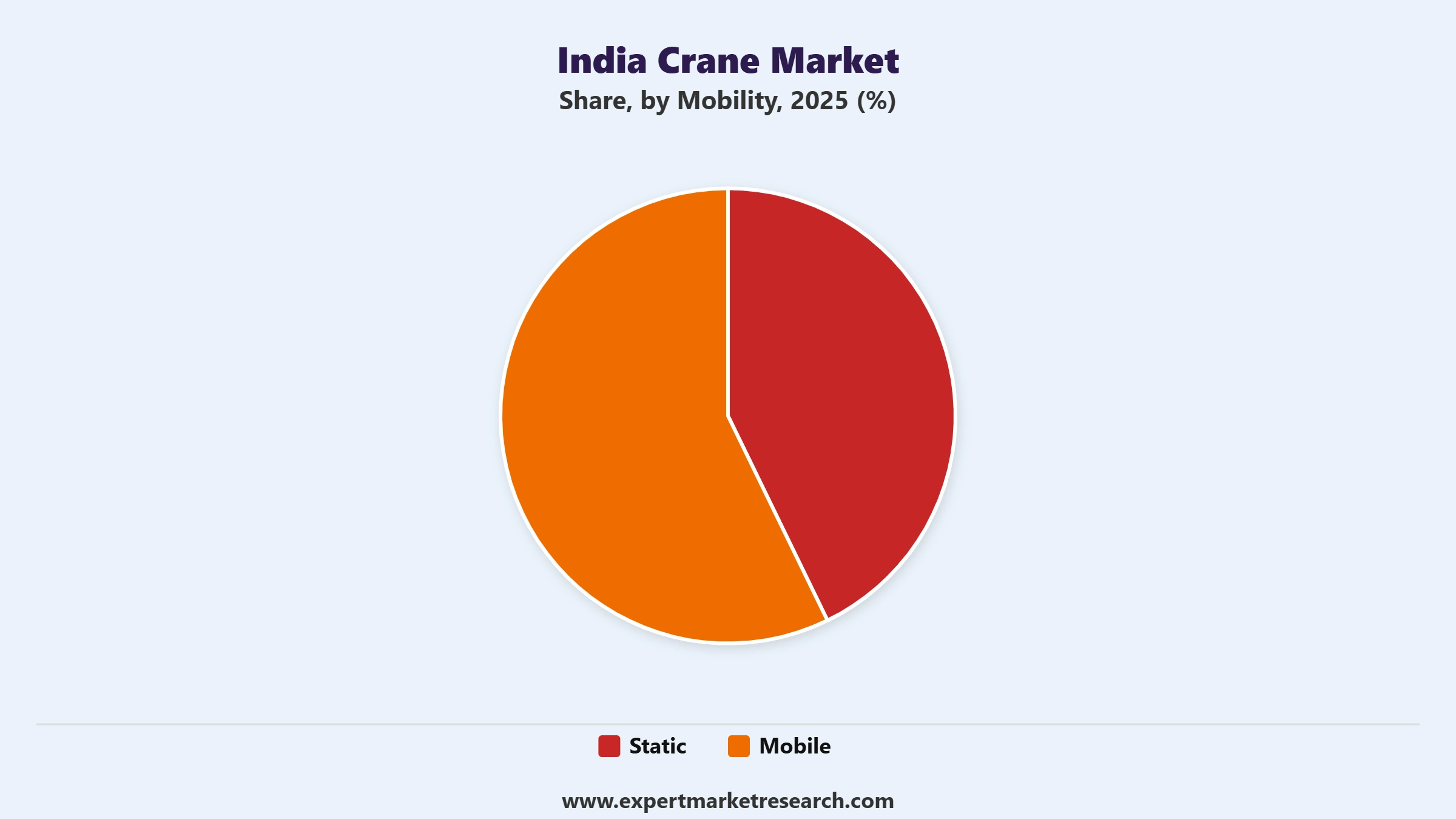
Key Insight: Static cranes account for a substantial share of the India crane market, supported by sustained demand for fixed tower and overhead lifting installations across construction and manufacturing sites. Mobile cranes represent the fastest-growing mobility format at an estimated CAGR of 5.70%, illustrated by Liebherr Group's September 2026 showcase of its LTM 1230-5.1 five-axle mobile crane at bauma CONEXPO INDIA, reflecting rising demand for site-flexible lifting equipment across infrastructure and energy projects. This shift toward flexible deployment is consistent with broader trends across the construction equipment industry, where buyers increasingly prioritise adaptability over dedicated, single-purpose machinery for large-scale projects.
Market Breakup by Type
Key Insight: Tower Crane is the fastest-growing type segment at an estimated CAGR of 5.80%, driven by urban high-rise construction and metro infrastructure projects, reinforced by Action Construction Equipment Ltd.'s May 2026 joint venture with KATO WORKS CO., LTD. to strengthen its premium heavy-crane capability. Overhead Travelling Crane and Bridge Crane continue to serve established industrial and manufacturing lifting applications, while Transporter Crane and Gantry Crane support port and heavy-fabrication site handling. Others captures specialised crane variants outside these core categories. Category breadth of this kind allows the report to capture emerging niche crane designs as they gain adoption, without requiring a full segmentation update each time a new variant appears.
Market Breakup by Sales Channel
Key Insight: OEM accounts for the largest share of the market, supported by sustained new-equipment procurement across infrastructure and industrial construction projects. Aftermarket is expanding as fleet operators increasingly prioritise maintenance, spare-parts, and component-upgrade services, illustrated by Konecranes' July 2026 disclosure of a record EUR 3.4 billion order book spanning both new equipment and service-linked demand across its global operations. Growth of this kind in service-linked revenue typically signals a maturing installed base, since a larger population of equipment already in the field naturally generates more recurring maintenance demand.
Market Breakup by Region
Key Insight: North India accounts for the largest share of the India crane market at approximately 31.2%, driven by major infrastructure projects including the Eastern Peripheral Expressway and strong urban and industrial demand across the National Capital Region. South India is the fastest-growing region at an estimated CAGR of 5.60%, supported by expanding industrial and port-linked infrastructure investment. West and Central India continues to represent substantial demand tied to its manufacturing and logistics corridors, while East India serves steady demand tied to mining and heavy-industry projects. Regional demand across all four zones was further reinforced by exhibitor momentum at bauma CONEXPO INDIA in September 2026, India's largest construction-equipment trade event. Events of this scale give regional buyers a rare opportunity to compare competing equipment platforms side by side, informing procurement decisions that might otherwise rely on limited local supplier information.
Read more about this report - REQUEST FREE SAMPLE COPY IN PDF
By mobility, static leads the market while mobile grows fastest given rising demand for site-flexible lifting equipment
Static continues to account for a substantial share of the market, reflecting sustained demand for fixed tower and overhead lifting installations across construction and manufacturing sites nationwide. Tata Hitachi Construction Machinery Company Private Limited's September 2026 showcase at bauma CONEXPO INDIA underscored continued domestic investment in fixed and heavy-lifting equipment manufacturing capability. Domestic manufacturers continue to expand fixed-installation capacity to serve steady demand from large-scale industrial and warehousing facilities. Facilities of this type generally favour static installations because permanently fixed lifting points reduce operational complexity and deliver more predictable maintenance costs over the life of the building itself.
Read more about this report - REQUEST FREE SAMPLE COPY IN PDF
Mobile is growing at a fast pace across the market at a projected CAGR of 5.70%, driven by rising demand for flexible, site-to-site deployable equipment. Liebherr Group's September 2026 showcase of its LTM 1230-5.1 mobile crane, featuring VarioBallast and VarioBase adaptive systems, reflects growing demand for equipment configurable across infrastructure and energy-sector project types. Fleet operators increasingly favour mobile units for their ability to redeploy quickly across multiple project sites without additional installation costs. This redeployment advantage becomes especially valuable on programmes with several concurrent but geographically dispersed sites, where moving a single unit is typically faster than mobilising a new fixed installation.
By type, overhead travelling crane leads the market while tower crane grows fastest given rising urban high-rise construction
Overhead Travelling Crane continues to account for a substantial share of the market, reflecting established demand across industrial and manufacturing lifting applications. Factories, warehouses, and processing facilities across India continue to rely on overhead travelling cranes for routine material handling, given their proven reliability and lower installation complexity relative to tower cranes. This broad industrial base continues to anchor the segment's leading position even as urban construction activity increasingly favours tower crane installations for high-rise projects.
Tower Crane is growing at a fast pace at a projected CAGR of 5.80%, driven by urban high-rise construction and metro infrastructure projects, reinforced by Action Construction Equipment Ltd.'s May 2026 joint venture with KATO WORKS CO., LTD. aimed at expanding its premium heavy-crane manufacturing capability. Momentum of this kind in the premium segment tends to draw additional manufacturing investment over time, as domestic producers seek to match the lifting capacities offered by newer imported platforms serving India's expanding metro rail network.
By sales channel, OEM leads the market while aftermarket grows fastest given rising fleet maintenance and service demand
OEM continues to account for the largest share of the market, supported by sustained new-equipment procurement across infrastructure and industrial construction projects nationwide. Action Construction Equipment Ltd.'s May 2026 joint venture with KATO WORKS CO., LTD. reflects continued OEM investment in premium heavy-crane manufacturing capability to meet this demand. Domestic and international OEMs continue to expand local manufacturing footprints to shorten delivery timelines for large infrastructure contracts. Shorter delivery timelines of this kind matter most on projects with fixed completion deadlines, where a delayed equipment order can directly push back the broader construction schedule.
Aftermarket is growing at a fast pace across the market, as fleet operators increasingly prioritise maintenance, spare-parts, and service contracts to extend equipment lifecycle. Konecranes' July 2026 half-year report disclosed a second-half order book approximately EUR 200 million higher than the prior year, reflecting sustained global service and aftermarket demand alongside new equipment orders. Fleet operators increasingly favour long-term service contracts to minimise unplanned downtime on large, capital-intensive infrastructure projects. Contracts structured this way also give service providers more predictable recurring revenue, which in turn supports continued investment in regional parts inventory and faster on-site response times.
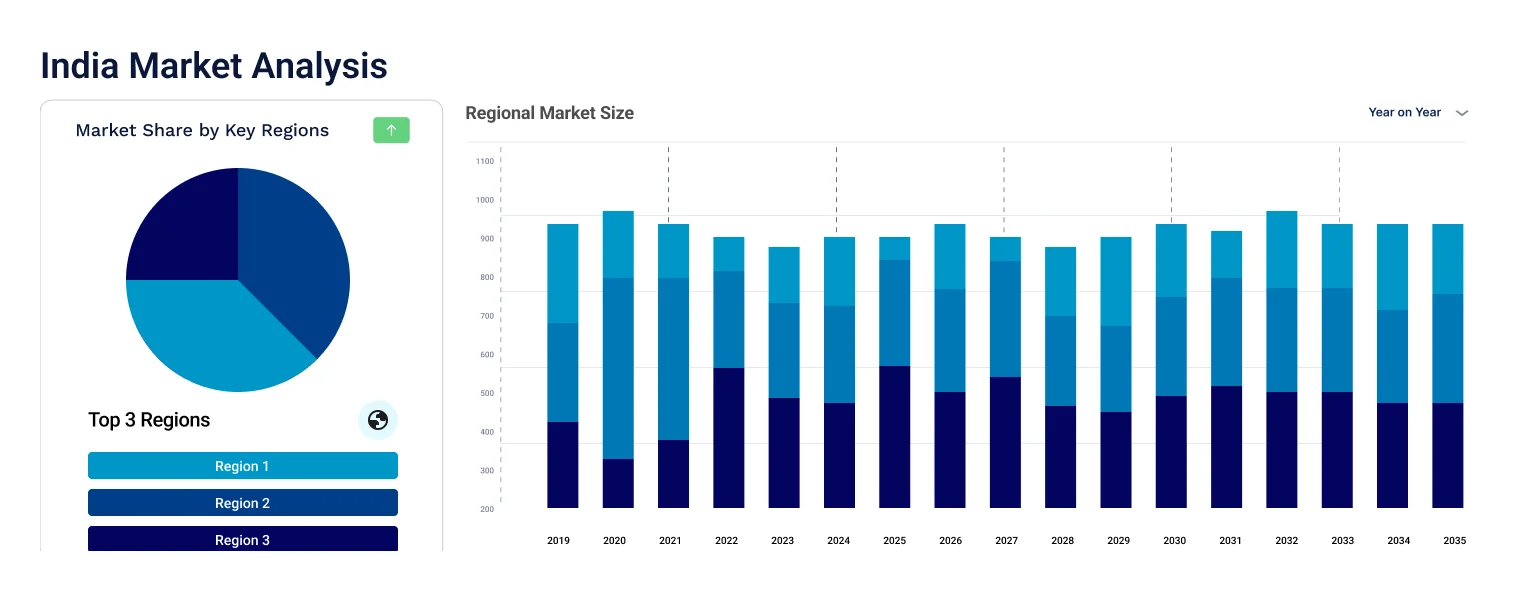
Regional dynamics across the India crane market are shaped by the concentration of infrastructure spending, industrial construction activity, and local manufacturing presence across the country's regions.
North India commands the largest share of the market at approximately 31.2%. This is driven by major infrastructure projects including the Eastern Peripheral Expressway and sustained urban and industrial demand across the National Capital Region, with domestic and international manufacturers prioritising local manufacturing and service presence to serve this concentrated demand base.
South India is emerging as the fastest-growing region at an estimated CAGR of 5.60%, illustrated by Konecranes' July 2026 disclosure of a record EUR 3.4 billion global order book spanning ports, defense, and power-sector lifting equipment demand. West and Central India continues to represent substantial demand tied to its manufacturing and logistics corridors, while East India serves steady demand tied to mining and heavy-industry projects across the region.
The industry is fragmented, with India crane market companies ranging from domestic heavy-equipment manufacturers to global lifting equipment specialists competing across mobility, type, sales channel, and region segments. Established players operate across the full crane value chain, from design and manufacturing through installation, aftermarket service, and component supply for construction, industrial, and infrastructure customers.
Competitive dynamics among India crane players are increasingly shaped by the scale of domestic manufacturing localisation, the depth of premium heavy-crane engineering capability, and the strength of aftermarket service networks. Manufacturers are investing in international joint ventures, adaptive crane technology, and expanded service infrastructure to secure long-term relationships with infrastructure and industrial customers.
Founded in 1995 and headquartered in Faridabad, Haryana, ACE manufactures cranes, construction equipment, and agricultural machinery for the domestic Indian market. The company reported its highest-ever quarterly revenue in Q4 FY26 in May 2026, with EBITDA margin expanding to 18.11%, and entered a 50:50 joint venture with KATO WORKS CO., LTD., aimed at expanding its premium heavy-crane manufacturing capability.
Founded in 1992 as a joint venture between Tata Motors and Hitachi Construction Machinery, and headquartered in Kolkata, West Bengal, Tata Hitachi manufactures excavators, cranes, and material-handling equipment for India's infrastructure and industrial sectors. The company showcased its next-generation construction equipment lineup at bauma CONEXPO INDIA in September 2026, reinforcing its domestic manufacturing and localisation focus.
Founded in 1910 and headquartered in Hyvinkaa, Finland, Konecranes manufactures cranes, hoists, and lifting equipment alongside a global maintenance and service network. The company reported in July 2026 a record order book of EUR 3.4 billion, a 15% year-over-year increase and its strongest backlog in three years, with order intake growing 13% in comparable currencies across ports, defense, power, and aviation-linked demand.
Founded in 1949 and headquartered in Bulle, Switzerland, Liebherr manufactures mobile, crawler, and tower cranes alongside a broader portfolio of construction and material-handling equipment. The company showcased its LTM 1230-5.1 five-axle mobile crane, capable of lifting heights up to 111 metres, at bauma CONEXPO INDIA in September 2026, featuring VarioBallast and VarioBase adaptive systems for infrastructure and energy applications.
Other key players in the India crane market include TIL Limited, Kobelco Construction Machinery Co., Ltd., Cranex Limited, SNK Project Aiders Pvt Ltd., Hydrolift, and Liftboy Industries, among others.
*Please note that this is only a partial list; the complete list of key players is available in the full report. Additionally, the list of key players can be customized to better suit your needs.*
Unlock the latest insights with our India crane market trends 2026 report. Discover regional growth patterns, mobility and type trends, and key industry players. Stay ahead of competition with trusted data and expert analysis. Download your free sample report today and drive informed decisions in the market.


Upto 15% Off
USD
$2499 $2249
$3999 $3599
$4999 $4249
$5999 $5099


*While we strive to always give you current and accurate information, the numbers depicted on the website are indicative and may differ from the actual numbers in the main report. At Expert Market Research, we aim to bring you the latest insights and trends in the market. Using our analyses and forecasts, stakeholders can understand the market dynamics, navigate challenges, and capitalize on opportunities to make data-driven strategic decisions.*
The market is projected to grow at a CAGR of 5.10% between 2026 and 2035.
The market is estimated to witness a healthy growth during 2026-2035 to reach around USD 1.84 Billion by 2035.
Pursuing international joint ventures to access premium heavy-crane technology, expanding domestic manufacturing localisation, and strengthening aftermarket service networks to support long equipment lifecycles.
The key trends aiding the crane market in India include technological advancements and port and marine development.
The major regions considered in the market are East India, West and Central India, North India, and South India.
The major market segmentations based on mobility of crane include static and mobile.
The key players in the market include Action Construction Equipment Ltd., Tata Hitachi Construction Machinery Company Private Limited, TIL Limited, Kobelco Construction Machinery Co., Ltd., Konecranes, Cranex Limited, SNK Project Aiders Pvt Ltd., Hydrolift, Liebherr Group, and Liftboy Industries, among others.
In 2025, the market reached an approximate value of USD 1.12 Billion.
Manufacturers face intense price competition from a fragmented domestic supplier base, the technical complexity of scaling premium heavy-crane engineering capability, and long project-execution timelines tied to large infrastructure contracts.
Explore our key highlights of the report and gain a concise overview of key findings, trends, and actionable insights that will empower your strategic decisions.
| REPORT FEATURES | DETAILS |
| Base Year | 2025 |
| Historical Period | 2019-2025 |
| Forecast Period | 2026-2035 |
| Scope of the Report |
Historical and Forecast Trends, Industry Drivers and Constraints, Historical and Forecast Market Analysis by Segment:
|
| Breakup by Mobility |
|
| Breakup by Type |
|
| Breakup by Sales Channel |
|
| Breakup by Region |
|
| Market Dynamics |
|
| Competitive Landscape |
|
| Companies Covered |
|
Datasheet
One User
USD 2,499
USD 2,249
tax inclusive*
Single User License
One User
USD 3,999
USD 3,599
tax inclusive*
Five User License
Five User
USD 4,999
USD 4,249
tax inclusive*
Corporate License
Unlimited Users
USD 5,999
USD 5,099
tax inclusive*
*Please note that the prices mentioned below are starting prices for each bundle type. Kindly contact our team for further details.*
Flash Bundle
Small Business Bundle
Growth Bundle
Enterprise Bundle
*Please note that the prices mentioned below are starting prices for each bundle type. Kindly contact our team for further details.*
Flash Bundle
Number of Reports: 3
20%
tax inclusive*
Small Business Bundle
Number of Reports: 5
25%
tax inclusive*
Growth Bundle
Number of Reports: 8
30%
tax inclusive*
Enterprise Bundle
Number of Reports: 10
35%
tax inclusive*
How To Order

Select License Type
Choose the right license for your needs and access rights.

Click on ‘Buy Now’
Add the report to your cart with one click and proceed to register.

Select Mode of Payment
Choose a payment option for a secure checkout. You will be redirected accordingly.
Strategic Solutions for Informed Decision-Making
Gain insights to stay ahead and seize opportunities.

Get insights & trends for a competitive edge.

Track prices with detailed trend reports.

Analyse trade data for supply chain insights.

Leverage cost reports for smart savings

Enhance supply chain with partnerships.

Connect For More Information
Our expert team of analysts will offer full support and resolve any queries regarding the report, before and after the purchase.
Our expert team of analysts will offer full support and resolve any queries regarding the report, before and after the purchase.
We employ meticulous research methods, blending advanced analytics and expert insights to deliver accurate, actionable industry intelligence, staying ahead of competitors.
Our skilled analysts offer unparalleled competitive advantage with detailed insights on current and emerging markets, ensuring your strategic edge.
We offer an in-depth yet simplified presentation of industry insights and analysis to meet your specific requirements effectively.




