Consumer Insights
Uncover trends and behaviors shaping consumer choices today
Procurement Insights
Optimize your sourcing strategy with key market data
Industry Stats
Stay ahead with the latest trends and market analysis.
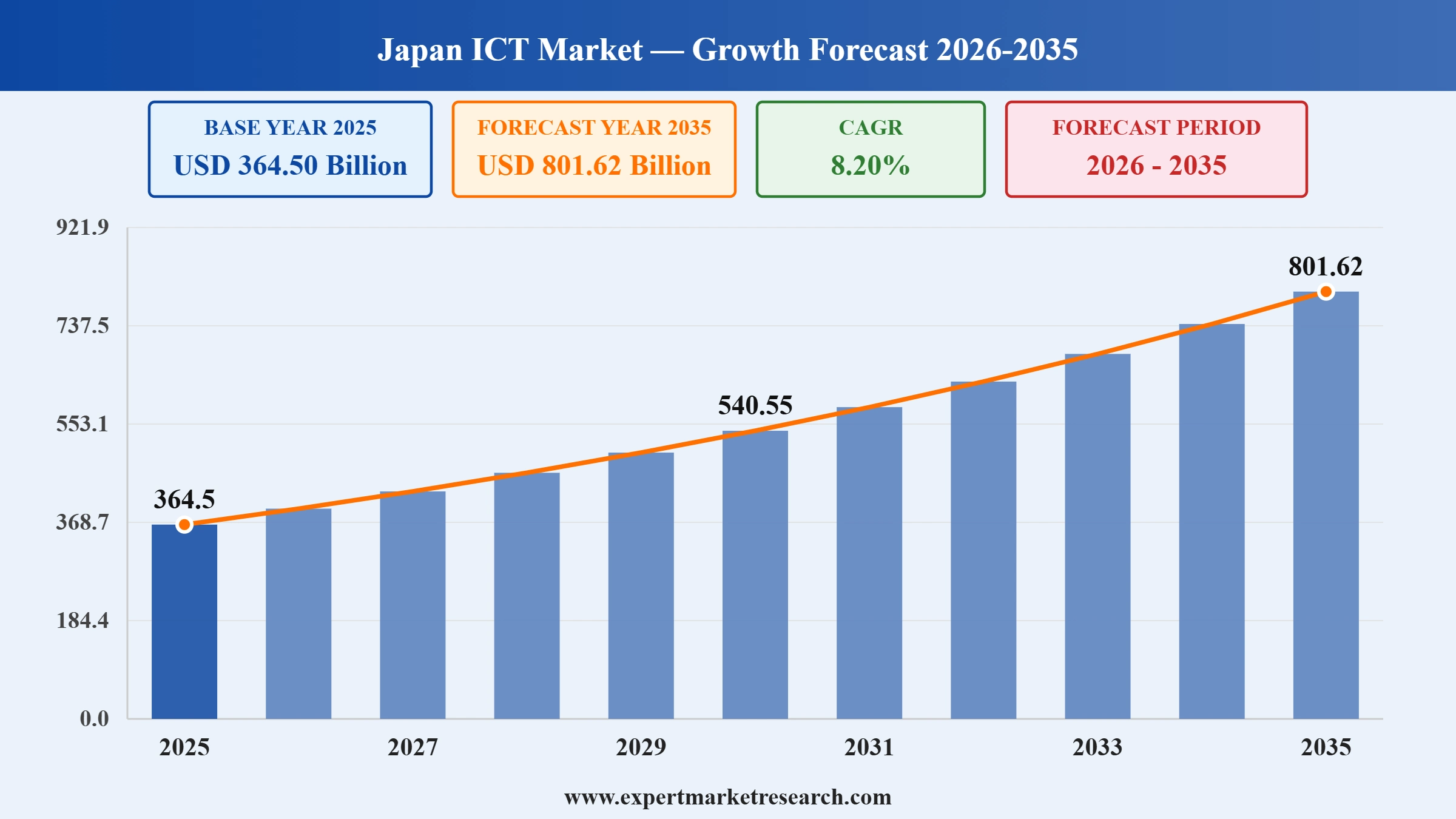
The Japan ICT market attained a value of USD 364.50 Billion in 2025 and is projected to expand at a CAGR of 8.20% through 2035. The market is further expected to achieve USD 801.62 Billion by 2035, supported by accelerating enterprise AI adoption, sovereign cloud and data centre investment, and sustained digital transformation across BFSI, manufacturing, and government sectors. Growth spans hardware, software, IT and infrastructure services, and telecommunication services, with technology providers across Japan competing on AI infrastructure scale, sovereign data capability, and enterprise service depth.
Sustained enterprise digital transformation and government-backed AI infrastructure investment continue to anchor steady demand across the Japan ICT market, as organisations across BFSI, manufacturing, and government sectors accelerate cloud migration and AI-enabled service adoption. Industry data published in September 2026 confirmed Japan's domestic AI infrastructure spending surpassing USD 5.5 billion in 2026, reinforcing sustained double-digit growth momentum across enterprise technology procurement nationwide.
The Japan ICT market is witnessing further developments as domestic and international technology providers commit substantial capital toward sovereign AI infrastructure. Microsoft announced, in April 2026, a USD 10 billion investment in Japan through 2029 to expand Azure AI and cloud data centre capacity, working alongside domestic partners SoftBank and Sakura Internet to deliver Japan-resident AI compute capability. This shift toward sovereign, domestically-hosted AI infrastructure is reshaping procurement priorities across regulated sectors including finance and government.
In addition, established domestic technology conglomerates are increasingly pursuing strategic partnerships to accelerate frontier AI capability within their existing service portfolios. Hitachi announced, in May 2026, a strategic partnership with Anthropic to strengthen its Lumada 3.0 digital platform through frontier AI, targeting system engineering, operations, and cybersecurity applications across energy, transportation, manufacturing, and finance sectors. Such partnerships are increasingly differentiating established IT service providers from smaller specialists lacking comparable frontier AI access.
Read more about this report - REQUEST FREE SAMPLE COPY IN PDF
| Japan ICT Market Report Summary | Description | Value |
| Base Year | USD Billion | 2025 |
| Historical period | USD Billion | 2019-2025 |
| Forecast Period | USD Billion | 2026-2035 |
| Market Size 2025 | USD Billion | 364.50 |
| Market Size 2035 | USD Billion | 801.62 |
| CAGR 2019-2025 | Percentage | XX% |
| CAGR 2026-2035 | Percentage | 8.20% |
| CAGR 2026-2035 - Market by Type | BFSI | 9.3% |
| CAGR 2026-2035 - Market by End Use | Small and Medium Enterprises | 10.3% |
Domestic semiconductor developers are increasingly targeting sovereign AI infrastructure as export controls and data-residency concerns reshape procurement priorities across regulated sectors. Fujitsu announced, in September 2026, that it would begin global sales of its next-generation FUJITSU-MONAKA CPU, designed and developed in Japan, alongside the made-in-Japan Fujitsu MONAKA Server positioned as sovereign AI infrastructure for financial, telecommunications, and manufacturing customers from November 2026. Companies can leverage domestically designed and manufactured AI hardware to capture sovereign infrastructure demand from customers prioritising data-residency and supply-chain auditability over pure performance.
Domestic data centre operators are committing substantial multi-year capital to keep pace with surging enterprise AI compute demand. NTT Data Group disclosed, in August 2026, plans to invest at least USD 9 billion through 2033 to quadruple its Japan computing capacity to 1 gigawatt, adding roughly 750 megawatts of capacity over the next seven years to meet accelerating demand from companies racing to adopt AI. Companies can leverage multi-year capacity expansion commitments to secure long-term hyperscaler and enterprise tenancy agreements ahead of anticipated demand growth.
Japanese industrial and technology conglomerates are increasingly pooling proprietary data to build domestically controlled foundation models rather than relying on imported AI systems. A consortium of 44 Japanese companies anchored by SoftBank, Sony Group, and Honda Motor formally began work in July 2026 on a sovereign AI foundation model project targeting industrial applications including factory optimisation, predictive maintenance, and materials discovery. Companies can leverage industry-wide data-pooling consortiums to accelerate proprietary AI model development beyond what any single organisation could achieve independently.
Established Japanese IT service conglomerates are increasingly forming strategic partnerships with frontier AI developers to differentiate their digital platforms. Hitachi announced, in May 2026, a strategic partnership with Anthropic to strengthen its Lumada 3.0 digital business through frontier AI, targeting system engineering, operations, and cybersecurity applications across critical infrastructure sectors including energy, transportation, manufacturing, and finance. Companies can leverage frontier AI partnerships to differentiate established digital service platforms from competitors relying solely on in-house AI development.
Global hyperscalers are increasingly structuring Japan AI investment around domestic partnerships to satisfy data-sovereignty requirements rather than building solely on their own balance sheets. Microsoft announced, in April 2026, a USD 10 billion investment in Japan running through 2029, more than tripling its prior two-year commitment, structured around expanding Azure AI and cloud data centre capacity in partnership with SoftBank and Sakura Internet while also training more than one million Japanese engineers and developers in AI by 2030. Companies can leverage structured partnerships with domestic compute and workforce-development partners to accelerate large-scale AI infrastructure delivery while meeting national data-sovereignty expectations.
Domestic data centre operators are increasingly prioritising AI-ready facility design as cloud and AI workload demand accelerates beyond established metro markets. NTT Data officially opened its Keihanna OSK11 Data Centre in Kyoto in April 2026, a next-generation, AI-ready facility incorporating advanced high-efficiency cooling technologies designed to strengthen digital infrastructure across Japan's fast-growing Kansai region. Companies can leverage AI-ready facility design in emerging regional markets to capture growing cloud and AI workload demand beyond saturated established metro locations.
Diversified Japanese industrial conglomerates are increasingly consolidating overlapping digital service subsidiaries to present unified, end-to-end delivery capability to enterprise clients. Hitachi announced, in January 2026, plans to integrate its GlobalLogic and Hitachi Digital Services US subsidiaries to accelerate the global growth of its Lumada 3.0 digital platform, combining digital engineering, software development, and AI application capabilities under a single delivery structure. Companies can leverage consolidated digital service subsidiaries to present unified, end-to-end delivery capability that reduces client-side integration complexity across the digital transformation lifecycle.
Domestic hardware manufacturers are increasingly localising AI server production to meet emerging critical-infrastructure security designations. Fujitsu announced, in February 2026, that it would begin manufacturing made-in-Japan sovereign AI servers at its Kasashima Plant from March 2026, drawing on manufacturing expertise from the supercomputer Fugaku to support customers designated as essential infrastructure service providers under Japan's Economic Security Promotion Act. Companies can leverage domestic manufacturing expertise from prior national-scale computing projects to meet emerging critical-infrastructure security and data-sovereignty designations.
This Expert Market Research Report titled "Japan ICT Market Report and Forecast 2026-2035" offers a detailed analysis of the market based on the following segments:
Market Breakup by Type
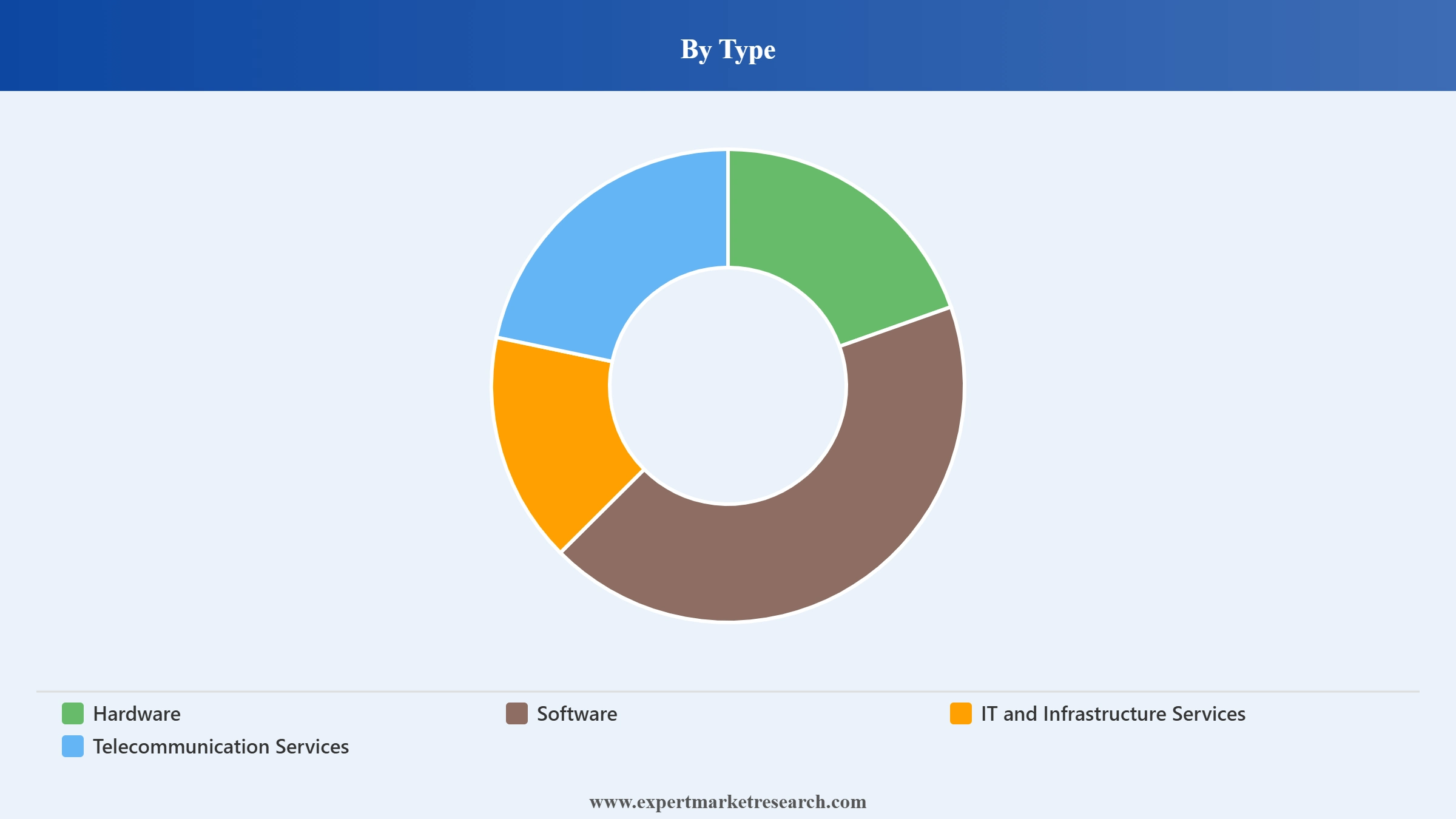
Key Insight: Hardware accounts for the largest share of the market, reflecting sustained enterprise investment in network switches, routers and WLAN equipment, and servers and storage infrastructure supporting data centre expansion nationwide, reinforced by Fujitsu's September 2026 launch of its domestically designed FUJITSU-MONAKA sovereign AI CPU and MONAKA Server hardware line. IT and Infrastructure Services continues to represent substantial demand tied to enterprise cloud migration and managed infrastructure support, illustrated by NTT Data's April 2026 opening of its AI-ready Keihanna OSK11 Data Centre in Kyoto. Telecommunication Services serves sustained connectivity and network infrastructure demand across enterprise and consumer segments. Software is growing fastest at a projected 10.80% CAGR as enterprises accelerate cloud migration and AI-enabled application adoption across BFSI, manufacturing, and government sectors, with industry data published in September 2026 confirming Japan's domestic AI infrastructure spending surpassing USD 5.5 billion in 2026.
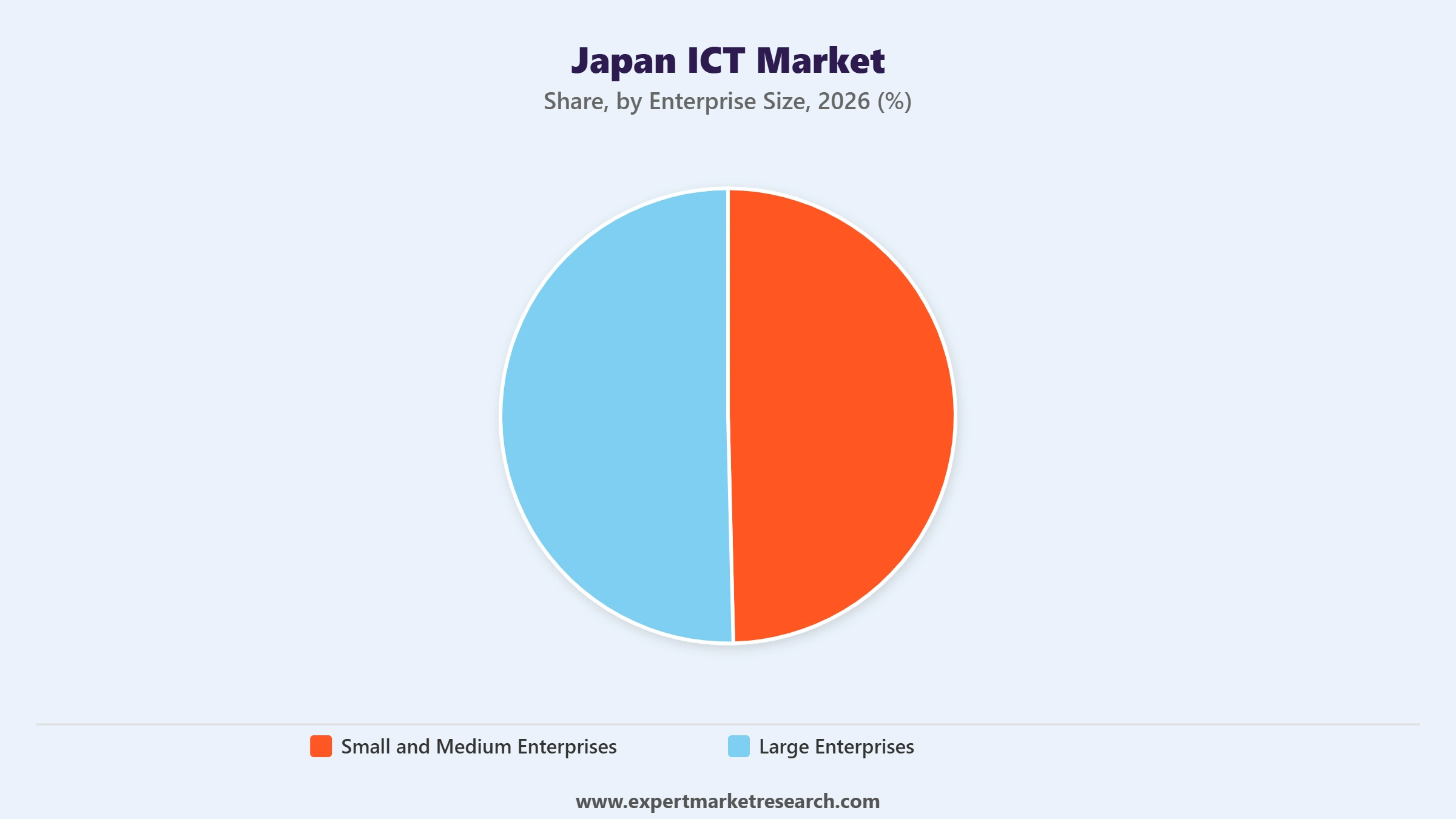
Market Breakup by Enterprise Size
Key Insight: Large Enterprises accounts for the largest share of the market, reflecting sustained IT budget allocation toward enterprise-scale digital transformation and AI infrastructure procurement, reinforced by Hitachi's January 2026 integration of GlobalLogic and Hitachi Digital Services to strengthen end-to-end delivery capability for large enterprise clients under its Lumada 3.0 platform. Small and Medium Enterprises is growing fastest at an estimated 9.60% CAGR, supported by expanding access to affordable cloud subscription services and government-backed digitalisation incentives that are lowering the barrier to enterprise-grade IT adoption for smaller organisations nationwide.
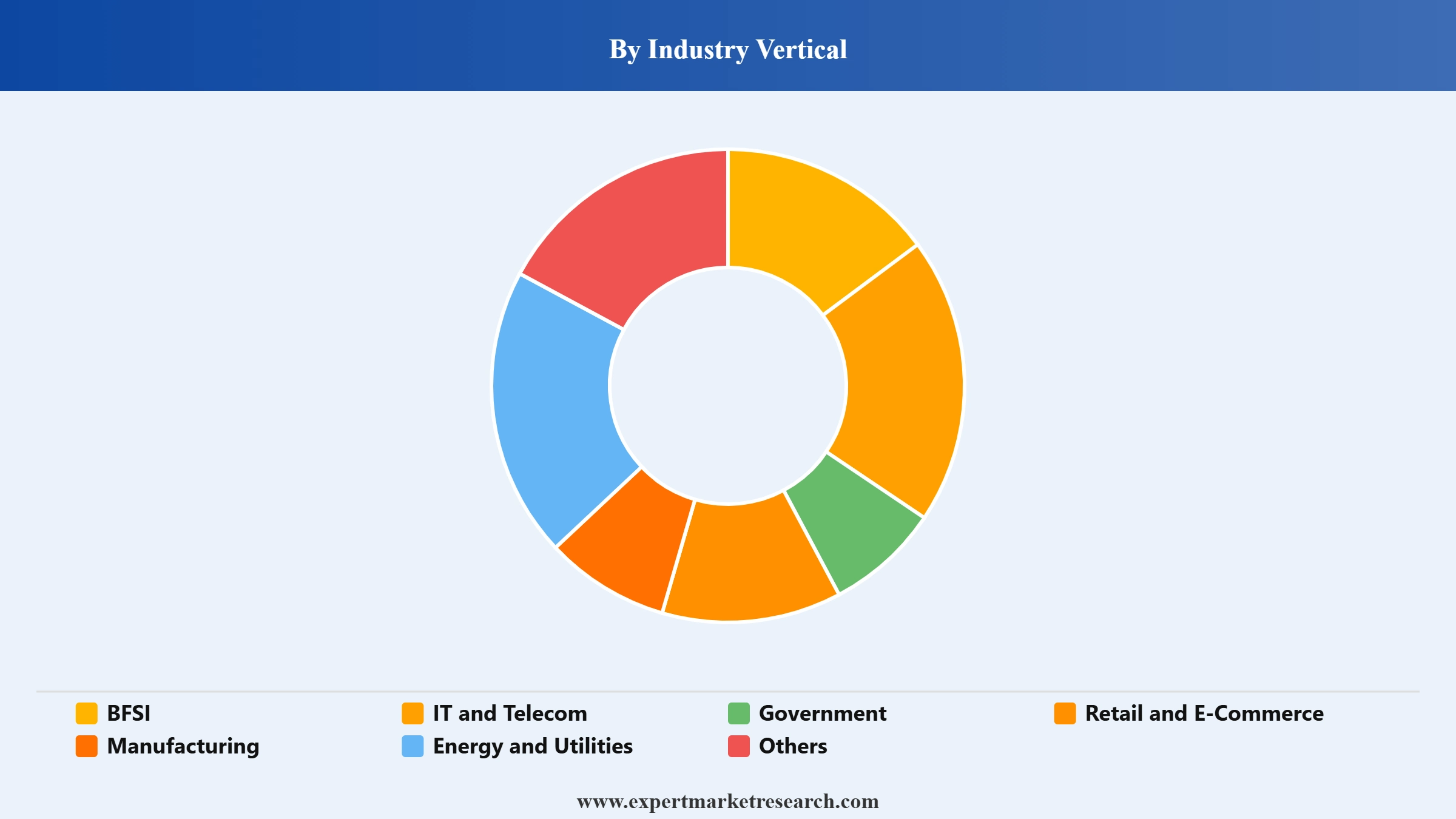
Market Breakup by Industry Vertical
Key Insight: IT and Telecom accounts for the largest share of the market, anchored by sustained data centre and network infrastructure investment, reinforced by NTT Data's disclosed August 2026 plan to invest at least USD 9 billion through 2033 to quadruple its Japan computing capacity. Government continues to represent substantial demand tied to national digitalisation and sovereign AI infrastructure initiatives, illustrated by the Sony-led 44-company consortium that began work in July 2026 on a domestically controlled AI foundation model. Manufacturing demand is reinforced by Hitachi's May 2026 partnership with Anthropic strengthening AI applications across industrial operations. Retail and E-Commerce, Energy and Utilities, and Others each continue to represent distinct, steadily expanding demand tied to sector-specific digitalisation. BFSI is growing fastest at a projected 11.40% CAGR as banks and insurers deepen investment in digital payment infrastructure, fraud analytics, and AI-driven customer service platforms nationwide.
Read more about this report - REQUEST FREE SAMPLE COPY IN PDF
Hardware continues to account for the largest share of the market, reflecting sustained enterprise investment in servers, storage, and network infrastructure supporting data centre expansion nationwide. Fujitsu's February 2026 announcement of sovereign AI server manufacturing at its Kasashima Plant reinforced continued domestic hardware production capacity anchoring this category's dominant position.
Read more about this report - REQUEST FREE SAMPLE COPY IN PDF
Software is the fastest-growing type at a projected 10.80% CAGR. Microsoft's April 2026 commitment of USD 10 billion toward Japan AI and cloud infrastructure through 2029 reinforced accelerating enterprise demand for cloud-delivered software and AI-enabled applications, as organisations increasingly favour subscription-based platforms over on-premises deployment.
Large Enterprises continues to account for the largest share of the market, reflecting sustained enterprise-scale IT budget allocation toward digital transformation initiatives. Industry estimates published in March 2026 confirmed large enterprises accounting for the majority of Japan's overall ICT procurement spending, as established corporations continue prioritising enterprise-grade security, compliance, and integration capability over smaller vendors.
Read more about this report - REQUEST FREE SAMPLE COPY IN PDF
Small and Medium Enterprises is the fastest-growing enterprise size segment at an estimated 9.60% CAGR. Industry estimates published in August 2026 confirmed expanding quick-deployment cloud subscription offerings from domestic providers, lowering the cost and technical barrier for smaller organisations to adopt enterprise-grade IT infrastructure and AI-enabled tools.
IT and Telecom continues to account for the largest share of the market, anchored by sustained data centre and network infrastructure investment. Industry data published in June 2026 confirmed IT and Telecom remaining the largest single contributor to overall enterprise technology spending nationwide, as telecom operators and IT service providers continue expanding 5G and fibre network infrastructure alongside data centre capacity.
Read more about this report - REQUEST FREE SAMPLE COPY IN PDF
BFSI is the fastest-growing industry vertical at a projected 11.40% CAGR. Industry data published in July 2026 confirmed accelerating investment by Japanese banks and insurers in digital payment infrastructure and AI-driven fraud analytics, as financial institutions race to modernise legacy systems ahead of tightening regulatory and competitive pressure.
The industry is fragmented, with japan ICT market companies ranging from diversified global technology conglomerates to specialist domestic IT service providers competing across type, enterprise size, and industry vertical segments. Established players operate across the full ICT value chain, from hardware manufacturing and software development through infrastructure services and telecommunication service delivery for enterprise, government, and consumer customers.
Competitive dynamics among japan ICT players are increasingly shaped by the scale of sovereign AI infrastructure investment, the depth of domestic data centre capacity, and the strength of frontier AI partnerships. Companies are investing in domestically manufactured hardware, expanded local cloud capacity, and strategic AI alliances to secure long-term relationships with enterprise and government customers navigating data-sovereignty requirements.
Founded in 1935 and headquartered in Tokyo, Japan, Fujitsu is a diversified technology company providing hardware, software, and IT infrastructure services spanning enterprise computing, networking, and digital transformation consulting. In September 2026, the company launched its domestically designed FUJITSU-MONAKA sovereign AI CPU and MONAKA Server, following February 2026 manufacturing groundwork at its Kasashima Plant. Fujitsu's combination of domestic chip design and sovereign server manufacturing differentiates its offering from hardware providers reliant on imported components.
Founded in 1988 and headquartered in Tokyo, Japan, NTT Data Group provides IT services, data centre infrastructure, and digital business consulting to enterprise and government clients worldwide. In April 2026, the company opened its AI-ready Keihanna OSK11 Data Centre in Kyoto, and in August 2026 disclosed plans to invest at least USD 9 billion through 2033 to quadruple its Japan computing capacity. NTT Data's large-scale domestic data centre expansion differentiates its offering from IT service providers without comparable infrastructure ownership.
Founded in 1910 and headquartered in Tokyo, Japan, Hitachi is a diversified industrial and technology group operating across digital systems and services, energy, mobility, and connective industries. In January 2026, the company announced plans to integrate its GlobalLogic and Hitachi Digital Services subsidiaries to accelerate its Lumada 3.0 digital platform, followed by a May 2026 strategic partnership with Anthropic to strengthen frontier AI capability. Hitachi's combination of industrial domain knowledge and consolidated digital service delivery differentiates its offering from pure-play IT service competitors.
Founded in 1975 and headquartered in Redmond, Washington, United States, Microsoft provides cloud computing, enterprise software, and AI platform services through its Azure and productivity software portfolios. In April 2026, the company committed USD 10 billion toward Japan AI and cloud infrastructure through 2029, partnering with SoftBank and Sakura Internet to deliver Japan-resident AI compute capability. Microsoft's structured domestic partnership model differentiates its offering from hyperscalers building solely on their own balance sheets.
Other key players in the Japan ICT market include IBM Corp., Sony Group Corp., Fuji Soft Inc., Salesforce Inc., NEC Corp., and TIS Inc., among others.
*Please note that this is only a partial list; the complete list of key players is available in the full report. Additionally, the list of key players can be customized to better suit your needs.*
Unlock the latest insights with our Japan ICT market trends 2026 report. Discover type, enterprise size, and industry vertical trends, and key industry players. Stay ahead of competition with trusted data and expert analysis. Download your free sample report today and drive informed decisions in the market.


Upto 15% Off
USD
$2499 $2249
$3999 $3599
$4999 $4249
$5999 $5099


*While we strive to always give you current and accurate information, the numbers depicted on the website are indicative and may differ from the actual numbers in the main report. At Expert Market Research, we aim to bring you the latest insights and trends in the market. Using our analyses and forecasts, stakeholders can understand the market dynamics, navigate challenges, and capitalize on opportunities to make data-driven strategic decisions.*
In 2025, the market reached an approximate value of USD 364.50 Billion.
The market is projected to grow at a CAGR of 8.20% between 2026 and 2035.
The market is assessed to witness healthy growth in the forecast period to reach around USD 801.62 Billion in 2035.
The different ICT types considered in the report include hardware, software, IT and infrastructure services, and telecommunication services.
The different sizes of enterprises in the market include small and medium enterprises and large enterprises.
The different industry verticals in the market include BFSI, IT and telecom, government, retail and e-commerce, manufacturing, and energy and utilities, among others.
The key players in the market include Fujitsu Ltd., NTT Data Group Corp., Hitachi Ltd., Microsoft Corp., IBM Corp., Sony Group Corp., Fuji Soft Inc., Salesforce Inc., NEC Corp., and TIS Inc., among others.
Technology providers face intense competition from a fragmented global and domestic supplier base, the technical complexity of building sovereign AI infrastructure that satisfies data-residency requirements, and substantial upfront capital demands for large-scale data centre and hardware manufacturing investment.
Investing in domestically manufactured sovereign AI hardware, expanding data centre capacity through structured domestic partnerships, and forming frontier AI alliances to strengthen existing digital service platforms.
Explore our key highlights of the report and gain a concise overview of key findings, trends, and actionable insights that will empower your strategic decisions.
| REPORT FEATURES | DETAILS |
| Base Year | 2025 |
| Historical Period | 2019-2025 |
| Forecast Period | 2026-2035 |
| Scope of the Report |
Historical and Forecast Trends, Industry Drivers and Constraints, Historical and Forecast Market Analysis by Segment:
|
| Breakup by Type |
|
| Breakup by Enterprise Size |
|
| Breakup by Industry Vertical |
|
| Market Dynamics |
|
| Competitive Landscape |
|
| Companies Covered |
|
Datasheet
One User
USD 2,499
USD 2,249
tax inclusive*
Single User License
One User
USD 3,999
USD 3,599
tax inclusive*
Five User License
Five User
USD 4,999
USD 4,249
tax inclusive*
Corporate License
Unlimited Users
USD 5,999
USD 5,099
tax inclusive*
*Please note that the prices mentioned below are starting prices for each bundle type. Kindly contact our team for further details.*
Flash Bundle
Small Business Bundle
Growth Bundle
Enterprise Bundle
*Please note that the prices mentioned below are starting prices for each bundle type. Kindly contact our team for further details.*
Flash Bundle
Number of Reports: 3
20%
tax inclusive*
Small Business Bundle
Number of Reports: 5
25%
tax inclusive*
Growth Bundle
Number of Reports: 8
30%
tax inclusive*
Enterprise Bundle
Number of Reports: 10
35%
tax inclusive*
How To Order

Select License Type
Choose the right license for your needs and access rights.

Click on ‘Buy Now’
Add the report to your cart with one click and proceed to register.

Select Mode of Payment
Choose a payment option for a secure checkout. You will be redirected accordingly.
Strategic Solutions for Informed Decision-Making
Gain insights to stay ahead and seize opportunities.
Get insights & trends for a competitive edge.
Track prices with detailed trend reports.
Analyse trade data for supply chain insights.
Leverage cost reports for smart savings
Enhance supply chain with partnerships.
Connect For More Information
Our expert team of analysts will offer full support and resolve any queries regarding the report, before and after the purchase.
Our expert team of analysts will offer full support and resolve any queries regarding the report, before and after the purchase.
We employ meticulous research methods, blending advanced analytics and expert insights to deliver accurate, actionable industry intelligence, staying ahead of competitors.
Our skilled analysts offer unparalleled competitive advantage with detailed insights on current and emerging markets, ensuring your strategic edge.
We offer an in-depth yet simplified presentation of industry insights and analysis to meet your specific requirements effectively.