

Consumer Insights
Uncover trends and behaviors shaping consumer choices today
Procurement Insights
Optimize your sourcing strategy with key market data
Industry Stats
Stay ahead with the latest trends and market analysis.
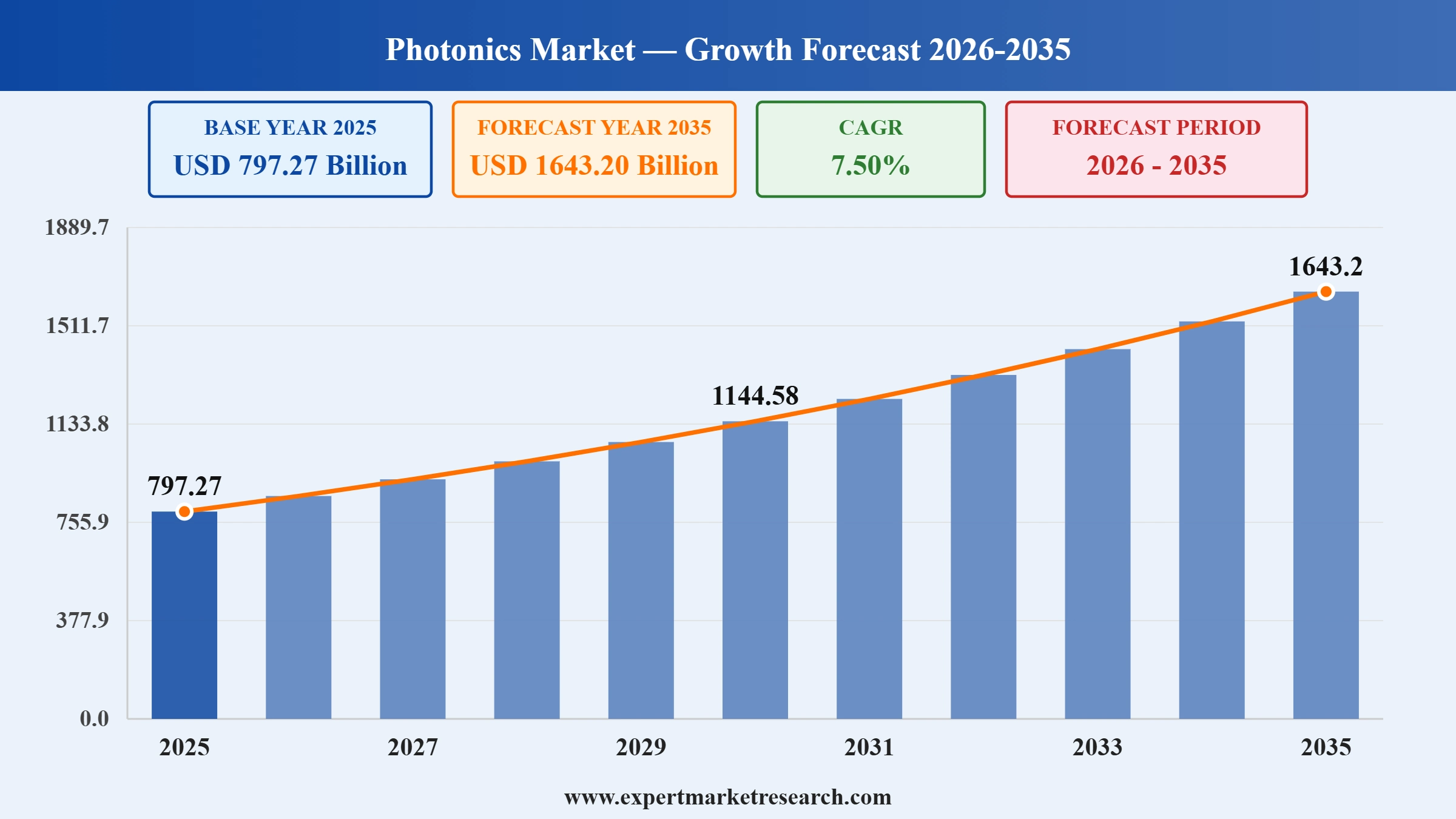
The global photonics market size reached around USD 797.27 Billion in 2025. The market is projected to grow at a CAGR of 7.50% between 2026 and 2035 to reach nearly USD 1643.20 Billion by 2035.
Read more about this report - REQUEST FREE SAMPLE COPY IN PDF
| Global Photonics Market Report Summary | Description | Value |
| Base Year | USD Billion | 2025 |
| Historical Period | USD Billion | 2019-2025 |
| Forecast Period | USD Billion | 2026-2035 |
| Market Size 2025 | USD Billion | 797.27 |
| Market Size 2035 | USD Billion | 1643.20 |
| CAGR 2019-2025 | Percentage | XX% |
| CAGR 2026-2035 | Percentage | 7.50% |
| CAGR 2026-2035 - Market by Region | Asia Pacific | 8.6% |
| CAGR 2026-2035 - Market by Country | India | 9.9% |
| CAGR 2026-2035 - Market by Country | China | 8.3% |
| CAGR 2026-2035 - Market by Type | Medical Technology | 8.7% |
| CAGR 2026-2035 - Market by End Use | Media, Broadcasting and Telecommunication | 11.3% |
| Market Share by Country 2025 | India | 3.5% |
Photonics refers to the science of light as it controls, detects, and produces photons and light waves or light particles. It encompasses the study of the application of light across various spectrums, from infrared to visible and ultraviolet regions. Photonics also involves the use of light (photons) to perform functions that traditional electronics (electrons) do, including communications, information processing, lighting, and sensing, among others.
The rising demand for energy-efficient products and the increasing use of photonic products in different applications are the major drivers propelling the photonics market growth. Another major driving force for the market is its rising application in silicone-based photonics. For telecommunications and data centre applications, hybrid silicon lasers (silicon and group III-V semiconductor) are used, which benefit from the luminous properties of III-V semiconductor materials. The technological progress of light-based technologies has driven a new wave of innovation by offering sustainable solutions to various challenges.
Photonic integrated circuits (PICs) for next-gen applications; trend of sustainability and green photonics; the pivotal role of photonics in quantum technologies; and technological advancements in laser technology are the major trends in the photonics market.
Coherent Corp. announced new photonics and laser technology solutions for semiconductor manufacturing, industrial processing, and optical communications applications. The company stated the portfolio expansion includes advanced optical components and integrated photonics platforms.
Hamamatsu Photonics introduced new optical sensors and imaging technologies for medical, industrial, and scientific applications. The company stated the products support spectroscopy, semiconductor inspection, and life sciences research activities.
IPG Photonics announced the expansion of its high-power fiber laser product line for industrial manufacturing and precision processing applications. The company stated the systems are designed for welding, cutting, and additive manufacturing operations.
ams OSRAM announced new photonics-based optical sensing and illumination technologies for automotive, healthcare, and consumer electronics applications. The company stated the developments include miniaturized optical components and advanced LED integration platforms.
Photonic integrated circuits (PICs) are becoming increasingly important due to their ability to integrate multiple photonic functions onto a single chip that can support next-gen applications.
There is a growing emphasis on sustainability within the photonics sector, focusing on energy-efficient lighting, renewable energy technologies such as photovoltaics, and environmentally friendly manufacturing processes.
Quantum technologies such as quantum computing, quantum communication, and quantum sensing promise revolutionary changes in computing power, secure communication, and measurement precision.
Investments in research and development activities by key market players and organisations are increasing to enable the development of scalable and reliable photonics-powered technologies.
The emphasis on sustainability within the photonics sector is a reflection of the broader global movement towards environmental responsibility and the reduction of carbon footprints across various end-use sectors. Photonics technologies enable the development of intelligent lighting systems that adjust based on natural light availability, occupancy, and other factors, further reducing energy consumption. Photonics is critical in the development and optimisation of photovoltaic cells for solar energy, and advances in materials science and photonic designs have led to higher efficiency solar panels, capable of converting more sunlight into electricity.
In December 2023, ORCA Computing, a London-based startup, made a significant announcement regarding its expansion into quantum computing infrastructure. The company revealed that it has been chosen to install two of its PT-1 quantum photonic systems at the Poznań Supercomputing and Networking Center (PSNC) in Poland. Quantum photonic systems, like the PT-1 developed by ORCA Computing, use light (photons) to perform quantum computations and this approach is distinct from other quantum computing technologies that might rely on superconducting circuits or trapped ions.
“Photonics Market Report and Forecast 2026-2035” offers a detailed analysis of the market based on the following segments:
Market Breakup by Type
Market Breakup by Application
Market Breakup by End Use
Market Breakup by Region
Read more about this report - REQUEST FREE SAMPLE COPY IN PDF
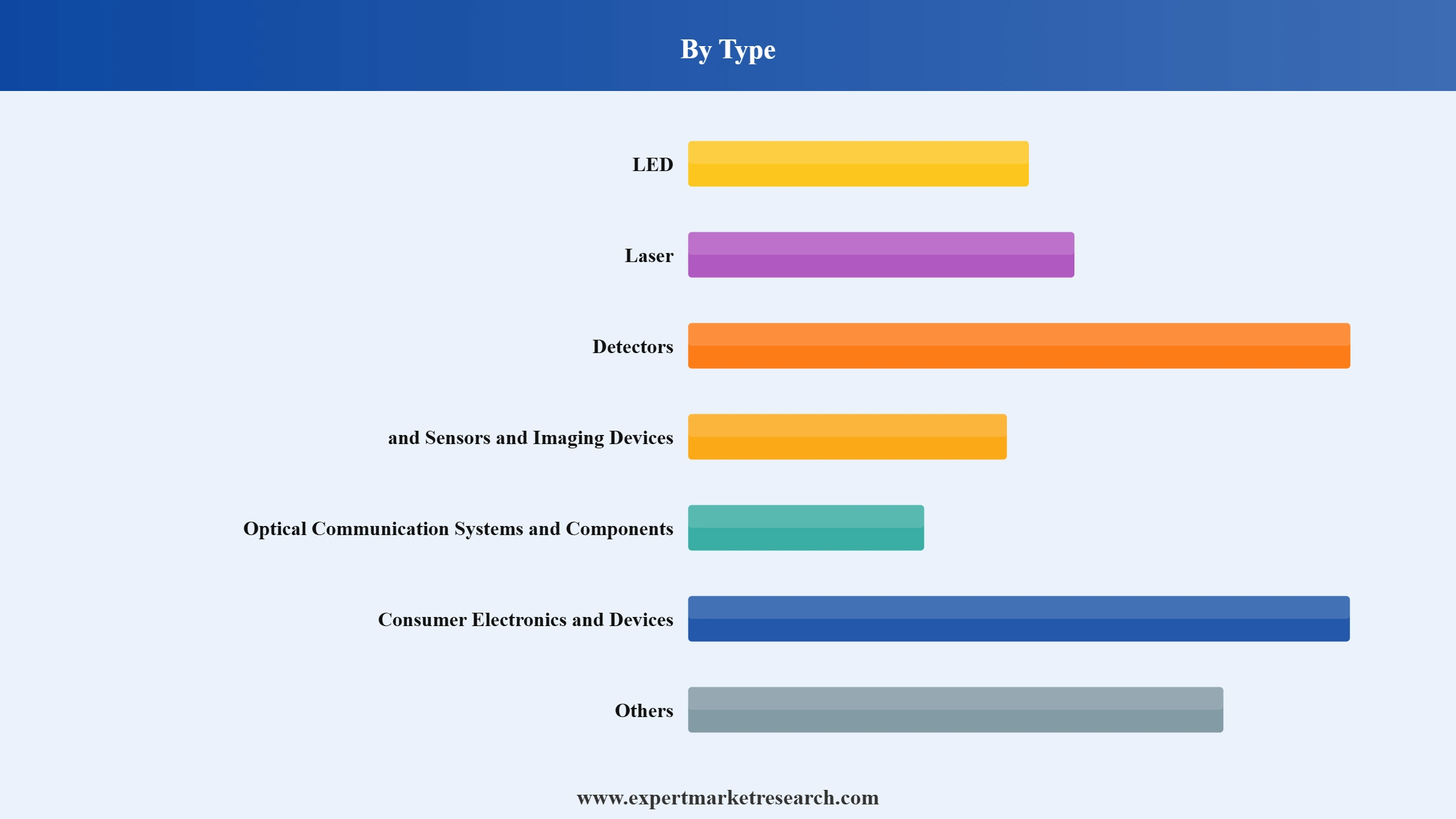
LEDs account for a major photonics market share owing to their growing adoption across the lighting sector
LEDs hold the highest share in the market due to their widespread application in lighting, displays, automotive, and consumer electronics. Their energy efficiency, long lifespan, and decreasing cost have driven their adoption across various sectors, making them a dominant technology in general lighting, automotive lighting, and backlighting for TVs, smartphones, and other devices.
Read more about this report - REQUEST FREE SAMPLE COPY IN PDF
The optical communication systems and components segment is also expected to witness a robust growth in the forecast period due to the critical role of optical communication in modern telecommunications infrastructure. The increasing demand for high-speed internet and data services has propelled the growth of optical communication technologies, including fibre optic cables, transceivers, amplifiers, and switches. These components are essential as the backbone of the internet, data centres, and cloud computing, supporting the massive data flow across global networks.
Data communication applications are expected to maintain their dominance in the photonics market
There is a surge in usage of photonics in data communication to enable high-speed, high-bandwidth communication systems, supporting the photonics market growth. Optical fibre technology, which relies on photonics, is the backbone of the Internet and global telecommunications, supporting the massive increase in data traffic.
Read more about this report - REQUEST FREE SAMPLE COPY IN PDF
Medical technology is another major application that holds a significant share of the photonics market. Photonics plays a crucial role in various medical and healthcare technologies, including diagnostic imaging systems (such as MRI, CT scans, and X-rays), laser surgeries, phototherapy, and endoscopy. The increasing adoption of advanced medical technologies for diagnosis, treatment, and patient care, combined with an ageing global population and rising healthcare standards, drives the demand for photonics in this segment.
The demand for photonics in North America is strong and growing, driven by several key factors and applications across various end-use sectors. The internet and telecommunications heavily rely on optical fibre technologies, which are a cornerstone of photonics. The demand for higher bandwidth and faster data transmission rates in North America has led to increased investments in upgrading and expanding fibre optic networks. The ongoing rollout of 5G technology and the expansion of data centre capacities further fuel this demand. Moreover, the defence and security sector in North America, particularly in the United States, invests heavily in photonics for applications ranging from night vision systems and laser-based communication to surveillance and guidance systems.
Read more about this report - REQUEST FREE SAMPLE COPY IN PDF
The Europe photonics market is robust, driven by a strong emphasis on innovation and sustainable development. The healthcare sector in Europe is a major driver of photonics demand, with applications ranging from medical diagnostics and imaging to therapeutic devices and minimally invasive surgeries. Europe's focus on advanced healthcare solutions and personalised medicine has spurred the development and adoption of photonic technologies in biophotonics, including lab-on-a-chip devices and optical biosensors.
The market players are increasing their research and development activities and are increasingly focusing on cross-industry collaborations to develop strategic partnerships and gain a competitive edge.
Founded in 1884 and headquartered in Mainz, Germany, Schott AG focuses on the development and manufacturing of speciality glass and glass ceramics used across industries such as healthcare, electronics, and optics.
Established in 1917 and based in Tokyo, Japan, Nikon Corporation produces a wide range of optics and imaging products, including cameras, camera lenses, binoculars, and microscopes.
Founded in 1941 and headquartered in Tokyo, Japan, Hoya Corporation specialises in eyeglass lenses, medical endoscopes, intraocular lenses for cataract surgery, and semiconductor-related products.
Founded in 1851 and headquartered in New York, United States, Corning Incorporated develops speciality glass, ceramics, and advanced materials used in telecommunications, consumer electronics, and life sciences.
Other major players in the photonics market include Intel Corporation, Ohara Corporation, and Hamamatsu Photonics K.K., among others. These companies operate in various segments, including optical components, lasers, imaging systems, photovoltaic cells, and fibre optics, among others.
*Please note that this is only a partial list; the complete list of key players is available in the full report. Additionally, the list of key players can be customized to better suit your needs.*


Upto 15% Off
USD
$2499 $2249
$3999 $3599
$4999 $4249
$5999 $5099


*While we strive to always give you current and accurate information, the numbers depicted on the website are indicative and may differ from the actual numbers in the main report. At Expert Market Research, we aim to bring you the latest insights and trends in the market. Using our analyses and forecasts, stakeholders can understand the market dynamics, navigate challenges, and capitalize on opportunities to make data-driven strategic decisions.*
In 2025, the market attained a value of nearly USD 797.27 Billion.
The market is assessed to grow at a CAGR of 7.50% between 2026 and 2035.
The market is estimated to witness a healthy growth in the forecast period of 2026-2035 to reach about USD 1643.20 Billion by 2035.
The major drivers of the market are the rising demand for energy-efficient products and the increasing use of photonic products in diverse applications.
The key trends guiding the growth of the market include the technological progress of light-based technologies, sustainable solutions, and growing applications in healthcare sectors.
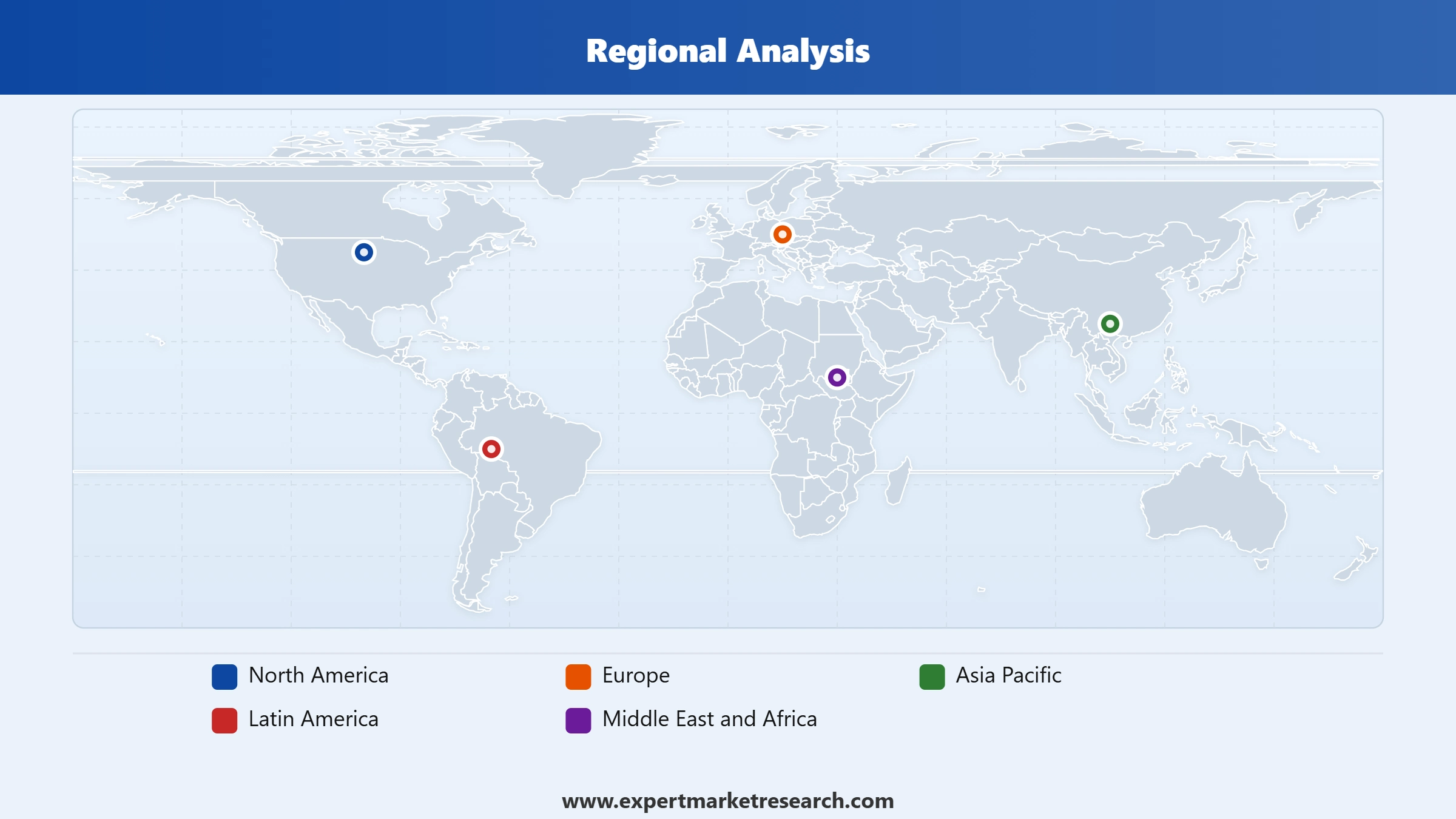
The major regions in the market are North America, Latin America, the Middle East and Africa, Europe, and the Asia Pacific.
LED, lasers, detectors, and sensors and imaging devices, optical communication systems and components, and consumer electronics and devices, among others, are the leading types of photonics in the market.
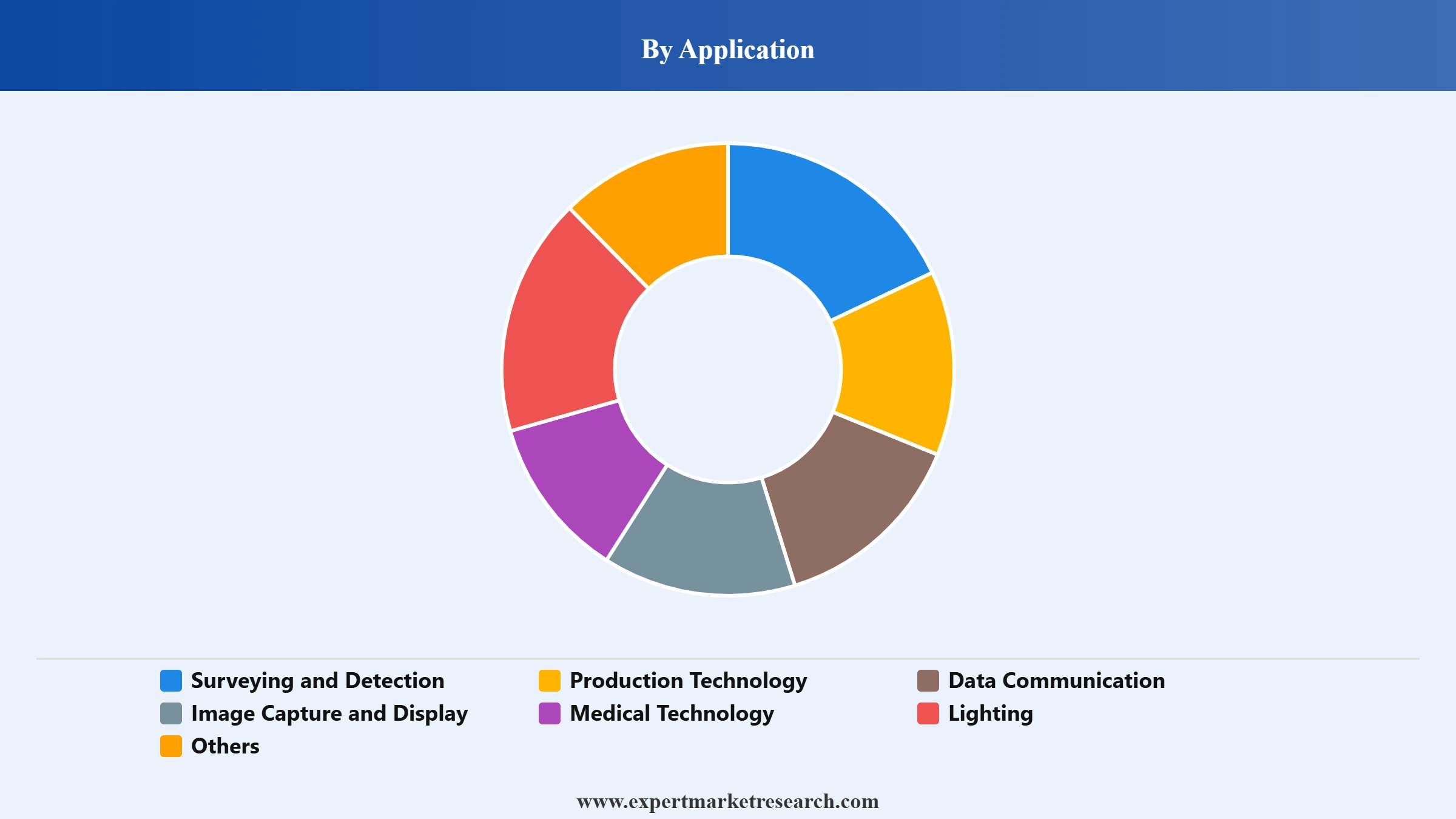
Surveying and detection, production technology, data communication, image capture and display, medical technology, and lighting, among others, are the significant applications of photonics.
Building and construction, media, broadcasting and telecommunication, consumer and business automation, medical, security and defence, and industrial, among others, are the major end uses of photonics in the market.
The major players in the market are Schott AG, Nikon Corporation, Hoya Corporation, Corning Incorporated, Intel Corporation, Ohara Corporation, and Hamamatsu Photonics K.K., among others.
Explore our key highlights of the report and gain a concise overview of key findings, trends, and actionable insights that will empower your strategic decisions.
| REPORT FEATURES | DETAILS |
| Base Year | 2025 |
| Historical Period | 2019-2025 |
| Forecast Period | 2026-2035 |
| Scope of the Report |
Historical and Forecast Trends, Industry Drivers and Constraints, Historical and Forecast Market Analysis by Segment:
|
| Breakup by Type |
|
| Breakup by Application |
|
| Breakup by End Use |
|
| Breakup by Region |
|
| Market Dynamics |
|
| Competitive Landscape |
|
| Companies Covered |
|
| Report Price and Purchase Option | Explore our purchase options that are best suited to your resources and industry needs. |
| Delivery Format | Delivered as an attached PDF and Excel through email, with an option of receiving an editable PPT, according to the purchase option. |
Datasheet
One User
USD 2,499
USD 2,249
tax inclusive*
Single User License
One User
USD 3,999
USD 3,599
tax inclusive*
Five User License
Five User
USD 4,999
USD 4,249
tax inclusive*
Corporate License
Unlimited Users
USD 5,999
USD 5,099
tax inclusive*
*Please note that the prices mentioned below are starting prices for each bundle type. Kindly contact our team for further details.*
Flash Bundle
Small Business Bundle
Growth Bundle
Enterprise Bundle
*Please note that the prices mentioned below are starting prices for each bundle type. Kindly contact our team for further details.*
Flash Bundle
Number of Reports: 3
20%
tax inclusive*
Small Business Bundle
Number of Reports: 5
25%
tax inclusive*
Growth Bundle
Number of Reports: 8
30%
tax inclusive*
Enterprise Bundle
Number of Reports: 10
35%
tax inclusive*
How To Order

Select License Type
Choose the right license for your needs and access rights.

Click on ‘Buy Now’
Add the report to your cart with one click and proceed to register.

Select Mode of Payment
Choose a payment option for a secure checkout. You will be redirected accordingly.
Strategic Solutions for Informed Decision-Making
Gain insights to stay ahead and seize opportunities.

Get insights & trends for a competitive edge.

Track prices with detailed trend reports.

Analyse trade data for supply chain insights.

Leverage cost reports for smart savings

Enhance supply chain with partnerships.

Connect For More Information
Our expert team of analysts will offer full support and resolve any queries regarding the report, before and after the purchase.
Our expert team of analysts will offer full support and resolve any queries regarding the report, before and after the purchase.
We employ meticulous research methods, blending advanced analytics and expert insights to deliver accurate, actionable industry intelligence, staying ahead of competitors.
Our skilled analysts offer unparalleled competitive advantage with detailed insights on current and emerging markets, ensuring your strategic edge.
We offer an in-depth yet simplified presentation of industry insights and analysis to meet your specific requirements effectively.




