

Consumer Insights
Uncover trends and behaviors shaping consumer choices today
Procurement Insights
Optimize your sourcing strategy with key market data
Industry Stats
Stay ahead with the latest trends and market analysis.
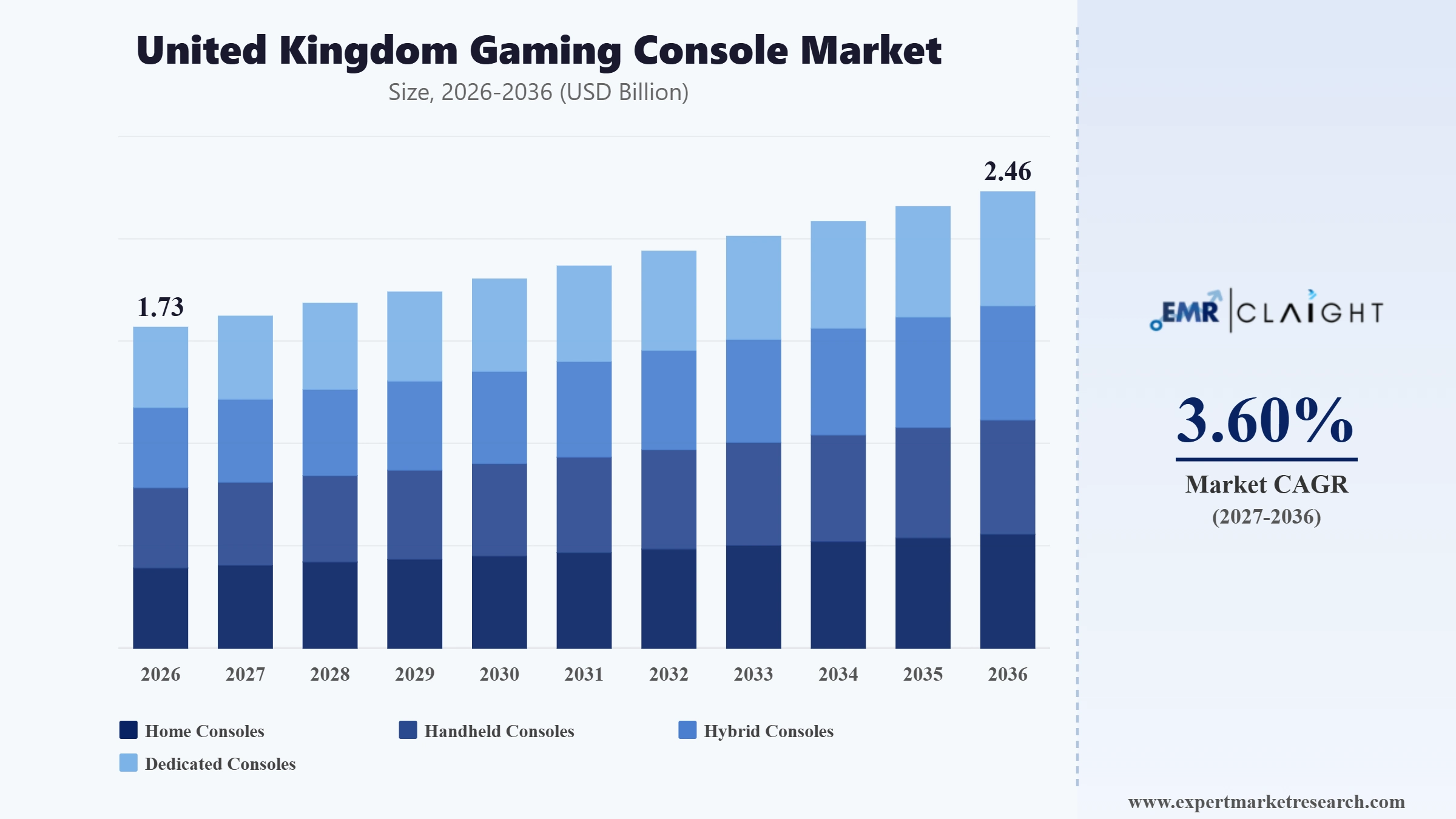
The United Kingdom gaming console market attained a value of USD 1.67 Billion in 2025and is projected to expand at a CAGR of 3.60% through 2035. The market is further expected to achieve USD 2.38 Billion by 2035. Hardware is increasingly becoming an ecosystem gateway rather than a standalone device. UK console hardware spending reached £811 million in 2025, while digital console game spending rose 9.2% to £2.49 billion, creating greater commercial value around subscriptions, downloadable content, accessories, services, and recurring player engagement.
Expansion of the digital ecosystem and subscription-based consumer engagement are changing UK gaming console demand to be more than just console ownership. In 2025, digital console games expenditure in the UK was £2.49 billion, which is a growth rate of 9.2% compared to the previous year, while in 2024, according to Ofcom, 36% of the gamers in the UK subscribed to some kind of gaming service. Gaming console makers are now generating revenues from their installed customer base through digital stores, DLCs, online gaming, cloud gaming, and subscription libraries. This model creates recurring revenue opportunities while encouraging consumers to remain within established platform ecosystems. The integration of consoles with handheld devices, PCs, and connected accessories is also widening usage scenarios, making gaming platforms less dependent on traditional living-room play. As digital services become more deeply integrated with hardware, manufacturers can increase engagement between major hardware upgrade cycles and create additional opportunities across games, peripherals, subscriptions, and online services, thereby boosting the United Kingdom gaming console market value.
Innovations in the UK gaming console industry have evolved from the creation of fast processing chips to convergence, adaptability, and portability of ecosystems. The ROG Xbox Ally family of products by Microsoft and ASUS is an example where the Xbox gaming ecosystem is available on handheld devices running on Windows OS, whereas innovations by Microsoft in 2026 have provided additional functionality in portable gaming environments. Similarly, the Switch 2 product of Nintendo incorporates handheld and TV gameplay and provides additional GameChat and accessibility features. Moreover, Sony's ecosystem has been expanded through the use of products like PlayStation Portal that integrate console gaming with remote-play functionality. Meanwhile, advanced peripherals featuring TMR sensing, high polling rates, modular components, and customisable controls are creating more responsive gaming setups. These developments are encouraging manufacturers to treat the console as part of a connected hardware ecosystem spanning home entertainment, portable gaming, digital services, and performance-oriented accessories, rather than as a standalone device.
High costs associated with hardware constitute one of the important barriers in the UK market for video game consoles, especially taking into account that companies will have to revise their pricing policies due to increased costs associated with the manufacture of hardware and accessories. It can be assumed that high costs of premium consoles and their accessories will contribute to the reluctance of people to make upgrades or keep using current consoles longer than necessary. There is also competition from PCs, mobile phones, tablets, and other portable gaming systems. Furthermore, reliance on digital platforms can bring additional costs associated with ongoing subscriptions. Rapid hardware and software evolution may also create uncertainty around upgrade timing, particularly when consumers expect newer processors, displays, storage capacities, and connectivity features. These factors can lengthen replacement cycles and make affordability, backward compatibility, and long-term platform support increasingly important considerations for UK consumers, thereby boosting the United Kingdom gaming console market developments.
Read more about this report - REQUEST FREE SAMPLE COPY IN PDF
Nintendo released further Switch 2 system updates during 2026, adding functionality related to GameChat, accessibility, virtual game cards, and overall system stability. A June update introduced Dutch and Russian text-to-speech and additional GameChat language support. These updates demonstrate Nintendo's continued focus on improving the user experience after the console's launch. For the UK gaming console market, ongoing platform enhancements can support longer-term user engagement while encouraging demand for compatible games, accessories, and digital services across the Switch 2 ecosystem.
Microsoft and ASUS introduced updates for the ROG Xbox Ally and ROG Xbox Ally X, including improved docking capabilities, broader game-library access, enhanced vibration functionality, and an Auto SR preview. The devices were launched with ASUS and AMD across 45 countries, strengthening the connection between Xbox services and portable gaming hardware. The development is relevant to the UK market as consumers gain additional ways to access Xbox gaming beyond traditional consoles, supporting growth across handheld hardware, controllers, displays, accessories, and related gaming services, thus shaping the trends of the United Kingdom gaming consoles market.
Logitech G introduced the G512 X TMR Analog/Mechanical Gaming Keyboard featuring Dual Swap technology, TMR sensors, True 8K technology, and customisable key functionality. Although designed as a gaming peripheral rather than a console, the product reflects increasing demand for high-performance and personalised gaming equipment. In the UK gaming console ecosystem, advanced peripherals can complement dedicated gaming setups and create additional opportunities for accessory purchases. Modular designs also support upgrades and replacement demand as consumers seek greater control, responsiveness, and customisation from their gaming hardware.
Sony Interactive Entertainment announced revised recommended retail prices for the PS5, PS5 Digital Edition, PS5 Pro, and PlayStation Portal, effective April 2, 2026. UK prices were set at £569.99 for PS5, £519.99 for PS5 Digital Edition, £789.99 for PS5 Pro, and £219.99 for PlayStation Portal. The adjustment reflects broader cost pressures affecting the global gaming hardware environment. For the UK market, changes across Sony's hardware portfolio can influence consumer movement between standard, digital, and premium configurations while shaping retailer promotions and purchasing decisions.
The commercial opportunity for console manufacturers is increasingly linked to software and digital services rather than one-time hardware transactions. Ukie recorded £2.49 billion in UK digital console game spending in 2025, up 9.2% year over year. At the same time, total UK game software spending reached £6.03 billion. This environment encourages platform owners to improve digital storefronts, subscription propositions, account-based services, and downloadable content. For hardware suppliers, the implication is a shift toward lifecycle-oriented product economics, where installed-base retention, software attachment, digital transactions, and accessories become important alongside unit sales. Businesses entering the UK market can therefore create greater value through integrated hardware-plus-service propositions rather than competing only on console specifications or initial retail pricing.
The boundary between console and portable gaming is becoming increasingly important for hardware planning. Nintendo's Switch 2 introduced a new generation of hybrid hardware in 2025, while Microsoft's Xbox ecosystem has expanded onto dedicated Windows-based handheld hardware through its partnership with ASUS. In April 2026, Xbox reported that ROG Xbox Ally devices had been launched in 45 countries, with updates focused on improving the docked experience and making handheld devices operate more like traditional Xbox consoles. This convergence creates opportunities for component manufacturers, display suppliers, battery-system providers, storage companies, peripheral brands, and retailers. It also expands the addressable use case from fixed living-room gaming toward portable and hybrid consumption.
The UK console ecosystem continues to benefit from a strong pipeline of major releases and platform-specific content. PlayStation's 2026 schedule includes titles such as Marvel's Wolverine, Control Resonant, Onimusha: Way of the Sword, and Silent Hill: Townfall. PlayStation also expanded its September 2026 PlayStation Plus catalogue with several new titles available to UK subscribers. Such release schedules create commercial opportunities for hardware bundles, accessories, retailer promotions, subscriptions, and premium console editions. For B2B suppliers, content calendars are increasingly relevant to inventory planning because high-profile releases can influence short-term hardware demand, accessory attachment, digital activity, and promotional intensity across retail channels.
The UK's broader retail infrastructure is becoming increasingly favorable to online console distribution. ONS data show that online sales represented 28.4% of total retail sales in August 2026, compared with 27.5% for full-year 2025. Online sales values were also 8.9% higher in August 2026 than a year earlier. Although these figures cover total retail rather than gaming specifically, they demonstrate the scale of the digital purchasing infrastructure available to console vendors and distributors. The trend supports direct-to-consumer launches, online-exclusive bundles, rapid price promotions, marketplace fulfillment, pre-orders, and geographically targeted campaigns. Console suppliers can therefore use online channels to shorten product discovery-to-purchase cycles and improve inventory visibility.
Gaming platform operators are operating within a more formal UK online-safety environment. Ofcom's guidance published in October 2025 explains how the Online Safety Act applies to certain online gaming services, particularly services where users interact, communicate, or create and share content. This increases the importance of safety-by-design, age assurance, reporting systems, moderation capabilities, and risk-management infrastructure. For console manufacturers and platform operators, compliance is increasingly connected with product architecture and service design rather than being treated solely as a legal function. Suppliers of identity, parental-control, moderation, security, cloud, and account-management technologies can consequently find additional B2B opportunities around connected console ecosystems.
The Expert Market Research’s report titled "United Kingdom Gaming Console Market Report and Forecast 2026-2035” offers a detailed analysis of the market based on the following segments:
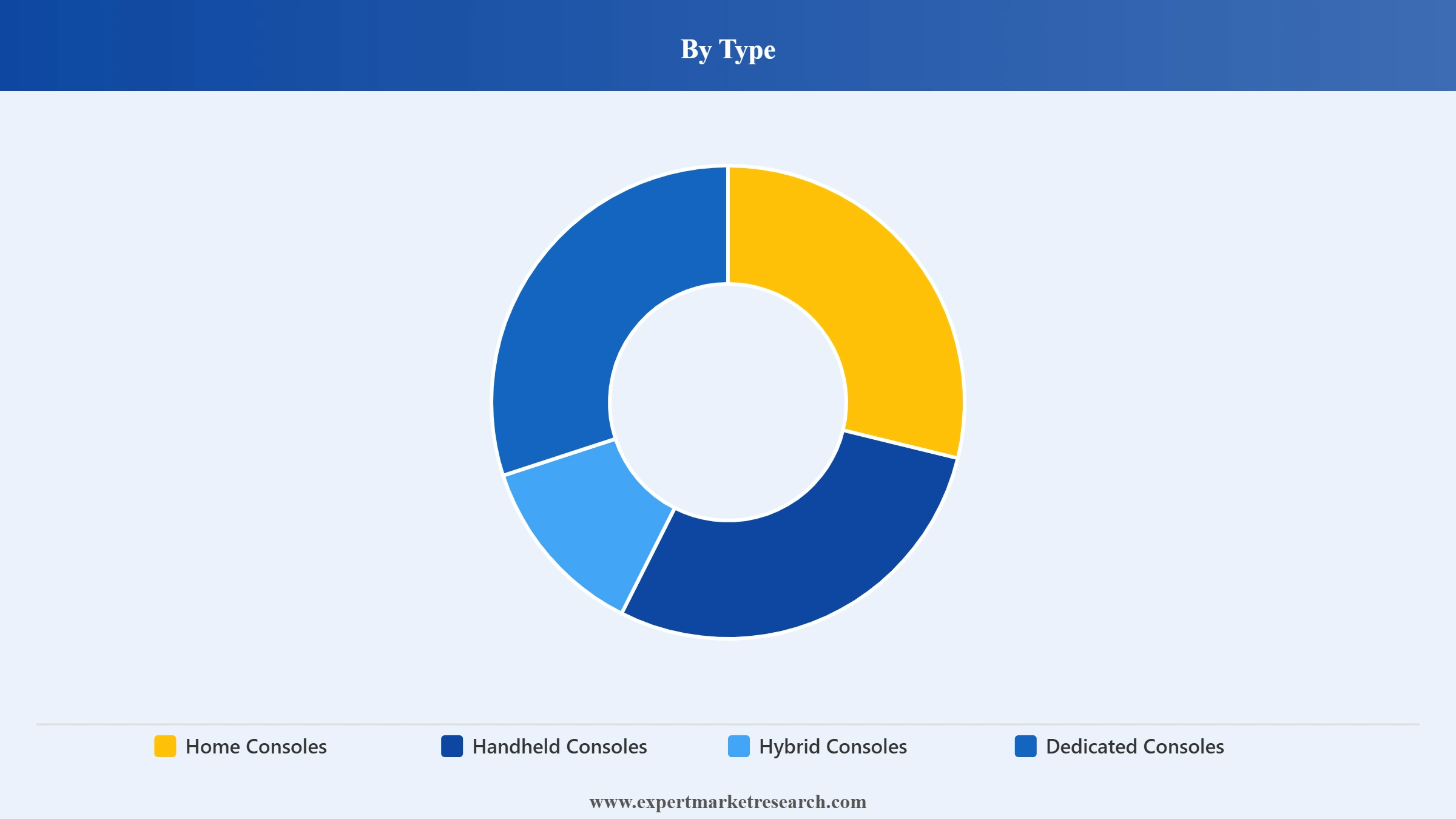
Market Breakup by Type
Key Insight: The United Kingdom market encompasses fixed home consoles, handheld devices, hybrid systems, dedicated consoles, and other specialized formats, creating multiple hardware propositions for manufacturers and retailers. Home consoles remain closely connected with large-screen entertainment and premium graphics, while handheld and hybrid systems broaden usage beyond the living room. Nintendo's Switch 2 is particularly relevant because Nintendo describes the system as a home video game platform following the hybrid model established by the original Switch. Meanwhile, Xbox's ROG Xbox Ally strategy shows how portable Windows hardware can increasingly connect with established console ecosystems. Suppliers can therefore target different performance, mobility, battery, display, storage, and accessory requirements across the type landscape.
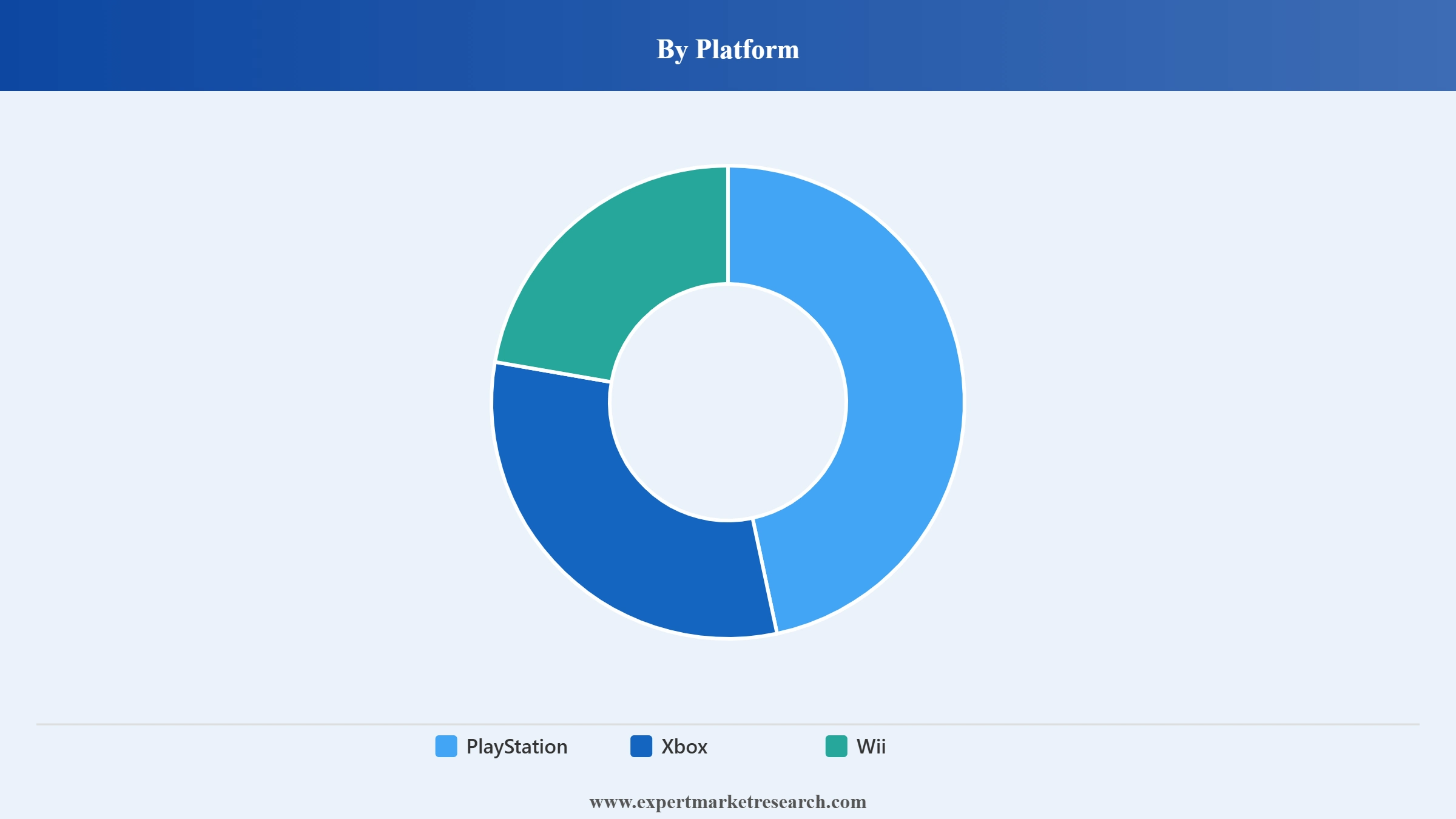
Market Breakup by Platform
Key Insight: The platform landscape remains centered on PlayStation and Xbox, while Nintendo's ecosystem provides a distinct hybrid-oriented proposition. Ofcom's 2024 data found that 38% of UK adults lived in a household with at least one games console, while 22% personally used a console. Among households with consoles, 30% had a PlayStation 5 and 29% had an Xbox Series X or S, showing the closely matched installed-base presence of the two major traditional platforms. Nintendo adds differentiation through its proprietary hardware and software ecosystem. For suppliers, platform-specific certification, accessory compatibility, software partnerships, retail placement, and promotional calendars remain central to commercial strategy.
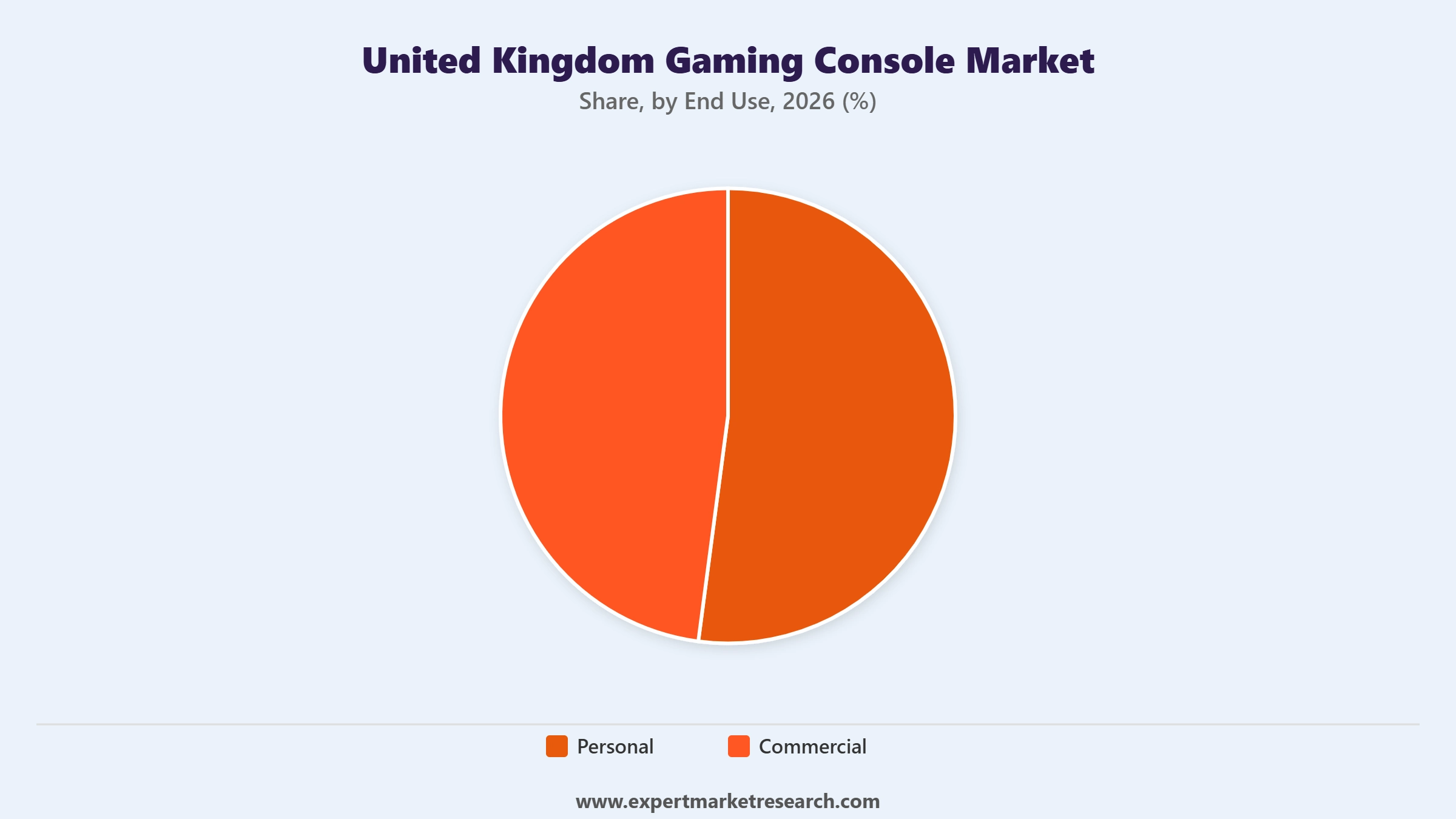
Market Breakup by End Use
Key Insight: Personal use constitutes the core addressable application because consoles are primarily purchased for household entertainment, multiplayer gaming, digital content, and subscription-based services. Commercial demand adds another layer through entertainment venues, hospitality, esports facilities, gaming centers, educational environments, and promotional installations. The distinction is increasingly important for suppliers because commercial customers can require higher durability, extended operating cycles, centralized management, and multi-device procurement. Ofcom's finding that 38% of UK adults lived in a household with a console provides evidence of substantial household penetration, while the UK's expanding games-event and esports ecosystem creates opportunities outside residential consumption. Product specifications and channel strategies should therefore differ between consumer and institutional buyers.
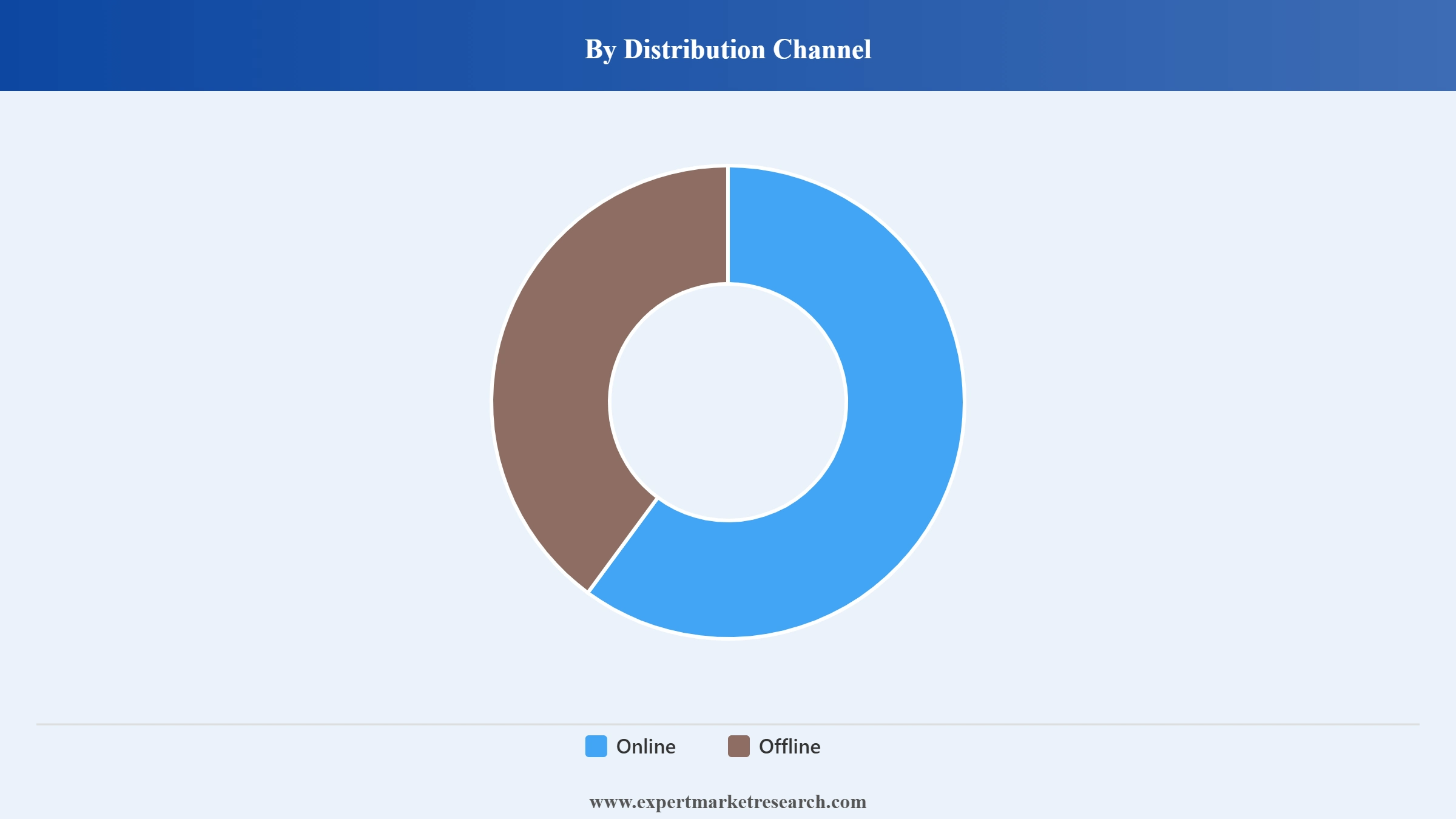
Market Breakup by Distribution Channel
Key Insight: Online and offline channels increasingly operate as complementary routes to market. Physical retailers remain important for product demonstration, immediate availability, trade-in programs, financing, and promotional bundles, while online platforms provide broader assortment, price comparison, pre-ordering, direct fulfillment, and rapid promotional adjustments. ONS data show that online sales accounted for 28.8% of total UK retail sales in August 2026, while the full-year 2025 proportion was 27.5%. This wider retail shift supports online console distribution, although specialist electronics stores and gaming retailers continue to provide important physical touchpoints. Suppliers can improve channel productivity through synchronized inventory, unified pricing policies, click-and-collect options, and launch-specific digital campaigns.
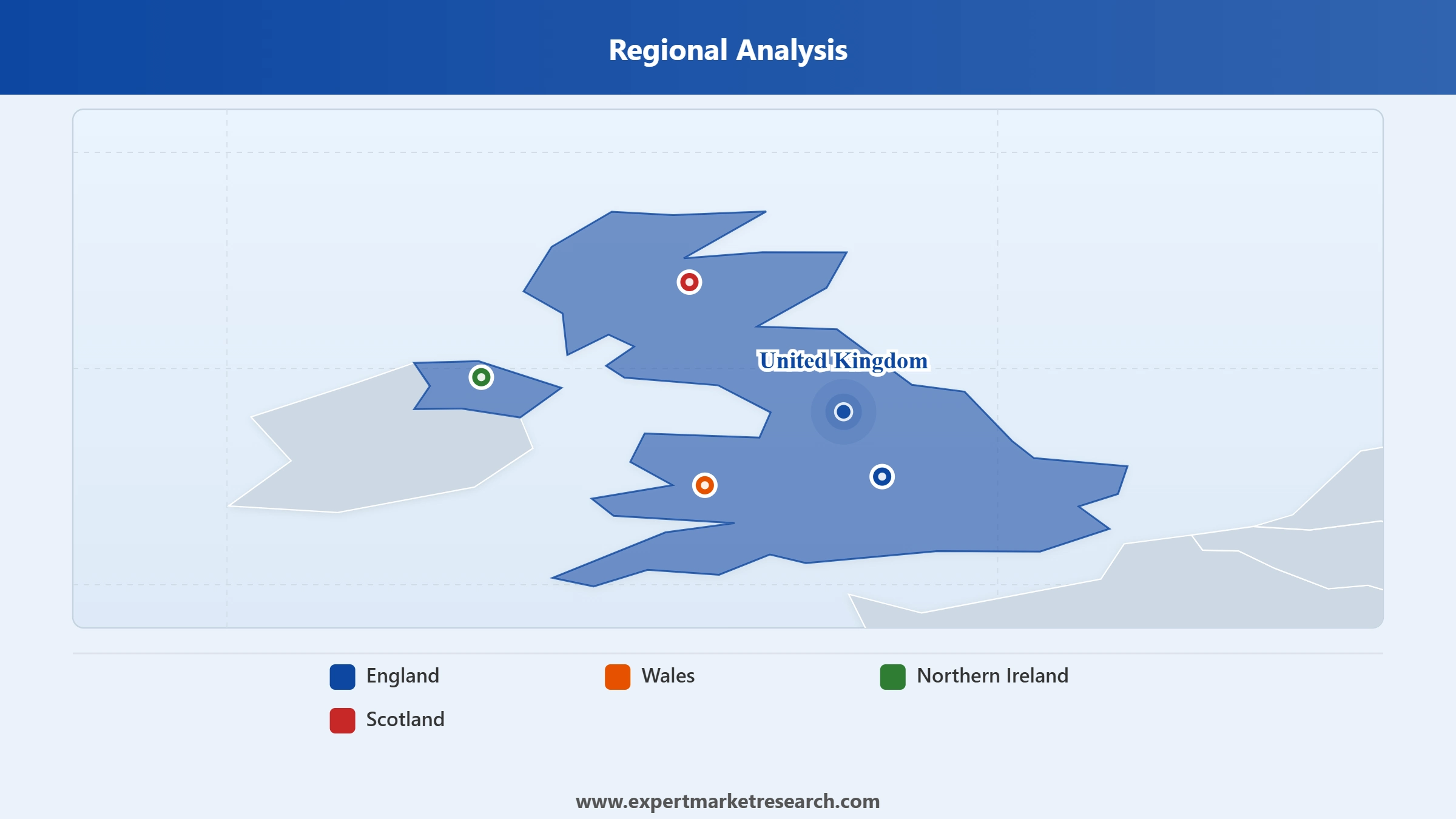
Market Breakup by Region
Key Insight: England represents the largest commercial base because of its population, concentration of retailers, creative clusters, and major gaming hubs, while Scotland and Wales are developing distinctive games-industry ecosystems. London alone generated £4.3 million in GVA and £3.1 million in additional revenue from the London Games Festival, according to the Mayor's annual report. Scotland reported 130 gaming companies and £340 million in annual industry turnover in 2025. Wales, meanwhile, has invested more than £5.7 million in more than 100 games businesses since 2020. These ecosystems can support local content, events, talent, and B2B partnerships that indirectly strengthen console-related commercial activity, thus driving the demand in the United Kingdom gaming console market.
Read more about this report - REQUEST FREE SAMPLE COPY IN PDF
Home consoles remain an important hardware category because they are closely integrated with living-room entertainment systems and support demanding titles requiring high processing and graphics capabilities. Their appeal is reinforced by established game libraries, multiplayer functionality, premium controllers, and compatibility with accessories such as gaming headsets and charging stations. Manufacturers also continue extending the lifecycle of fixed consoles through revised models, enhanced storage, performance upgrades, and subscription-linked services, allowing consumers to access broader content ecosystems without changing platforms frequently. Such developments will thus boost United Kingdom gaming console market trends in the long run.
Read more about this report - REQUEST FREE SAMPLE COPY IN PDF
Hybrid consoles are attracting consumers by combining the performance and television connectivity of traditional systems with the flexibility of portable gaming. Nintendo's Switch 2 has strengthened this format by supporting higher-resolution output, improved processing performance, and enhanced functionality across handheld and docked modes. Its success is also supported by Nintendo's first-party franchises, which encourage hardware adoption alongside software purchases. The format particularly appeals to households seeking one gaming device that can transition between shared-screen entertainment and individual portable use.
PlayStation continues to benefit from a mature ecosystem encompassing hardware, first-party studios, third-party publishing relationships, digital storefronts, and online services. Sony's strategy increasingly connects console ownership with complementary products and services, including PlayStation Plus, DualSense controllers, premium audio equipment, and remote-play functionality. Strong recognition of franchises such as Marvel's Spider-Man, God of War, and Gran Turismo also supports software engagement around the platform. The availability of multiple PS5 configurations enables Sony to address different consumer preferences while maintaining a unified software ecosystem.
Read more about this report - REQUEST FREE SAMPLE COPY IN PDF
The others segment is developing as gaming increasingly extends beyond conventional console architectures. Windows-based handhelds, including devices supported by Xbox software and PC game libraries, are creating new opportunities for portable gaming without requiring consumers to remain within a traditional console environment. Steam Deck has similarly demonstrated demand for PC-oriented handheld hardware. Manufacturers are increasingly improving display quality, battery efficiency, controls, operating-system integration, and access to digital storefronts, creating greater overlap between conventional consoles, handheld computers, and portable gaming PCs.
Personal use remains central to console demand because gaming systems are primarily purchased for household entertainment, individual play, and multiplayer experiences among friends and family. Consumer preferences are increasingly shaped by access to digital libraries, online multiplayer, downloadable content, streaming capabilities, and personalised account ecosystems. Console manufacturers therefore seek to extend engagement beyond the initial hardware purchase through subscriptions, digital storefronts, accessories, and recurring content. This ecosystem-based approach encourages users to remain active on their chosen platform across successive gaming releases, thus bolstering the United Kingdom gaming console market growth.
Read more about this report - REQUEST FREE SAMPLE COPY IN PDF
Commercial demand is expanding through esports venues, gaming cafés, entertainment centres, hospitality locations, educational environments, and organised gaming events. Such applications can require multiple consoles, additional controllers, displays, networking equipment, and professional-grade accessories, creating procurement opportunities beyond individual household purchases. Esports infrastructure is particularly relevant as venues seek reliable systems capable of supporting tournaments and spectator experiences. Gaming-focused entertainment facilities are also broadening their offerings by combining console gaming with food, social activities, virtual experiences, and competitive events to attract recurring visitors.
Offline distribution remains significant for gaming consoles because consumers can physically compare different hardware configurations, controllers, storage options, and bundled packages before purchase. Specialist retailers also support product discovery through demonstrations, staff recommendations, trade-in programmes, financing arrangements, and launch-day promotions. Physical stores can be particularly influential during major hardware releases when consumers seek immediate availability and want to evaluate competing platforms. Retailers also benefit from cross-selling games, accessories, warranties, and gaming furniture, increasing the commercial value of each console transaction.
Read more about this report - REQUEST FREE SAMPLE COPY IN PDF
Online distribution is gaining importance as consumers increasingly research specifications, compare prices, monitor stock availability, and pre-order consoles through e-commerce platforms. Digital retailers can respond rapidly to promotional campaigns and major gaming launches while offering broader product selections than individual physical stores. Online channels also facilitate direct-to-consumer sales and manufacturer-operated storefronts, giving brands greater control over product presentation and customer engagement. The growth of digital purchasing is further supported by integrated delivery services, online payment options, price-tracking tools, and retailer loyalty programmes.
England remains the principal commercial market for gaming consoles because of its large consumer population, extensive retail infrastructure, concentration of game publishers, and established creative clusters. London is particularly significant for industry activity. The Mayor's 2024-25 annual report stated that Games London-supported London Games Festival activity generated £4.3 million in GVA and £3.1 million in additional revenue, while a 2026 City Hall update noted that games businesses in the capital had doubled over the preceding decade. These conditions create opportunities for console manufacturers, retailers, game publishers, event operators, peripheral suppliers, and technology providers, thereby directly boosting the United Kingdom gaming console market regional growth.
Read more about this report - REQUEST FREE SAMPLE COPY IN PDF
Scotland and Wales offer increasingly differentiated growth ecosystems, while Northern Ireland remains a smaller but developing market within the UK-wide framework. Scotland reported 130 gaming companies and £340 million in annual industry turnover in 2025, with the Scottish Government also highlighting games-focused accelerator activity. Wales has pursued a particularly active export and scale-up strategy, investing over £5.7 million in more than 100 games businesses and sending Welsh companies to GDC and Tokyo Game Show in 2026. For console-related B2B companies, these regional ecosystems matter because they can generate localized content, talent, events, development partnerships, and international investment connections that reinforce hardware and software demand.
Leading United Kingdom gaming console market players are aiming to strengthen their ecosystems by combining hardware, software, subscriptions, and digital services. Sony Interactive Entertainment continues to develop the PlayStation ecosystem through new hardware capabilities, exclusive titles, accessories, and PlayStation Plus services. Microsoft is focusing on expanding Xbox across consoles, PCs, cloud gaming, and subscription-based services, while increasing access to its game catalogue across devices. Nintendo is seeking to sustain demand through distinctive hardware experiences, first-party franchises, and family-oriented gaming content.
United Kingdom gaming console companies are also aiming to increase recurring revenue and user engagement by expanding digital distribution, online multiplayer services, game subscriptions, and downloadable content. They are investing in stronger developer relationships, immersive gaming technologies, accessories, and cross-platform experiences to retain users within their respective ecosystems. Competition is therefore increasingly centred on the broader gaming ecosystem rather than console hardware alone, with companies seeking to improve customer retention, broaden their addressable user base, and create multiple revenue streams from games, services, accessories, and digital content.
Founded in 1946 and headquartered in Tokyo, Japan, Sony operates across entertainment, technology, imaging, and games. Its gaming business is anchored by PlayStation, including PS5 hardware, DualSense controllers, PlayStation Plus subscriptions, PlayStation Portal, accessories, and first- and third-party software. Sony's 2026 strategy combines hardware refinement, premium products, software releases, subscription content, and ecosystem services. Its UK presence is reinforced by an established PlayStation installed base and extensive retailer and publisher relationships.
Founded in 1975 and headquartered in Redmond, Washington, Microsoft operates Xbox as part of its broader gaming business. Its market offering includes Xbox Series X|S, Xbox Game Pass, Xbox Cloud Gaming, PC gaming, first-party studios, accessories, and increasingly handheld-compatible experiences. The company's 2026 strategy emphasizes cross-device access, including ROG Xbox Ally hardware, Play Anywhere, backward compatibility, and subscription content. This broadens Xbox's commercial ecosystem beyond conventional console hardware.
Founded in September 1889 and headquartered in Kyoto, Japan, Nintendo develops and sells home entertainment products built around proprietary hardware and software. Its gaming portfolio includes Nintendo Switch 2, Nintendo Switch Online, controllers, first-party franchises, and digital and physical games. Switch 2 extends Nintendo's hybrid-console strategy while its proprietary intellectual property provides differentiation from Sony and Microsoft. Continued system updates and software support are important to maintaining engagement with the installed hardware base.
Founded in 1981 and headquartered in Lausanne, Switzerland, Logitech develops software-enabled hardware for gaming, computing, streaming, and creation. Through Logitech G, its portfolio includes gaming mice, keyboards, headsets, controllers, steering wheels, simulation products, and related accessories. Its 2026 G3 and G5 product families emphasize personalization, high polling rates, modularity, and performance technologies. Logitech also uses gaming partnerships and developer relationships to expand its presence across competitive and enthusiast gaming segments.
Other key players in the United Kingdom gaming console market include Atari Inc., Meta Platforms Technologies, Inc., Samsung Electronics Co. Ltd., Valve Corporation, HTC Corporation, and ASUSTEK Computer Inc., among others.
*Please note that this is only a partial list; the complete list of key players is available in the full report. Additionally, the list of key players can be customized to better suit your needs.*
Access the sample report to understand the United Kingdom Gaming Console Market trends 2026, competitive dynamics, segment opportunities, and regional developments shaping the industry. The report provides structured insights for manufacturers, game publishers, retailers, distributors, investors, and technology suppliers seeking to evaluate the United Kingdom Gaming Console Market forecast 2026-2035 and identify commercially relevant opportunities across hardware, platforms, channels, and end-use applications.


Upto 15% Off
USD
$2499 $2249
$3999 $3599
$4999 $4249
$5999 $5099


*While we strive to always give you current and accurate information, the numbers depicted on the website are indicative and may differ from the actual numbers in the main report. At Expert Market Research, we aim to bring you the latest insights and trends in the market. Using our analyses and forecasts, stakeholders can understand the market dynamics, navigate challenges, and capitalize on opportunities to make data-driven strategic decisions.*
In 2025, the market reached an approximate value of USD 1.67 Billion.
The market is projected to grow at a CAGR of 3.60% between 2026 and 2035.
The market is estimated to witness a healthy growth during 2026-2035 to reach around USD 2.38 Billion by 2035.
Key strategies include expanding digital game libraries, developing subscription services, introducing advanced hardware and accessories, strengthening exclusive game portfolios, adopting cloud gaming capabilities, improving online services, partnering with retailers and developers, offering flexible pricing, and targeting diverse consumer segments through personalised gaming experiences.
The key trends aiding the market include the launch of next-gen gaming consoles, effective marketing strategies, and technological advancements.
Regions considered in the market are England, Wales, Northern Ireland, and Scotland.
Based on platform, market segmentations include PlayStation, Xbox, and Wii, among others.
Various end uses are personal and commercial.
Key players in the market are Sony Corporation, Microsoft Corporation, Nintendo Co., Ltd., Logitech International SA, Atari Inc., Meta Platforms Technologies, Inc., Samsung Electronics Co. Ltd., Valve Corporation, HTC Corporation, and ASUSTEK Computer Inc., among others.
Key challenges include high console and game prices, intense competition among leading brands, supply chain disruptions, limited hardware differentiation, increasing digital gaming subscriptions, consumer preference for mobile and PC gaming, energy costs, and rapid technological changes requiring frequent product innovation and upgrades.
Explore our key highlights of the report and gain a concise overview of key findings, trends, and actionable insights that will empower your strategic decisions.
| REPORT FEATURES | DETAILS |
| Base Year | 2025 |
| Historical Period | 2019-2025 |
| Forecast Period | 2026-2035 |
| Scope of the Report |
Historical and Forecast Trends, Industry Drivers and Constraints, Historical and Forecast Market Analysis by Segment:
|
| Breakup by Type |
|
| Breakup by Platform |
|
| Breakup by End Use |
|
| Breakup by Distribution Channel |
|
| Breakup by Region |
|
| Market Dynamics |
|
| Competitive Landscape |
|
| Companies Covered |
|
Datasheet
One User
USD 2,499
USD 2,249
tax inclusive*
Single User License
One User
USD 3,999
USD 3,599
tax inclusive*
Five User License
Five User
USD 4,999
USD 4,249
tax inclusive*
Corporate License
Unlimited Users
USD 5,999
USD 5,099
tax inclusive*
*Please note that the prices mentioned below are starting prices for each bundle type. Kindly contact our team for further details.*
Flash Bundle
Small Business Bundle
Growth Bundle
Enterprise Bundle
*Please note that the prices mentioned below are starting prices for each bundle type. Kindly contact our team for further details.*
Flash Bundle
Number of Reports: 3
20%
tax inclusive*
Small Business Bundle
Number of Reports: 5
25%
tax inclusive*
Growth Bundle
Number of Reports: 8
30%
tax inclusive*
Enterprise Bundle
Number of Reports: 10
35%
tax inclusive*
How To Order

Select License Type
Choose the right license for your needs and access rights.

Click on ‘Buy Now’
Add the report to your cart with one click and proceed to register.

Select Mode of Payment
Choose a payment option for a secure checkout. You will be redirected accordingly.
Strategic Solutions for Informed Decision-Making
Gain insights to stay ahead and seize opportunities.

Get insights & trends for a competitive edge.

Track prices with detailed trend reports.

Analyse trade data for supply chain insights.

Leverage cost reports for smart savings

Enhance supply chain with partnerships.

Connect For More Information
Our expert team of analysts will offer full support and resolve any queries regarding the report, before and after the purchase.
Our expert team of analysts will offer full support and resolve any queries regarding the report, before and after the purchase.
We employ meticulous research methods, blending advanced analytics and expert insights to deliver accurate, actionable industry intelligence, staying ahead of competitors.
Our skilled analysts offer unparalleled competitive advantage with detailed insights on current and emerging markets, ensuring your strategic edge.
We offer an in-depth yet simplified presentation of industry insights and analysis to meet your specific requirements effectively.




