

Consumer Insights
Uncover trends and behaviors shaping consumer choices today
Procurement Insights
Optimize your sourcing strategy with key market data
Industry Stats
Stay ahead with the latest trends and market analysis.
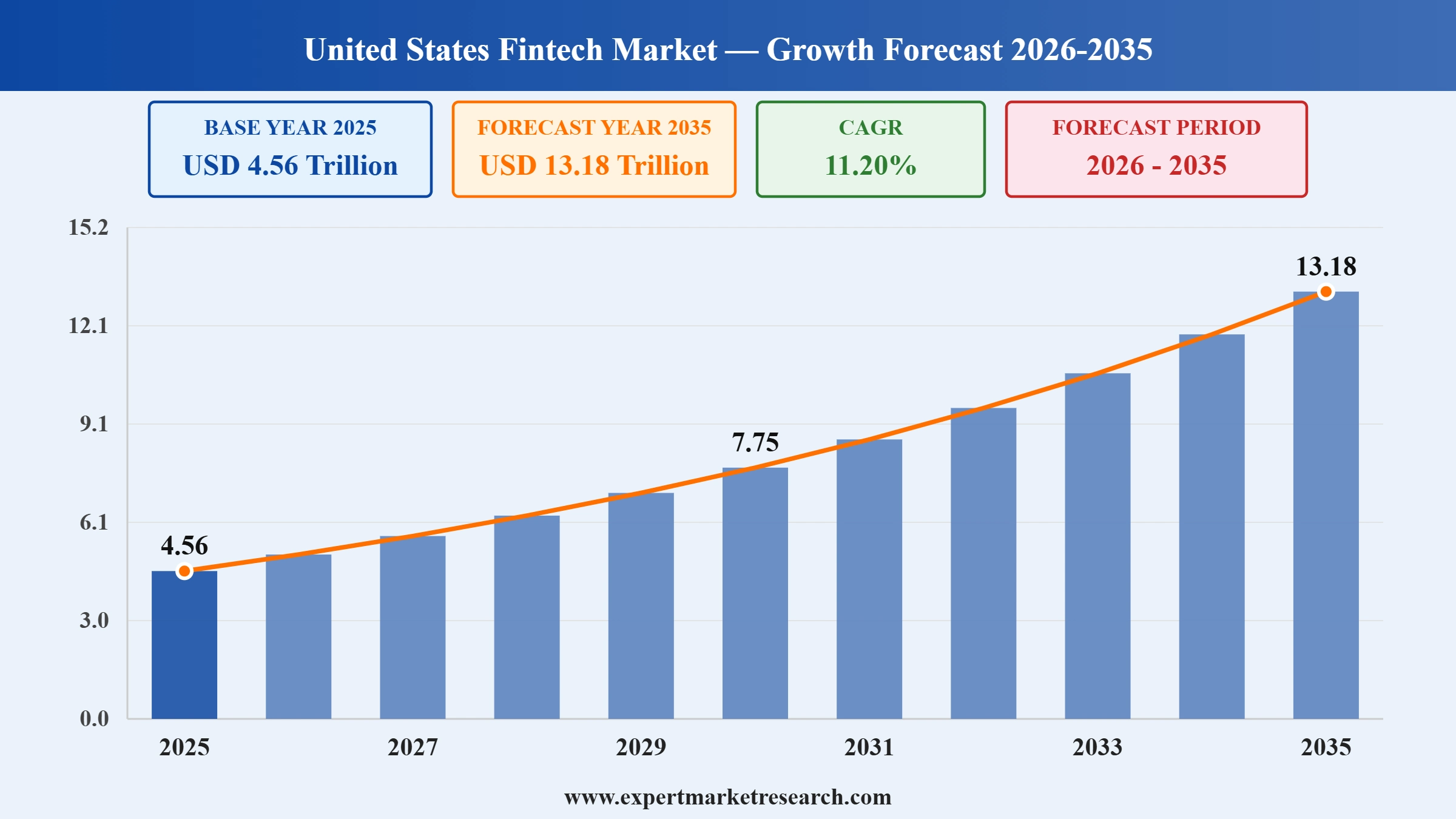
The United States fintech market size was valued at USD 4.56 Trillion in 2025. The industry is expected to grow at a CAGR of 11.20% during the forecast period of 2026-2035 to reach a value of USD 13.18 Trillion by 2035. In the United States, the fintech market continues to be significantly driven by innovations in the incorporation of digital assets and financial services enabled by cryptocurrencies. These are fundamentally transforming payments, investing, and cross-border transfers.
Besides these broad themes, the United States fintech market benefits from several local and niche structural drivers. Among these are the shift toward APIs and native financial architectures, the rising reliance on real-time data analytics, and the growing requirement for embedded compliance and risk automation. In fact, these elements allow a quicker product iteration, a flawless interoperability between platforms, and digitally scalable financial services, all while getting regulatory complexity under control and transaction security ensured. This has resulted in increased fintech adoption across specialized use cases and client segments.
Fintech companies are broadening their product portfolios to offer stablecoin payments, crypto investing, and blockchain-powered financial solutions, thereby fusing traditional finance with the new digital currencies of the future. Competitors in the market are eagerly collaborating and launching new products to be able to offer more. For instance, MoonPay teamed up with Mastercard in May 2025 to release stablecoin-enabled debit cards that will enable users to spend digital currencies at more than 150 million points worldwide. Likewise, SoFi took its crypto-powered functionalities a step further in August 2025 by combining international money transfers and crypto investing in its app.
Read more about this report - REQUEST FREE SAMPLE COPY IN PDF
| United States Fintech Market Report Summary | Description | Value |
| Base Year | USD Trillion | 2025 |
| Historical Period | USD Trillion | 2019-2025 |
| Forecast Period | USD Trillion | 2026-2035 |
| Market Size 2025 | USD Trillion | 4.56 |
| Market Size 2035 | USD Trillion | 13.18 |
| CAGR 2019-2025 | Percentage | XX% |
| CAGR 2026-2035 | Percentage | 11.20% |
| CAGR 2026-2035 - Market by Region | Southeast | 11.1% |
| CAGR 2026-2035 - Market by Region | New England | 10.4% |
| CAGR 2026-2035 - Market by Service Proposition | Digital Payments | 12.8% |
| CAGR 2026-2035 - Market by Application | Banking | 13.1% |
| Market Share by Region | Plains | 8.7% |
Visa Inc. made it possible for United States issuer and acquirer partners to settle via USDC stablecoin, allowing settlement with Circle's dollar-backed stablecoin on blockchain rails. This innovation brings the institutional settlement infrastructure up to date by offering 24/7 fund movements, increased liquidity, and improved treasury operations for banks and fintechs, thereby boosting digital settlement efficiency across the payment's ecosystem.
Western Union is introducing the United States Dollar Payment Token (USDPT) stablecoin on the Solana blockchain through its collaboration with Anchorage Digital Bank. The project allows users to send, receive, spend, and hold USDPT and thus contributes to an efficient cross-border payment system and the continued adoption of digital assets at scale.
Lili unveiled its BusinessBuild Program for small businesses that will offer a business credit building component by connecting a secured credit card product with Dun & Bradstreet data. This feature allows business owners to create and manage credit profiles within their banking app, promoting financial inclusion and growth opportunities for SMBs in the fintech ecosystem.
Securitize and BlackRock grew the BlackRock USD Institutional Digital Liquidity Fund (BUIDL) through the introduction of a new share class on the Solana network, thereby broadening the tokenized treasury access to top-notch blockchain networks. This leads to a higher liquidity level, cross-chain interoperability, and institutional involvement, hence facilitating a higher digital asset adoption level and connecting traditional finance with on-chain yields.
Blockchain adoption is helping fintech capabilities in cross-border payments to become even more powerful through faster settlement and cheaper transaction costs. Companies in the United States fintech market are using decentralized rails to upgrade their remittance and international transfer features, while at the same time, increasing transparency and the overall customer experience. Ultimately, this strategy opens the way for scaling up and extends the global reach. For instance, SoFi cooperating with Lightspark in August 2025 made it possible to realize blockchain-enabled international transfers via their app, thus utilizing the Lightning Network for worldwide payments that are both fast and efficient.
Demand for specialist implementation, modernization, and managed services that assist banks in scaling up digital products is driving growth in the United States fintech market. As financial institutions accelerate their core transformation and AI adoption, service-led fintech enablers play an important role in lowering deployment complexity and time to market. In January 2026, UST purchased Tailwind Business Ventures to expand digital banking implementation and support services, strengthening execution capabilities across global financial ecosystems.
Innovative funding structures are enabling United States fintech lenders to scale credit origination while maintaining balance sheet efficiency. Revolving securitization models improve capital recycling, support sustained loan growth, and attract long-term institutional investors, strengthening market liquidity and resilience in personal lending. In January 2026, Pagaya launched a USD 350 million revolving personal loan ABS, enhancing funding flexibility and supporting expansion across its digital lending network.
Embedding banking features in non-financial platforms is one of the key catalysts for the United States fintech market growth, as it enhances both accessibility and customer engagement. With embedded savings and account services, users do not have to leave their digital environments to manage their finances. Such a strategy leads to higher customer acquisition and frequent usage. In April 2025, Verizon and Openbank collaborated to offer digital high-yield savings accounts to United States customers, thus bringing banking services directly into the Verizon ecosystem.
As fintech platforms expand to include more modules to cater to different enterprise and consumer needs, product-led growth continues to be the main growth engine. With scalable platforms, banks and other financial institutions can quickly add features such as payments, cards, and banking. FIS rolled out its Atelio fintech platform in May 2024, which helps businesses customize the financial experience for their customers through payments, deposits, and card issuance. This further demonstrates the United States market's fintech growth driven by the ecosystem.
The EMR’s report titled “United States Fintech Market Report and Forecast 2026-2035” offers a detailed analysis of the market based on the following segments:
Market Breakup by Service Proposition
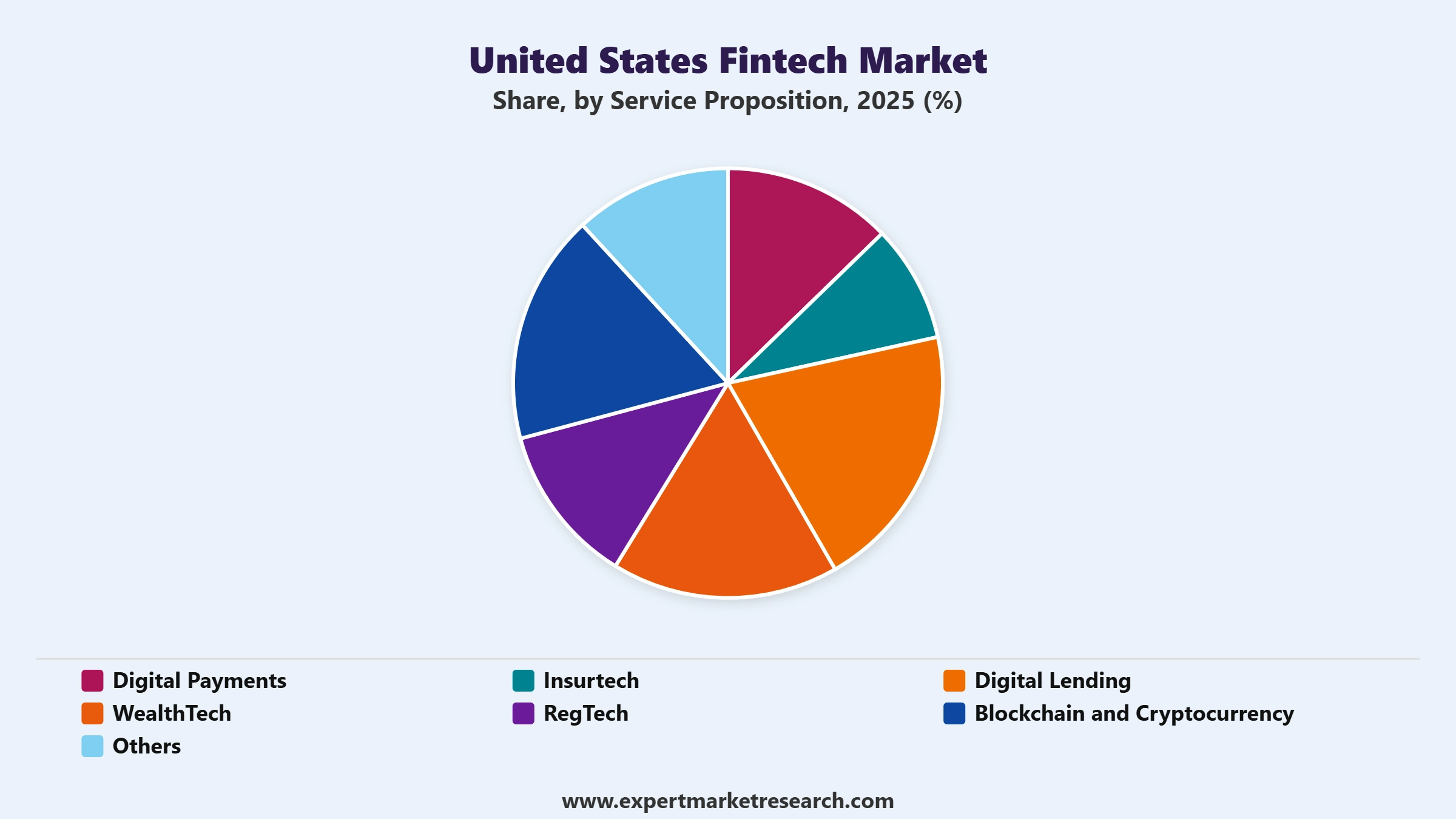
Key Insights: The United States fintech market includes areas such as digital payments, insurtech, digital lending, WealthTech, RegTech, blockchain and cryptocurrency, and other services, all being driven by product and platform expansions that are tailored to each. PayPal and Stripe still work on creating payment rails and cross, platform experiences, while LendingClub and Affirm ramp up the digital lending offerings. WealthTech is gaining through Robinhood's retail investing features and Betterment's autopilot advice engines. RegTech requirements increase with Plaid's compliance APIs, and Coinbase's infrastructure backs blockchain services. In April 2025, PayPal and Coinbase extended their stablecoin partnership to enable a wider range of PYUSD use cases across platforms.
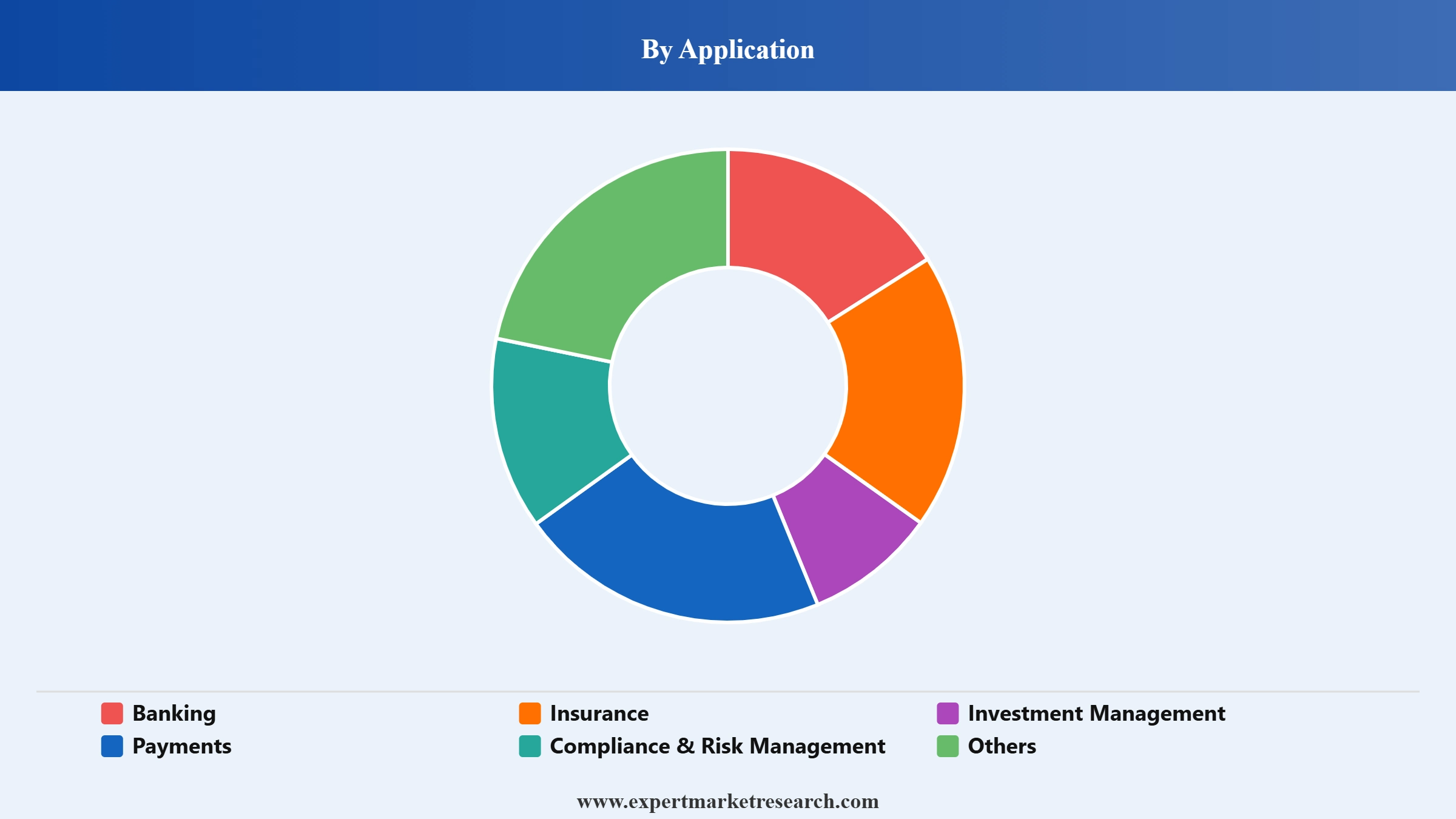
Market Breakup by Application
Key Insights: In terms of application, the United States fintech market caters to sectors such as banking, insurance, investment management, payments, compliance and risk management, and other use cases which is a great reflection of the sector's going digital in financial workflows. Chime and Varo strengthened their digital banking offerings with mobile-first accounts, and Adyen and Stripe upgraded enterprise payments infrastructure. Investment management grows through Wealthfront and Robinhood's platforms. Compliance and risk solutions are enhanced by Plaid and Alloy, while companies like Square include business financial services in their offering. For instance, in July 2025, Stripe acquired Orum and hired the Orum team to advance real-time payment and bank verification capabilities, thus reinforcing speed and resilience in payments infrastructure.
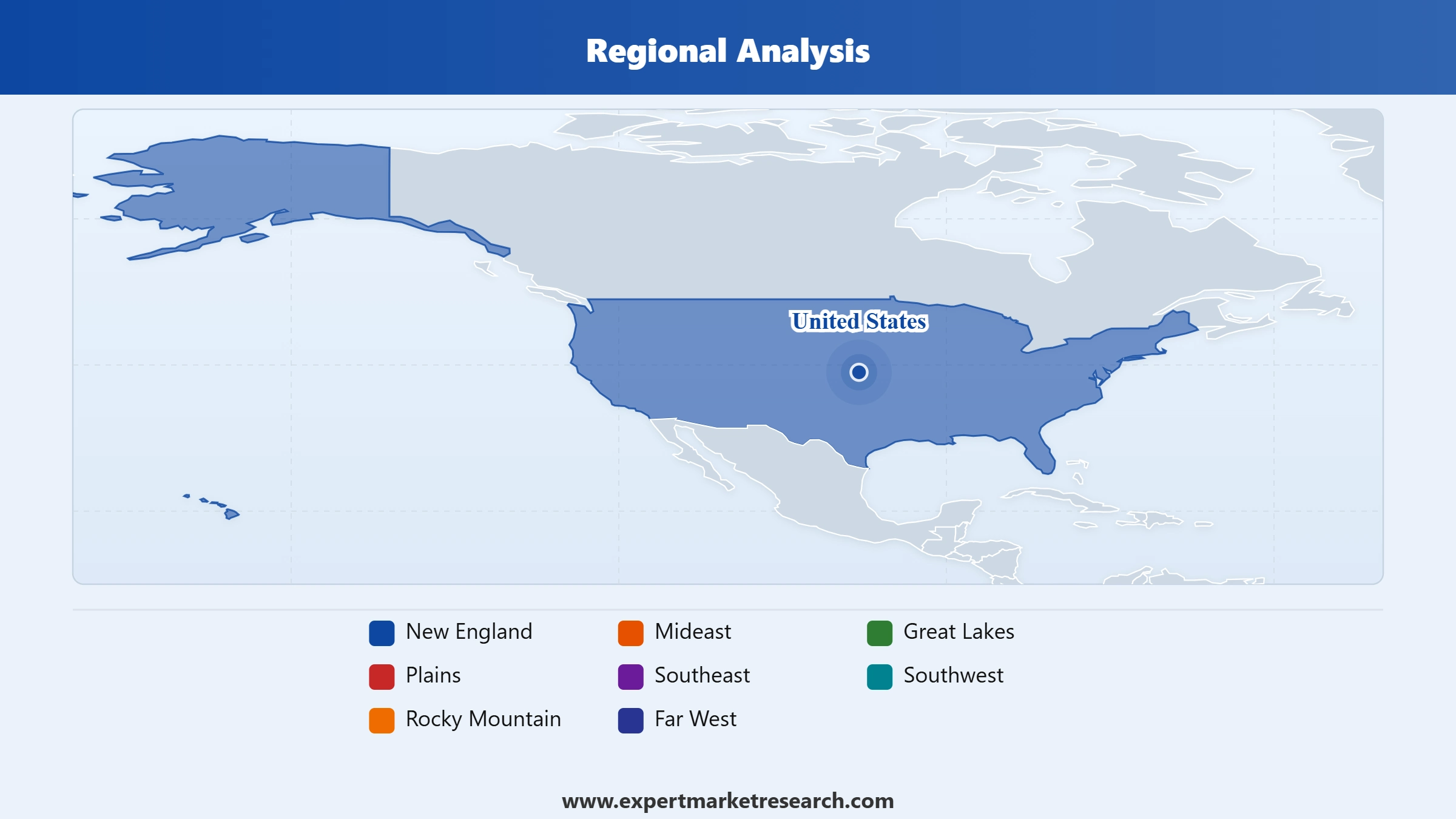
Market Breakup by Region
Key Insights: Growth throughout New England, the Mideast, the Great Lakes, the Plains, the Southeast, the Southwest, the Rocky Mountain, and the Far West regions results from local innovation clusters working together with the rollout of national platforms. Major firms in the United States fintech market, like Stripe, Coinbase, and Plaid, are going on and on about their payment, data, and compliance services all over the country. For instance, PayPal introduced its Pay with Crypto option in July 2025, which allows merchants in the United States to get paid with over 100 cryptocurrencies, thus expanding digital payment choices across areas. Meanwhile, the Federal Reserve's FedNow Service became operational in July 2023, and thus it is now possible for banks and credit unions to instantly send and receive payments, thereby facilitating faster settlements in the United States payments ecosystem in general.
Read more about this report - REQUEST FREE SAMPLE COPY IN PDF
By service proposition, Insurtech records significant uptake
In terms of service proposition, the United States fintech market scope comprises a variety of offerings, such as digital payments, insurtech, digital lending, wealthtech, regtech, blockchain and cryptocurrency, and other areas. These are basically built on tailor-made solutions addressing different needs of customers. Insurtech innovations help improve policy issuance and claims processing by using data analytics and automation. On the other hand, digital payments and lending platforms facilitate greater accessibility. Additionally, wealthtech is expanding its range of algorithm-driven portfolio tools, and regtech is focusing on compliance automation. For instance, in November 2025, FICO and Plaid collaborated to launch the next-generation cash flow UltraFICO Score, which incorporates real-time financial data into credit decisions, allowing for better underwriting and faster loan availability.
Read more about this report - REQUEST FREE SAMPLE COPY IN PDF
Digital lending accounts for a significant share of the United States fintech market, as fintech lenders employ AI-powered credit scoring, open banking data, and automated loan origination to deliver lower prices and wider credit access. Digital payments and blockchain rails bring new levels of efficiency to transaction flows, whereas wealthtech and regtech empower customer insights and compliance. In February 2025, Algebrik AI and Plaid teamed up in a way that consumer-permissioned data integration helps to streamline loan approvals and fast-track financing for under-resourced credit unions and lenders.
By application, insurance shows robust growth through automation and embedded finance
The United States fintech market amasses substantial revenue from insurance applications that benefit from automated underwriting, embedded policy features, and real-time risk analytics. Banking and payments provide seamless account and transaction services, while investment management platforms democratize portfolio tools. Compliance and risk solutions automate monitoring and reporting. For example, MANTL became the first fintech to offer Plaid Layer in July 2025, enabling instant financial onboarding that can be leveraged by insurers and banks to accelerate customer acquisition and improve data integrity in policy issuance.
Read more about this report - REQUEST FREE SAMPLE COPY IN PDF
The demand in the United States fintech market is dominated by digital payment solutions that use real-time settlement, tokenized rails, and integrated checkout tools. Banking incorporates digital payments into daily operations, insurance uses them for premium processing, and investment platforms manage money flows for investment. Compliance tools ensure transaction integrity. For instance, in 2025, Visa launched USDC stablecoin settlement in the US market, allowing Cross River Bank and Lead Bank to settle transactions utilizing Circle's USDC. This marks a significant step forward in programmable payments infrastructure.
By region, New England leads the market growth driven by fintech innovation, academic strength, and venture capital networks
New England is emerging to be a hotspot in the United States fintech market as strong academic institutions and venture networks foster fintech research, fintech-bank collaborations, and product rollouts that serve national markets. Firms integrate digital payments, RegTech compliance tools, and WealthTech solutions tailored to both urban and small business users. For example, Coinbase’s new product suite launched in late 2025 introduces advanced staking, yield, and institutional custody tools, enhancing crypto-related infrastructure used by businesses and developers across Northeastern hubs.
Read more about this report - REQUEST FREE SAMPLE COPY IN PDF
Meanwhile, the Great Lakes region shows consistent growth in the United States fintech market as banks and fintechs collaborate to enhance digital banking, risk management, and payments. WealthTech platforms expand investor access, and blockchain services support novel settlement options. For instance, in September 2025, State Street Corporation announced a strategic partnership with Apex Fintech Solutions, aimed at addressing global wealth market opportunities and expanding fintech support for asset management and digital services across United States regions.
Major United States fintech market players are focusing on product-led innovation and platform extension as a means of securing their competitive positions. They are making massive investments into upgrading their modular architectures, creating API-driven platforms, and using cloud-based infrastructure so that they can launch products faster and be more scalable. As a result, these companies can quickly convert newly integrated payments, lending, and financial management solutions into more adoption by both the consumer and the business segments.
In addition, fintech companies in the United States emphasize increasing their market reach and improving customer service by partnering strategically and operating within the ecosystem. Along with banks, technology providers, and non-financial platforms, companies can make financial services an integral part of broader digital ecosystems. Besides changes in business models, market players are also strengthening their compliance and data security measures to grow sustainably, thus meeting regulatory and trust-based requirements simultaneously, thereby boosting the United States fintech market expansion.
Established in 1998. PayPal provides digital payments online checkout peer to peer transfers merchant acquiring and cross border payment solutions across the United States. The platform supports consumers small businesses and enterprises through digital wallets invoicing buy now pay later services and advanced fraud protection. Headquarters located in San Jose California United States.
Established in 2009. Square delivers point of sale systems payment processing business software and financial services to merchants and individuals across the United States. Its offerings include Square POS Cash App payroll services lending solutions and analytics tools supporting small and mid sized businesses. Headquarters located in San Francisco California United States.
Established in 2010. Stripe focuses on providing online payment infrastructure enabling United States businesses to accept digital payments manage subscriptions handle billing and reduce fraud. The company serves ecommerce platforms SaaS providers and large enterprises through API driven financial automation tools. Headquarters located in San Francisco California United States.
Established in 2013. Robinhood operates a digital financial platform offering commission free stock ETF options and cryptocurrency trading to retail investors in the United States. The platform emphasizes mobile first investing cash management services and financial access for new investor segments. Headquarters located in Menlo Park California United States.
*Please note that this is only a partial list; the complete list of key players is available in the full report. Additionally, the list of key players can be customized to better suit your needs.*
Other players in the market include Coinbase Global, Inc., among others.
Explore the latest trends shaping the United States Fintech Market 2026-2035 with our in-depth report. Gain strategic insights, future forecasts, and key market developments that can help you stay competitive. Download a free sample report or contact our team for customized consultation on United States fintech market trends 2026.
United States Regulatory Technology Trends
United States Digital Payments Infrastructure Growth
United States Neobanking And Digital Banking Platforms


Upto 15% Off
USD
$2499 $2249
$3999 $3599
$4999 $4249
$5999 $5099


*While we strive to always give you current and accurate information, the numbers depicted on the website are indicative and may differ from the actual numbers in the main report. At Expert Market Research, we aim to bring you the latest insights and trends in the market. Using our analyses and forecasts, stakeholders can understand the market dynamics, navigate challenges, and capitalize on opportunities to make data-driven strategic decisions.*
In 2025, the United States fintech market reached an approximate value of USD 4.56 Trillion.
The market is projected to grow at a CAGR of 11.20% between 2026 and 2035.
The key players in the market include PayPal Holdings, Inc., Square, Inc., Stripe, Inc., Robinhood Markets, Inc., and Coinbase Global, Inc., which collectively contribute to innovation across payments, digital banking, lending, and financial infrastructure segments.
Key strategies driving the market include product innovation, embedded finance adoption, strategic partnerships, platform-based expansion, and increased investment in data security and compliance.
The market players face challenges related to regulatory complexity, cybersecurity risks, rising customer acquisition costs, intense competition, and the need to maintain trust while scaling digital platforms.
Explore our key highlights of the report and gain a concise overview of key findings, trends, and actionable insights that will empower your strategic decisions.
| REPORT FEATURES | DETAILS |
| Base Year | 2025 |
| Historical Period | 2019-2025 |
| Forecast Period | 2026-2035 |
| Scope of the Report |
Historical and Forecast Trends, Industry Drivers and Constraints, Historical and Forecast Market Analysis by Segment:
|
| Breakup by Service Proposition |
|
| Breakup by Application |
|
| Breakup by Region |
|
| Market Dynamics |
|
| Competitive Landscape |
|
| Companies Covered |
|
Datasheet
One User
USD 2,499
USD 2,249
tax inclusive*
Single User License
One User
USD 3,999
USD 3,599
tax inclusive*
Five User License
Five User
USD 4,999
USD 4,249
tax inclusive*
Corporate License
Unlimited Users
USD 5,999
USD 5,099
tax inclusive*
*Please note that the prices mentioned below are starting prices for each bundle type. Kindly contact our team for further details.*
Flash Bundle
Small Business Bundle
Growth Bundle
Enterprise Bundle
*Please note that the prices mentioned below are starting prices for each bundle type. Kindly contact our team for further details.*
Flash Bundle
Number of Reports: 3
20%
tax inclusive*
Small Business Bundle
Number of Reports: 5
25%
tax inclusive*
Growth Bundle
Number of Reports: 8
30%
tax inclusive*
Enterprise Bundle
Number of Reports: 10
35%
tax inclusive*
How To Order

Select License Type
Choose the right license for your needs and access rights.

Click on ‘Buy Now’
Add the report to your cart with one click and proceed to register.

Select Mode of Payment
Choose a payment option for a secure checkout. You will be redirected accordingly.
Strategic Solutions for Informed Decision-Making
Gain insights to stay ahead and seize opportunities.

Get insights & trends for a competitive edge.

Track prices with detailed trend reports.

Analyse trade data for supply chain insights.

Leverage cost reports for smart savings

Enhance supply chain with partnerships.

Connect For More Information
Our expert team of analysts will offer full support and resolve any queries regarding the report, before and after the purchase.
Our expert team of analysts will offer full support and resolve any queries regarding the report, before and after the purchase.
We employ meticulous research methods, blending advanced analytics and expert insights to deliver accurate, actionable industry intelligence, staying ahead of competitors.
Our skilled analysts offer unparalleled competitive advantage with detailed insights on current and emerging markets, ensuring your strategic edge.
We offer an in-depth yet simplified presentation of industry insights and analysis to meet your specific requirements effectively.




