

Consumer Insights
Uncover trends and behaviors shaping consumer choices today
Procurement Insights
Optimize your sourcing strategy with key market data
Industry Stats
Stay ahead with the latest trends and market analysis.
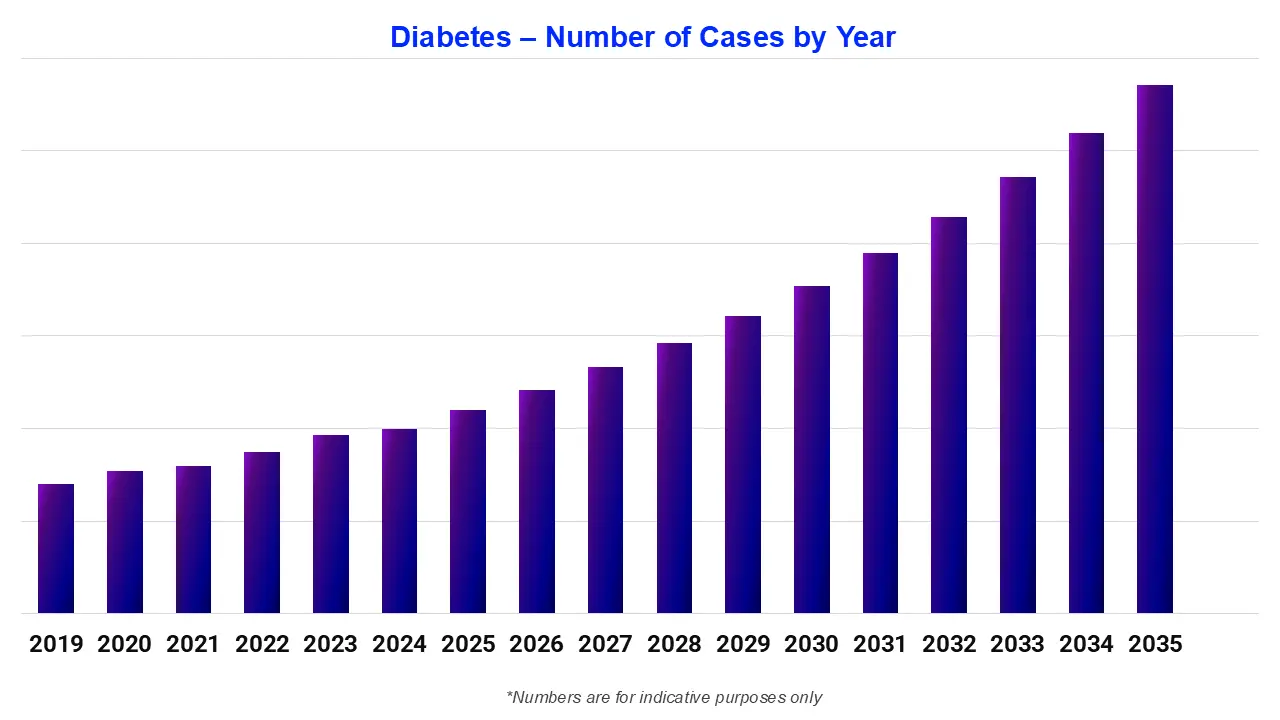
Diabetes is a chronic metabolic disorder characterized by persistently elevated blood glucose levels due to impaired insulin production, insulin action, or both. According to the International Diabetes Federation, 589 million adults (20–79 years) are living with people living with diabetes globally. As per the diabetes epidemiology forecast by Expert Market Research, the disease burden is expected to continue rising, highlighting the need for effective prevention and management.
Base Year
Historical Period
Forecast Period
Read more about this report - Request a Free Sample
Expert Market Research's “Diabetes Epidemiology Forecast Report 2026-2035” offers comprehensive information on the prevalence and demographics of diabetes. It projects the future incidence and prevalence rates of diabetes cases across various populations. The study covers age, gender, and type as major determinants of the diabetes population. The report highlights patterns in the prevalence of diabetes over time and projects future trends based on multiple variables.
The report provides a comprehensive overview of the disease, as well as historical and projected data on the epidemiology of diabetes in the 8 major markets.
Regions Covered
Diabetes is a chronic metabolic disorder characterized by persistently elevated blood glucose levels due to inadequate insulin production, impaired insulin action, or both. The condition develops when the pancreas produces insufficient insulin or when the body's cells become resistant to its effects, resulting in disrupted glucose metabolism. The primary types include Type 1 diabetes, Type 2 diabetes, and gestational diabetes, each with distinct etiologies and clinical presentations. If left unmanaged, diabetes can lead to severe complications affecting the cardiovascular system, kidneys, eyes, and nerves. Insulin resistance is a key factor associated with disease progression, particularly in Type 2 diabetes.
|
Parameter |
Insight |
|
Largest Patient Pool |
United States |
|
Fastest Growing Region |
India |
|
High-Risk Population |
Adults with obesity, older adults, and individuals with a family history of diabetes |
|
Key Diagnostic Method |
Glycated hemoglobin (HbA1c) test and fasting plasma glucose test |
|
Major Risk Factor |
Obesity, physical inactivity, and unhealthy dietary habits |
|
Major gap in the market |
Delayed diagnosis and suboptimal long-term disease management |
The diabetes epidemiology division offers information on the patient pool from history to the present as well as the projected trend for each of the 8 major markets. Expert Market Research provides both current and predicted trends for the diabetes epidemiology scenario by examining a wide range of studies. Additionally, the report covers the diagnosed patient pool for diabetes and their trends. The data is broken down into specific categories, such as total prevalent cases in males and females, and total diagnosed cases across different age groups and patient pools.
|
Epidemiology Segment |
Key Insights |
|
Diagnosed Prevalent Cases of the Disease |
According to the International Diabetes Federation (2025), approximately 589 million adults aged 20–79 years are living with diabetes globally, and the number is projected to increase to 853 million by 2050. The organization also reported that three in four adults with diabetes live in low- and middle-income countries, highlighting the growing global disease burden. |
|
Gender-Specific Cases of the Disease |
Based on Robert Koch Institute, physician-diagnosed diabetes in Germany was reported in 11.6% of men and 9.0% of women. As reported by Kazue Nagai et al. (2026), South/Southeast Asian women and Black women had the highest cumulative incidence of type 2 diabetes by 70 years of age, indicating notable gender- and ethnicity-related differences. |
|
Age-Specific Cases of the Disease |
As per the Centers for Disease Control and Prevention (2022), diagnosed diabetes prevalence in the United States increased with age, ranging from 1.3% among adults aged 18–34 years to 20.1% among adults aged 65 years and older. Higher prevalence was also observed among adults aged 50–64 years than younger age groups. |
|
Ethnicity-Wise Cases of the Disease |
As reported by Kazue Nagai et al. (2026), South/Southeast Asian women had the highest adjusted risk of type 2 diabetes compared with White women (hazard ratio: 4.13), while Black women also demonstrated a substantially elevated cumulative incidence, emphasizing important ethnicity-related variations in disease burden. |
|
Mortality and Survival Analysis of the Disease |
According to the International Diabetes Federation (2025), diabetes is responsible for more than 3.4 million deaths annually worldwide. The increasing mortality burden highlights the importance of effective disease prevention, early diagnosis, and long-term management strategies. |
|
Disease Type |
Prevalence |
|
Type 1 Diabetes |
According to the International Diabetes Federation (2025), approximately 1.8 million children and young adults younger than 20 years are living with type 1 diabetes globally, reflecting a considerable disease burden among younger populations. |
|
Type 2 Diabetes |
As per the International Diabetes Federation (2025), one in eight adults worldwide is at high risk of developing type 2 diabetes. Viswanathan Mohan et al. (2025) also reported that the prevalence of type 2 diabetes is increasing rapidly in both India and globally. |
Read more about this report - Request a Free Sample
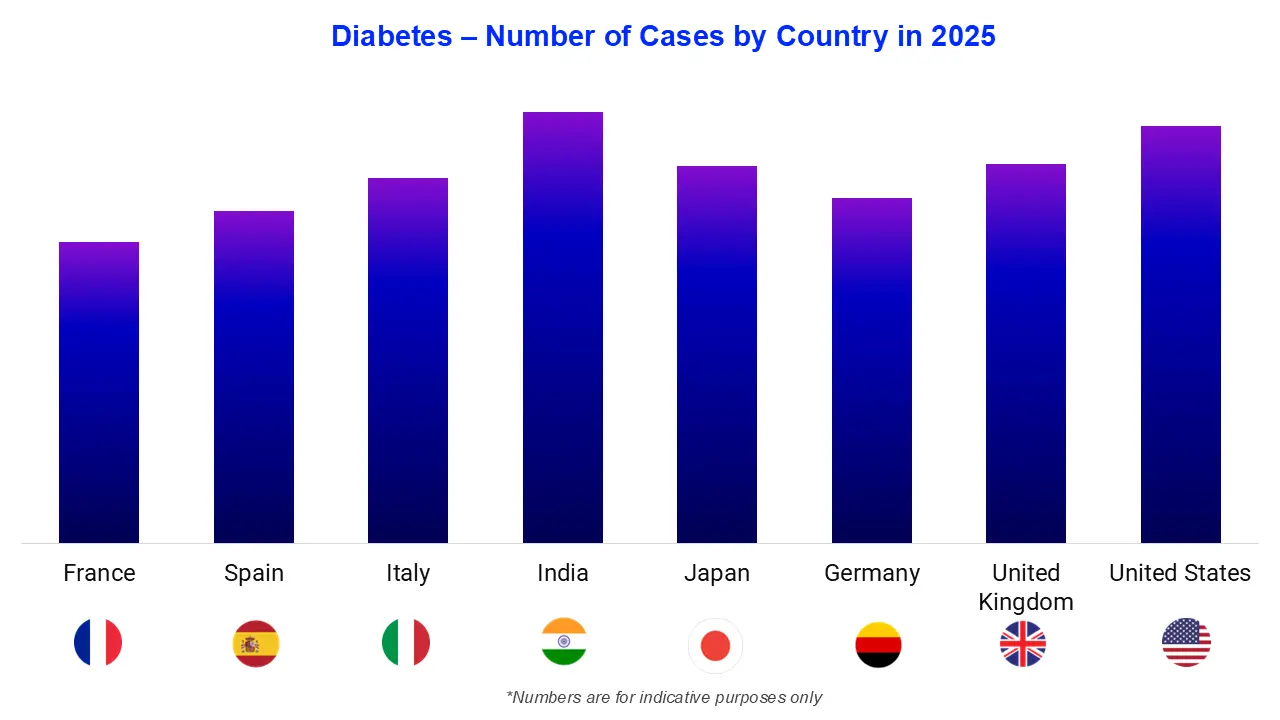
The diabetes epidemiology data and findings for the United States, Germany, Spain, Italy, France, the United Kingdom, Japan, and India are also provided in the epidemiology section.
|
Country |
Key Insights |
|
United States |
As per the Centers for Disease Control and Prevention (2022), 9.6% of adults aged 18 years and older had diagnosed diabetes. The prevalence increased from 1.3% among adults aged 18–34 years to 20.1% among adults aged 65 years and older, with lower prevalence reported in metropolitan areas than nonmetropolitan areas. |
|
Germany |
Based on Robert Koch Institute, 10.3% of adults in Germany reported physician-diagnosed diabetes. The prevalence was 11.6% among men and 9.0% among women, increasing from 3.1% in adults aged 18–44 years to 22.5% among adults aged 80 years and older. |
|
France |
As reported by Marie Hauguel-Moreau et al. (2023), approximately 3.5 million people, representing 5.3% of the French population, were treated for diabetes in 2020. The authors also emphasized the importance of identifying prediabetes and undiagnosed diabetes to support public health planning. |
|
Italy |
Diabetes remains an important public health concern in Italy, with epidemiological monitoring supporting disease surveillance, healthcare planning, and long-term management across different population groups. |
|
Spain |
According to the International Diabetes Federation Diabetes Atlas, Spain has approximately 5.1 million people living with diabetes, representing a 42% increase compared with 2019, making it the second European country with the highest number of diabetes cases. |
|
United Kingdom |
Craig J. Currie et al. (2024) reported that the increasing older population and rising obesity levels in the United Kingdom are expected to contribute to a greater burden of type 2 diabetes, with obesity projected to continue increasing by 2030. |
|
Japan |
As per Cardio ThinkLab, citing the International Diabetes Federation (2021), approximately 11 million adults in Japan are living with diabetes. The increasing prevalence has been associated with lifestyle changes and increased longevity. |
|
India |
According to Viswanathan Mohan et al. (2025), the estimated number of individuals with diabetes in India increased from 32 million in 2000 to 63 million in 2012, 74 million in 2021, and 101 million based on the ICMR–INDIAB Study, while the NCD Risk Factor Collaboration estimated 212 million individuals using different diagnostic criteria. |
Despite advances in diabetes diagnosis and management, significant challenges remain across regional epidemiology landscapes, including delayed detection, inadequate disease awareness, and disparities in access to screening and long-term care. Many individuals remain undiagnosed until complications develop, increasing the overall healthcare burden. Emerging opportunities include expanding community-based screening programs, integrating digital health and remote glucose monitoring technologies, and strengthening preventive interventions targeting obesity and sedentary lifestyles. Enhanced patient education, earlier risk identification, and improved access to comprehensive diabetes management services are expected to support better clinical outcomes and reduce disease progression across diverse populations.
Diabetes management focuses on maintaining optimal blood glucose levels, preventing complications, and improving long-term health outcomes. Treatment strategies include lifestyle modifications such as a balanced diet, regular physical activity, weight management, and smoking cessation. Pharmacological interventions involve insulin therapy for individuals with Type 1 diabetes and selected patients with advanced Type 2 diabetes, along with oral and injectable glucose-lowering medications. Continuous glucose monitoring and regular glycated hemoglobin (HbA1c) assessments support personalized treatment decisions. Glycemic control remains the primary objective of therapy to minimize microvascular and macrovascular complications while enhancing patients' quality of life.


Upto 15% Off
USD
$2699 $2429
$4299 $3869
$5799 $4949
$6999 $5949


*While we strive to always give you current and accurate information, the numbers depicted on the website are indicative and may differ from the actual numbers in the main report. At Expert Market Research, we aim to bring you the latest insights and trends in the market. Using our analyses and forecasts, stakeholders can understand the market dynamics, navigate challenges, and capitalize on opportunities to make data-driven strategic decisions.*
Explore our key highlights of the report and gain a concise overview of key findings, trends, and actionable insights that will empower your strategic decisions.
|
Report Features |
Details |
|
Base Year |
2025 |
|
Historical Period |
2019-2025 |
|
Forecast Period |
2026-2035 |
|
Epidemiology Statistics Provided |
|
|
Segmentation Provided |
|
|
Geographies Covered |
|
Datasheet
One User
USD 2,699
USD 2,429
tax inclusive*
Single User License
One User
USD 4,299
USD 3,869
tax inclusive*
Five User License
Five User
USD 5,799
USD 4,949
tax inclusive*
Corporate License
Unlimited Users
USD 6,999
USD 5,949
tax inclusive*
*Please note that the prices mentioned below are starting prices for each bundle type. Kindly contact our team for further details.*
Flash Bundle
Small Business Bundle
Growth Bundle
Enterprise Bundle
*Please note that the prices mentioned below are starting prices for each bundle type. Kindly contact our team for further details.*
Flash Bundle
Number of Reports: 3
20%
tax inclusive*
Small Business Bundle
Number of Reports: 5
25%
tax inclusive*
Growth Bundle
Number of Reports: 8
30%
tax inclusive*
Enterprise Bundle
Number of Reports: 10
35%
tax inclusive*
How To Order

Select License Type
Choose the right license for your needs and access rights.

Click on ‘Buy Now’
Add the report to your cart with one click and proceed to register.

Select Mode of Payment
Choose a payment option for a secure checkout. You will be redirected accordingly.
Strategic Solutions for Informed Decision-Making
Gain insights to stay ahead and seize opportunities.

Get insights & trends for a competitive edge.

Track prices with detailed trend reports.

Analyse trade data for supply chain insights.

Leverage cost reports for smart savings

Enhance supply chain with partnerships.

Connect For More Information
Our expert team of analysts will offer full support and resolve any queries regarding the report, before and after the purchase.
Our expert team of analysts will offer full support and resolve any queries regarding the report, before and after the purchase.
We employ meticulous research methods, blending advanced analytics and expert insights to deliver accurate, actionable industry intelligence, staying ahead of competitors.
Our skilled analysts offer unparalleled competitive advantage with detailed insights on current and emerging markets, ensuring your strategic edge.
We offer an in-depth yet simplified presentation of industry insights and analysis to meet your specific requirements effectively.




