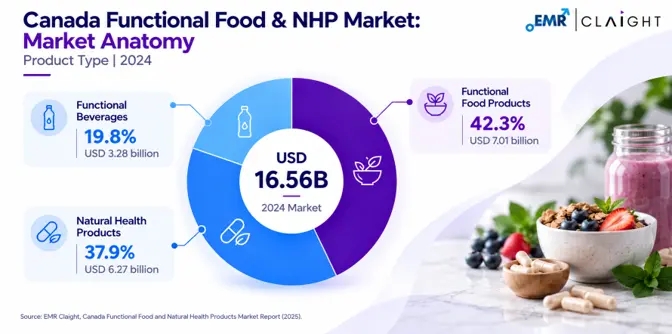
Canada's functional food and natural health products market sits across two different regulatory worlds: ordinary food, and Health Canada-regulated natural health products. Consumers no longer see the difference. This case study looks at how Claight's EMR Healthcare and Pharmaceuticals Insights practice built a single, defensible model of both, sized and segmented through 2034. In 2024, the combined Functional Food & Natural Health Products Canada market was valued at USD 16.56 billion and is forecast to reach USD 32.19 billion by 2034, with growth accelerating at 7.0% CAGR over 2025 to 2034.
| USD 32B+ |
~7% |
17-Yr |
20+ |
| Canada market size, 2034 |
Forecast CAGR, 2025 to 2034 |
Historical + forecast window, 2018 to 2034 |
Product subsegments modelled |
The Brief: Sizing a Market Split Across Two Regulatory Categories
Businesses evaluating entry into, or expansion within, Canada's functional food and natural health products space rarely arrive with a simple question. An ingredient manufacturer weighing a new production line, a consumer packaged goods company scoping a Canada launch, a private equity group screening an acquisition target, and a policy or trade body trying to understand the shape of a fast-moving category all need the same underlying thing: a market that will not size itself with a single number, sized properly.
The objective behind this assignment was to build one defensible model spanning both of the market's regulatory categories, functional food and natural health products, instead of treating them as two separate reports stitched together after the fact. That meant quantifying where growth is genuinely concentrated by segment instead of assumed from the aggregate, mapping the competitive and investment landscape so a portfolio decision could be checked against both incumbent strength and where capital is actually moving, and accounting for a regulatory transition that is reshaping the category from within the forecast period itself, not added as a footnote once the numbers were finalised.
Without that kind of model, the alternative is a patchwork: a food-industry report that treats natural health products as an afterthought, a supplements-focused report that misses how much of the category's growth is happening in ordinary grocery aisles, and neither one accounting for a live policy change that could shift the competitive balance between large and small manufacturers within the forecast window itself. Decisions made on that patchwork, where to launch first, which segment to prioritise, how much regulatory risk to budget for, are only as sound as the seams between the reports that inform them.
The result gives decision-makers a single evidence base for market-entry timing, portfolio prioritisation, competitive and investment due diligence, and regulatory risk planning, built to the same standard end to end instead of assembled from whatever data happened to be available for each piece.
The Challenge: Where Food Regulation and Health Product Regulation Collide
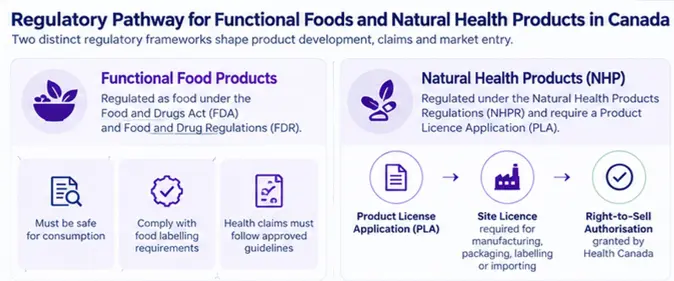
Functional foods and natural health products look increasingly similar on a store shelf: an immune-boosting yogurt next to a vitamin D gummy, a protein bar next to a probiotic capsule. But they sit in two different regulatory worlds. Functional foods are regulated as food. Natural health products fall under Health Canada's Natural Health Products Regulations, which require a Product License Application, a site license, and a right-to-sell authorisation before a product reaches a shelf at all.
A model that treats these as one undifferentiated market misses how differently each category behaves, in cost structure, in time to market, and in who can realistically compete. A model that treats them as entirely separate misses how consumers actually shop: by health outcome, not by regulatory category.
The challenge sharpened further midway through the forecast period. Health Canada's proposed cost-recovery fee structure for natural health products, covering pre-market evaluation, site licensing, and annual right-to-sell charges, was still under stakeholder consultation through May 2025. It is a structural shift the forecast itself had to account for.
| Category |
Regulatory Pathway |
Representative Subcategories |
| Functional Food |
Regulated as food |
Bakery and confectionery, dairy, fish and eggs, pulses, oats and cereals, oils and fats |
| Natural Health Product |
Regulated under Health Canada's Natural Health Products Regulations (Product License Application, site license, right-to-sell authorisation) |
Probiotics, proteins and amino acids, phytochemicals and plant extracts, prebiotics, omega-3s, natural vitamins and minerals |
Our Approach: A Four-Step Framework for Sizing a Fragmented Market
Sizing a market this fragmented meant applying the same structured research framework Claight uses across its consumer and healthcare intelligence work, adapted to a market that splits by regulation but not by consumer behaviour.
1. Defining the boundary between two categories. Every product was consistently classified into functional food, natural health product, or functional beverage, and further by nature (organic or conventional). This kept category comparisons analytically consistent while accounting for differences in cost structures, approval timelines, and competitive sets.
2. Triangulating primary and secondary research. Primary interviews covered demand-side stakeholders, including health professionals, retailers, health food stores, procurement decision-makers and consumers, as well as supply-side stakeholders across product management, R&D, clinical, sales, business development and distribution. These inputs were cross-referenced with Health Canada, the Canadian Food Inspection Agency, Statistics Canada, and Claight's internal database. No single source was treated as sufficient; each was used to test and refine the others.
3. Validating top-down against bottom-up. Category-level estimates based on key-player revenues were checked against a bottom-up build from segment-level interviews and cross-referenced with macroeconomic indicators such as GDP, consumer and producer price indices, and trade balance. Divergences were treated as flags for further investigation rather than simply smoothed out.
4. Applying a three-step validation protocol. Before publication, estimates underwent internal quality control, validation by industry experts and key opinion leaders, and a final check against Claight's analytical models. This layered process helped identify and resolve inconsistencies before release.
Key Findings: What the Model Reveals About Growth, Competition, and Risk
The model produced a full 2018 to 2034 view of Canada's functional food and natural health products market, at the aggregate level and across nature, product, application, end user, and distribution channel. Six patterns stood out. The figures presented here summarise selected findings from the engagement; the full licensed report contains detailed segment-level estimates and forecasts.
1. A Historically Steady Market Now Set to Accelerate
Canada's functional food and natural health products market has grown steadily on established staples, but the forecast points to a materially faster trajectory. The market is expected to accelerate from a 4.5% historical CAGR over 2018 to 2024 to 7.0% over 2025 to 2034, increasing from USD 16.56 billion in 2024 to USD 32.19 billion by 2034. Rising health consciousness, an aging population, and increasing category maturity are expanding the pool of potential buyers.
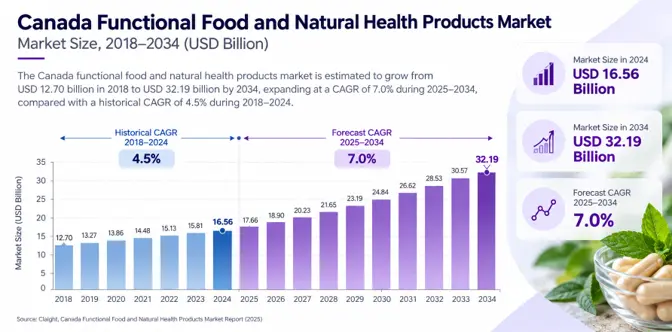
This reflects a category moving from niche to mainstream at the same time that an aging population and a more health-conscious middle market are both expanding the pool of likely buyers. For businesses planning around the historical pace, the implication is straightforward: capacity, distribution relationships, and marketing investment need to be aligned with a market expected to grow significantly faster than before.
2. Conventional Leads on Scale, Organic Leads on Growth
Conventional products still command the larger share of the market, accounting for 62.7% in 2024 and USD 10.38 billion in market value. But organic is growing meaningfully faster: it represented 37.3% of the market in 2024 and is forecast to grow at 8.9% CAGR through 2034, compared with 5.7% for conventional products. By 2034, organic is projected to reach USD 14.26 billion, a signal that the market's centre of gravity is shifting well before it shows up in the topline number.
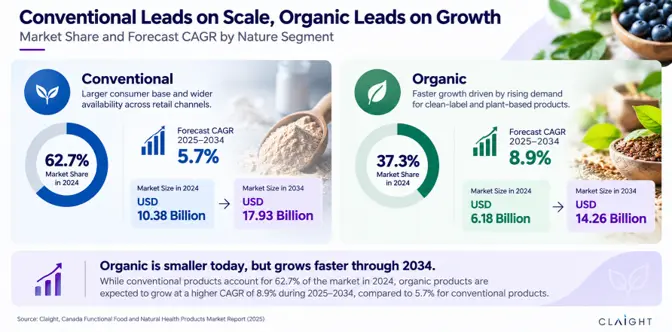
That shift carries direct implications for shelf strategy and supplier relationships alike. A portfolio built entirely around conventional formulations is defending share in the market's largest segment, but it is not necessarily positioned to capture where the next several years of growth are actually likely to land.
3. A Fragmented Market Where Investment Capital Is Concentrating Fast
The market remains highly fragmented, with global names such as Nestlé, Danone, and PepsiCo competing alongside domestic and emerging players. No single company accounts for a dominant share.
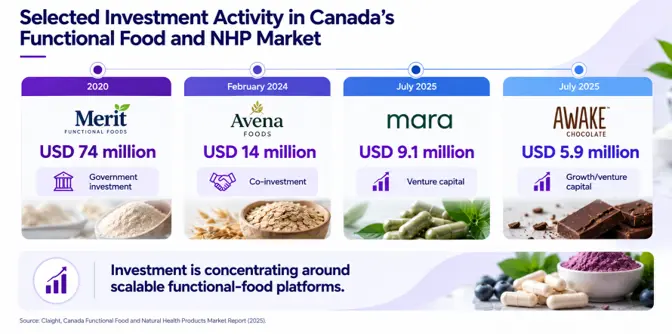
Investment activity, however, is increasingly visible among emerging manufacturers. Recent examples include USD 5.9 million raised by AWAKE Chocolate and USD 9.1 million by Mara Canada in 2025, USD 14 million in co-investment for Avena Foods in 2024, and USD 74 million in government investment for Merit Functional Foods in 2020. The activity spans product innovation, manufacturing capacity, and scale-up.
For incumbents, this creates a market too fragmented to defend through scale alone. For entrants and investors, it signals room for new category leaders to emerge.
4. The Fastest Growth Sits Outside the Market's Current Volume Leaders
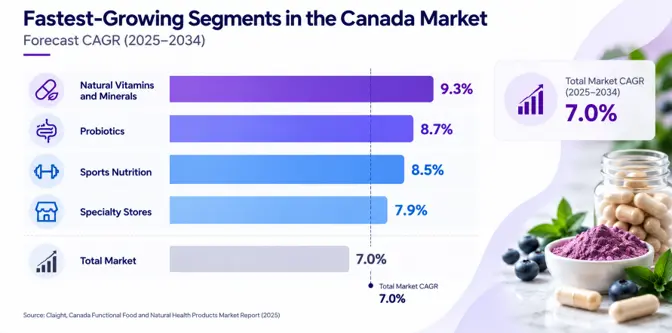
The subcategories growing fastest are not the market's current volume leaders. Several natural health product subcategories, alongside specialty retail as a distribution channel, are outpacing the broader market's own growth rate, a pattern with real implications for where a portfolio or a new listing should be prioritised. Natural vitamins and minerals are forecast to grow to USD 3.01 billion by 2034 at a 9.3% CAGR, while probiotics rise to USD 2.77 billion at 8.7%. Sports nutrition also grows at 8.5%, and specialty stores reach a 7.9% CAGR.
These signals matter for portfolio planning and new listings because the fastest-growing opportunities may sit outside today's volume leaders.
5. Regulatory Change Could Reshape Competitive Economics
Health Canada's proposed cost-recovery fee structure for natural health products was still under stakeholder consultation through May 2025, with implementation phased across seven years. It adds a Product License Application fee, a site license fee, and an annual right-to-sell charge, on top of existing documentation and manufacturing-practice requirements. Modelling the natural health product category's growth without accounting for that transition would have overstated how evenly it is likely to be shared between large and small manufacturers.
For a manufacturer already operating on thin margins in a competitive aisle, that is not a minor administrative change. It is a cost structure shift that a five or ten-year forecast cannot responsibly ignore, and one that smaller, newer entrants are considerably less equipped to absorb than the multinational names already established in the category.
6. Physical Retail Remains the Anchor Channel, Specialty Retail Is Growing Fastest
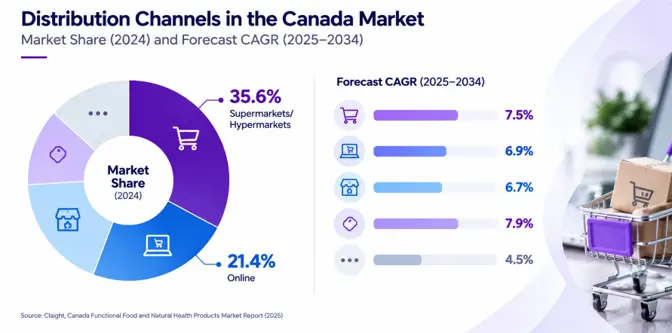
Physical retail, and supermarkets and hypermarkets in particular, remains the anchor distribution channel. Supermarkets and hypermarkets accounted for 35.6% of the 2024 market and are forecast to reach USD 11.95 billion by 2034 at a 7.5% CAGR. But it is specialty retail, not e-commerce, forecast to grow fastest of all channels: specialty stores rise at a CAGR of 7.9%, compared with 6.9% for online channels. That distinction is easy to miss without a full channel-level breakdown.
For businesses allocating trade marketing investment, the distinction matters: the channel carrying the most volume today is not necessarily the channel offering the fastest incremental growth.
Strategic Impact: Turning the Model into Decisions Businesses Can Act On
The Canada Functional Food and Natural Health Products Market Report and Forecast 2025 to 2034 gives a reader four things a scatter of single-category data never could.
Commercial Planning and Market Sizing
– A single, consistent value baseline across two regulatory categories, so a portfolio spanning both is measured on like-for-like terms.
– Segment-level growth patterns by nature, product, application, end user, and distribution channel, for sizing a specific opportunity, not just the whole market.
– A 2018 to 2034 window long enough to separate a temporary category trend from a structural one.
↳ A single sizing model built to support market-entry timing and portfolio decisions, not just a headline number. |
Portfolio and Category Strategy
– A clear read on where the market's growth is concentrated, distinct from where its current volume sits.
– Competitive positioning alongside investment activity, so portfolio bets can be checked against both incumbent strength and where capital is actually moving.
– A view of which segments are large today versus which are simply growing fast, so category bets are not made on momentum alone.
↳ Category prioritisation grounded in where the market is heading, not just where it is today. |
Regulatory and Risk Planning
– A dedicated view of Health Canada's proposed cost-recovery fee structure, factored into the forecast itself instead of treated as a footnote.
– A structural read on which company sizes are likely to absorb that cost, and which stand to benefit from a higher compliance bar for competitors.
– A basis for engaging with policymakers and industry associations from a position of evidence, not anecdote.
↳ Regulatory change modelled as a forecast input, not an afterthought. |
Investment and Competitive Intelligence
– A view of where capital is moving within the category, and how that compares with the current competitive leaderboard.
– A vendor positioning view distinguishing established players from emerging challengers.
– A reference point for benchmarking a potential acquisition target or investment against the category's broader competitive and funding trends.
↳ A single view of who leads today, and which emerging players warrant closer competitive monitoring. |
“A market this fragmented does not hand you a clean number. Building one that holds up, category by category, is the job.”
This is the difference between a market report as a static snapshot and a market report as a planning instrument.
Why This Approach Matters for Markets Beyond Canada
The same challenge, two adjacent categories converging in consumer behaviour but diverging in regulation, a competitive landscape fragmented at the top but concentrated at the investment level, and a policy shift landing mid-forecast, appears across food, consumer health, and wellness markets well beyond Canada. Claight's segmentation and validation framework is designed for markets where regulatory boundaries no longer reflect how consumers shop and behave.
A business that has faced this question in one market, functional food and supplements in the United States, nutraceuticals in parts of Europe, or fortified food in growth markets across Asia, is likely to encounter it again. The framework built for Canada is designed to travel: the same category-boundary discipline, triangulation of primary and secondary sources, and integration of regulatory change directly into the forecast.
- Where does a market split by regulation actually behave as one market for consumers?
- Which subsegments are growing fastest, and do they align with where current leaders are positioned?
- How does live regulatory change reshape the forecast, beyond its headline number?
- Where is investment capital moving, and does it reinforce or challenge the current competitive landscape?
How Claight Supports Consumer and Healthcare Intelligence Clients Globally
Claight's EMR Healthcare and Pharmaceuticals Insights practice builds sizing, segmentation, and competitive intelligence across food, nutrition, consumer health, and pharmaceuticals, combining primary research, macroeconomic validation, and a disclosed three-step quality process on every report.
Claight supports clients across North America, Europe, Asia-Pacific, and emerging markets, including consumer goods companies, ingredient manufacturers, investors, and policy institutions, each working from the same evidence standard regardless of category or geography.
Ready to Build a Defensible Model for Your Next Market?
Whether the need is a full multi-country sizing model, a single-category deep dive, or a competitive and investment landscape, Claight's analyst team can build it on the same evidence standard.
Contact: sales@claight.com
Visit: www.claight.com










Share