Neurodermatitis, clinically known as lichen simplex chronicus (LSC), is a chronic, self-reinforcing itch-scratch disorder with no dedicated clinical guideline and a surprisingly thin body of disease-specific epidemiology. This case study demonstrates how Claight's EMR Healthcare and Pharmaceuticals Insights practice delivered a comprehensive Neurodermatitis Epidemiology Forecast Report for 2019 to 2035, covering nine major markets across the United States, Europe, Japan, India, and China, that became a strategic planning tool for a global dermatology-focused pharmaceutical client navigating one of dermatology's most under-quantified chronic disease areas.
| 9MM |
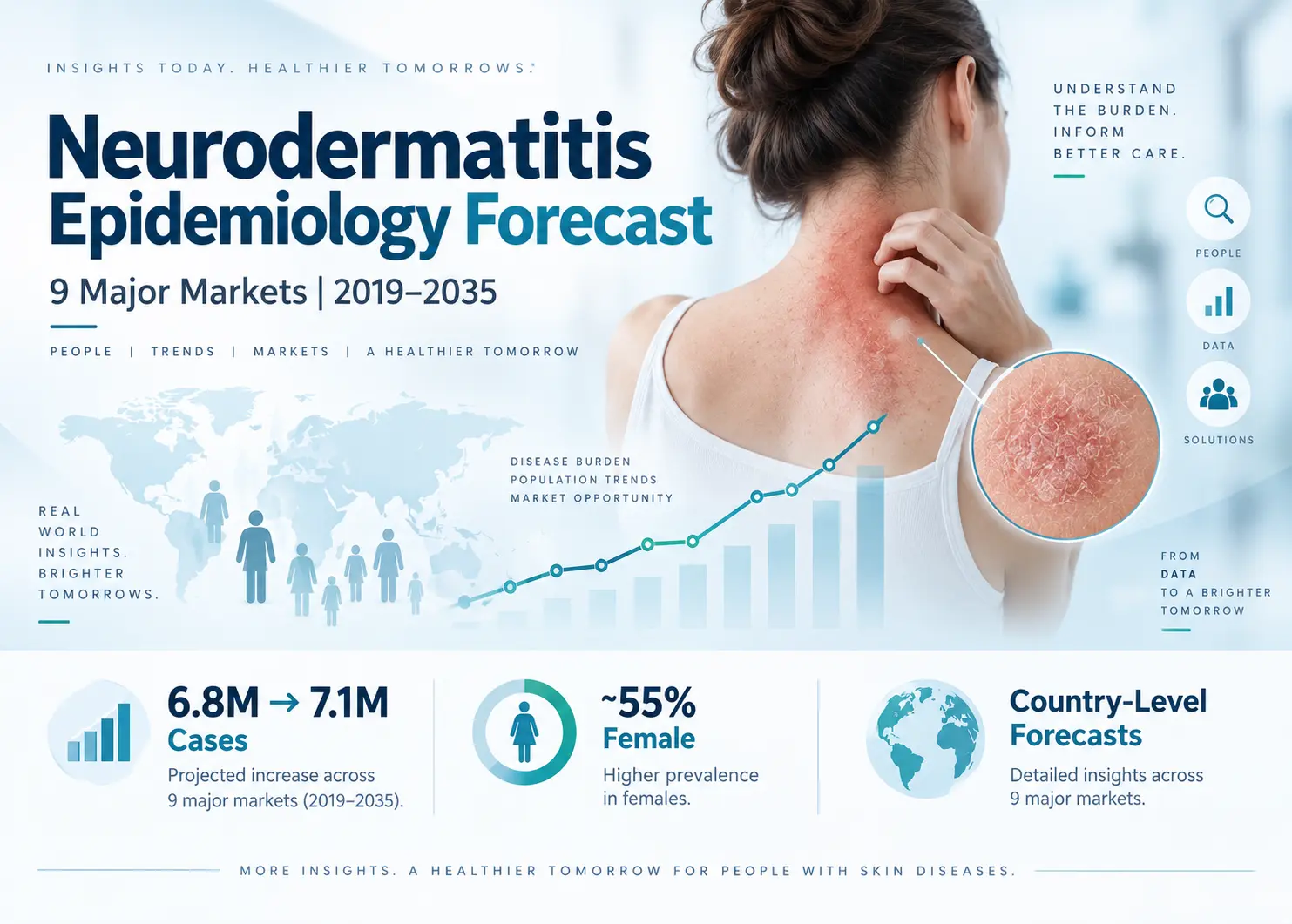
6.8M → 7.1M |
2019-2035 |
~55% |
3 |
| Major markets modelled |
9MM prevalent cases, 2025 to 2035 |
Historical + forecast window |
Share of 9MM burden that is female |
Evidence-confidence tiers applied to every input |
The Challenge: A Chronic Itch Disorder That Resists Easy Quantification
Neurodermatitis occupies a genuinely difficult position in dermatology. Its own clinical literature frames it as a self-reinforcing itch-scratch cycle with no fixed onset-to-progression timeline, and no professional body has issued a dedicated diagnostic guideline for it. There is no validated severity score in routine clinical use, and the condition's own review literature describes it as underrepresented in dermatologic literature and underprioritised in clinical practice relative to its prevalence.
Terminology compounds the problem. In several European markets, and in German-language clinical sources in particular, “neurodermatitis” functions as a general, colloquial term for atopic dermatitis, a considerably broader and more common condition than the narrower, LSC-specific definition used in English-language dermatology. Any model that skips this distinction at the country level risks conflating two clinically different populations and overstating the addressable market by a wide margin.
Quantifying the burden with precision is complicated further by how thin the disease-specific literature actually is. The number most often quoted for general population neurodermatitis prevalence, around 12%, traces back to a single published study. Applied uniformly across nine demographically different markets, a single-study figure like that would produce a forecast that looks confident but is not defensible, a critical methodological issue with direct implications for commercial planning and portfolio decisions.
The Client: Navigating a Data-Constrained Disease Space
For a pharmaceutical company with an active asset in inflammatory and pruritic skin disease, neurodermatitis represents both a genuine area of unmet need and one of the harder patient populations to size with confidence. Diagnosis is complicated by terminology conflation, and published epidemiological data across geographies vary considerably due to differences in clinical convention and reporting infrastructure.
The client faced a challenge that sits at the intersection of science and strategy: how to plan credibly in a disease area where the patient population is real and commercially relevant, but the published evidence will not, on its own, support a defensible nine-market forecast.
Three Linked Strategic Questions
Existing published epidemiology was fragmented, often single-study, and rarely stratified across the geographic and demographic dimensions the client needed. The engagement was structured around three specific intelligence gaps:
1. How large is the neurodermatitis patient population, today and through 2035, across nine major markets, using a consistent, LSC-specific definition that keeps the broader atopic dermatitis population out of the model?
2. How does that burden divide by age group and gender across the nine markets, and which segments are shifting fastest as demographics change through the forecast horizon?
3. Where are the most significant unmet needs across the neurodermatitis patient journey, from recognition through diagnosis, initial treatment, and long-term management, and which of those needs are realistically addressable in the near term?
“The fundamental challenge was not simply counting how many people have neurodermatitis today. It was separating that population, market by market, from a much larger group colloquially labelled the same way, without losing the true patient pool in the process.”
Our Approach: A Multi-Source, Country-Stratified Epidemiology Model
Claight built the Neurodermatitis Epidemiology Forecast Report (2019 to 2035) as a precision planning instrument, not a high-level disease overview. The model covered all nine major markets individually across prevalence, incidence, and diagnosed cases from 2019 through 2035, grounded in four analytical pillars.

Modelling Framework for Epidemiology Forecasting
Pillar 1: Defining the True Neurodermatitis Patient Universe
Neurodermatitis was defined strictly around its clinical hallmark: a localised, lichenified, intensely pruritic plaque driven by a self-reinforcing itch-scratch cycle. A key step in several markets, Germany in particular, was excluding the broader, colloquial use of “neurodermatitis” as a general term for atopic dermatitis. Because that colloquial usage is considerably more common than the narrower LSC-specific condition, leaving it unaddressed would have overstated the addressable population in the affected markets by a wide margin.
Pillar 2: Triangulating Evidence Across Three Confidence Tiers
Every quantitative input was classified into one of three tiers at the point of entry: directly sourced population and demographic data, cross-referenced against at least two independent sources; prevalence and incidence rates built from published evidence plus a modelled adjustment; and sub-segment splits treated as directional signals only. Where a middle-tier rate could be built two ways, from a top-down literature rate and from a bottom-up reconstruction based on linked conditions, the two were compared directly, and any material divergence was disclosed to the client as a signal of genuine estimation uncertainty.
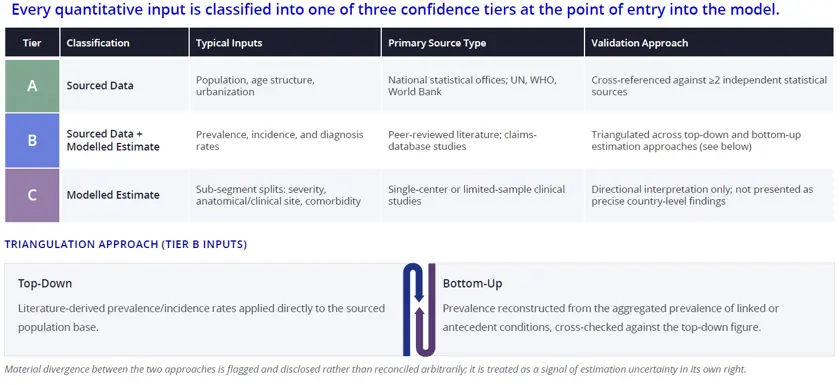
Data-Confidence Tier
Pillar 3: Stratifying by Gender, Age Group, and Country
For every one of the nine markets, the neurodermatitis population was split by gender and by age band (paediatric 0 to 14, adult 15 to 64, geriatric 65 plus). Separate prevalence, incidence, and diagnosed-case curves were generated for each demographic stratum at the country level, built independently instead of apportioned down from a single global split.
Pillar 4: Forecasting Through 2035 on Evidence-Anchored Assumptions
The forecast to 2035 combined country-specific demographic trajectories, ageing populations in Japan and Germany, a younger and growing population in India, with epidemiological rates held constant unless independently published evidence supported a genuine trend. Low, base, and high scenarios were built with a documented rationale for every assumption, and forecast controls kept year-on-year movement gradual unless the evidence supported a step change.
Key Findings: What the 9MM Neurodermatitis Epidemiology Data Revealed
The model produced country-level neurodermatitis prevalence, incidence, and diagnosed-case estimates for all nine markets from 2019 through 2035. The headline trajectory is modest, a 9MM population that grows by roughly 7% over seventeen years, but the strategic value sits in the country-level patterns, demographic shifts, and evidence-quality distinctions beneath that aggregate number.
Finding 1: A Slow, Population-Driven Climb, Not a Flat Market
Across the 9MM, total neurodermatitis prevalence is projected to grow from approximately 6.64 million in 2019 to 7.12 million by 2035, a rise of roughly 7%. Because epidemiological rates were held constant unless evidence justified otherwise, this growth traces almost entirely to population change, with no shift in disease rate or diagnostic practice built into the model.
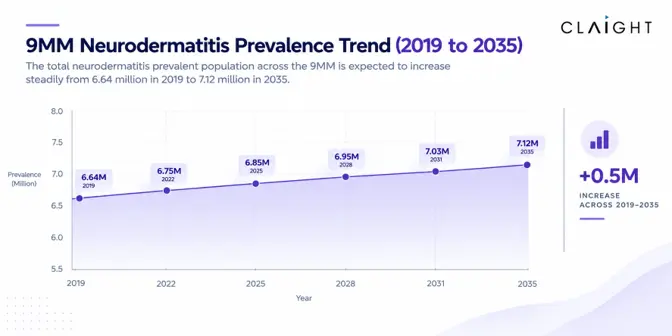
Source: Claight, Neurodermatitis Epidemiology Forecast Report 2019 to 2035. Figures are illustrative of trend direction; full country-level data is available in the report.
Finding 2: Country-Level Prevalence: India and China Dominate Absolute Burden
India and China together account for more than three-quarters of the 9MM neurodermatitis population in absolute terms, a reflection of population size more than disease rate. China holds close to flat while India grows by 17%, since India's younger, expanding population pushes the number up even with an unchanged disease rate. The United States, United Kingdom, and France also grow through 2035, while Japan, Germany, and Italy contract slightly, consistent with their ageing and shrinking populations.
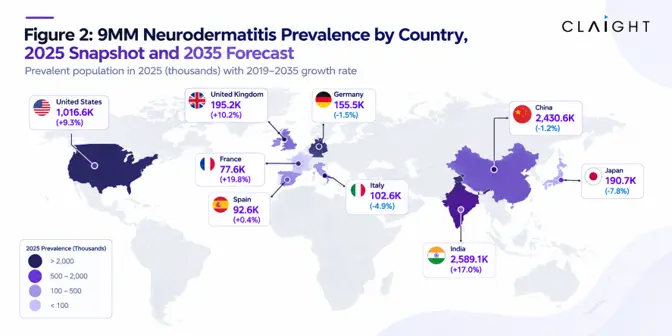
9MM Neurodermatitis Prevalence by Country
Finding 3: Age Stratification Reveals a Population Shifting Younger
The age-stratified analysis showed how the composition of the 9MM population itself shifts across the forecast horizon, even as the aggregate total grows only modestly.
| Age Group |
9MM Share (2025) |
Strategic Relevance |
| Paediatric (0-14 years) |
~13% |
Smallest segment in absolute terms, but the fastest-growing share, tracking population growth in younger markets such as India. |
| Adult (15-64 years) |
~70% |
Largest segment throughout the forecast; the core population for any commercial or clinical planning exercise. |
| Geriatric (65+ years) |
~17% |
Contracting share overall, concentrated in the ageing European and Japanese markets; still relevant given the comorbidity burden reported in LSC cohorts. |
Source: Claight, Neurodermatitis Epidemiology Forecast Report 2019 to 2035.
Finding 4: A Consistent Female Majority, With Planning Implications
Across the 9MM aggregate, the model shows a stable female majority throughout the forecast, close to 55% of prevalent cases. Published single-study findings on gender distribution vary by country and by care setting; one widely cited US study reported female patients considerably over-represented among diagnosed cases. The model treats country-level gender splits as a calibrated output of the full framework, keeping any single study's reported ratio as supporting context only.
Finding 5: The Diagnosed Share of the Burden Widens Across the Forecast
In the 2025 base year, diagnosed prevalent cases represent roughly 52% of total 9MM prevalence. By 2035, that share is expected to rise to approximately 62%, a directional finding tied to the calibration stage's diagnosis and access assumptions. The gap between total burden and the diagnosed, treated population, often the more commercially relevant number, narrows meaningfully across the horizon, even though the underlying disease rate stays unchanged.
Finding 6: Treatment Gaps and Unmet Needs Persist Across the Patient Journey
The patient journey and unmet-need analysis identified structural gaps that recur across the pathway, independent of geography:
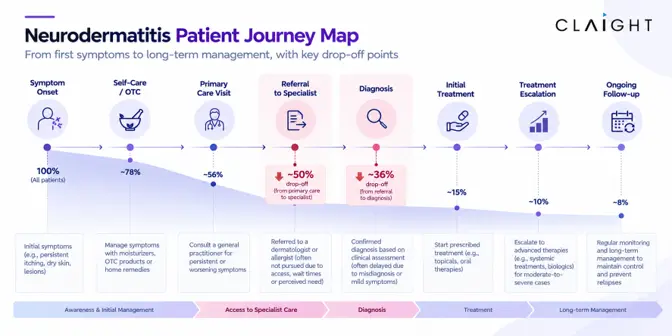
Neurodermatitis Patient Journey Map
- Diagnosis and referral: no defined referral window exists for persistent, localised itch, and diagnosis itself rests on history and examination, without a lab-confirmed marker to fall back on.
- Initial therapy: potency and frequency guidance for first-line topical corticosteroids is consensus-based, without head-to-head randomised evidence behind it.
- Sensitive-site and refractory disease: escalation options exist (occlusive, procedural, systemic) but with limited comparative-effectiveness evidence to guide sequencing.
- Awareness and recognition: the condition's own literature describes it as underrepresented relative to its prevalence, with no validated severity-scoring tool in routine use.
Strategic Impact: Turning a Thin Evidence Base into a Defensible Neurodermatitis Strategy
The Neurodermatitis Epidemiology Forecast 2019 to 2035 gave the client a single, tiered, country-stratified evidence base for decisions that had previously relied on a handful of inconsistent, single-study figures. The value showed up across four areas.
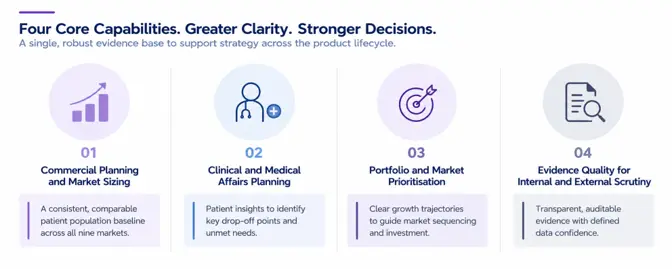
01 Commercial Planning and Market Sizing
– A consistent, LSC-specific population count across all nine markets, with the terminology conflation risk resolved market by market.
– A patient population forecast anchored to a single base year and evidence framework throughout, so market comparisons are like for like.
– Diagnosed-versus-total-prevalence trajectories that separate the addressable treated population from the full disease burden.
↳ A country-by-country neurodermatitis patient population baseline built on one auditable evidence standard.
02 Clinical and Medical Affairs Planning
– Country-level age and gender splits that show where paediatric, adult, and geriatric burden concentrates.
– A patient journey map that pinpoints where referral and diagnosis create the steepest drop-off.
– An unmet-need prioritisation that separates high-impact, addressable gaps from harder structural ones.
↳ Medical affairs and patient-support planning grounded in where patients actually get lost in the system.
03 Portfolio and Market Prioritisation
– Country trajectories that separate genuinely growing markets, India, France, the United States, from markets where the burden is stable or contracting, Japan, Germany, Italy.
– A 17-year forecast horizon long enough to model the patient pool at multiple future planning points, not a single snapshot.
– Low, base, and high scenario bounds that let planning teams stress-test country sequencing against different diagnosis and access assumptions.
↳ Sequencing decisions supported by a seventeen-year patient trajectory instead of one point estimate.
04 Evidence Quality for Internal and External Scrutiny
– A three-tier data-confidence classification applied to every input, so medical, regulatory, and commercial stakeholders can see which numbers are sourced, modelled, or directional.
– Documented, peer-reviewed assumptions and disclosed divergence between top-down and bottom-up estimates.
– Single-study findings kept clearly labelled throughout, never folded into country-level rates without disclosure.
↳ A single evidence base built to withstand scrutiny from medical, regulatory, and commercial reviewers alike.
“Country-level neurodermatitis prevalence and diagnosis data, stratified by age and gender and built on a disclosed, tiered evidence standard, gave our client a foundation that held up from internal portfolio review to conversations with regional medical teams.”
This is the difference between epidemiology as a background statistic and epidemiology as a strategic instrument.
Read more about Claight's epidemiology forecasting services
Why Epidemiology Forecasting Matters in Neurodermatitis and Beyond
Epidemiology forecasting in neurodermatitis is useful only when it answers the real questions planning teams face. Because the condition is genuinely hard to define consistently across markets, thin on disease-specific evidence, and easily conflated with a much more common adjacent diagnosis, a single global prevalence figure will not hold up to scrutiny. Biopharma and dermatology teams need a forward-looking view of the patient population that speaks directly to portfolio, launch, and access decisions.
Claight's country-level disease burden modelling is built to answer questions such as:
- Where is the addressable neurodermatitis patient population growing fastest, and at what rate, across markets?
- Which patient segments, by age, gender, or geography, are most relevant to a given asset, and how large are they today versus at expected launch?
- What does the gap between total prevalence and diagnosed population mean for realistic addressable-market sizing at different points in the forecast?
- What epidemiology evidence will regulators, payers, and internal governance teams expect, and does the current data package meet that bar?
- How sensitive are portfolio and opportunity forecasts to key assumptions such as diagnosis rates, healthcare access, and demographic change?
While this case study focuses on neurodermatitis, the same evidence-tiered, country-stratified modelling framework applies wherever published epidemiology is thin, inconsistent, or scattered across adjacent diagnoses, including other chronic pruritic and inflammatory skin conditions, rare and underdiagnosed indications, and therapeutic areas.
How Claight Supports Strategic Healthcare Intelligence Globally
Claight's EMR Healthcare and Pharmaceuticals Insights practice delivers customised healthcare market intelligence and strategic research across pharmaceuticals, biotechnology, diagnostics, medical devices, and healthcare services. The team combines structured epidemiology modelling, competitive intelligence, and therapeutic landscape assessment to support evidence-based decisions across the full product lifecycle, from early development through to market launch and lifecycle management.
Claight supports clients across North America, Europe, Asia-Pacific, and emerging markets, including pharmaceutical companies, biotechs, healthcare investors, payers, regulatory bodies, and policy institutions.
Ready to Build Your Own Epidemiology Model?
Whether the need is a full multi-market epidemiology forecast, a single-country deep dive, a syndrome- or subtype-specific patient sizing model, or a broader patient journey and unmet-need analysis, Claight's team can build it, tiered, disclosed, and ready for medical, regulatory, and commercial use.
Contact us:
sales@expertmarketresearch.com
Visit: www.expertmarketresearch.com
Our team supports engagements across epidemiology forecasting, patient population modelling, competitive intelligence, and healthcare market intelligence, globally.
Related Reports
Neurodermatitis Epidemiology Forecast Report
Atopic Dermatitis Epidemiology Forecast
Psoriasis Epidemiology Forecast
Plaque Psoriasis Epidemiology Forecast









Share