

Consumer Insights
Uncover trends and behaviors shaping consumer choices today
Procurement Insights
Optimize your sourcing strategy with key market data
Industry Stats
Stay ahead with the latest trends and market analysis.
The AI in genomic data analysis market was valued at USD 1.45 Billion in 2025 and is projected to reach USD 15.22 Billion by 2035, advancing at a CAGR of 26.50%. Growth is supported by falling sequencing costs that generate data faster than specialist staff can interpret it, the addition of genome sequencing to rare disease, oncology and newborn programmes, the move of analysis software from research use into regulated clinical workflows, and the arrival of genome-scale foundation models that raise accuracy in variant interpretation.
Patent activity reflects the same momentum. Filings concentrate on deep learning variant calling from sequencing reads, variant annotation and pathogenicity prediction, single-cell and spatial transcriptomic analysis, polygenic risk score modelling, genome and foundation language models, and cloud pipelines for secondary and tertiary analysis. Validation signals include the 2018 publication of DeepVariant by Google researchers, the 2023 release of AlphaMissense predictions for human missense variants, FDA-cleared sequencing systems that bundle analysis software, and the growing use of machine learning interpretation in hospital genomics laboratories.
This AI in Genomic Data Analysis Patent Landscape Analysis Report provides a structured view of patent families, assignees, jurisdictions and technology clusters, together with the commercial and regulatory context needed to judge competitive positions and filing opportunities.
The AI in genomic data analysis market is experiencing strong growth, driven by falling sequencing costs, expanding clinical genome sequencing programmes, and the shift of analysis software into regulated clinical workflows. The UK Biobank released whole genome sequences for close to 500,000 participants in 2023, a data volume that only automated machine learning pipelines can analyse at scale.
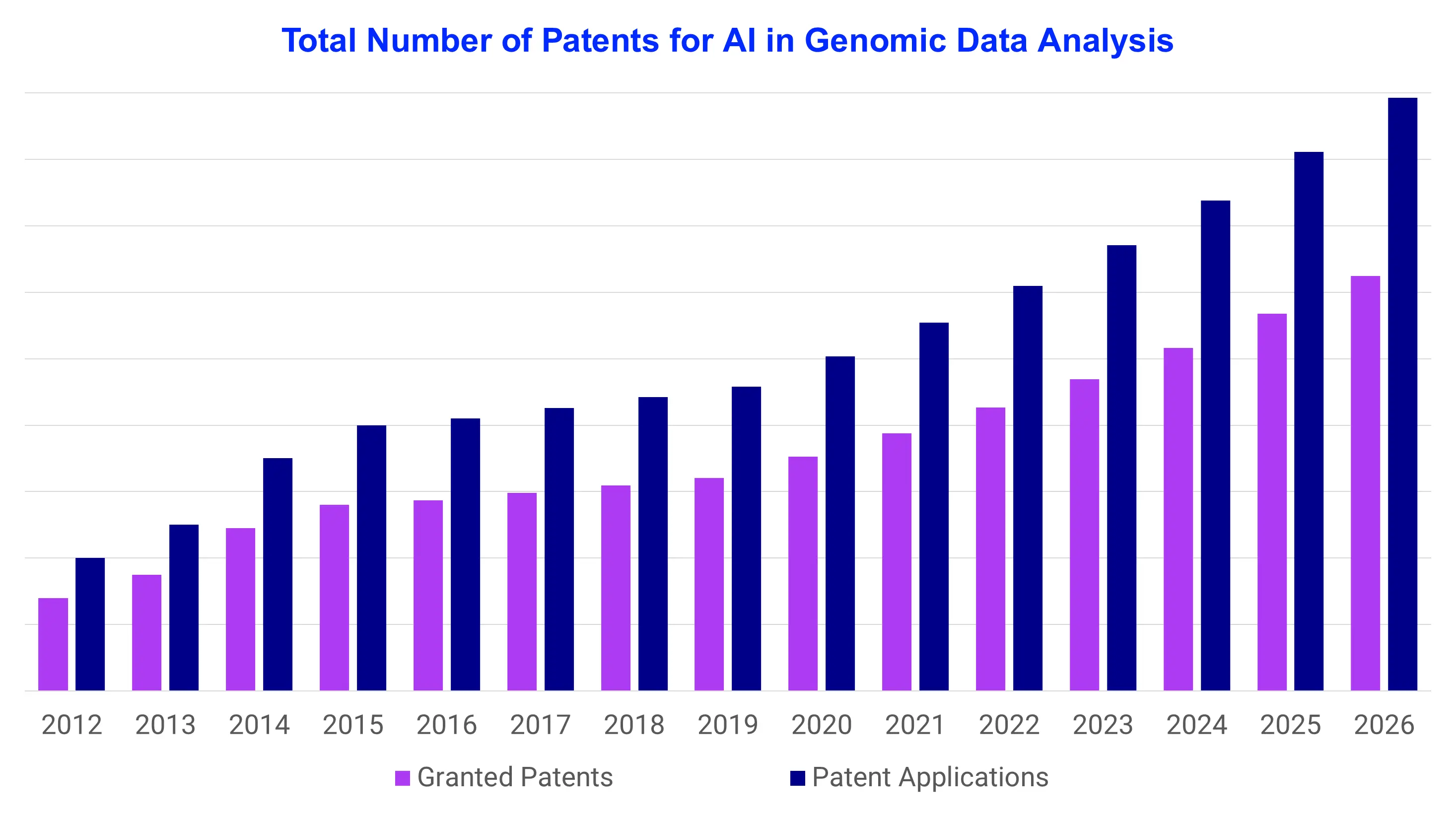
Patent activity is accelerating, with 800+ AI in genomic data analysis patents granted in 2025, reflecting strong innovation momentum in deep learning variant calling from sequencing reads, variant annotation and pathogenicity prediction, single-cell and spatial transcriptomic analysis, and polygenic risk score modelling.
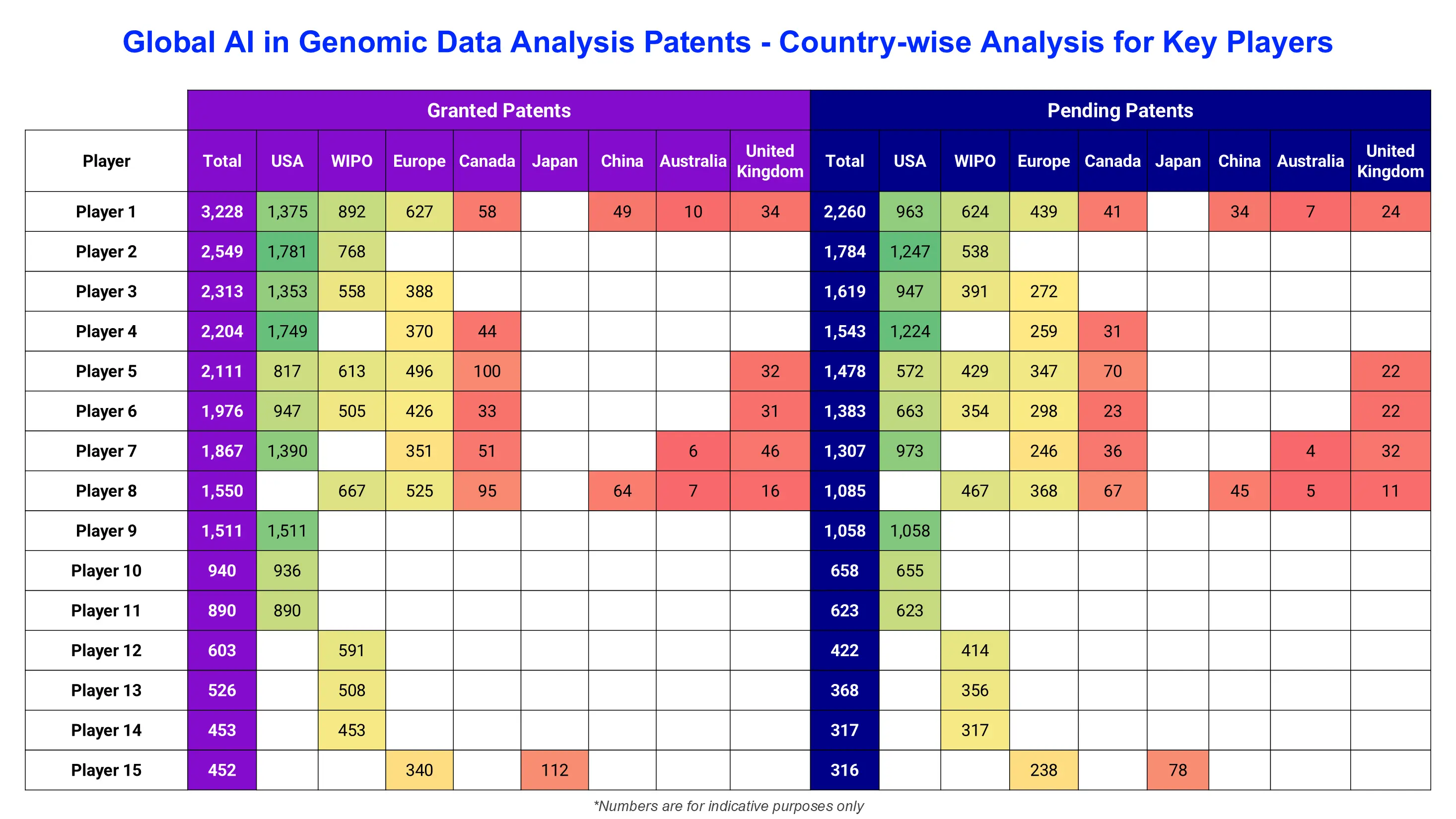
Top assignees in the AI in genomic data analysis patent landscape include Illumina, Google, BGI Genomics, Pacific Biosciences, and Sophia Genetics, with the United States, China, and Europe as the dominant patent jurisdictions.
Genomic data has outgrown the manual methods once used to read it. Sequencing a human genome now costs well under one thousand US dollars, and population programmes, newborn screening pilots and hospital precision medicine services add millions of genomes each year. Interpretation, not sequencing, has become the constraint, because a single whole genome yields roughly four to five million variants that must be filtered, annotated and classified before a clinician can act on a result. Machine learning models now handle variant calling, annotation, expression profiling and risk scoring at a scale that human curators cannot match. Demand comes from clinical genomics laboratories, pharmaceutical developers using human genetics for target selection, and health systems building genome-informed care pathways.
Market growth is driven by the gap between sequencing output and expert interpretation capacity, which pushes laboratories toward machine learning classification and automated pipelines. Rare disease shows the pressure: an estimated 300 million people live with one of roughly 7,000 rare diseases, and exome or genome sequencing reaches a diagnosis in about 25 to 40 percent of tested patients, a yield that rises as annotation models mature. The UK Biobank released whole genome sequences for close to 500,000 participants in 2023, showing why automated analysis is now a requirement. Regulatory movement points the same way, as FDA-cleared sequencing systems and CE-marked interpretation software let laboratories report machine learning outputs clinically.
Several data points explain why demand is durable. The ClinVar archive holds millions of variant submissions, and many missense variants in it remain of uncertain significance, so laboratories cannot report them with confidence. AlphaMissense, released in 2023, assigned a pathogenicity class to roughly 89 percent of the 71 million possible human missense variants, showing that learned models can shrink the uncertain pool and help laboratories prioritise review queues. Polygenic risk scores add a second demand stream, since a score drawn from millions of common variants can separate individuals with a several-fold difference in coronary artery disease risk, and health systems are testing earlier screening on that basis. Oncology adds volume through tumour profiling panels, where every case needs somatic variant calling and clinical annotation within days.
Read more about this report - REQUEST FREE SAMPLE COPY IN PDF
Filing intensity tracks commercial investment in sequencing platforms, cloud genomics and clinical interpretation software. Instrument makers file on analysis methods because each new platform needs an error model and a basecalling stack, while software companies file on pipelines, classifiers and reporting workflows. Cloud providers and technology groups contribute claims on model architectures and training data handling. Acquisitions of analysis specialists by sequencing companies, such as Illumina's purchase of Edico Genome in 2018 and its later purchase of Emedgene, have been accompanied by growth in related filings, which shows capital and patent activity moving together.
The landscape comprises more than 11,500 patent families. Filing activity peaked between 2022 and 2024, when machine learning claims moved from research tools into clinical and cloud products. Deep learning variant calling from sequencing reads and variant annotation and pathogenicity prediction account for the largest share of families. Single-cell and spatial transcriptomic analysis, polygenic risk score modelling, genome and foundation language models, and cloud pipelines for secondary and tertiary analysis make up the remaining clusters, with genome and foundation language models the newest and the fastest growing.
Rising sequencing volumes and the move of interpretation software into clinical laboratories have raised the commercial value of analysis methods, and that demand shows directly in the steady expansion of patent families across every technology cluster.
This report covers patent filings in the United States, China and Europe, the three largest jurisdictions, together with South Korea, India and international filings made through WIPO. Market coverage runs from research genomics to clinical diagnostics, including germline testing, tumour profiling, population screening and microbial genomics for infectious disease. Filings from 2010 to 2025 are examined, a period that spans the 2018 publication of DeepVariant, the 2023 release of AlphaMissense and the first genome language models. The coverage applies to the full range of AI in genomic data analysis activity, from signal processing inside sequencers to cloud platforms that deliver reports to clinicians.
Technology coverage spans Variant Calling and Annotation, Variant Interpretation and Classification, Gene Expression and Transcriptomic Analysis, Single-Cell and Spatial Genomics Analysis, and Polygenic Risk Scoring. Algorithm families include Deep Learning Models, Machine Learning Classifiers, Large Language and Foundation Models, and Graph and Network Models. Applications cover Rare Disease Diagnosis, Oncology Genomics, Pharmacogenomics, Population Genomics, and Infectious Disease Genomics. Claims on basecalling, error correction, structural variant detection, methylation calling, and compression and storage of genomic files are included, as are cloud pipelines for secondary and tertiary analysis.
Entities include sequencing instrument manufacturers, clinical genomics service companies, interpretation software specialists, large technology groups, and pharmaceutical developers that apply human genetics to target selection. Start-ups working on foundation models, single-cell analysis and variant interpretation appear alongside established firms such as Illumina, Pacific Biosciences, BGI Genomics, Sophia Genetics and Google. Academic and clinical institutions contribute a meaningful share of early filings, among them the Broad Institute, Stanford University, the University of California system and Chinese research institutes. Hospital genomics laboratories and university medical centres add filings that come out of clinical interpretation workflows.
The report will cover the following sections in detail:
Analysis by Analysis Type
Analysis by Algorithm Type
Analysis by Application
AI in Genomic Data Analysis Patent Filing Trend Analysis
Patent filings in AI in genomic data analysis show a clear shift in emphasis. Early filings centred on statistical variant callers and rule-based annotation, while recent filings concentrate on neural network architectures, transformer-based genome models and cloud-scale training pipelines. Grant volumes have risen with filings, and more than 800 patents were granted in 2025. The mix of claims has moved from algorithms in isolation toward claims tied to sequencing hardware, clinical reports and regulated diagnostic workflows.
Annual filing growth is estimated at approximately 18 percent between 2020 and 2024. Growth was driven by the spread of deep learning from variant calling into annotation and single-cell analysis, by long-read platforms that need dedicated error models, and by the commercial interest that followed AlphaMissense and other genome-scale models. Cloud providers and sequencing companies filed on pipeline orchestration and data handling as clinical volumes grew. Applicants from China rose faster than the average, supported by domestic sequencing platforms and national precision medicine programmes.
Among the players with AI in genomic data analysis patent families, new entrants have been identified, which can be either established companies or startups developing novel technology in the field. Some of the major companies mentioned in this report (a non-exhaustive list) are as follows:
Illumina holds one of the broadest portfolios in the landscape, covering sequencing chemistry, flow cell and instrument design, and the informatics that turn raw signal into variant calls and clinical reports. Its named platforms include the NovaSeq X series, the MiSeqDx and NovaSeq 6000Dx diagnostic systems, and the DRAGEN secondary analysis platform, which it gained through the 2018 acquisition of Edico Genome. The firm's machine learning work includes PrimateAI and SpliceAI, models for variant pathogenicity and splice effect prediction, and the Emedgene interpretation software, which it acquired later. MiSeqDx was the first next-generation sequencing system cleared by the FDA, in 2013, and diagnostic configurations carry FDA clearance or CE marking in several regions. Illumina's intellectual property strategy combines broad hardware and consumable patents with a growing set of software and model claims that bind analysis to its instruments, and its commercial position rests on a large installed base of sequencers that feed its analysis products.
Google files in this field mainly through its research groups and Google DeepMind, with a portfolio centred on neural network architectures, training methods and cloud delivery for genomic data. Named assets include DeepVariant, the deep learning variant caller published by Google researchers in 2018, DeepConsensus for correcting long-read errors, developed with Pacific Biosciences data, and AlphaMissense, released in 2023 to predict the pathogenicity of human missense variants. DeepVariant is open source and is built into several commercial pipelines, among them NVIDIA Parabricks and the analysis software of Pacific Biosciences. These tools are released as research software and are not regulated devices on their own, so clinical use depends on partners that validate them inside diagnostic workflows. The company's intellectual property approach pairs patent filings on model methods with open publication and code release, which spreads adoption while protecting specific implementations, and its commercial position is that of a technology supplier to sequencing companies, cloud customers and laboratories.
Other companies include BGI Genomics, Pacific Biosciences, and Sophia Genetics.
Leading assignees hold a meaningful but not dominant share of the landscape, and the long tail of start-ups, universities and hospitals remains large. Illumina combines sequencing chemistry, instrument and DRAGEN analysis claims, giving it the broadest portfolio from signal to report. Google concentrates on model architectures, training methods and cloud delivery, often paired with open-source release of software. BGI Genomics builds claims around clinical testing workflows, population screening and analysis methods tied to the DNBSEQ sequencing ecosystem of the wider BGI group. Pacific Biosciences protects long-read signal processing, consensus and variant detection methods, while Sophia Genetics holds claims on cloud-based clinical interpretation and data-driven medicine workflows.
*Please note that this is only a partial list; the complete list of key players is available in the full report. Additionally, the list of key players can be customized to better suit your needs.*
The report assesses patent activity across major jurisdictions, including:
The United States, China and Europe lead filing volumes, and each reflects a different commercial base. Filings from the United States come from sequencing companies, technology groups and academic centres and tend to claim methods and systems. Chinese filings are driven by domestic sequencing platforms, large population screening programmes and a growing group of university applicants, and they have grown faster than the global average. European filings, largely through the European Patent Office, centre on clinical interpretation software, diagnostics and academic research. South Korea contributes through national genome projects and consumer genomics firms, and India through clinical genomics companies and population programmes such as GenomeIndia, while WIPO filings show applicants positioning claims in several jurisdictions at once.
Read more about this report - REQUEST FREE SAMPLE COPY IN PDF
Patent activity in AI in genomic data analysis is organised around five technology segments:
Deep learning variant calling and annotation leads patent activity. Every sequencing workflow needs accurate variant calls, so the claims apply across platforms, laboratories and disease areas, and they sit close to commercial products such as DRAGEN and DeepVariant. Variant interpretation and classification is the next largest segment, supported by the large backlog of variants of uncertain significance, while genome and foundation language models are the fastest growing.
Competition spans three groups: sequencing platform owners, technology companies and clinical software specialists. Illumina and Pacific Biosciences embed analysis into instruments, Google and other technology groups contribute model architectures, and Sophia Genetics and similar firms sell interpretation platforms to hospitals. BGI Genomics competes through integrated sequencing and testing in Asia. Start-ups offer interpretation, single-cell analysis and foundation models, and many are acquired or licensed by larger players once they prove clinical accuracy. Patent positions are increasingly tied to access to labelled clinical data, which is harder to replicate than an algorithm.
Companies are focusing on:
Several themes are emerging. Genome language models trained on large collections of genomes aim to predict the regulatory effects of non-coding variants, a gap in coding-focused tools. Graph genome references and pangenome methods are reducing reference bias in variant calling and are attracting filings on graph and network models. Multi-omic models that combine expression, methylation and imaging data are moving into oncology. Federated learning and privacy-preserving analysis are gaining attention as hospitals share models rather than raw genomes, and regulators are examining how to validate software whose outputs change as models are retrained.
The patent landscape maps more than 11,500 patent families across variant calling, interpretation, expression and single-cell analysis, risk scoring and genome models, and connects them to the assignees, jurisdictions and technology clusters that shape commercial positions. It shows where filings are crowded, such as short-read variant calling, and where they appear thinner, such as non-coding variant effect prediction and pharmacogenomic decision support. Decision makers in sequencing, diagnostics and pharmaceutical companies can use it to judge freedom to operate, identify licensing and partnership candidates, and time investment.
The landscape provides actionable intelligence for the following nine uses:
Patent research draws on global patent databases, including those of the United States Patent and Trademark Office, the European Patent Office, the China National Intellectual Property Administration, the Korean Intellectual Property Office, the Indian patent office and WIPO PATENTSCOPE. Searches combine Cooperative Patent Classification codes, such as G16B and C12Q, with keyword strings for genomic data analysis, sequencing, variant, transcriptomic and machine learning terms. Search strings were refined through test queries until results held steady across jurisdictions.
Retrieved records were screened for relevance by title, abstract and claims, and duplicate families and filings with no relevance to genomic data analysis were removed. Remaining families were classified by analysis type, algorithm type, application, end user, jurisdiction and technology cluster. Assignee names were harmonised across subsidiaries, acquisitions and spelling variants, and legal status and grant year were recorded to separate granted patents from pending applications.
Market analysis draws on company filings and annual reports, FDA and European regulatory records, published clinical studies, national genomics programme disclosures and interviews with industry participants. Patent counts were set against sequencing volumes, product launches and regulatory milestones to test whether filing growth matched commercial demand. Market value, forecast and growth figures come from the market model for the report and are used to frame the patent findings.
Next-Generation Sequencing Diagnostics Patent Landscape Report


Upto 15% Off
USD
$2699 $2429
$4299 $3869
$5799 $4949
$6999 $5949


*While we strive to always give you current and accurate information, the numbers depicted on the website are indicative and may differ from the actual numbers in the main report. At Expert Market Research, we aim to bring you the latest insights and trends in the market. Using our analyses and forecasts, stakeholders can understand the market dynamics, navigate challenges, and capitalize on opportunities to make data-driven strategic decisions.*
EMR's AI in Genomic Data Analysis Patent Landscape Analysis provides a comprehensive assessment of patent filings, innovation clusters, assignee portfolios, and geographic filing patterns across the AI in genomic data analysis landscape. The report identifies 11,500+ patent families, evaluates leading jurisdictions including the United States, China, and Europe, and profiles the top assignees by portfolio size.
The global AI in genomic data analysis market was valued at USD 1.45 Billion in 2025. The market is projected to reach USD 15.22 Billion by 2035, expanding at a CAGR of 26.50% during 2026 - 2035.
The report analyses approximately 11,500+ patent families related to AI in genomic data analysis. These include filings from the United States, China, Europe, and international WIPO filings.
Key companies operating within the landscape include Illumina, Google, BGI Genomics, Pacific Biosciences, and Sophia Genetics, among others. These organisations collectively account for a significant portion of patent activity analysed in this report.
The report evaluates patent activity across the United States, Europe, China, Japan, South Korea, India, and international WIPO filings. The United States is the largest single jurisdiction for AI in genomic data analysis, with more than 4,900 patents associated with it within a landscape of more than 11,500 patent families.
Yes. The report scope can be customised based on geography, technology segment, assignee selection, time period, or specific innovation cluster focus. Readers can contact the Expert Market Research team through the enquiry form on the report page to scope a customised AI in genomic data analysis study covering specific assignees, jurisdictions or technology clusters.
Patent landscape analysis helps organisations understand innovation trends, competitive activity, technology whitespace, and IP risk across a defined domain. For AI in genomic data analysis, this report supports strategic decisions in R&D prioritisation, licensing evaluation, competitive benchmarking, and market entry planning.
Explore our key highlights of the report and gain a concise overview of key findings, trends, and actionable insights that will empower your strategic decisions.
|
Scope of the Report |
Details |
|
Analysis by Analysis Type |
|
|
Analysis by Algorithm Type |
|
|
Analysis by Application |
|
|
Analysis by End User |
|
|
Key Players Mentioned |
|
|
Geographies Covered |
|
Mini Report
One User
USD 2,699
USD 2,429
tax inclusive*
Single User License
One User
USD 4,299
USD 3,869
tax inclusive*
Five User License
Five User
USD 5,799
USD 4,949
tax inclusive*
Corporate License
Unlimited Users
USD 6,999
USD 5,949
tax inclusive*
*Please note that the prices mentioned below are starting prices for each bundle type. Kindly contact our team for further details.*
Flash Bundle
Small Business Bundle
Growth Bundle
Enterprise Bundle
*Please note that the prices mentioned below are starting prices for each bundle type. Kindly contact our team for further details.*
Flash Bundle
Number of Reports: 3
20%
tax inclusive*
Small Business Bundle
Number of Reports: 5
25%
tax inclusive*
Growth Bundle
Number of Reports: 8
30%
tax inclusive*
Enterprise Bundle
Number of Reports: 10
35%
tax inclusive*
How To Order

Select License Type
Choose the right license for your needs and access rights.

Click on ‘Buy Now’
Add the report to your cart with one click and proceed to register.

Select Mode of Payment
Choose a payment option for a secure checkout. You will be redirected accordingly.
Strategic Solutions for Informed Decision-Making
Gain insights to stay ahead and seize opportunities.

Get insights & trends for a competitive edge.

Track prices with detailed trend reports.

Analyse trade data for supply chain insights.

Leverage cost reports for smart savings

Enhance supply chain with partnerships.

Connect For More Information
Our expert team of analysts will offer full support and resolve any queries regarding the report, before and after the purchase.
Our expert team of analysts will offer full support and resolve any queries regarding the report, before and after the purchase.
We employ meticulous research methods, blending advanced analytics and expert insights to deliver accurate, actionable industry intelligence, staying ahead of competitors.
Our skilled analysts offer unparalleled competitive advantage with detailed insights on current and emerging markets, ensuring your strategic edge.
We offer an in-depth yet simplified presentation of industry insights and analysis to meet your specific requirements effectively.




