

Consumer Insights
Uncover trends and behaviors shaping consumer choices today
Procurement Insights
Optimize your sourcing strategy with key market data
Industry Stats
Stay ahead with the latest trends and market analysis.
The targeted drug delivery using nanoparticles market was valued at USD 11.40 Billion in 2025 and is projected to reach USD 41.53 Billion by 2035, growing at a CAGR of 13.80%. Growth is supported by the rising burden of cancer and rare genetic disease, clinical proof of nanoparticle-delivered nucleic acids, wider use of ligand-guided carriers and the need to reduce systemic toxicity of potent drugs.
Patent activity has expanded steadily since 2020, with filings concentrated in ligand-conjugated surfaces, stimuli-responsive release, extrahepatic lipid nanoparticle targeting and blood-brain barrier transport. Clinical readouts in in vivo gene editing and the 2025 acquisitions of Capstan Therapeutics and Verve Therapeutics confirm commercial interest in organ- and cell-selective carriers.
This Targeted Drug Delivery Using Nanoparticles Patent Landscape Analysis Report maps assignees, jurisdictions, technology clusters and filing trends to support R&D, licensing and freedom-to-operate decisions.
The targeted drug delivery using nanoparticles market is experiencing strong growth, driven by rising cancer and genetic disease burden, clinical validation of nanoparticle-delivered nucleic acids, and demand for lower off-target toxicity. The 2018 approval of Onpattro, the first lipid nanoparticle small interfering RNA therapy, and the 2025 personalised gene-editing treatment of an infant with CPS1 deficiency through lipid nanoparticles show that targeted nanocarriers now reach patients.
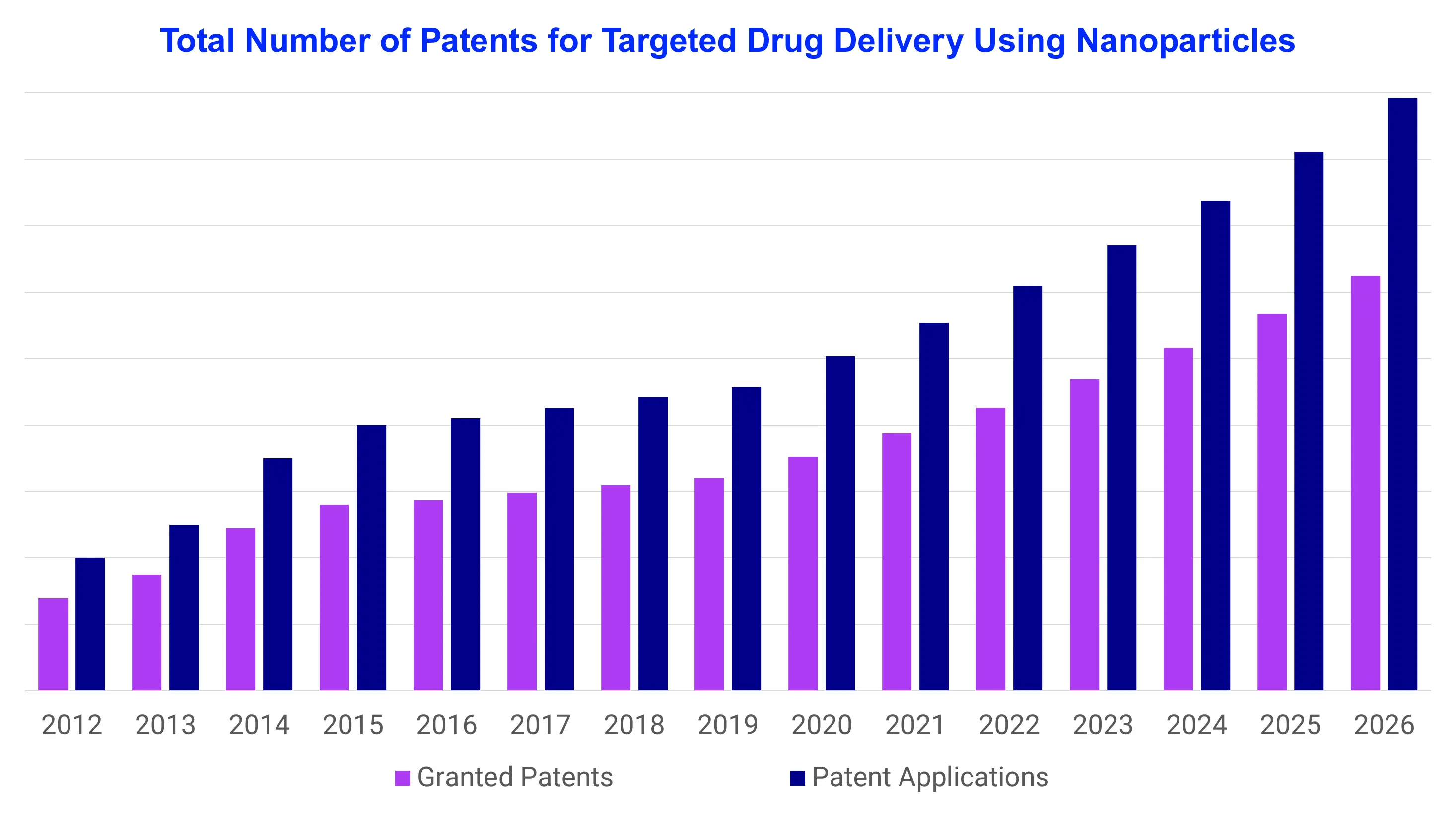
Patent activity is accelerating, with 250+ targeted drug delivery using nanoparticles patents granted in 2025, reflecting strong innovation momentum in antibody and peptide ligand conjugation on nanocarrier surfaces, stimuli-responsive release chemistries, extrahepatic organ targeting of lipid nanoparticles, and biomimetic cell membrane coatings.
Top assignees in the targeted drug delivery using nanoparticles patent landscape include Massachusetts Institute of Technology, The Regents of the University of California, Harvard University, Johns Hopkins University, and Novartis, with China, the United States, and Europe as the dominant patent jurisdictions.
Targeted nanoparticle delivery sits between oncology, genetic medicine and drug formulation. Carriers between 20 and 200 nanometres in size are engineered to carry small molecules, nucleic acids or proteins to selected tissues and cells. Demand comes from drug developers who need higher local drug exposure with lower systemic toxicity, and from gene medicine programmes that require a vehicle for fragile payloads. Hospital cancer centres, biotechnology firms and large pharmaceutical groups all invest in the area.
The market growth is driven by the shift of nanoparticle platforms from passive liposomal formulations to ligand-guided and nucleic acid carriers that expand the treatable disease set. GLOBOCAN estimates recorded about 20 million new cancer cases worldwide in 2022, which sustains demand for tumour-selective carriers. More than 50 nanoparticle-based products are now cleared by the FDA, giving developers a defined regulatory route.
A 2016 meta-analysis found that a median of only 0.7% of an injected nanoparticle dose reaches a solid tumour, so every gain in delivery efficiency cuts dose and side effects. This gap drives sponsors toward antibody, peptide and aptamer targeting, and it explains the steady flow of ligand-conjugation patents. In June 2025 AbbVie agreed to acquire Capstan Therapeutics for up to USD 2.1 billion for a T cell-targeted lipid nanoparticle platform, which shows that large groups pay for selective carriers. North America leads revenue through its nanomedicine sponsors and cancer centres, while Asia Pacific adds manufacturing capacity fastest.
Read more about this report - REQUEST FREE SAMPLE COPY IN PDF
Filing activity in targeted nanoparticle delivery has grown with each wave of clinical validation. The first wave followed liposomal and albumin-bound taxane products, and the second followed the approval of lipid nanoparticle RNA medicines. Universities file the largest share of early-stage families, and pharmaceutical groups follow with composition, formulation and manufacturing claims.
The dataset covers about 23,800 patent families, with filings peaking in 2021 and 2024 as messenger RNA and gene editing programmes expanded. Around 250 patents were granted in 2025, and roughly 8,260 patents sit with the primary jurisdiction. Chinese applicants account for the fastest rise in new families since 2020.
Demand for tumour-selective and organ-selective carriers in oncology and genetic disease translates directly into rising claims on ligands, ionisable lipids and release triggers.
This report covers patents and published applications on nanoparticle carriers designed to direct a drug or nucleic acid payload to a chosen tissue, cell type or intracellular compartment. Coverage includes lipid-based, polymeric, inorganic, protein-based, membrane-coated and dendrimeric carriers, together with their targeting ligands, release triggers and manufacturing methods.
Patent families are counted by priority date from 2010 to 2025 and grouped by assignee, jurisdiction, nanocarrier type, targeting mechanism and therapeutic area. Applications covering untargeted nanoparticle excipients, cosmetic nanoemulsions and diagnostic-only contrast agents are excluded from the core set.
Assignees analysed include universities and research hospitals, large pharmaceutical groups, nanomedicine specialists, gene medicine developers and contract development and manufacturing organisations.
The report will cover the following sections in detail:
Analysis by Nanocarrier
Analysis by Targeting Mechanism
Analysis by Therapeutic Area
Targeted Drug Delivery Using Nanoparticles Patent Filing Trend Analysis
Annual filings for targeted nanoparticle delivery grew at an estimated 11% per year between 2020 and 2024. Growth came from lipid nanoparticle patents for messenger RNA, small interfering RNA and base editing, which followed the 2020 and 2021 vaccine launches. Applicants also added claims on organ-selective lipids that direct payloads to the lung, spleen and bone marrow.
Granted patents trail filings by three to five years, so 2025 grants reflect applications from the 2020-2022 peak. Oncology still carries the largest claim count, and neurological and cardiometabolic claims are rising fastest from a smaller base. Litigation over ionisable lipid composition between lipid nanoparticle licensors and messenger RNA developers has raised the value of claim drafting around lipid structure.
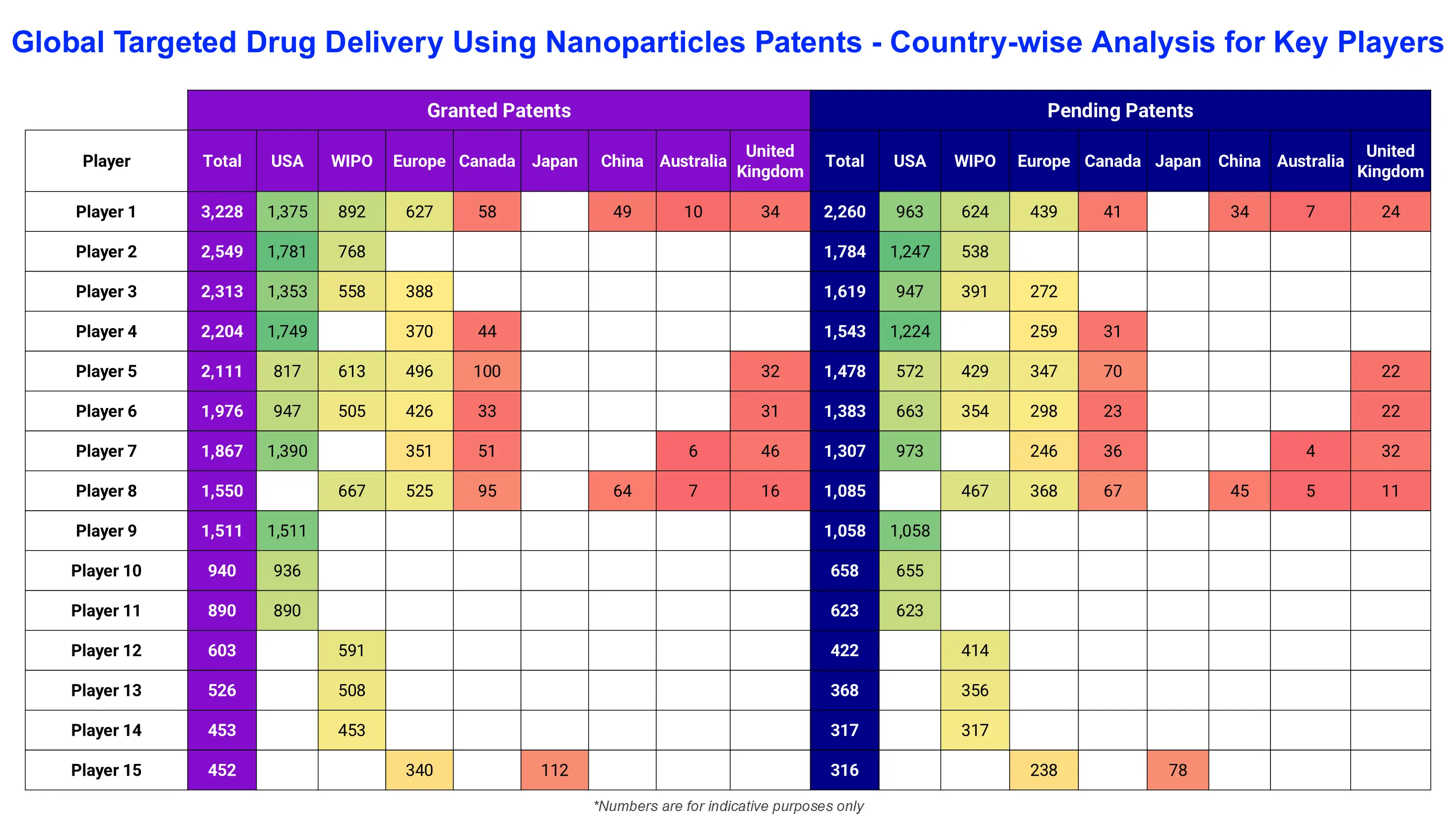
Among the players with targeted drug delivery using nanoparticles patent families, new entrants have been identified, which can be either established companies or startups developing novel technology in the field. Some of the major companies mentioned in this report (a non-exhaustive list) are as follows:
Massachusetts Institute of Technology holds one of the largest academic portfolios in targeted nanocarriers, built mainly in the laboratories of Robert Langer, Daniel Anderson and Paula Hammond. The portfolio covers lipidoid and ionisable lipid libraries for nucleic acid delivery, layer-by-layer coated nanoparticles, polymer-drug conjugates and ligand-decorated carriers for tumour and lung targeting. Early PSMA-targeted polymeric nanoparticle work from the group fed the Bind Therapeutics programme, and lipid chemistry from the institute has been licensed to several RNA medicine developers. As a non-profit institution, MIT files broadly, licenses exclusively by field of use and keeps continuation filings open to cover derivative compositions. Its Koch Institute for Integrative Cancer Research and the Technology Licensing Office act as the commercial interface for spin-outs and pharmaceutical partners.
The Regents of the University of California files across ten campuses, which gives it a wide spread of nanoparticle chemistries. Notable families include cell membrane-coated nanoparticles from the University of California San Diego, mesoporous silica nanocarriers from UCLA, and magnetic and gold nanoparticle systems from UC Berkeley and UC San Francisco. The oncology share is large, with growing activity in neuro-targeted and anti-infective carriers. System-wide licensing through campus technology transfer offices has produced spin-outs such as Cellics Therapeutics around biomimetic nanosponges. Filing strategy favours provisional applications followed by PCT entry in the United States, Europe, China and Japan.
Other companies include Harvard University, Johns Hopkins University, and Novartis.
The top five assignees hold roughly 7% of families, which indicates a fragmented field with a long tail of universities and start-ups. Academic institutions hold most early-stage ligand and carrier chemistry, and pharmaceutical groups concentrate on formulation, scale-up and clinical use claims.
*Please note that this is only a partial list; the complete list of key players is available in the full report. Additionally, the list of key players can be customized to better suit your needs.*
The report assesses patent activity across major jurisdictions, including:
China leads filing volume with about 35% of families, driven by university and provincial research programmes in tumour-targeted carriers. The United States ranks second and holds the highest share of pharmaceutical and gene medicine filings. Europe follows, with filings concentrated in Germany, France and the United Kingdom through the European Patent Office.
Read more about this report - REQUEST FREE SAMPLE COPY IN PDF
The report segments the patent portfolio by nanocarrier, targeting mechanism and therapeutic area, including:
Among these, lipid-based nanocarriers account for the largest share of patent families, supported by messenger RNA, small interfering RNA and gene editing programmes.
Competition combines academic technology originators with pharmaceutical groups that acquire or license platforms. Universities file first and license by field, while companies add composition, process and indication claims. Start-ups founded around a single carrier chemistry often become acquisition targets once early clinical data appear.
Companies are focusing on:
Emerging innovation themes include selective organ targeting beyond the liver, in vivo cell reprogramming with antibody-decorated lipid nanoparticles, macrophage and neutrophil hitchhiking carriers, machine learning screening of ionisable lipid libraries and radiotherapy-enhancing inorganic nanoparticles.
The field combines mature taxane and liposomal formulations with fast-moving gene medicine carriers. Patent clusters on ligand chemistry and ionisable lipids carry the most commercial weight in licensing, while release-trigger and biomimetic clusters remain open to new entrants.
Technology segments, assignees and jurisdictions in this report are mapped to commercial activity, and the report provides actionable intelligence supporting:
Patent data was drawn from the European Patent Office worldwide database, the United States Patent and Trademark Office, the China National Intellectual Property Administration, the Japan Patent Office and the World Intellectual Property Organization PCT collection. Queries combine CPC classes A61K 9/51, A61K 47/69, A61K 9/127 and B82Y 5/00 with keywords for ligands, nanoparticles and targeted delivery.
Records were screened for relevance and consolidated into patent families by priority date. Assignee names were normalised across subsidiaries, universities and research hospitals, and legal status was verified against national registers.
Market-side context draws on regulatory filings from the FDA, the European Medicines Agency and the National Medical Products Administration, company disclosures, clinical trial registries and peer-reviewed literature.


Upto 15% Off
USD
$2699 $2429
$4299 $3869
$5799 $4949
$6999 $5949


*While we strive to always give you current and accurate information, the numbers depicted on the website are indicative and may differ from the actual numbers in the main report. At Expert Market Research, we aim to bring you the latest insights and trends in the market. Using our analyses and forecasts, stakeholders can understand the market dynamics, navigate challenges, and capitalize on opportunities to make data-driven strategic decisions.*
EMR’s Targeted Drug Delivery Using Nanoparticles Patent Landscape Analysis provides a comprehensive assessment of patent filings, innovation clusters, assignee portfolios, and geographic filing patterns across the targeted drug delivery using nanoparticles landscape. The report identifies 23,800+ patent families, evaluates leading jurisdictions including China, the United States, and Europe, and profiles the top assignees by portfolio size.
The global targeted drug delivery using nanoparticles market was valued at USD 11.40 Billion in 2025. The market is projected to reach USD 41.53 Billion by 2035, expanding at a CAGR of 13.80% during 2026 - 2035.
The report analyses approximately 23,800+ patent families related to targeted drug delivery using nanoparticles. These include filings from China, the United States, Europe, and international WIPO filings.
Key companies operating within the landscape include Massachusetts Institute of Technology, The Regents of the University of California, Harvard University, Johns Hopkins University, and Novartis, among others. These organisations collectively account for a significant portion of patent activity analysed in this report.
The report evaluates patent activity across the United States, Europe, China, Japan, South Korea, India, and international WIPO filings. China leads patent activity in targeted drug delivery using nanoparticles with about 35% of families, followed by the United States and Europe.
Yes. The report scope can be customised based on geography, technology segment, assignee selection, time period, or specific innovation cluster focus. Please connect with the EMR team to define the customisation scope.
Patent landscape analysis helps organisations understand innovation trends, competitive activity, technology whitespace, and IP risk across a defined domain. For targeted drug delivery using nanoparticles, this report supports strategic decisions in R&D prioritisation, licensing evaluation, competitive benchmarking, and market entry planning.
Explore our key highlights of the report and gain a concise overview of key findings, trends, and actionable insights that will empower your strategic decisions.
|
Scope of the Report |
Details |
|
Analysis by Nanocarrier |
|
|
Analysis by Targeting Mechanism |
|
|
Analysis by Therapeutic Area |
|
|
Analysis by End User |
|
|
Key Players Mentioned |
|
|
Geographies Covered |
|
Mini Report
One User
USD 2,699
USD 2,429
tax inclusive*
Single User License
One User
USD 4,299
USD 3,869
tax inclusive*
Five User License
Five User
USD 5,799
USD 4,949
tax inclusive*
Corporate License
Unlimited Users
USD 6,999
USD 5,949
tax inclusive*
*Please note that the prices mentioned below are starting prices for each bundle type. Kindly contact our team for further details.*
Flash Bundle
Small Business Bundle
Growth Bundle
Enterprise Bundle
*Please note that the prices mentioned below are starting prices for each bundle type. Kindly contact our team for further details.*
Flash Bundle
Number of Reports: 3
20%
tax inclusive*
Small Business Bundle
Number of Reports: 5
25%
tax inclusive*
Growth Bundle
Number of Reports: 8
30%
tax inclusive*
Enterprise Bundle
Number of Reports: 10
35%
tax inclusive*
How To Order

Select License Type
Choose the right license for your needs and access rights.

Click on ‘Buy Now’
Add the report to your cart with one click and proceed to register.

Select Mode of Payment
Choose a payment option for a secure checkout. You will be redirected accordingly.
Strategic Solutions for Informed Decision-Making
Gain insights to stay ahead and seize opportunities.

Get insights & trends for a competitive edge.

Track prices with detailed trend reports.

Analyse trade data for supply chain insights.

Leverage cost reports for smart savings

Enhance supply chain with partnerships.

Connect For More Information
Our expert team of analysts will offer full support and resolve any queries regarding the report, before and after the purchase.
Our expert team of analysts will offer full support and resolve any queries regarding the report, before and after the purchase.
We employ meticulous research methods, blending advanced analytics and expert insights to deliver accurate, actionable industry intelligence, staying ahead of competitors.
Our skilled analysts offer unparalleled competitive advantage with detailed insights on current and emerging markets, ensuring your strategic edge.
We offer an in-depth yet simplified presentation of industry insights and analysis to meet your specific requirements effectively.




