

Consumer Insights
Uncover trends and behaviors shaping consumer choices today
Procurement Insights
Optimize your sourcing strategy with key market data
Industry Stats
Stay ahead with the latest trends and market analysis.
The Asia Pacific beer market attained a value of USD 221.88 Billion in 2025 and is projected to grow at a CAGR of 3.50% through 2035. The market is further expected to reach USD 312.98 Billion by 2035, supported by continued premiumization, expanding on-trade consumption, and sustained brewery investment across major producer markets. Growth spans lager, ale, and stout product types across macro, micro, and craft brewery production, with manufacturers across Japan, China, India, and ASEAN competing on brand portfolio depth, local manufacturing capacity, and premium product mix.
Sustained local manufacturing investment continues to anchor growth across the Asia Pacific beer market, as global brewers expand capacity in high-growth markets. Anheuser-Busch InBev S.A. disclosed in September 2026 that it had invested INR 200 crore in a new brewery in Neemrana, Rajasthan, which commenced operations in July 2026 to serve consumers across Rajasthan, Uttar Pradesh, Madhya Pradesh, and Jharkhand, bringing the company's cumulative India investment since 2016 to more than USD 1.5 billion. This reflects a broader industry emphasis on scaling local production close to end markets, reducing import duties and logistics costs while shortening delivery times to regional distributors.
The market is witnessing further regional restructuring as producers optimize supply chains across Southeast Asia. Heineken N.V. announced in March 2026 that it would wind down large-scale beer production at its Singapore Tuas brewery by 2027, relocating manufacturing to established facilities in Vietnam and Malaysia under its EverGreen 2030 strategy, while retaining Singapore as Tiger Beer's global brand headquarters. Such consolidation into fewer, larger facilities lets global brewers capture economies of scale while freeing prime urban sites for higher-value uses as regional real estate costs rise.
In addition, producers are establishing dedicated regional structures to accelerate decision-making. Kirin Holdings Co. Ltd. established Kirin Brewery Southeast Asia Sdn. Bhd. in Kuala Lumpur, Malaysia, beginning operations in October 2025, to oversee strategic planning, sales, marketing, and product development across Southeast Asia's alcoholic beverage market. This dedicated structure allows the company to respond more quickly to shifting regional consumer preferences than a centralised global operating model would typically allow. This shift toward dedicated regional entities mirrors a wider industry trend of decentralising commercial decision-making, letting regional teams tailor pricing and marketing investment to local consumer tastes.
Compound Annual Growth Rate
3.5%
Value in USD Billion
2026-2035
Read more about this report - REQUEST FREE SAMPLE COPY IN PDF
| Asia Pacific Beer Market Report Summary | Description | Value |
| Base Year | USD Billion | 2025 |
| Historical Period | USD Billion | 2019-2025 |
| Forecast Period | USD Billion | 2026-2035 |
| Market Size 2025 | USD Billion | 221.88 |
| Market Size 2035 | USD Billion | 312.98 |
| CAGR 2019-2025 | Percentage | XX% |
| CAGR 2026-2035 | Percentage | 3.50% |
| CAGR 2026-2035 - Market by Region | India | 4.0% |
| CAGR 2026-2035 - Market by Region | China | 3.6% |
| CAGR 2026-2035 - Market by Product Type | Lager | 3.9% |
| CAGR 2026-2035 - Market by Distribution Channel | On-Trade | 4.1% |
| 2025 Market Share by Country | Japan | 4.3% |
AB InBev commenced operations at its new Neemrana brewery in Rajasthan in July 2026, representing an investment of INR 200 crore and expanding the company's North India manufacturing footprint to serve Rajasthan, Uttar Pradesh, Madhya Pradesh, and Jharkhand markets. The company has invested more than USD 1.5 billion in India since its 2016 acquisition of SABMiller, with India ranking among Budweiser's largest global markets. Companies can leverage regional brewery investments in states with stable, predictable alcohol policy environments to accelerate local market share gains. This regional build-out illustrates how leading brewers prioritise states with predictable alcohol taxation and licensing frameworks when allocating new investment across the broader Asia Pacific beer industry.
Asahi reported that its flagship Asahi Super Dry brand grew 15% year-over-year outside home markets, with unit sales prices rising 2.9% as the company advanced its premiumization strategy and expanded Beer Adjacent Categories, including non-alcohol beverages and ready-to-drink products, across regional markets. Companies can leverage international brand premiumization to offset softer domestic demand while capturing higher per-unit revenue growth. This premiumization push mirrors a broader industry shift toward higher-margin product mixes, as brewers lean on flagship brands and non-alcohol formats to offset softer home-market volumes.
Heineken announced it would wind down large-scale brewing at its Singapore Tuas facility by 2027, shifting production to established Vietnam and Malaysia breweries as part of its EverGreen 2030 strategy, while repurposing the Tuas site for regional logistics, innovation, and pilot brewing activities. Singapore will retain its role as Tiger Beer's global brand headquarters, overseeing strategy, creativity, and research and development. Companies can leverage production consolidation into established regional hubs to improve manufacturing efficiency while preserving brand headquarters functions. The move also reflects a broader industry pattern of separating brand stewardship from manufacturing footprint, shifting capital-intensive production toward lower-cost regional hubs with strong logistics connectivity.
Kirin established Kirin Brewery Southeast Asia Sdn. Bhd. as a wholly owned subsidiary headquartered in Kuala Lumpur, Malaysia, beginning operations in October 2025 to replace previous Singapore-managed oversight with a dedicated local entity responsible for strategic planning, sales, marketing, product development, and OEM business promotion across the region. Companies can leverage dedicated regional headquarters entities to enable more agile decision-making and faster response to local consumer preferences. A standalone regional subsidiary, rather than a distant headquarters, also shortens approval cycles for pricing and promotional spend as competition for Southeast Asia's beverage consumers intensifies.
Following its Neemrana brewery launch in July 2026, AB InBev India's leadership reaffirmed the company's long-term commitment to India as one of its most exciting global growth markets, citing improving state-level alcohol tax and pricing policies in states such as Maharashtra, Karnataka, and Rajasthan as key enablers of continued manufacturing investment. Companies can leverage improving state-level regulatory environments to time regional brewery capacity expansion decisions. This reflects a broader pattern of pairing new manufacturing capacity with distributor investment, ensuring additional brewing output reaches retail and hospitality outlets as regulatory conditions stabilise.
Even as large-scale production shifts to Vietnam and Malaysia following its March 2026 EverGreen 2030 announcement, Heineken confirmed that Singapore operations would continue to focus on regional commercial operations, demand planning, packaging adaptation, export-market services, and innovation support, ensuring continuity of Tiger Beer's global brand identity despite the manufacturing relocation. Companies can leverage functional specialization across regional hubs to separate brand stewardship from manufacturing footprint decisions. Retaining these commercial functions in Singapore also lets Heineken draw on established logistics and talent infrastructure, mirroring how other multinational brewers separate headquarters roles from production footprint.
Kirin Brewery Southeast Asia, which began operations in October 2025, outlined plans to strengthen partnerships with local distributors, expand its product portfolio, and launch new products across the region, citing steady growth in Southeast Asia's alcoholic beverage market driven by population growth and economic development. Companies can leverage local distributor partnerships to accelerate new product launches across fragmented Southeast Asian retail and on-trade channels. Strengthening local distributor ties also helps Kirin navigate the fragmented retail and on-trade landscape typical of Southeast Asian markets, reinforcing the value of a dedicated regional structure.
Asahi's July 2026 results highlighted continued growth in Beer Adjacent Categories, including non-alcohol and ready-to-drink beverages, alongside a 6% year-over-year increase in Peroni Nastro Azzurro sales outside home markets, reflecting the company's broader strategy of earnings structure reform and global brand portfolio expansion. Companies can leverage adjacent-category expansion, including alcohol-free formats, to capture health-conscious consumer segments without diluting core beer brand positioning. Growth in these adjacent, lower-alcohol formats gives Asahi added shelf presence alongside its core portfolio, capturing spending from health-conscious consumers without diluting flagship brand positioning.
This Expert Market Research's Report titled "Asia Pacific Beer Market Report and Forecast 2026-2035" offers a detailed analysis of the market based on the following segments:
Market Breakup by Product Type
Key Insight: Lager accounts for a dominant share of the Asia Pacific beer market and is also the fastest-growing product type at a projected CAGR of 3.90%, reflecting its established consumer preference across mature and emerging markets alike. Ale follows as the second-fastest-growing type at a projected CAGR of 3.70%. Stouts and Others continue to represent smaller, specialty demand pockets, with an April 2026 industry report noting more than 60% of urban Gen Z consumers now favour flavoured or premium styles over traditional lagers. This generational taste shift is prompting established lager-focused brewers to broaden portfolios with flavoured and premium variants, mirroring the wider premiumization trend across category and country demand.
Market Breakup by Production
Key Insight: Macro Brewery accounts for a substantial share of the market, reflecting the scale advantages of large producers such as Anheuser-Busch InBev S.A. and Heineken N.V. across regional manufacturing networks. Craft Brewery is the fastest-growing production segment at an estimated CAGR of 4.30%, supported by rising consumer interest in premium and specialty beer styles across urban markets. Micro-Brewery continues to represent a growing niche tied to local and regional taproom demand, with an April 2026 industry report noting craft and premium beer's more-than-20% annual growth pace. This gap highlights a broader industry bifurcation, where large-scale producers compete on distribution reach and cost efficiency while craft operations differentiate through local sourcing and flavour innovation.
Market Breakup by Category
Key Insight: Standard Beer continues to account for a substantial share of the market, reflecting broad affordability-driven consumption across the region. Premium Beer is the fastest-growing category segment, reinforced by Asahi Group Holdings, Ltd.'s July 2026 disclosure that unit sales prices rose 2.9% amid continued premiumization progress, with flagship brand Asahi Super Dry growing 15% outside home markets. This widening gap reflects a broader regional shift in consumer spending power, as rising urban disposable incomes encourage a gradual trade-up that established brewers increasingly target.
Market Breakup by Alcohol Content
Key Insight: High alcohol content beer accounts for a substantial share of the market, reflecting established consumer preference across traditional beer categories. Alcohol Free is the fastest-growing alcohol content segment, supported by Asahi Group Holdings, Ltd.'s continued expansion of its Beer Adjacent Categories portfolio, including non-alcohol beverages, disclosed in its July 2026 results. Low alcohol content beer continues to serve a growing segment of moderation-focused consumers. This growing appetite for alcohol-free options reflects a broader lifestyle shift among health-conscious consumers, prompting brewers to widen adjacent-category portfolios alongside traditional higher-alcohol formats.
Market Breakup by Distribution Channel
Key Insight: Off-Trade accounts for a substantial share of the market, reflecting the scale of retail and convenience store beer sales across the region. On-Trade is the fastest-growing distribution channel at a projected CAGR of 4.10%, supported by continued hospitality and food service sector recovery, reinforced by Heineken N.V.'s March 2026 EverGreen 2030 strategy preserving Singapore's role in regional commercial and export-market operations. This on-trade recovery also benefits premium and craft beer, which rely more heavily on bars and restaurants for brand discovery than off-trade retail, reinforcing the hospitality-premiumization link.
Market Breakup by Country
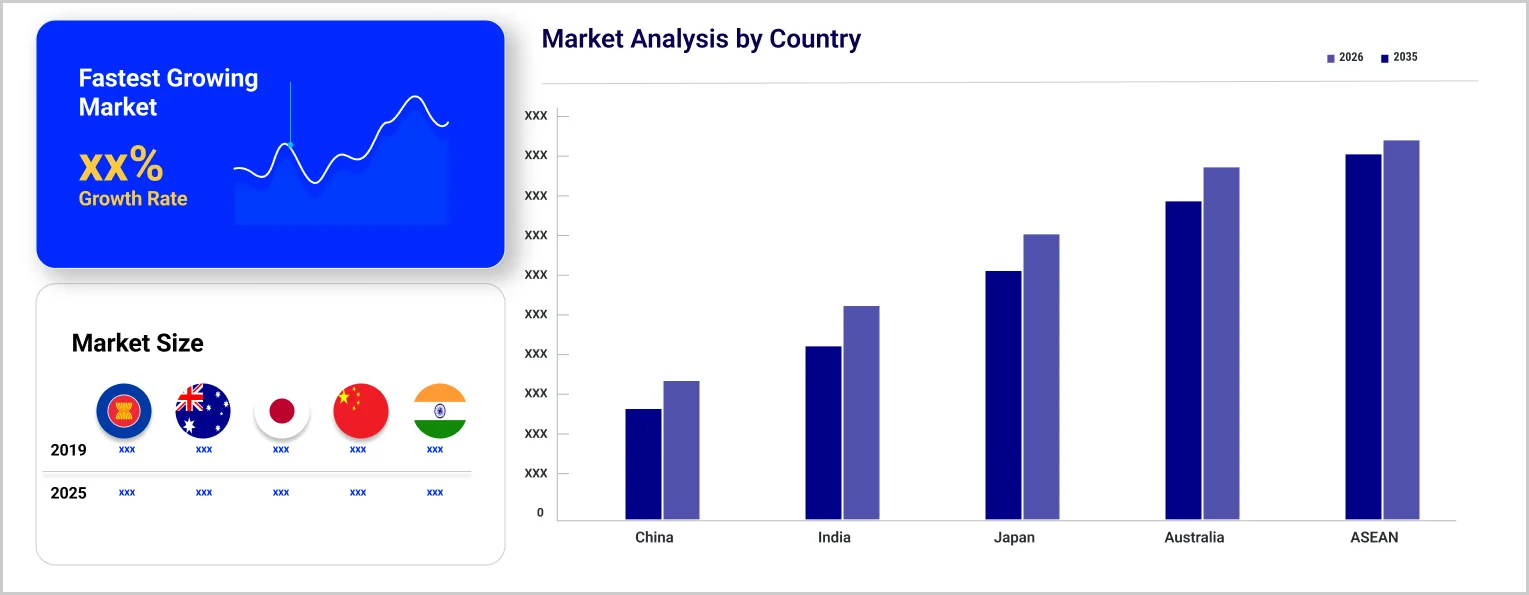
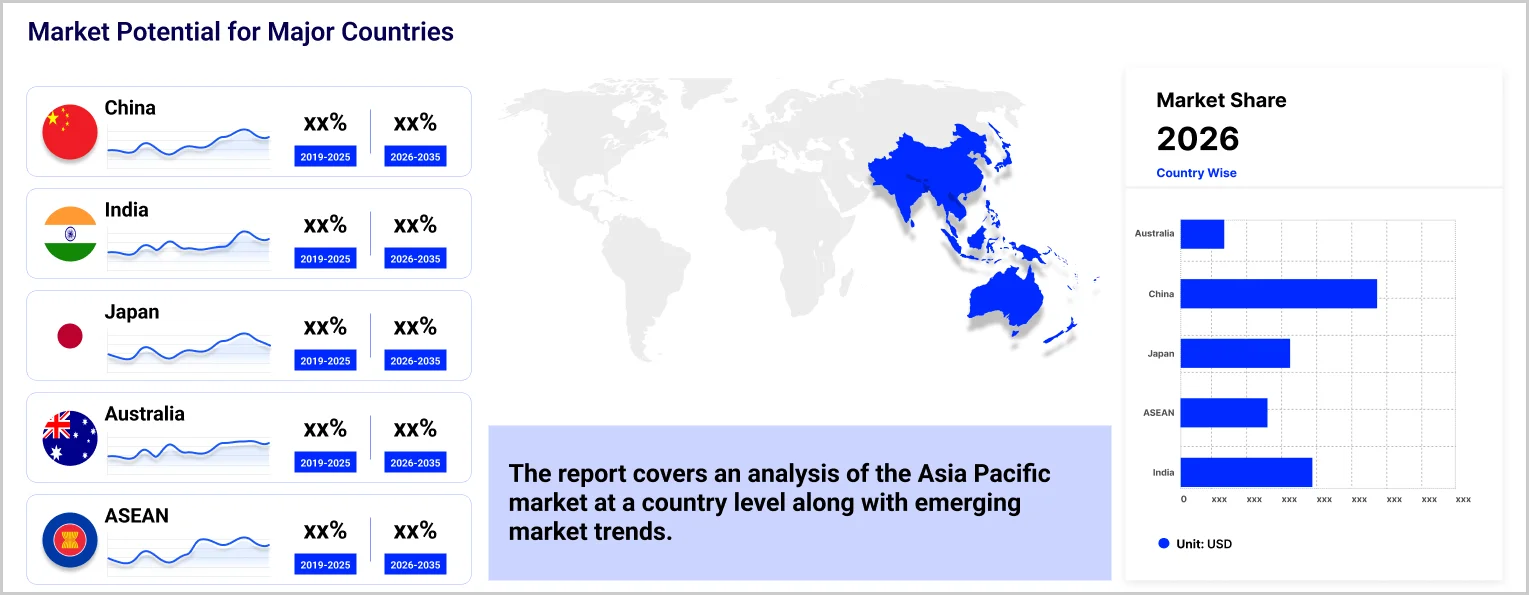
Key Insight: Japan accounts for the largest country-level share of the market at approximately 4.30% in 2025, supported by Asahi Group Holdings, Ltd.'s and Kirin Holdings Co. Ltd.'s established domestic manufacturing and brand portfolios. India is the fastest-growing country market at a projected CAGR of 4.00%, reinforced by Anheuser-Busch InBev S.A.'s September 2026 disclosure of its INR 200 crore Neemrana brewery investment in Rajasthan. China follows at a projected CAGR of 3.60%, while ASEAN benefits from Kirin Holdings Co. Ltd.'s September 2025 establishment of a dedicated Southeast Asia headquarters in Malaysia. Australia and the remaining Others markets continue to represent smaller, steady demand pockets shaped by mature consumption patterns and localised distribution. Together, these country dynamics show mature markets like Japan anchoring absolute value while growth concentrates in developing economies, prompting brewers to balance established portfolios with regional expansion.
Read more about this report - REQUEST FREE SAMPLE COPY IN PDF
Lager accounts for a dominant share of the market and is also the fastest-growing product type at a projected CAGR of 3.90%, reflecting sustained consumer preference across mature and emerging markets. Its broad accessibility across price points and established distribution footprint continue to anchor consumption in both on-trade and off-trade channels throughout the region. Brewers have responded by expanding lager sub-brands and flavour variants rather than diversifying into entirely new categories, reinforcing the format's dominant position even as adjacent segments compete for incremental growth and shelf space.
Premium Beer is gaining category share, reinforced by Asahi Group Holdings, Ltd.'s July 2026 disclosure of a 2.9% rise in unit sales prices amid continued premiumization progress and 15% growth in Asahi Super Dry sales outside home markets. This premiumization momentum reflects rising consumer willingness to trade up toward higher-priced, higher-margin offerings across urban markets in particular. Brewers increasingly target this shift through expanded premium portfolios, packaging upgrades, and targeted marketing toward higher-income consumers, positioning premium beer as the category's clearest near-term margin-expansion opportunity even as lager retains its dominant volume base.
Off-Trade continues to account for a substantial share of the market, reflecting the scale of retail and convenience channel beer sales across the region. Supermarkets, convenience stores, and e-commerce platforms continue to expand shelf space and delivery options for packaged beer, reinforcing off-trade's position as the default purchase channel for everyday consumption. Brewers increasingly tailor multipack formats and promotional pricing specifically for off-trade retail, recognising that at-home consumption occasions now account for the bulk of category volume across both mature and emerging Asia Pacific markets.
On-Trade is growing at a fast pace at a projected CAGR of 4.10%, supported by continued hospitality recovery, illustrated by Heineken N.V.'s March 2026 EverGreen 2030 strategy that preserves Singapore's regional commercial and export-market operations even as manufacturing relocates to Vietnam and Malaysia. Bars, restaurants, and entertainment venues across the region continue to rebuild footfall following earlier disruption, prompting brewers to invest in on-premise activation, draught programs, and venue partnerships. This recovery in social hospitality occasions is reinforcing on-trade's role as the category's primary venue for premium and experiential beer consumption.
Macro Brewery continues to account for a substantial share of the market, reflecting the scale advantages of large producers such as Anheuser-Busch InBev S.A. and Heineken N.V. These producers maintain extensive regional manufacturing footprints, established distributor networks, and broad portfolio breadth that smaller operators cannot easily replicate. Continued investment in regional brewery capacity, including AB InBev's North India expansion, reinforces macro brewers' ability to serve both mainstream and premium price points at scale, sustaining their dominant position even as craft and specialty segments gain visibility among urban consumers.
Craft Brewery is growing at a fast pace at an estimated CAGR of 4.30%, supported by rising consumer interest in premium and specialty beer styles. An April 2026 industry report found craft beer growing more than 20% annually, prompting United Breweries, AB InBev, and Carlsberg to commit INR 3,500 crore combined toward capacity expansion. This scale-versus-specialisation dynamic mirrors other beverage categories, where multinational producers defend broad distribution reach while smaller, agile operators capture premium price points through localised sourcing and small-batch positioning that resonates with experimentation-seeking younger drinkers.
Standard Beer continues to account for a substantial share of the market, reflecting broad affordability-driven consumption across the region. Its established price positioning and wide distribution across both on-trade and off-trade channels continue to anchor category volume, particularly in price-sensitive markets where consumers prioritise value over premium attributes. Producers continue to maintain standard beer as the category's volume foundation, using it to fund premiumization investment elsewhere in their portfolios while defending shelf space against emerging value-tier competitors.
Premium Beer is growing at a fast pace, reinforced by Asahi Group Holdings, Ltd.'s July 2026 disclosure that unit sales prices rose 2.9% amid continued premiumization progress, with flagship brand Asahi Super Dry growing 15% outside home markets. Retailers across the region continue to expand premium beer shelf space to capture rising willingness to pay among urban consumers. This trade-up pattern tracks closely with premiumization trends already observed across product type and alcohol content, suggesting diversified premium brand portfolios best capture category growth across income segments.
High alcohol content beer continues to account for a substantial share of the market, reflecting established consumer preference across traditional beer categories. Its dominant position is reinforced by deep-rooted drinking occasions and cultural familiarity across both mature and emerging Asia Pacific markets, supported by extensive existing brand portfolios from established producers. Brewers continue to prioritise this segment for volume stability even as they expand alcohol-free and low-alcohol offerings alongside it, treating the two as complementary rather than competing parts of a broader portfolio strategy.
Alcohol Free is growing at a fast pace, supported by Asahi Group Holdings, Ltd.'s continued expansion of its Beer Adjacent Categories portfolio, including non-alcohol beverages, disclosed in its July 2026 results. Beverage makers across the region continue to broaden alcohol-free formulations to meet shifting consumer preferences without sacrificing established flavour profiles. This divergence in growth rates points to brewers reallocating innovation and marketing investment toward alcohol-free and low-alcohol formats, particularly among younger, health-conscious urban consumers seeking moderation without abandoning social drinking occasions.
This is supported by the established domestic manufacturing and brand portfolios of Asahi Group Holdings, Ltd. and Kirin Holdings Co. Ltd., both of which reported continued premiumization and international brand expansion through their respective July 2026 and September 2025 disclosures.
India is emerging as the fastest-growing country market at a projected CAGR of 4.00%, reinforced by Anheuser-Busch InBev S.A.'s September 2026 disclosure of its INR 200 crore Neemrana brewery investment in Rajasthan. China follows at a projected CAGR of 3.60%, while ASEAN continues to benefit from Kirin Holdings Co. Ltd.'s September 2025 establishment of a dedicated Southeast Asia headquarters in Malaysia and Heineken N.V.'s March 2026 regional production consolidation into Vietnam and Malaysia.
The industry is consolidated, with Asia Pacific beer market companies ranging from large multinational brewing conglomerates to established regional and national producers competing across product type, production, category, and country segments. Established players operate across the full beer value chain, from brewing and packaging through on-trade and off-trade distribution for mature and emerging consumer markets alike.
Competitive dynamics among Asia Pacific beer players are increasingly shaped by the pace of local manufacturing investment, the depth of premium and adjacent-category product portfolios, and the strength of dedicated regional headquarters structures. Producers are investing in local brewery capacity, regional supply chain consolidation, and premiumization strategies to secure long-term relationships with distributors and consumers.
Founded in 1889 and headquartered in Tokyo, Japan, Asahi produces beer, spirits, and beverages across the Asia Pacific region. The company reported in July 2026 that its flagship Asahi Super Dry brand grew 15% year-over-year outside home markets, with unit sales prices rising 2.9% amid continued premiumization progress and expansion of its Beer Adjacent Categories, including non-alcohol and ready-to-drink beverages.
Founded in 1907 and headquartered in Tokyo, Japan, Kirin produces beer, beverages, and pharmaceuticals across the Asia Pacific region. The company established Kirin Brewery Southeast Asia Sdn. Bhd. as a wholly owned subsidiary headquartered in Kuala Lumpur, Malaysia, beginning operations in October 2025 to drive strategic planning, sales, marketing, and product development across Southeast Asia.
Founded in 1864 and headquartered in Amsterdam, Netherlands, Heineken produces beer and cider brands distributed across the Asia Pacific region, including Tiger Beer. The company announced in March 2026 that it would wind down large-scale production at its Singapore Tuas brewery by 2027, relocating manufacturing to Vietnam and Malaysia under its EverGreen 2030 strategy while retaining Singapore as Tiger Beer's global brand headquarters.
Founded in 2008 and headquartered in Leuven, Belgium, AB InBev produces Budweiser and other beer brands distributed across the Asia Pacific region. The company disclosed in September 2026 that it had invested INR 200 crore in a new brewery in Neemrana, Rajasthan, which commenced operations in July 2026, bringing its cumulative India investment since 2016 to more than USD 1.5 billion.
Other key players in the Asia Pacific beer market include Carlsberg A/S, Beijing Yanjing Beer Co., Ltd., United Breweries Ltd., Tsingtao Brewery Co. Ltd., HiteJinro Co., Ltd., and B9 Beverages Private Limited, among others.
*Please note that this is only a partial list; the complete list of key players is available in the full report. Additionally, the list of key players can be customized to better suit your needs.*
Unlock the latest insights with our Asia Pacific beer market trends 2026 report. Discover country-level growth patterns, product type and category trends, and key industry players. Stay ahead of competition with trusted data and expert analysis. Download your free sample report today and drive informed decisions in the market.


Upto 15% Off
USD
$2499 $2249
$3999 $3599
$4999 $4249
$5999 $5099


*While we strive to always give you current and accurate information, the numbers depicted on the website are indicative and may differ from the actual numbers in the main report. At Expert Market Research, we aim to bring you the latest insights and trends in the market. Using our analyses and forecasts, stakeholders can understand the market dynamics, navigate challenges, and capitalize on opportunities to make data-driven strategic decisions.*
In 2025, the market reached an approximate value of USD 221.88 Billion.
The market is projected to grow at a CAGR of 3.50% between 2026 and 2035.
The market is assessed to witness healthy growth in the forecast period to reach around USD 312.98 Billion in 2035.
The different product types in the market are lager, ale, and stouts, among others.
The different distribution channels in the market are on-trade and off-trade.
The different categories of beer in the market include standard beer and premium beer.
The different countries covered in the market report are China, Japan, India, ASEAN, and Australia, among others.
The key players in the market include Asahi Group Holdings, Ltd., Kirin Holdings Co. Ltd., Heineken N.V., Anheuser-Busch Inbev S.A., Carlsberg A/S, Beijing Yanjing Beer Co., Ltd., United Breweries Ltd., Tsingtao Brewery Co. Ltd., HiteJinro Co., Ltd., and B9 Beverages Private Limited, among others.
Producers face fragmented and evolving state and national alcohol policy environments, rising input and logistics costs amid regional supply chain restructuring, and the capital-intensive complexity of scaling local manufacturing across diverse country markets.
Expanding local manufacturing investment in high-growth country markets, consolidating regional production into established hubs, and pursuing premiumization and adjacent-category expansion to capture evolving consumer preferences.
Explore our key highlights of the report and gain a concise overview of key findings, trends, and actionable insights that will empower your strategic decisions.
| REPORT FEATURES | DETAILS |
| Base Year | 2025 |
| Historical Period | 2019-2025 |
| Forecast Period | 2026-2035 |
| Scope of the Report |
Historical and Forecast Trends, Industry Drivers and Constraints, Historical and Forecast Market Analysis by Segment:
|
| Breakup by Product Type |
|
| Breakup by Production |
|
| Breakup by Category |
|
| Breakup by Alcohol Content |
|
| Breakup by Distribution Channel |
|
| Breakup by Country |
|
| Market Dynamics |
|
| Competitive Landscape |
|
| Companies Covered |
|
Datasheet
One User
USD 2,499
USD 2,249
tax inclusive*
Single User License
One User
USD 3,999
USD 3,599
tax inclusive*
Five User License
Five User
USD 4,999
USD 4,249
tax inclusive*
Corporate License
Unlimited Users
USD 5,999
USD 5,099
tax inclusive*
*Please note that the prices mentioned below are starting prices for each bundle type. Kindly contact our team for further details.*
Flash Bundle
Small Business Bundle
Growth Bundle
Enterprise Bundle
*Please note that the prices mentioned below are starting prices for each bundle type. Kindly contact our team for further details.*
Flash Bundle
Number of Reports: 3
20%
tax inclusive*
Small Business Bundle
Number of Reports: 5
25%
tax inclusive*
Growth Bundle
Number of Reports: 8
30%
tax inclusive*
Enterprise Bundle
Number of Reports: 10
35%
tax inclusive*
How To Order

Select License Type
Choose the right license for your needs and access rights.

Click on ‘Buy Now’
Add the report to your cart with one click and proceed to register.

Select Mode of Payment
Choose a payment option for a secure checkout. You will be redirected accordingly.
Strategic Solutions for Informed Decision-Making
Gain insights to stay ahead and seize opportunities.

Get insights & trends for a competitive edge.

Track prices with detailed trend reports.

Analyse trade data for supply chain insights.

Leverage cost reports for smart savings

Enhance supply chain with partnerships.

Connect For More Information
Our expert team of analysts will offer full support and resolve any queries regarding the report, before and after the purchase.
Our expert team of analysts will offer full support and resolve any queries regarding the report, before and after the purchase.
We employ meticulous research methods, blending advanced analytics and expert insights to deliver accurate, actionable industry intelligence, staying ahead of competitors.
Our skilled analysts offer unparalleled competitive advantage with detailed insights on current and emerging markets, ensuring your strategic edge.
We offer an in-depth yet simplified presentation of industry insights and analysis to meet your specific requirements effectively.




