

Consumer Insights
Uncover trends and behaviors shaping consumer choices today
Procurement Insights
Optimize your sourcing strategy with key market data
Industry Stats
Stay ahead with the latest trends and market analysis.
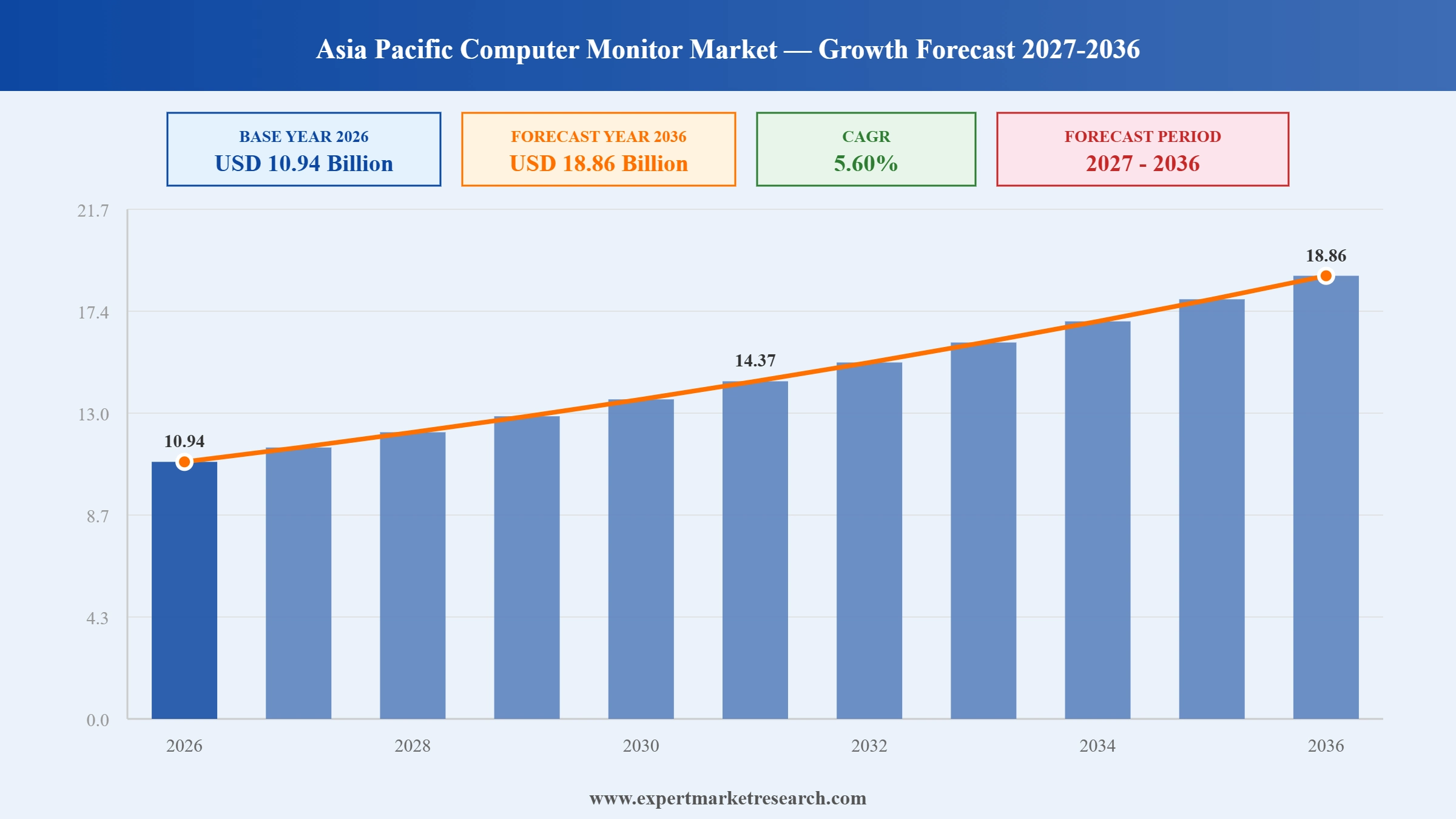
The Asia Pacific computer monitor market attained a value of USD 10.36 Billion in 2025 and is projected to expand at a CAGR of 5.60% through 2035. The market is further expected to achieve USD 17.86 Billion by 2035. The Asia Pacific computer monitor market is being shaped by the shift toward higher-performance displays across commercial and consumer applications. China illustrates this trend, with PC monitor shipments reaching 7.07 million units in Q1 2025, representing 14% year-on-year growth. Within the market, gaming monitors recorded particularly strong momentum, with shipments increasing 56% year on year to 2.58 million units. This reflects growing demand for higher refresh rates, improved resolutions and specialised displays across the region.
Digitization being driven by governments is also increasing commercial demand. Electronics manufacturing in India touched INR 12 lakh crore in FY2024-25, while electronics exports touched INR 3.27 lakh crore. Japan's Digital Society Priority Plan 2026 focuses on government DX infrastructure, private AI infrastructure investments, data utilization, and cybersecurity. Such efforts present procurement opportunities for business monitors, docked displays, high-resolution professional displays, and multi-display deployments, thereby boosting the Asia Pacific computer monitor market value.
Innovation in the Asia Pacific computer monitor market is moving beyond conventional improvements in resolution and screen size toward multi-functional and application-specific displays. The Samsung Odyssey 3D gaming monitors employ glasses-free 3D technology, allowing users to view images in three dimensions without wearing special glasses. LG is developing the next-generation of OLED monitor technology, which includes both high contrast and high refresh rates for gaming and professional usage. The new Studio Display by Apple comes with a 12MP camera, six-speaker system, and Center Stage inbuilt into the monitor to make it a much more useful productivity tool for video conferencing. Dell is also expanding ultra-high-resolution professional displays, including large-format 6K monitors designed for data-intensive workflows. These developments demonstrate a shift toward monitors functioning as integrated computing peripherals, combining display, collaboration, entertainment and specialised workflow capabilities within a single device.
A key restraint in the Asia Pacific computer monitor market is the high cost of advanced display technologies, particularly OLED, Mini LED, 4K/6K and high-refresh-rate panels. Premium monitors require more sophisticated panels, graphics capabilities and supporting components, raising purchase prices for consumers and procurement costs for businesses. For example, OLED gaming monitors typically command a substantial premium over conventional LCD models, limiting adoption among price-sensitive buyers in emerging Asia Pacific markets. In addition, rapid technology cycles can shorten product replacement periods and make older premium models depreciate quickly, encouraging some users to postpone upgrades. This creates a barrier to widespread adoption of advanced monitors despite increasing availability of sophisticated display technologies, thereby restricting the Asia Pacific computer monitor market developments.
Read more about this report - Request a Free Sample
Dell introduced new commercial computing products for Indian enterprises at the Dell Technologies Forum in Mumbai on September 2, 2026, including new monitors designed for professional workplace environments. The portfolio expansion accompanies Dell’s AI-enabled PCs and workstations, reflecting the company’s focus on integrated workplace hardware. The development strengthens Dell’s presence in India’s enterprise display segment and supports demand for monitors designed for modern professional and AI-intensive workflows.
Samsung unveiled its latest Odyssey gaming monitor lineup at Gamescom 2026, including the 27-inch Odyssey G6 with a 1,100Hz refresh rate. Its Dual Mode supports QHD resolution at up to 600Hz or HD resolution at 1,100Hz. Samsung also introduced new OLED G7, OLED G8 and OLED G9 models. The development highlights the market’s movement toward extremely high refresh rates, OLED panels, large-format gaming displays and flexible display modes.
Apple announced the new Studio Display and Studio Display XDR in March 2026, expanding its professional monitor portfolio. The Studio Display XDR features a 27-inch 5K Retina XDR panel, mini-LED backlighting, 2,000-nit peak HDR brightness and 120Hz refresh rate. It also incorporates Thunderbolt 5 connectivity and a 12MP Center Stage camera. The launch strengthens demand for high-resolution professional displays targeting filmmaking, design, print, 3D animation and other colour-sensitive workflows.
The National Advertising Division (NAD) reviewed advertising claims made by Nanit following a challenge from Owlet and recommended that Nanit discontinue its “#1 smart baby monitor” and “#1 baby monitor” claims. The February 2026 decision highlights the increasingly competitive positioning of smart-monitor brands in North America, where product differentiation increasingly depends on measurable technology capabilities and substantiated performance claims.
LG introduced the UltraFine evo 6K (32U990A), targeting professional creators with a 6,144 × 3,456 resolution and Thunderbolt 5 connectivity. LG stated that the monitor would begin rolling out in South Korea and Japan in late September 2025, before expanding globally. The display provides 224 PPI and is designed for workflows involving dense timelines, colour pipelines and AI-assisted creative effects, strengthening the premium professional-monitor segment across Asia Pacific, thus boosting the trends of the Asia Pacific computer monitor market.
OLED technology is moving beyond niche premium displays as manufacturers expand gaming portfolios around deeper contrast, faster response and high refresh rates. LG’s Asia Pacific monitor portfolio now includes dedicated OLED gaming models alongside UltraGear and Mini LED products, indicating broader technology segmentation. The company’s Indian portfolio specifically lists OLED gaming monitors and Hyper Mini LED gaming monitors as separate categories. This diversification is encouraging buyers to compare display technologies based on gaming workload rather than resolution alone.
AI-enabled computing is increasing demand for monitors that complement professional workstations rather than functioning solely as output devices. India’s electronics ecosystem is supporting this transition, with electronics production reaching ₹11.3 lakh crore in FY2024-25, nearly six times the FY2014-15 level. As AI PCs, workstations and cloud-based applications expand, monitor manufacturers are increasingly targeting professional users with high-resolution displays, USB-C/Thunderbolt connectivity and multitasking-oriented screen formats. This supports a shift toward monitors designed around complete digital workflows rather than basic desktop display requirements.
Professional monitors are increasingly differentiated through extremely high resolution and colour-intensive workflows. Apple’s 2026 Studio Display XDR, for example, combines a 27-inch 5K Retina XDR display with mini-LED backlighting, 120Hz refresh rate and up to 2,000 nits peak HDR brightness. Such specifications indicate growing convergence between conventional monitors and professional reference-display requirements. Across Asia Pacific, this trend is particularly relevant to video production, design, 3D modelling and other applications where colour performance, HDR capability and pixel density influence purchasing decisions, thereby boosting the Asia Pacific computer monitor market dynamics and trends.
Monitor supply chains are increasingly being influenced by the expansion of Asian electronics manufacturing outside traditional production centres. India’s electronics production increased from ₹1.9 lakh crore in FY2014-15 to ₹11.3 lakh crore in FY2024-25, according to government data. This expansion is creating a broader domestic ecosystem for electronic assembly, components and finished devices. For monitor manufacturers, the trend can support localisation of production, supplier development and shorter regional supply chains, while also strengthening India’s role within the Asia Pacific electronics manufacturing landscape.
Monitor manufacturers are increasingly combining display functionality with smart and lifestyle-oriented capabilities. LG’s regional portfolio now separates Smart Monitors, Lifestyle Monitors, Professional Monitors, UltraWide and gaming categories, demonstrating how displays are being designed for distinct usage environments rather than one universal PC-monitor category. This segmentation reflects demand for screens that can serve multiple purposes, including entertainment, remote work, content consumption and productivity. The resulting product diversification allows manufacturers to target households and professionals with different connectivity, ergonomics and usage requirements.
The Expert Market Research’s report titled "Asia Pacific Computer Monitor Market Report and Forecast 2026-2035” offers a detailed analysis of the market based on the following segments:
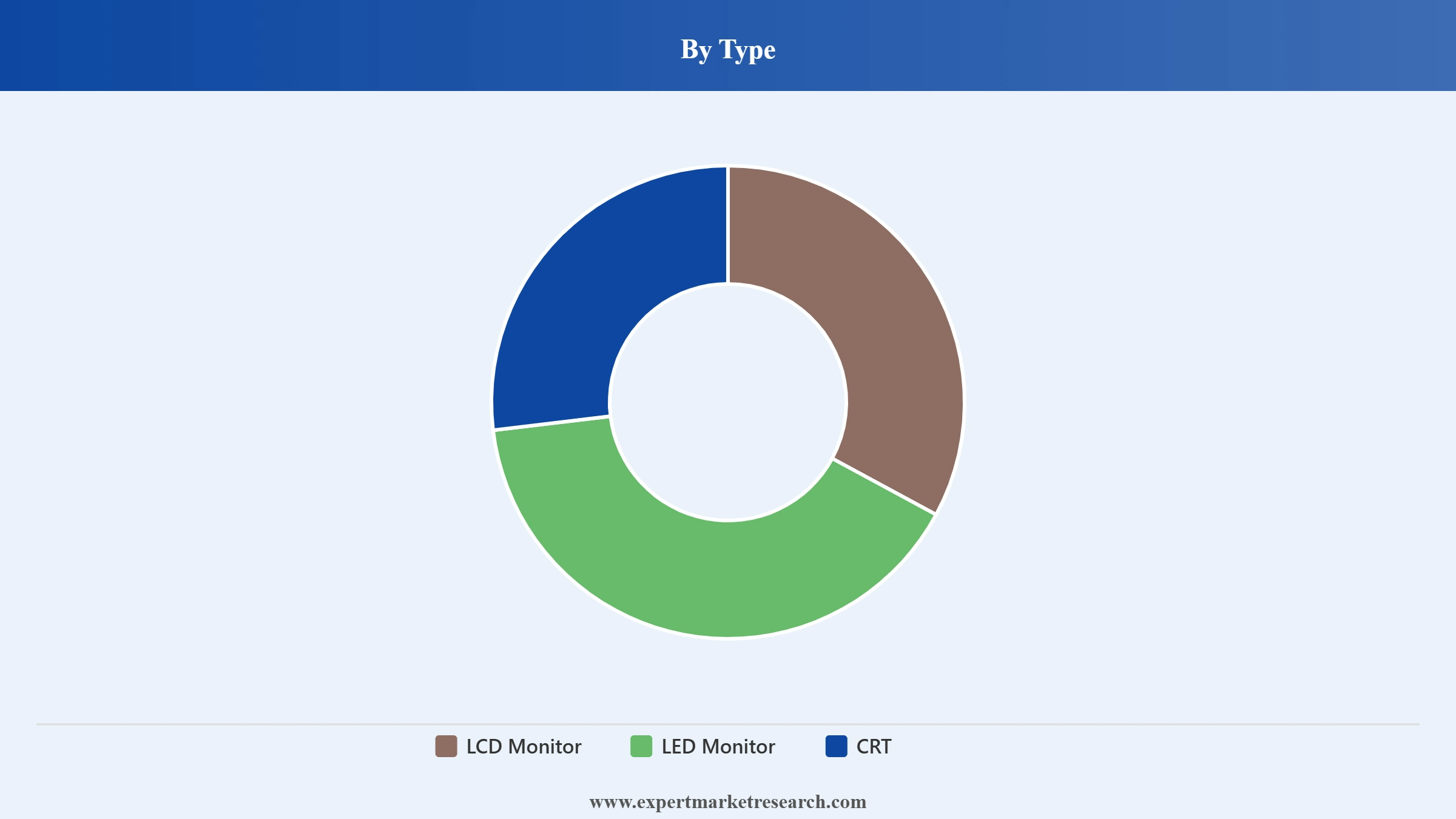
Market Breakup by Type
Key Insight: LCD and LED-based displays continue to form the volume foundation of the computer monitor industry because they provide scalable manufacturing economics and broad compatibility with commercial and consumer systems. LED-backlit LCD designs remain particularly relevant to mainstream procurement because manufacturers can offer thin form factors, improved brightness, and competitive operating costs. At the premium end, OLED and Mini LED technologies are increasing competitive pressure on conventional LCD configurations. Omdia estimates that LCD monitor panel shipments remained substantially larger than OLED shipments, while OLED monitor panel shipments are expanding rapidly. In 2026, OLED monitor shipments in large-area displays are projected to grow 79% year on year in the first half and 57% in the second half.
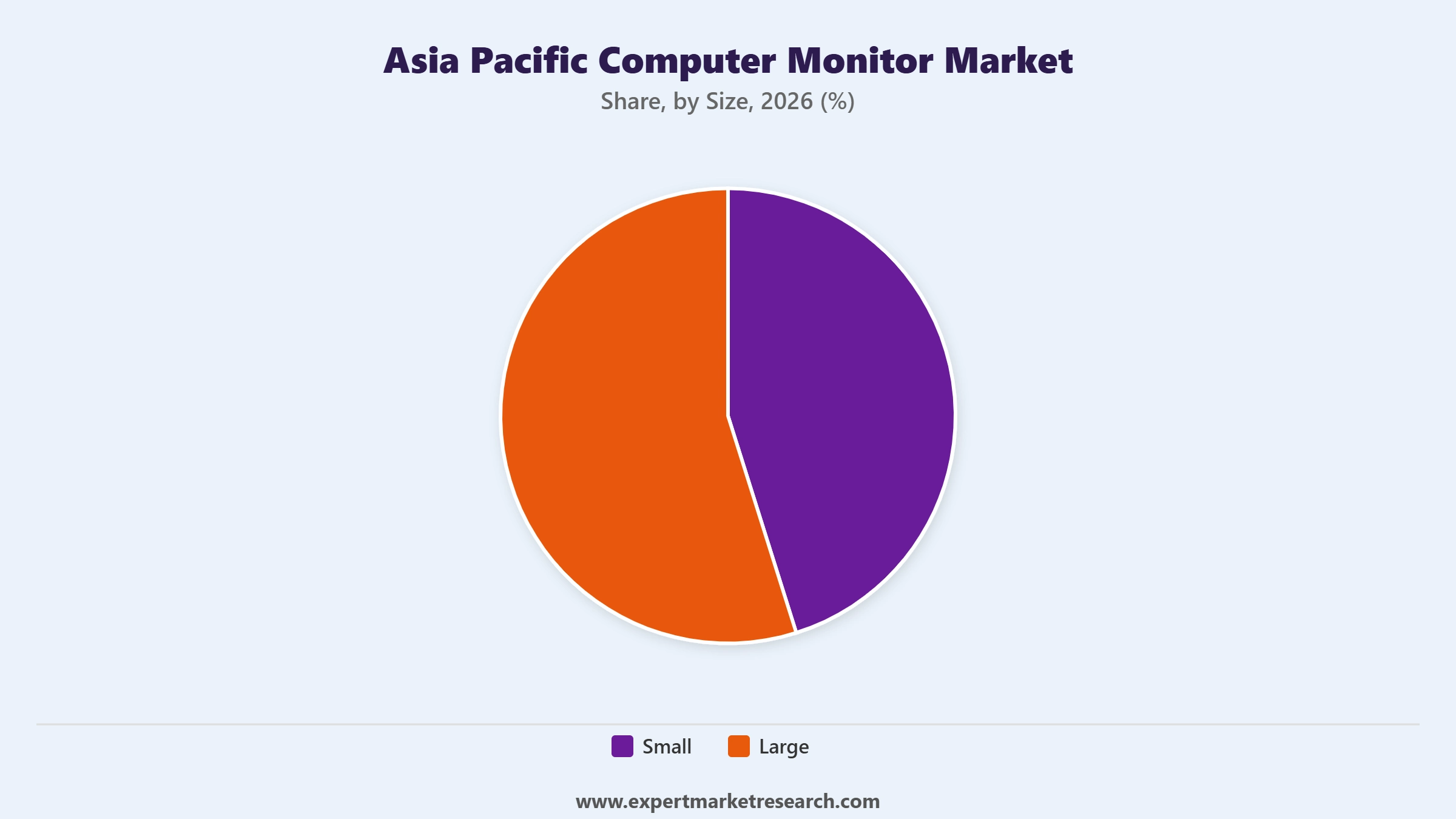
Market Breakup by Size
Key Insight: Small and large monitors address distinct procurement requirements across the Asia Pacific market. Smaller displays remain relevant for standardized office desks, education labs, call centers, retail counters, and space-constrained workstations. Larger screens, meanwhile, are gaining strategic importance in financial services, engineering, content creation, gaming, data analysis, and hybrid-work environments where screen real estate directly supports productivity. The premiumization of monitor specifications is also increasingly connected with larger formats and high-resolution panels. TrendForce reported strong shipment momentum for 27-inch OLED monitors, particularly 240Hz QHD configurations, demonstrating the commercial potential of the upper mainstream size category, thus driving the demand in the Asia Pacific computer monitor market.
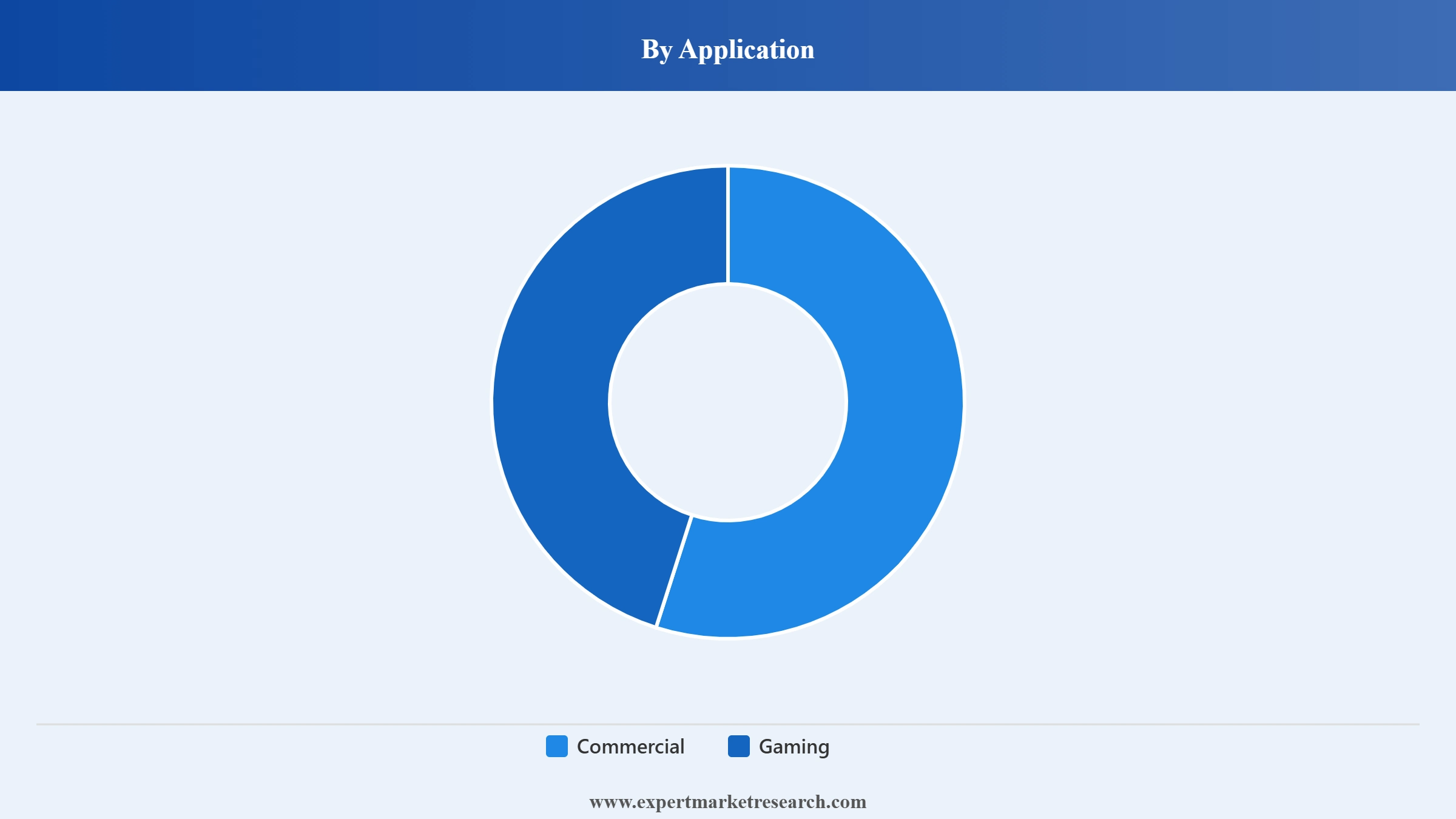
Market Breakup by Application
Key Insight: Commercial, gaming, and other application types will be expanding the demand base for computer monitors. Commercial demand includes office environments, government departments, education, healthcare, engineering, finance, and retail environments where the specifications of monitors will affect productivity and workstation design. The gaming application area is creating a further premium demand segment via high refresh rates, OLED, low response times, and adaptive synchronization. Other application segments include professional content creation, home productivity, mobile computing, and visualization. Omdia’s numbers for 2025 demonstrate the extent of the gaming demand segment with 31.1% of global shipments of desktop monitors being gaming monitors.
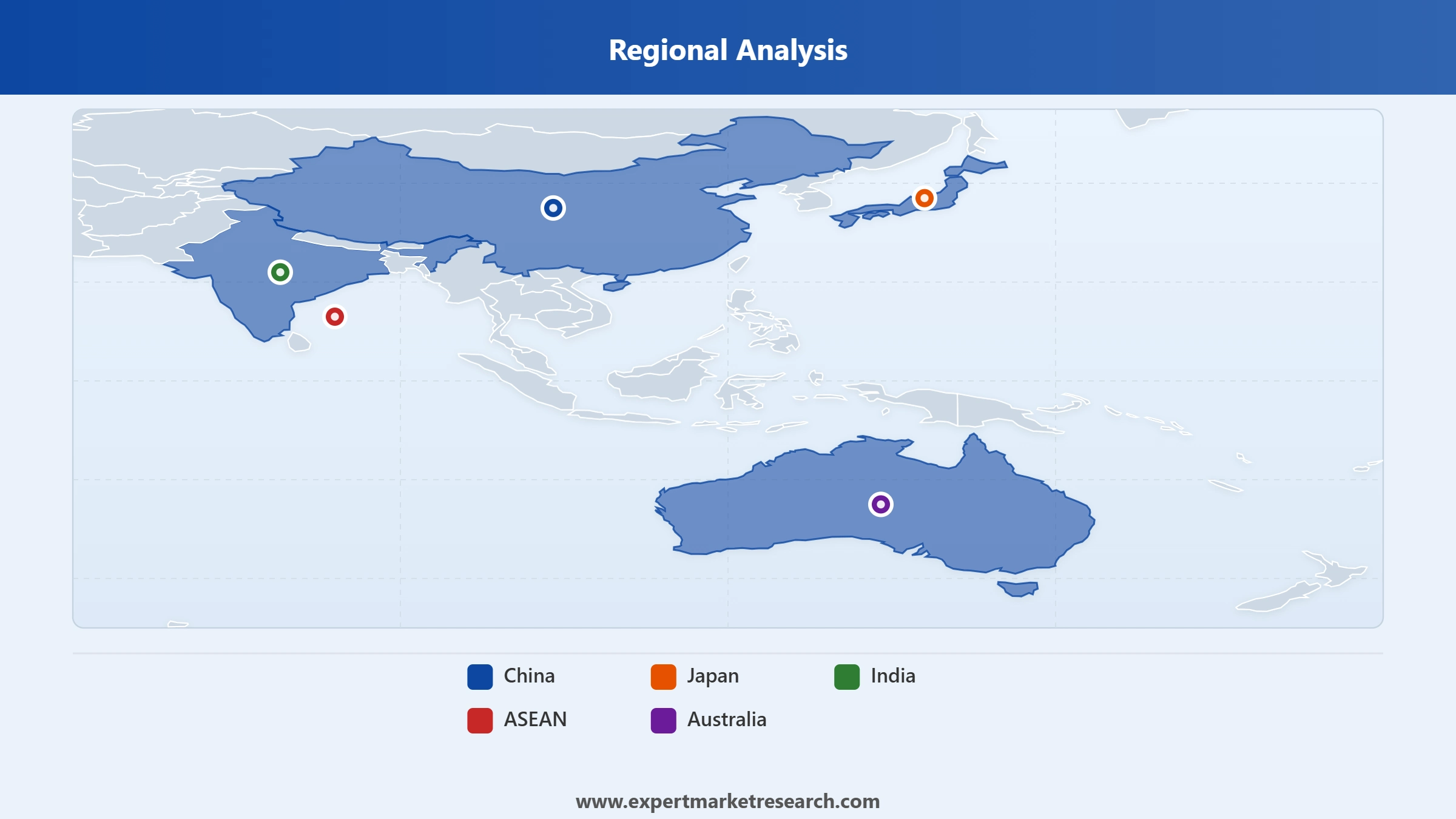
Market Breakup by Country
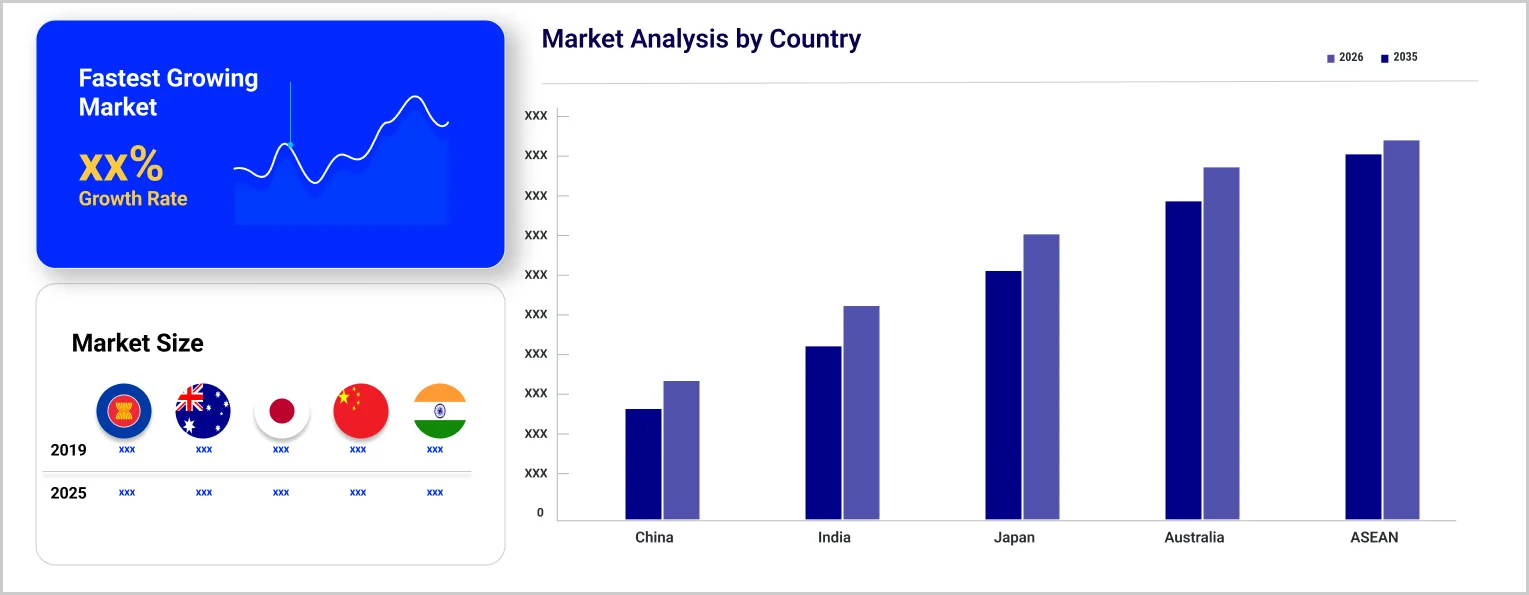
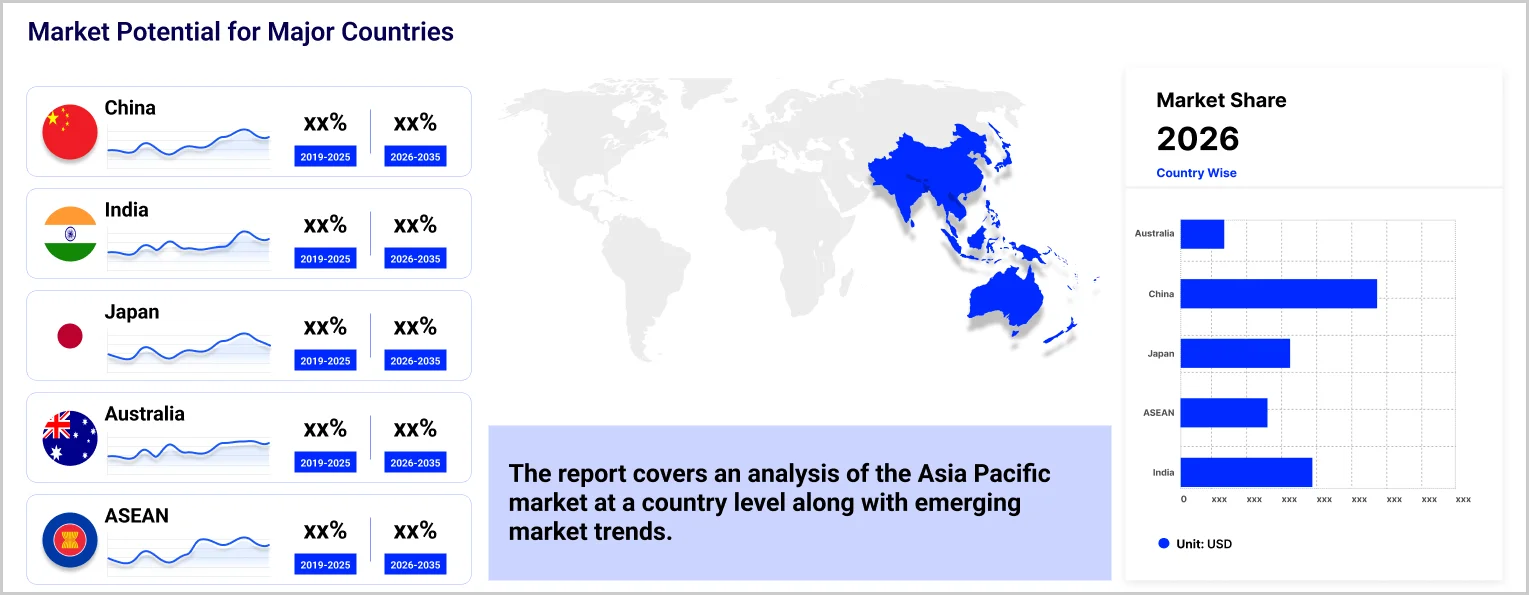
Key Insight: China, Japan, India, ASEAN, Australia, and other Asia Pacific markets exhibit different procurement structures and technology adoption patterns. China combines large-scale monitor manufacturing, consumer replacement programs, gaming demand, and a mature commercial market. India is strengthening its electronics manufacturing ecosystem and expanding institutional technology adoption. Japan is advancing government DX, AI infrastructure, and digital services, supporting professional display requirements. ASEAN is attracting ICT and digital-economy investment, while Australia benefits from near-universal internet access and sophisticated digital consumption. These differences create opportunities for region-specific channel strategies rather than a single Asia Pacific product model.
Read more about this report - Request a Free Sample
By type, LED monitors remain dominant due to scalable deployment, affordability, and broad commercial compatibility
LED monitors remain the dominant practical category because LED backlighting is embedded across a broad range of mainstream LCD displays used in offices, education, retail, gaming, and home computing. Their combination of thin construction, brightness, availability, and manufacturing scalability supports high-volume deployment. Omdia's 2025 data showed 133.4 million desktop monitors shipped globally, illustrating the scale of the underlying flat-panel ecosystem in which LED-backlit products remain central. Such developments will thus boost Asia Pacific computer monitor market trends in the long run.
Read more about this report - Request a Free Sample
The others category is positioned for faster technology-led expansion as Mini LED and OLED products gain adoption in premium gaming and professional applications. Global OLED monitor shipments reached 2.735 million units in 2025, increasing 92% year on year, while OLED monitor shipments are expected to continue expanding in 2026. This creates an opportunity for manufacturers to use emerging technologies to capture higher-value demand.
By size, large monitors gain traction through higher workspace requirements, premium specifications, and specialized workloads
Large-size monitors represent the dominant value opportunity as buyers increasingly use monitors as primary workstations for multitasking, gaming, content creation, and data-intensive applications. Demand is particularly supported by ultrawide and high-resolution configurations, where larger screen real estate allows multiple applications and visual assets to be displayed simultaneously. Premium manufacturers are increasingly positioning 34-inch-and-above ultrawide, 5K/6K and OLED products toward professional and enthusiast users. This segment therefore benefits from a higher average selling value than conventional mainstream displays, making large monitors particularly important from a revenue perspective, even where smaller screens retain substantial unit demand.
Read more about this report - Request a Free Sample
Medium monitors are poised for faster unit growth due to being the most appropriate transition from office-level displays to advanced mainstream displays. Medium monitors have received advancements in the form of QHD, 120-180Hz refresh rate, USB-C connectivity and ergonomic stands but without incurring the high price levels of very large monitors. Medium sized monitors are especially useful for hybrid workers, students, SMEs, and mainstream gamers. China's Q1 2025 monitor market provides evidence of this specification upgrade: 180Hz represented 41.1% of gaming-monitor shipments, while shipments of 2K gaming monitors increased 56% year on year.
By application, commercial monitors lead through institutional procurement volume
The commercial segment is the most prominent one since monitors are purchased in bulk by companies, government agencies, educational establishments, hospitals, and other organizations. China’s shipment of commercial PC monitors amounted to 3.64 million in Q1 2025, up 10.9% from the previous year, according to data from IDC. The commercial segment also has a distinct replacement cycle, with procurement decisions influenced by warranty coverage, device management, ergonomic requirements and connectivity standards. These characteristics create recurring institutional demand that differs from discretionary consumer purchases, thus boosting the Asia Pacific computer monitor market revenues.
Read more about this report - Request a Free Sample
The gaming application is the fastest-growing segment among all applications, driven by the quick proliferation of high refresh rate and high-end displays. Worldwide shipments of gaming monitors grew to 41 million units in 2025, showing a YoY growth of 50.2% and making up 31.1% of total desktop monitor shipments, as stated by Omdia. In China specifically, gaming-monitor shipments reached 2.58 million units in Q1 2025, up 56%, while 4K gaming-monitor shipments increased 71.5%. The 180Hz category accounted for 41.1% of gaming-monitor shipments, highlighting the shift toward performance-oriented specifications.
By country, China leads through scale, while India is expanding through electronics manufacturing and digitalization
China remains the central demand and supply hub within the Asia Pacific computer monitor ecosystem. Its Q1 2025 PC monitor shipments reached 7.07 million units, representing 14% year-on-year growth. The consumer segment increased 17.4%, supported by China's national consumer subsidy program, while commercial shipments rose 10.9%. China also benefits from an extensive display manufacturing ecosystem and continued development of next-generation display technologies. Shanghai's 2026-2030 action plan specifically targets Micro LED, silicon-based OLED, flexible displays, and other advanced technologies, reinforcing the country's role in the regional display value chain, thereby directly boosting the Asia Pacific computer monitor market regional growth.
Read more about this report - Request a Free Sample
India is an important emerging opportunity as electronics manufacturing and digital infrastructure expand. Government data indicates that electronics production reached approximately INR 12 lakh crore in FY2024-25, compared with about INR 1.9 lakh crore in FY2014-15. Japan provides a different growth pathway through government-led DX and AI infrastructure investment. Its July 2026 digital plan emphasizes national and local government DX infrastructure and private investment supporting new technologies. ASEAN is also strengthening its position as a digital investment destination, with ICT accounting for approximately 5% of ASEAN FDI inflows in 2024 and recording the strongest growth among sectors. Australia offers a mature digital-consumption environment, with 99.7% of adults accessing the internet in 2025.
Asia Pacific computer monitor market players operating in the Asia Pacific computer monitor market are aiming to achieve growth and scalability by expanding product portfolios, strengthening premium and specialised display segments, and investing in emerging display technologies. Apple is focused on premium professional displays and deeper integration across its device ecosystem, while Samsung and LG are broadening offerings across gaming, OLED, high-resolution, ultrawide, smart and professional monitors. Dell is strengthening its presence across workplace, professional, creative and gaming applications through differentiated monitor families. Across these companies, product development increasingly centres on higher refresh rates, sharper resolutions, larger and ultrawide screens, improved connectivity, ergonomic designs and energy efficiency.
Another important competitive strategy is the integration of monitors with broader computing ecosystems. Asia Pacific computer monitor companies are combining displays with docking, webcams, connectivity, ergonomic features, software controls, and device-management capabilities. At the premium end, investments in OLED, Mini LED, high refresh rates, AI-based image optimization, and advanced color management are helping companies build technology-led differentiation. The result is a market where scalability increasingly depends on portfolio breadth, channel specialization, panel sourcing, service infrastructure, and the ability to match specifications to specific enterprise or consumer workloads.
Established in 1976, Apple Inc. is headquartered in Cupertino, California, United States. In the Asia Pacific computer monitor market, Apple offers its premium Studio Display and Studio Display XDR. The current Studio Display features a 27-inch 5K Retina display, 600-nit brightness, 12MP Center Stage camera, six-speaker audio and Thunderbolt 5 connectivity. The Studio Display XDR targets professional users with a 27-inch 5K Retina XDR panel, mini-LED backlighting, 120Hz refresh rate and up to 2,000 nits HDR brightness.
Established in 1969, Samsung Electronics Co., Ltd. is headquartered in Suwon, South Korea. Across Asia Pacific, Samsung offers a broad monitor portfolio spanning Odyssey gaming monitors, ViewFinity high-resolution monitors, Smart Monitors, curved displays, and FHD models. Its Odyssey range focuses on gaming performance through high refresh rates and low response times, while ViewFinity monitors target professional and creative users requiring high-resolution imagery. Smart Monitors combine conventional display functionality with smart TV applications and connected-workspace capabilities, addressing home, entertainment and productivity requirements.
Established in 1947, LG Corporation is headquartered in Seoul, South Korea. In the Asia Pacific computer monitor market, LG provides displays across UltraGear gaming, UltraFine, UltraWide, UHD 4K and 5K, FHD, QHD, Smart, Ergo and lifestyle categories. Its portfolio includes OLED gaming monitors designed around fast response times and high refresh rates, while its UltraWide monitors support multitasking and immersive viewing. LG also offers high-resolution professional monitors aimed at designers and creative professionals, alongside ergonomic models featuring adjustable positioning for workplace applications.
Established in 1984, Dell Inc. is headquartered in Round Rock, Texas, United States. Dell offers an extensive computer monitor portfolio across the Asia Pacific region, including Dell, Dell Plus, Dell Pro, Dell Pro Plus, Dell Pro P, UltraSharp and Alienware lines. Its offerings cover Full HD, QHD, 4K UHD, 5K, 6K and ultrawide formats, with models designed for personal computing, professional workplaces, creative applications and gaming. Current regional offerings include USB-C monitors with charging capabilities, high-resolution displays, curved monitors and Alienware gaming products.
Other key players in the market include ASUSTEK Computer Inc., HP Inc., ViewSonic Corporation, BenQ Corporation, Acer Inc., and Razer Inc., among others.
*Please note that this is only a partial list; the complete list of key players is available in the full report. Additionally, the list of key players can be customized to better suit your needs.*
Access the sample report to understand the latest Asia Pacific Computer Monitor Market trends 2026, technology shifts, competitive developments, and application-level opportunities. The report provides structured insights into the Asia Pacific Computer Monitor Market Size, demand dynamics, segmentation, and competitive landscape. Request the sample to assess the Asia Pacific Computer Monitor Market forecast 2026-2035 and evaluate opportunities relevant to your business strategy.


Upto 15% Off
USD
$2499 $2249
$3999 $3599
$4999 $4249
$5999 $5099


*While we strive to always give you current and accurate information, the numbers depicted on the website are indicative and may differ from the actual numbers in the main report. At Expert Market Research, we aim to bring you the latest insights and trends in the market. Using our analyses and forecasts, stakeholders can understand the market dynamics, navigate challenges, and capitalize on opportunities to make data-driven strategic decisions.*
In 2025, the market reached an approximate value of USD 10.36 Billion.
The market is projected to grow at a CAGR of 5.60% between 2026 and 2035.
The revenue generated from the market is expected to reach USD 17.86 Billion in 2035.
Based on type, the computer monitor market is split into LCD Monitor, LED Monitor, CRT, and others.
Key players in the market are Apple Inc., Samsung Electronics Co., Ltd., LG Corporation, Dell Inc., ASUSTEK Computer Inc., HP Inc., ViewSonic Corporation, BenQ Corporation, Acer Inc., and Razer Inc., among others.
Based on the application, the market is split between commercial, gaming, and others.
Based on the country, the market is split into China, Japan, India, ASEAN, Australia and others.
Key challenges in the Asia Pacific computer monitor market include intense price competition, rapidly changing display technologies, supply chain disruptions, fluctuating component costs, short product lifecycles, and varying consumer purchasing power across countries.
Key strategies driving the Asia Pacific computer monitor market include product innovation, adoption of high-resolution and high-refresh-rate displays, competitive pricing, expansion of e-commerce channels, localisation of products, strategic partnerships, investment in gaming monitors, and development of energy-efficient display technologies.
Explore our key highlights of the report and gain a concise overview of key findings, trends, and actionable insights that will empower your strategic decisions.
| REPORT FEATURES | DETAILS |
| Base Year | 2025 |
| Historical Period | 2019-2025 |
| Forecast Period | 2026-2035 |
| Scope of the Report |
Historical and Forecast Trends, Industry Drivers and Constraints, Historical and Forecast Market Analysis by Segment:
|
| Breakup by Type |
|
| Breakup by Size |
|
| Breakup by Application |
|
| Breakup by Region |
|
| Market Dynamics |
|
| Competitive Landscape |
|
| Companies Covered |
|
Datasheet
One User
USD 2,499
USD 2,249
tax inclusive*
Single User License
One User
USD 3,999
USD 3,599
tax inclusive*
Five User License
Five User
USD 4,999
USD 4,249
tax inclusive*
Corporate License
Unlimited Users
USD 5,999
USD 5,099
tax inclusive*
*Please note that the prices mentioned below are starting prices for each bundle type. Kindly contact our team for further details.*
Flash Bundle
Small Business Bundle
Growth Bundle
Enterprise Bundle
*Please note that the prices mentioned below are starting prices for each bundle type. Kindly contact our team for further details.*
Flash Bundle
Number of Reports: 3
20%
tax inclusive*
Small Business Bundle
Number of Reports: 5
25%
tax inclusive*
Growth Bundle
Number of Reports: 8
30%
tax inclusive*
Enterprise Bundle
Number of Reports: 10
35%
tax inclusive*
How To Order

Select License Type
Choose the right license for your needs and access rights.

Click on ‘Buy Now’
Add the report to your cart with one click and proceed to register.

Select Mode of Payment
Choose a payment option for a secure checkout. You will be redirected accordingly.
Strategic Solutions for Informed Decision-Making
Gain insights to stay ahead and seize opportunities.

Get insights & trends for a competitive edge.

Track prices with detailed trend reports.

Analyse trade data for supply chain insights.

Leverage cost reports for smart savings

Enhance supply chain with partnerships.

Connect For More Information
Our expert team of analysts will offer full support and resolve any queries regarding the report, before and after the purchase.
Our expert team of analysts will offer full support and resolve any queries regarding the report, before and after the purchase.
We employ meticulous research methods, blending advanced analytics and expert insights to deliver accurate, actionable industry intelligence, staying ahead of competitors.
Our skilled analysts offer unparalleled competitive advantage with detailed insights on current and emerging markets, ensuring your strategic edge.
We offer an in-depth yet simplified presentation of industry insights and analysis to meet your specific requirements effectively.




