

Consumer Insights
Uncover trends and behaviors shaping consumer choices today
Procurement Insights
Optimize your sourcing strategy with key market data
Industry Stats
Stay ahead with the latest trends and market analysis.
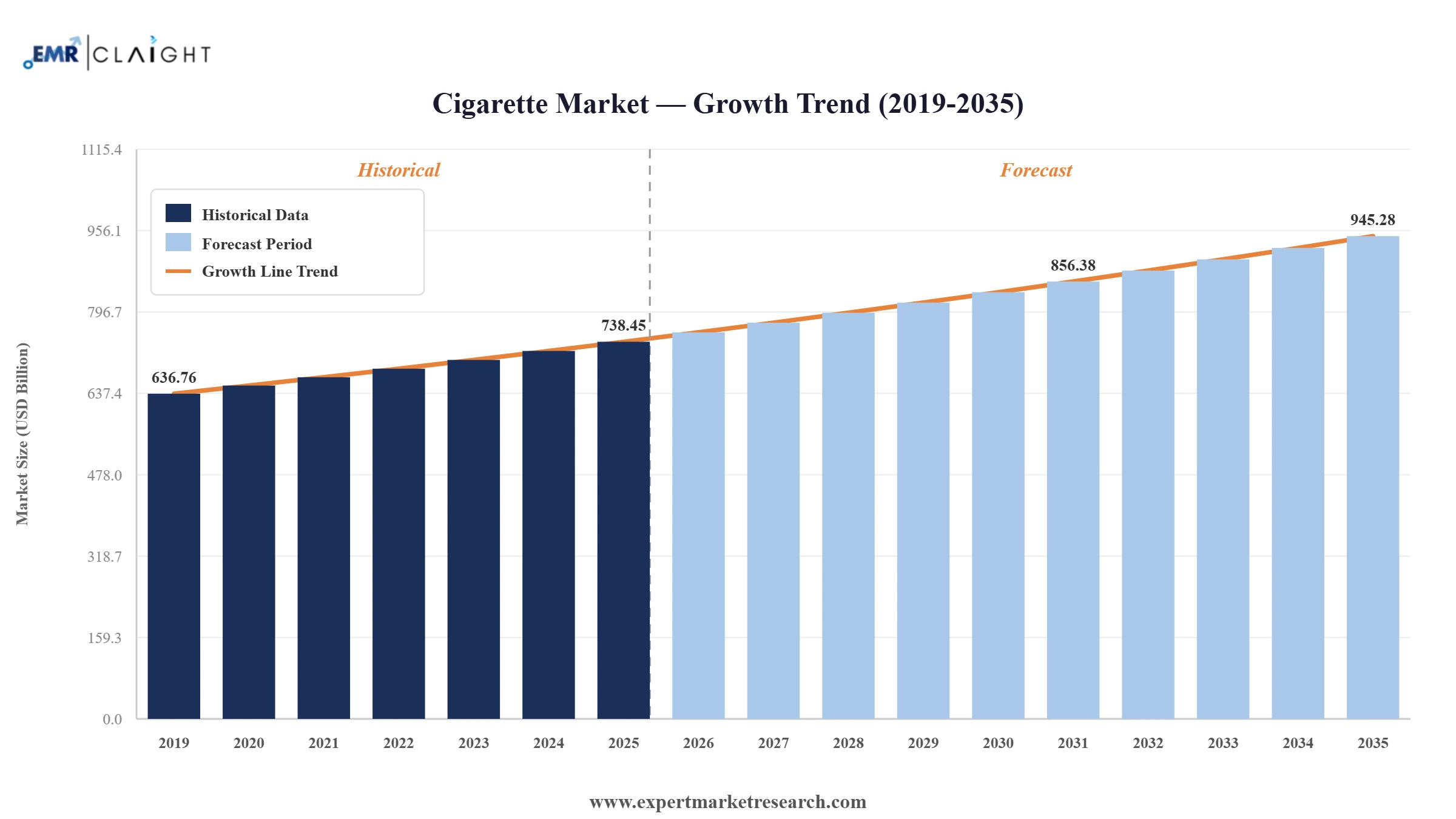
The Global Cigarette Market was valued at USD 738.45 Billion in 2025 and is set to grow at a CAGR of around 2.50% through 2026-2035. Pricing strategy innovation and the ongoing expansion of flavoured and premium cigarette offerings across growth markets are sustaining market revenue despite tightening regulatory environments. The market is on track to reach USD 945.28 Billion by 2035. Resilient demand in emerging economies, strategic premiumization by leading tobacco manufacturers, rising disposable incomes across Asia Pacific and Africa, and sustained brand loyalty underpinning consumption habits in established markets are driving the global cigarette market.
Read more about this report - REQUEST FREE SAMPLE COPY IN PDF
| Cigarette Market Report Summary | Description | Value |
| Base Year | USD Billion | 2025 |
| Historical Period | USD Billion | 2019-2025 |
| Forecast Period | USD Billion | 2026-2035 |
| Market Size 2025 | USD Billion | 738.45 |
| Market Size 2035 | USD Billion | 945.28 |
| CAGR 2019-2025 | Percentage | XX% |
| CAGR 2026-2035 | Percentage | 2.50% |
| CAGR 2026-2035 - Market by Region | Asia Pacific | 3.1% |
| CAGR 2026-2035 - Market by Country | India | 5.1% |
| CAGR 2026-2035 - Market by Country | Brazil | 3.6% |
| CAGR 2026-2035 - Market by Distribution Channel | Online Stores | 4.1% |
| CAGR 2026-2035 - Market by Type | Light | 3.2% |
| Market Share by Country 2025 | Germany | 5.6% |
The global cigarette market is navigating a period of structural transition, characterised by volume decline in regulated Western markets offset by sustained and growing demand across Asia Pacific, Africa, and the Middle East. Major manufacturers are actively optimising production capacity through strategic partnerships, pursuing pricing power in core markets, and managing the long-term reallocation of capital toward next-generation nicotine products while maintaining their conventional cigarette portfolios as the primary revenue base.
British American Tobacco's first-half pre-close trading update in June 2026 projected global cigarette industry volume to decline approximately 2.5% for the year, a downward revision from an earlier estimate of approximately 2%. The update reflected ongoing combustible volume pressure in mature markets while BAT reported continued progress with its smoke-free product portfolio and maintained its progressive dividend commitment.
Cigarette manufacturers operating in India implemented price increases in January 2026 to offset rising excise duties and tax restructuring under India's regulatory framework. The price adjustments reflected industry efforts to protect margins amid tightening fiscal policy while maintaining competitiveness in the world's second-most-populous cigarette market, where consumption has remained resilient in the premium and medium segments.
Philip Morris International and British American Tobacco announced a joint venture in September 2025 to optimise cigarette production across Poland, Croatia, and Portugal. Under the agreement, PMI will produce in BAT facilities while BAT will manufacture in PMI's European plants, improving capacity utilisation as overall combustible volumes in Western Europe continue their structural decline.
Japan Tobacco International adopted a differentiated market strategy in September 2025, focusing investment on affordable and value-tier cigarette segments in emerging markets as rivals Philip Morris and BAT redirected capital toward smoke-free alternatives. The strategy positions Japan Tobacco to capture volume in price-sensitive growth markets across Africa, the Middle East, and parts of Asia.
Asia Pacific drives the dominant share of global cigarette market revenue. China National Tobacco Corporation controls the world's largest single national cigarette market. India's cigarette market is growing on the back of rising incomes and tobacco retail expansion. Southeast Asia's large smoking populations provide a structurally resilient demand base for the global cigarette market.
Leading cigarette manufacturers are pursuing premiumisation strategies, shifting product mix toward light, slim, and flavoured variants at higher price points. This approach supports revenue growth and margin improvement even as volume declines in regulated markets. Philip Morris and BAT both report positive price and mix variances in their annual combustible cigarette revenue reporting.
Cigarette manufacturers are using tax-driven price increases as a tool for margin protection in regulated markets. India's excise restructuring, Turkey's pricing adjustments, and European markets all reflect the global cigarette industry's pricing power in the face of increasing fiscal pressure. PMI reported favorable pricing variance in its FY2025 full-year results supporting revenue growth despite volume decline.
Global cigarette regulation is tightening across packaging, advertising, flavour restrictions, and public smoking bans. Standardised plain packaging laws, menthol cigarette bans in several markets, and increasing minimum pack pricing are progressively reducing cigarette accessibility in developed economies, concentrating volume decline in regulated Western markets while leaving emerging market demand relatively unaffected.
While tobacco shops and convenience stores remain the dominant cigarette distribution channels globally, online stores are the fastest-growing channel, supported by e-commerce expansion in emerging markets and increasing digital tobacco retail platforms. Regulatory complexity around online tobacco sales limits the channel's growth in many regulated markets but its contribution to the global cigarette market is expanding.
The report of Expert Market Research's titled "Global Cigarette Market Report and Forecast 2026-2035" offers a detailed analysis of the market based on the following segments:
Market Breakup by Type
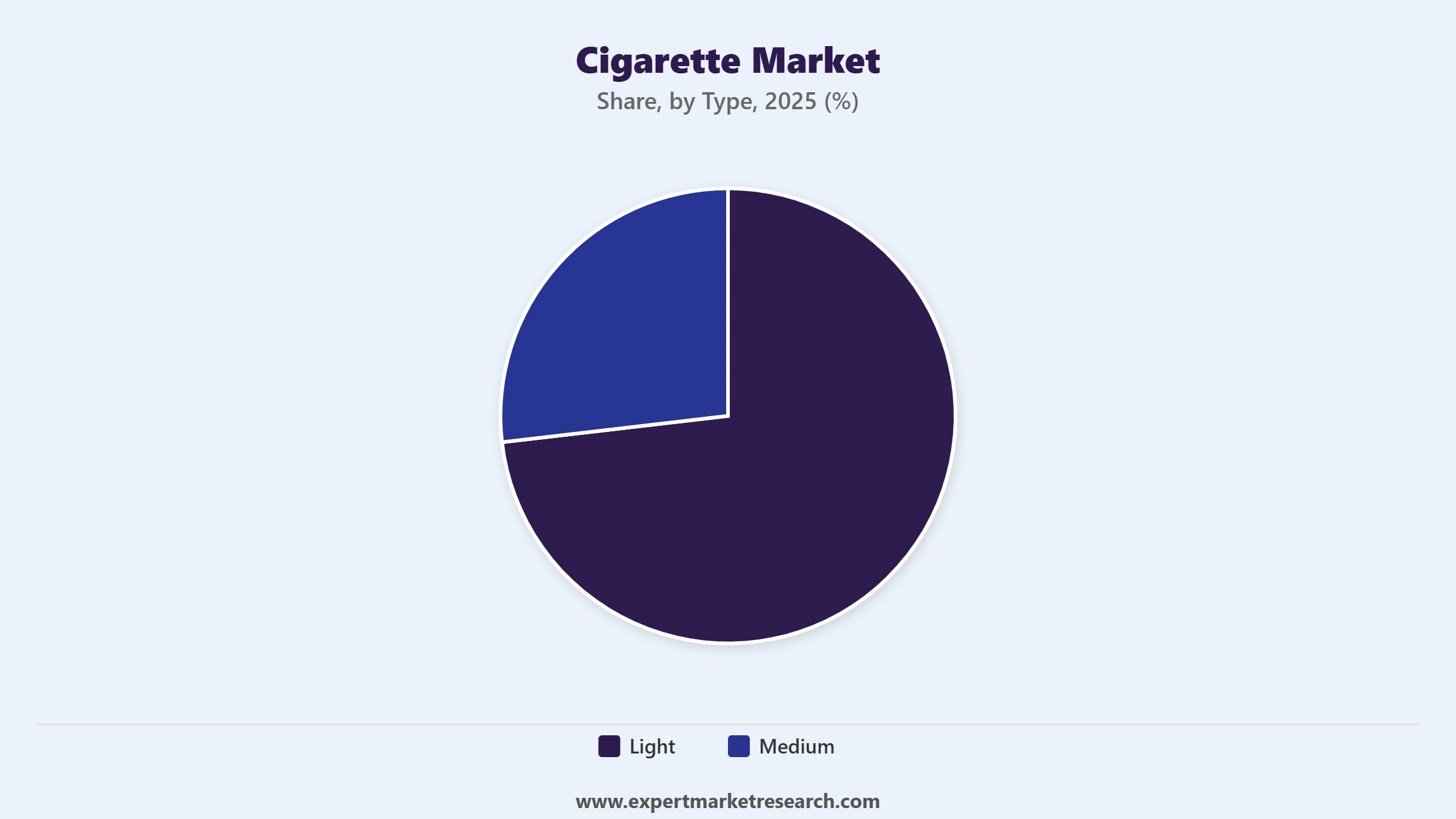
Key Insight: Light cigarettes hold the dominant share of the global cigarette market by value, driven by health-conscious consumer preferences for lower-tar and lower-nicotine conventional cigarette variants across regulated markets. Medium cigarettes serve a large and structurally stable volume base across price-sensitive emerging market consumer segments globally.
Market Breakup by Distribution Channel
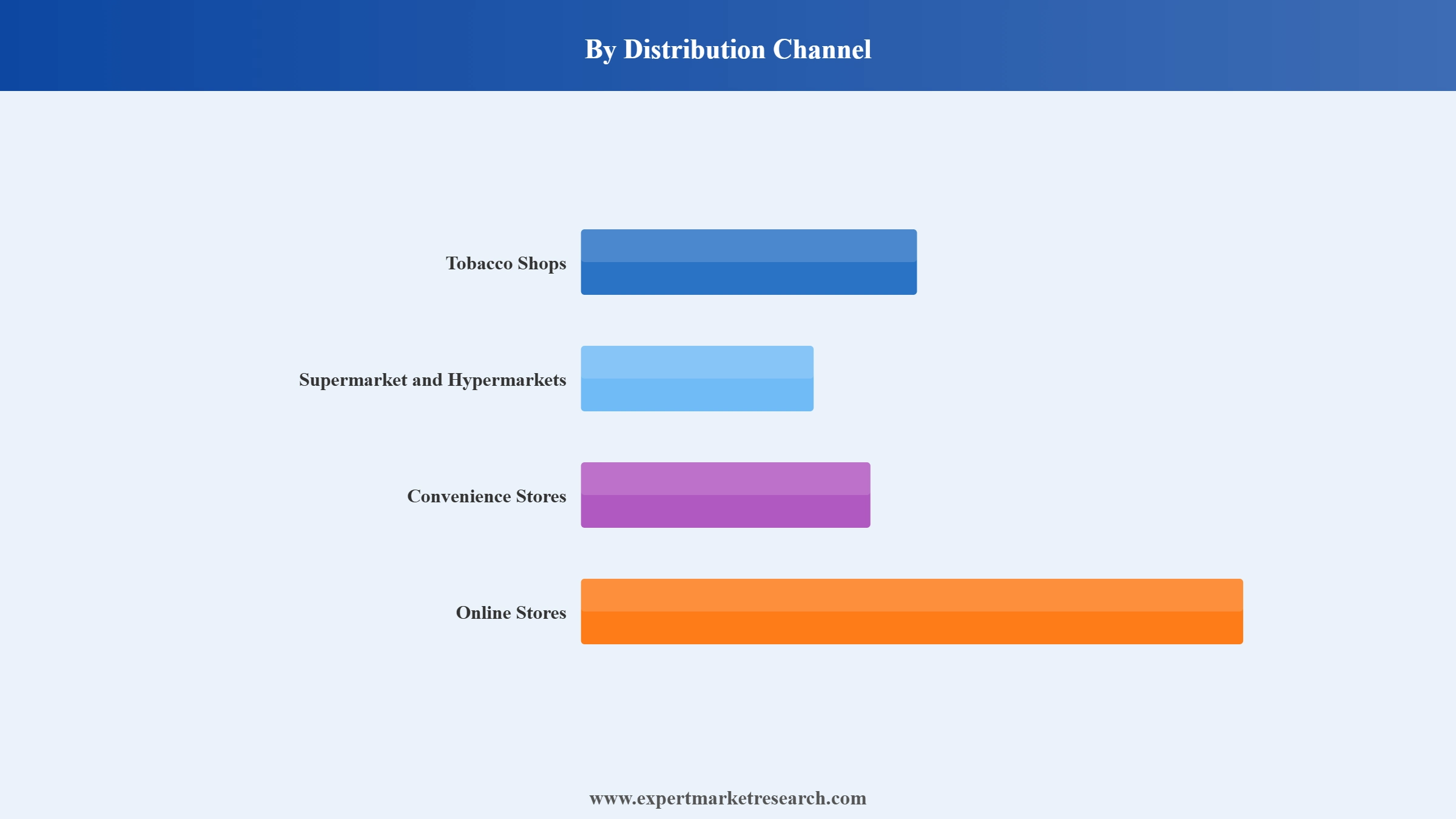
Key Insight: Tobacco shops are the primary distribution channel in most global markets, operating as licensed retail outlets for tobacco products where regulatory requirements often channel sales through dedicated tobacco specialists. Convenience stores are a significant secondary channel. Online stores are the fastest-growing channel, supported by digital retail expansion in emerging markets.
Market Breakup by Region
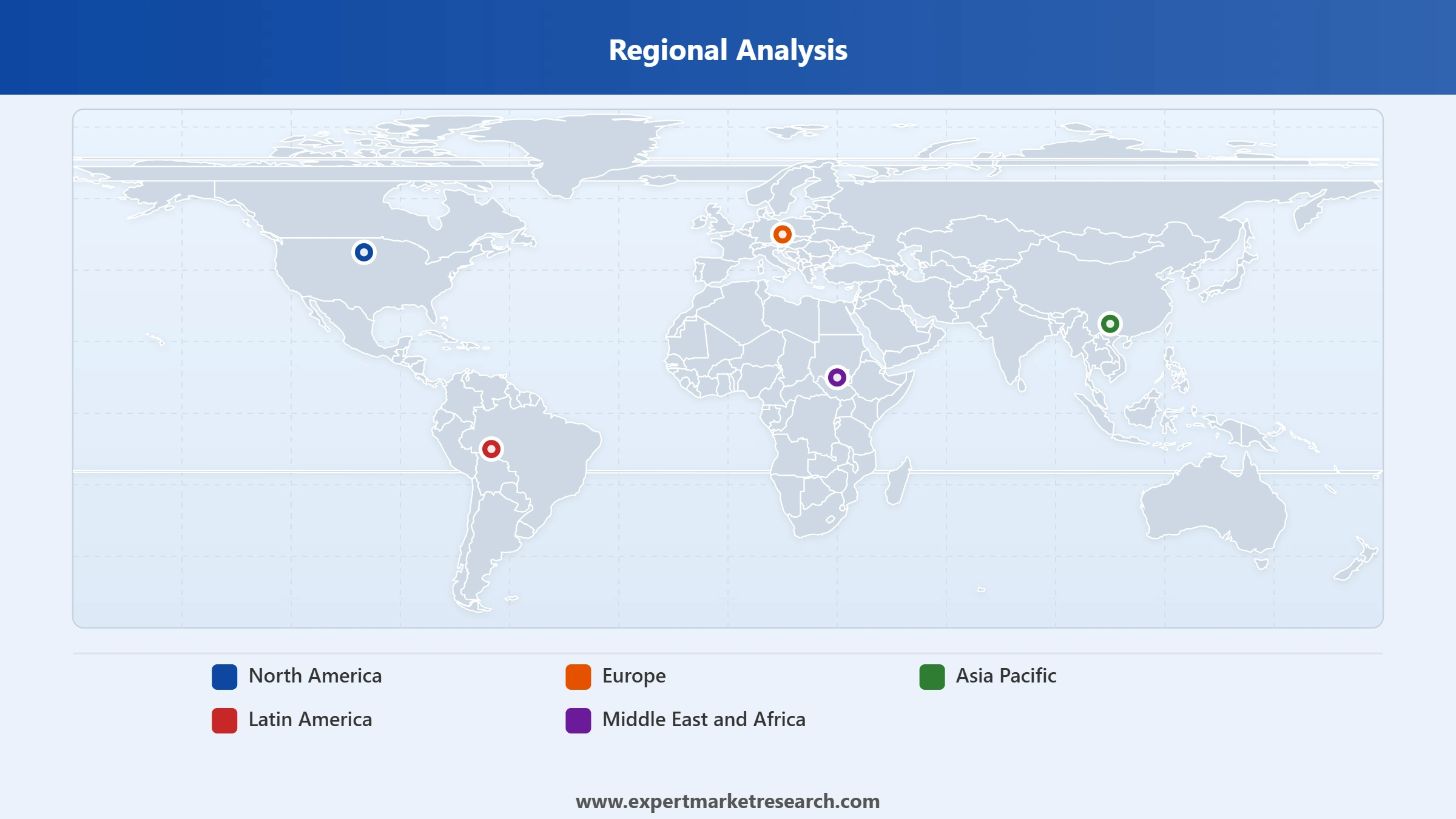
Key Insight: Asia Pacific dominates global cigarette consumption, anchored by China's structurally large state-controlled market and India's growing middle-class consumption. North America and Europe are declining-volume markets with strong pricing power, while Africa and the Middle East are volume-growth regions supported by population expansion and rising tobacco consumption.
Read more about this report - REQUEST FREE SAMPLE COPY IN PDF
By Type, Light cigarettes dominate the market due to consumer preference for lower-tar and lower-nicotine conventional formats across health-conscious and regulated markets
Light cigarettes hold the largest share of the global cigarette market by value, reflecting the broad consumer shift toward perceived lower-risk conventional formats in mature markets. Philip Morris International, BAT, and Japan Tobacco all maintain extensive light cigarette ranges. The premiumisation of light variants through slim, flavoured, and branded sub-variants supports above-average revenue contribution per unit.
Medium cigarettes maintain a large and structurally stable volume base in price-sensitive emerging markets across Asia, Africa, and the Middle East where cost is the primary purchasing criterion. Japan Tobacco's value-tier strategy and regional domestic brands target this segment with cost-competitive offerings.
Read more about this report - REQUEST FREE SAMPLE COPY IN PDF
By Distribution Channel, Tobacco Shops account for the dominant share of the market due to regulatory licensing requirements and their structural role as the primary authorised tobacco retail outlet globally
Tobacco shops hold the dominant distribution channel share for cigarettes in most global markets, reinforced by licensing regulations that restrict retail sales to registered tobacco outlets. This creates a structurally captive role for tobacco shops where regulatory compliance channels consumer purchasing. Philip Morris, BAT, and Japan Tobacco all maintain intensive trade distribution programs targeting tobacco shop networks.
Convenience stores are an important secondary channel in North America and Asia Pacific, where high footfall drives impulse tobacco purchases. Online stores are the fastest-growing channel, expanding in Southeast Asia, the Middle East, and Africa. Regulatory barriers around age verification and cross-border tobacco trade constrain online channel growth in developed markets.
Read more about this report - REQUEST FREE SAMPLE COPY IN PDF
Asia Pacific dominates the global cigarette market due to the world's largest tobacco-consuming populations, a state-controlled domestic market in China, and growing consumption in India and Southeast Asia
Asia Pacific accounts for the largest share of global cigarette revenue and volume. China National Tobacco Corporation controls the world's largest single national cigarette market. India represents a significant and growing market with rising middle-class consumption. Southeast Asia's large smoking populations in Indonesia, Vietnam, and the Philippines provide structural demand for both domestic and multinational cigarette brands.
North America and Europe are declining-volume markets where cigarette consumption falls annually under health awareness, plain packaging, and access restriction policies. Africa and the Middle East represent the most structurally attractive volume-growth regions, supported by population expansion, rising incomes, and lower tobacco control regulatory intensity compared to developed markets.
Read more about this report - REQUEST FREE SAMPLE COPY IN PDF
The global cigarette market is dominated by a small number of large multinational tobacco companies alongside China National Tobacco Corporation, which controls the world's single largest national market. Philip Morris International, British American Tobacco, Japan Tobacco International, and Imperial Brands collectively serve the majority of international cigarette volume outside China. Competition is driven by brand equity, pricing strategy, distribution network depth, and the ability to navigate an increasingly complex global regulatory environment.
Founded in 1982 and headquartered in Beijing, China, China National Tobacco Corporation is the world's largest cigarette manufacturer by volume, producing approximately 40% of the world's cigarettes. Operating as a state monopoly, CNTC controls manufacturing, distribution, and retail across China's provincial tobacco systems, serving the world's single largest national cigarette market.
Founded in 1847 and headquartered in Stamford, Connecticut, Philip Morris International is the world's largest publicly listed international tobacco company. PMI markets its cigarette portfolio, including Marlboro, across more than 175 markets, while actively transitioning its business toward smoke-free products. In September 2025, PMI announced a European cigarette manufacturing joint venture with BAT to optimise production capacity across Poland, Croatia, and Portugal.
Founded in 1902 and headquartered in London, United Kingdom, British American Tobacco is one of the world's largest tobacco companies, with cigarette brands including Lucky Strike, Dunhill, Rothmans, Kent, and Pall Mall distributed across more than 175 markets. BAT's June 2026 H1 trading update projected global cigarette industry volume to decline approximately 2.5% for 2026 while reporting continued progress with its smoke-free portfolio strategy.
Founded in 1985 and headquartered in Tokyo, Japan, Japan Tobacco Inc. is the world's third-largest international tobacco company, operating through its Japan Tobacco International subsidiary across global markets. JTI's brands include Winston, Camel, and Mevius. In September 2025, Japan Tobacco adopted a differentiated value and affordable-tier cigarette strategy in emerging markets, contrasting with the smoke-free pivot strategy of its key global competitors.
Other key players in the market are Imperial Brands PLC, and others.
*Please note that this is only a partial list; the complete list of key players is available in the full report. Additionally, the list of key players can be customized to better suit your needs.*
Our full report for 2026-2035 provides the demand analysis, pricing trends, distribution channel intelligence, and competitive benchmarking to navigate the global cigarette market with confidence. Reach out to our team to access the complete report or request a customised version.
Cigarette Lighter Manufacturing Plant Project Report
United States E-Cigarette and Vape Market
United States Cigarette Lighter Market
Latin America E-cigarettes Market
Cigarette Filter And Product Design
Cigarette Distribution And Retail Channels
Tobacco Leaf Processing And Supply Chain


Upto 15% Off
USD
$2499 $2249
$3999 $3599
$4999 $4249
$5999 $5099


*While we strive to always give you current and accurate information, the numbers depicted on the website are indicative and may differ from the actual numbers in the main report. At Expert Market Research, we aim to bring you the latest insights and trends in the market. Using our analyses and forecasts, stakeholders can understand the market dynamics, navigate challenges, and capitalize on opportunities to make data-driven strategic decisions.*
The market was valued at USD 738.45 Billion in 2025.
The market is projected to grow at a CAGR of 2.50% between 2026 and 2035.
The revenue generated from the Cigarette market is expected to reach USD 945.28 Billion in 2035.
Key factors driving the market include higher disposable incomes, a growing population, marketing strategies employed by tobacco companies, the availability of various cigarette flavours, and other social and cultural influences.
The rise of reduced-harm products, sustainability, and environmental concerns, premiumisation of cigarette brands, and technological advancements in production are the major trends enhancing the cigarette industry growth rate.
The market is broken down into North America, Europe, Asia Pacific, Latin America, the Middle East, and Africa.
Based on the type, the global cigarette market has been segregated into light, medium, and others.
Based on the distribution channel, the global cigarette market can be bifurcated into tobacco shops, supermarkets and hypermarkets, convenience stores, online stores, and others.
The major players in the global cigarette market include China National Tobacco Corporation, Phillip Morris International, British America Tobacco, Japan Tobacco International, and Imperial Tobacco Group, among others.
The Asia-Pacific region is the fastest-growing region in the global cigarette market, driven by largely due to entrenched social norms and historical tobacco use.
The unexpected outbreak of the COVID-19 pandemic led to the enforcement of strict lockdown measures in various countries, causing the temporary shutdown of many cigarette manufacturing facilities.
Explore our key highlights of the report and gain a concise overview of key findings, trends, and actionable insights that will empower your strategic decisions.
| REPORT FEATURES | DETAILS |
| Base Year | 2025 |
| Historical Period | 2019-2025 |
| Forecast Period | 2026-2035 |
| Scope of the Report |
Historical and Forecast Trends, Industry Drivers and Constraints, Historical and Forecast Market Analysis by Segment:
|
| Breakup by Type |
|
| Breakup by Distribution Channel |
|
| Breakup by Region |
|
| Market Dynamics |
|
| Competitive Landscape |
|
| Companies Covered |
|
| Report Price and Purchase Option | Explore our purchase options that are best suited to your resources and industry needs. |
| Delivery Format | Delivered as an attached PDF and Excel through email, with an option of receiving an editable PPT, according to the purchase option. |
Datasheet
One User
USD 2,499
USD 2,249
tax inclusive*
Single User License
One User
USD 3,999
USD 3,599
tax inclusive*
Five User License
Five User
USD 4,999
USD 4,249
tax inclusive*
Corporate License
Unlimited Users
USD 5,999
USD 5,099
tax inclusive*
*Please note that the prices mentioned below are starting prices for each bundle type. Kindly contact our team for further details.*
Flash Bundle
Small Business Bundle
Growth Bundle
Enterprise Bundle
*Please note that the prices mentioned below are starting prices for each bundle type. Kindly contact our team for further details.*
Flash Bundle
Number of Reports: 3
20%
tax inclusive*
Small Business Bundle
Number of Reports: 5
25%
tax inclusive*
Growth Bundle
Number of Reports: 8
30%
tax inclusive*
Enterprise Bundle
Number of Reports: 10
35%
tax inclusive*
How To Order

Select License Type
Choose the right license for your needs and access rights.

Click on ‘Buy Now’
Add the report to your cart with one click and proceed to register.

Select Mode of Payment
Choose a payment option for a secure checkout. You will be redirected accordingly.
Strategic Solutions for Informed Decision-Making
Gain insights to stay ahead and seize opportunities.

Get insights & trends for a competitive edge.

Track prices with detailed trend reports.

Analyse trade data for supply chain insights.

Leverage cost reports for smart savings

Enhance supply chain with partnerships.

Connect For More Information
Our expert team of analysts will offer full support and resolve any queries regarding the report, before and after the purchase.
Our expert team of analysts will offer full support and resolve any queries regarding the report, before and after the purchase.
We employ meticulous research methods, blending advanced analytics and expert insights to deliver accurate, actionable industry intelligence, staying ahead of competitors.
Our skilled analysts offer unparalleled competitive advantage with detailed insights on current and emerging markets, ensuring your strategic edge.
We offer an in-depth yet simplified presentation of industry insights and analysis to meet your specific requirements effectively.




