

Consumer Insights
Uncover trends and behaviors shaping consumer choices today
Procurement Insights
Optimize your sourcing strategy with key market data
Industry Stats
Stay ahead with the latest trends and market analysis.
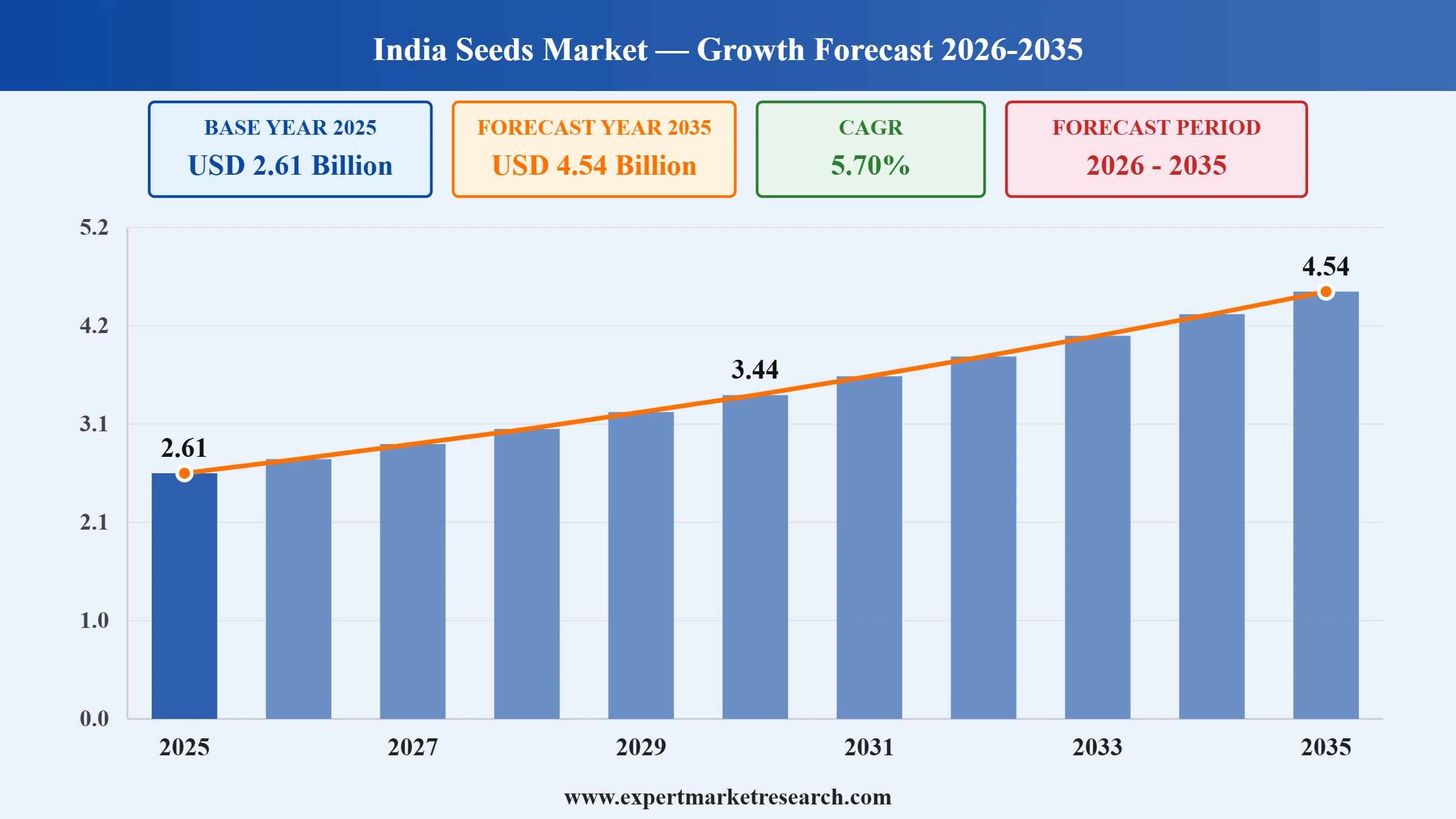
The India seeds market attained a value of USD 2.61 Billion in 2025 and is projected to grow at a CAGR of 5.70% through 2035. The market is further expected to reach USD 4.54 Billion by 2035, supported by rising hybrid and genetically modified seed adoption, expanding row crop and vegetable cultivation, and increasing farmer focus on treated, trait-enhanced planting material. Growth spans conventional and genetically modified seed types across row crop and vegetable applications, with producers across North India, West India, East and Central India, and South India competing on germplasm quality, trait innovation, and regional distribution reach.
Strategic corporate restructuring continues to reshape the India seeds market, as global producers reorganize to sharpen focus on genetics and trait innovation. Corteva Inc. disclosed in September 2026 that it would split into two companies effective October 2026, with the seeds and genetics business, to be named Vylor, becoming the world's second-largest holder of gene-edited product patents globally, and outlined plans to leverage its Hyderabad-based Multi Crop Research Centre for advanced wheat hybrid development in India. This realignment reflects a broader industry pattern of diversified agribusiness conglomerates separating crop protection from seed genetics to sharpen investor focus and accelerate research funding toward gene-editing innovation.
The market is witnessing further consolidation as producers strengthen their vegetable seed portfolios through acquisition. BASF SE's Nunhems business announced in December 2025 that it would acquire Noble Seeds Pvt. Ltd., a New Delhi-based vegetable seed company specializing in cauliflower and radish varieties, a deal expected to enhance BASF's market coverage across North India upon closing in the first quarter of 2026. This consolidation reflects a broader industry shift toward strengthening regional germplasm depth through targeted acquisition rather than organic research investment, letting acquirers shorten development timelines for high-value varieties.
In addition, Indian seed producers are pursuing public-market capital to fund expansion. UPL Ltd.'s Advanta Enterprises Ltd. disclosed in September 2025 that it was exploring an initial public offering targeting approximately USD 500 million, at an estimated valuation of USD 4 billion, to support its seed operations spanning more than 80 countries under the Advanta, Alta, and Pacific Seeds brands. This move mirrors a wider trend among seed subsidiaries seeking public-market capital to fund germplasm research and distribution expansion while letting parent companies retain majority strategic control over operations.
Read more about this report - REQUEST FREE SAMPLE COPY IN PDF
Corteva announced it would separate into two companies effective October 2026, with Vylor carrying the Pioneer brand and seeds and genetics business, positioning it as the world's second-largest holder of gene-edited product patents after China, while committing combined annual R&D spending of USD 1.4 billion, including approximately USD 1 billion allocated to seeds. The company outlined plans to leverage its Hyderabad Multi Crop Research Centre, its second-most advanced R&D facility outside the United States, to develop wheat hybrids and expand gene-editing licensing to crops including rice and pigeon pea. Companies can leverage dedicated regional R&D centers to accelerate localized trait development for climate-resilient crop varieties. This scale of research commitment underscores how leading seed producers prioritize dedicated regional infrastructure to shorten development cycles for climate-resilient, trait-enhanced varieties suited to local growing conditions.
Syngenta Group reported full-year 2025 seeds sales of USD 4.8 billion, up 2% year-over-year, with vegetable seeds growing 5% amid stable market conditions, while its Asia, Middle East and Africa seeds region continued building momentum through rice and biotech corn launches. The company also confirmed the India launch of ALTESSIA, a key herbicide for use in rice fields. Companies can leverage combined seed and herbicide product launches to strengthen crop-specific value propositions for row crop farmers. This performance underscores how multinational seed producers continue prioritizing geographic diversification and product-line breadth, pairing biotech seed launches with complementary crop-protection chemistries to strengthen customer retention.
BASF's Nunhems vegetable seed business agreed to acquire Noble Seeds Pvt. Ltd., a New Delhi-headquartered producer specializing in cauliflower and radish varieties, with the deal expected to close in January 2026 pending statutory approval. The acquisition adds Noble Seeds' regional germplasm expertise to BASF's existing hot pepper, watermelon, gourd, and tomato portfolio, strengthening coverage across North India. Companies can leverage targeted acquisitions of regional germplasm specialists to rapidly expand vegetable seed portfolio depth in underserved geographies. This transaction illustrates the broader competitive dynamic in which multinational seed producers pursue bolt-on acquisitions of specialized regional players to deepen germplasm libraries rather than rely solely on internal breeding.
Advanta Enterprises Ltd., the seed subsidiary majority-owned by UPL Ltd., disclosed it was exploring a public listing that could raise approximately USD 500 million at an estimated valuation of USD 4 billion, engaging four financial institutions to guide the process. The company markets seeds across more than 80 countries under the Advanta, Alta, and Pacific Seeds brands, with UPL retaining a 78% ownership stake. Companies can leverage public listings of seed subsidiaries to unlock capital for germplasm research while retaining majority strategic control. This move reflects the broader industry trend of seed subsidiaries tapping public capital markets to accelerate research funding while their parent agrochemical companies retain long-term strategic oversight of operations.
Following its September 2026 business-split announcement, Corteva's Asia-Pacific leadership outlined plans to expand gene-editing licensing beyond seeds to additional crops including tomatoes and pigeon pea, while emphasizing that India's proposed Seeds Bill represents a directionally positive step for preserving farmer choice in agricultural decision-making. Companies can leverage proactive engagement with emerging seed-sector regulation to help shape frameworks that support continued trait innovation. This regulatory engagement reflects a broader trend of multinational seed producers proactively participating in shaping emerging legislative frameworks, balancing intellectual-property protection with continued farmer access to trait-enhanced planting material.
BASF's Nunhems business confirmed that both companies would maintain independent operations through the transition period following the December 2025 acquisition announcement, ensuring continuity for farmers and distribution partners, while Noble Seeds' 154-person team and germplasm expertise in cauliflower and radish varieties integrate into BASF's broader vegetable seed innovation pipeline. Companies can leverage phased post-acquisition integration to preserve distributor and farmer relationships during ownership transitions. This measured approach reflects a broader industry practice among acquirers of specialized regional seed producers, who commonly prioritize operational continuity during ownership transitions to safeguard established farmer relationships.
UPL's board, having approved exploring strategic alternatives for Advanta in 2024, disclosed in September 2025 that it was continuing to evaluate a public listing that would value the seed subsidiary at approximately USD 4 billion, up from an approximately USD 2.8 billion valuation in 2023 when KKR and Alpha Wave first invested a combined USD 650 million for a joint 25.5% stake. Companies can leverage rising private-market valuations of seed-sector subsidiaries as a signal for timing public-listing decisions. This valuation trajectory reflects growing investor appetite for seed-sector subsidiaries with diversified international distribution footprints, as strategic backers increasingly view germplasm-focused businesses as attractive long-term investments.
Syngenta's seeds business reported China sales growth of 7% alongside 122 new national variety approvals in 2025, reinforcing the company's broader Asia strategy of launching biotech corn and rice varieties across the region, including its March 2026-confirmed ALTESSIA rice herbicide launch in India. Companies can leverage regional variety-approval momentum in adjacent Asian markets to accelerate cross-border product launch timelines. This regional variety-approval pace reinforces the company's broader strategy of accelerating biotech seed introductions across comparable Asian growing conditions. This sustained variety-approval pace reflects the broader competitive emphasis multinational seed producers place on rapid regulatory clearance across Asian markets, enabling faster commercialization of biotech traits regionally.
This Expert Market Research's Report titled "India Seeds Market Report and Forecast 2026-2035" offers a detailed analysis of the market based on the following segments:
Market Breakup by Type
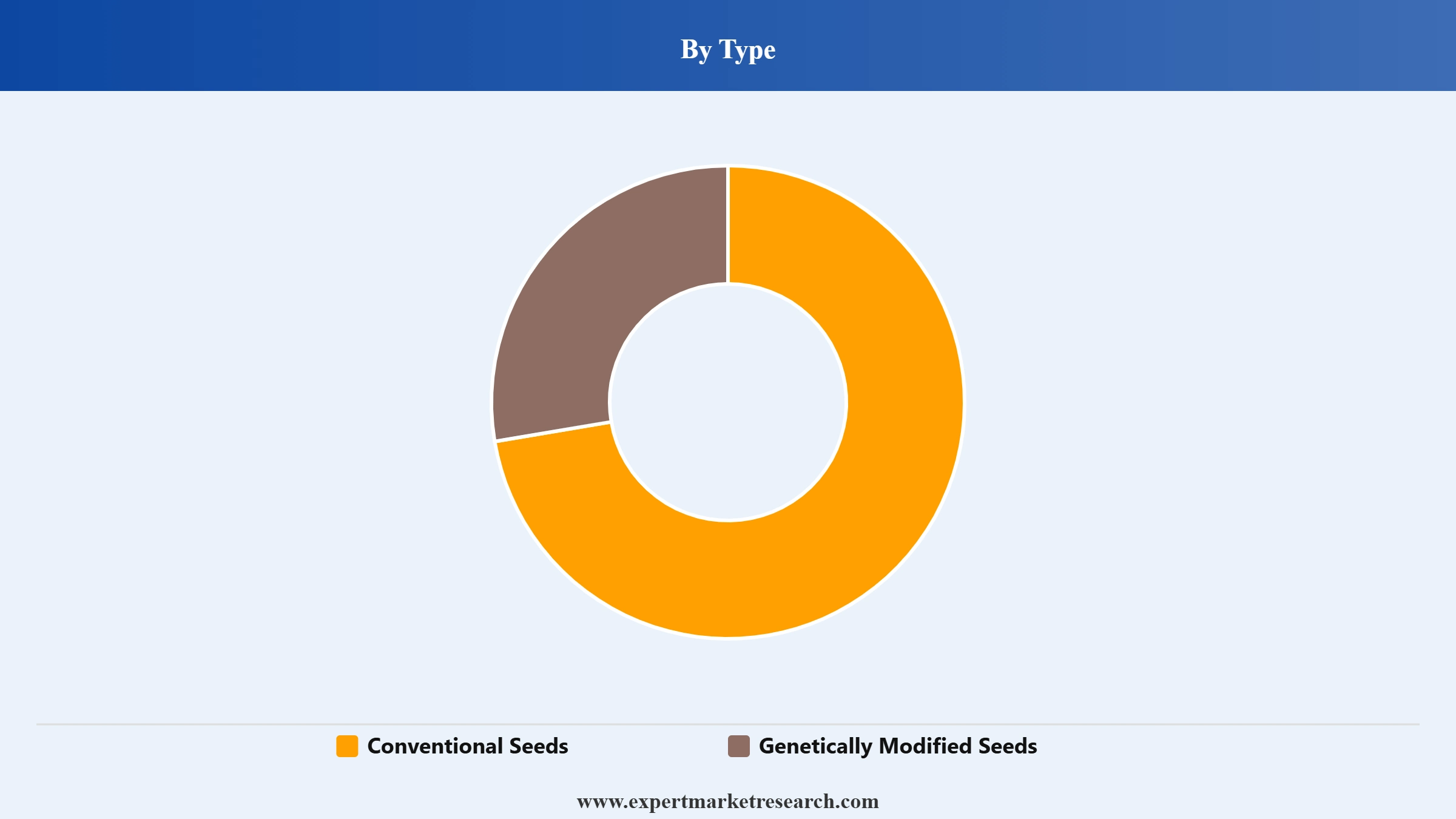
Key Insight: Genetically Modified Seeds occupy a significant share of the India seeds market, led by growing hybrid adoption in maize, rice, and vegetable cultivation, and represent the fastest-growing type segment at an estimated CAGR of 6.60%, reinforced by Corteva Inc.'s September 2026 positioning of its Vylor seeds business as the world's second-largest holder of gene-edited product patents. Conventional Seeds continue to represent substantial demand across staple row crop cultivation nationwide. This pattern mirrors the broader industry trend of multinational breeders directing gene-editing investment toward high-adoption row crops, while conventional seed types continue serving cost-sensitive smallholder segments.
Market Breakup by Crop Type
Key Insight: Row Crops account for a substantial share of the India seeds market, led by grains and cereals as staple cultivation across the country's major agricultural belts. Vegetables is the fastest-growing crop type segment at an estimated CAGR of 6.90%, reinforced by BASF SE's December 2025 acquisition of Noble Seeds Pvt. Ltd., which specializes in Brassicas varieties including cauliflower and radish. Pulses and Oil Seeds continue to represent steady row crop demand tied to India's dietary and edible-oil consumption patterns. Within Row Crops, Fiber Crops and Forage Crops continue to serve smaller, regionally concentrated cultivation needs, while within Vegetables, Cucurbits, Roots and Bulbs, Solanaceae, and Unclassified Vegetables round out demand across diverse horticultural categories. This distribution reflects the broader agricultural pattern in which staple grain cultivation anchors overall seed demand nationally, while horticultural segments benefit disproportionately from targeted regional acquisitions.
Market Breakup by Treatment
Key Insight: Untreated Seeds continue to account for a substantial share of the market, reflecting cost-driven farmer preference across smallholder cultivation. Treated Seeds represent the fastest-growing treatment segment, as rising farmer awareness of disease protection and yield-enhancement benefits drives adoption alongside broader trait-enhanced seed uptake, reinforced by Corteva Inc.'s gene-editing licensing expansion plans announced in September 2026 across Indian row crops. This split reflects the broader tension between near-term affordability and long-term yield performance that shapes smallholder purchasing behavior, as distributors position treated seed as a value-added upgrade.
Market Breakup by Trait
Key Insight: Insect Resistance accounts for a substantial share of the market, reflecting its established legacy across Indian cotton and row crop cultivation. Herbicide Tolerance is the fastest-growing trait segment at an estimated CAGR of 6.30%, supported by Syngenta Group's March 2026 launch of ALTESSIA, a key herbicide for rice fields, in India. Others captures additional emerging trait categories including drought tolerance and disease resistance. This pattern reflects the broader industry shift toward herbicide-compatible trait stacking, as producers pair seed genetics with complementary crop-protection launches to help farmers manage weed-resistance pressure.
Market Breakup by Region
Key Insight: North India accounts for a substantial share of the India seeds market, reinforced by BASF SE's December 2025 acquisition of Noble Seeds Pvt. Ltd., which the company stated would strengthen its market coverage across the region. West India is the fastest-growing regional market at an estimated CAGR of 6.10%, supported by UPL Ltd.'s Mumbai-headquartered Advanta seed operations pursuing continued expansion. East and Central India and South India continue to represent substantial demand tied to diversified row crop and vegetable cultivation. This regional split reflects the broader industry pattern in which established northern distribution networks anchor overall demand, while western markets benefit from active corporate expansion and germplasm investment.
Read more about this report - REQUEST FREE SAMPLE COPY IN PDF
By type, genetically modified seeds lead adoption while row crops dominate crop type given India's staple cultivation base
Genetically Modified Seeds occupy a significant share of the market, led by growing hybrid adoption across maize, rice, and vegetable cultivation. Corteva Inc.'s September 2026 disclosure that its Vylor seeds business would rank as the world's second-largest holder of gene-edited product patents reflects the scale of innovation investment supporting this segment's continued expansion. Multinational and domestic breeders continue to expand hybrid seed research investment, reinforcing this segment's central role in India's ongoing agricultural productivity gains. This concentration of research investment reflects a broader industry pattern of multinational breeders prioritizing hybrid trait development to capture premium pricing and defend market share against smaller producers.
Read more about this report - REQUEST FREE SAMPLE COPY IN PDF
Row Crops continue to account for a substantial share of the market, led by grains and cereals as staple cultivation across India's major agricultural belts, while Vegetables is growing at a fast pace at a projected CAGR of 6.90%. BASF SE's December 2025 acquisition of Noble Seeds Pvt. Ltd. reflects continued investment in vegetable seed germplasm and regional distribution reach. This dynamic reflects the broader industry pattern in which established staple-crop segments retain the largest revenue base even as higher-value horticultural categories post faster proportional growth.
By treatment, untreated seeds leads the market while treated seeds grows fastest given rising disease-protection and yield-enhancement awareness
Untreated Seeds continues to account for a substantial share of the market, reflecting cost-driven farmer preference across smallholder cultivation. Rising input costs continue to push cost-conscious smallholders toward untreated options, particularly across regions where credit access and extension support remain limited. This affordability advantage continues to anchor untreated seeds' leading position, even as treated alternatives gain visibility through targeted farmer outreach programs run by seed companies and agricultural input distributors.
Treated Seeds is growing at a fast pace as rising farmer awareness of disease protection and yield-enhancement benefits drives adoption, reinforced by Corteva Inc.'s gene-editing licensing expansion plans announced in September 2026 across Indian row crops. Distributors increasingly bundle treated seed options with extension services to demonstrate yield benefits directly to farmers, gradually shifting preference toward treated alternatives. This split reflects a broader affordability-versus-performance tension shaping smallholder purchasing decisions across India's fragmented agricultural retail landscape.
By trait, insect resistance leads the market while herbicide tolerance grows fastest given new herbicide-compatible product launches
Insect Resistance continues to account for a substantial share of the market, reflecting its established legacy across Indian cotton and row crop cultivation. Decades of farmer familiarity with insect-resistant trait technology, combined with extensive existing distribution and stewardship infrastructure, continue to anchor this trait's dominant position across major cultivation belts. Seed companies continue to maintain broad insect-resistant product lines as their commercial foundation even as newer trait combinations gain traction among progressive growers.
Herbicide Tolerance is growing at a fast pace at a projected CAGR of 6.30%, supported by Syngenta Group's March 2026 launch of ALTESSIA, a key herbicide for rice fields, in India. Herbicide-resistant weed pressure across major cultivation belts continues to reinforce farmer demand for compatible, next-generation trait combinations. This dynamic reflects the broader industry pattern in which legacy trait categories retain the largest installed base even as newer, herbicide-compatible traits gain share across cultivation regions and crop types.
Read more about this report - REQUEST FREE SAMPLE COPY IN PDF
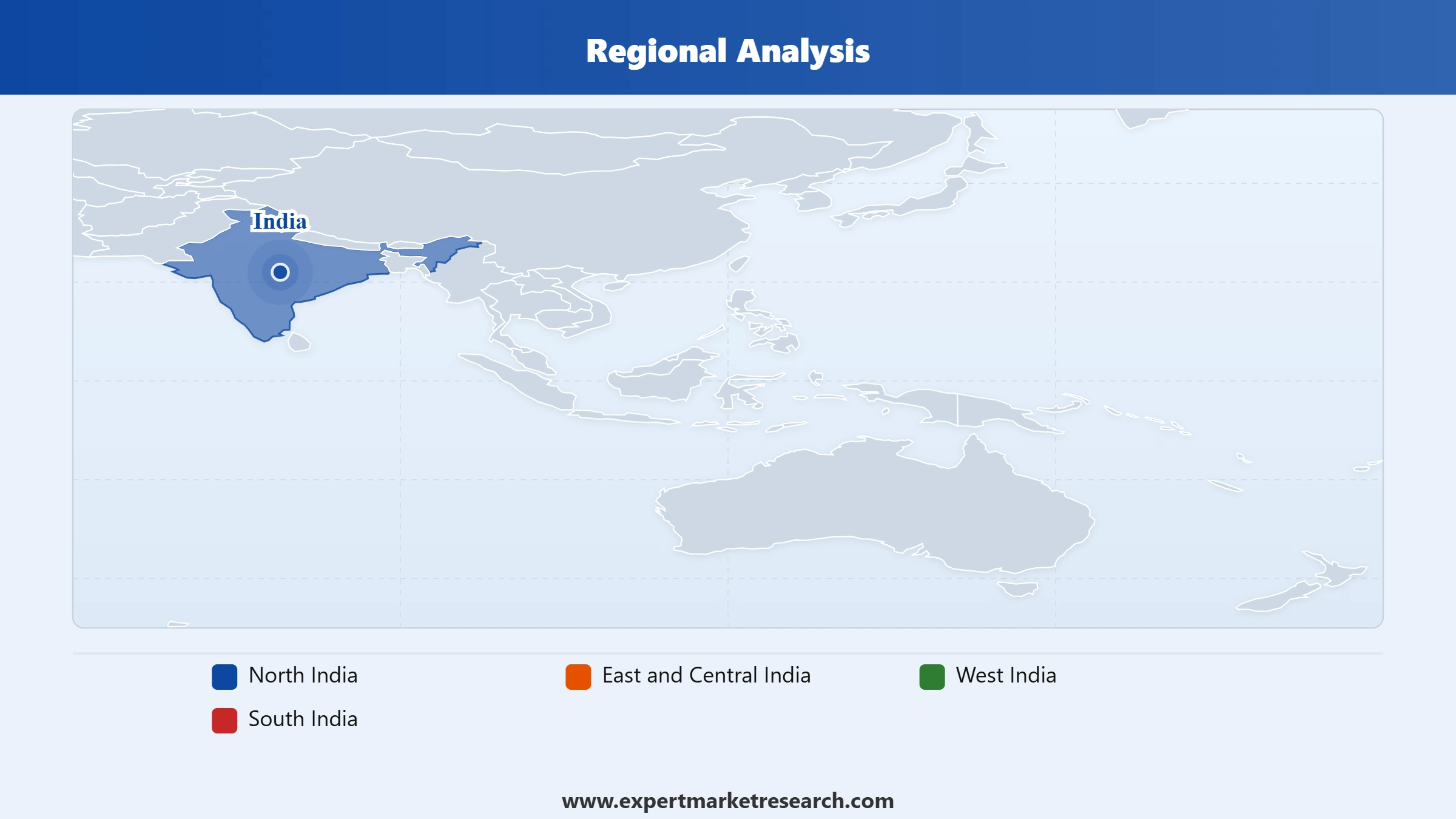
Regional dynamics across the India seeds market are shaped by cultivation patterns, germplasm distribution reach, and the pace of hybrid and gene-edited variety adoption across the country's regions.
North India commands a substantial share of the market. This is supported by its established grains, cereals, and vegetable cultivation base, reinforced by BASF SE's December 2025 acquisition of Noble Seeds Pvt. Ltd., a New Delhi-headquartered vegetable seed producer, which the company stated would strengthen its market coverage across the region.
West India is emerging as the fastest-growing region at an estimated CAGR of 6.10%, supported by UPL Ltd.'s Mumbai-headquartered Advanta Enterprises Ltd. pursuing continued expansion, including its September 2025 disclosure of a potential public listing to fund further growth. East and Central India and South India continue to represent substantial demand tied to diversified row crop and vegetable cultivation across the country.
The industry is consolidated, with India seeds market companies ranging from large multinational agribusiness conglomerates to specialized regional seed producers competing across type, crop type, treatment, and trait segments. Established players operate across the full seed value chain, from germplasm breeding and trait development through seed processing, treatment, and regional distribution to row crop and vegetable growers.
Competitive dynamics among India seeds players are increasingly shaped by the pace of gene-editing and trait innovation, the depth of regional germplasm acquisitions, and access to public-market capital for continued research investment. Producers are investing in dedicated R&D centers, targeted acquisitions, and capital-raising strategies to secure long-term relationships with farmers and distribution partners.
Founded in 2019 and headquartered in Indianapolis, Indiana, United States, Corteva provides seeds, crop protection, and digital agriculture solutions across India. The company announced in September 2026 that it would separate into two companies effective October 2026, with its seeds and genetics business, to be named Vylor, becoming the world's second-largest holder of gene-edited product patents globally.
Founded in 1865 and headquartered in Ludwigshafen, Germany, BASF provides vegetable seeds and crop solutions across India through its Nunhems business. The company announced in December 2025 that it would acquire Noble Seeds Pvt. Ltd., a New Delhi-based vegetable seed producer specializing in cauliflower and radish varieties, strengthening its market coverage across North India upon closing in early 2026.
Founded in 2000 and headquartered in Basel, Switzerland, Syngenta provides seeds and crop protection solutions across India. The company reported in March 2026 that its global seeds sales reached USD 4.8 billion in 2025, up 2% year-over-year, with vegetable seeds growing 5%, while confirming the India launch of ALTESSIA, a key herbicide for rice fields.
Founded in 1969 and headquartered in Mumbai, Maharashtra, India, UPL provides agrochemical and seed solutions through its Advanta Enterprises Ltd. subsidiary, marketing seeds across more than 80 countries under the Advanta, Alta, and Pacific Seeds brands. The company disclosed in September 2025 that Advanta was exploring an initial public offering targeting approximately USD 500 million at an estimated valuation of USD 4 billion.
Other key players in the India seeds market include Bayer AG, Nuziveedu Seeds Limited, Groupe Limagrain Holding, East-West Seed Group, Sakata Seed Corporation, and Rijk Zwaan Zaadteelt en Zaadhandel B.V., among others.
*Please note that this is only a partial list; the complete list of key players is available in the full report. Additionally, the list of key players can be customized to better suit your needs.*
Unlock the latest insights with our India seeds market trends 2026 report. Discover regional growth patterns, type and crop type trends, and key industry players. Stay ahead of competition with trusted data and expert analysis. Download your free sample report today and drive informed decisions in the market.


Upto 15% Off
USD
$2499 $2249
$3999 $3599
$4999 $4249
$5999 $5099


*While we strive to always give you current and accurate information, the numbers depicted on the website are indicative and may differ from the actual numbers in the main report. At Expert Market Research, we aim to bring you the latest insights and trends in the market. Using our analyses and forecasts, stakeholders can understand the market dynamics, navigate challenges, and capitalize on opportunities to make data-driven strategic decisions.*
In 2025, the market reached an approximate value of USD 2.61 Billion.
The market is projected to grow at a CAGR of 5.70% between 2026 and 2035.
The market is projected to reach a value of around USD 4.54 Billion by the year 2035.
Pursuing gene-editing licensing and dedicated regional R&D investment, acquiring specialized regional germplasm producers, and raising public-market capital to fund continued seed innovation and expansion.
Growing demand for genetically modified seeds and an increase in the popularity of organic produce are the key trends in the market.
Conventional seeds and genetically modified seeds are the two types of seeds considered in the market.
The key players in the market include Corteva Inc., BASF SE, Syngenta AG, UPL Ltd. (Advanta), Bayer AG, Nuziveedu Seeds Limited, Groupe Limagrain Holding, East-West Seed Group, Sakata Seed Corporation, and Rijk Zwaan Zaadteelt en Zaadhandel B.V., among others.
Producers face regulatory uncertainty surrounding gene-edited and genetically modified crop approvals, fragmented smallholder distribution networks, and the capital-intensive complexity of scaling regional germplasm and trait research.
Explore our key highlights of the report and gain a concise overview of key findings, trends, and actionable insights that will empower your strategic decisions.
| REPORT FEATURES | DETAILS |
| Base Year | 2025 |
| Historical Period | 2019-2025 |
| Forecast Period | 2026-2035 |
| Scope of the Report |
Historical and Forecast Trends, Industry Drivers and Constraints, Historical and Forecast Market Analysis by Segment:
|
| Breakup by Type |
|
| Breakup by Crop Type |
|
| Breakup by Treatment |
|
| Breakup by Trait |
|
| Breakup by Region |
|
| Market Dynamics |
|
| Competitive Landscape |
|
| Companies Covered |
|
Datasheet
One User
USD 2,499
USD 2,249
tax inclusive*
Single User License
One User
USD 3,999
USD 3,599
tax inclusive*
Five User License
Five User
USD 4,999
USD 4,249
tax inclusive*
Corporate License
Unlimited Users
USD 5,999
USD 5,099
tax inclusive*
*Please note that the prices mentioned below are starting prices for each bundle type. Kindly contact our team for further details.*
Flash Bundle
Small Business Bundle
Growth Bundle
Enterprise Bundle
*Please note that the prices mentioned below are starting prices for each bundle type. Kindly contact our team for further details.*
Flash Bundle
Number of Reports: 3
20%
tax inclusive*
Small Business Bundle
Number of Reports: 5
25%
tax inclusive*
Growth Bundle
Number of Reports: 8
30%
tax inclusive*
Enterprise Bundle
Number of Reports: 10
35%
tax inclusive*
How To Order

Select License Type
Choose the right license for your needs and access rights.

Click on ‘Buy Now’
Add the report to your cart with one click and proceed to register.

Select Mode of Payment
Choose a payment option for a secure checkout. You will be redirected accordingly.
Strategic Solutions for Informed Decision-Making
Gain insights to stay ahead and seize opportunities.

Get insights & trends for a competitive edge.

Track prices with detailed trend reports.

Analyse trade data for supply chain insights.

Leverage cost reports for smart savings

Enhance supply chain with partnerships.

Connect For More Information
Our expert team of analysts will offer full support and resolve any queries regarding the report, before and after the purchase.
Our expert team of analysts will offer full support and resolve any queries regarding the report, before and after the purchase.
We employ meticulous research methods, blending advanced analytics and expert insights to deliver accurate, actionable industry intelligence, staying ahead of competitors.
Our skilled analysts offer unparalleled competitive advantage with detailed insights on current and emerging markets, ensuring your strategic edge.
We offer an in-depth yet simplified presentation of industry insights and analysis to meet your specific requirements effectively.




