Consumer Insights
Uncover trends and behaviors shaping consumer choices today
Procurement Insights
Optimize your sourcing strategy with key market data
Industry Stats
Stay ahead with the latest trends and market analysis.
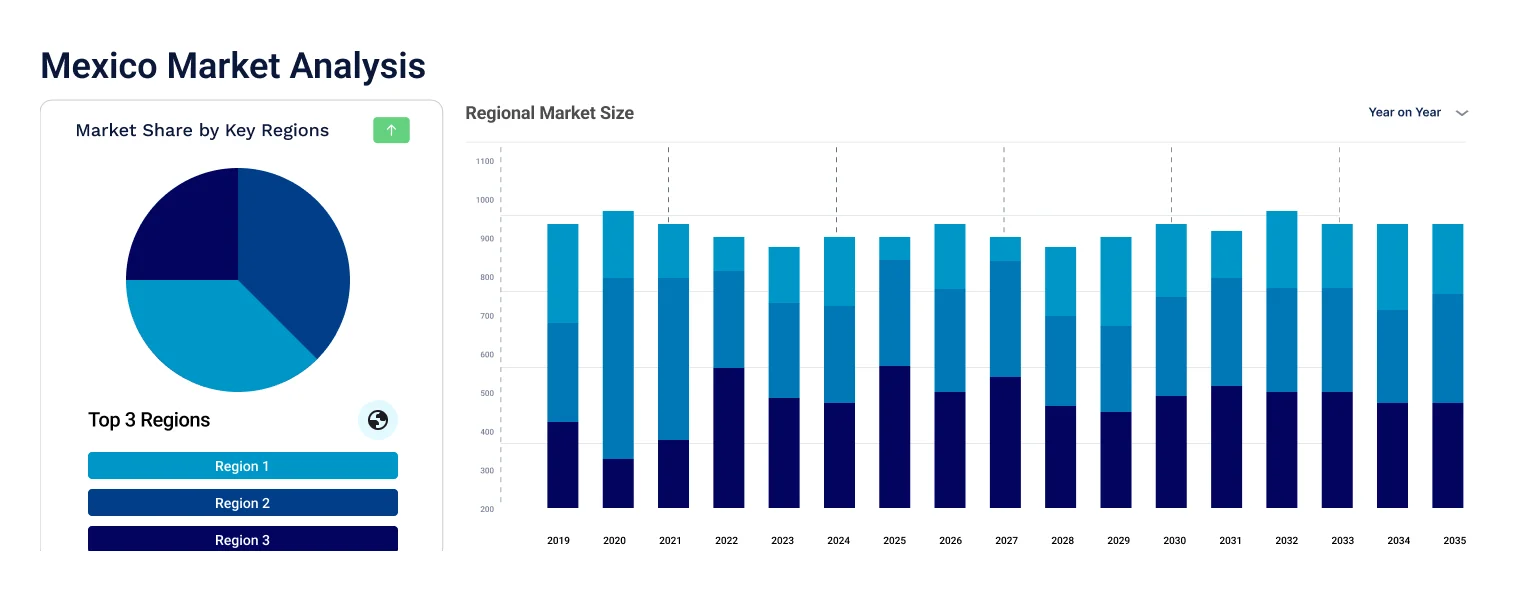
The Mexico Gynecology Robotic Surgery market was valued at USD 135.30 Million in 2025 and is expected to grow at a CAGR of 7.80%, reaching USD 286.74 Million by 2035. The market growth is driven by the increasing adoption of minimally invasive gynecological procedures, rising prevalence of gynecological disorders and cancers, growing demand for improved surgical precision, expanding investments in advanced hospital infrastructure, increasing availability of robotic-assisted surgical technologies, and greater emphasis on reducing postoperative complications and recovery times.
Compound Annual Growth Rate
7.8%
Value in USD Million
2026-2035
Read more about this report - REQUEST FREE SAMPLE COPY IN PDF
The Mexico Gynecology Robotic Surgery Market comprises a broad range of robotic surgical systems, robotic arms, surgical instruments, endoscopic cameras, visualization technologies, accessories, software solutions, and specialized services used in minimally invasive gynecological procedures. Robotic-assisted gynecological surgery enables greater surgical precision, enhanced instrument maneuverability, reduced procedural invasiveness, and improved capabilities for complex pelvic operations, hysterectomy, endometriosis treatment, and gynecological cancer management. The market was valued at USD 135.30 Million in 2025, driven by the growing preference for minimally invasive surgical techniques, rising demand for advanced gynecological interventions, expansion of robotic-assisted surgical facilities, increasing investments in surgical robotics, broader surgeon training programs, and technological advancements in robotic platforms, three-dimensional imaging, articulated instruments, and surgical automation.
|
Analysis Type |
Factors |
Example |
|
Market Drivers |
Mexico’s public-sector investment in robotic surgery is strengthening institutional adoption. |
According to the Mexican Institute of Social Security (IMSS), a robotic endometrial cancer operation at Centro Médico Nacional Siglo XXI in January 2026 enabled discharge within 48 hours. |
|
Market Restraints |
Robotic gynecological surgery in Mexico faces barriers associated with system acquisition, recurring instrument costs, maintenance and specialist training. |
According to Medrano Guzman et al., 2025, robotic surgery for endometrial cancer was introduced at the Oncology Hospital of Centro Médico Nacional Siglo XXI, while the authors highlighted the limited availability of robotic systems across public tertiary hospitals. |
|
Market Opportunities |
Mexico’s emerging hospital-based training programmes create opportunities for robotic system suppliers, simulation providers and specialized surgical services. |
According to Alvarado-Gay and Contreras-Vargas, 2025, Hospital Ángeles Lindavista implemented a gynecological robotic surgery programme using the da Vinci Xi, reporting experience across hysterectomy, myomectomy and endometriosis procedures |
The following section outlines the key factors influencing the growth of the market, including major drivers, restraints, and emerging opportunities.
Increasing Public Hospital Investment Is Expanding Access to Robotic Gynecological Surgery
Mexico’s public-sector investment in robotic surgery is strengthening institutional adoption. According to the Mexican Institute of Social Security (IMSS), a robotic endometrial cancer operation at Centro Médico Nacional Siglo XXI in January 2026 enabled discharge within 48 hours. The expansion of specialist capabilities supports demand for robotic platforms, instruments and maintenance services. From a healthcare-financing perspective, higher procedural throughput and shorter admissions may improve infrastructure utilization, although cost savings depend on case complexity and local operating costs.
High Capital Costs and Limited Specialist Capacity Constrain Market Penetration
Robotic gynecological surgery in Mexico faces barriers associated with system acquisition, recurring instrument costs, maintenance and specialist training. According to Medrano Guzman et al., 2025, robotic surgery for endometrial cancer was introduced at the Oncology Hospital of Centro Médico Nacional Siglo XXI, while the authors highlighted the limited availability of robotic systems across public tertiary hospitals. These constraints can increase financial risk for hospitals with low case volumes and restrict access where patients or insurers cannot absorb higher procedural costs.
Training and Hospital Programme Development Can Broaden Adoption
Mexico’s emerging hospital-based training programmes create opportunities for robotic system suppliers, simulation providers and specialised surgical services. According to Alvarado-Gay and Contreras-Vargas, 2025, Hospital Ángeles Lindavista implemented a gynecological robotic surgery programme using the da Vinci Xi, reporting experience across hysterectomy, myomectomy and endometriosis procedures. Structured surgeon certification, simulation and insurer coordination can help hospitals establish sustainable programmes. Commercial opportunities will depend on training capacity, procedure volumes and financing models that make treatment accessible beyond self-paying patients.
Public-Sector Robotic Surgery Programmes Are Moving Beyond Initial Installation
Mexico’s robotic surgery programmes are increasingly emphasizing operational utilization rather than equipment acquisition alone. According to ISSSTE, in October 2026, Hospital General de Saltillo reported substantial progress toward its planned robotic surgery volume, including procedures for uterine tumors and other cancers. This shift toward utilization targets reflects the economics of capital-intensive surgery: hospitals need sufficient case throughput, trained multidisciplinary teams and reliable maintenance to spread fixed costs across procedures and justify continued investment
Read more about this report - REQUEST FREE SAMPLE COPY IN PDF
Hysterectomy Likely to Dominate the Market Share by Application
Hysterectomy is a central application for robotic gynecological surgery in Mexico, spanning benign uterine disease, endometriosis and selected malignancies. According to Cantú-de León et al., 2025, Mexico’s second consensus on endometrial cancer established interinstitutional recommendations for diagnosis and treatment, reinforcing the need for appropriate surgical management. Combined with established hospital programmes performing robotic hysterectomy and complex pelvic procedures, this clinical demand supports adoption of robotic platforms, specialized instruments and surgeon training, particularly in tertiary-care centers
The key features of the market report include patent analysis, funding and investment analysis, and strategic initiatives by leading players. The major companies in the market are as follows:
Intuitive Surgical develops robotic-assisted surgical systems, including the da Vinci platform, used in minimally invasive procedures. Its portfolio includes surgical instruments, imaging technologies, and related services. The company has an international presence and supports surgeon training, clinical education, and system maintenance. Its robotic technologies are used in several surgical specialties, including gynecology, urology, general surgery, and thoracic surgery.
CMR Surgical develops the Versius robotic surgical system, designed to support minimally invasive surgery through a modular, portable platform. Its portfolio includes robotic instruments, visualization technologies, and supporting services. The company focuses on expanding access to robotic-assisted surgery through hospital partnerships, surgeon training, and international market development. Versius has applications across multiple surgical specialties, including selected gynecological procedures.
Olympus Corporation specializes in medical technologies, particularly endoscopy, imaging, and therapeutic solutions. Its portfolio includes endoscopic systems, surgical devices, and related services for diagnostic and minimally invasive procedures. The company serves healthcare providers across international markets and invests in medical technology development. Although its products support surgical visualization and minimally invasive care, it is not primarily a gynecology-specific robotic surgery system manufacturer.
Medtronic develops medical devices and surgical technologies across several therapeutic areas. Its surgical portfolio includes robotic-assisted systems, instruments, and technologies supporting minimally invasive procedures. The company operates globally and provides clinical education, technical support, and services to healthcare institutions. Its Hugo robotic-assisted surgery system is designed for multiple procedures, including urological and gynecological surgery, subject to local regulatory approvals.
Other key players in the market include Shanghai MicroPort MedBot (Group) Co., Ltd., Stryker Corporation.
*Please note that this is only a partial list; the complete list of key players is available in the full report. Additionally, the list of key players can be customized to better suit your needs.*
The market report offers a detailed analysis of the market based on the following segments:
Market Breakup by Components
The market is categorized by component into robotic systems, instruments, and accessories. Robotic systems include the primary surgical platforms, robotic arms, and visualization technologies, whereas instruments and accessories encompass specialized surgical tools, endoscopic components, and replaceable instruments. Market demand is shaped by gynecological procedure volumes, robotic system utilization rates, equipment maintenance needs, and hospital investments in robotic-assisted surgical technologies.
Market Breakup by Application
The market is classified by application into hysterectomy, sacrocolpopexy and myomectomy, gynecologic malignancy treatment, and other surgical procedures. Adoption across these applications depends on procedural complexity, surgeon proficiency, patient eligibility, and healthcare facility capabilities. Robotic-assisted surgical techniques facilitate minimally invasive interventions, particularly for procedures requiring meticulous tissue dissection, precise suturing, and access to anatomically challenging pelvic structures.
Market Breakup by End-User
The market is categorized by end user into hospitals and clinics, ambulatory surgical centers, and others. Hospitals represent key adoption centers because robotic-assisted procedures require significant capital expenditure, dedicated operating facilities, specialized surgical teams, and technical support services. Uptake across alternative healthcare settings depends on procedural requirements, infrastructure readiness, reimbursement mechanisms, and the overall costs associated with implementing and maintaining robotic surgical technologies.


Upto 15% Off
USD
$1999 $1799
$3099 $2789
$4599 $3909
$5999 $5099


*While we strive to always give you current and accurate information, the numbers depicted on the website are indicative and may differ from the actual numbers in the main report. At Expert Market Research, we aim to bring you the latest insights and trends in the market. Using our analyses and forecasts, stakeholders can understand the market dynamics, navigate challenges, and capitalize on opportunities to make data-driven strategic decisions.*
Explore our key highlights of the report and gain a concise overview of key findings, trends, and actionable insights that will empower your strategic decisions.
| REPORT FEATURES | DETAILS |
| Base Year | 2025 |
| Historical Period | 2019-2025 |
| Forecast Period | 2026-2035 |
| Scope of the Report |
Historical and Forecast Trends, Industry Drivers and Constraints, Historical and Forecast Market Analysis by Segment:
|
| Breakup by Component |
|
| Breakup by Application |
|
| Breakup by End User |
|
| Market Dynamics |
|
| Supplier Landscape |
|
| Companies Covered |
|
Datasheet
One User
USD 1,999
USD 1,799
tax inclusive*
Single User License
One User
USD 3,099
USD 2,789
tax inclusive*
Five User License
Five User
USD 4,599
USD 3,909
tax inclusive*
Corporate License
Unlimited Users
USD 5,999
USD 5,099
tax inclusive*
*Please note that the prices mentioned below are starting prices for each bundle type. Kindly contact our team for further details.*
Flash Bundle
Small Business Bundle
Growth Bundle
Enterprise Bundle
*Please note that the prices mentioned below are starting prices for each bundle type. Kindly contact our team for further details.*
Flash Bundle
Number of Reports: 3
20%
tax inclusive*
Small Business Bundle
Number of Reports: 5
25%
tax inclusive*
Growth Bundle
Number of Reports: 8
30%
tax inclusive*
Enterprise Bundle
Number of Reports: 10
35%
tax inclusive*
How To Order

Select License Type
Choose the right license for your needs and access rights.

Click on ‘Buy Now’
Add the report to your cart with one click and proceed to register.

Select Mode of Payment
Choose a payment option for a secure checkout. You will be redirected accordingly.
Strategic Solutions for Informed Decision-Making
Gain insights to stay ahead and seize opportunities.

Get insights & trends for a competitive edge.

Track prices with detailed trend reports.

Analyse trade data for supply chain insights.

Leverage cost reports for smart savings

Enhance supply chain with partnerships.

Connect For More Information
Our expert team of analysts will offer full support and resolve any queries regarding the report, before and after the purchase.
Our expert team of analysts will offer full support and resolve any queries regarding the report, before and after the purchase.
We employ meticulous research methods, blending advanced analytics and expert insights to deliver accurate, actionable industry intelligence, staying ahead of competitors.
Our skilled analysts offer unparalleled competitive advantage with detailed insights on current and emerging markets, ensuring your strategic edge.
We offer an in-depth yet simplified presentation of industry insights and analysis to meet your specific requirements effectively.