Consumer Insights
Uncover trends and behaviors shaping consumer choices today
Procurement Insights
Optimize your sourcing strategy with key market data
Industry Stats
Stay ahead with the latest trends and market analysis.
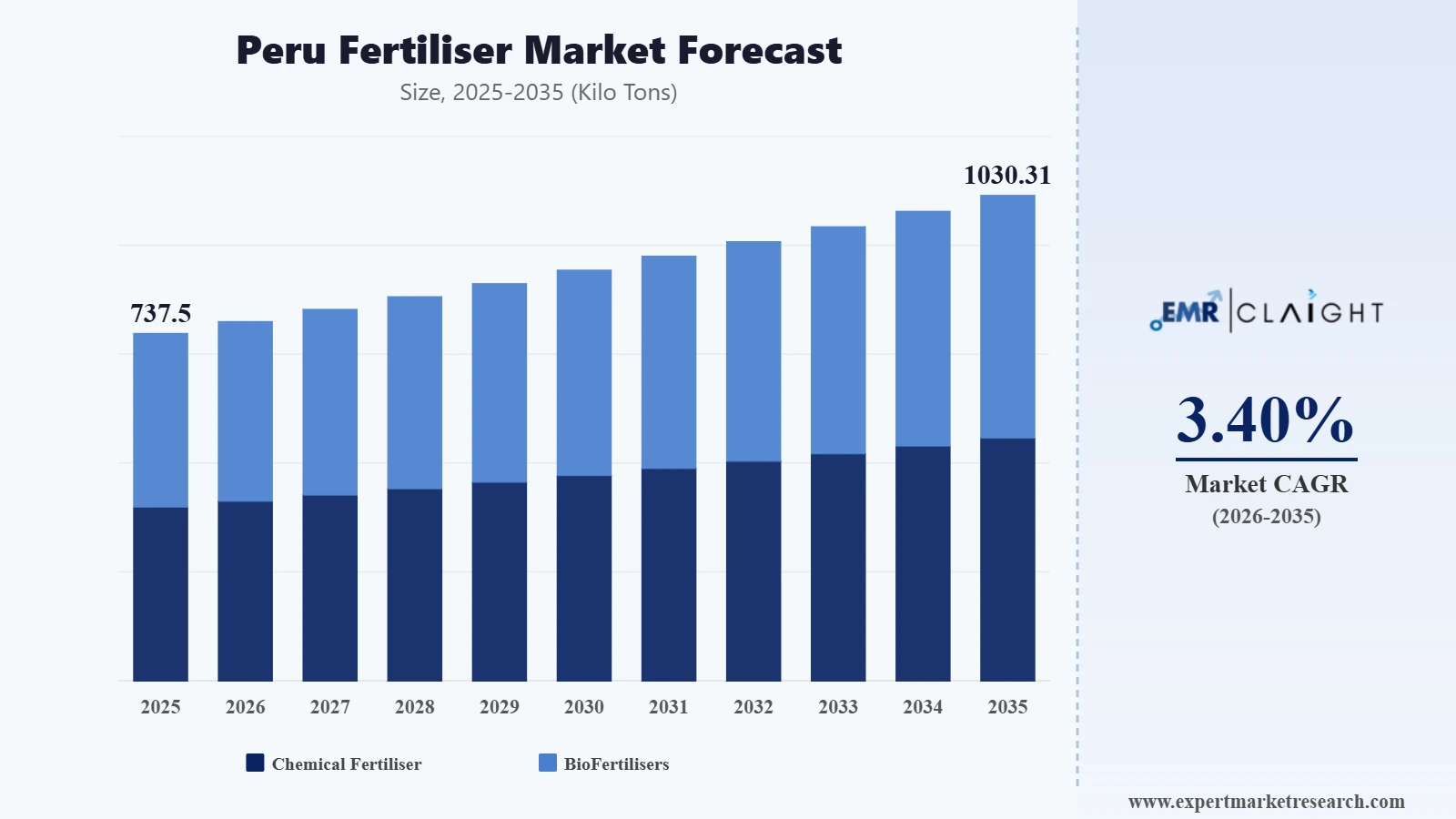
The Peru fertilizer market attained a volume of 737.50 Kilo Tons in 2025 and is projected to expand at a CAGR of 3.40% through 2035. The market is further expected to achieve 1030.31 Kilo Tons by 2035. The adoption of greenhouses, protected cultivation, and fertigation systems is creating a specialized fertilizer demand in Peru. These production environments require precisely soluble nutrients that can be delivered through irrigation systems and adjusted according to crop growth stages. For fertilizer suppliers, this is opening opportunities for water-soluble NPK blends, calcium nitrate, potassium nitrate, micronutrient solutions, and customized fertigation programs. The trend also enables suppliers to move from commodity-based sales toward recurring, higher-value nutrient-management contracts with commercial growers.
One major demand catalyst is the expansion of Peru’s export-oriented horticulture and fruit industry. The value of agricultural exports grew to 15.013 billion USD in 2025, and agricultural exports exceeded 3 million tonnes to 115 foreign destinations. For example, avocado production amounted to 767,230 tonnes, grapes amounted to 555,524 tonnes, and blueberries amounted to 343,537 tonnes, which illustrates the large-scale intensive commercial production of crops that require nutrients. Export growers require consistent crop quality, fruit sizing, productivity, and harvest timing, increasing the relevance of fertigation-compatible, soluble, micronutrient, and crop-specific products.
Another factor is the government’s increasing emphasis on soil productivity and affordable nutrient access. In 2026, AGRO RURAL planned to commercialize 17,000 tonnes of guano from the islands, equivalent to 340,000 sacks, across 23 regions, with the program expected to benefit more than 29,000 producer families and fertilize over 28,660 hectares. This creates a broader market for organic fertilizers while also encouraging suppliers to combine soil-health products with conventional crop nutrition programs, thereby boosting the Peru fertilizer market value.
The heavy dependence of Peru on imported fertilizers renders consumers susceptible to external fluctuations in price and freight rates. During the first seven months of 2026, the volume of fertilizer imports fell by 11.6% while import values grew by 1.4%, implying higher average cost of purchase. Urea prices also surged dramatically in 2026 due to global supply shortages. Fertilizer distributors can reduce this exposure by sourcing from multiple origins, increasing inventory buffers before periods of expected supply disruption, and expanding portfolios beyond urea into phosphate, potassium, soluble and specialty fertilizers. Longer-term supplier agreements can also provide greater price and supply visibility, thereby boosting the Peru fertilizer market developments.
Read more about this report - REQUEST FREE SAMPLE COPY IN PDF
Yara Peru has expanded its focus on lower-carbon fertilizer solutions, combining reduced-carbon production technologies with more efficient nutrient-use strategies and digital agronomic services. Its portfolio includes Yara Climate Choice fertilizers, YaraLiva calcium nitrate, YaraBela nitrogen fertilizers, YaraRega soluble NPK products and YaraTera water-soluble fertilizers for fertigation. The company also promotes soil analysis, customised recommendations and crop monitoring to optimise fertilizer doses and application timing. This development strengthens the availability of differentiated fertilizer solutions for Peruvian growers seeking greater nutrient efficiency and lower environmental impact.
Syngenta presented its biological product portfolio to agricultural audiences in Trujillo and Ica during June 2026, with the initiative reported in July. The presentations targeted important fruit-growing regions and included specialists discussing biological crop solutions, soil fertility and product development. Syngenta Peru already combines crop protection, biological products and high-technology seeds within its local offering. The activity highlights the company’s expansion beyond conventional crop protection toward biological inputs that can complement nutrient-management programmes and support growers seeking alternative approaches to crop performance and soil health.
FERTISUR recorded an import of prilled urea from Russia on 2 July 2026, according to available Peruvian trade records. The product contained a minimum of 46% total nitrogen, with the nitrogen supplied entirely in ureic form, and was described as completely water-soluble and suitable for irrigation systems. The shipment was transported from Rotterdam to the Port of Callao. The transaction demonstrates continued activity by the Peruvian fertilizer supplier in concentrated nitrogen products and adds another international sourcing route to its fertilizer procurement operations.
Mosaic reported its second-quarter 2026 results in August, providing insight into fertilizer-market conditions during the period. Its Mosaic Fertilizantes segment recorded US$1.034 billion in net sales and 1.5 million tonnes of sales volume, while average finished-product selling prices reached US$585 per tonne, compared with US$474 per tonne in the second quarter of 2025. Mosaic also highlighted continuing nutrient-replenishment requirements and fertilizer affordability and availability concerns. The development illustrates changing fertilizer economics across Latin American agricultural markets, including conditions relevant to regional supply and procurement.
The process of soil diagnosis has been playing an important role in the way fertilizer demands are being established in Peru. The Perú 2M project is aimed at taking 2 million samples of soils used in agriculture. This project will lead to the creation of maps of fertility and more accurate plans of fertilization. The INIA possesses 16 laboratories certified for soil, water and foliar analyses, where such indicators as nitrogen, phosphorus, potassium, pH, organic matter, and soil texture are tested. The programme is expected to benefit more than 100,000 producers. This creates opportunities for fertilizer suppliers to combine products with laboratory analysis, crop-specific recommendations and agronomic advisory services, shifting procurement toward more tailored nutrient programmes.
Organic nutrient supply is becoming more structured through government-backed distribution rather than remaining limited to individual farming practices. In March 2026, MIDAGRI announced that 14,765 tonnes of guano de las islas would be extracted, processed and sold at social prices during 2026. The programme is intended to benefit 13,731 agricultural-family households across 23 regions. Guano is promoted for crops including coffee, potato, cacao, quinoa, wheat, fruit and pasture. This institutional distribution creates opportunities for private suppliers to complement organic fertilization with microbial inputs, mineral amendments, soil conditioners and integrated nutrient-management solutions.
The development of biofertilizers in Peru is becoming more reliant on the use of local technological innovations that have been developed based on the agricultural requirements of the country. In June 2026, INIA approved the release of the BIO CHUMBINIA biofertilizer which has been innovated at the Agricultural Experimental Station of Chumbibamba in Apurímac. INIA claims that the technology can enhance soil fertility and plant health by as much as 70%. The product is also reported to support flowering, fruiting, foliage development, rooting and seed germination. This development encourages commercial players to evaluate locally adapted biological inputs alongside conventional fertilizer programmes and establish demonstration-based adoption models.
Peru’s expanding agricultural export activity is encouraging fertilizer suppliers to develop more crop-specific nutrient programmes. Between January and May 2026, the country’s agricultural exports reached US$4.713 billion, representing a 5.2% increase from the corresponding period of 2025. Traditional agricultural exports also reached US$267 million, up 27.8%, with coffee, refined sugar and wool contributing to the increase. For fertilizer suppliers, this broader commercial base supports opportunities to tailor nutrition around crop development stages, quality requirements and production schedules. Specialty nutrients, soluble products and micronutrient programmes can therefore complement conventional NPK offerings.
Fertilizer suppliers in Peru are increasingly maintaining diversified product portfolios covering both commodity and specialty nutrients. FertiSur, for example, lists granular products including diammonium phosphate, calcium nitrate, potassium nitrate, ammonium sulphate, potassium sulphate, triple superphosphate, agricultural urea and NPK blends. Its soluble portfolio includes potassium nitrate, monoammonium phosphate, monopotassium phosphate, calcium nitrate, magnesium nitrate and soluble NPK. The company also maintains a distribution network across major agro-industrial areas and states that it holds inventory throughout the year. Such breadth allows suppliers to serve different application systems while reducing dependence on a single fertilizer category.
The Expert Market Research’s report titled "Peru Fertilizer Market Report and Forecast 2026-2035” offers a detailed analysis of the market based on the following segments:
Market Breakup by Product Type
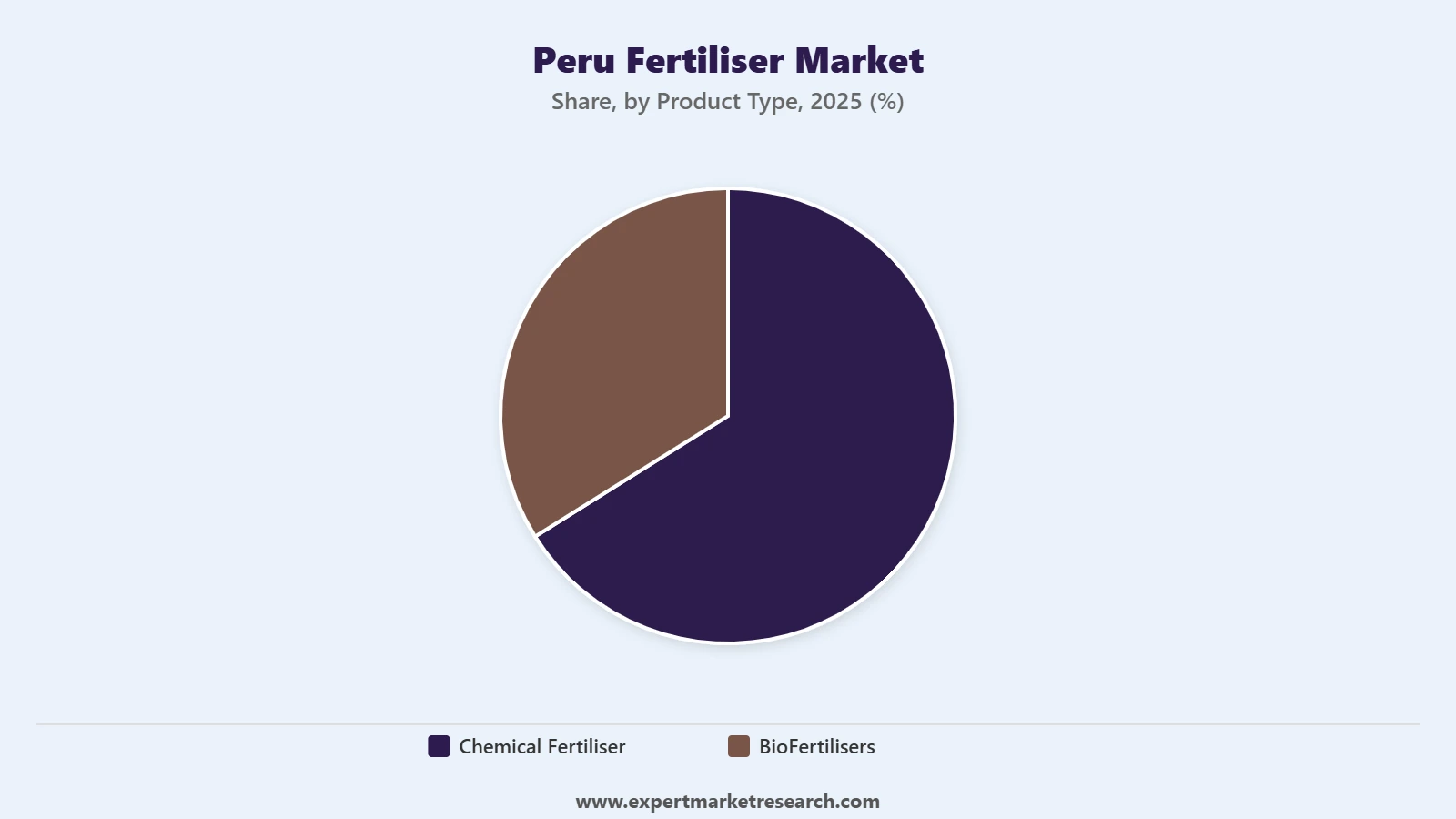
Key Insight: Chemical fertilisers continue to underpin Peru’s commercial crop nutrition system because they provide predictable nutrient concentrations and rapid crop availability, particularly for high-output farming. Urea, phosphates, potash products, nitrates, and NPK formulations remain important across field crops and intensive horticulture. At the same time, biofertilisers are gaining commercial relevance as government institutions promote biological soil management and locally developed technologies. INIA reported that its organic technologies increased productivity across more than 120 hectares by 33% and reduced synthetic fertilizer use by 30% over four years. This suggests that future procurement will increasingly involve complementary chemical-biological programs rather than a simple substitution between the two categories.
Market Breakup by Product
Key Insight: Straight fertilizers continue to be useful in cases where growers are in need of correcting a certain nutrient deficiency, such as nitrogen, potassium, phosphorus, calcium, or any other micronutrient. Their simple nutrient composition is also helpful in providing for the flexibility of blends as well as for application programs for specific crops. The use of complex fertilizers, however, offers a commercial edge to growers who wish to achieve the delivery of different nutrients in one application. Peru’s expanding agroexport sector makes nutrient balancing particularly relevant because fruit and vegetable producers manage crop stages, fertigation schedules, and quality specifications. Suppliers can strengthen complex-fertilizer demand by developing formulations for specific crop phases, soil conditions, and irrigation systems rather than relying only on standard NPK ratios, thus driving the demand in the Peru fertilizer market.
Market Breakup by Product Form
Key Insight: Dry fertilizers remain central to conventional field application because granular products are relatively easy to transport, store, distribute, and apply across broad cultivation areas. They also accommodate major products such as urea, phosphates, potassium salts, and granular NPK blends. Liquid fertilizers are gaining traction where intensive agriculture uses drip irrigation, fertigation, foliar feeding, and controlled nutrient delivery. FertiSur specifically markets soluble products for drip irrigation, fertigation, foliar application, and greenhouse cultivation, indicating a commercial shift toward application flexibility. As Peru’s horticultural and protected-cultivation segments expand, suppliers that combine soluble nutrient portfolios with technical application support can capture higher-value demand.
Market Breakup by Crop Type
Key Insight: Fruits and vegetables represent an important high-value fertilizer application base because Peru’s agricultural growth is increasingly connected to export-oriented horticulture. In 2025, avocado, grape, blueberry, mandarin, and mango shipments formed major components of the country’s agricultural export basket. Grains and cereals remain essential to domestic food supply and agricultural-family production, while pulses and oilseeds create additional demand for balanced soil nutrition. Flowers and ornamentals are also developing as a commercial niche. For instance, flower sales during Valentine’s Day 2026 increased by more than 20% compared with 2025, according to MIDAGRI. This diversification creates opportunities for crop-specific formulations rather than one-size-fits-all products.
Read more about this report - REQUEST FREE SAMPLE COPY IN PDF
By product type, chemical fertiliser is anticipated to dominate due to predictable nutrient delivery
Chemical fertilisers represent the established product category in Peru, supported by their widespread use for supplying concentrated macronutrients to crops. Peru’s fertilizer supply remains significantly connected to imports, with urea imports reaching about 1.1 million tonnes between 2021 and 2025, according to SUNAT trade data reported by the Peruvian government. Nitrogen fertilisers are particularly important for maintaining crop productivity, while phosphate and potassium products enable targeted nutrient management. Their high nutrient concentration, established distribution channels, and predictable nutrient content continue to support demand among commercial and smallholder farmers. Such developments will thus boost Peru fertilizer market trends in the long run.
Read more about this report - REQUEST FREE SAMPLE COPY IN PDF
Biofertilizers are becoming increasingly popular in Peru since Peruvian agriculture has been using biological products in soil and crop management programs. The Peruvian SENASA registered over 200 products based on microorganisms for agricultural use by 2024, thus demonstrating the increasing number of biological options available for agriculture. The use of biofertilizers which include beneficial microorganisms could help provide nutrients and stimulate soil life while at the same time supplementing traditional fertilization. Their appeal is also linked to growers seeking input strategies that improve soil health and reduce dependence on purely chemical nutrient sources, particularly in production systems adopting more sustainable agricultural practices.
By product, straight fertilisers dominate due to flexible, targeted nutrient application
Straight fertilisers remain important in Peru because they allow growers to supply individual nutrients according to crop and soil requirements. The Banco Central de Reserva del Perú (BCRP) records import prices for individual products, including urea and ammonium sulphate. For example, the recorded FOB import price of urea reached US$1,022 per tonne in February 2022, highlighting the commercial significance of nitrogen fertilisers within Peru’s agricultural-input supply. Their flexibility also enables farmers to modify application rates according to nutrient deficiencies and crop development stages.
Complex fertilisers benefit from Peru’s established trade in multi-nutrient agricultural inputs. SUNAT classifies fertilisers containing nitrogen, phosphorus and potassium under tariff subheading 3105.20, confirming the presence of NPK products within the country’s import structure. The classification also covers fertilisers containing combinations of major nutrients, demonstrating product diversity beyond single-nutrient formulations. Complex fertilisers appeal to commercial growers because predetermined nutrient combinations can simplify procurement and field application while supporting more balanced fertilisation programmes across different crops and production systems.
By form, dry fertilisers dominate due to established storage, transport, and application infrastructure
Dry fertilizer demand in Peru is driven by the agricultural activities in the country, especially through the planting of potatoes. This is because of the significance of potato as an agricultural commodity in Peru where more than 330,000 hectares are grown each year, according to the Ministry of Agriculture of Peru (MIDAGRI). It is appropriate to use dry fertilizers in such agricultural settings because they can be shipped to remote farms and then applied directly to the ground without requiring any special equipment. Their relatively simple handling and compatibility with traditional application methods make dry formulations suitable for Peru’s geographically dispersed farming communities, thus boosting the demand in the Peru fertilizer market.
There is increased demand for liquid fertilizers from Peru due to the increased use of protected agriculture and controlled environment farming. The Peruvian Ministry of Agriculture and Irrigation (MIDAGRI) has been advocating for the use of fertigation as well as the latest forms of irrigation technology within agriculture development projects that focus on optimizing water and inputs. Liquid fertilizers are injectable into irrigation systems and are able to vary depending on crop growth stage. This makes them very attractive to farmers who prefer high technology.
By crop type, fruits and vegetables dominate due to Peru’s high-value agroexport orientation
Grains and Cereals represent the dominant crop-type segment in Peru’s fertilizer market, supported by their broad cultivation base and importance to domestic food supply. Peru’s official agricultural statistics track major crops including rice, maize and wheat, reflecting sustained fertilizer requirements across these staples. The segment also benefits from established farming systems and recurring nutrient application cycles. In 2025, Peru’s agricultural sector expanded by 4.8%, while the agricultural subsector grew 5.5%, indicating a stronger production environment for input suppliers
Fruits and vegetables are anticipated to attain the fastest growing CAGR during the forecast period primarily due to the rising production of higher-value crops and expanding commercial cultivation. As per the Ministry of Agrarian Development and Irrigation, in 2025, there were significant increases in the production of various fruits and vegetables. The observations were 18.7% for grapes, 16.8% for avocados and 49.4% for mangoes, creating greater demand for crop-specific nutrition, micronutrients and fertigation inputs. These products are appealing to consumers because fruits and vegetables increasingly serve fresh-food, processing and export markets, while growers value their higher commercial returns.
By region, Coastal regions drive demand for specialised fertilizers supporting intensive export agriculture
Peru’s Coastal region remains commercially important for fertilizer suppliers because its irrigated agricultural zones support intensive fruit and vegetable production and major agroexport operations. Ica, La Libertad, Lambayeque, Piura, and Lima are particularly relevant to export-oriented crop production. The 2025 agricultural expansion included stronger blueberry production in Ica, La Libertad, and Lambayeque, while grape production increased in Ica, Piura, and Arequipa. Coastal producers are therefore important customers for soluble fertilizers, fertigation products, micronutrients, and crop-stage-specific formulations. The region also benefits from logistics infrastructure supporting international agricultural trade. For example, Peru’s 2025 agricultural exports exceeded USD 15 billion, thereby directly boosting the Peru fertilizer market regional growth.
The Andean and Amazonian regions offer expanding opportunities through agricultural-family family programs, soil improvement, coffee, cacao, potatoes, grains, and other regional crops. The distribution of fertilizers by the government is becoming increasingly decentralized, whereas soil testing is being extended to the less industrialized production areas. For example, in Puno, in July 2026, regional officials and INIA have improved their technical skills for soil testing as per the national soil fertility program. At the same time, MIDAGRI provided 400 tons of guano to 2,000 coffee growers in Villa Rica, as per the national coffee program of 2026. These developments create opportunities for suppliers offering smaller-pack products, organic fertilizers, localized nutrient blends, and technical distribution networks.
Leading Peru fertilizer market players are aiming to gain scalability by broadening distribution networks, strengthening import and supply-chain capabilities, and expanding product portfolios suited to Peru’s diverse agricultural base. Companies are increasingly focusing on soluble fertilizers, NPK formulations, micronutrients, and crop-specific nutrient solutions to serve commercial farms as well as smaller agricultural producers. Building relationships with cooperatives, distributors, agro-dealers, and large-scale growers is also important for improving last-mile access. Players are further seeking operational efficiencies through larger procurement volumes, improved warehousing, and more reliable logistics to manage international fertilizer-price and supply fluctuations while maintaining product availability across Peru’s major agricultural regions.
Peru fertilizer companies are providing soil and crop analysis, fertigation support, and application guidance to encourage higher-value product adoption rather than competing solely on commodity fertilizer prices. Companies such as SGS can support this ecosystem through testing and quality-assurance services, while manufacturers and distributors can use analytical data to develop formulations tailored to crop and soil requirements. Expansion into export markets, digital sales channels, and partnerships with agricultural organisations can further increase customer reach and create repeat demand.
Grupo Andina is a Peruvian agricultural-inputs company established in 1978 and headquartered in Miraflores, Lima, Peru. In Peru, Grupo Andina offers a range of crop-nutrition and soil-conditioning products, including Fertiphos Plus, Fertiphoska, Magnesoil, Ulexita, Rhuzterr and TMK 15G. Its portfolio is designed to provide essential nutrients, improve soil conditions and support plant development across different agricultural applications. The company also supplies complementary products focused on crop growth and productivity.
SGS S.A. was founded in 1878 and is headquartered in Geneva, Switzerland. In Peru, SGS has operated since 1986, with its Peruvian headquarters in Callao. Rather than manufacturing conventional fertilizers, SGS supports Peru’s fertilizer industry through testing, inspection and analytical services. Its agricultural offering includes fertilizer quality assessment, chemical and physical analysis, nutrient testing, soil and fertilizer analysis, field trials and product-development support. These services help fertilizer manufacturers, importers and agricultural businesses verify product composition, quality and compliance with applicable requirements.
FERTILIZANTES DEL SUR S.A.C. (FERTISUR) was established in 2005 and is headquartered in Lima, Peru. The company specialises in the production, distribution and export of agricultural and chemical products, with a particular focus on fertilizers and crop nutrients. Its Peruvian portfolio includes soluble NPK fertilizers, potassium nitrate, monoammonium phosphate, monopotassium phosphate, calcium nitrate, magnesium nitrate, potassium sulphate, magnesium sulphate, manganese sulphate, zinc sulphate and ferrous sulphate. These products support fertigation, foliar application, greenhouse cultivation and conventional crop-nutrition programmes.
*Please note that this is only a partial list; the complete list of key players is available in the full report. Additionally, the list of key players can be customized to better suit your needs.*
Explore the Peru fertilizer market forecast 2026-2035 to understand evolving fertilizer demand, product opportunities, crop-specific requirements, competitive strategies, and emerging biofertilizer trends. The report provides focused insights into the Peru fertiliser market, including segmentation, market dynamics, key players, and future opportunities. Request a free sample to evaluate the detailed analysis and understand the factors shaping the Peru fertilizer market trends 2026 and beyond.


Upto 15% Off
USD
$2499 $2249
$3999 $3599
$4999 $4249
$5999 $5099


*While we strive to always give you current and accurate information, the numbers depicted on the website are indicative and may differ from the actual numbers in the main report. At Expert Market Research, we aim to bring you the latest insights and trends in the market. Using our analyses and forecasts, stakeholders can understand the market dynamics, navigate challenges, and capitalize on opportunities to make data-driven strategic decisions.*
In 2025, the market reached an approximate value of 737.50 Kilo Tons.
The market is projected to grow at a CAGR of 3.40% between 2026 and 2035.
The market is estimated to witness a healthy growth during 2026-2035 to reach around 1030.31 Kilo Tons by 2035.
Key strategies driving the Peru fertilizer market include expanding domestic distribution networks, developing customised nutrient blends, strengthening relationships with agricultural cooperatives, promoting balanced fertilization, improving last-mile availability, adopting precision agriculture technologies, and introducing efficient products tailored to Peru’s diverse crops and soil conditions.
The key trends aiding the market include the utilisation of high-end technologies, like sensors and data analytics, the implementation of precision agriculture techniques, and the burgeoning popularity of micronutrient fertilisers.
Based on product type, market segmentations include chemical fertiliser and biofertilisers.
Different products are straight fertilisers and complex fertilisers.
Key players in the market are Grupo Andina, SGS SA, and FERTILIZANTES DEL SUR S.A.C., among others.
Key challenges in the Peru fertilizer market include volatile international fertilizer prices, dependence on imports, rising transportation and logistics costs, limited access to financing for smallholder farmers, climate-related disruptions, soil nutrient imbalances, and uneven adoption of modern fertilizer application practices.
Explore our key highlights of the report and gain a concise overview of key findings, trends, and actionable insights that will empower your strategic decisions.
| REPORT FEATURES | DETAILS |
| Base Year | 2025 |
| Historical Period | 2019-2025 |
| Forecast Period | 2026-2035 |
| Scope of the Report |
Historical and Forecast Trends, Industry Drivers and Constraints, Historical and Forecast Market Analysis by Segment:
|
| Breakup by Product Type |
|
| Breakup by Product |
|
| Breakup by Product Form |
|
| Breakup by Crop Type |
|
| Market Dynamics |
|
| Competitive Landscape |
|
| Companies Covered |
|
Datasheet
One User
USD 2,499
USD 2,249
tax inclusive*
Single User License
One User
USD 3,999
USD 3,599
tax inclusive*
Five User License
Five User
USD 4,999
USD 4,249
tax inclusive*
Corporate License
Unlimited Users
USD 5,999
USD 5,099
tax inclusive*
*Please note that the prices mentioned below are starting prices for each bundle type. Kindly contact our team for further details.*
Flash Bundle
Small Business Bundle
Growth Bundle
Enterprise Bundle
*Please note that the prices mentioned below are starting prices for each bundle type. Kindly contact our team for further details.*
Flash Bundle
Number of Reports: 3
20%
tax inclusive*
Small Business Bundle
Number of Reports: 5
25%
tax inclusive*
Growth Bundle
Number of Reports: 8
30%
tax inclusive*
Enterprise Bundle
Number of Reports: 10
35%
tax inclusive*
How To Order

Select License Type
Choose the right license for your needs and access rights.

Click on ‘Buy Now’
Add the report to your cart with one click and proceed to register.

Select Mode of Payment
Choose a payment option for a secure checkout. You will be redirected accordingly.
Strategic Solutions for Informed Decision-Making
Gain insights to stay ahead and seize opportunities.

Get insights & trends for a competitive edge.

Track prices with detailed trend reports.

Analyse trade data for supply chain insights.

Leverage cost reports for smart savings

Enhance supply chain with partnerships.

Connect For More Information
Our expert team of analysts will offer full support and resolve any queries regarding the report, before and after the purchase.
Our expert team of analysts will offer full support and resolve any queries regarding the report, before and after the purchase.
We employ meticulous research methods, blending advanced analytics and expert insights to deliver accurate, actionable industry intelligence, staying ahead of competitors.
Our skilled analysts offer unparalleled competitive advantage with detailed insights on current and emerging markets, ensuring your strategic edge.
We offer an in-depth yet simplified presentation of industry insights and analysis to meet your specific requirements effectively.