

Consumer Insights
Uncover trends and behaviors shaping consumer choices today
Procurement Insights
Optimize your sourcing strategy with key market data
Industry Stats
Stay ahead with the latest trends and market analysis.
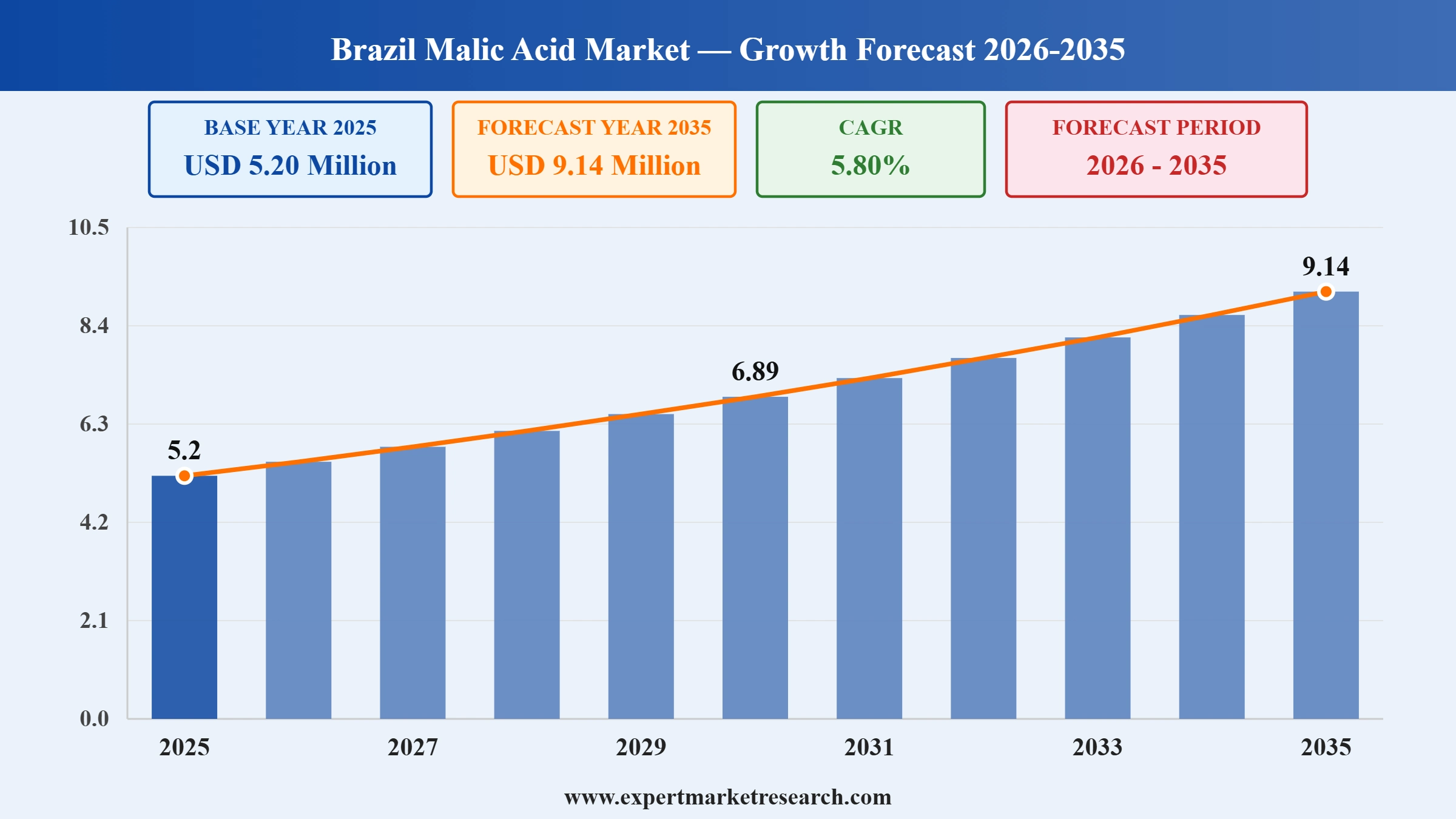
The Brazil malic acid market was valued at USD 5.20 Million in 2025. The market is expected to grow at a CAGR of 5.80% during the forecast period of 2026-2035 to reach a value of USD 9.14 Million by 2035. Rising demand for food and beverage additives, increasing consumption of processed foods and beverages, and growing applications in confectionery and functional products are driving the overall growth in the market. Malic acid is widely used for acidity regulation and flavor enhancement, encouraging demand from food processors. Growth in pharmaceutical and industrial applications is also contributing to market expansion.
Read more about this report - REQUEST FREE SAMPLE COPY IN PDF
| Brazil Malic Acid Market Report Summary | Description | Value |
| Base Year | USD Million | 2025 |
| Historical Period | USD Million | 2019-2025 |
| Forecast Period | USD Million | 2026-2035 |
| Market Size 2025 | USD Million | 5.20 |
| Market Size 2035 | USD Million | 9.14 |
| CAGR 2019-2025 | Percentage | XX% |
| CAGR 2026-2035 | Percentage | 5.80% |
| CAGR 2026-2035 - Market by Region | São Paulo | 4.7% |
| CAGR 2026-2035 - Market by Region | Minas Gerais | 4.4% |
| CAGR 2026-2035 - Market by Product | D- Malic Acid | 4.5% |
| CAGR 2026-2035 - Market by End User | Food and Beverages | 4.6% |
| 2025 Market Share by Region | Minas Gerais | 20.5% |
Fibromyalgia affects nearly 2% of Brazil’s population. It is a chronic disorder that leads to widespread musculoskeletal pain, apart from fatigue and cognitive difficulties. Since Brazil’s female population has surged to 50.9% from 50.1% over 50 years, there is an increasing need for medications that improve muscle performance, reduce pain, and facilitate energy production within the body. Medicines formulated with malic acid are expected to play a critical role in preventing and tackling the incidence of such diseases.
Brazil is the world’s largest orange juice producer and exports 75% of its domestic production. In 2022-23, it exported nearly 1.04 MMT of frozen concentrated orange juice. The European Union is a leading export destination for Brazil’s orange juice and accounted for nearly 70% of its exports. The overall demand for orange juice surged by 26,622 MMT in foreign countries, reaching 388.022 MMT. This can be attributed to the increased demand for NFC orange juice. From July to October 2022, orange juice exports to the United States recorded a year-on-year growth of 60%, reaching 112,432 MT. In 2021-2022, NFC exports of orange juice surged by 15% year-on-year, indicating the presence of substantial demand from the US market. Since malic acid is extensively used as an acidity regulator in orange juice production, its demand is expected to drive Brazil malic acid market expansion.
ICL Group acquired a 49.9% stake in Bartek Ingredients, a global producer of food-grade malic and fumaric acids. ICL identified the transaction as an expansion of its food-grade specialty-ingredients capabilities. Bartek produces malic acid for applications including beverages, confectionery, bakery and other food formulations and distributes internationally. For Brazil, the transaction could affect the competitive supply landscape by connecting a major malic-acid producer with ICL's global specialty-ingredients platform and distribution capabilities.
Brazilian supplier Exodo Científica Química Fina Indústria e Comércio, based in Sumaré, São Paulo, issued a revised Safety Data Sheet for DL-malic acid (25 kg). The document was revised on 4 July 2025 and identifies the product as DL-malic acid, CAS 6915-15-7, supplied under Exodo's own product code. It confirms the company's continued commercial handling of malic acid for laboratory and industrial applications in Brazil, providing direct evidence of local product availability and an active domestic supply channel.
Brazilian chemical supplier Verquímica issued a revised Safety Data Sheet for malic acid, identifying the ingredient as E296 and documenting its use as an acidulant, flavouring agent and stabiliser in food applications. The document provides direct evidence of malic acid being commercially handled within Brazil's chemical and food-ingredient supply chain. It also confirms the continued availability of malic acid for Brazilian food manufacturers, supporting applications where acidity regulation and flavour enhancement are required.
Brazilian food-ingredient publication Aditivos & Ingredientes published an article on acidulants with flavouring functions, specifically discussing the use of citric acid + malic acid combinations to strengthen fruity flavour and prolong acidity. The article reflects active formulation interest in Brazil's food industry and specifically identifies malic acid as part of acidulant-blend strategies. This is not a supplier launch, but it is a dated Brazil-market development directly connected to increasing application of malic acid in food formulations.
The use of malic acid in beverages is gaining momentum in Brazil owing to its unique characteristic of delivering a pleasant and enduring acid sensation which works well with fruity notes. This acidulant is applicable in soft drinks, powder beverages, sports beverages, flavored water, and functional beverages using citrus fruits and tropical fruits. It can be used by itself or in combination with citric acid to give a fuller taste sensation. The country's strong consumption of fruit-oriented beverages provides opportunities for acidulant suppliers to expand application support and customised blends. Malic acid is also useful where manufacturers seek a clean acidic profile without relying exclusively on citric acid. Consequently, distributors are increasingly positioning malic acid alongside other food acids as part of broader beverage formulation portfolios, supporting demand from Brazilian beverage manufacturers.
The Brazilian confectionery industry is presenting opportunities for malic acid owing to its excellent compatibility with the sour confectionery, gums, jelly, hard candy, and fruit-flavored confectionery. Malic acid gives a long-lasting sour taste and could assist in highlighting fruit flavors, which makes it an appealing choice for manufacturers who are working on developing intense flavored products. The manufacturers can blend malic acid with citric and fumaric acid in order to control sourness and flavor release. The trend is being driven by product diversification wherein the confectionery manufacturers are coming up with fruit and sour flavored variants. It presents opportunities for ingredient distributors to distribute food-grade malic acid in various grades and packaging forms. As Brazilian manufacturers continue experimenting with flavour systems, malic acid is becoming a more relevant component of specialised acidulant blends.
The Brazilian malic acid industry shows considerable dependence on imported inputs, meaning that distributors as well as specialty chemical importers play crucial roles in connecting international suppliers with domestic food producers. Thus, an obvious trend is seen in the emergence of the development of local networks that provide malic acid along with citric, fumaric, lactic and tartaric acids. Brazilian companies like Vogler and OXQuim keep malic acid in their range of products so that producers can purchase it from domestic sources without going to international suppliers. Technical advice is gaining more relevance, especially for beverage and confectionery applications. Broader distributor portfolios can improve product accessibility for small and medium-sized Brazilian manufacturers and support greater experimentation with malic-acid formulations. This trend reinforces distribution as a key competitive factor alongside price and product quality.
Brazilian food formulators are increasingly looking at formulations where malic acid is combined with other organic acids as opposed to considering acidulants to be equivalent stand-alone products. Malic acid can be blended with citric acid so as to adjust the level of acidity, flavor persistence and the taste as well. This blend is especially useful in flavoring fruit drinks, confectionery, sauces, and other processed foods. This will allow food formulators to tailor their formulations depending on the specific flavor needed and at the same time reduce reliance on one particular acidulant. As such, Brazilian ingredient suppliers are now offering malic acid in the context of acidulant mixes that give formulators various options. This trend also supports demand for technical formulation services, as food producers require assistance in determining suitable acid ratios and application levels. As product differentiation becomes increasingly important, customised acidulant systems can provide an additional route to flavour innovation.
Food processing companies in Brazil are increasingly taking into consideration the importance of documented specifications, traceability, and compliance in sourcing specialty ingredients such as malic acid. Documentation of the product that indicates malic acid as INS 296/E296 and specifications for the purity, handling, storing and application of the ingredient in food products are increasingly becoming significant during the procurement process. Brazilian suppliers such as Verquímica maintain technical documentation for malic acid used in food applications, providing manufacturers with information required for quality assessment and ingredient approval. This trend favours established distributors and suppliers capable of providing consistent specifications, documentation and technical support. It also creates opportunities for suppliers to differentiate through reliable quality assurance and regulatory assistance rather than competing solely on price. For Brazilian food and beverage producers, stronger documentation practices can simplify supplier qualification and support the incorporation of imported malic acid into commercial formulations.
Malic acid is used in developing personal care products for sensitive skin, since it’s gentler than other alpha-hydroxy acids (AHA) such as glycolic acid. It maintains the pH balance of different cosmetic formulations, thereby enhancing its safety and efficacy of application. Regular use of moisturisers enriched with malic acid can significantly improve skin texture, fade discolouration, and promote cell turnover, which can prevent the appearance of wrinkles. This is expected to drive its demand over the forecast period.
The Expert Market Research's report titled “Brazil Malic Acid Market Report and Forecast 2026-2035” offers a detailed analysis of the market based on the following segments:
Market Breakup by Product
Market Breakup by End User
Market Breakup by Region
Read more about this report - REQUEST FREE SAMPLE COPY IN PDF
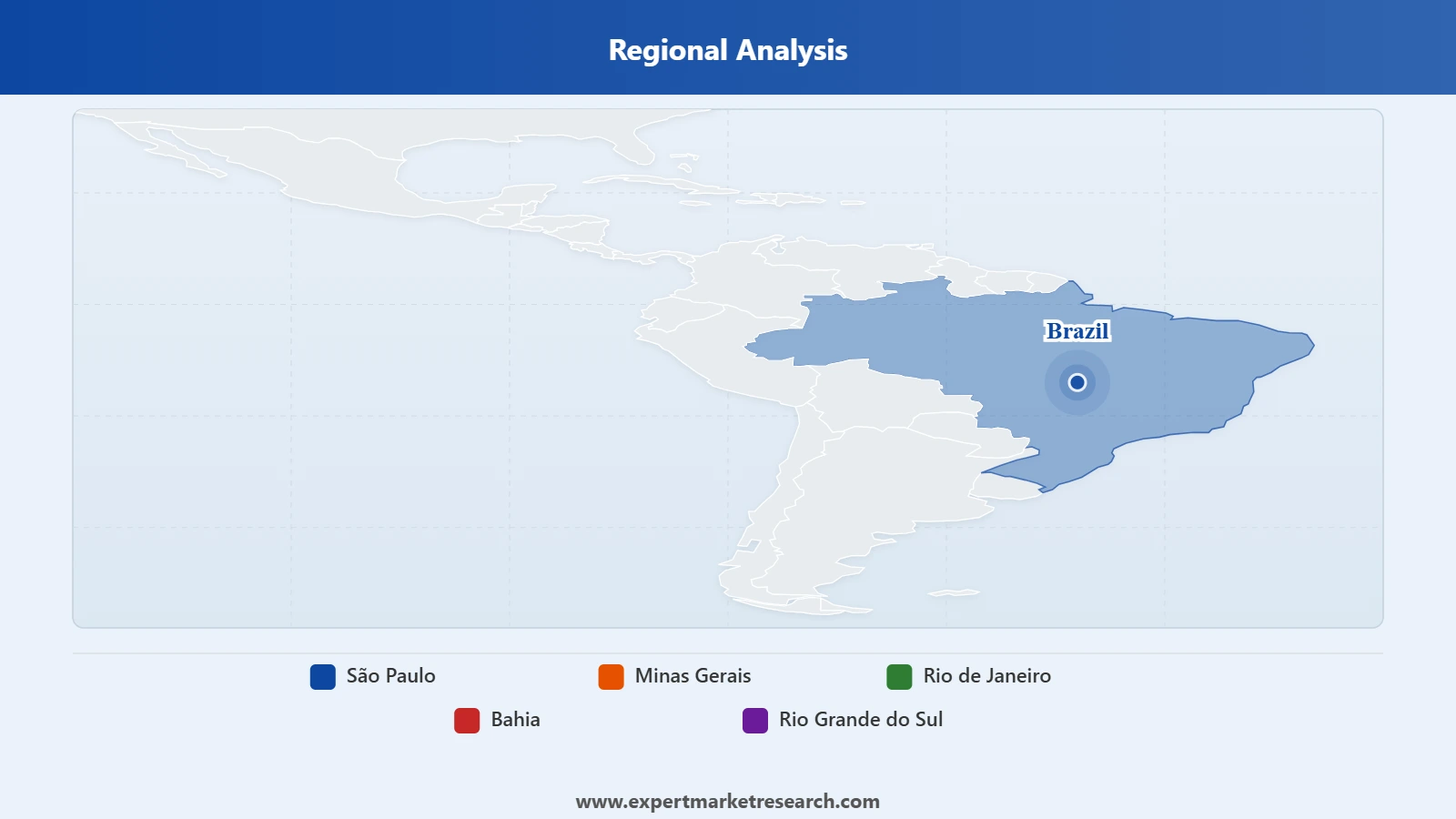
Based on region, the market is segmented into São Paulo, Minas Gerais, Rio de Janeiro, Bahia, and Rio Grande do Sul. Minas Gerais is projected to dominate the market, representing 21% of the overall market share. Over the forecast period, São Paulo is expected to grow at a CAGR of 4.7%, as the demand for malic acid enriched personal care products soars.
Read more about this report - REQUEST FREE SAMPLE COPY IN PDF
Major players are capitalising on the increasing applications of malic acid, such as in the production of electronics’ cleaning products, pharmaceuticals, and skin care products. This is also driving Brazil malic acid market share.
Enologica Vason S.p.A is a family-owned company based in Verona, Italy. Founded in 1981, it offers biotechnologies, adjuvants, clarifying agents, stabilisers, and natural preservatives. The company also collaborates with universities and research institutes to enhance its offerings.
POLYNT SPA is a global manufacturer of speciality chemicals with its headquarters located in Scanzorosciate, Italy. Established in 1958, POLYNT specialises in producing resins and other chemical products for coatings, adhesives, and composites industries.
Merck KGaA, based in Darmstadt, Germany is a leading science and technology company founded in 1668. It operates across three main sectors: healthcare, life science, and performance materials. It is renowned for developing innovative medicines and high-tech materials.
*Please note that this is only a partial list; the complete list of key players is available in the full report. Additionally, the list of key players can be customized to better suit your needs.*
Brazil's malic acid market faces notable operational challenges shaped by its heavy dependence on imported supply. Domestic production capacity for malic acid remains limited, with the majority of volumes sourced from overseas manufacturers, particularly in Asia. This import reliance exposes food and beverage producers to supply chain disruptions, extended lead times, and price instability. Additionally, malic acid competes directly with citric acid, a more widely available and cost-competitive acidulant that holds a stronger established position across Brazilian food manufacturing, making it difficult for malic acid to displace existing formulations at scale.
Currency volatility represents a persistent structural restraint for the market. Fluctuations in the Brazilian real against major trading currencies directly inflate the landed cost of imported malic acid, compressing margins for distributors and downstream food producers. Brazil's regulatory framework, administered by ANVISA, also requires ongoing compliance with updated normative instructions governing food additive usage conditions and maximum limits, adding administrative and reformulation costs for manufacturers operating across multiple food categories.
Despite these constraints, meaningful growth opportunities are emerging. Brazil's large and expanding food and beverage industry, combined with ANVISA's mandatory front-of-pack nutrition labelling requirements, is accelerating product reformulation and increasing demand for functional, clean-label acidulants. The growth of functional beverages, natural confectionery, and pharmaceutical applications where malic acid serves as an active excipient further broadens the addressable market across Brazil's diversified food manufacturing base.


Upto 15% Off
USD
$2499 $2249
$3999 $3599
$4999 $4249
$5999 $5099


*While we strive to always give you current and accurate information, the numbers depicted on the website are indicative and may differ from the actual numbers in the main report. At Expert Market Research, we aim to bring you the latest insights and trends in the market. Using our analyses and forecasts, stakeholders can understand the market dynamics, navigate challenges, and capitalize on opportunities to make data-driven strategic decisions.*
The market is assessed to grow at a CAGR of 5.80% between 2026 and 2035.
The different products in the market are D- malic acid, L- malic acid, and DL-malic acid, among others.
The different end uses of malic acid include food and beverages, personal care and cosmetics, and pharmaceuticals.
The different regions covered in the market report are São Paulo, Minas Gerais, Rio de Janeiro, Bahia, and Rio Grande do Sul.
Key players in the market are Enologica Vason S.p.A, POLYNT SPA, and Merck KGaA, among others.
In 2025, the Brazil malic acid market reached an approximate value of USD 5.20 Million.
The market is expected to attain approximately USD 9.14 Million by 2035.
Explore our key highlights of the report and gain a concise overview of key findings, trends, and actionable insights that will empower your strategic decisions.
| REPORT FEATURES | DETAILS |
| Base Year | 2025 |
| Historical Period | 2019-2025 |
| Forecast Period | 2026-2035 |
| Scope of the Report |
Historical and Forecast Trends, Industry Drivers and Constraints, Historical and Forecast Market Analysis by Segment:
|
| Breakup by Product |
|
| Breakup by End User |
|
| Breakup by Region |
|
| Market Dynamics |
|
| Competitive Landscape |
|
| Companies Covered |
|
Datasheet
One User
USD 2,499
USD 2,249
tax inclusive*
Single User License
One User
USD 3,999
USD 3,599
tax inclusive*
Five User License
Five User
USD 4,999
USD 4,249
tax inclusive*
Corporate License
Unlimited Users
USD 5,999
USD 5,099
tax inclusive*
*Please note that the prices mentioned below are starting prices for each bundle type. Kindly contact our team for further details.*
Flash Bundle
Small Business Bundle
Growth Bundle
Enterprise Bundle
*Please note that the prices mentioned below are starting prices for each bundle type. Kindly contact our team for further details.*
Flash Bundle
Number of Reports: 3
20%
tax inclusive*
Small Business Bundle
Number of Reports: 5
25%
tax inclusive*
Growth Bundle
Number of Reports: 8
30%
tax inclusive*
Enterprise Bundle
Number of Reports: 10
35%
tax inclusive*
How To Order

Select License Type
Choose the right license for your needs and access rights.

Click on ‘Buy Now’
Add the report to your cart with one click and proceed to register.

Select Mode of Payment
Choose a payment option for a secure checkout. You will be redirected accordingly.
Strategic Solutions for Informed Decision-Making
Gain insights to stay ahead and seize opportunities.

Get insights & trends for a competitive edge.

Track prices with detailed trend reports.

Analyse trade data for supply chain insights.

Leverage cost reports for smart savings

Enhance supply chain with partnerships.

Connect For More Information
Our expert team of analysts will offer full support and resolve any queries regarding the report, before and after the purchase.
Our expert team of analysts will offer full support and resolve any queries regarding the report, before and after the purchase.
We employ meticulous research methods, blending advanced analytics and expert insights to deliver accurate, actionable industry intelligence, staying ahead of competitors.
Our skilled analysts offer unparalleled competitive advantage with detailed insights on current and emerging markets, ensuring your strategic edge.
We offer an in-depth yet simplified presentation of industry insights and analysis to meet your specific requirements effectively.




