Consumer Insights
Uncover trends and behaviors shaping consumer choices today
Procurement Insights
Optimize your sourcing strategy with key market data
Industry Stats
Stay ahead with the latest trends and market analysis.
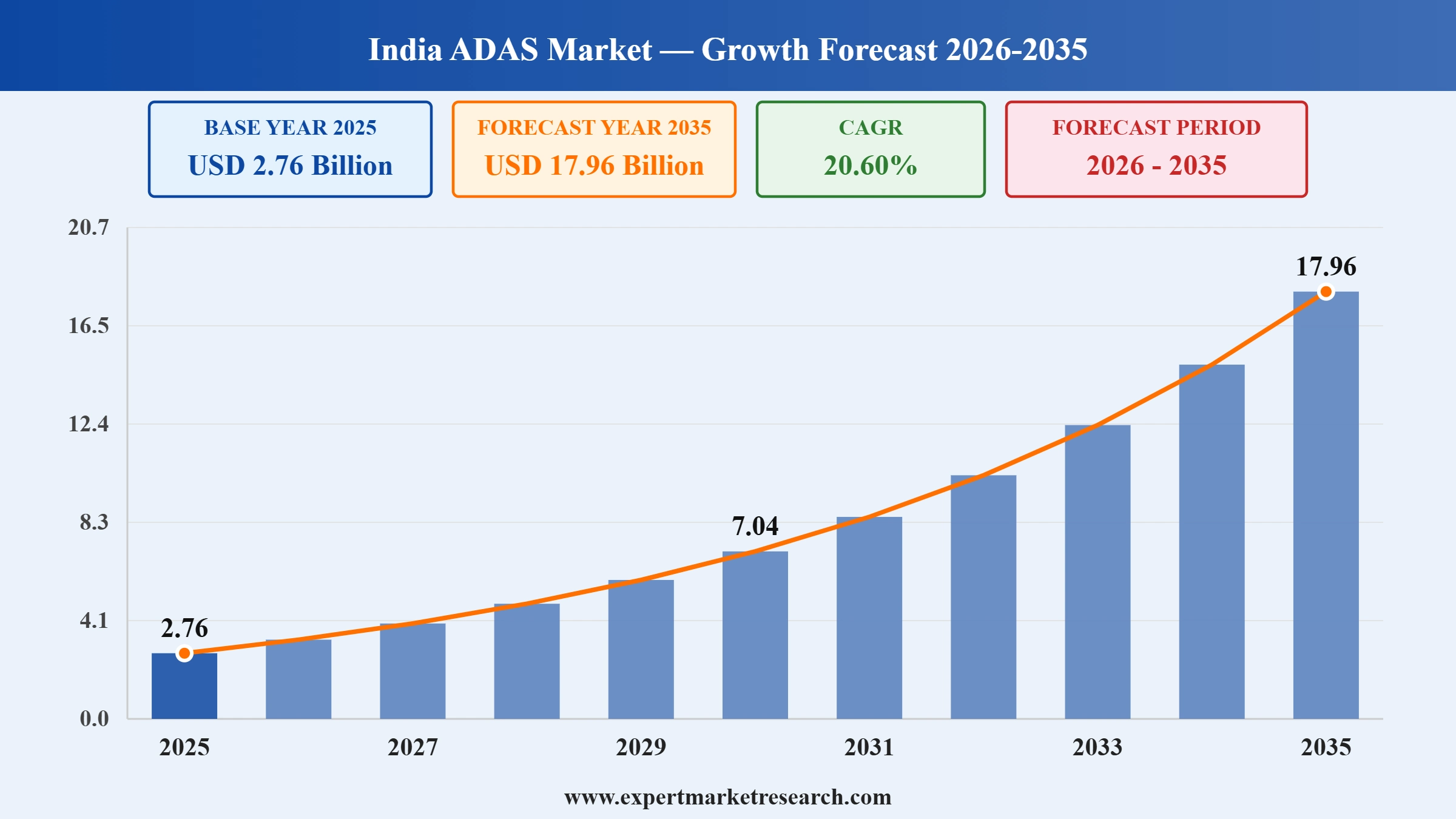
The India ADAS market attained a value of USD 2.76 Billion in 2025 and is projected to expand at a CAGR of 20.60% through 2035. The market is further expected to achieve USD 17.96 Billion by 2035, supported by tightening vehicle-safety regulation under India's GSR 184(E) mandate, rising consumer demand for driver-assistance features in passenger and commercial vehicles, and expanding local production of radar, camera, and semiconductor content by both global and domestic suppliers. Growth spans adaptive cruise control, autonomous emergency braking, and blind-spot detection solutions across passenger cars and commercial vehicles, with suppliers across North, West, South, and East and Central India competing on sensor cost, software content, and OEM co-development partnerships.
Tightening safety regulation continues to anchor demand growth across the India ADAS market, as suppliers align product roadmaps with upcoming compliance deadlines. Robert Bosch GmbH disclosed in May 2026 that India's commercial-vehicle ADAS mandate requires new truck and bus models to carry collision-warning, lane-assistance, and automatic-braking functionality from January 2027, with all vehicles covered by October 2027, alongside a separate Corporate Average Fuel Efficiency Phase III deadline of April 2027 that is pushing suppliers to raise ADAS content per vehicle even as overall production volumes stay flat, as the pace of regulatory tightening continues to reshape supplier investment priorities across the broader driver-assistance value chain.
Semiconductor suppliers are racing to bring driver-assistance processing within reach of mass-market vehicles. NXP B.V. announced in June 2026 its SAF8444 single-chip radar system-on-chip, built on 28-nanometre RFCMOS technology and operating across the 76-81 GHz automotive radar band, integrating an applications processor, a real-time core, and a dedicated radar accelerator to enable on-chip Level 2 and Level 2+ processing with camera-radar fusion, a design the company says brings adaptive cruise control and automatic emergency braking within reach of economy-class vehicles while meeting Euro NCAP 2030 requirements, an approach that echoes Continental AG's scale, having shipped 200 million radar units and captured roughly a fifth of the worldwide market by mid-2025.
Suppliers are also localising complete ADAS suites rather than importing components individually. Valeo SE disclosed in May 2026 that it was selected by a leading Indian original equipment manufacturer to deploy its Valeo Smart Safety 360 suite, a cost-optimised, single-box design integrating three radars and one camera to deliver automatic emergency braking, lane departure warning, and driver drowsiness detection for commercial vehicles, manufactured at the company's Sanand, Gujarat facility and supporting over-the-air software updates ahead of India's upcoming General Safety Regulation requirements, an approach increasingly favoured across the market as OEMs prioritise single-source accountability and streamlined after-sales support for complex driver-assistance hardware.
Read more about this report - REQUEST FREE SAMPLE COPY IN PDF
| India ADAS Market Report Summary | Description | Value |
| Base Year | USD Billion | 2025 |
| Historical Period | USD Billion | 2019-2025 |
| Forecast Period | USD Billion | 2026-2035 |
| Market Size 2025 | USD Billion | 2.76 |
| Market Size 2035 | USD Billion | 17.96 |
| CAGR 2019-2025 | Percentage | XX% |
| CAGR 2026-2035 | Percentage | 20.60% |
| CAGR 2026-2035 - Market by Region | West India | 23.5% |
| CAGR 2026-2035 - Market by Region | North India | 22.0% |
| CAGR 2026-2035 - Market by Solution | Adaptive Cruise Control | 23.1% |
| CAGR 2026-2035 - Market by Vehicle Type | Passenger Cars | 24.5% |
| 2025 Market Share by Region | West India | 27.4% |
Magna International invested an additional $35 million in Bengaluru-based Yuma Energy in September 2026, lifting its ownership stake above 51% and building on an earlier funding commitment made in prior years. Yuma has completed more than 60 million battery swaps to date and operates over 400 swap stations and 2,500 charging units across 18 Indian cities. Companies can leverage adjacent electric-mobility infrastructure investments to deepen relationships with Indian OEMs ahead of expanding driver-assistance and electrification content per vehicle, reflecting the broader trend of global suppliers deepening their strategic footholds across India's fast-evolving mobility and driver-assistance ecosystem.
NXP B.V. unveiled its SAF8444 radar system-on-chip in June 2026, combining an Arm Cortex-A53 applications processor, a Cortex-M7 real-time core, and a proprietary dual-threaded radar accelerator on a single 28-nanometre die spanning the 76-81 GHz automotive radar band. The chip enables camera-radar sensor fusion for adaptive cruise control, automatic emergency braking, blind-spot detection, and park assist while meeting Euro NCAP 2030 requirements. Companies can leverage single-chip radar integration to extend Level 2 and Level 2+ driver assistance into lower price-band vehicle segments, a consolidation trend paralleled by Robert Bosch GmbH's expanded Qualcomm partnership on Snapdragon Digital Chassis, already powering over 10 million vehicle computers globally.
Valeo SE announced in May 2026 that a leading Indian original equipment manufacturer selected its Valeo Smart Safety 360 suite for commercial-vehicle deployment, combining three radars and one camera in a single-box design to deliver automatic emergency braking, lane departure warning, and driver drowsiness and attention warning. The system, manufactured at Valeo's Sanand, Gujarat facility, supports over-the-air updates and both 12V and 24V vehicle architectures. Companies can leverage single-box, cost-optimised sensor bundles to accelerate ADAS adoption across price-sensitive commercial-vehicle fleets, positioning the company to capture rising demand as commercial-vehicle fleets across India move toward mandatory driver-assistance compliance over the coming two years.
Robert Bosch GmbH and Qualcomm Technologies expanded their collaboration in April 2026 to cover strategic ADAS solutions built on the Snapdragon Digital Chassis platform, extending a partnership that has already delivered more than 10 million Snapdragon-powered vehicle computers worldwide across cockpit and driver-assistance domains. The expanded scope combines Bosch's driver-assistance software stack with Qualcomm's automotive-grade computing hardware for scalable Level 2 and Level 2+ systems. Companies can leverage joint software-hardware computing platforms to shorten development cycles for next-generation ADAS programs, a strategy consistent with the broader wave of semiconductor-level consolidation seen in NXP B.V.'s June 2026 launch of its single-chip SAF8444 radar system-on-chip.
ZF Commercial Vehicle Control Systems India secured a nomination in March 2026 to supply an ADAS suite built on the OnGuardMAX platform for a domestic mobility OEM's upcoming electric bus platforms, with production scheduled to begin in early 2027. The suite integrates a front camera, mid-range radar, and up to three short-range radars to deliver 16 driver-assistance functions, including the five mandated under India's GSR 184(E) regulation, and completed 450,000 kilometres of Indian road testing with ARAI certification. Companies can leverage regulation-anchored nomination wins to secure multi-year commercial-vehicle ADAS supply programs, a milestone that parallels the wider push toward domestic ADAS content, echoed in Valeo SE's expansion of camera-assembly capacity at its Sanand, Gujarat facility.
Bosch's India managing director said in May 2026 that the company was aligning product development with India's phased commercial-vehicle ADAS mandate, which requires new truck and bus models to carry collision-warning, lane-assistance, and automatic-braking functionality from January 2027 and extends to all vehicles by October 2027, alongside a Corporate Average Fuel Efficiency Phase III deadline of April 2027. The company is drawing on its Euro 7 experience in Europe to prepare for India's anticipated BS7 emissions timeline. Companies can leverage early regulatory alignment to secure first-mover positioning with OEM engineering teams, a regulatory push also driving fresh nomination wins, such as ZF Commercial Vehicle Control Systems India's March 2026 selection for an electric-bus programme.
Valeo SE inaugurated a new vision-camera assembly line at its Sanand, Gujarat facility in April 2026, expanding local production capacity for camera-based driver-assistance components as part of the company's Elevate 2028 strategic plan to deepen its Indian industrial footprint. The move follows Valeo's broader push to localise ADAS component manufacturing rather than rely solely on imports, supporting both passenger and commercial-vehicle camera demand. Companies can leverage local camera and sensor assembly capacity to reduce landed component costs and shorten OEM delivery timelines, reflecting the broader wave of localisation investment underway across India's driver-assistance supply chain as global Tier-1 suppliers expand their domestic manufacturing footprint.
India's Competition Commission cleared Honda Motor's acquisition of an additional 21% stake in Astemo from Hitachi in June 2026, a deal valued at approximately ¥152.3 billion, that will raise Honda's voting rights from 40% to 61% while reducing Hitachi's holding from 40% to 19%. Astemo, which supplies automotive and two-wheeler components including driver-assistance hardware across India, will transition from an equity-method Hitachi associate to a consolidated Honda subsidiary once the deal closes. Companies can leverage ownership realignments among Tier-1 suppliers to reassess long-term component sourcing relationships, a realignment that reflects the broader pattern of consolidation and ownership restructuring reshaping the global Tier-1 supplier landscape supporting India's driver-assistance market.
This Expert Market Research's Report titled "India ADAS Market Report and Forecast 2026-2035" offers a detailed analysis of the market based on the following segments:
Market Breakup by Solution
Key Insight: Autonomous Emergency Braking accounts for a substantial share of the India ADAS market, reflecting its status as one of the functions mandated under India's GSR 184(E) commercial-vehicle safety regulation. Adaptive Cruise Control is the fastest-growing solution segment at an estimated CAGR of 23.1%, aided by radar suppliers such as Continental AG, which disclosed in May 2025 that it had produced 200 million automotive radar sensors and secured approximately EUR 1.5 billion in new series orders for manufacturing beginning in 2026-2027. Adaptive Front Light continues to see steady adoption in premium vehicle trims, while Blind Spot Detection (BSD) System and Lane Departure Warning System are gaining traction alongside expanding radar and camera deployment. Park Assistance remains a widely fitted convenience feature across passenger vehicles, Tire Pressure Monitoring System benefits from broad regulatory mandates across vehicle categories, and Others captures emerging functions such as driver drowsiness and attention warning. This broad-based adoption pattern parallels the Passenger Cars segment's own projected 24.5% CAGR through 2035, reflecting accelerating safety-feature bundling across the wider market.
Market Breakup by Vehicle Type
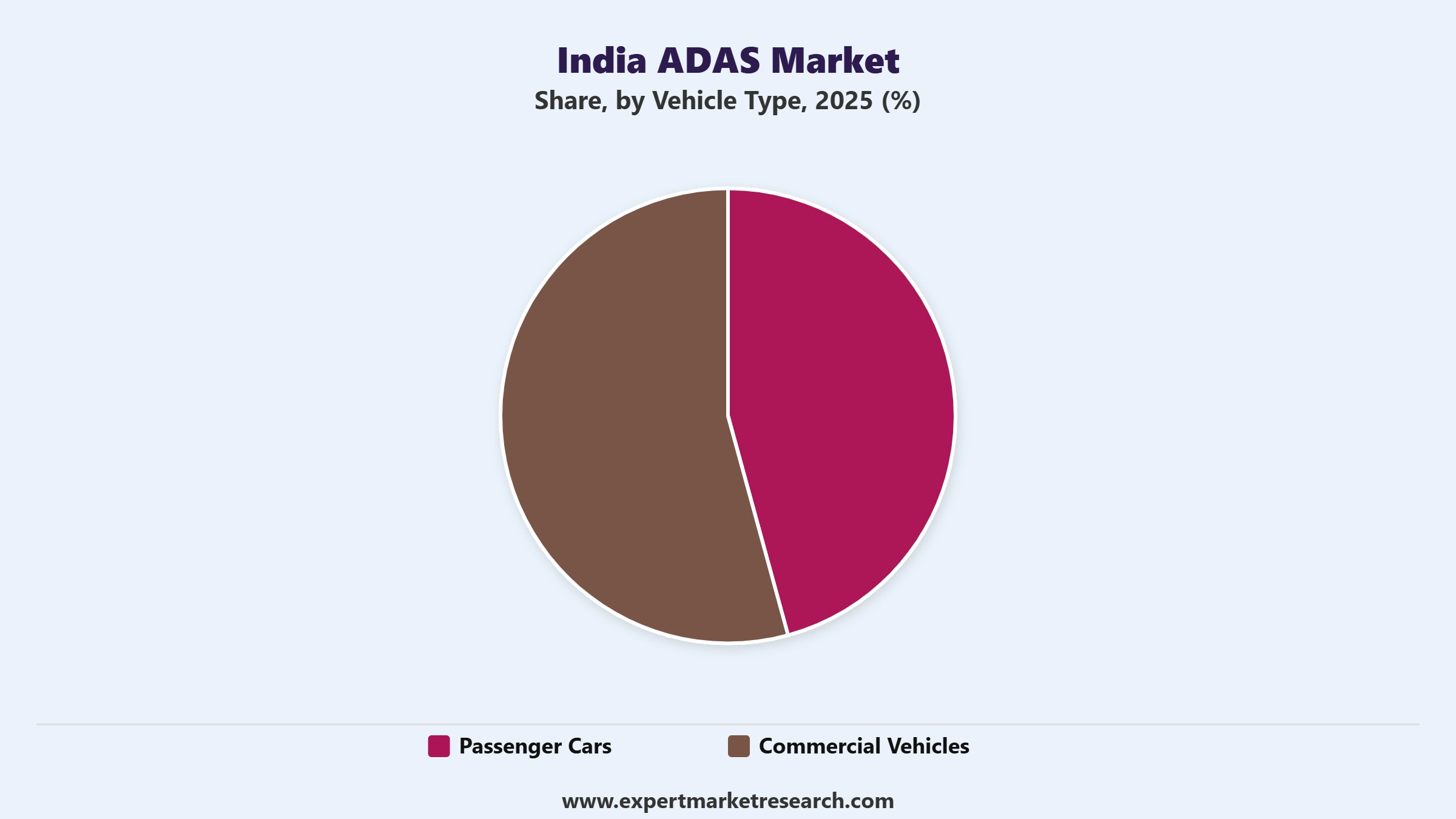
Key Insight: Passenger Cars accounts for the largest share of the India ADAS market, a position reinforced by Denso Corp.'s February 2025 disclosure that it already supplies Level-2 ADAS modules for the Toyota Innova HyCross and plans to expand similar programs to Tata Motors and Mahindra & Mahindra. Commercial Vehicles is the fastest-growing vehicle type as India's phased GSR 184(E) mandate pushes adoption across both Light Commercial Vehicles and Heavy Commercial Vehicles, with new truck and bus models required to carry collision-warning and automatic-braking functionality from January 2027 and the full fleet covered by October 2027. This pattern mirrors the dynamic in which West India's manufacturing scale supports volume while North India's Haryana and Delhi-NCR base drives incremental growth.
Market Breakup by Component
Key Insight: Sensors accounts for a substantial share of the India ADAS market, spanning Radar, LiDAR, Ultrasonic, and Others sub-types, reinforced by Valeo SE's April 2026 inauguration of a new vision-camera assembly line at its Sanand, Gujarat facility to expand local sensor-adjacent production. Software is the fastest-growing component segment as suppliers add over-the-air update capability and AI-based processing, illustrated by Garmin Ltd.'s January 2026 unveiling of its Unified Cabin 2026 platform, which layers an AI/LLM-based virtual assistant onto a single automotive system-on-chip. Processors are gaining share as single-chip radar designs consolidate compute onto fewer components, while Others covers auxiliary hardware supporting sensor calibration and integration. This mirrors NXP B.V.'s June 2026 SAF8444 radar chip, which consolidates its applications processor and radar accelerator onto a single die.
Market Breakup by Region
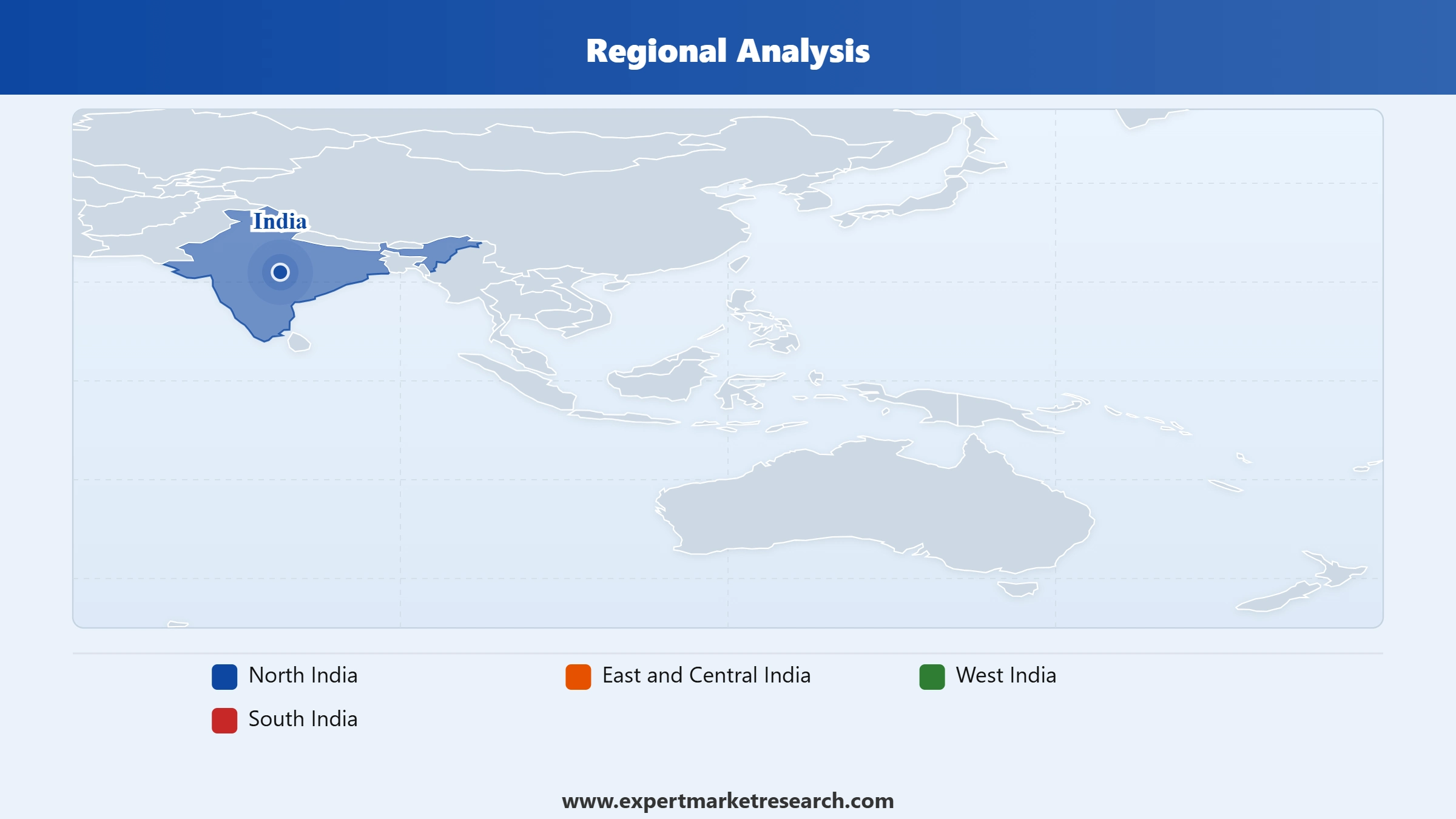
Key Insight: West India accounts for the largest share of the India ADAS market at approximately 27.4% in 2025, supported by expanding camera and sensor manufacturing capacity across Gujarat, including Valeo SE's April 2026 vision-camera assembly line at Sanand. North India is the fastest-growing region among the remaining markets at an estimated CAGR of 22.0%, anchored by the Delhi-NCR and Haryana automotive-component corridor. East and Central India and South India continue to represent steady demand tied to established passenger and commercial-vehicle manufacturing clusters. This regional concentration parallels the vehicle-type split, where Passenger Cars retains the largest share while Commercial Vehicles expands fastest under GSR 184(E) mandate rules.
Read more about this report - REQUEST FREE SAMPLE COPY IN PDF
By solution, autonomous emergency braking leads the market while adaptive cruise control grows fastest given falling radar-processing costs
Autonomous Emergency Braking continues to account for a substantial share of the market, reflecting its status among the five driver-assistance functions mandated under India's GSR 184(E) regulation. ZF Friedrichshafen AG's March 2026 nomination to supply an OnGuardMAX-based ADAS suite for a domestic electric bus OEM, validated across 450,000 kilometres of Indian road testing and carrying ARAI certification, underscores the regulatory pull sustaining demand for automatic-braking-capable systems across new commercial-vehicle platforms entering production from early 2027, with the same regulation also underpinning the CAFE Phase III fuel-efficiency deadline of April 2027 pushing higher ADAS content per vehicle.
Adaptive Cruise Control is growing at a fast pace across the market at a projected CAGR of 23.1%, as single-chip radar processing lowers the cost of longitudinal driver assistance for mass-market vehicles. NXP B.V.'s June 2026 launch of its SAF8444 radar system-on-chip, which integrates camera-radar fusion on a single 28-nanometre die spanning the 76-81 GHz band, illustrates how semiconductor consolidation is bringing adaptive cruise control within reach of economy-class passenger vehicles previously excluded from advanced driver-assistance offerings, a trend also visible across other high-growth solution categories as radar and camera cost curves continue to fall industry-wide, widening addressable demand.
By vehicle type, passenger cars lead the market while commercial vehicles grow fastest given phased regulatory mandates
Passenger Cars continues to account for the largest share of the market, supported by Continental AG's May 2025 disclosure that it had reached 200 million automotive radar sensors in cumulative production, holding over 20% share of the global automotive radar market, with sensors increasingly bundled into adaptive cruise control, automatic emergency braking, and blind-spot detection features across mid-premium passenger car trims sold in India, a scale reinforced by the roughly EUR 1.5 billion in fresh series-production orders it booked for output starting in 2026 and 2027.
Read more about this report - REQUEST FREE SAMPLE COPY IN PDF
Commercial Vehicles is growing at a fast pace across the market as India's GSR 184(E) mandate takes effect for new truck and bus models from January 2027 and the full fleet from October 2027. Robert Bosch GmbH's May 2026 disclosure that it was aligning product development with this phased timeline, alongside a parallel Corporate Average Fuel Efficiency Phase III deadline of April 2027, reflects the regulatory urgency accelerating ADAS adoption across both Light Commercial Vehicles and Heavy Commercial Vehicles, a timeline tied to the same GSR 184(E) framework that mandates five specific safety functions, among them automatic braking and lane-departure alerts.
By component, sensors lead the market while software grows fastest given rising over-the-air and AI processing content
Sensors continues to account for a substantial share of the market, spanning Radar, LiDAR, Ultrasonic, and Others sub-types. Ouster, Inc. reported in May 2026 that its first-quarter revenue reached $49 million, up 49% year-over-year, on shipments of more than 12,600 lidar and camera sensors and the launch of its Rev8 OS digital lidar platform featuring native colour sensing and functional safety, underscoring continued growth in sensor content across global driver-assistance and mobility platforms, as sensor content expands across radar, camera, and lidar hardware amid rising demand for higher-resolution perception systems in passenger and commercial vehicles alike.
Software is growing at a fast pace across the market as suppliers layer over-the-air update capability and AI-based processing onto driver-assistance platforms. Denso Corp.'s February 2025 disclosure that it is pursuing a software-defined-vehicle strategy pillar alongside its ADAS and electrification programs, while already supplying Level-2 modules for the Toyota Innova HyCross, illustrates how software content is becoming a distinct growth lever separate from underlying sensor hardware, a shift that is also reshaping supplier roadmaps as artificial-intelligence and cloud-connected features become standard differentiators across driver-assistance platforms.
Read more about this report - REQUEST FREE SAMPLE COPY IN PDF
West India commands the largest share of the market at approximately 27.4% in 2025, and is also its fastest-growing region at an estimated CAGR of 23.5%.
This is supported by Valeo SE's April 2026 inauguration of a new vision-camera assembly line at its Sanand, Gujarat facility, part of the company's Elevate 2028 plan to deepen its Indian industrial footprint. Complementing this Gujarat-based expansion, Continental AG's radar-sensor output has surpassed 200 million cumulative units and more than a fifth of world market share.
North India is the fastest-growing region among the remaining markets at an estimated CAGR of 22.0%, anchored by the Delhi-NCR and Haryana automotive-component corridor and supported by Robert Bosch GmbH's May 2026 disclosure of its alignment with India's phased commercial-vehicle ADAS mandate. East and Central India and South India round out the market with more measured growth, reflecting their comparatively smaller passenger and commercial-vehicle production bases. This regulatory tailwind mirrors the compliance pressure already prompting Robert Bosch GmbH to align its India product roadmap with the same phased mandate timeline.
The industry is fragmented, with India ADAS market companies ranging from large global Tier-1 suppliers to specialised sensor and semiconductor manufacturers competing across solution, vehicle type, component, and regional segments. Established players operate across the full driver-assistance value chain, from radar, camera, and lidar sensor production through processor design, software integration, and system validation for passenger and commercial-vehicle OEM customers.
Competitive dynamics among India ADAS market players are increasingly shaped by the depth of local sensor and camera manufacturing capacity, the scale of semiconductor content integration, and the strength of OEM co-development relationships. Suppliers are investing in single-chip radar consolidation, cost-optimised sensor bundles, and regulatory-aligned product roadmaps to secure long-term nomination wins ahead of India's phased ADAS mandate deadlines.
Founded in 1871 and headquartered in Hanover, Germany, Continental AG is a global automotive technology supplier manufacturing radar, camera, and integrated driver-assistance systems alongside tyres and industrial products. The company disclosed in May 2025 that it had reached 200 million automotive radar sensors in cumulative production, holding over 20% global market share, and secured approximately EUR 1.5 billion in new series orders for manufacturing beginning in 2026-2027.
Founded in 1886 and headquartered in Gerlingen, Germany, Robert Bosch GmbH is a diversified technology and engineering group supplying driver-assistance sensors, software, and computing platforms to automakers worldwide. The company expanded its collaboration with Qualcomm Technologies in April 2026 to cover Snapdragon-based ADAS computing, building on a partnership that has already delivered more than 10 million Snapdragon-powered vehicle computers globally.
Founded in 1949 and headquartered in Kariya, Aichi, Japan, Denso Corp. is a leading automotive components supplier manufacturing ADAS sensors, electrification systems, and software-defined vehicle platforms. The company disclosed in February 2025 that it aims to double its India revenue from approximately Rs 9,000 crore to Rs 20,000 crore by 2030, already supplying Level-2 ADAS modules for the Toyota Innova HyCross and planning to expand similar programs to Tata Motors and Mahindra & Mahindra.
Founded in 1957 and headquartered in Aurora, Ontario, Canada, Magna International is a global automotive supplier manufacturing driver-assistance sensors, camera systems, and vehicle electronics alongside broader mobility-technology investments. The company disclosed in September 2026 that it invested an additional $35 million in Bengaluru-based Yuma Energy, lifting its ownership stake above 51% and deepening its exposure to India's electric-mobility ecosystem.
Other key players in the India ADAS market include ZF Friedrichshafen AG, NXP B.V., Garmin Ltd., Valeo SE, Hitachi Ltd., and Ouster, Inc., among others.
*Please note that this is only a partial list; the complete list of key players is available in the full report. Additionally, the list of key players can be customized to better suit your needs.*
Unlock the latest insights with our India ADAS market trends 2026 report. Discover regional growth patterns, solution and component trends, and key industry players. Stay ahead of competition with trusted data and expert analysis. Download your free sample report today and drive informed decisions in the market.


Upto 15% Off
USD
$2499 $2249
$3999 $3599
$4999 $4249
$5999 $5099


*While we strive to always give you current and accurate information, the numbers depicted on the website are indicative and may differ from the actual numbers in the main report. At Expert Market Research, we aim to bring you the latest insights and trends in the market. Using our analyses and forecasts, stakeholders can understand the market dynamics, navigate challenges, and capitalize on opportunities to make data-driven strategic decisions.*
In 2025, the market reached an approximate value of USD 2.76 Billion.
The market is projected to grow at a CAGR of 20.60% between 2026 and 2035.
The market is estimated to witness a healthy growth in the forecast period of 2026 -2035 to reach about USD 17.96 Billion by 2035.
Localising cost-optimised, single-box ADAS suites for Indian conditions, consolidating radar and processing functions onto single-chip semiconductor platforms, pursuing OEM co-development partnerships, and expanding domestic camera, radar, and sensor manufacturing capacity ahead of regulatory deadlines.
As per the EMR report, the different vehicle types are passenger cars and commercial vehicles.
Regions considered in the market are North India, East and Central India, West India, and South India.
The key players in the market include Continental AG, Robert Bosch GmbH, Denso Corp., Magna International Inc., ZF Friedrichshafen AG, NXP B.V., Garmin Ltd., Valeo SE, Hitachi Ltd., and Ouster, Inc., among others.
Suppliers face the complexity of meeting phased GSR 184(E) and Corporate Average Fuel Efficiency compliance deadlines, cost sensitivity among price-conscious Indian buyers, semiconductor and sensor supply-chain constraints, and limited calibration and testing infrastructure for advanced driver-assistance systems.
Explore our key highlights of the report and gain a concise overview of key findings, trends, and actionable insights that will empower your strategic decisions.
| REPORT FEATURES | DETAILS |
| Base Year | 2025 |
| Historical Period | 2019-2025 |
| Forecast Period | 2026-2035 |
| Scope of the Report |
Historical and Forecast Trends, Industry Drivers and Constraints, Historical and Forecast Market Analysis by Segment:
|
| Breakup by Solution |
|
| Breakup by Vehicle Type |
|
| Breakup by Component |
|
| Breakup by Region |
|
| Market Dynamics |
|
| Competitive Landscape |
|
| Companies Covered |
|
Datasheet
One User
USD 2,499
USD 2,249
tax inclusive*
Single User License
One User
USD 3,999
USD 3,599
tax inclusive*
Five User License
Five User
USD 4,999
USD 4,249
tax inclusive*
Corporate License
Unlimited Users
USD 5,999
USD 5,099
tax inclusive*
*Please note that the prices mentioned below are starting prices for each bundle type. Kindly contact our team for further details.*
Flash Bundle
Small Business Bundle
Growth Bundle
Enterprise Bundle
*Please note that the prices mentioned below are starting prices for each bundle type. Kindly contact our team for further details.*
Flash Bundle
Number of Reports: 3
20%
tax inclusive*
Small Business Bundle
Number of Reports: 5
25%
tax inclusive*
Growth Bundle
Number of Reports: 8
30%
tax inclusive*
Enterprise Bundle
Number of Reports: 10
35%
tax inclusive*
How To Order

Select License Type
Choose the right license for your needs and access rights.

Click on ‘Buy Now’
Add the report to your cart with one click and proceed to register.

Select Mode of Payment
Choose a payment option for a secure checkout. You will be redirected accordingly.
Strategic Solutions for Informed Decision-Making
Gain insights to stay ahead and seize opportunities.
Get insights & trends for a competitive edge.
Track prices with detailed trend reports.
Analyse trade data for supply chain insights.
Leverage cost reports for smart savings
Enhance supply chain with partnerships.
Connect For More Information
Our expert team of analysts will offer full support and resolve any queries regarding the report, before and after the purchase.
Our expert team of analysts will offer full support and resolve any queries regarding the report, before and after the purchase.
We employ meticulous research methods, blending advanced analytics and expert insights to deliver accurate, actionable industry intelligence, staying ahead of competitors.
Our skilled analysts offer unparalleled competitive advantage with detailed insights on current and emerging markets, ensuring your strategic edge.
We offer an in-depth yet simplified presentation of industry insights and analysis to meet your specific requirements effectively.